INTRODUCTION
The first records about echinoderms in the Adriatic Sea are from the end of the 18th Century, when Olivi (Reference Olivi1792) noted for the first time some echinoderm species in the northern part of the Adriatic in the Venice region. Grube (Reference Grube1840) for the first time systematically elaborated the echinoderms of the Adriatic Sea and Heller (Reference Heller and von der Herausgegeben1868) listed 53 species. After the ‘Pola’ Expedition (1890–1894) that included the deeper part of the southern Adriatic the number of echinoderms recorded in the Adriatic Sea increased to 62 (Marenzeller, Reference Marenzeller1895). Zavodnik (Reference Zavodnik1961) counted 80 echinoderm species and a decade later 83 with their geographical distribution (Zavodnik, Reference Zavodnik1969, Reference Zavodnik1972a). Since then, 101 species of echinoderms have been recorded in the Adriatic Sea: 2 species of crinoids, 36 species of holothurians, 23 species of sea stars, 22 species of brittle stars and 18 species of sea urchins (Radović, Reference Radović1999).
Complex investigations of echinoderm fauna in the Adriatic Sea have been performed mainly in the area along the eastern Adriatic coast and islands (Vatova, Reference Vatova1928, Reference Vatova1950; Kolosváry, Reference Kolosváry1936/1937, Reference Kolosváry1938; Reference Kolosváry1940; Mayer, Reference Mayer1937; Zavodnik, Reference Zavodnik1960, Reference Zavodnik1972b, Reference Zavodnik1977, Reference Zavodnik1979, Reference Zavodnik1980, Reference Zavodnik, Burke, Mladenov, Lambert and Parsley1988, Reference Zavodnik1997a, Reference Zavodnik, Arko-Pijevac, Kovačić and Crnković1998, Reference Zavodnik1999, Reference Zavodnik2003; Bruno, Reference Bruno1972; Gjiknuri, Reference Gjiknuri1985; Milojević, Reference Milojević1986; Zavodnik & Kovačić, Reference Zavodnik and Kovačić2000).
The data on distribution of echinoderms in the open waters of the Adriatic are very scarce. Vidović-Matvejev (Reference Vidović-Matvejev1978) listed echinoderms collected during the ‘Hvar’ Expedition (1948–1949) that investigated the stocks of bottom fish and edible invertebrates in the open part of the Adriatic Sea. Ungaro (Reference Ungaro1995) listed echinoderms in the area of trawling bottoms in the western part of the southern Adriatic Sea. Additionally, data on distribution of echinoderms in the open waters of the northern and middle part of the Adriatic could be found in faunistic and biocoenological investigations by Vatova (Reference Vatova1949), Gamulin-Brida (Reference Gamulin-Brida1965, Reference Gamulin-Brida1974) and Šimunović (Reference Šimunović1997).
This study presents the first extensive investigation of echinoderm distribution in the area of mobile bottoms in the open part of the northern and middle Adriatic Sea.
MATERIALS AND METHODS
Investigation of echinoderm fauna was performed during the ‘Pipeta’ Expedition on sediment bottoms of the northern and middle Adriatic Sea, in Italian territorial waters, international waters and in the outer part of Croatian territorial waters up to the line of the outer islands (only one survey) on a total surface of 58,509 km2.
Investigation was carried out during 11 cruises of the ‘Pipeta’ Expedition (7th–17th cruises) from 1985 to 1994: 7th in November–December 1985, 8th in June–July 1986, 9th in May–June 1987, 10th in December 1987–February 1988, 11th in October–November 1988, 12th in December 1990–February 1991, 13th in February–March 1992, 14th in July 1992, 15th in September–October 1992, 16th in May–June 1993 and 17th in November 1993–January 1994.
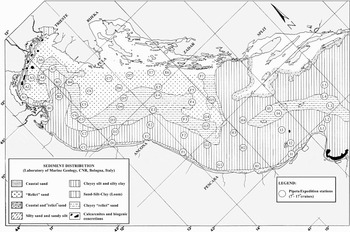
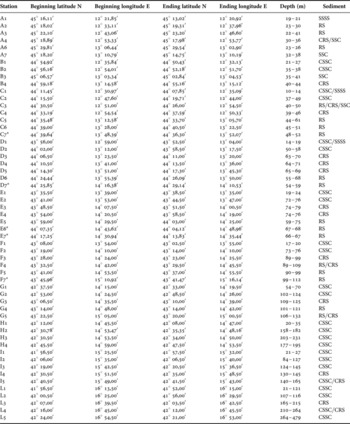
Five hundred and eighteen bottom trawl hauls were performed at 56 predetermined permanent stations along ten transects (A, B, C, D, E, F, G, H, I and L) (Table 1; Figure 1) over different sediment types, ‘relict’ sand (sediment that was settled during the last glacial and that was re-sedimented during Holocene transgression), clayey ‘relict’ sand, sand–silt–clay, clayey silt and silty clay, silty sand and sandy silt, at depths of 10 to 430 m. Samples were continuously collected using the standard Italian bottom trawl (Piccinetti, Reference Piccinetti1972) during day and night by an Italian commercial trawler ‘Pipeta’. Samples were fixed with a 4% solution of formaldehyde and determined according to Tortonese (Reference Tortonese1965). Taxonomic nomenclature based on ERMS (Costello et al., Reference Costello, Emblow and White2001) was used.
‘Pipeta’ Expedition stations (1985–1994) in the Adriatic Sea, superimposed on the distribution of sediments. Based on: CNR, Istituto di Geologia Marina, Bologna (1981).

Coordinates, depth-range and sediment types on investigated stations of the 7th cruise of the ‘Pipeta’ Expedition in the Adriatic Sea. RS, ‘relict’ sand; CRS, clayey ‘relict’ sand; SSC, sand–silt–clay; CSSC, clayey silt and silty clay; SSSS, silty sand and sandy silt; *16th cruise.

RESULTS
In this study, a total of 34 species of Echinodermata were identified from the area of open waters of the continental shelf in the northern and middle Adriatic Sea. We listed the species together with data on depth and sediment distribution, and the stations where individual species were found:
Holothuria (Panningothuria) forskali Delle Chiaje, 1823
Stations: B3, B4, C1, C2, C3, C4, C5, C6, C7, D2, D3, D4, D5, D6, D7, E3, E4, E5, E6, E7, F3, F4, F5, F7, G3, G4, G5 and L1.
Depth: 13–125 m.
Sediment: ‘relict’ sand, clayey ‘relict’ sand, sand–silt–clay, clayey silt and silty clay.
Holothuria (Holothuria) tubulosa Gmelin, 1788
Stations: A1, A2, A3, A4, A6, A7, B4, C2, C3, C4, C5, C6, C7, D3, D4, D5, D6, D7, E4, E5, E6, E7, F5 and G5.
Depth: 20–123 m.
Sediment: ‘relict’ sand, clayey ‘relict’ sand, sand–silt–clay, clayey silt and silty clay, silty sand and sandy silt.
Eostichopus regalis (Cuvier, 1817)
Stations: C5, C6, C7, D2, D3, D4, D5, D6, D7, E1, E2, E3, E4, E5, E6, E7, F2, F3, F4, F5, F7, G1, G3, G4, G5, H1, H2, I2, I3, I4, I5, L1, L2, L3 and L4.
Depth: 21–254 m.
Sediment: ‘relict’ sand, clayey ‘relict’ sand, clayey silt and silty clay.
Mesothuria intestinalis (Ascanius, 1805) Östergren, 1896
Stations: L4 and L5.
Depth: 260–289 m.
Sediment: clayey ‘relict’ sand, clayey silt and silty clay.
Ocnus planci (Brandt, 1835)
Stations: A1, A2, A3, A4, A6, A7, B1, B2, B3, B4, C2, C3, C4, C5, C6, C7, D2, D6, E1, E2, E3, E4, E5, F2, F3, G1, G2, G3, G4, G5, H1, H2, I1, I2, I3, L1, L2 and L3.
Depth: 20–174 m.
Sediment: ‘relict’ sand, clayey ‘relict’ sand, sand–silt–clay, clayey silt and silty clay, silty sand and sandy silt.
Leptopentacta elongata (Düben & Koren, 1846)
Stations: B1, B2, C2, D1, E1, E2, F1, G1, H1 and I1.
Depth: 16–74 m.
Sediment: clayey silt and silty clay.
Leptopentacta tergestina (M. Sars, 1857)
Stations: B3, C2, C3, D2, E1, E3, H1, H2, I1, L1 and L2.
Depth: 21–167 m.
Sediment: clayey ‘relict’ sand, sand–silt–clay, clayey silt and silty clay.
Phyllophorus (Phyllophorus) urna Grube, Reference Grube1840
Stations: A3 and D1.
Depth: 16–26 m.
Sediment: ‘relict’ sand, clayey silt and silty clay.
Labidoplax digitata (Montagu, 1815)
Stations: E1 and F1.
Depth: 18–24 m.
Sediment: clayey silt and silty clay.
Luidia ciliaris (Philippi, 1837)
Stations: E6, L3 and L5.
Depth: 67–347 m.
Sediment: ‘relict’ sand, clayey ‘relict’ sand, clayey silt and silty clay.
Luidia sarsi Düben & Koren, 1845
Stations: L3, L4 and L5.
Depth: 166–347 m.
Sediment: clayey ‘relict’ sand, clayey silt and silty clay.
Astropecten aranciacus (Linnaeus, 1758)
Stations: A3, A7 and C5.
Depth: 25–50 m.
Sediment: ‘relict’ sand, sand–silt–clay.
Astropecten irregularis (Pennant, 1777)
Stations: A1, A2, A3, A4, A6, A7, B1, B2, B3, B4, C1, C2, C3, C4, C5, C6, C7, D1, D2, D3, D4, D5, D6, E1, E2, E3, E4, E5, F1, F2, F3, F4, F5, F7, G1, G2, G3, G4, G5, H1, H2, H3, H4, I1, I2, I3, I4, I5, L1, L2, L3, L4 and L5.
Depth: 12–363 m.
Sediment: ‘relict’ sand, clayey ‘relict’ sand, sand–silt–clay, clayey silt and silty clay, silty sand and sandy silt.
Tethyaster subinermis (Philippi, 1837)
Stations: L4.
Depth: 254 m.
Sediment: clayey ‘relict’ sand.
Odontaster mediterraneus (von Marenzeller, 1893)
Stations: F4, G3, G4, G5, I3, I4, I5, L2, L3 and L4.
Depth: 96–254 m.
Sediment: ‘relict’ sand, clayey ‘relict’ sand, clayey silt and silty clay.
Chaetaster longipes (Retzius, 1805)
Stations: E6, F3, F4, F5, F7, G3, G4 and G5.
Depth: 67–128 m.
Sediment: ‘relict’ sand, clayey ‘relict’ sand.
Peltaster placenta (J.P. Müller & Troschel, 1842)
Stations: F3, F4, F5, F7, G2, G3, G4 and G5.
Depth: 93–126 m.
Sediment: ‘relict’ sand, clayey ‘relict’ sand, clayey silt and silty clay.
Anseropoda placenta (Pennant, 1777)
Stations: B4, C1, C2, C3, C5, C6, C7, D3, D6, E5, F3, F4, F5, G3, G4 and G5.
Depth: 12–120 m.
Sediment: ‘relict’ sand, clayey ‘relict’ sand, sand–silt–clay, clayey silt and silty clay.
Echinaster sepositus (Retzius, 1783)
Stations: B4, C3, C4, C5, C6, C7, D5, D6, D7, E4, E5, E6, E7, F3, F4, F5, G3, G4 and G5.
Depth: 43–126 m.
Sediment: ‘relict’ sand, clayey ‘relict’ sand, sand–silt–clay.
Marthasterias glacialis (Linnaeus, 1758)
Stations: C2, C3, C4, C5, C6, C7, D2, D3, D4, D5, D6, D7, E1, E3, E4, E5, E6, E7, F2, F3, F5, G2, G3, G4, G5, I4, L1 and L2.
Depth: 21–142 m.
Sediment: ‘relict’ sand, clayey ‘relict’ sand, sand–silt–clay, clayey silt and silty clay.
Brisingella coronata (G.O. Sars, 1871)
Stations: L4 and L5.
Depth: 254–347 m.
Sediment: clayey ‘relict’ sand, clayey silt and silty clay.
Amphiura filiformis (O.F. Müller, 1776)
Stations: B2.
Depth: 37 m.
Sediment: clayey silt and silty clay.
Ophiothrix fragilis (Abildgaard, 1789)
Stations: A2, A3, A4, A6, A7, B2, B3, B4, C3, C4, C5, C6, C7, D4, D6, E4, E5 and E6.
Depth: 23–76 m.
Sediment: ‘relict’ sand, clayey ‘relict’ sand, sand–silt–clay, clayey silt and silty clay.
Ophiura albida Forbes, 1839
Stations: A2, C5, H1, I1 and L1.
Depth: 21–49 m.
Sediment: ‘relict’ sand, clayey silt and silty clay.
Ophiura ophiura (Linnaeus, 1758)
Stations: A1, A2, A3, A4, A6, A7, B1, B2, B3, B4, C1, C2, C3, C4, C5, C7, D1, D2, D6, D7, E1, E2, E7, F1, F2, I1, I2 and L3.
Depth: 10–170 m.
Sediment: ‘relict’ sand, clayey ‘relict’ sand, sand–silt–clay, clayey silt and silty clay, silty sand and sandy silt.
Cidaris cidaris (Linnaeus, 1758)
Stations: F4, G5, I5, L3, L4 and L5.
Depth: 93–363 m.
Sediment: ‘relict’ sand, clayey ‘relict’ sand, clayey silt and silty clay.
Sphaerechinus granularis (de Lamarck, 1816)
Stations: A2, A3, A6, C5 and C6.
Depth: 23–48 m.
Sediment: ‘relict’ sand.
Echinus acutus de Lamarck, 1816
Stations: A2, A3, A4, A6, A7, B4, C3, C4, C5, C6, C7, D3, D4, D5, D6, D7, E4, E5, E7, F4, F5, F7, G3, G4, G5 and I5.
Depth: 24–147 m.
Sediment: ‘relict’ sand, clayey ‘relict’ sand, sand–silt–clay.
Echinus melo de Lamarck, 1816
Stations: G4, G5, L2, L3, L4 and L5.
Depth: 112–363 m.
Sediment: ‘relict’ sand, clayey ‘relict’ sand, clayey silt and silty clay.
Psammechinus microtuberculatus (de Blainville, 1825)
Stations: A1, A2, A3, A4, A6, A7, B1, B2, B3, B4, C1, C3, C4, C5, C6, C7, D6, D7 and I1.
Depth: 12–62 m.
Sediment: ‘relict’ sand, clayey ‘relict’ sand, sand–silt–clay, clayey silt and silty clay, silty sand and sandy silt.
Paracentrotus lividus (de Lamarck, 1816)
Stations: A2, A3 and A6.
Depth: 25–27 m.
Sediment: ‘relict’ sand.
Spatangus purpureus (O.F. Müller, 1776)
Stations: L3 and L5.
Depth: 186–363 m.
Sediment: clayey ‘relict’ sand, clayey silt and silty clay.
Schizaster canaliferus (de Lamarck, 1816)
Stations: B1, D1, E1, F1 and I1.
Depth: 16–25 m.
Sediment: clayey silt and silty clay, silty sand and sandy silt.
Brissopsis lyrifera (Forbes, 1841)
Stations: B2, B3, C3, D2, E2, F2, F3, G1, G5, H2, H3 and H4.
Depth: 36–212 m.
Sediment: clayey ‘relict’ sand, sand–silt–clay, clayey silt and silty clay.
DISCUSSION
In the area of mobile bottoms in the open part of the northern and middle Adriatic Sea, 34% of the total number of echinoderm species recorded in the Adriatic Sea (101 species) was found. Nine species from the class Holothuroidea, holothurians (25% of total number of holothurians recorded in the Adriatic), twelve species from the class Asteroidea, sea stars (52% of the total number of sea stars recorded in the Adriatic), four species from the class Ophiuroidea, brittle stars (18% of the total number of brittle stars recorded in the Adriatic) and nine species from the class Echinoidea, sea urchins (50% of the total number of sea urchins recorded in the Adriatic) were recorded. The majority of recorded species were Atlanto-Mediterranean (56%), then Boreal–Mediterranean (35%), and 9% endemic to the Mediterranean.
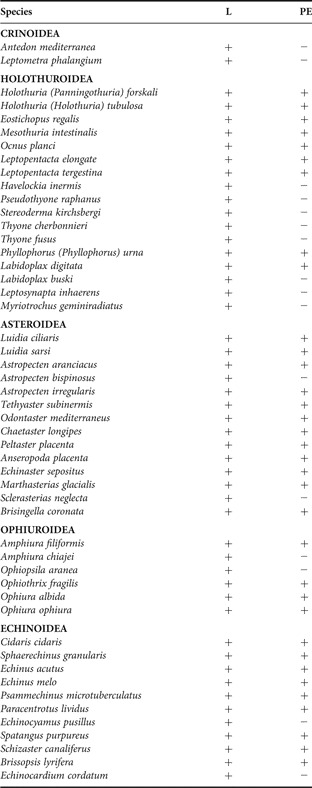
During the eleven surveys of the ‘Pipeta’ Expedition, 68% of echinoderm species previously recorded in the investigated area was found (Table 2).
List of echinoderms in sampled area on continental shelf of the northern and middle Adriatic Sea. L, literature; PE, ‘Pipeta’ Expedition (7th–17th cruises).

Since this Expedition, complex investigations of echinoderm fauna in the Adriatic Sea have been performed only in the area along the eastern Adriatic coast and islands and one in the area of trawling bottoms in the western part of the southern Adriatic Sea. In the area of Rijeka Bay 47 species were recorded (Zavodnik, Reference Zavodnik, Arko-Pijevac, Kovačić and Crnković1998; Zavodnik & Kovačić, Reference Zavodnik and Kovačić2000). In the insular region of the northern Adriatic 52 species are known (Zavodnik, Reference Zavodnik1980). Zavodnik (Reference Zavodnik1992) recorded 36 echinoderm species in the area of Lošinj insular region. In the area of Vir Island 35 echinoderm species were recorded (Zavodnik, Reference Zavodnik1977). Zavodnik (Reference Zavodnik1999) in Kaštela Bay noted 31 echinoderm species. Great numbers of echinoderm species, 61, were recorded in the area of the National Park Kornati and Murter Island (Zavodnik, Reference Zavodnik1997a, Reference Zavodnik, Meštrov, Durbešić and Kerovecb). In the National Park Mljet 53 echinoderm species were found (Zavodnik, Reference Zavodnik2003). Additionally, in the area of Boka Kotorska Bay 30 species were noted (Kolosváry, Reference Kolosváry1938; Bruno, Reference Bruno1972).
Ungaro (Reference Ungaro1995) listed 43 echinoderm species collected by bottom trawl on mobile bottoms in the western part of the southern Adriatic Sea.
Šimunović (Reference Šimunović1997) in investigations of qualitative and quantitative distribution of benthic communities of mobile bottoms in the open Adriatic, based on samples collected during the first and second surveys of the ‘Pipeta’ Expedition (1982), listed 33 echinoderm species with abundance data, and four of them were not found during our investigations: Thyone cherbonnieri Reys, 1960, Thyone fusus (O.F. Müller, 1776), Sclerasterias neglecta (Perrier, 1891) and Echinocardium cordatum (Pennant, 1777).
Vatova (Reference Vatova1949), based on sampling with the grab, listed 31 echinoderm species, 11 holothurians, 5 sea stars, 7 brittle stars, 5 sea urchins and 2 species of crinoids in the area of the northern and middle Adriatic Sea. It is obvious that the number of holothurians and brittle stars recorded during Vatova's investigation is greater than the number recorded during our investigation, but he recorded lower numbers of sea stars and sea urchins.
Pérès & Gamulin-Brida (Reference Pérès and Gamulin-Brida1973) stated that bottom trawl nets give qualitatively a pretty good picture about epifauna in the sea bottom biocoenose, while Zavodnik (Reference Zavodnik1971) stated that deficiency in sampling by bottom trawl net is because the bottom trawl does not sample animals that are deeply burrowed in the sediment and that reflects on estimates of composition and biomass in investigated biocoenoses of mobile bottoms. Comparing the list of echinoderms in Vatova (Reference Vatova1949), based on samplings with grab with lists in Ungaro (Reference Ungaro1995), Šimunović (Reference Šimunović1997) and this research that are based on samplings with bottom trawl net, it is obvious that only a small number of species collected with grab do not appear in samples collected by bottom trawl. Additionally, comparing previous records, it is obvious that numerous species of holothurians, sea stars and sea urchins were absent in samples collected with grab. Echinoderms are a complex taxonomic group with species with very different ecological preferences. It is clear that the bottom trawl net is not the most efficient tool for sampling echinoderms burrowed in substratum, such as some holothurians, brittle stars and sea urchins. So, the best method for investigation of echinoderms’ distribution is a combination of different sampling methods.
It is obvious that the sediment type and depth affect echinoderm assemblage on the soft bottoms in the area of the northern and middle Adriatic Sea. The highest species richness was recorded in the area of ‘relict’ sand and clayey ‘relict’ sand at different depths, while on clayey silt and silty clay sediment, areas with the smallest number of echinoderm species were recorded. According to Ellis & Rogers (Reference Ellis and Rogers2000), the influence of substrate on echinoderm distribution may be connected with resource partitioning, locomotion and predator–prey interactions. We can conclude that the areas of ‘relict’ sand and clayey ‘relict’ sand due to size of sediment particles, composition of organic matter and available food are the most suitable substrata for assembling echinoderm species on soft bottoms in the investigated area.
ACKNOWLEDGEMENT
The authors wish to thank the late Dr Ante Šimunović who collected the samples during the ‘Pipeta’ Expedition.