Economic historians have long been interested in the relationship between transportation improvements and the English Industrial Revolution. One of the central questions is why greater infrastructure investment emerged during the eighteenth century, rather than in earlier periods. One argument is that new institutional arrangements increased incentives for investment. An alternative view is that economic development provided the impetus for improvement and that other factors were secondary in importance.
This article evaluates the effects of a particular institutional change by examining the contribution of turnpike trusts to greater road expenditure. Turnpike trusts were private organizations that financed road improvements by levying tolls. They were established by individual Acts of Parliament. The acts appointed local landowners and merchants to the body of trustees and gave them the authority to levy a maximum schedule of tolls and to issue mortgage debt secured upon the income from the tolls. Trustees were also given the authority to purchase property in order to widen or divert existing roads. Lastly, most acts required that trustees could not earn direct profits, by mandating that all revenues be devoted to road improvements and other expenses.
Turnpike trusts were established throughout the seventeenth, eighteenth, and early nineteenth centuries. The most significant period of adoption occurred during the 1750s and 1760s, when over 300 trusts were created along 10,000 miles of road (see Figure 1). By the 1830s the turnpike network expanded further to include approximately 20,000 miles or 17 percent of the entire road network.1
Great Britain, House of Commons, “Appendix,” p. 79.
THE ADOPTION OF TURNPIKE TRUSTS AND TURNPIKE MILEAGE IN ENGLAND AND WALES, 1700–1840
The geographic features of the turnpike system are best illustrated by Eric Pawson's map of the network in 1770 (see Figure 2). It shows that turnpike trusts managed all of the major highways leading into London as well as a dense network of roads in the industrial regions of the West Midlands and the North.
ERIC PAWSON'S MAP OF THE TURNPIKE SYSTEM IN 1770
Turnpike trusts emerged as the dominant supplier of road maintenance and investment along major roadways, but they were not the first to have this responsibility. Nearly all turnpike trusts were established along existing roads that were previously maintained by parishes. Unlike turnpike trusts, parishes did not have access to external sources of funding, such as tolls or bonds. Instead, they financed road improvements by levying local property taxes and by claiming up to six days of labor per year from their residents. Parishes were also different because they were subject to the oversight of county magistrates, who had the authority to levy fines upon parishes if they failed to provide adequate road repair.
The transition from parishes to turnpike trusts clearly changed the way road improvements were organized and financed, but it is not obvious that this transition was necessary for greater road expenditure. It is possible that parishes were willing to finance road improvements with their own tax revenues, but they preferred turnpike trusts because the tolls shifted the tax burden to external road-users. As a result, turnpike trusts may have simply replaced existing or forthcoming parish road spending.2
For a theoretical discussion of this hypothesis see Levinson, Financing Transport Networks, pp. 1–12.
An alternative hypothesis is that turnpike trusts increased road expenditure by resolving a problem of underinvestment in the parish system. According to this view, parishes did not have an incentive to provide adequate investment because they were forced to rely on local labor and property taxes. Turnpike trusts eliminated this constraint because they could issue debt and levy tolls on road-users. In addition, there is an argument that parishes invested too little because they were unable to coordinate with other parishes. Turnpike trusts could have resolved this problem, because they often maintained an entire roadway linking cities, whereas parishes maintained smaller segments.
The different views of parishes and turnpike trusts have long been debated in the literature. In a well known study, Sidney Webb and Beatrice Webb examined a variety of written testimonies concerning parish and turnpike road expenditure. Despite being fairly critical of turnpike trusts, Webb and Webb concluded that they were much more effective than parishes in providing road expenditure. They even asserted that without turnpike trusts, parishes would not have undertaken any considerable road improvements for most of the eighteenth century.3
Webb and Webb, Story, p. 146.
A number of other scholars examined the relative effectiveness of parishes and turnpike trusts by using evidence from the transport sector. William Albert and Eric Pawson showed that freight charges and passenger travel times fell during the 1750s and 1760s, when many turnpike trusts were established.4
Albert, Turnpike Road System, pp. 168–87; and Pawson, Transport, pp. 287–99.
These results provided indirect evidence that turnpike trusts invested more than parishes. However, these conclusions were challenged by John Ginarlis and Sidney Pollard.
5 Ginarlis and Pollard, “Roads,” pp. 182–224.
As part of a larger study of capital formation during the Industrial Revolution, Ginarlis and Pollard provided the first estimates of total parish and turnpike trust road expenditure between 1750 and 1850. Surprisingly, their estimates imply that parish road expenditure was already significant by 1750 and that total road expenditure did not increase in real terms between 1750 and 1800 because rising turnpike expenditures were offset by falling parish expenditures. These results suggest that turnpike trusts had no effect on road spending and that they simply redistributed the tax burden from parishes to road-users.
This article reassesses the findings of Ginarlis and Pollard and shows that turnpike trusts increased total road expenditure and did not replace existing parish spending. It uses a new data set of account books from over 40 turnpike trusts and 50 parishes between 1700 and 1819, along with a collection of County Order Books, which describe all parish highway taxes between 1700 and 1773. It also uses new data from the Parliamentary Papers, which describe total parish spending, other than poor relief, at various dates between 1750 and 1803. The new evidence shows that total parish road spending was far below total turnpike spending between 1750 and 1800. It also shows that turnpike trusts accounted for the majority of a four-fold increase in total road spending between 1730 and 1800. These findings are further corroborated by micro-evidence, which indicates that road expenditure per-mile increased by a factor of more than ten after turnpike trusts replaced parishes along individual roads.
These findings demonstrate that turnpike trusts spent more than parishes, but they do not rule out the possibility that parishes would have increased their road expenditure in the absence of turnpike trusts. Turnpike trusts may have “crowded-out” forthcoming parish road spending because they were adopted in areas that were developing more rapidly. As a result, parishes might have responded to these changes by increasing their road expenditure. This issue is addressed by studying parishes that managed roads for which petitions to establish turnpike trusts failed in Parliament. As the analysis will show, parishes did not increase their road expenditure after petitions failed, and therefore, it is unlikely that parishes would have invested as much as turnpike trusts.
Through their effects on road expenditure, turnpike trusts exemplify how changes in institutional arrangements increased transportation investment in eighteenth-century England. The improvements in roads had an important effect on the transport sector, because they allowed horses to carry larger loads and travel faster.6
See Jackman, Development; Pawson, Transport; and Gerhold, “Productivity Change.”
Both of these changes significantly lowered transportation costs and far outweighed the effects of the tolls. In fact, as I show in another paper, turnpike trusts contributed to around half of the 40 percent reduction in freight charges and the 60 percent reduction in passenger travel times between 1750 and 1800.
7 Bogart, “Turnpike Trusts.”
The impact of turnpike trusts on road investment and transport costs raises the question of whether they were linked with the process of industrialization. In many cases, it is clear that trusts were adopted in response to local economic development. At the same time, turnpike trusts also promoted development by increasing passenger travel and inter-regional trade.8
See Chartres and Turnbull, “Road Transport.”
Greater mobility and trade encouraged firms to increase their scale and invest in new capital. They also encouraged the diffusion of information about new technologies and changes in consumer tastes.
9 For the wider effects of transport improvements, see Pawson, Transport; and Szostak, Role.
Therefore, along with other transport improvements, turnpike trusts set in motion a number of dynamic factors that contributed to Industrial Revolution in England.
TURNPIKE TRUST AND PARISH ROAD EXPENDITURE
One of the key questions concerning turnpike trusts is whether they increased road expenditure or whether they replaced existing parish expenditures. To discriminate between these two possibilities, it is necessary to consider financial expenditures as well as statute labor, which consisted of unpaid labor performed by the inhabitants of local parishes. Financial expenditures included outlays on labor, land, and materials. Parishes paid for financial expenditures by levying taxes on the assessed value of property income, in particular the rental value of land. Parishes also collected revenues from individuals who paid their way out of the statute labor requirement. By contrast, turnpike trusts paid for financial expenditures with toll revenues and the issuance of debt. The tolls were restricted by a maximum schedule, which distinguished between different types of traffic, including wagons, coaches, and livestock. The tolls were also used as collateral for the turnpike bonds, which paid for most of the expenditures of the trust during its early years.
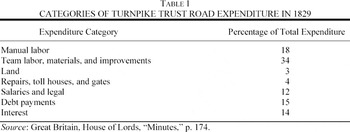
Turnpike trusts allocated their revenues to a number of expenditure categories. Table 1 illustrates the breakdown of financial expenditures for all turnpike trusts in 1829. The largest expense consisted of team labor, materials, and improvements. The next largest categories were manual labor, salaries and legal expenses, interest, and debt payments, while only minor payments were made towards the purchase of land and repairs to toll houses and gates.
A similar itemization of parish financial expenditure is not available during this period, but we know that parishes were exempt from many of the expenses associated with turnpike trusts. For example, parishes did not pay wages for toll collectors or the costs of constructing toll houses and toll gates. They were also exempt from legal fees, such as the expense of passing or renewing an Act of Parliament.
Road improvements also involved the use of statute labor. Parish officials had the right to claim at most six days of labor from their residents per year. Turnpike trusts were also granted statute labor, but they had to share this service with the parishes along their route. As a result, local residents had to perform at most six days of labor per year on either parish roads or turnpike roads.
The inclusion of statute labor complicates the analysis of road expenditure, because it is possible that turnpike trusts increased financial spending, but decreased statute labor resulting in no net effect. Therefore, an assessment of the differences between turnpike trusts and parishes requires an analysis of both financial road expenditure and statute labor.
The First Assessment of Parish and Turnpike Trust Financial Expenditure
John Ginarlis and Sidney Pollard provided the first estimates of parish and turnpike trust financial road expenditure between 1750 and
1850.10
Ginarlis and Pollard, “Roads,” pp. 182–224. The original estimates come from John Ginarlis's dissertation, which is discussed in J. P. Higgins and Sidney Pollard, Aspects. Because these estimates were not published, until the coauthored work with Pollard, I refer to them as the Ginarlis and Pollard series.
Their estimates were based on published information on total parish road expenditure in England and Wales beginning in 1812 as well as total turnpike trust expenditure beginning in 1818.
11 The figures on parish road expenditure in 1812 come from Great Britain, House of Commons, “Abstract,” p. 255. The figures on turnpike expenditure in 1818 are from Great Britain, House of Commons, “Report from the Select Committee,” p. 343.
To provide estimates for the earlier period, Ginarlis and Pollard extrapolated from the published figures using a sample of parishes and turnpike trusts.
To examine the trends in Ginarlis and Pollard's series, it is necessary to adjust for changes in the cost of providing road maintenance and improvement. For this purpose, I use Greg Clark's wage series for agricultural laborers.12
Clark, “Farm Laborer,” pp. 502–03. The Clark series on agricultural laborers was preferred to the Feinstein wage series because the latter does not begin until 1770. The Clark series was preferred over the Phelps, Brown, and Hopkins wage series because it is more complete in its geographic coverage.
Wages represent a good proxy for the general changes in costs, because labor was the primary input for road maintenance and improvement.
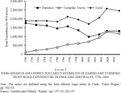
Figure 3 plots Ginarlis and Pollard's estimates after deflating their series with the Clark wage index based in 1819.13
The base year of 1819 was chosen because the Parliamentary Papers published the first figures on total turnpike expenditure between 1818 and 1820.
The most striking aspect is that total road expenditure remained largely unchanged in real terms between 1750 and 1800 because rising turnpike expenditures were offset by declining parish expenditures. These results suggest that turnpike trusts simply provided a substitute for existing parish expenditure.
JOHN GINARLIS AND SIDNEY POLLARD'S ESTIMATES OF PARISH AND TURNPIKE TRUST ROAD EXPENDITURE IN ENGLAND AND WALES, 1750–1850
The accuracy of Ginarlis and Pollard's series can be checked with new information from the Parliamentary Papers. As mentioned earlier, the first date in which there is direct information on parish road expenditures is 1812. However, there is information on total parish expenditures, excluding poor relief, in 1748–1750, 1775–1776, 1783–1785, and 1802–1803.14
Great Britain, House of Commons, “Abstract,” p. 207.
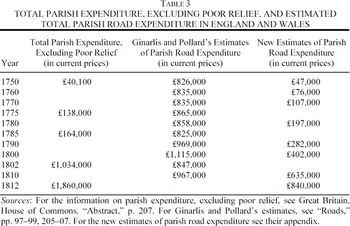
This residual category largely includes spending on highways, churches, and constables. After comparing Ginarlis and Pollard's estimates with the figures for non–poor law expenditures, it is immediately clear that they overestimated parish road expenditure between 1750 and 1802. According to Ginarlis and Pollard, parish road expenditures equaled £826,000 in 1750, but parish non–poor law expenditures were only £40,100 in 1750. Similarly, they estimated that parish road expenditure was £865,000 in 1775 and £851,000 in 1783, while parish non–poor law expenditures equaled only £138,000 in 1775 and £164,000 in 1783.
Why did Ginarlis and Pollard overestimate parish road expenditure so substantially before 1800? The answer lies in their assumption about how much unobserved parishes were spending on roads. Ginarlis and Pollard based their estimates on a sample of parish highway accounts in five counties. They calculated the total expenditure in their sample and then extrapolated to an aggregate estimate by assuming that all unob-served parishes were spending the same amount as the parishes in their sample.15
For example, if they collected expenditure for 10 percent of all parishes in the county, they multiplied their sample total by a factor of ten in order to arrive at an estimate for all parish expenditure in the county. They used a similar procedure to extrapolate from the county estimates to the national total. See Ginarlis and Pollard, “Roads,” p. 204, for a discussion of their methodology.
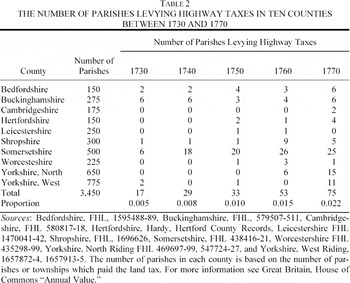
The problem with this assumption is that very few parishes spent money on their roads. This can be illustrated by new information on the proportion of parishes that were levying taxes for the purposes of highway improvements. The data comes from a sample of County Order Books, which record all parishes that levied a highway tax within each county in every year before 1773.
16 In 1773 a new law changed the administrative procedure by which highway taxes were recorded.
The sample is drawn from ten counties throughout England and contains information on 3,450 parishes and townships, which represents about 25 percent of the total population.
17 County Order Books can be located in Quarter Sessions Records, which are available in the Family History Library, Church of Latter Day Saints [hereafter FHL].
Table 2 lists the number of parishes or townships in each county, along with the number levying highway taxes in 1730, 1740, 1750, 1760, and 1770. It shows that very few parishes were levying highway taxes before 1770. In fact, it is likely that only 2 percent of all parishes were spending money on their roads in any given year. Based on this new evidence, it is not surprising that Ginarlis and Pollard overestimated parish road expenditure by assuming that unobserved parishes were spending the same amount as parishes with surviving records. They attributed the behavior of a minority of parishes to the overwhelming majority, who were not levying any highway taxes.
A New Assessment of Parish and Turnpike Trust Financial Expenditure
In order to evaluate the aggregate effects of turnpike trusts, it is necessary to have new estimates of total road expenditure during the eighteenth century. The new estimates of parish road expenditure are based on two separate calculations for the 1730 to 1770 period and the 1770 to 1812 period.18
For a detailed description of the estimating procedure see Appendix 2.
For the latter period, I use the published figures on total parish road expenditure in 1812 as the base level and assume that between 1770 and 1812, total parish spending grew at the same rate as total spending across a sample of approximately 60 parishes.
19 For information on the sample of parishes see Appendix 1.
This procedure is different from Ginarlis and Pollard's approach, because it does not assume that all parishes were levying highway taxes. The procedure does assume, however, that the sample is representative of all parishes that were levying highway taxes.
The second calculation builds on the first by using the 1770 estimate as the base level of parish expenditure. I then assume that between 1730 and 1770, total parish road spending grew at the same rate as the number of parishes levying highway taxes across the ten sample counties in Table 2 This procedure differs from the previous method because it incorporates the data from County Order Books, which are the most comprehensive source on parish road expenditure before 1770.20
Ideally I would use County Order Books to estimate the trends in parish road expenditure up to 1812, but this source becomes uninformative after 1773.
The new estimates of total turnpike expenditure are based on a single calculation for the 1730 to 1818 period. I take the published expenditure figures in 1818 as the base level and assume that total expenditure between 1730 and 1818 grew at the same rate as total expenditure across a sample of 43 trusts. The sample was drawn from a list of surviving records provided by the National Register of Archives. It represents approximately 5 percent of all trusts established before 1820 and it is fairly representative in terms of its geographic coverage and levels of expenditure.21
To check whether the sample is representative, I compared the sample distribution of expenditure per mile in 1818 with the population distribution of expenditure per mile in 1818. The sample and population histograms were nearly identical, which suggests that the sample of trusts is representative. For more information see Appendix 1.
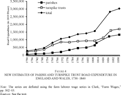
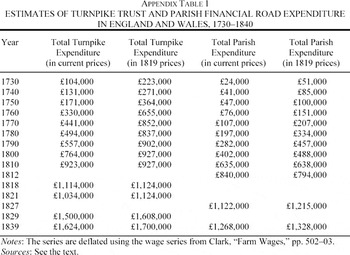
Figure 4 plots the new estimates of turnpike trust and parish financial road expenditure in England and Wales after deflating both series with the Clark wage index. They show that total real road expenditure increased substantially between 1730 and 1840. The greatest absolute change occurred between 1810 and 1830, but the greatest relative change occurred during the 1750s and 1760s, when real road expenditure more than doubled. The new estimates also show that parish road expenditures were minimal prior to the late eighteenth century, whereas turnpike expenditures rose dramatically during the 1750s and 1760s. Together the two series reveal that turnpike trusts accounted for over 80 percent of the increase in total road expenditure between 1730 and 1770 and over 60 percent of the increase between 1730 and 1800.22
See Appendix Table 1 for the estimates of parish and turnpike trust road expenditure.
NEW ESTIMATES OF PARISH AND TURNPIKE TRUST ROAD EXPENDITURE IN ENGLAND AND WALES, 1730–1840
The new estimates of total parish road expenditure are clearly different from Ginarlis and Pollard's estimates. The greater accuracy of the present series can be confirmed by a comparison with the figures on total parish expenditure, excluding poor relief (see Table 3). Although there are some small discrepancies in 1750 and 1780, the new estimates of parish road spending lie below non–poor law expenditures and they follow its trend of rapid growth between 1750 and 1812.
The new figures on total turnpike expenditure are relatively similar to Ginarlis and Pollard's estimates, but there are some noticeable differences. In particular, the new series exhibits more rapid growth between 1750 and 1770 and slower growth between 1800 and 1820. The more rapid growth between 1750 and 1770 is a reflection of the greater expenditure by trusts that were established during this period. For example, the average annual expenditure per mile for trusts created during the 1750s and 1760s was £84 during their first ten years, but it was only £58 for trusts established after 1770.23
Each of these figures is expressed in constant 1819 prices.
The differences across time may be due to a number of factors, but the most likely explanation is that later trusts were established on roads with lower levels of traffic.
The new estimates of total road expenditure suggest that the adoption of turnpike trusts ultimately increased road maintenance and investment. However, the dramatic rise in parish road spending during the 1810s and 1820s also reveals that parishes were certainly capable of financing substantial levels of road expenditure.24
Part of the impetus came from greater road spending by turnpike trusts and the construction of canals, which increased traffic along local roads managed by parishes. Another important factor may have been the new techniques of road building developed by John Macadam and Thomas Telford.
In light of this finding, one might wonder whether the aggregate estimates fail to capture the expenditures of parishes just before the adoption of turnpike trusts. In addition, there may be concerns that parishes would have increased their road expenditure had turnpike trusts not been established. The following section addresses the first concern by examining the changes in expenditure per mile before and after turnpike trusts were established.
Micro-Evidence on Road Expenditure
It is straightforward to estimate the level of turnpike expenditure per mile using the sample of trusts introduced earlier, but it is more complicated to measure parish expenditure per mile just before turnpike trusts were established. The most complete information comes from County Order Books, which describe every parish that levied a highway tax, along with the rate at which property income was taxed. This information can be combined with data on assessed property values in order to estimate the amount of tax revenues collected for the purposes of highway improvements. Finally, the level of parish highway revenues can be matched with a Parliamentary survey, which describes the mileage for every turnpike trust, the parishes through which the road passed, and the date at which each turnpike trust was established.25
The survey is in Great Britain, House of Commons, “Report of the Commissioners.” Additional information on the location of turnpike trusts comes from Albert, Turnpike Road System; and Pawson, Transport.
As a first step, Table 4 illustrates the frequency of parish tax levying along 164 roads in ten counties where turnpike trusts were established. It lists the total number of parishes managing these roads, along with the proportion that levied a highway tax during each of the five years before the turnpike trust was established. The evidence indicates that less than 5 percent of parishes levied a highway tax during any of the five years preceding the adoption of a turnpike trust in their jurisdiction.
There were some cases where parishes did levy taxes just before trusts were established. One example comes from Somersetshire, where a turnpike trust was established along a set of roads leading into the market town of Crewkerne in 1765. Between 1760 and 1764, three of the eight parishes maintaining this road levied a highway tax, including Stoke under Hamdon in 1760, 1761, and 1762, Misterton in 1764, and Crewkerne in 1764. Although these three parishes began improving their roads before trusts, they were the exception, especially along the major roads. For example, along the “Great North Road,” connecting London with Newcastle, there was a 29 mile stretch between Ferrybridge and Boroughbridge that was originally managed by 21 separate parishes or townships.26
In the North of England, townships rather than parishes were responsible for road maintenance.
During the five-year period before a turnpike trust was established in 1741, not a single parish or township levied a highway tax and only two, Sherburn and Boroughbridge, levied any highway taxes during any year before 1741.
The low frequency of parish highway taxes implies that road spending was low just before turnpike trusts, but it does not indicate by how much road expenditure ultimately increased. To determine the magnitude, I estimate the level of parish expenditure per mile along the 164 roads where turnpike trusts were established. The estimates are based on assessed property values and the tax rates used for highway levies. For example, a highway tax levied at six pence in the pound was equivalent to a 2.5 percent tax on property income. Therefore, if the assessment was £2,000 in a parish, a six pence tax would yield £50 in revenues.
The data on property assessments come from the published figures for the 1815 property tax.27
Great Britain, Annual Value, p. 327.
The 1815 assessment was used because it was not possible to collect data on tax assessments for many parishes during the eighteenth century. The cost of using the 1815 assessment is that it introduces an upward bias into parish expenditure due to the fact that tax assessments were lower before 1815. The bias is not a major concern, however, because it works against the hypothesis that trusts increased road expenditure.
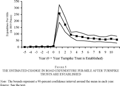
To illustrate the estimates, Figure 5 plots a 90-percent confidence interval for average parish expenditure per mile during the five years preceding and the ten years following the establishment of turnpike trusts. It is fairly striking how much more turnpike trusts spent than parishes. During their first two years, trusts spent over 20 times more than parishes and around ten times more during subsequent years.28
During their first two years trusts spent between £172 and £257 per mile, whereas parishes spent only £7 per mile the year before. For later years, trusts spent between £60 and £70 per mile.
THE ESTIMATED CHANGE IN ROAD EXPENDITURE PER-MILE AFTER TURNPIKE TRUSTS ARE ESTABLISHED
The peak in initial turnpike expenditure suggests that once trusts were adopted, they made substantial investments through purchases of land and materials as well as payments to surveyors and laborers. This conclusion could be questioned if the initial expenditures reflected legal expenses associated with passing an Act of Parliament or the costs of constructing toll houses and gates. To address this issue, I excluded such expenditures whenever they could be identified in account books. Therefore, the turnpike expenditures in Figure 5 largely reflect road spending.
Additional evidence on turnpike investments comes from a Parliamentary report, which itemizes spending for all trusts in 1829.29
See the statement of returns in Great Britain, House of Lords, “Minutes.”
According to these published figures, trusts that were less than five years old in 1829 spent 9 percent on manual labor, 47 percent on team labor, materials, and improvements, 6 percent on land, 5 percent on repairs to toll houses and gates, 20 percent on salaries and legal, and 13 percent on interest and debt payments. When these figures are compared with the data from
Table 1 which applies to all turnpike trusts, I find that new trusts devoted an additional 16 percent (53 percent – 37 percent) of their revenues to investment expenditures such as land, team labor, materials, and improvements, while they spent only 8 percent (20 percent–12 percent) more on salaries and legal expenses. This provides further evidence that turnpike trusts devoted the majority of their initial expenditures to road investment, rather than the legal expenses of passing an Act of Parliament.
30 For a discussion of repair techniques of trusts see Albert, Turnpike Road System, pp. 132–67; and Pawson, Transport, pp. 236–64.
One of the remaining issues is whether the greater financial expenditures of turnpike trusts were offset by less statute labor. Unfortunately, there is little information on the amount of statute labor performed before turnpike trusts; however, the evidence from the early nineteenth century suggests that statute labor was still being used by both parishes and turnpike trusts. The only estimate of the value of statute labor applies to 1812, 1813, and 1814.31
Great Britain, House of Commons, “Abstract,” p. 255.
The value of labor performed was £515,500 in 1812, and the amount of composition payments in lieu of statute labor was £271,500. When combined the total value of statue labor amounted to 53 percent of parish and turnpike financial expenditures in 1812.
32 In 1812 revenues from parish highway taxes were £570,700, and in 1810 estimated turnpike expenditure was £923,000.
As these figures indicate, statute labor represented a substantial portion of total road expenditure in the early nineteenth century. They also suggest that the rise of turnpike trusts did not result in a reduction of statute labor.
There is also evidence that some turnpike trusts relied on statute labor before it was eventually abolished in 1835. In a Parliamentary survey, trusts were asked whether their financial status was affected by the elimination of statute labor.33
Great Britain, House of Commons, “Report of the Commissioners.”
Forty-five percent of trusts said that they were negatively affected, whereas 42 percent said that they were unaffected and 13 percent gave no response. Some turnpike trusts also estimated the annual value of statute labor relative to their income from tolls. Based on their calculations, statute labor represented around 21 percent of the value of tolls. Therefore, it appears that many turnpike trusts continued to use statute labor and regarded it as an important component of road expenditure.
34 Some turnpike trusts may have preferred to use less statute labor because it helped parishes maintain their secondary roads, which served as important feeders for the trust.
DID TURNPIKE TRUSTS REPLACE FORTHCOMING PARISH ROAD EXPENDITURE?
Although it is now clear that turnpike trusts devoted more resources to road improvements, there is still the question of whether parishes would have increased their road expenditure had trusts never been established. This concern arises because turnpike trusts were often established in areas where road traffic was growing, and hence the demand for road investment was rising. For example, numerous turnpike trusts were established in the West Midlands and the North during the same period that these regions were beginning to industrialize.35
For a detailed study of the changing patterns of turnpike trust adoption, see Pawson, Transport, pp. 134–69.
Given that parish residents were participating in the industrialization process, they might have eventually viewed greater parish road expenditure as being beneficial to their economic interests. One way of measuring the counter-factual level of road expenditure is to observe parishes along roads where petitions to establish turnpike trusts failed in Parliament. A key to this analysis is that turnpike petitions failed for reasons unrelated to the demand for road investment. Therefore, before examining how much parishes were spending after petitions failed, it is necessary to study the reasons why turnpike petitions were unsuccessful in Parliament.
The process of creating a turnpike trust began when a group of individuals petitioned the House of Commons. The petitions typically stated that heavy road traffic has made the ordinary laws insufficient for the maintenance and improvement of a particular stretch of highway. After the petition was read before the House, a committee was formed among all the Members who had an interest in the legislation. The committee conducted an inquiry into the merits of the petition and then presented their findings to the House. If there was no immediate objection, the committee fashioned the details of the legislation and presented it before the House for a second time. Next, the House voted on the legislation, and if it was successful, a draft of the bill was sent to the House of Lords, where a similar process was undertaken.36
For a discussion of the procedure for creating Acts of Parliament, see Hoppit, Failed Legislation.
The following passage comes from a petition to establish a turnpike trust along one of the major roads in Kent. It was written in 1709 by the county magistrates, who supported the establishment of this particular turnpike trust.
That the highways from the parish of Sevenoaks to the parish of Spellhurst … are impassible for travelers by reason of the badness of the roads … notwithstanding there have been great sums of money already laid out towards the repairing the same…. All of which sums have proved hitherto insufficient to repair the said roads … Therefore, it is humbly prayed that this honorable house would give leave for a bill to be brought in for a turnpike on some part of the said highway.37
Center For Kentish Studies, Quarter Sessions Order Book, Q/SB/30, pp. 85–86.
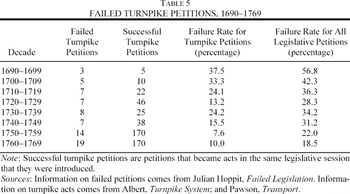
According to research by Julian Hoppit, it was not uncommon for early turnpike petitions to fail in Parliament.38
Hoppit, Failed Legislation.
The failure rate was above 25 percent between 1690 and 1719, before falling to 13 percent during the 1720s (see
Table 5). It rose again during the 1730s to 24 percent and then fell to less than 10 percent during the 1750s and 1760s. The trend in failure rates for turnpike petitions followed the trend in failure rates among all forms of legislation. For example, the failure rate for all legislation was at its height between 1690 and 1719, which is also the same period when the largest proportion of turnpike petitions failed.
The similarity in failure rates among general legislation and turnpike legislation suggests that some turnpike petitions failed because of spillover effects from disputes over larger political issues, such as war, religion, and government finances. It is also possible that Parliament was learning how to govern in the period after the Glorious Revolution, and as a result more petitions stalled in the legislative process. In either case, the general political environment appears to have been one factor that led to the failure of turnpike petitions.39
See Hoppit and Innes, “Introduction,” for a general discussion of the reasons why petitions failed.
Local concerns over redistribution were another important factor in determining whether turnpike petitions failed. For example, there was a petition submitted in opposition to the establishment of a turnpike trust along the road between Sevenoaks and Spellhurst in the county of Kent. The author of the petition claimed that these parishes were wealthy enough to finance adequate road repair and did not need the benefit of the tolls. The author also claimed that the farmers who drove their cattle along this road would earn few benefits and would be unjustly burdened by the tolls.40
Hampshire Record Office, 44m69/G2/342.
Another example of local opposition comes from the inhabitants of Buckingham in 1712, who argued that the proposed turn-pike road from Bicester to Aylesbury would injure the trading interests of their city.
41 For more information on this counter-petition see Great Britain, House of Commons, Journals, March, 1712.
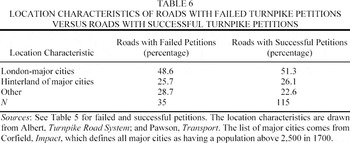
Although it appears that many factors influenced the success or failure of turnpike petitions, the most important consideration is whether Members of Parliament dismissed petitions because they believed that there was no demand for road improvements. One way of addressing this possibility is to compare the location characteristics of roads where turnpike petitions failed versus those where petitions were immediately successful. Table 6 illustrates this comparison using a sample of all 150 roads where a turnpike petition was introduced before 1750. The roads were classified into one of three categories: roads connecting London with major cities with populations above 2,500 in 1700, roads in the hinterland of a major city, and all other roads. If the location characteristics of failed turnpike petitions were concentrated in the “other” category, then it is more likely that Parliament selected failure based on demand considerations. However, the evidence indicates that the distributions of locations across the two categories of petitions are almost identical. In other words, roads with failed petitions do not appear to have any observable location characteristics that separate them from roads where petitions were immediately successful.
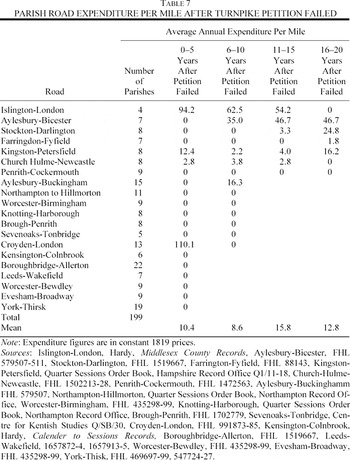
The preceding analysis suggests that it is reasonable to use the expenditure of parishes along roads where turnpike petitions failed as a measure of the road expenditure that would have occurred had turnpike trusts not been established. To explore this counter-factual, I use a sample of 199 parishes along 21 roads for which turnpike petitions initially failed, but were ultimately successful. Table 7 describes the average annual expenditure per mile in five-year intervals beginning with the year after the initial turnpike petition was unsuccessful and ending with the year when a new petition was ultimately successful. As before, parish road expenditure per mile is estimated with information on highway taxes and assessed property income in 1815.
The most striking result from this experiment is that many parishes continued to spend nothing on their roads after the turnpike petition failed. Across the sample of 21 roads, average expenditure per mile equaled between £8.6 and £15.8 (in 1819 prices), which is far below the average expenditure of turnpike trusts. A similar conclusion holds, if the sample is restricted to those roads where the time between successful and unsuccessful petitions was more than five years.
Whereas most parishes continued to spend relatively little, there were some cases where parish expenditures did increase after turnpike petitions failed. For example, along the London-Croyden road, parishes spent an annual average of £110 per mile between 1715 and 1719. The parishes along this road achieved such a high level of road expenditure because they had large tax bases and they were able to coordinate their spending. In 1715, one year after the turnpike petition failed, Bermondsey, Southwark, and Putney all levied highway taxes. In 1717 a fourth parish, Lambeth, joined Bermondsey and Southwark by levying its first highway tax. Finally, in 1719 Newington followed the other parishes and levied its first highway tax. Not surprisingly, the expenditures of all these parishes ceased in 1720, when the Croyden to London turnpike act was eventually passed.
Even though some parishes changed their behavior, the general conclusion from this new evidence is that parishes would have continued to spend relatively little on their roads had turnpike trusts not been available. As a result, it appears that rising demand was not sufficient for greater road expenditure and that changes in the institutional framework were necessary.
WHY DID TURNPIKE TRUSTS INCREASE ROAD EXPENDITURE?
Turnpike trusts had a large effect on road expenditure because they directly addressed a number of problems in the parish system. One problem was that parishes could not force external road-users to contribute to the costs of maintenance and investment.42
For a discussion of this issue see Pawson, Transport, pp. 65–70.
This problem was especially relevant along the major highways leading into London, where wagons and carriages often passed through dozens of parishes along their route. In such cases, parishes would be forced to pay for the improvement of the road, even though they derived only a fraction of the benefits.
Bethnal Green in Middlesex provides an example of the through-traffic problem facing parishes along the major highways. In 1693 Bethnal Green appealed for assistance from county magistrates because its repair expenses amounted to the substantial sum of £200 per year. In their appeal, Bethnal Green claimed that other parishes from the area should contribute to their repair costs because it had only 200 inhabitants, yet it was forced to maintain two of the major roads leading into London.43
The arguments made by Bethnal Green are drawn from William Hardy, Middlesex County Records.
Turnpike trusts resolved the through-traffic problem because the tolls forced external road-users to contribute to the costs of improvement. This redistribution of the tax burden was clearly beneficial for parishes, because it lowered their tax payments. As it turns out, it was also beneficial to road-users because the gains in efficiency from better roads were sufficient to offset the additional costs of the tolls.44
See Bogart, “Turnpike Trusts.”
The tolls were also effective because they allowed trusts to price discriminate against different types of road-users. The opportunities for price discrimination depended on the maximum schedule of tolls, which were set in the Act of Parliament. The schedules included separate tolls for wagons, carriages, and livestock. In some cases, they also included provisions for specific commodities, such as grain, iron, coal, and in one case, earthenware. By discriminating against different types of road-users, turnpike trusts were able to generate the necessary revenues without incurring substantial deadweight losses.45
For a more general discussion of price discrimination in early transport and its relation to modern telecommunications, see Andrew Odlyzko,“Evolution.”
Turnpike trusts also raised road investment by relieving borrowing constraints faced by parishes. The inability to issue debt forced parishes to finance road improvements using current revenues from property taxes. As a result, parishes were less likely to undertake investments if they had a smaller tax base or if the expenses of remaking the road were large. Turnpike trusts eliminated this problem because they were able to issue debt at a low cost. According to William Albert, turnpike bonds typically paid an interest rate below 5 percent for most of the eighteenth century.46
For a discussion of the effects of interest rates on turnpike investment, see T. H. Ashton, Economic Fluctuations; and Albert, Turnpike System, pp. 120–31.
Interest rates were low in part because turnpike trusts were able to use the revenues from the tolls as collateral. Another factor was that local investors stood to earn indirect returns through higher land values. The indirect returns may have been important in those cases where low traffic volumes made it unlikely that turnpike bonds would generate a reasonable return.
47 There is an interesting parallel in the early United States, where Daniel Klein, John Majewski, and John Wallis have suggested that the opportunity to profit through higher land values was especially important in promoting greater turnpike investment. See Klein, “Voluntary Provision,” Majewski, House Dividing; and Wallis, “Property Tax.”
Turnpike trusts were also successful in raising road investment because they addressed coordination problems in the parish system. Coordination was relevant because the benefits associated with improving one road segment often depended on the investments in another segment. For example, it was not very beneficial to invest in half of a road linking two major cities. It was also less valuable to invest in secondary roads, if primary roads were unimproved. Turnpike trusts were able to resolve some of these coordination problems by unifying control over an entire roadway or a network of roads. Some turnpikes also created interlocking bodies of trustees, which aligned the interests of numerous trusts within a particular county.48
See William Albert, Turnpike Road System, p. 63.
Although it is clear that turnpike trusts addressed a variety of problems in the parish system, it is not obvious that they represented the only solution. In France and Spain, the central bureaucracy replaced the authority of local governments and directly planned and financed improvements along the major highways leading into Paris and Madrid. In England, a similar set of institutions did not exist and was unlikely to emerge because Parliament would have had to substantially increase taxation. At the same time, England did have a more viable alternative to turnpike trusts, in which county magistrates (or Justices of the Peace) forced parishes to increase their road expenditure by levying fines. This system first emerged during the mid-seventeenth century and was permanently instituted in an Act of Parliament passed in 1691.49
For more information on this policy, see Webb and Webb, Story, pp. 51–58.
The act stated that magistrates could issue fines upon parishes if they failed to adequately maintain or improve their road. The revenues from the fines had to be applied to the road and were financed by parish highway taxes.
In theory, magistrates could have resolved a number of the problems in the parish system, but in practice they did not issue enough fines in order to increase parish road expenditure. For example, in Somersetshire magistrates levied fines on only ten of the 224 parishes that had a turnpike trust established in their jurisdiction between 1740 and 1770. In the North Riding of Yorkshire, magistrates were even less active, fining only two of the 182 such parishes between 1740 and 1770.50
For Somersetshire fines see FHL 438416-21; and for North Riding fines see FHL 469697-99, 547724-27.
In the West Riding of Yorkshire, magistrates were more interventionist. Over the period between 1715 and 1830, they issued £64,550 in fines. However, the vast majority were issued between 1770 and 1830, which is after turnpike trusts were established along most of the major roadways in the county.
51 Between 1715 and 1769 West Riding magistrates issued £3850 in fines in comparison with £60,700 between 1770 and 1830 (FHL 1657872-4, 1657913-5). Magistrates may have favored turnpike trusts over levying fines before 1770, because the tolls shifted a greater portion of the tax burden to road-users outside the county. The switch toward fines after 1770 may also reflect the need for improvements on local roads, where it was more difficult to shift the costs to external road-users.
Therefore, it appears that magistrates were generally unwilling to force parishes to invest in their roads by levying fines.
CONCLUSION
Economic historians have long been interested in the sources of greater transportation investment in eighteenth-century England. This article explored the impact of institutional arrangements by examining the effect of turnpike trusts on greater road expenditure. It focuses on whether turnpike trusts increased road expenditure, or whether they replaced existing or forthcoming parish expenditure. The conventional view among earlier scholars was that turnpike trusts increased road spending by replacing parishes who underinvested in their roads. This argument was challenged by John Ginarlis and Sidney Pollard's estimates of total parish and turnpike road expenditure between 1750 and 1850. Their estimates suggested that turnpike trusts did not increase total road spending and instead they replaced existing parish expenditures.
The new evidence presented in this article shows that Ginarlis and Pollard overestimated parish road expenditure between 1750 and 1800. It provides new estimates that indicate that turnpike trusts accounted for most of the four-fold increase in total road spending between 1730 and 1800. It also shows that road expenditure per mile increased by a factor of more than ten after turnpike trusts were established along individual roads. Lastly, it provides evidence that turnpike trusts did not replace forthcoming parish expenditure by showing that parishes continued to spend relatively little on their roads, even after turnpike petitions failed.
The history of turnpike trusts has implications beyond the transport sector because it illustrates how institutional changes contributed to the process of economic development in eighteenth-century England. Ever since the seminal paper by Douglass North and Barry Weingast, economic historians have focused on changes in political institutions and their effects on the security of property rights in capital markets.52
North and Weingast, “Constitutions and Commitment.”
The turnpike system offers a different perspective because it illustrates how an institutional change increased infrastructure investment. Turnpike trusts were able to increase road investment by addressing a variety of problems in the parish system, including coordination failures, borrowing constraints, and the inability to tax external road-users. By removing these bottlenecks, turnpike trusts were able to improve the road network and contribute to the Industrial Revolution.
Appendix 1: Data Sets
The sample of 43 turnpike trusts was drawn from a list of surviving records provided by the National Register of Archives (www.nra.nationalarchives.gov.uk/nra/). According to the National Register, there are approximately 200 trusts with surviving account books, and fewer than 100 with a fairly complete set of accounts beginning with the first year the trust was established and extending into the early nineteenth century. To assemble a sample from the list of surviving records, I collected all complete accounts in 25 record offices throughout England. I also collected accounts that included the first year of the trust and the majority of all subsequent years.
The sample of parish highway accounts was also drawn from a list of surviving records in the National Register of Archives and from a list of parish records available on microfilm in the Family History Library. In this case, it was not possible to collect information on all surviving parish records in any particular county record office. Therefore, I chose to collect records that were most complete in terms of time coverage.
The following list identifies each archive along with the references for the sample of turnpike trust and parish accounts.
Bedfordshire Record Office. Hockliffe and Woburn Turnpike X/21/4-5, Hartlington, Houghton Conquest DDP 11/21, Meppershal P 29/21/1, Upper Stondon P 55/21
Cambridgeshire Record Office. Cambridge and Ely Turnpike T/E/AM1-AM2.
Centre for Kentish Studies. Tonbridge to Maidstone Turnpike T2/3-4, Kippings Cross to Willsley Turnpike T1/3, Dover to Deal and Sandwich Turnpike T11/f1.
Cheshire Record Office. Hartford Green Turnpike DC 170/6, Sutton in Macclesfield MF 335/9, Handforth P10/21/1, Handley P3/5, Farndon P45/13, Winwick P155/17/1-6, Nether Peover, Halton, Nether Alderley P 143/15/1-2, Tattenhal P5/17/1, Warburton P68/28/1, and Wettenhal P40/22.
Chiswick Library. Isleworth Turnpike and Isleworth Parish
Derbyshire Record Office. Nottingham and Ilkestone Turnpike D 5050/2 and Denby Abbey D1061/A/PS/1
Doncaster Archive. Fishlake PR Fish 1/4/1-4.
Family History Library. Ayott St. Peter 1537956, Waltham Cross 1593498-9, Chestnut 1593499, Great Hadham 1593527-8, Hertford St. Andrew 1538075, Hitchin 1538105-6, Little Berkstead 1537964, Aldenham 579621, Hyde Staleybridge 1648262
Gloucestershire Record Office. Burford and Preston Turnpike D1070/8/1, Turksdean P341/su/2/1
Hertfordshire Record Office. Chestnut Turnpike TP1/1-4, Essex and Hertfordshire Turnpike TP3/1-11, Sparrow Herne Turnpike TP4/25-31, Wadesmill Turnpike TP7/1-4, Watton Turnpike TP8/1-2.
Hampshire Record Office. Odiham to Alton Turnpike 50m63/c5, Gosport Turnpike 36m72/b/a1-a2, and Basingstoke and Alton Turnpike.
Hounslow Library. Brentford Turnpike
Islington Library. Islington Turnpike.
Lancashire Record Office. Blackburn and Burscough Turnpike TTE/3
Leicestershire Record Office. Hinckley and Lutterworth Turnpike T/MB/2/1-2, Leicester and Hinckley Turnpike T/SA/4/1, Anstey DE/199/6, Ashby Magma DE/437/1/9, Belgrave 17 D64/E/2, Blaby parish, Bruntingshorpe DE 765/9, Borough on the Hill DE 990/22, Cole Overton, Cossington DE 40/36, Seagrave DE 3897/10, Shenton 6 D 43/6/5.
Lincolnshire Record Office. Donnington Turnpike and Grimsby Turnpike
Manchester City Archive. Manchester and Wilmslow Turnpike M124 and Cheetham M10/7/4/1
Northamptonshire Record Office. Northampton and Wellington Turnpike
Nottingham Record Office. Leadenham Turnpike DDT/27/1-2, Mansfield and Southwell Turnpike DDM/111/57.
Sheffield Record Office. Rawmarsh PR 80/17, Sheffield CB 1640/1-15, Sykehouse PR Syke 1/411, Thorne PR Thor 43.
Shropshire Record Office. Ludlow Turnpike, First District LB13/1, Ludlow Turnpike, Second District LB18/25, Caynham Turnpike LB18/86-89, Madeley Turnpike 1681/196/1-2, Balderton P201/N/1/1, Llanymyne P168/N/1, Preston on Weald Moors P233/N/1/1, and Porkington Selattyn P240/N/1.
Staffordshire Record Office. Cheadle Turnpike, Oakmoor D239/M/4/48, Cheadle Turnpike, Huntley D239/M, Cheadle Turnpike, Dilhorne D239/M, Cheadle Turnpike, Alton D239/M, Armitage D805/4/1, Tettenhal D571, and Haughton.
Yorkshire Archeological Society. Welburn in Bulmer MS 524, Garton Grimston MS 490, Harden in Bingley MD 290/9, and Kirkheaton MS 704/A.
West Yorkshire Record Office. Huddersfield and Pennistone Turnpike, Bawtry and Selby Turnpike RT 13/5, Harrowgate and Hewick Turnpike RT 44, Knaresborogh and Pately Turnpike RT 52, Redhouse and Crofton Turnpike RT 73, Ripon and Pateley Bridge Turnpike RT 44, Almondbury D 12/176A.
William Salt Library. Cheadle-Ipstones Turnpike 52/31
Wiltshire Record Office. Britford, Charlton 1813/17, Bratton 1872/16-17, Blunden St. Andrew 1564/24.
Appendix 2: Procedure for Estimating Total Road Expenditure
The estimates of total parish and turnpike trust road expenditure are provided in Appendix Table 1. The turnpike series is based on the sample of turnpike accounts and published figures for total turnpike expenditure between 1818 and 1820.53
Great Britain, House of Commons, “Report from the Select Committee,” p. 343.
Published figures are also available for 1821, 1829, and every year after 1833.
54 Great Britain, House of Lords, “Minutes,” p. 175; and Great Britain, House of Commons, “Appendix,” p. 83.
The earlier estimates take the published figures in 1818 as the base and assume that total turnpike expenditure between 1730 and 1818 grew at the same rate as total expenditures across a sample of 43 trusts.
The sample of turnpike expenditures needs to be adjusted because of a bias towards trusts established before 1770. The sample consists of seven trusts (16 percent) established between 1700 and 1749, 23 trusts (54 percent) between 1750 and 1769, and 13 trusts (30 percent) between 1770 and 1819. These divisions are slightly different from the population, where 146 trusts (18 percent) were established before 1750, 340 trusts (46 percent) between 1750 and 1769, and 313 trusts (36 percent) between 1770 and 1819. To correct for the bias in sampling, three separate expenditure series were calculated for trusts established between 1700 and 1749, 1750 and 1769, and 1770 and 1819. Let
be total expenditure in year t for the seven sample trusts established before 1750,
is total expenditure in year t for the 23 sample trusts established between 1750 and 1769, and
is total expenditure in year t for the 13 sample trusts established after 1770. The three series were then added together using weights that adjust for the sampling bias. The weights were (146/7) for the 1700–1749 series, (340/23) for the 1750–1769 series, and (313/13) for the 1770–1819 series. The weighting procedure yields the following sample expenditure series Et
The weighted sample expenditure index Et is then transformed into an index et with the base year of 1819. Finally, the estimate of total road expenditure in year t is equal to the index et multiplied by total turnpike expenditure in 1819.
The estimates of total parish road expenditure are based on published figures for 1812, 1813, 1814, 1827, and 1839, along with a sample of parish accounts and a sample of County Order Books.55
Great Britain, House of Commons, “Abstract,” p. 255, and “Report on Local Taxation,” p. 43.
The estimates before 1812 come from two separate calculations. The first takes the published figures in 1812 as the base and assumes that between 1770 and 1812, total parish spending grew at the same rate as total spending across a sample of approximately 60 parishes. Let
Ft equal total expenditure across the sample of parishes in year
t and let
ft be the index of
Ft with the base year 1812. The estimate of total parish road expenditure in year
t is equal to
ft multiplied by total parish expenditure in 1812.
The estimates between 1730 and 1770 build on the previous calculation by using the 1770 estimate of total parish expenditure as the base figure. It then assumes that total parish expenditure grew at the same rate as the total number of parishes levying highway taxes across the ten sample counties. According to Table 2, 75 parishes were levying highway taxes in 1770, whereas only 17 were levying taxes in 1730. Assuming that tax levying represents a good proxy for road expenditure, this would imply that parish spending increased by a factor of 4.41 between 1730 and 1770.
I would like to thank Jean-Laurent Rosenthal, Naomi Lamoreaux, Ken Sokoloff, Dan Treisman, Sandra Bogart, Greg Clark, Julian Hoppit, Gary Richardson, Jun Ishii, Marigee Bacolod, John Majewski, John Wallis, Duol Kim, and three anonymous referees for very helpful comments on earlier drafts of this article. I would also like to thank participants at the Economic History Association Meetings in 2002 and the All-UC group in economic history. Finally, I would like to acknowledge the financial support of the National Science Foundation (SES-0136749), the Institute for Humane Studies, and the all-UC group in Economic History.