


The history of phonology is in fact a long series of struggles with marginal phenomena.
(Labov et al. Reference Labov, Karen and Miller1991: 34)1 Introduction
Categorical phonological processes (e.g. assimilation) that are driven by gradient, subphonemic effects traditionally considered to fall within the domain of phonetics (e.g. coarticulation) constitute a challenge for phonological theory. Such data raise the question of the nature of phonology and its relation with phonetic substance, which has given rise to a long debate in linguistic theory, opposing substance-free approaches to phonological theory, which hold that phonetic substance is not relevant to phonological theory, to phonetically grounded approaches, for which (at least some) phonological phenomena are rooted in natural phonetic processes.Footnote 1
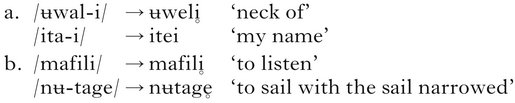
In this paper, I present novel data that bear on this debate: ‘subphonemic teamwork’, a particular kind of cumulative effect which obtains when two segments aspiring to trigger the same phonological process, but too weak to trigger it on their own, may ‘join forces’ and together pass the threshold necessary for that process to occur (cf. Lionnet Reference Lionnet2016). A case of teamwork is found in Woleaian (Sohn Reference Sohn1971, Reference Sohn1975, Flemming Reference Flemming1997, Suzuki Reference Suzuki1997), where /a/ is raised to [e] when flanked by two syllables with a [+high] nucleus, as illustrated in (1a). Raising does not apply if only one of the flanking syllables has a high vowel, as in (b).
-
(1)

Flemming (Reference Flemming2002: 77) points out the difficulty in accounting for multiple-trigger processes using standard autosegmental representations: ‘spreading a feature from two sources onto a target achieves the same as spreading the feature from one source, so the role of the second source is unexplained’. Classic Optimality Theory (Prince & Smolensky Reference Prince and Smolensky1993), based on strict ranking, also faces a challenge, since it cannot model cumulative effects: a structure is either marked and needs to be repaired through a phonological process (markedness ⪢ faithfulness (M⪢F)), or it is unmarked and no repair is needed (F⪢M), but it cannot be weakly marked, triggering a repair strategy only if a certain threshold of markedness is reached, since no number of violations of M will ever make up for a violation of F if F⪢M, and vice versa.
A possible solution to the latter problem is to allow two or more weak constraints, each militating for a categorical change, to gang up in order to overcome strong faithfulness. This can be done using Local Constraint Conjunction (Smolensky Reference Smolensky1993, Reference Smolensky1995) as in Suzuki's (Reference Suzuki and Elzinga1997) account of the Woleaian data in (1), or in Harmonic Grammar (Legendre et al. Reference Legendre, Miyata and Smolensky1990, Smolensky & Legendre Reference Smolensky and Legendre2006), as in Lionnet (Reference Lionnet2015). Such entirely grammar-driven analyses, compatible with a substance-free approach to phonology, are easy to model, but do not generalise to the full range of teamwork effects, as exemplified by the main case study of this paper. Indeed, the constraint gang-up effects that they model are categorical: the full phonological process occurs only if both weak constraints are violated at once. If this isn't the case, nothing happens. In particular, if only one of the weak constraints is violated, no partial effect is predicted (cf. Lionnet Reference Lionnet2016: 167–176).
A different (and not OT-specific) approach is to ground teamwork phonetically, by enriching phonology with scalar phonetic representations. In such an approach, teamwork is analysed as resulting from cumulative coarticulatory effects (cf. Flemming Reference Flemming1997, Reference Flemming2002).
The main difference between the grammar-driven and phonetically grounded approaches lies in the prediction they make in cases where one of the two (or more) triggers necessary for teamwork to occur is present: the grammar-driven approach predicts no effect, whereas the phonetically grounded account predicts that there should be a partial effect.
In this paper, I show that subphonemic teamwork is driven by partial effects, which constitutes a serious argument in favour of phonetic grounding. Instead of granting phonology direct access to the full range of phonetic information, however, I claim that coarticulatory effects that are relevant to phonological processes are encoded in stable, abstract subfeatural representations, which are a reification of phonetic knowledge, a major building block of phonetically grounded approaches to phonology. Subfeatures capture perceptually distinct but featurally identical categories that are visible to the phonological grammar.
This proposal is based on the description and analysis of a particularly revealing case of teamwork: the doubly triggered rounding harmony of Laal, an endangered isolate spoken by around 800 people in Chad.Footnote 2 Though motivated in this paper by Laal data, this account also extends to cases like Woleaian a-raising (see Lionnet Reference Lionnet2016: 58–162).
The organisation of the paper is as follows. I first describe the doubly triggered rounding harmony of Laal in §2. In §3, I develop a theory of subfeatural representations, and then provide instrumental evidence in support of these representations in §4. Finally, in §5 I compare the subfeatural approach to two alternative accounts, based entirely on binary features, and argue that the former fares better on both grammatical simplicity and explanatory power.
2 The Laal doubly triggered rounding harmony
2.1 Basic pattern
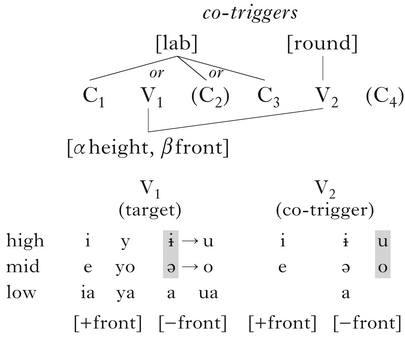
Laal is characterised by a complex anticipatory rounding harmony, which applies under very restrictive conditions. First, it is parasitic: the trigger and target vowels need to be of the same height (the ‘αheight’ condition) and frontness (the ‘βfront’ condition). Second, it is particularly unusual in requiring two triggers: a round vowel can round a preceding vowel only with the help of a labial consonant. Interestingly, the round vowel and the labial consonant – the two co-triggers – may be on either side of the target, as in (2a), or on the same side, as in (2b, c). This harmony is restricted to certain specific morphological contexts, discussed in §2.4.
-
(2)
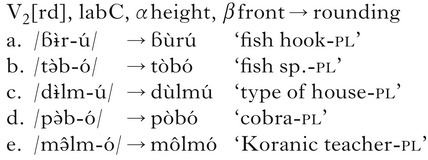
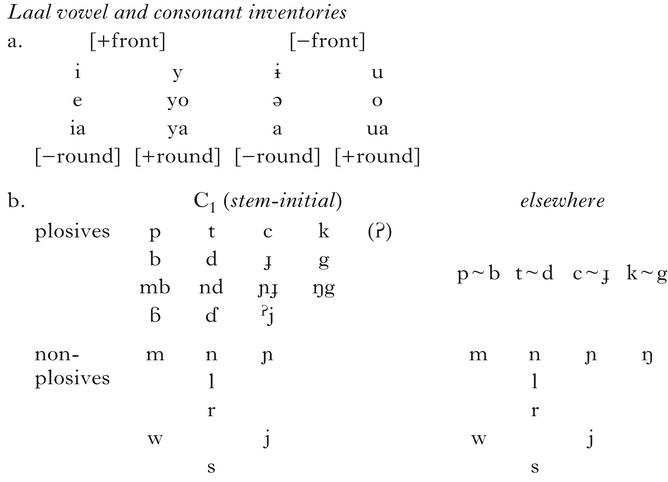
As can be seen in (3a), Laal has twelve phonemic vowels, characterised by three degrees of aperture and an opposition between [+front] and [−front] vowels, coupled with a rounding contrast among both [+front] and [−front] vowels.Footnote 3
-
(3)
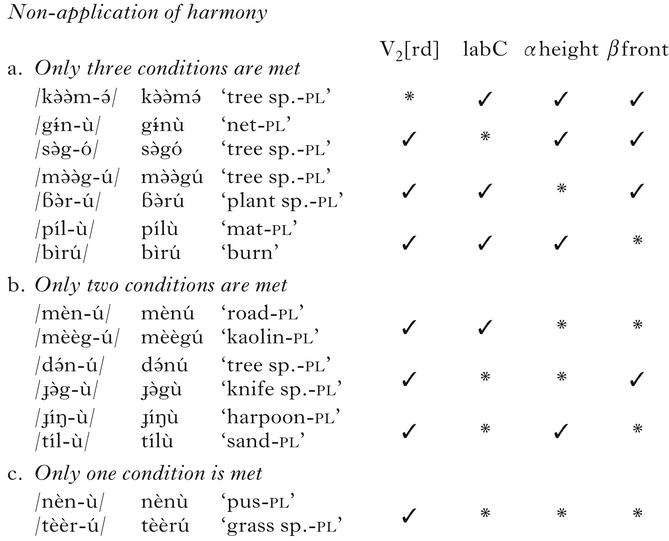
The examples in (4) show that all four conditions (the two triggers V2[rd] and labC, and the two additional conditions αheight and βfront) must be met in order for rounding to occur. If any one of the four conditions is missing, as in (4a), harmony fails to apply. The examples in (b, c) show that, as expected, harmony also does not apply when more than one condition is missing.
-
(4)
Additionally, the teamwork effect is necessarily driven by the association of a labial consonant and a round vowel. Two labial consonants may not team up to co-trigger rounding, as shown in (5).Footnote 4
-
(5)

General phonotactic restrictions limit the number of potential triggers and targets of the harmony. First, since words in Laal are maximally disyllabic,Footnote 5 it is impossible to derive forms that would show harmony across more than one syllable. The harmony thus involves only one target, the stem-initial vowel V1 (there are no prefixes in Laal). The trigger is always V2, and may be part of a disyllabic stem or a suffix, as in the examples in (2).
Furthermore, the full vowel inventory in (3a) is only attested in the stem-initial syllable (V1). In V2 position, only seven of the twelve vowels are attested: the three front round vowels /y yo ya/, and the two low peripheral vowels /ia ua/ are never found there.Footnote 6 The only triggers of the harmony are thus /u/ and /o/ – the only two [+round] vowels attested in V2 – each of which, by virtue of the αheight and βfront conditions, can only target one vowel: V2 /u/ rounds V1 /ɨ/ to [u], while V2 /o/ rounds V1 /ə/ to [o]. The properties of the doubly triggered rounding harmony are summarised in (6).
-
(6)
2.2 A note on vowel harmony
The underlying forms in the examples seen so far are those resulting from application of all other phonological processes, in particular vowel raising or lowering resulting from other vowel harmonies. A brief note on these harmonies is in order at this point, to make the data presented in the remainder of this section easier to read. No fewer than four harmony processes are attested in Laal. In additional to the doubly triggered rounding harmony, a simpler rounding harmony also exists (cf. §2.5), as well as two height harmonies: perseverative [+high] harmony and anticipatory [±low] harmony, illustrated in (7).
-
(7)

In what follows, the underived form of each example will be given alongside the intermediate and final derived forms.
2.3 The blocking effect of intervening /w/
The only nine (regular) exceptions to the doubly triggered rounding harmony are listed in (8a) and (b), and illustrate another intriguing property of the harmony: the blocking effect of /w/ when it intervenes between V1 and V2.
-
(8)
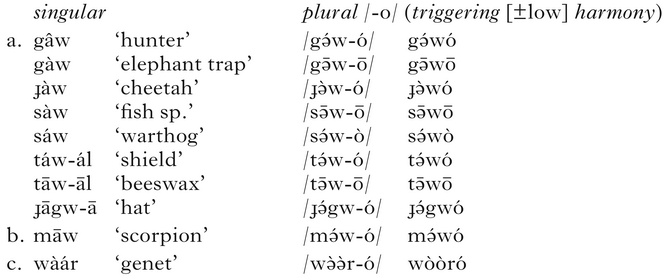
Not only does an intervening /w/ not co-trigger the harmony (a), it blocks it, as clearly shown by [məwó] in (b), where word-initial /m/ fails to act as a co-trigger. Word-initial /w/, on the other hand, co-triggers the harmony like any other labial consonant, as shown in (c).Footnote 7 This blocking effect of intervening /w/ is rooted in an exceptionless phonotactic constraint that bans sequences of a round vowel followed by /w/ (with an optional intervening consonant): *U(C)w. This constraint is exceptionless, both in the lexicon and in morphologically derived environments (cf. (14) below).
2.4 Morphological conditioning
The harmony is only actively enforced between roots and number-marking suffixes (other types of suffixes and their effects will be presented in §2.5). Laal has 29 number-marking suffixes (10 singular, 19 plural), which combine arbitrarily with a restricted set of nouns and verbs. Out of 1150 monomorphemic nouns in my corpus, 384 combine with at least one such suffix. The most frequent (/-u/) is attested with 73 nouns, while eleven of these suffixes are attested with fewer than five nouns each. Additionally, some of these suffixes are used to derive either the plural or the singular subject form of 38 intransitive verbs, e.g. /ɲún/ ‘go (sg subj)’ vs. /ɲún-ì/ ‘go (pl subj)’.
Four number-marking suffixes contain a round vowel (henceforth ‘round suffixes’): the three plural suffixes /-u/ (73 occurrences), /-o/ (46) and /-or/ ~ /-ur/ (14), and the singular suffix /-o/ (7). /-or/ ~ /-ur/ varies between a mid and a high realisation, subject to [+high] harmony (cf. (7a) above). All three occur only on nouns in my corpus. The doubly triggered rounding harmony is thus attested as an active process only with nouns, although this is most probably accidental.
140 of the 1150 monomorphemic nouns in the lexicon are compatible with one of the four round suffixes above. Of these 140 nouns, 89 have an underlying non-round V1. 34 of these meet the conditions for doubly triggered rounding harmony, i.e. their plural form has both a labial consonant (C1, C2 and/or C3) and two vowels of identical height and frontness. These nouns obey doubly triggered rounding harmony, with only the nine (regular) exceptions with intervening /w/ in (8) above. This leaves 25 attested cases of active doubly triggered rounding harmony, some of which are given in (9a) and (b, c), where V1 and V2 are both high and both mid respectively.Footnote 8
-
(9)
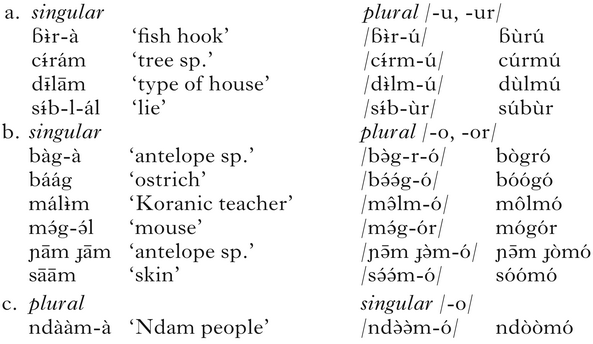
A few nouns have more than one possible plural form. Interestingly, two such nouns, shown in (10), have two round suffixes, and contain a labial consonant. As expected, rounding harmony applies only when both vowels are of the same height before application of the harmony, i.e. with /-ó/, but not with /-ú/.
-
(10)

The limited productivity of doubly triggered rounding harmony is due to the limited productivity of the number-marking suffixes, which seem to be in the process of becoming lexicalised. In this respect, it is not different from other morphophonological alternations that phonologists regularly choose to model. However, number-marking morphology cannot be said to be entirely fossilised, since plural suffixes (including the round suffixes /-ó/ and /-ú/) sometimes occur with more or less recent loanwords, as shown in (11). Note that the first two examples illustrate the application of doubly triggered rounding harmony to words of foreign origin. Loanwords from Bagirmi and Arabic are most probably not older than 200 to 300 years, and French loanwords are definitely less than a century old.
-
(11)

The doubly triggered rounding harmony is also a morpheme structure constraint: there is no word in the lexicon that does not conform to its requirements. Words like [gōbə̄r] ‘cloud’ and [gúmlí̵l] ‘round’ further show that the harmony is strictly anticipatory.
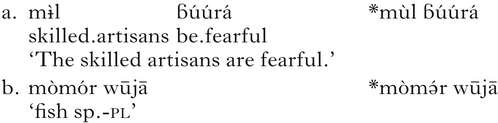
Finally, both the harmony and the *U(C)w phonotactic constraint apply only within words, and never across a word boundary, as shown in (12).
-
(12)
2.5 A phonological alternation
There is evidence that the doubly triggered rounding harmony described above is a phonological process, rather than a superficial phonetic effect. Firstly, the harmony is exceptionless: it applies systematically whenever the conditions are met. The only exceptions are entirely regular, and result from an independent phonotactic restriction, *U(C)w. Furthermore, it is not sensitive to speech rate: when asked to speak slowly, or even to mark a pause between the two syllables of a word where the harmony should apply, speakers never ‘undo’ the harmony.
The most solid argument in favour of the phonological status of the harmony is its morphological conditioning: it applies as a morpheme structure constraint, and between roots and number-marking suffixes. With pronominal suffixes, on the other hand, anticipatory rounding harmony is systematic and unconditional, as illustrated in (13a) with the object suffixes /-nǔ/ ‘us (excl)’ and /-ò(n)/ ‘her’ (subject to [+high] harmony; cf. (7a) above). (13b) shows segmentally similar examples illustrating doubly triggered harmony. As can be seen, the conditions for doubly triggered harmony (labC, αheight and βfront) are irrelevant to the simple harmony.
-
(13)

Simple rounding harmony also fails to apply in contexts where it would violate *U(C)w, as seen in (14).
-
(14)

The two rounding harmonies are thus specific to two exclusive sets of morphological environments. Given the requirement that words be maximally disyllabic in Laal, the segmental domain of application of both harmonies is exactly the same. For all of the above reasons, we can safely conclude that the doubly triggered rounding harmony is a phonological process, and whatever drives it should consequently be accounted for in phonology.
In conclusion, the doubly triggered rounding harmony of Laal is a phonological process that has no irregular exceptions: it systematically applies whenever the conditions summarised in (15) below are met.
-
(15)

3 Subfeatural distinctions in phonology
On the basis of acoustic measurements to be presented in §4, I argue that the coarticulatory effect of labial consonants on [ɨ ə] in Laal is such that labialised [ɨB əB] constitute a separate category, perceptually distinct, but identical to [ɨ ə] in terms of contrastive features. (The abbreviations and codes used throughout the paper are given in Table I.Footnote 10 ) I also argue that this perceptual distinction allows [ɨB əB] to form a natural class, targeted by doubly triggered rounding harmony to the exclusion of [ɨ ə]. I propose a new type of phonological representations to represent the perceptual distinction between these two categories: subfeatures.
Abbreviations and codes used in the paper.

3.1 Subfeatural representations: the basics
The featural system I propose is a two-tiered system: contrastive featural categories are subdivided into non-contrastive, perceptually distinct subfeatural categories arising from coarticulatory effects. This proposal is in keeping with the idea, supported by a growing body of evidence, that contrastiveness, i.e. unpredictable phonological distribution, and perceptual distinctiveness are independent criteria (Hall Reference Hall2013, Kiparsky Reference Kiparsky2013 and references therein).
The subfeatural level of representation, scalar in nature, captures differences in perceptual distinctiveness resulting from coarticulation. The featural [±round] contrast may thus coexist with a multi-level subfeatural rounding scale, as separate (but substantively related) representations of the lip-rounding continuum.Footnote 11
By convention, contrastive categories correspond to full subfeatural values, i.e. [−F] and [+F] entail 〚0F〛 and 〚1F〛 respectively, unless coarticulation applies (subfeatures are given in double square brackets). On the subfeatural scale, coarticulatorily driven subphonemic distinctions may be encoded whenever relevant, with intermediate subfeatural values x (0 < x < 1). For example in Laal, the perceptual rounding scale, corresponding at the contrastive level to the binary feature [+round] vs. [−round], can be represented as a continuum between 〚0round〛 and 〚1round〛. [+round] vowels are 〚1round〛, [−round] are 〚0round〛, unless they are labialised, in which case they are 〚xround〛. The [−round] category is thus subdivided into two subfeatural categories: 〚0round〛 ([i e ia ɨ ə a], which are not rounded at all, and 〚xround〛 ([ɨB əB], which have some proportion x of the phonetic properties that characterise fully round vowels. In other words, labial coarticulation increases 〚0round〛 to 〚xround〛. The subfeatural value 〚xround〛 represents the consequences of labial coarticulation on the realisation and perception of the feature [−round]. Subfeatures are thus determined on the basis of both phonetic factors and phonological representations.
Crucially, labialised [ɨB] and [əB] are featurally [−round], but subfeaturally 〚xround〛. This explains why they behave like their non-labialised counterparts with respect to the simple rounding harmony, which refers to binary features only, and how they can also be seen as a distinct category by doubly triggered rounding harmony, which is sensitive to subfeatural distinctions, as illustrated in Fig. 1.
Targets of the doubly triggered and simple rounding harmonies.

3.2 Calculating subfeatural values: the Coarticulation function
Coarticulatory triggers have the property of assigning to their target a proportion of increase (or decrease) in the value of the affected subfeature 〚F〛 incurred by the coarticulatory effect of the trigger onto the target. I will call this proportion a coarticulatory coefficient, and represent it as p Trigger→Target,〚F〛, or simply p. The resulting intermediate subfeatural value x of the target segment is obtained through the application of a Coarticulation function C, defined in (16), and schematised in (18) below.
-
(16)
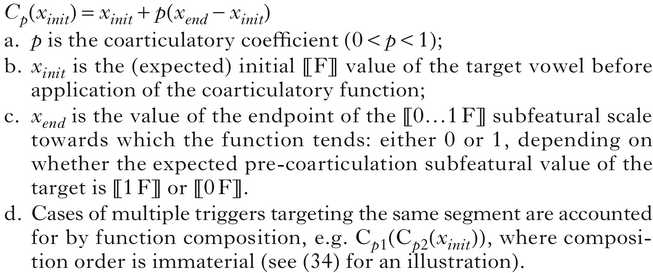
Note that the Cp function can be either additive or subtractive, depending on which endpoint of the 〚0…1F〛 scale the function starts from, and which one it tends toward. If, as in Laal, the pre-coarticulation subfeatural value of the target corresponds to the lower endpoint 〚0F〛, the function is additive: the amount of increase incurred by the target (assuming that there is only one trigger) is +p(xend − xinit ) = +p(1 − 0) = +p. The 〚0F〛 value of the target segment is thus increased to 〚p F〛. If, on the other hand, xinit corresponds to the full value 〚1F〛, the function is subtractive: the amount of decrease is +p(xend − xinit ) = +p(0 − 1) = −p, i.e. the target segment's initial 〚1F〛 value is lowered to 〚(1 − p)F〛.Footnote 12
The value of the binary feature that a given intermediate subfeatural value x is associated with thus depends on the initial subfeatural value of the target and the ‘direction’ of the coarticulation function. If the function is additive (i.e. property-increasing), 〚xF〛 corresponds to [−F], like the value 〚0F〛 from which it derives; if the function is subtractive (i.e. property-decreasing), 〚xF〛 corresponds to [+F], like the value 〚1F〛 from which it is derived. The only two subfeatural values that are always associated with the same featural value are 〚0F〛, which systematically corresponds to [−F], and 〚1F〛, which can only correspond to [+F]. Conversely, [+F] and [−F] can in theory correspond to any subfeatural value between 0 and 1 except 1 and 0 respectively ([−F] ↔ 〚xF〛 with 0 ≤ x < 1; [+F] ↔ 〚xF〛 with 0 < x ≤ 1). This is schematised in (17).
-
(17)
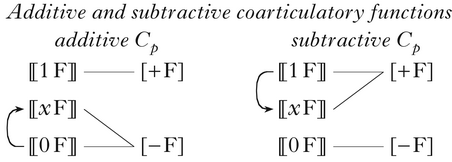
Doubly triggered rounding harmony targets vowels whose increased subfeatural 〚xround〛 value is the result of the application of the additive coarticulatory function schematised in (18).Footnote 13
-
(18)
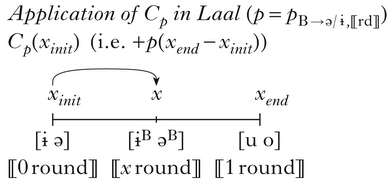
The value of p depends on the properties of each of the segments involved and the perceptual correlate of their coarticulation. Additionally, the Cp function needs to be relativised to context, e.g. interspeaker differences, distance between the target and the trigger, relative position of trigger and target, etc. (cf. Lionnet Reference Lionnet2016). Each trigger–target interaction in each of the relevant contexts is likely to yield a different subfeatural value (e.g. [ɨB] / B __ ≠ [ɨB] / __ B ≠ [əB] / B __, etc.). In the interest of a clear presentation of the theory, I tentatively consider [ɨB] and [əB] to be 〚xround〛, for all speakers, irrespective of the specific environment. This simplified analysis will be refined in §4.4.3, after the presentation of the phonetic data in §4.1 to §4.3.
3.3 Illustrative analysis: Laal doubly triggered rounding harmony
With the analysis sketched in §3.1 above, doubly triggered rounding harmony can be reduced to a case of rounding harmony parasitic on height and backness, targeting only vowels that are at least 〚xround〛. Any theory of parasitic vowel harmony will presumably account for the Laal harmony if it can refer to subfeatures, whether it utilises feature spreading (e.g. Padgett Reference Padgett1997, Jurgec Reference Jurgec2011, Reference Jurgec2013), feature alignment (Kirchner Reference Kirchner1993, Smolensky Reference Smolensky1993, Kaun Reference Kaun1995), feature agreement or no-disagreement constraints (Baković Reference Bakovi«2000, Pulleyblank Reference Pulleyblank2002), Agreement by Correspondence (Hansson Reference Hansson2001, Reference Hansson2010, Rose & Walker Reference Rose and Walker2004) or Wayment's (Reference Wayment2009) Attraction Framework.
The goal of this section is not to argue in favour of one specific theory of vowel harmony, but simply to illustrate how one such theory may easily account for the Laal harmony by simply including subfeatural representations. The illustrative analysis I propose uses Hansson's (Reference Hansson2014) Agreement by Projection theory, a revision of Agreement by Correspondence, couched in Optimality Theory (Prince & Smolensky Reference Prince and Smolensky1993).Footnote 14
First, independently of the harmony pattern, I propose that subfeatural distinctions be enforced by the phonological grammar, through high-ranked markedness constraints. The default 〚0round〛 ↔ [−round] and 〚1round〛 ↔ [+round] associations are enforced through the constraints defined in (19a, b), while labial coarticulation is enforced by the constraint in (c).
-
(19)
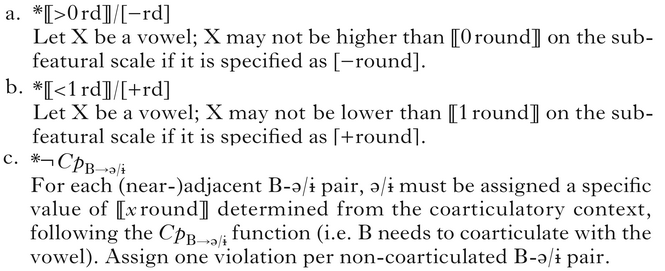
Constraints like (19c), penalising the non-application of the coarticulatory function, must be ranked higher than the two constraints in (a) and (b) if coarticulation-driven subfeatural values are to be assigned, as shown in the tableaux in (20). In this specific case, the coarticulation function being additive, (19c) need only be ranked higher than (19a), which is the only one that is violated if Cp B→ə/ɨ applies.
-
(20)
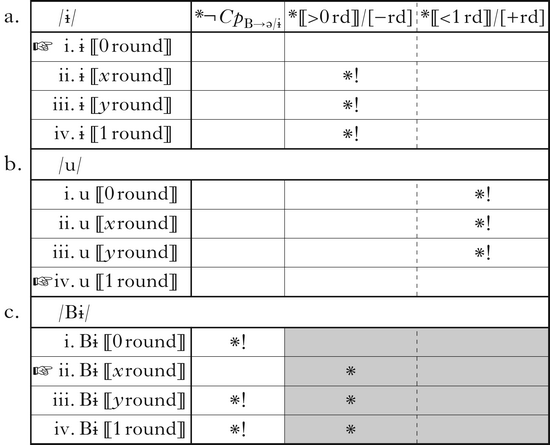
As seen in (20), the constraints pick only one of all the possible subfeatural values between 0 and 1 for each input: default 0 or 1 when there is no coarticulation (20a, b), x (and not y ≠ x, or any other intermediate value) when B-ɨ/e coarticulation is involved (c). To keep tableaux simple and legible, these three constraints will from now on be conflated into the placeholder constraint Subfeature (Subf).
I now turn to the analysis of the harmony pattern, using Hansson's (Reference Hansson2014) revision of Agreement by Correspondence (ABC). ABC is a theory of similarity-based segmental interaction that was initially developed for long-distance consonant agreement (Walker Reference Walker1998, Reference Walker2000, Reference Walker, Kirchner, Pater and Wikeley2001, Hansson Reference Hansson2001, Reference Hansson2010, Rose & Walker Reference Rose and Walker2004). It has since been extended to vowel harmony (Sasa Reference Sasa2009, Walker Reference Walker2009, Rhodes Reference Rhodes2012), long-distance consonant dissimilation (Bennett Reference Bennett2013, Reference Bennett2015) and local effects of assimilation and dissimilation (Shih Reference Shih2013, Inkelas & Shih Reference Inkelas and Shih2014, Shih & Inkelas Reference Shih, Inkelas, Kingston, Moore-Cantwell, Pater and Staubs2014, Sylak-Glassman Reference Sylak-Glassman2014).
What makes ABC particularly suited to parasitic vowel harmony is its central insight that (dis)harmony is driven by similarity threshold effects. Harmony between segments is viewed as agreement between segments in a correspondence relationship based on phonological similarity. This surface correspondence is unstable (Inkelas & Shih Reference Inkelas and Shih2014): two (or more) segments are sufficiently similar to interact (they are in correspondence), but are too uncomfortably similar to coexist within a certain distance. Two repairs are possible: harmony (more similarity) and disharmony (less similarity).
The basic mechanics of ABC theory involve two types of output–output correspondence constraints: Corr-XX establishes surface correspondence between segments X similar in a particular (set of) feature(s), while Ident-XX[F] enforces agreement in the feature [F] between segments in the correspondence set defined by Corr-XX. Both types of constraints are ranked higher than the constraints enforcing faithfulness to the assimilating feature. Based on a diagnosis of pathological properties of the division of labour between Ident-XX[F] and Corr-XX, Hansson (Reference Hansson2014) proposes to conflate the work of both constraints into a single ‘projection-based’ markedness constraint, defined in (21).
-
(21)

I adopt Hansson's (Reference Hansson2014) projection-based constraints here, simply allowing them to refer to subfeatures as well as binary features. The constraint that drives the doubly triggered rounding harmony is given in (22). In order to account for the threshold effect, I propose that projection-based constraints refer to ranges of subfeatural values rather than single values.
-
(22)
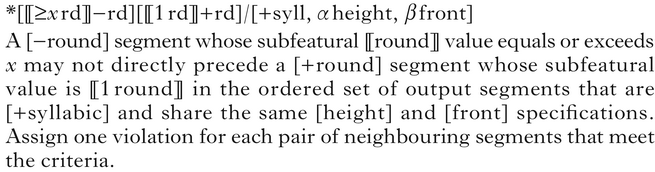
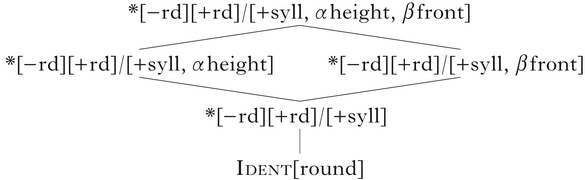
The constraint in (22) (henceforth *〚≥xrd〛〚1rd〛/[+syll, αheight, βfront]) drives the harmony by establishing the threshold of subphonemic rounding beyond which a labialised [əB] or [ɨB] is targeted by the harmony at 〚xround〛. This constraint stands in a markedness hierarchy that mirrors the featural similarity scale in Table II, where the similarity levels are ordered on the basis of how much they restrict the number of potential targets; the highest level of similarity is the most restrictive.Footnote 15
Similarity between round and non-round vowels in Laal: tentative scale.

Each level of similarity in the scale could in theory be the threshold involved in a rounding-harmony process. Consequently, the similarity scale translates into a markedness-constraint hierarchy, shown in (23), in which the constraint defined in (22) is ranked highest.Footnote 16
-
(23)
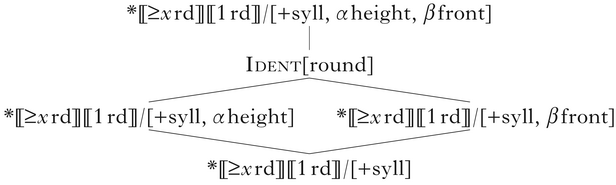
In doubly triggered rounding harmony, the similarity threshold at work is the highest level on the scale; Ident[round] must therefore be ranked right below the highest markedness constraint *〚≥xrd〛〚1rd〛/[+syll, αheight, βfront], but crucially higher than all the other constraints in the hierarchy, as shown in tableaux (24) and (25).
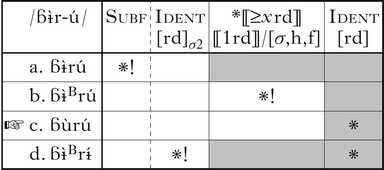
Undominated Subf ensures that (24a) /ɓì̵r-ú/ and (24b) /ɓə̀r-ú/ do not surface with a V1 that is not at least 〚xround〛, since in both forms V1 is adjacent to a labial consonant: candidates (a.i) and (b.i) are thus always suboptimal. Candidate (a.ii), [ɓì̵Brú], violates *〚≥xrd〛 〚1rd〛/[+syll, αheight, βfront]. The fact that this constraint is ranked higher than Ident[round] favours candidate (a.iii), [ɓùrú], in which rounding harmony has applied, repairing the marked structure. On the other hand, candidate (b.ii), [ɓə̀Brú], does not violate this constraint: it only violates constraints that are lower on the markedness hierarchy,
-
(24)
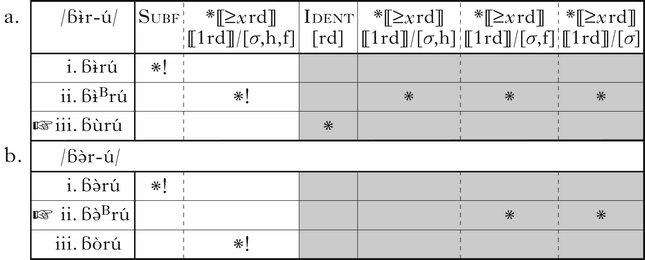
and crucially ranked lower than Ident[round], which makes it the optimal output.
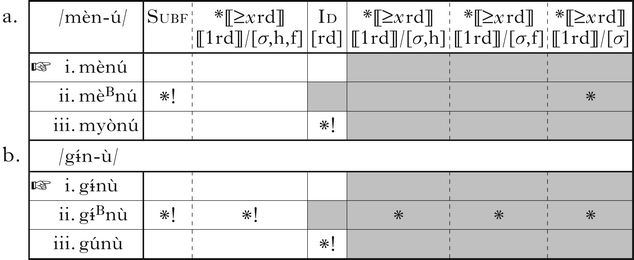
Finally, given the inputs /mèn-ú/ and /gí̵n-ù/ in (25), Subf strikes candidates (a.ii), [mèBnú], and (b.ii), [gí̵Bnù], where labial coarticulation has overapplied ([e] is not a coarticulatory target, and [g n] are not labialisation triggers), leaving only (a.i), [mènú], and (b.i), [gí̵nù], as the optimal outputs. Indeed, the violation of Ident[round] incurred by rounding V1 in candidates (a.iii), [myònú], and (b.iii), [gúnù], is not compensated by satisfying a higher constraint: there is no marked structure to repair.
-
(25)
To complete the analysis, two undominated constraints need to be added. The first one is a positional faithfulness constraint (Beckman Reference Beckman1999), Ident[round]σ2, which accounts for the fact that unrounding of V2 is not a possible repair, as shown by candidate (26d). Note that the directionality of the harmony is accounted for by the combination of this positional faithfulness constraint and the markedness constraint penalising *〚≥xrd〛〚1rd〛/[+syll, αheight, βfront] (which can only correspond to a [−round][+round], not a [+round][−round], sequence): if the [+round] feature of V2 cannot be changed, then only anticipatory rounding will fix the marked 〚≥xround〛〚1round〛 sequence.
-
(26)
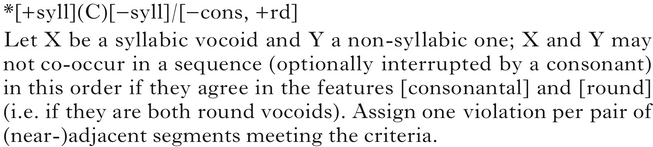
Additionally, we need a projection-based markedness constraint accounting for the opacity of intervening /w/, defined in (27).
-
(27)
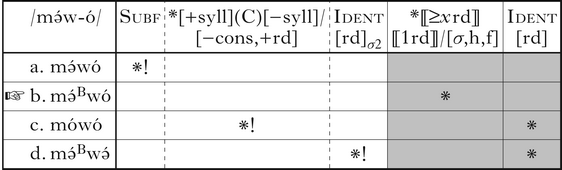
This is illustrated in (28).
-
(28)
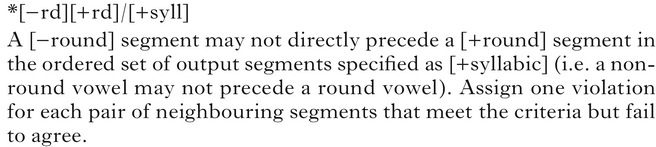
Finally, simple rounding harmony, which belongs to a separate, morphologically specific subgrammar, is driven by a projection-based constraint referring only to binary features, defined in (29).
-
(29)
This constraint also stands in a markedness hierarchy, mirroring the similarity scale in Table II. In this case, however, Ident[round] is ranked below the lowest constraint of the hierarchy, i.e. the threshold for rounding is at the lowest possible point, as shown in (30).Footnote 17
-
(30)
This is illustrated in (31).
-
(31)
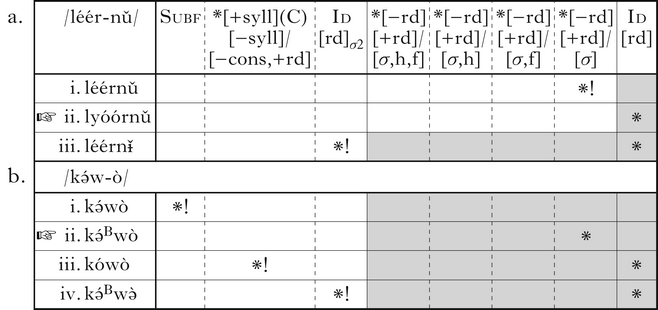
The analysis presented above is one of many possible, and illustrates one of the advantages of the subfeatural representations proposed in this paper: extending the domain of application of existing theories of vowel harmony (and more generally assimilation) to complex multiple-trigger cases involving subphonemic teamwork.
3.4 The nature of subfeatures
3.4.1 A representation of phonetic knowledge
The theory proposed here crucially rests on the assumption that phonology has access to language-specific phonetic knowledge (Kingston & Diehl Reference Kingston and Diehl1994), i.e. ‘the speakers’ partial understanding of the physical conditions under which speech is produced and perceived’ (Hayes & Steriade Reference Hayes and Steriade2004: 1). This is true of most phonetically grounded approaches to phonology, notably Steriade's (Reference Steriade, Hanson and Inkelas2009) P-map and similar licensing-by-cue approaches. Subfeatures are actually a reification of this knowledge: 〚xround〛 represents the knowledge that Laal speakers have of the labial coarticulation affecting [ɨ] and [ə], and its perceptual correlate.
Importantly, phonetic knowledge is abstract, and subfeatures accordingly represent abstract categories. They are discretised, scalar representations of phonologised coarticulation, not representations of actual acoustic/perceptual information. Like tone, they are contextually determined, and capture relative levels rather than absolute values: 〚xround〛 is not an absolute F2 value, but an indication that labialised [əB] and [ɨB] have x% of the phonetic property or properties that distinguish [o] and [u] from [ə] and [ɨ] respectively.
Evidence of the abstract nature of subfeatures comes from the fact that a word like /ɓì̵r-ú/ is always realised as [ɓùrú], never [ɓì̵Brú]. This is a problem if the optimal output [ɓùrú] is derived through phonotactic ‘repair’ of the marked structure [ɓì̵Brú], which is what I propose to do. Where is the form [ɓì̵Brú] to be found if it is neither in the underlying representation nor in the uttered/perceived surface form? The answer is that the form [ɓì̵Brú] is the predicted realisation of /ɓì̵r-ú/, a prediction based on the speakers’ knowledge of the coarticulatory effect of labial consonants on a neighbouring [ɨ]. Indeed, 〚xround〛 [ɨB] does exist in articulation and perception, e.g. in words like /ɓì̵r-à/ ‘fish hook’ and /pí̵r/ ‘catch’, where the initial vowel is always realised and perceived as 〚xround〛 [ɨB], as we will see in §4. Based on this phonetic experience, Laal speakers are able to determine that labial consonants increase the round subfeatural value of a neighbouring non-low central vowel by the coarticulatory coefficient p, and can therefore predict that, if the sequence [ɨB…u] were not unlawful, /ɓì̵r-ú/ would be realised with a 〚xround〛 [ɨB], as in [ɓì̵Brà] and [pí̵Br]. It is this purely abstract, predicted phonetic realisation [ɓì̵Brú] containing the marked structure 〚xround〛 … 〚1round〛 that the language strives to avoid, and that it ‘repairs’ by ‘rounding up’ the initial vowel.Footnote 18
This concept of a predicted (but never realised) phonetic realisation of the input, or ‘inferred input’, was first proposed by Steriade (Reference Steriade1997), and later developed by Jun (Reference Jun2002), as well as Gallagher (Reference Gallagher2007) and Flemming (Reference Flemming2008) under the label ‘realised input’. The major difference in comparison with subfeatural representations is that only inputs are subject to pre-phonological phonetic interpretation in Flemming's system. It is this realised input that is then fed to the phonotactic constraint grammar. The necessity to include phonetic information in the input comes from the fact that in Flemming's approach (inspired by Steriade's Reference Steriade, Hume and Johnson2001, Reference Steriade, Hanson and Inkelas2009 licensing by cue), phonetically grounded processes are driven by the degree of faithfulness of the output to this phonetic information. No such mechanism is needed in the theory I propose here, which is crucially driven by markedness constraints rather than faithfulness: the input is pre-phonetic, and the predicted phonetic realisation is enforced by high-ranked coarticulatory constraints belonging to phonetic knowledge.Footnote 19
3.4.2 Subfeatures as emergent categories
Another assumption underlying the theory is that subfeatural representations are, like contrastive features, emergent (Boersma Reference Boersma1998, Mielke Reference Mielke2008), i.e. they are generalisations that emerge from sound patterns. This assumption answers two major questions posed by subfeatural representations: the origin of subfeatures, and the limits on their values. If subfeatures are emergent, one expects to see them used in phonology only to distinguish categories that are perceptually distinct. In other words, the limits on human articulation and perception act as a stringent limiter on the possible types and number of subfeatures, as well as the values they may have.
3.5 Enforcing and manipulating subfeatures in a constraint grammar
A crucial property of subfeatures illustrated by the analysis proposed above is that, in an OT grammar, they are not protected by faithfulness. Indeed, a faithfulness constraint referring to a subfeature, if ranked sufficiently high, would make this subfeature contrastive, contrary to the key intuition that subfeatures encode non-contrastive categories. The nature of subfeatures thus makes them invisible to faithfulness. I assume that this is because subfeatures are not present in the input.
Additionally, it is necessary to rank the markedness constraints responsible for assigning subfeatures very high in order for subfeatural distinctions to play a role in the phonological grammar. If coarticulatory effects can be seen by phonology, the markedness constraints responsible for enforcing coarticulation-driven subfeatural distinctions cannot be ranked below other constraints whose effects would undo coarticulation. An interesting consequence of the high ranking of such constraints is that they constitute the only part of the constraint grammar that can manipulate subfeatures, i.e. be satisfied by a subfeature being added to or removed from the input. All other constraints referring to subfeatures (e.g. *〚≥xrd〛〚1rd〛/[αheight, βfront] in (22) above) can in theory be satisfied by manipulating either subfeatures or binary features, but only the latter will ever be optimal, since any subfeatural change will be filtered out by the high-ranked constraints enforcing coarticulation. Subfeatural values can thus only be modified indirectly, by changing the (substantively related) featural content of the input, e.g. changing [−round] into [+round] necessarily entails a change from 〚0round〛 or 〚xround〛 to 〚1round〛. In other words, the undesirable effects of coarticulation can only be undone by modifying the phonological environment responsible for it, not by simply modifying the subfeatural values that are a representation of those effects. In that sense, subfeatures are subordinate to classical binary features.Footnote 20
3.6 The architecture of the phonological grammar
Subfeatures constitute a representation of segments in context, i.e. a representation of the phonetic knowledge of how segments interact when put together. This abstract knowledge exists alongside phonology, and is what phonology uses to predict the realisation of specific inputs. In cases where this predicted realisation violates a phonotactic constraint, a phonological operation must apply to change the coarticulatory context in order to ensure that the realisation of the output conforms to the phonotactics. The phonological grammar is thus organised in a feed-back/feed-forward loop (cf. Boersma Reference Boersma1998) that constitutes a fluid and dynamic model of the phonetics/phonology interface, where phonology and phonetic knowledge are not ordered, but parallel and interactive.
The next section presents instrumental evidence in support of subfeatural categories.
4 The phonetic underpinnings of the harmony
While the doubly triggered rounding harmony described above is, as far as I know, unique, its phonetic basis is unsurprising: labiality, rounding, height and backness are all factors that are known to contribute to the rounding of a vowel (Terbeek Reference Terbeek1977, Linker Reference Linker1982, Kaun Reference Kaun1995, Reference Kaun2004). In this section, I present instrumental evidence showing that a labial consonant affects the non-low central vowels [ɨ ə], by significantly lowering their F2. This supports the analysis of labialised [ɨB əB] as a separate category in Laal.
To test this, acoustic measurements were extracted from recordings made in Gori (one of the two Laal-speaking villages), Chad, in March 2014 and January 2015. Two native Laal speakers, both male, were recorded: Kalem Dakour (KD), in his late fifties, and his 27-year old son Adoum Kalem (AK). Both are also fluent in Lua, Ba and Chadian Arabic. KD also speaks intermediate French, while AK's command of that language is limited. The recorded sessions consisted mainly in word-lists, elicited in French.
The recordings were made using a Zoom H4n recorder set at a sample rate of 44.1 kHz and 16-bit sample size, and a mono Røde NTG2 condenser shotgun microphone. Vowel formants were extracted in Praat (Boersma & Weenink Reference Boersma and Weenink2014); the first three formants of the stem-initial vowel were automatically extracted from 546 tokens at the midpoint of the total vowel interval (defined manually), i.e. as far as possible from formant transitions. To better describe auditory frequency resolution, formant frequency values in Hz were converted into Equivalent Rectangular Bandwidth (ERB), using Moore & Glasberg's (Reference Moore and Glasberg1983) equation. Both Hz and ERB values are provided, but the statistics and vowel plots are all based on the latter.
Since the recording sessions could only take place in a relatively noisy environment, some recordings had to be excluded from the sample, due to excessive background noise. This explains why the words and number of tokens per word considered for each speaker are not always identical. However, the number of words and tokens overlap sufficiently to make the data presented here representative.
In the figures which follow, ellipses in vowel plots indicate two standard deviations. Statistical significance is assessed using a Welch two-sample two-sided t-test at the 5% significance level (p < 0.05). (See Table I above for the abbreviations and codes used in this section.)
Note that words where [ɨ ə] are adjacent to a palatal consonant (e.g. [cɨ əj], etc.) were excluded from the sample, because the contrast between front and back vowels is partially neutralised in this environment.
In the interests of space, I have excluded some of the acoustic measurements made for this study. First, I focus exclusively on short vowels. Additionally, the coarticulatory effect of [w] is ignored here, because the impossibility of clearly discriminating between the vowel and glide portions in /wV/ or /Vw/ sequences makes them likely to be less accurate. I also exclude all cases of multiple conditions, except ə / B __ B. See Lionnet (Reference Lionnet2016) for more details on these measurements.
4.1 Effects of the B condition
Acoustic measurements clearly show that a labial consonant has a very significant F2 lowering effect on (near-)adjacent [ə] and [ɨ].
4.1.1 Effect of the B condition on [ə]
The ə-words included in the sample for both speakers are summarised in Table III (the full list can be found in Table VI in Appendix B in the online supplementary materials). The total number of tokens within each condition includes repetitions, e.g. three separate productions of the word [p5d] ‘pass’ and one production of the word [mə̀l] ‘be straight’ constitute a total of four [Bə] tokens.
ə-words sample, B and U conditions (both speakers).

Figure 2 shows the mean F1, F2 and F3 values of stem-initial [ə] in each of the B and U conditions, for both speakers. As can be seen, the two B conditions appear to have a strong lowering effect on F2. The U condition also seems to lower F2 somewhat, but to a lesser extent. F1 and F3 appear to be unaffected.Footnote 21 In the remainder of this section, I will concentrate on the F2 lowering effect of the B and U conditions.
Effect of B and U conditions on [ə]: (a) speaker AK; (b) speaker KD.

Figure 3a shows the distribution of the F2 values of non-labialised [ə] vs. [ə] / B __ and [ə] / __ B in AK's speech. As can be seen from these figures and from Tables VIII and IX in Appendix B, a neighbouring labial consonant has a strong, consistent and highly statistically significant F2 lowering effect on [ə]: [ə] / B __ is on average 1.66 ERB (288 Hz) lower in F2 than [ə] (t(20) = −5.6, p = 9.96e−6), while [ə] / __ B is 1.42 ERB (250 Hz) lower (t(22.8) = 3.9, p = 7.79e−4). Since the lowering of F2 incurred by the B __ and __ B conditions is of similar magnitude, both can be collapsed into one single category: [əB], which in this case is on average 1.61 ERB (279 Hz) lower in F2 than [ə] (t(18) = 5.9, p = 1.54e−5). The overall F2 lowering effect is of a similar magnitude in KD's speech, as shown in Fig. 3b, the effect of a preceding B being stronger (ΔF2 = −1.76 ERB (−311 Hz), t(24.5) = −3.7, p = 0.001) than that of a following B (ΔF2 = −0.95 ERB (−181 Hz), t(19.9) = 2.1, p = 0.049). [əB] is on average 1.43 ERB (256 Hz) lower in F2 than [ə] (t(21.5) = 3.4, p = 0.003).
Effect of /B_ and /_B conditions on F2 of [ə]: (a) speaker AK; (b) speaker KD.

The vowel plots in Fig. 4 very clearly show that the distributions of [Bə] and [əB] mostly overlap, and that they are distinct from both [ə] and [o]: both [Bə] and [əB] (= [əB]) are exactly between [ə] and [o] in terms of F2.Footnote 22
[ə]/B_ and [ə]/_B plotted against [e], [ə] and [o]: (a) speaker AK; (b) speaker KD.

4.1.2 Effect of the B condition on [ɨ]
The coarticulatory effects on [ɨ] are congruent with, and stronger than, the effects on [ə], for both speakers, and across the two conditions B and U. The ɨ-words included in the sample are listed in Table VII in Appendix B, and summarised in Table IV.Footnote 23
ɨ-words sample, B and U conditions (both speakers).

Note that two of the above conditions (U in [gí̵nù] ‘nets’ and ɨCB in [lì̵gmà] ‘horses’) are attested in only one word each. Each one was recorded only once, from one speaker only (AK and KD respectively). I return to these two words below.
Figure 5 presents the mean F1, F2 and F3 values of stem-initial [ɨ] in both B __ and __ B environments, for both speakers. As in Fig. 4 for [ə], only F2 seems to be affected by a preceding or following labial consonant, and it is strongly affected, for both speakers.
Effect of B conditions on [ɨ]: (a) speaker AK; (b) speaker KD.

As shown in Fig. 6, the F2 lowering effect of the B condition on [ɨ] is drastic, and very highly significant for both speakers. In AK's speech, F2 is on average 2.25 ERB (407 Hz) lower in [ɨ] / B __ than [ɨ] (t(79.7) = −14.6, p = 2.20e−16), 2.20 ERB (396 Hz) lower in [ɨ] / __ B (t(87.7) = 12.5, p = 2.20e−16), and overall 2.22 ERB (402 Hz) lower for labialised [ɨB] than for [ɨ] (t(75) = 15.4, p = 2.20e−16). For KD, the findings are extremely similar: 1.96 ERB (343 Hz) lower in [ɨ] / B __ (t(59.9) = −8.6, p = 5.40−12), 1.42 (257 Hz) lower in [ɨ] / __ B (t(18.1) = 4.1, p = 6.67e−4), and 1.87 ERB (328 Hz) lower overall (t(56) = 8.5, p = 1.10e−11).
Effect of /B_ and /_B conditions on F2 of [ɨ]: (a) speaker AK; (b) speaker KD.

The vowel plots in Fig. 7 show that the B __ and __ B environments have virtually the same effect on a neighbouring [ɨ]. The distribution of labialised [ɨ] / B __ and [ɨ] / B (= [ɨB]) with respect to [ɨ] and [u] is similar to that of [ə] / B __ and [ə] / __ B (= [əB]) with respect to [ə] and [o]: [ɨ] and [ɨB] have virtually non-overlapping distributions, and [ɨB] seems to be exactly between [ɨ] and [u], for both speakers.
[ɨ]/B_ and [ɨ]/_B plotted against [i], [ɨ] and [u]: (a) speaker AK; (b) speaker KD.

As mentioned earlier, only one token illustrating the ɨCB condition could be included in the sample: the plural noun [lì̵gmà] (KD). With only one token, it is impossible to draw any generalisations. However, it is noteworthy that the mean F2 of [ɨ] in [lì̵gmà], 18.02 ERB (1407 Hz), is much closer to that of KD's [ɨ] / __ B (17.80 ERB/1378 Hz) than to that of non-labialised [ɨ] (19.22 ERB/1635 Hz), and the mean F2 difference between the [ɨ] in [lì̵gmà] and KD's non-labialised [ɨ] (ΔF2 = 1.20 ERB (227 Hz)) is very close to that between KD's [ɨ] and [ɨ] / __ B (ΔF2 = −1.42 (−257 Hz)).This suggests that the intervening non-labial consonant does not prevent labialisation of the preceding [ɨ].
4.2 Effect of the U condition
4.2.1 Effect of the U condition on [ə]
As previously noted, the charts in Fig. 2 show lowering of the mean F2 [ə] in the presence of a following round vowel for both speakers, although this lowering effect is less strong than that caused by either of the two B environments. For AK, [ə] / __ U is on average 0.57 ERB (110 Hz) lower than [ə] (Fig. 8a), and for KD 0.89 ERB (172 Hz) lower (Fig. 8b). However, this difference is not statistically significant, as shown in Appendix C (t(13.7) = 1.7, p = 0.12 for AK; t(18) = 2.0, p = 0.059 for KD).
Effect of U condition on F2 of [ə]: (a) speaker AK; (b) speaker KD.

This can be seen in the vowel plot in Fig. 9, where the centre of the [ə…U] ellipse is noticeably further right than that of the [ə] ellipse – indicating a substantive mean F2 difference – but the F2 range of [ə…U] is nearly entirely contained within that of the [ə] ellipse, contrary to that of the [əB] (= [Bə]+[əB]) ellipse, which clearly occupies an intermediate range between [ə] and [o].
[ə]/__…U plotted against [e], [ə], [əB] and [o]: (a) speaker AK; (b) speaker KD.

4.2.2 Effect of the U condition on [ɨ]
The effect of a following round vowel on [ɨ] cannot be tested convincingly, since only one word illustrating this condition is attested in the language: [gí̵nù], of which only one token, produced by AK, could be included in the sample. It is however interesting to note that the F2 value of the [ɨ] in [gí̵nù] (1696 Hz/19.56 ERB) does not show any sign of lowering. It is actually 0.07 ERB (8 Hz) higher than the mean F2 of AK's non-labialised [ɨ] (19.49 ERB/1688 Hz). This clearly contrasts with the extent of the effect of the B condition on [ɨ] (average F2 lowering of 2.22 ERB/402 Hz for AK; cf. Table VIII in Appendix C), and suggests that a round V2 has no more effect on a preceding [ɨ] than it does on a preceding [ə].
4.3 Cumulative effect
When more than one condition is met, the effect of each individual condition is cumulative. This can be illustrated with AK's short [ə] in the B __ B condition only. As can be seen in Fig. 10 and in Table VIII in Appendix C, the cumulative F2 lowering effect of two labial consonants (B __ B) on [ə], such as in [mə̀mlə̀l] ‘my grandchild’, is significantly greater than that of a single labial consonant. Indeed, [ə] / B __ B is 2.51 ERB (425 Hz) lower in F2 than [ə] (t(10) = 8.4, p = 7.72e−6), and 0.91 ERB (146 Hz) lower than that of short [əB] (t(0.7) = −4.1, p = 0.011).
Effect of B_B condition on F2 of [ə] (speaker AK).

4.4 Summary and discussion
4.4.1 Coarticulatory effect from the labial consonant only
In summary, we have seen that a labial consonant has a very significant F2-lowering effect on a neighbouring non-low central vowel. The average F2 difference between non-labialised [ɨ ə] and labialised [ɨB əB] for both speakers is between 181 Hz (0.95 ERB) and 407 Hz (2.25 ERB).
We can conclude that there is a clear phonetic distinction between non-labialised and labialised non-low central vowels. Although no perception experiment has been carried out yet to verify whether this strong acoustic difference is perceived as different by speakers, F2 differences of that magnitude are so likely to be perceptible that I feel comfortable hypothesising that they actually are.
We have also seen that the apparent (more limited) lowering effect of a following round vowel is not statistically significant. This seems to indicate that the role of the [round] V2 in the harmony is purely phonological, and the height-identity requirement between the trigger and target is likely due to a phonological similarity precondition on rounding harmony.
4.4.2 Cumulative coarticulation
Interestingly, the cumulative coarticulatory effect of B (cf. Fig. 10) is irrelevant to the harmony. Whether [ɨB əB] are subphonemically rounded by one labial or more strongly by two labials does not affect their status as targets: both are rounded in the presence of a following round vowel, and are unchanged otherwise. In other words, the threshold of subphonemic rounding is such that the effect of one labial consonant is enough to reach it.Footnote 24
4.4.3 Calculating p and x
The coarticulatory coefficient p B→ə/ɨ,〚rd〛 involved in the labialisation of [ə ɨ] can be calculated on the basis of the F2 measurements provided above. For example, assuming that the F2 values of [ə] (18.95 ERB) and [o] (14.31 ERB) correspond to the subfeatural values 〚0round〛 and 〚1round〛 respectively, the proportion of increase from 〚0round〛 [ə] to 〚xround〛 [əB] p B→ə,〚rd〛 in AK's speech can be calculated as the ratio between ΔF2 [əB]–[ə] and ΔF2 [o]–[ə], as shown in (32).
-
(32)

Table V provides the value of p for all trigger–target pairs (i.e. B→[ə] and B→[ɨ]), for both speakers.
Values for p B→ə,〚rd〛 and p B→əɨ,〚rd〛 for speakers AK and KD.

The subfeatural value of x for an 〚x round〛 vowel can then be determined by applying the C p function defined in (16) above, as shown in (33).
-
(33)
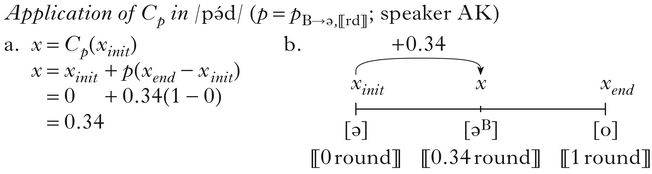
In other words, in AK's speech, a labial consonant increases the subfeatural 〚round〛 value of a (near-)adjacent [ə] by ≈34%, making labialised [əB] subfeaturally 〚0.34 round〛.
In a form like [mə̀mlə̀l], where the first [ə] is surrounded by two labial consonants, the same function applies twice (i.e. is composed with itself, cf. (16d)), as illustrated in (34).Footnote 25
-
(34)
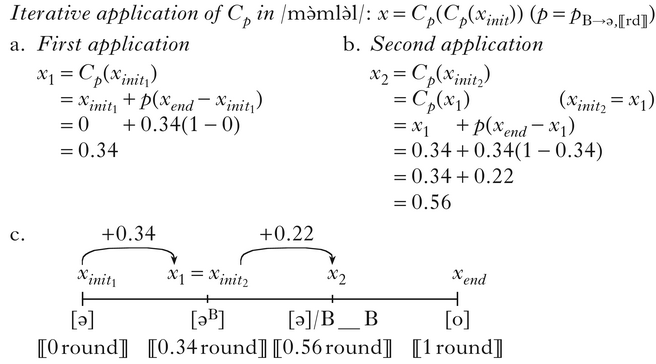
This prediction almost perfectly matches the observed F2 decrease incurred by two labial consonants on [ə] (cf. Table IX in Appendix C). Indeed, the observed F2 value of [ə] / B_B (16.44 ERB) corresponds to 54% of that of 〚0round〛 [ə] (18.95 ERB), given that 〚1round〛 [o] is 14.31 ERB. Compare this with the predicted 56% in (34b).
To refine the analysis developed in §3 above, there should be as many coarticulation-enforcing constraints (i.e. *¬Cp B→ə/ɨ,〚rd〛; cf. (19c)) as there are p Tr→Ta,〚rd〛 values. For example, for AK, we need both *¬Cp B→ə,〚rd〛, setting the proportion of 〚round〛 caused by B on [ə] at 34%, and *¬Cp B→ɨ,〚rd〛, setting the proportion of increase caused by B on [ɨ] at 47% (cf. Table III).
The threshold at work in doubly triggered rounding harmony can be defined as 〚≥0.34〛 for AK and 〚≥0.39〛 for KD (i.e. the lowest x-value obtained through B-ɨ/ə coarticulation). The constraint driving doubly triggered rounding harmony, defined in (22) above (as well as the other constraints in the markedness constraint hierarchy in (23)) can thus be redefined as (35).
-
(35)

As we have seen, every one of the constraints referring to subfeatures exists in as many variants as there are relevant coarticulatory contexts, i.e. as there are p and x values, and of course as many as there are speakers. In this way, the theory of subfeatural representations can easily accommodate interspeaker variation.
5 Alternatives using only binary features
As two anonymous referees noted, one could object that concluding that the difference between coarticulated and non-coarticulated [ɨ ə] is distinctive and relevant to phonological processes does not necessarily warrant proposing an entirely new set of representations. In this section, I develop two alternative analyses of the Laal pattern using only traditional binary (or privative) features, and show their weaknesses compared to the subfeatural account.
5.1 The [labial] approach
The first possibility is to represent the coarticulatory effect of labial consonants on neighbouring central vowels with the feature [labial]: labialised [ɨB əB] are both [−round] and [labial], and doubly triggered rounding harmony targets only [labial] vowels: V[labial] → [+round] / __ C(C)V[+round]. This supposes both that the CPlace feature [labial] and the VPlace feature [round] are phonologically different (as in VPlace theory; cf. Ní Chiosáin & Padgett Reference Ní Chiosáin and Padgett1993). This account is descriptively adequate: the feature [labial] plays exactly the same role as the 〚xround〛 subfeature advocated above, without adding any novel representations to the phonological machinery.
However, the distinction between [labial] and [round] vowels has five main problems, which are avoided in the subfeatural approach.
First, the fact that labial consonants and round vowels pattern together in the doubly triggered rounding harmony is exactly the kind of argument used elsewhere in favour of treating labial consonants and round vowels as carrying the same contrastive feature, as opposed to two substantively separate features [labial] and [round] (cf. Unified Feature Theory; Clements Reference Clements1989, Clements & Hume Reference Clements, Hume and Goldsmith1995; also Ní Chiosáin & Padgett Reference Ní Chiosáin and Padgett1993: 2).
More problematic is the fact that the [labial] account is more stipulative than the subfeatural one. Indeed, the CPlace feature [labial] seems to have properties that other binary or privative CPlace features do not have, and such properties must be stipulated. For example, it must be stipulated that [labial], despite being a CPlace feature, may be borne by a vowel.Footnote 26 Additionally, in order to maintain the non-structure-preserving nature of this allophony (i.e. [ɨ ə] and [ɨB əB] do not constitute contrastive phonemes), it also has to be stipulated that [labial] is non-contrastive for vowels, and never part of any vowel's underlying representation: it may only be assigned to a vowel through coarticulation (or spreading) from a neighbouring consonant. No such stipulation is necessary in the subfeatural approach, where 〚xround〛 is not specific to consonants, but substantively related to the VPlace feature [±round], and is, like any other subfeature, defined as non-contrastive and never present underlyingly.
The third problem posed by the [labial] approach is that there is no natural relation between the [round]–[labial] featural difference and the acoustic differences observed between the two categories of vowels. Indeed, while it seems natural for a vowel that has only 34% of what constitutes a fully round vowel (as in the case of AK's [əB] vs. [o]) to be characterised as 〚0.34 round〛, it is not clear why a [labial] vowel (let alone a labial consonant) should be realised with 34% of the phonetic correlate of the feature [round]. It is actually not entirely clear how a [labial] vowel should be realised.
Fourth, such a convenient split between two similar features – one vocalic, the other consonantal – is not available in all cases of teamwork. Cases that involve only vocalic triggers and targets, such as the Woleaian alternation illustrated in §1, could not be accounted for in the same way (cf. Lionnet Reference Lionnet2016: 105–111).
Finally, the [labial] account seems to be mostly based on convenience, rather than explanatory adequacy, and misses an important generalisation. What the acoustic measurements show in Laal is partial F2 lowering, which is not accounted for by the feature [labial] and the mostly artificial distinction between [labial] and [round].
5.2 The backness approach
Another possibility is to consider that the doubly triggered rounding harmony is actually better characterised as [+back] harmony. Indeed, front vowels do not take part in the harmony – which we have seen involves only [−front] vowels – and rounding and backness are systematically correlated among [−front] vowels: the central vowels are always [−round], and the back ones always [+round]. There is thus a confound: the doubly triggered harmony may be regarded either as rounding harmony or as [+back] harmony.
The advantage of choosing the latter option is that it leaves the feature [+round] available to account for the labial coarticulatory effect on [ɨ] and [ə]. Non-low central vowels [ɨ ə] would thus not be analysed as partially rounded to [ɨB əB] in the vicinity of a labial consonant, but as fully rounded to [ʉ ɵ]. All that is left to do is restrict the possible targets of [+back] harmony to [−front, +round] vowels with the same height specification as the trigger vowel: [ʉ ɵ] → [u o] / __ (CC)V[+back, αheight].
This analysis, which seems to render the use of subfeatures unnecessary, would be descriptively adequate if we focused only on the doubly triggered harmony. However, it has less explanatory power than the subfeatural account, and encounters numerous problems when the simple rounding harmony described in §2.5 is considered, which seriously undermines its validity.
Firstly, it mischaracterises the doubly triggered rounding harmony, by failing to capture its most interesting property: the substantive relation that exists between the activity of the two triggers. Indeed, both the alternation and the instrumental measurements indicate that the doubly triggered rounding harmony is a single process, involving only one property: rounding – not two separate properties and processes: rounding from the labial consonant, backing from the V2. In that sense, 〚xround〛 [ɨB əB] is a better transcription and analysis than [+round, −back] [ʉ ɵ], since it clearly indicates the degree and provenance of the partial rounding effect. The substantive relation between the partial coarticulatory effect of the labial co-trigger and the categorical effect of the round vowel is also very well represented in the two-tiered feature + subfeature system, whereas it is not at all represented in either the [labial] vs. [round] or [−back, +round] vs. [+back, +round] accounts.
But more importantly, by making the vowel inventory more complex, it severely mischaracterises simple rounding harmony as well, and unnecessarily complicates its analysis. As shown in (36), the recognition of a featural distinction between [ʉ ɵ] and [u o] requires a third feature to account for the now five-way horizontal distinction: [±front] and [±round] are no longer sufficient; [±back] is also necessary (compare the inventory in (3a) above).
-
(36)
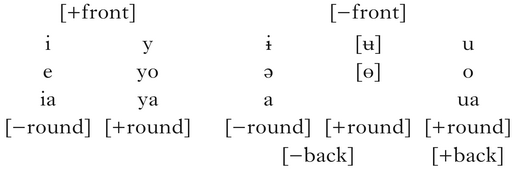
This complicates the analysis of the simple rounding harmony. If it is analysed as one single rounding harmony process, then [+front] vowels are rounded to [y yo a], as expected, but [−front] vowels are changed to central rounded vowels [ʉ ɵ ɞ].Footnote 27 For the latter to be realised as [u o ua], we would further need to change these vowels into [+back] [u o ua], either through a high-ranked constraint against central rounded vowels (in parallel OT), or with a late rule ensuring that [ʉ ɵ ɞ] are unconditionally changed to [+back] on the surface (in a rule-based account). However, this option is not available, since [ʉ ɵ] (= [ɨB əB]) are attested on the surface, as shown by the phonetic measurements in §4. They are not contrastive, but are definitely part of the inventory, as conditioned allophones of /ɨ ə/, which means that there cannot be a high-ranked constraint (or a late rule) banning them from surface representations.
A second option is to analyse the [ɨ ə a] → [u o ua] change as a case of [+back] harmony (similar to the one involved in the doubly triggered harmony, but without the height and frontness conditions). What appears to be a very simple case of rounding harmony is here divided into two unrelated processes, driven by two different rules or set(s) of constraints: rounding harmony among [+front] vowels, [+back] harmony among [−front] vowels, as illustrated in (37).
-
(37)
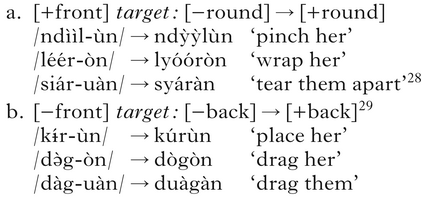
However, there is no evidence that (37a) and (37b) are distinct processes, and treating them separately goes against both the economy principle and the human instinct for pattern recognition.
In conclusion, the [labial] and [+back] accounts seem to be uninsightful and unnecessarily complicated solutions whose unique advantage is to avoid adding new representations to phonological theory. However, they only achieve this representational economy at the expense of grammatical simplicity and, more importantly, explanatory power. I contend that the new subfeatural representations proposed here offer a simpler and more explanatory account of the Laal data, a criterion I think should be ranked above representational economy in the design of a theory.
6 Conclusion
I have proposed in this paper that phonology should be enriched with subfeatural representations capturing non-contrastive but perceptually distinctive categories arising through coarticulation. Subfeatures are phonetically grounded scalar representations that are substantively related to binary features, in a two-tiered featural system. I have shown how successfully subfeatural representations account for the partial, cumulative effects that drive subphonemic teamwork, on the basis of a phonological and acoustic analysis of doubly triggered rounding harmony in Laal.
The instrumental evidence provided in §4 shows that the Laal harmony is driven by a partial subphonemic effect originating in coarticulation. This constitutes a strong argument in favour of subfeatural representations, and against grammar-driven accounts using Local Constraint Conjunction or Harmonic Grammar, which fail to predict such partial effects (cf. Lionnet Reference Lionnet2016: 167–176). I have also shown that the subfeatural approach is superior to more traditional analyses based solely on binary features, in that it offers a simpler, more intuitive and more explanatory account of the vowel-harmony system of Laal.
The theory of subfeatural representations proposed here is also a theory of the interface between phonetics and phonology, whereby phonology and phonetics are separate, but mediated by the phonetically grounded, abstract representations of phonetic knowledge, reified into subfeatures.
Finally, future research in phonetics and phonology may benefit from including subfeatures. Because they represent non-fine-grained, non-contrastive properties, subfeatures show promise for tackling the issue of categories that seem to be ‘intermediate between contrast and allophony’ (Hall Reference Hall2013: 217), for example, quasi-phonemic contrast (e.g. Scobbie & Stuart-Smith Reference Scobbie, Stuart-Smith, Avery, Dresher and Rice2008, Kiparsky Reference Kiparsky2013, Kavitskaya Reference Kavitskaya2014), covert contrast (e.g. Macken & Barton Reference Macken and Barton1980, Maxwell & Weismer Reference Maxwell and Weismer1982), incomplete neutralisation (e.g. Dinnsen & Garcia-Zamor Reference Dinnsen and Garcia-Zamor1971, Port et al. Reference Port, Mitleb and O'Dell1981, Slowiaczek & Dinnsen Reference Slowiaczek and Dinnsen1985), near-mergers (Labov et al. Reference Labov, Karen and Miller1991) and phonetic analogy effects (Steriade Reference Steriade, Broe and Pierrehumbert2000), which are still a problem for phonological theory.



