INTRODUCTION
The basking shark Cetorhinus maximus (Gunnerus, 1765) is the second largest species of shark, attaining a maximum size of at least 9.8 m L T and possibly up to 15.2 L T (Compagno, Reference Compagno2001). It is one of only three shark species which feed on planktonic organisms by filter feeding. Cetorhinus maximus has a primarily antitropical distribution in all boreal to warm temperate seas (Compagno, Reference Compagno2001; Martin & Harvey-Clark, Reference Martin and Harvey-Clark2004). In the Indian Ocean, it has only been recorded at the southern tip of South Africa and along the coast of south-western Australia (Compagno, Reference Compagno2001; Last & Stevens, Reference Last and Stevens2009). This shark occurs in coastal areas during spring and summer in many parts of its range where it feeds on its planktonic prey, but also occurs well offshore in the epipelagic zone (Berrow & Heardman, Reference Berrow and Heardman1994; Darling & Keogh, Reference Darling and Keogh1994; Sims & Quayle, Reference Sims and Quayle1998). Records from tropical regions are rare and in this paper the first confirmed record from Indonesian waters is presented.
MATERIALS AND METHODS
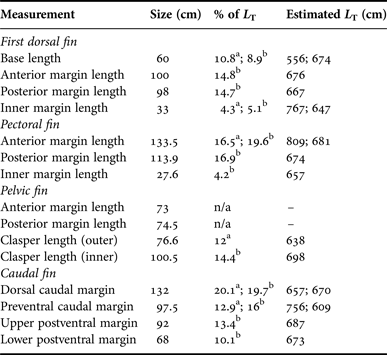
On 17 July 2013, a mature male Cetorhinus maximus was found stranded at Klatakan beach, about 9 km south of Gilimanuk Harbour, north-west Bali, Indonesia (08°13.98′S; 114°27.48′E) (Figure 1). The individual was found washed ashore near a pearl farm owned by PT Ocean Blue Mutiara (PT. OBM) and was identified as a basking shark by the owner of the pearl farm, Mr David Schonell. The specimen was reported as still being alive when first found near the beach but several hours later it was found stranded and dead on the beach. The carcass remained on the beach for five days and due to the deteriorating condition of the specimen, it was then discarded. All the fins were retained and tissue samples were collected. The fins were obtained by one of us (F) ten days after the stranding. Several standard measurements of the fins were taken following Compagno (Reference Compagno2001) (see Table 1).
The stranded Cetorhinus maximus as it was first observed in July 2013 at Klatakan beach, Bali (photo by D. Schonell).

Measurements of the first dorsal, pectoral, pelvic and caudal fins, and clasper of the stranded Cetorhinus maximus individual from Bali. Percentages of L T and resulting estimates of L T for the Bali individual are provided.
aPercentages of L T from Springer & Gilbert (Reference Springer and Gilbert1976).
bPercentages of L T from Hernandez et al. (Reference Hernandez, Vogler, Bustamante and Lamilla2010).
RESULTS AND DISCUSSION
The fins obtained from the stranded specimen (Figure 2) were measured and used to estimate the total length of the specimen by comparing the measurements, as percentages of total length, to those in Springer & Gilbert (Reference Springer and Gilbert1976) and Hernandez et al. (Reference Hernandez, Vogler, Bustamante and Lamilla2010) for Cetorhinus maximus. The individual measured by Springer & Gilbert (Reference Springer and Gilbert1976) was an adult male 846 cm L T taken from Drake's Bay, California, and the individual measured by Hernandez et al. (Reference Hernandez, Vogler, Bustamante and Lamilla2010) was also an adult male 838 cm L T from Llico, Chile (see Table 1). The estimations of total size ranged between 556 and 809 cm L T. The variation in L T estimates using these two sources reflects either intraspecific variation in fin morphology in this species or differences in measurement methodology. Interpretation of the inner margin lengths can vary between researchers due to the apices of some fins, particularly the pectoral fins, being rounded. The variation may also be a result of the deteriorating condition of the specimen. Some parts of the fins, especially the dorsal fins, were decomposed and made it difficult to determine the fin origin and the tip. The body part measurement that provided the best agreement in size estimates deriving from the measurements obtained by Springer & Gilbert (Reference Springer and Gilbert1976) and Hernandez et al. (Reference Hernandez, Vogler, Bustamante and Lamilla2010) was the dorsal caudal-margin, which yielded estimated sizes of 657 and 670 cm L T, respectively. Taking into account the estimates obtained through fin and clasper measurements, the adult male C. maximus stranded in Bali was estimated to be between 5.6 and 8.1 m L T, but was probably around 6.6–6.7 m L T.
Examined parts of the stranded Cetorhinus maximus specimen. (A) caudal fin (left side); (B) pectoral fin (dorsal); (C) dorsal surface of mature clasper; and (D) pelvic fin with clasper (ventral).
In the colder months, C. maximus appears to be most common in deep-water areas rather than in coastal and surface waters (Fairfax, Reference Fairfax1998; Francis & Duffy, Reference Francis and Duffy2002), leading to the hypothesis that C. maximus moves into deeper water on the continental slope during winter. It has been suggested that during these movements into deeper water, C. maximus ‘hibernates’ near the bottom based on evidence that some basking sharks caught in autumn and winter lack gill rakers (van Deinse & Adriani, Reference van Deinse and Adriani1953; Parker & Boeseman, Reference Parker and Boeseman1954; Matthews, Reference Matthews1962). However, Francis & Duffy (Reference Francis and Duffy2002) found that C. maximus were caught by commercial trawlers in mesopelagic waters in some areas off the coast of New Zealand during winter, and were thus unlikely to be hibernating. Individuals caught in winter that still had gill rakers also indicate that at least some C. maximus continue to feed on zooplankton during this season, although at much lower densities (Sims, Reference Sims1999; Francis & Duffy, Reference Francis and Duffy2002). Another hypothesis for the shedding of gill rakers is that they may shift to benthic feeding during winter months and feed on small schooling fish while the gill rakers regenerate (Compagno, Reference Compagno2001).
Briggs (Reference Briggs1960) hypothesized that C. maximus may migrate across the equatorial region and this was recently confirmed by Skomal et al. (Reference Skomal, Zeeman, Chisholm, Summer, Walsh, McMahon and Thorrold2009) who showed that, in the western North Atlantic Ocean, they migrated into tropical waters and across the equatorial region during the winter months. Springer & Gilbert (Reference Springer and Gilbert1976) suggested that C. maximus may migrate from cool temperate waters to warmer waters in lower latitudes by following favourable isotherms in deep waters toward the equator in order to find sufficient food. Although information on the occurrence of C. maximus in tropical waters is limited, Springer & Gilbert (Reference Springer and Gilbert1976) recorded an individual from warm waters off the coast of Sarasota in Florida, Sandoval-Castillo et al. (Reference Sandoval-Castillo, Ramirez-Gonzalez and Villavicencio-Garayzar2005) reported on one confirmed record off the coast of Baja California in Mexico and Hoffmayer et al. (Reference Hoffmayer, Driggers, Franks, Hanisko, Roffer and Cavitt2011) reported four individuals in the Gulf of Mexico.
The occurrence of C. maximus in Indonesian waters provides some evidence that this species undergoes migrations from cool temperate waters into or through tropical waters. The cause behind the shark stranding and its origin are unknown. The Lombok Strait, between Bali and the Lombok islands, is one of the main passages for the Indonesian Throughflow (ITF) that transports massive quantities of water from the Pacific Ocean into the Indian Ocean. The ITF is known to transport cold water in the surface layer to the Indian Ocean as a result of a northward pressure gradient in the surface layer of the Makassar Strait (Gordon et al., Reference Gordon, Susanto and Vranes2003). The existence of the ITF passing through the Bali and Lombok Straits, resulting in cold currents in this area, may provide an ideal location for basking sharks to move between hemispheres or act as a seasonal migration route into Indonesian waters. It is thus possible that this individual was moving through this area as part of a normal migration pattern, rather than it being a rare and random occurrence. Further information on the movement patterns of basking sharks in the Indo-Pacific region would be of interest.
ACKNOWLEDGEMENTS
We would like to thank Mr D. Schonell and his staff for donating the specimen and providing valuable information to us. Thanks also go to Mr P. Agustono, M. Adrim and H.Y. Sugeha for their contributions in the collection and preservation of the specimen. We also thank the director of the Research Centre for Oceanography, M. Erdmann, for providing funds and facilities for the collection and the Conservation International staff that contributed valuable information and supported us in the process of collection.