Introduction
Internalising problems, such as anxiety, depression and withdrawal, increase dramatically from childhood to adolescence, often continue into adulthood and account for a large proportion of mental health problems (Costello et al. Reference Costello, Copeland and Angold2011). Twin studies in children, adolescents and adults (Fanous & Kendler, Reference Fanous and Kendler2004; Rice, Reference Rice2009) specifically addressing genetic influences as well as shared and non-shared environmental factors, suggest that genetic risk factors substantially influence not only individual differences in internalising problems but also stability/instability of anxious and depressive symptoms through different age periods (van der Valk et al. Reference van der Valk, van den Oord, Verhulst and Boomsma2003).
One of the most investigated genetic polymorphisms in internalising disorder is a functional polymorphism in the promoter region of the serotonin transporter gene (5-HTTLPR). The short allele (S) in the 5-HTTLPR is associated with in vitro lower transcriptional efficiency of the promoter compared with the long (L) allele (Lesch et al. Reference Lesch, Bengel, Heils, Sabol, Greenberg, Petri, Benjamin, Muller, Hamer and Murphy1996). Unaffected children and adolescents with the L–L genotype have been found to have significantly higher maximal uptake of serotonin in platelets, thus suggesting also an in vivo effect of this polymorphism (Nobile et al. Reference Nobile, Begni, Giorda, Frigerio, Marino, Molteni, Ferrarese and Battaglia1999). More recently, a new single nucleotide polymorphism (SNP: rs25531) has been identified within the repeats of 5-HTTLPR. The L allele is subdivided into L A and L G variants: the L G variant has a level of serotonin transporter expression comparable with the S allele, and both have lower levels than L A (Hu et al. Reference Hu, Lipsky, Zhu, Akhtar, Taubman, Greenberg, Xu, Arnold, Richter, Kennedy, Murphy and Goldman2006). Even though the functional interpretation of the L G allele has been questioned (Martin et al. Reference Martin, Cleak, Willis-Owen, Flint and Shifman2007) some more recent studies have used this classification (for a review see Bellani et al. Reference Bellani, Nobile, Bianchi, van Os and Brambilla2013).
The leading theory (Lesch et al. Reference Lesch, Bengel, Heils, Sabol, Greenberg, Petri, Benjamin, Muller, Hamer and Murphy1996; Jacobs et al. Reference Jacobs, Kenis, Peeters, Derom, Vlietinck and van Os2006) is that 5-HTTLPR S-carriers are characterised by the stable trait of negative affectivity that is converted to psychopathology only under conditions of stress. Unfortunately, two meta-analyses (Munafo et al. Reference Munafo, Durrant, Lewis and Flint2009; Risch et al. Reference Risch, Herrell, Lehner, Liang, Eaves, Hoh, Griem, Kovacs, Ott and Merikangas2009) have shown inconsistent results. However, two consecutive reviews of Uher & McGuffin (Reference Uher and McGuffin2008, Reference Uher and McGuffin2010) and one large quantitative meta-analysis (Karg et al. Reference Karg, Burmeister, Shedden and Sen2011) suggest that the method used to assess environmental adversities could explain most discrepancies in those results. Studies using objective measures (e.g. ‘family structure’) or detailed interviews to assess environmental adversity consistently found an interaction in the expected direction. Furthermore, Karg et al. (Reference Karg, Burmeister, Shedden and Sen2011) suggested that the actual duration of the stressor was another critical point, evidence of moderating effect being greater for chronic stressors (for a review, see Bellani et al. Reference Bellani, Nobile, Bianchi, van Os and Brambilla2013).
More specifically, the ‘family structure’ variable (Meltzer et al. Reference Meltzer, Gatward, Corbin, Goodman and Ford2003) refers to the makeup of the family where a child lives; families in which both the biological mother and father live are the most frequent occurrence, and are usually associated with the lowest risk for offspring's dysfunction (Bramlett & Blumberg, Reference Bramlett and Blumberg2007). On the contrary, offspring living in one-parent households are more likely to show behavioural and emotional problems in childhood (O'Connor et al. Reference O'Connor, Dunn, Jenkins, Pickering and Rasbash2001) and an excess of depressive symptoms in adolescence (Cuffe et al. Reference Cuffe, McKeown, Addy and Garrison2005). Parental socioeconomic status (SES) could be another reliable and chronic environmental factor. SES is a powerful predictor of childhood psychopathology, including internalising syndromes. Low SES may contribute to these psychopathologies, either directly or indirectly, through negative effects onto more proximal child-specific factors, such as parenting or exposure to trauma (for a review, see Rao & Chen, Reference Rao and Chen2009).
A recent review that focused on youth depression (Dunn et al. Reference Dunn, Uddin, Subramanian, Smoller, Galea and Koenen2011) reported that, although data have been collected longitudinally, the association between environmental exposure and outcome has been analysed cross-sectionally. Therefore, little is known about the impact of genetic risk factors and environmental exposure over time, particularly during childhood and adolescence. The effect of 5-HTTLPR polymorphism on the stability/instability of internalising problems throughout the critical developmental period of adolescence, taking into account the effects of chronic societal stressors, has yet to be examined. Based on these considerations in this study we examined the moderating role of the 5-HTTLPR on the relationship between two objective chronic risk factors (namely low SES and family structure) and internalising symptoms, using time-sensitive techniques across adolescence (from early- to late-adolescence). Furthermore, we analysed the co-joint effect of environmental and genetic features on the main components of internalising symptoms (i.e. anxious and depressive symptoms) while taking into account the reciprocal co-variation and influence of these psychopathological traits.
Methods
Subjects
This study is a 5-year follow-up of the genetic section of the Italian preadolescent mental health (Progetto Italiano Salute Mentale Adolescenti, PrISMA) project and of a longitudinal study on emotional and behavioural problems in a small suburban community (Ponte Lambro, PL), (Frigerio et al. Reference Frigerio, Vanzin, Pastore, Nobile, Giorda, Marino, Molteni, Rucci, Ammaniti, Lucarelli, Lenti, Walder, Martinuzzi, Carlet, Muratori, Milone, Zuddas, Cavolina, Nardocci, Tullini, Morosini, Polidori and De Girolamo2006; Nobile et al. Reference Nobile, Giorda, Marino, Carnet, Pastore, Vanzin, Bellina, Molteni and Battaglia2007, Reference Nobile, Rusconi, Bellina, Marino, Giorda, Carlet, Vanzin, Molteni and Battaglia2009). The original study population consisted of 607 Italian children (441 of PrISMA sample and 166 of PL sample) aged 10–14 years at the time of the first wave study (W1). Participants in the W1 study were invited by mail and/or by telephone to participate in the follow-up phase (W2). Of the 607 combined sample adolescents who were candidates in the W2, 22.4% (n = 136) were no longer available due to change of address, incomplete mail/phone data or relocation. Questionnaires were thus sent in sealed envelopes to the families of the remaining 471 adolescents, with 287 subjects (60.9%: 50.9% boys, 49.1% girls, aged 15–19) accepting participation in the study.
Procedures
The study protocols were approved by the ‘Eugenio Medea’ Scientific Institute Research Ethical Committee. Parents' and adolescents' (when required) written informed consent was obtained for all participants.
Emotional and behavioural assessment
Parent-reported Internalising behaviour was assessed using the Child Behaviour Checklist 6–18 (CBCL/6–18; Achenbach & Rescorla, Reference Achenbach and Rescorla2001). This is an empirically based checklist of social competence and behavioural problems filled out by parents of children and adolescents aged 6–18. According to the Achenbach System of Empirically Based Assessment (ASEBA), the CBCL/6–18 is divided into two major broad band scales: the Internalizing and the Externalizing Scales. The Internalizing Scale consists of 32 items and three subscales: Anxious/Depressed, Withdrawn/Depressed and Somatic Complaints Scales. In the present sample, the Internalizing Scale showed an acceptable internal reliability at both waves (Cronbach's W1-α = 0.835 and W2-α = 0.85). Subscales at W1 and W2 showed acceptable internal reliability (Anxious/Depressed Scales: W1-α = 0.76, W2-α = 0.79; Withdrawn/Depressed: W1-α = 0.73, W2-α = 0.79) with the exception of Somatic Problems Scales (W1-α = 0.55, W2-α = 0.57), which were not included in further analyses.
Sociodemographic form
The individual and family characteristics of the sample were gathered by an ‘ad hoc’ form filled out by parents. This was an expanded version of the questionnaires originally employed during the PrISMA and PL W1-assessment that encompassed questions on family sociodemographic data (child's gender and age, parents' marital status coded as: married, cohabiting, divorced, separated, widowed, single), mother's and father's levels of education, child's education (school attended, repeated year at school, presence of a remedial teacher), possible contacts with the health services and family SES (Nobile et al. Reference Nobile, Colombo, Bellina, Molteni, Simone, Nardocci, Carlet and Battaglia2013). We used parental employment as a measure of SES coded according to the Hollingshead 9-point scale for parental occupation (Hollingshead, Reference Hollingshead1975). A score of 1–9 was assigned to each parental job and when both parents were employed, the highest of the two scores was used. Since low SES has been identified as a specific risk factor for psychopathology (van Oort et al. Reference van Oort, van der Ende, Wadsworth, Verhulst and Achenbach2011), we split SES into two classes of risk: low SES 1–3 (mean = 2.89, s.d. = 0.41) and medium to high SES 4–9 (mean = 6.31, s.d. = 1.53).
As adopted by major epidemiological surveys (Office for National Statistics, Reference Meltzer2003), the categories of parental marital status were recoded for analysis into two classes of family structure: ‘two-parent’ (encompassing: married – 92.1% and cohabiting parents – 0.4% of the combined sample) and ‘one-parent’ families (encompassing divorced – 3.6%, separated – 3.2% and single parents – 0.7% of the combined sample).
DNA collection and extraction
Genomic DNA was extracted from mouthwash samples collected in 4% sucrose using the DNAzol Genomic DNA Isolation reagent (Molecular Research Center, Cincinnati). DNA concentration and quality were verified on a NanoDrop 1000 instrument (Thermo Scientific, Wilmington, DE, USA). 5-HTTLPR S/L and rs25531 genotypes were both determined by amplification using the primers described by Lesch et al. (Reference Lesch, Bengel, Heils, Sabol, Greenberg, Petri, Benjamin, Muller, Hamer and Murphy1996) followed by sequencing. All amplification reactions were performed on a Mastercycler thermocycler (Eppendorf). A 0.5-ml aliquot of each amplified DNA sample was labelled with a BigDye Terminator 3.1 cycle sequencing kit (Applied Biosystems, Monza, Italy) and sequenced on an ABI3130 Genetic Analyzer (Applied Biosystems, Monza, Italy). The 5-HTTLPR genotypes were divided into two groups: S-carriers (encompassing SS and LS-subjects) and long allele homozygotes (LL-subjects). We also repeated our analyses after recoding children according to SNP rs25531 (Hu et al. Reference Hu, Lipsky, Zhu, Akhtar, Taubman, Greenberg, Xu, Arnold, Richter, Kennedy, Murphy and Goldman2006). Since the L G variant has a level of serotonin transporter expression comparable with the S allele, and both have lower levels than L A, we reclassified children dichotomously between L A homozygotes v. rest of the sample.
Data analyses
Attrition analyses were conducted to test sociodemographic and clinical differences between participants and non-participants in the W2 phase. Specifically, we analysed (i) all the scale scores and age at W1 by ANOVA, and (ii) gender, father's and mother's levels of education and family structure at W1 by χ 2. To investigate the possible effect of being part of the PrISMA or PL sample on attrition rate, the variable ‘sample’ was simultaneously entered as an independent variable in ANOVA. χ 2 tests were stratified by ‘sample’, and homogeneity of different sample χ2 was tested by the Breslow–Day test. We preliminarily controlled the possible association of family structure with available socioeconomic measures. By multiple logistic regression analysis, we found that class of family structure at W1 and W2 could not be predicted by parental SES at W1 and W2, mother's level of education, or father's level of education (p-range: 0.34–0.92). Independence of distribution of genotypes in relation to both genders, family structure and SES was preliminary analysed by χ 2 statistic. The distributions of the scale scores at W1 and W2 were square-root transformed to attenuate deviations from normality, which led to acceptable kurtosis (range: −0.114, 0.372) and skewness (range: −0.970, 0.225).
To investigate the effect of 5-HTTLPR polymorphism on the relationships between SES, family structure and internalising problems at W1 and W2, a multigroup path analysis was employed. To account for possible gender and age effects, these variables were included in the model. Furthermore, to better understand the specific effects on the main dimensions of Internalising Problems we performed a multigroup path analysis, simultaneously including the Anxious/Depressed and the Withdrawan/Depressed Scales at W1 and W2; gender and age effects were included in the model. Model fits were evaluated by the χ 2 statistic, the standardised root-mean-square residual (SRMR, whose values ≤0.08 indicate adequate fit), and the root-mean-square error of approximation (RMSEA, whose values ≤0.06 indicate adequate fit). To test for path differences across the two levels of 5-HTTLPR polymorphism, we used Lagrange Multiplier tests (LM test, Kline, Reference Kline1998); paths that were significant at least in one path were constrained to increase the model's χ 2 with respect to the original one. The modification indices were calculated to estimate the benefit of releasing each equality constraint. The statistical significance of the change in model-data-fit, using model χ 2 decrease was used as the criteria to release the constraints.
Data analyses were carried out using SPSS Statistics 17.0 and Mplus program 6.11 (Muthén & Muthén, Reference Muthén and Muthén2011).
Results
Attrition and preliminary analysis
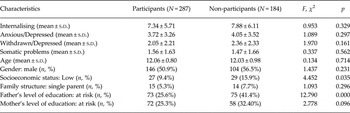
Attrition analyses were conducted to test sociodemographic and clinical differences at W1 between participants and non-participants in the W2 phase (Table 1). No significant differences were found between participants and non-participants, for scores at Internalising Problems, Anxious/Depressed, Withdrawn/Depressed and Somatic Problems, gender, age and family structure evaluated at W1. A significant difference was found for SES and father's level of education with lower SES and father's level of education among non-participants. The Breslow–Day test of homogeneity was not significant either for SES or father's level of education (χ 2 = 0.055, p = 0.815 and χ 2 = 0.178, p = 0.673, respectively), suggesting that the two samples (PrISMA and PL) were homogeneous for these attrition biases.
Sociodemographic and behavioural characteristics of participants and non-participants in the W2 phase at the first evaluation

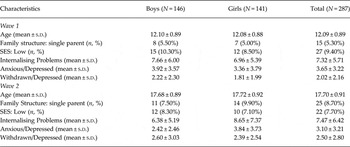
The sociodemographic characteristics of the study group and the raw score (mean ± s.d.) for the Internalising Problems, Anxious/Depressed and Withdrawn/Depressed scales at both waves are shown in Table 2. Consistent with previous studies investigating internalising problems during adolescence (Kendler et al. Reference Kendler, Gardner and Lichtenstein2008; Lau & Eley, Reference Lau and Eley2008; Petersen et al. Reference Petersen, Bates, Goodnight, Dodge, Lansford, Pettit, Latendresse and Dick2012) there was a slight but not significant increase in time of the mean scores for Internalising Problems, with a significant time × gender interaction (F = 20.107; p < 0.001) sustained by a marked increase of scores in time among girls and a slight decrease among boys. Anxious/Depressed problems showed a slight but significant decrease in time (F = 7.237; p = 0.008), with a significant time × gender interaction sustained by a decrease of score in time among boys and a slight increase among girls (F = 37.62; p < 0.001). The Withdrawn/Depressed score showed a significant increase (F = 9.045; p = 0.003) with no time × gender effect.
Sociodemographic and behavioural characteristics of the study group at first- and second-wave

Genotyping of 5-HTTLPR was successful for 278 subjects (96.8% of the sample) with complete sociodemographic and behavioural data. The 5-HTTLPR genotype frequencies in the total sample were: L/L = 37.4% (n = 104), L/S = 46.4% (n = 129), S/S = 16.2% (n = 45); and the allele frequencies were: L = 60.6% and S = 39.4%. The genotype frequencies were in Hardy–Weinberg equilibrium (χ 2 = 0.22; p = n.s.), and similar to those previously reported for Caucasian populations (Petersen et al. Reference Petersen, Bates, Goodnight, Dodge, Lansford, Pettit, Latendresse and Dick2012). Genotype frequencies were evenly distributed, both trichotomously and dichotomously (S-carriers v. LL-subjects), across genders (χ 2 = 1.43, p = n.s. and χ 2 = 1.22, p = n.s., respectively), W1-family structure (χ 2 = 2.56, p = n.s. and χ 2 = 1.76, p = n.s., respectively), W2-family structure (χ2 = 0.97, p = n.s. and χ2 = 0.834, p = n.s., respectively) and SES (χ2 = 1.03, p = n.s. and χ 2 = 1.00, p = n.s., respectively). No significant difference was found in Internalising, Anxious/Depressed and Withdrawn/Depressed scores at W1 between LL-subjects and S-carriers (t = 0.99, p = n.s., t = −0.75, p = n.s., and t = 0.30, p = n.s., respectively). Participants were then reclassified according to L A L G classification: 15 out of 104 LL children (14.4%) were genotyped as LALG and reclassified into 5-HTTLPR genotype = L A L A v. 5-HTTLPR genotype = L G or S-carrier group. The genotype frequencies were L A L A = 32.0% (n = 89); L A L G = 5.3% (n = 15); L G S = 5.7% (n = 16); L A S = 40.6% (n = 113); SS = 16.2% (n = 45); L A allele = 55.0%; L G allele = 5.6%; S allele = 39.4%. The tri-allelic genotype frequencies were in Hardy–Weinberg equilibrium (χ 2 = 3.109; df = 3; p = n.s.).
Path analysis for internalising problems scale: pattern of influences
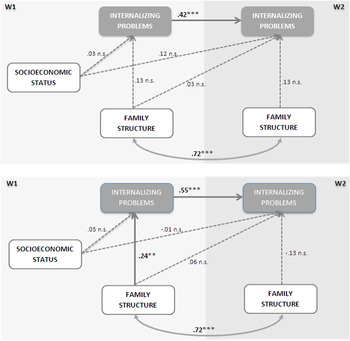
The exploratory model was tested for both levels of 5-HTTLPR genotypes (LL-subjects v. S-carriers). To account for possible gender and age effects, these variables were included in the model. In contrast to our hypotheses, SES at W2 was excluded from the model as it has insufficient variance to test a multigroup path model. The two-level paths with beta coefficients are shown in Fig. 1a and b . The model provided an acceptable fit to the data both for the entire sample (χ 2 = 18.21, p = n.s.; SRMR = 0.03, RMSEA = 0.05) and also for the two levels of 5-HTTLPR genotypes (χ 2 = 12.70, p = n.s.; SRMR = 0.05, RMSEA = 0.04 for LL-subjects; χ 2 = 10.19, p = n.s.; SRMR = 0.03, RMSEA = 0.00 for S-carriers) suggesting there was invariance of the model structure across 5-HTTLPR genotype. The results indicate that W2-internalising problems were positively influenced by W1-internalising problems, and W2-family structure was correlated with W1-family structure for both samples. Examination of the model yielded interesting group differences: for S-carriers, the pathway between W1-family structure and W1-internalising problems was positive and significant; for LL-subjects this pathway was not significant. Furthermore, we constrained the paths to be equal for the two levels of 5-HTTLPR genotypes, to see if there were differences between the constrained and unconstrained models. We utilised the LM test for each of the paths that were significant at least in one model to assess which paths should be unconstrained thereby resulting in a better model fit. The two groups showed a significant difference in the pathway between W1-internalising problems and W2-internalising problems (χ 2 = 3.89, p < 0.05), suggesting that the direct impact of W1-internalising problems on W2-internalising problems was significantly greater for the S-carriers. However, the two groups did not show a significant difference in the pathway between W1-family structure and W1-internalising problems (χ 2 = 1.29, p = 0.256) at the LM test. The model accounted for 24.4% and for 34.0% of the variance in W2-internalising problems for LL-subjects (Fig. 1a ) and for S-carriers (Fig. 1b ), respectively. Analyses were repeated according to SNP rs25531: children were reclassified dichotomously between L A homozygotes v. the rest of the sample (Model fit for the entire sample: χ 2 = 18.21, p = n.s.; SRMR = 0.03, RMSEA = 0.05; for L A L A subjects: χ 2 = 10.61, p = n.s.; SRMR = 0.06, RMSEA = 0.00; for L G or S-carriers: χ 2 = 10.22, p = n.s.; SRMR = 0.03, RMSEA = 0.00). The results indicate that W2-internalising problems were positively influenced by W1-internalising problems (5-HTTLPR genotype = L A L A: β = 0.41, p < 0.001; 5-HTTLPR genotype = L G or S-carrier: β = 0.53, p < 0.001) and W2-family structure was correlated with W1-family structure for both samples (5-HTTLPR genotype = L A L A: r = 0.77, p < 0.001; 5-HTTLPR genotype = L G or S carrier: r = 0.74, p < 0.001). Group differences were also found: for genotype L G or S carrier, the pathway between W1-family structure and W1-internalising problems was positive and significant (β = 0.24, p < 0.001); for genotype = L A L A these pathways were not significant. Based on the results of the LM test, the two groups showed a significant difference only in the pathway between W1-internalising problems and W2-internalising problems (χ 2 = 6.73, p < 0.01), suggesting that the direct impact of W1-internalising problems on W2-internalising problems was significantly greater for the 5-HTTLPR genotype = low functioning alleles carrier group. As for previous analyses, the two groups did not show a significant difference in the pathway between W1-family structure and W1-internalising problems (χ 2 = 1.02, p = n.s) at the LM test.
Path Model for Internalizing Problems with standardized coefficients for 5-HTTLPR genotype = LL-subjects; Path Model for Internalizing Problems with standardized coefficients for 5-HTTLPR genotype = S-carriers Note: dashed lines indicate non-significant paths; *p < .05, **p < .01, ***p < .001; n.s. = not significant; W1 = first wave; W2 = second wave

Path analysis for anxiety/depressed and withdrawn/depressed scales: pattern of influences
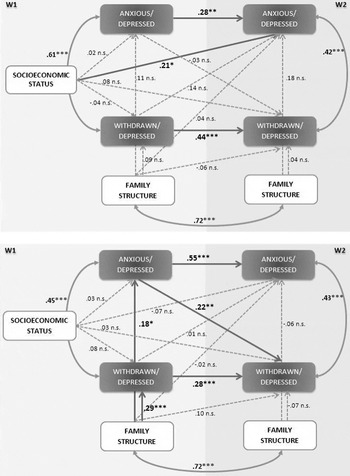
The two level paths (LL-subjects v. S-carriers) with beta coefficients are shown in Fig. 2a and b . Gender and age effects were included in the model. The model provided an acceptable fit to the data both for the entire sample (χ 2 = 28.17, p = n.s.; SRMR = 0.03, RMSEA = 0.03) and also for the two levels of 5-HTTLPR genotypes (χ 2 = 16.08, p = n.s.; SRMR = 0.04, RMSEA = 0.04 for LL-subjects; χ 2 = 16.31, p = n.s.; SRMR = 0.03, RMSEA = 0.03 for S-carriers) suggesting there was invariance of the model structure across the 5-HTTLPR genotype. The results show that: at both levels, W2-Anxiety/Depressed Scale was positively influenced by W1-Anxiety/Depressed Scale; W2-Withdrawn/Depressed Scale was positively influenced by W1-Withdrawn/Depressed Scale; W2-family structure was correlated with W1-family structure. Examination of the model revealed that: – for LL-subjects the pathway between the W2-Anxiety/Depressed Scale regressing on W1-SES was positive and significant; – for genotype S-carrier, the pathway between the W1-Anxiety/Depressed Scale and W1-family structure, the pathway between the W1-Withdrawn/Depressed Scale and W1-family structure and the pathway between W2-Withdrawn/Depressed and W1-Anxious/Depressed Scale were positive and significant. At the LM test, the two groups showed a significant difference in the pathway between the W1- and the W2-Anxious/Depressed Scale (χ 2 = 5.94, p = 0.015), suggesting that the direct impact of the W1- on the W2-Anxious/Depressed Scale was significantly greater for the 5-HTTLPR genotype = S-carriers group. Furthermore, the two groups showed a significant difference in the pathway between the W1-Anxious/Depressed Scale and the W2-Withdrawn/Depressed Scale (χ 2 = 3.85, p = 0.05), suggesting that the direct impact of the W1-Anxious/Depressed Scale on the W2-Withdrawn/Depressed Scale was greater for the S-carriers group. Finally, the two groups showed a significant difference in the pathway between the W2-Anxious/Depressed Scale and W1-SES (χ 2 = 6.58, p = 0.01), suggesting that the direct impact of W1-SES on W2-Anxious/Depressed Scale was significantly greater for LL-subjects than for S-carriers. The two groups did not show a significant difference in the other pathways. The model accounted for 24.4% of the variance of the W2-Anxious/Depressed Scale and 22.1% of the W2-Withdrawn/Depressed Scale for 5-HTTLPR LL-subjects, whereas for the 5-HTTLPR genotype = S-carriers the model accounted for 34.3% of the variance of the W2-Anxious/Depressed Scale and for 20.3% of the variance for the W2-Withdrawn/Depressed Scale.
Path Model for Anxious/Depressed and Withdrawn/Depressed scales with standardized coefficients for 5-HTTLPR genotype = LL-subjects; Path Model for Anxious/Depressed and Withdrawn/Depressed scales with standardized coefficients for 5-HTTLPR genotype = S-carriers. Note: dashed lines indicate non-significant paths; *p < .05, **p < .01, ***p < .001; n.s. = not significant; W1 = first wave; W2 = second wave

Analyses were repeated according to SNP rs25531 (Model fit for the entire sample χ 2 = 21.86, p = n.s.; SRMR = 0.03, RMSEA = 0.05; for L A L A subjects: χ 2 = 11.90, p = n.s.; SRMR = 0.05, RMSEA = 0.00; for L G or S-carriers: χ 2 = 15.04, p = n.s.; SRMR = 0.03, RMSEA = 0.02) The results showed that: at both levels, W2-Anxiety/Depressed Scale was positively influenced by W1-Anxiety/Depressed Scale (β = 0.33, p < 0.01 and β = 0.53, p < 0.001, respectively); W2-Withdrawn/Depressed Scale was positively influenced by W1-Withdrawn/Depressed Scale (β = 0.27, p < 0.05 and β = 0.33, p < 0.001, respectively); W2-family structure was correlated with W1-family structure (r = 0.77, p < 0.001 and r = 0.74, p < 0.001, respectively). Group differences were also found: –for genotype = L A L A the pathway between the W2-Anxiety/Depressed Scale regressing on W1-SES was positive and significant (β = 0.21, p < 0.01); – for genotype L G− or S-carriers, the pathway between the W1-Anxiety/Depressed Scale and W1-family structure, the pathway between the W1-Withdrawn/Depressed Scale and W1-family structure and the pathway between W2-Withdrawn/Depressed and W1-Anxious/Depressed Scale were positive and significant (β = 0.19, p < 0.01; β = 0.27, p < 0.01; β = 0.18, p < 0.05). Based on the results of the LM test, the two groups showed a significant difference in the pathway between the W1- and the W2-Anxious/Depressed Scale (χ 2 = 4.13, p < 0.05), and in the pathway between the W2-Anxious/Depressed Scale and W1-SES (χ 2 = 5.60, p < 0.05), thus confirming that the direct impact of the W1- on the W2-Anxious/Depressed Scale and W1-SES on W2-Anxious/Depressed Scale was significantly greater for the low level functioning alleles.
Discussion
In this study we evaluated whether 5-HTTLPR polymorphism could play a role in the continuity of internalising problems and of their main dimensions (i.e. anxious and depressive symptoms) throughout adolescence, at the same time taking into account the interaction with two chronic social adversities, namely SES and family structure.
Our data suggest that 5-HTTLPR plays an important role in determining the stability of this trait through a critical developmental period (i.e. adolescence). In fact, early-adolescence internalising problems were revealed to be strong predictors of internalising problems in late-adolescence in both groups, but in the 5-HTTLPR S-carrier group this relationship was significantly higher, i.e. the trait was significantly more stable in this population, even when the impact of certain social adversities, gender and age were taken into account. This finding was confirmed even when the sample was grouped according to SNP rs25531. When we examined the moderating role of 5-HTTLPR on the effect of family structure in determining the presence of internalising problems, we found a significant effect of the W1-family structure on W1-Internalising problems in the S-carrier group only, even though this data turned out not to be significant at the LM test. These data suggest a possible gene–environment interaction (G × E) of 5-HTTLPR polymorphism and family structure on internalising problems only during early-adolescence. We did not find any effect of family structure, assessed during both early- and late-adolescences, alone or in interaction with 5-HTTLPR polymorphism, on internalising problems during late-adolescence, even when the sample was grouped according to SNP rs25531. This finding could be due to the progressive lack of influence of the familial background during adolescence, when different external influences, such as stressful life events, peer context or some aspects of neighbourhood, start to exert a greater effect on emotional and behavioural problems (Petersen et al. Reference Petersen, Bates, Goodnight, Dodge, Lansford, Pettit, Latendresse and Dick2012).
Focus on the main dimensions of internalising problems, i.e. anxiety and depression, and on their co-variation and reciprocal effect, revealed other interesting features. The effect of the 5-HTTLPR polymorphism emerged to be mainly on the stability/continuity of Anxiety symptoms: in the S-carriers this trait seems to be highly stable (β = 0.55; p < 0.001) and to significantly predict Depressive symptoms (β = 0.22; p < 0.01). On the contrary, in the LL-subjects the anxiety trait is significantly less stable, even though significant (β = 0.28; p < 0.01), and, at W2, seems to be significantly predicted by SES (β = 0.21; p < 0.05). These data suggest that in the S-carriers the stability of Internalising symptoms may mainly be due to the anxiety component, and that this same component may partly influence the development of depressive symptoms during adolescence. These data are in agreement with the leading theory that S-carriers are characterised by a stable trait of negative affectivity based on underlying anxiety and fear neural circuits. These data also suggested that in S-carriers the anxiety problems could be part of a developmental pathway towards the development of depressive problems (probably under conditions of other genetic or environmental stressors which we did not take into account). In the LL-subjects anxiety symptoms seem to be less stable, not to influence the development of depressive symptoms and to be more influenced by societal context during late adolescence. In young people carrying the LL genotype the exposure to a socioeconomic disadvantaged background during childhood will predict the development of anxiety problems in adolescence, thus suggesting a moderating role of 5-HTTLPR on the effect of SES on late adolescence anxiety problems. The involvement of the long allele rather than the short allele as a risk factor, in the G × E interaction with SES, was opposite to that which we had hypothesised. Nevertheless, these data are in agreement with other studies examining the effect of 5-HTTLPR on anxiety traits, suggesting a protective role of S-allele in the vulnerability to panic, in adults (Schruers et al. Reference Schruers, Esquivel, van Duinen, Wichers, Kenis, Colasanti, Knuts, Goossens, Jacobs, van Rozendaal, Smeets, van Os and Griez2011) and to generalised anxiety across adolescence (Olsson et al. Reference Olsson, Byrnes, Anney, Collins, Hemphill, Williamson and Patton2007). Olsson et al. (Reference Olsson, Byrnes, Anney, Collins, Hemphill, Williamson and Patton2007) also found that this genetic protection seemed to be more pronounced under a condition of high stress and hypothesised that during adolescence 5-HTTLPR S-alleles might effectively work as a natural antidepressant by reducing metabolism and reuptake of bio-amines, thereby increasing availability of serotonin to buffer reactivity to life stress.
Furthermore, according to our data the 5-HTTLPR does not seem to differently affect the stability of the Withdrawn/Depressed trait over time, while it seems to be involved in the moderation of the effect of family structure on depressive problems in pre-adolescence, suggesting a possible G × E effect mainly on the depressive component of internalising problems during childhood and early adolescence only, even though the difference between groups did not reach statistical significance. These data are in agreement with previous works, suggesting a role for G × E between chronic family stress (but not acute stress) in early-adolescence and 5-HTTLPR in the prediction of depressive symptoms in youth (Dunn et al. Reference Dunn, Uddin, Subramanian, Smoller, Galea and Koenen2011). According to this perspective, we could hypothesise that during late-adolescence the gene is still active but, from this age onwards, it will interact with other kinds of environmental adversities (i.e. external stressful life events, neighbourhood or school environments) (Petersen et al. Reference Petersen, Bates, Goodnight, Dodge, Lansford, Pettit, Latendresse and Dick2012). Depending on 5-HTTLPR genotype, two different developmental patterns are possible: a more stable anxiety trait with a possible evolution towards the development of depressive symptoms in S-carriers, and a less stable but more reactive-to-environmental-determinants anxiety trait in L homozygotes especially during late-adolescence. These findings also suggest that inconsistent data on the moderational role of 5-HTTLPR on the link between environmental adversities and the aetiology of mental illness during transition period could be related not only to the quality of environmental exposure measurement or to the type of environment itself, but also to the timing of exposure and to different developmental trajectories.
There are several limitations in this study. First, while the psychometric variables did not affect agreement to participate in the study, non-participants were more likely to belong to socially disadvantaged backgrounds, as suggested by the excess of lower SES and father's level of education. The sample may thus not be fully representative of a general population. Second, in the second wave of this study the only sources on behavioural problems of adolescents were behaviour checklists filled out by parents. Other sources of information, such as the adolescents themselves, could have been beneficial. The use of ‘repeated’ measures obtained by the same informants (i.e. parents) could, in time, suffer from shared-method variance and inflate the estimates of stability of behaviour. Third, even though we did not find any association between 5-HTTLPR and family structure or SES at either waves, the presence of G × E correlation could not be completely ruled out. Since family structure cannot be considered a simple ‘environmental’ risk factor, in that environmental and genetic risk factors correlate within families, the possibility remains that what we have interpreted as a gene-by-environment interaction is instead a gene-by-gene interaction. Last, family structure and SES are broad, distal, family-wide risk factors that are likely to encompass several other subfactors, which can have a variable time effect across different families. Although the prevalence of one-parent families in our sample mirrors the average Northeast Italian general population prevalence (ISTAT, 2005), this remains a smaller figure than the average prevalence reported for other European or North-American cultures. Thus, in this specific culture separation/divorce may index only the most severely dysfunctional families, and the ‘one-parent’ variable may have acted as a particularly strong enhancer of risk for internalising symptoms over genotypes.
In conclusion, we found that 5-HTTLPR polymorphism plays an important role in determining the stability of anxiety and depressive symptoms throughout adolescence, even though it remains entirely possible that the same genetic disposition could be protective under some conditions, yet create risk for others. Future models of the developmental link between environmental adversities and internalising behaviour therefore need to consider that the effect of G × E interaction may be associated with internalising behaviour via different mechanisms during different time frames and that shifts in the strength of this effect should be expected across development. A more ‘dynamic’ G × E perspective has future potential to better describe the kinds of environments children need to maximise their genetic potentials and minimise their genetic sensitivities.
Acknowledgement
The authors thank the study families and participants for taking part to the study.
Financial Support
This work is a part of the Progetto Italiano Salute Mentale Adolescenti (PrISMA) project. PrISMA has been supported by the Italian Ministry of Health (grant numbers RF-2002; CCM-2006; SP-2008).
Conflict of Interest
None.
Ethical Standards
The authors assert that all procedures contributing to this work comply with the ethical standards of the relevant national and institutional committees on human experimentation and with the Helsinki Declaration of 1975, as revised in 2008.