Introduction
Paragonimiasis, or infection with lung flukes, is an important water-borne zoonosis caused by infection with a number of trematode species belonging to the genus Paragonimus. In China, two species, Paragonimus westermani and Paragonimus skrjabini, cause human paragonimiasis, with the former being strongly dominant (Liu et al. Reference Liu, Wei, Liu, Yang and Zhang2008). Infections are caused by consumption of freshwater crustaceans containing Paragonimus metacercariae. In Chongqing, Sinopotamon denticulatum and Sinopotamon nanum are important sources of human infections. Moreover, crayfish in the family Cambaridae, which were introduced for crayfish farming, are an increasingly significant host of this parasite.
Few epidemiological studies of paragonimiasis have been carried out since Chongqing separated from Sichuan province in 1997. Our laboratory has focused on the epidemiology of paragonimiasis Chongqing since 1999. Our 2002 epidemiological survey showed that the rate of paragonimiasis infection in migration areas of the Three Gorges Reservoir was 21·96% (Yang et al. Reference Yang, Liu, Song, Lin, Huang, Zhu, Tan and Shi2002). Another serum study carried out from 2006 to 2009 indicated that the population infection rate was 14·36 or 7·46%, as determined by intradermal test or enzyme-linked immunosorbent assay (ELISA), respectively (Zhang et al. Reference Zhang, Wang, Wang, Chen, He, Niu, Li, Chen and Wang2012).
Most of our previous studies have focused on the Three Gorges Reservoir in Chongqing. Little epidemiological information is available on paragonimiasis in the wider Chongqing area. In the present study, we analysed patient records collected between 2010 and 2015. A total of 638 patients were diagnosed with paragonimiasis in our laboratory. We summarized the distribution and clinical characteristics of these patients. Our records likely represent a substantial portion of the paragonimiasis cases that occurred in Chongqing within the past 6 years and provide the opportunity to elucidate the clinical features of current cases of paragonimiasis.
Materials and methods
Subjects and samples
A total of 1309 clinical cases referred to our laboratory from 1 January 2010 to 30 December 2015 were diagnosed as paragonimiasis. Patients suspected to have a Paragonimus infection by their clinician were recommended to our laboratory for further testing. Case data were collected by our technicians using a paragonimiasis epidemiological form, including clinical symptoms, dietary history, radiographic findings and laboratory data in addition to the results of immunodiagnostic tests performed in our laboratory. This study was approved by the Ethics Committee of the Third Military Medical University.
Immunodiagnostic methods
A rapid Paragonimus test kit produced by Zhejiang Academy of Medical Sciences and ELISA were used in parallel for diagnosis, as previously described (Zhang et al. Reference Zhang, Wang, Wang, Chen, He, Niu, Li, Chen and Wang2012).
Statistical analysis
Patients were categorized according to their age, gender, place of residence, dietary history and clinical symptoms. Statistical analysis was performed using Prism software version 5·0 (GraphPad). A P value <0·05 was considered statistically significant. Differences in the number of patients in each age group were assessed using a one-tailed t-test.
Results
Distribution of paragonimiasis cases by date of diagnosis
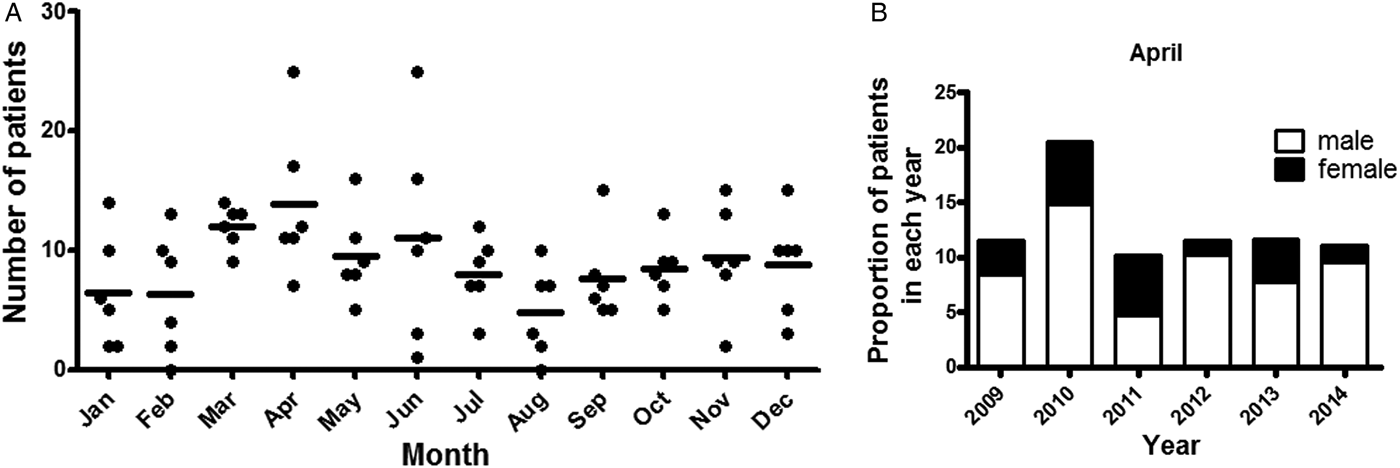
A total of 1309 cases were recorded by our laboratory from 1 January 2010 to 30 December 2015 following the serodiagnosis of Paragonimus infection. Of these, 638 patients were diagnosed with paragonimiasis, including 477 males and 161 females. The number of patients diagnosed with paragonimiasis annually from 2010 to 2015 ranged from 63 to 147. Moreover, more than 50·0% of patients were diagnosed between March and July (Fig. 1A). Most patients were diagnosed in April, accounting for 10–20·5% patients each year (Fig. 1B). This indicates that clinical symptoms manifest at approximately 6 months post-infection, as fresh water crabs are usually consumed in October in this region.
Distribution of paragonimiasis cases by date of diagnosis. Data were collected from 1 January 2010 to 30 December 2015. Six hundred and thirty-eight patients were diagnosed as paragonimiasis. (A) Distribution of paragonimiasis cases by month. The dot shows patients number each year and the black line represents mean value of each month. (B) Patients diagnosed in April accounted for the proportion of the whole year.

Geographical distribution of paragonimiasis cases
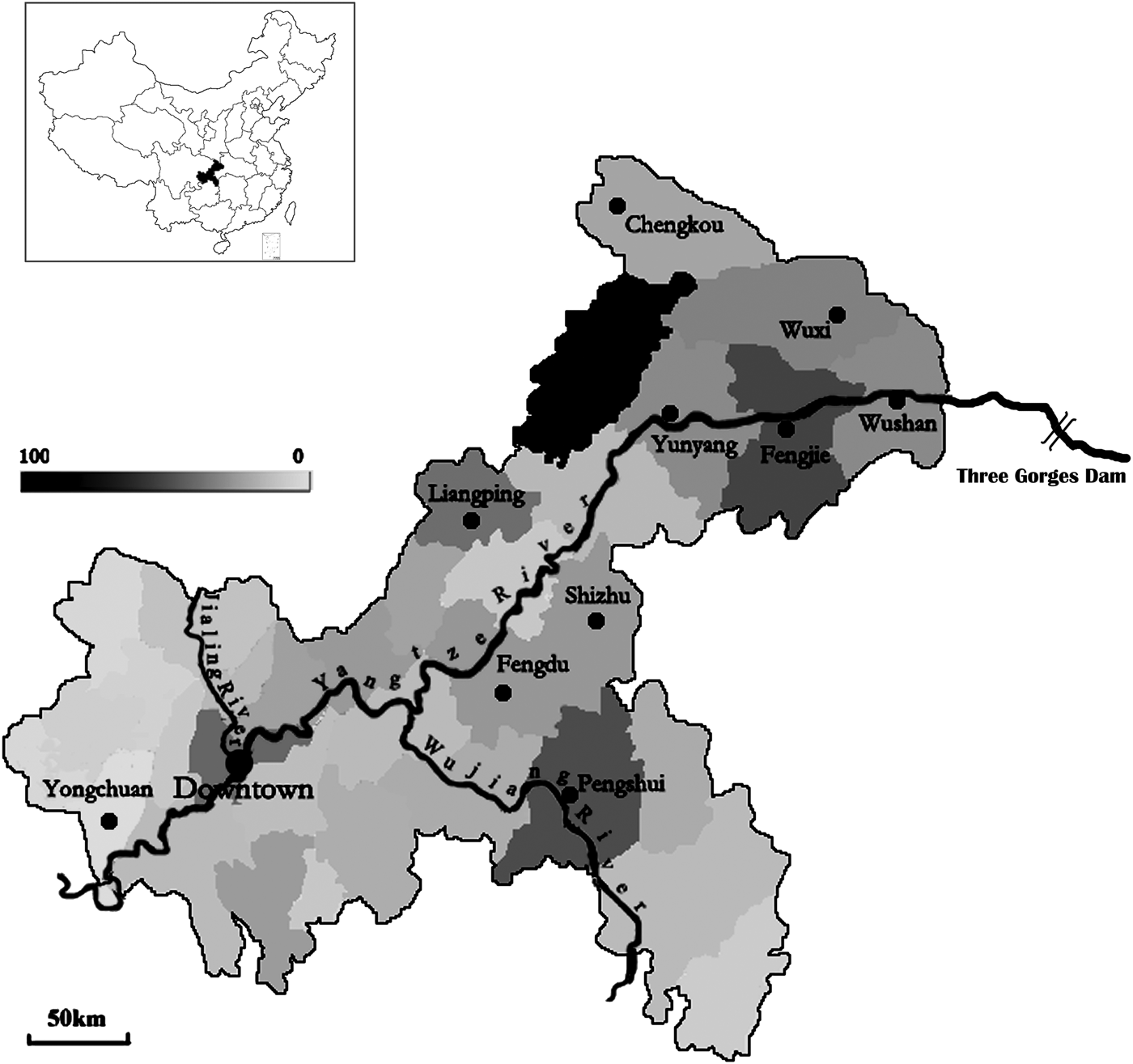
The geographical distribution of the cases is shown in Fig. 2. Chongqing is located in southwestern China, and it has become a municipality in 1997. Chongqing is upstream from the Three Gorges Dam, and it composes of 32 counties. Most of the counties are rural areas except Downtown Chongqing. We found that the majority (46·1%) of the patients were residents of northeast Chongqing (Kaixian, 96; Fengjie, 53; Liangping, 36; Wuxi, 29; Yunyang, 26; Wushan, 26; Chengkou, 17; Wanzhou, 11). Outside northeast Chongqing, a relatively large number of patients were diagnosed in Pengshui (49 patients), Shizhu (22), Fengdu (22) and Downtown Chongqing (39). Only a few cases were confirmed from the district around Yongchuan in west Chongqing. Since Downtown is in the western part of Chongqing, we investigated why it showed such a high level of morbidity. We found that 34 of the 39 patients residing in Downtown had visited northwest Chongqing in the previous year.
Geographical distribution of paragonimiasis patients were residents in Chongqing, China. The patient number in each district was exhibited by different gradation as the grey scale bar shows in the left corner.

Dietary history of patients
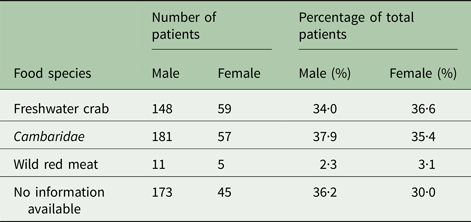
The dietary history of patients is summarized in Table 1. Approximately two-thirds of patients (420/638, 65·8%) had a history of consuming a second intermediate host or a transported host of the parasite. The proportion of female patients (116/161, 72·5%) was slightly higher than that of male patients (304/477, 63·7%). Only a few patients (16/638, 2·5%) stated that they had consumed the raw or undercooked wild vertebrates meat such as goat and boar, another potential transport host of Paragonimus. Among the 420 patients who had confirmed their dietary history, 233 patients belonged to children group. The primary cause of infection was consumption of freshwater crabs or Cambaridae.
Dietary history of patients

Note that the total number of patients is more than 638, due to the patients who consumed two (38 patients) or three (three patients) food species.
Age distribution of patients
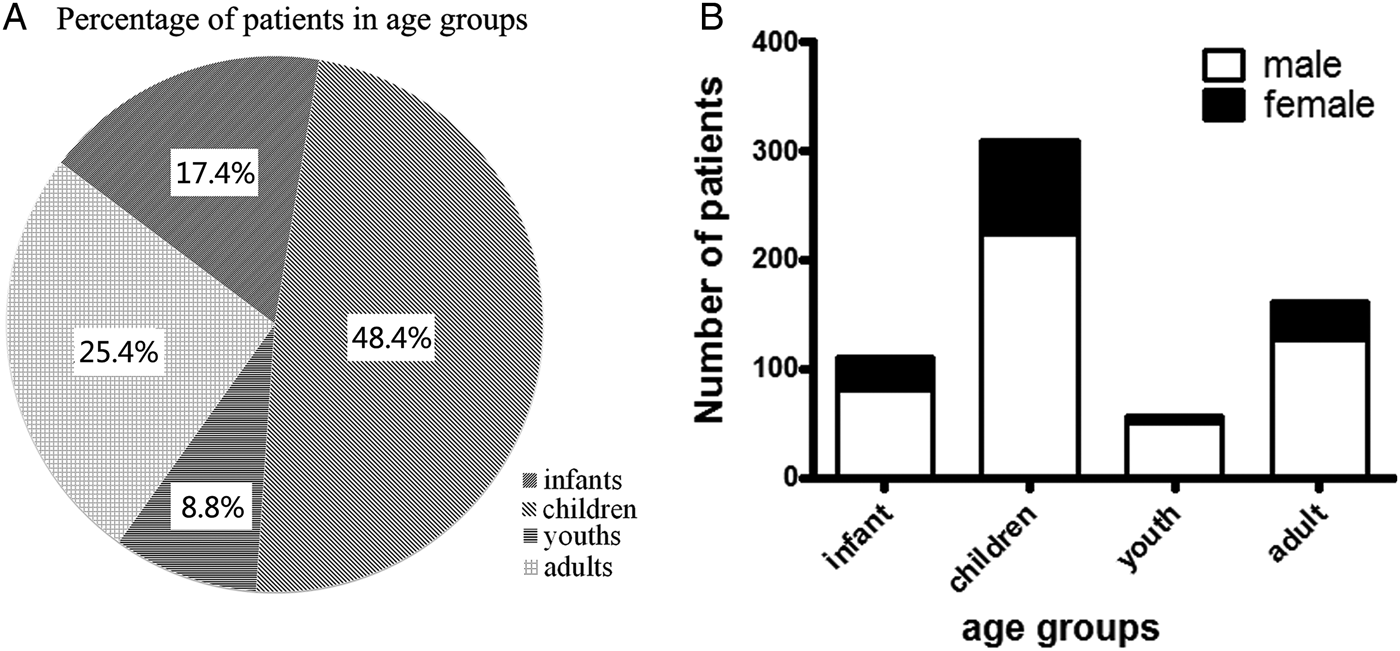
To analyse the relationship between outdoor activity and morbidity, patients who were confirmed to have a Paragonimus infection were divided into four groups by age. The distribution of paragonimiasis cases by age group is displayed in Fig. 3A. Children (5–12 years old) group showed the highest infection rate; 309 of the 638 (48·4%) patients were children. However, youths (13–21 years old) group exhibited the lowest infection rate. Only 56 of 638 (8·8%) patients were youths, perhaps since most individuals in this age group were boarding school residents. Furthermore, infants (<5 years old) and adults groups showed a 17·4% (111/638) and 25·4% (162/638) infection rate, respectively. Notably, there were more male patients than female patients in all age groups (P = 0·0495) (Fig. 3B).
Distribution of paragonimiasis cases by age of patients. Patients were divided into four groups by age. Infants group represents patients under 5 years old; children group equal to 5–12 years old patients; youths group means 13–21 years old patients and adults group shows patients over 21 years old. (A) The percentage of patients in age groups. (B) The number of patients in different age groups.

Classification of clinical symptoms
Parasitic invasion of different organs caused different clinical symptoms. Cases were divided into five types according to self-reported symptoms: subcutaneous, pleurisy, cerebral, abdominal and asymptomatic types (Table 2). Most patients reported a single symptom type, except four patients who reported multiple symptoms. One hundred and thirty-three (20·9%) cases were asymptomatic. These patients were referred to us due to computed tomography or B ultrasound findings. Only 47 (7·4%) of patients showed abdominal symptoms. A similar number of patients belonged to the subcutaneous, pleurisy and cerebral symptom groups.
Clinical symptoms classification of patients

Note that the total number of patients is more than 638, due to four patients who consumed two types of food species.
Discussion
Paragonimiasis is an important water-borne zoonosis that is endemic in most parts of Asia, including China, Japan (Nagayasu et al. Reference Nagayasu, Yoshida, Hombu, Horii and Maruyama2015; Yatera et al. Reference Yatera, Hanaka, Hanaka, Yamasaki, Nishida, Kawanami, Kawanami, Ishimoto, Kanazawa and Mukae2015), India (Das et al. Reference Das, Doleckova, Shenoy, Mahanta, Narain, Devi, Konyak, Mansoor and Isaakidis2017), Vietnam (Doanh et al. Reference Doanh, Tu, Bui, Loan, Nonaka, Horii, Blair and Nawa2016), with sporadic case reports from America (Fischer and Weil, Reference Fischer and Weil2015), Africa (Friant et al. Reference Friant, Brown, Saari, Segel, Slezak and Goldberg2015) and Russia (Besprozvannykh, Reference Besprozvannykh1994). Approximately 20 million people are infected with paragonimiasis and 300 million people are at risk of infection (Ahn et al. Reference Ahn, Na, Chung, Kim, Kim and Kong2015). Nine species of Paragonimus can infect humans (Blair et al. Reference Blair, Nawa, Mitreva and Doanh2016). Paragonimus westermani is the predominant species in Asia, whereas P. skrjabini is only found in China. In China, a national epidemiological survey of parasitic diseases published in 2005 (Coordinating Office of the National Survey on the Important Human Parasitic Diseases, 2005) showed that the rate of serological positivity for paragonimiasis was 1·71%. The report indicated that paragonimiasis remains a threat to public health. Chongqing is an important region of paragonimiasis endemism, especially P. skrjabini. However, few studies have been carried out to investigate the epidemiology of paragonimiasis in Chongqing after it separated from Sichuan province in 1997. Our laboratory has focused on diagnosis of paragonimiasis in the Chongqing area since 1999. In 2008, we carried out serological testing for paragonimiasis using ELISA and a rapid diagnosis kit produced by Zhejiang Academy of Medical Sciences (Gan et al. Reference Gan, Shi, Wang, Wang, Shen, Zhu, Tang and Zhang2005). Deficiently, this method is hard to identify the Paragonimus at species level. However, we had been working on a new Paragonimus test kit these years (Yu et al. Reference Yu, Zhang, Chen, Zheng, Ai, Ye and Wang2017). It will be used in the future. In this study, we performed a retrospective review of cases reported between 1 January 2010 and 30 December 2015. To the best of our knowledge, this is the first report of a systematic epidemiological review of paragonimiasis in Chongqing.
In this 6-year period, 638 patients were confirmed to have paragonimiasis. Based on the geographical distribution analysis, most patients were distributed on the east side of the Wujiang River (Fig. 2). Notably, more than one-third of patients confirmed to be infected lived along the border of Hubei province, which also belongs to the Three Gorges region. We also identified 39 patients from Downtown Chongqing, the region of west Chongqing with the highest infection rate. Further investigation showed that 33/39 patients had travelled to east Chongqing prior to infection. Our previous publication suggested that the rising water level in the Three Gorges region may have produced more streams that are a suitable habitat for freshwater crabs or Cambaridae, which could cause an increase in morbidity from paragonimiasis (Zhang et al. Reference Zhang, Wang, Wang, Chen, He, Niu, Li, Chen and Wang2012). The results of this study confirmed our hypothesis that paragonimiasis is increasing in this region. The epidemiology of Paragonimus in the Three Gorges region should be investigated further, and a public health education initiative is strongly recommended to control this disease.
After ingestion of metacercariae, juvenile worms excyst from the metacercariae and migrate to the target organ, where they settle and develop into adult worms in 2–3 months (Keiser and Utzinger, Reference Keiser and Utzinger2009). However, limited data are available on how long it takes for patients to become symptomatic. In this study, we found that more than 50% of patients were diagnosed between March and July. In 2011, 20·5% of patients were diagnosed in April (Fig. 1B). Considering crabs were always harvested around October, and crabs consumption concentrate on October in China, we speculate that approximately 6 months is required for manifestation of serious clinical symptoms post-infection.
We observed an age distribution pattern among the patients; paragonimiasis occurs predominantly in children (Fig. 3A), with almost half of patients being children. Children of this age typically live with their grandparents, and they spend considerable time outdoors without adult supervision. They tend to eat raw or undercooked crabs, and they are thus at highest risk of infection. However, only 8·8% of patients were youths. This is likely because most youths are boarding school residents, with few opportunities for unsupervised outdoor activity. Notably, 17·4% of patients were infants. Infant patients show more serious symptoms but early detection is difficult.
Approximately 70% of patients had eaten raw crab, Cambaridae, or wild vertebrate meat. Raw crab or Cambaridae consumption was the main reason for infection. A recent study confirmed that deer can also host P. westermani (Yoshida et al. Reference Yoshida, Matsuo, Moribe, Tanaka, Kikuchi, Nagayasu, Misawa and Maruyama2016), and indicated that other vertebrates may also be unreported paratenic hosts of Paragonimus. Hence, although only approximately 3% of patients had a history of eating wild vertebrate meat, consumption of undercooked wild game cannot be ignored as a source of infection, and should be investigated further.
In conclusion, paragonimiasis remains a public health issue in Chongqing, especially the Three Gorges region. Many publications show that the risk of paragonimiasis infection is high in the Three Gorges region (Wang et al. Reference Wang, Yang, Wang, Pan, Lv, Qiu, Li and Gan2009; Zhang et al. Reference Zhang, Wang, Wang, Chen, He, Niu, Li, Chen and Wang2012, Reference Zhang, Peng, Liu, Fan, Zhang, Chen, He, Wu, Liu, Yang, Yu and Yun2014), and we strongly recommend that an in-depth survey be carried out in this area, and that a public health education initiative be started to help control this disease.
Financial support
This work was supported by the Natural Science Foundation of Chong Qing China (grant no. cstc2016jcyjA0485).
Conflict of interests
The authors declare no conflict of interests.