1. Introduction
The last 25 years have witnessed an increasing interest in pragmatic markers (for example, Schiffrin Reference Schiffrin1987, Fraser Reference Fraser1996, Mosegaard Hansen Reference Mosegaard Hansen1998, Fischer Reference Fischer2006, and Brinton Reference Brinton2008). They have been studied for the way they organize discourse (for example, as a topic introducer or an interruption device); for the interpersonal functions they fulfill (for instance, as an establisher of common ground or a marker of disagreement with the addressee's position); for the development from propositional over textual to subjective or speaker-related and intersubjective or addressee-related meanings that they go through (see Traugott & Dasher Reference Traugott and Dasher2002). The English literature has focused largely on pragmatic markers of adverbial origin (see, among others, Oh Reference Oh2000, Smith & Jucker Reference Smith, Jucker, Andersen and Fretheim2000, Clift Reference Clift2001, Taglicht Reference Taglicht2001, and Aijmer Reference Aijmer2002:251–276 on actually). The markers of verbal origin, and in particular those of imperatival origin, have received significantly less attention. The only detailed study on look, for example, is Brinton Reference Brinton2001.
For Dutch, the situation is somewhat different. The research into this language's pragmatic markers has a remarkably rich history (see, for instance, Kirsner & Deen Reference Kirsner, Deen and Lacy1990, Foolen Reference Foolen1993, and Vismans Reference Vismans1994). Kijk ‘look’, for instance, has been discussed in some depth (see, for example, De Vriendt Reference De Vriendt1995 and Janssen Reference Janssen2006). The contrastive literature on pragmatic markers of imperatival origin, however, is restricted to Van Olmen Reference Van Olmen2010a,Reference Van Olmenb. In these articles, the Dutch imperatives of intentional visual and auditory perception, kijk ‘look’ and luister ‘listen’, are compared to their English counterparts, look and listen. The present study concentrates on another imperative from which the two languages have derived pragmatic markers, that is, that of say. Its main goals are to map the pragmatic functions that say and zeg ‘say’ currently fulfill and to examine their development.
Say has already been discussed by quite a few linguists (for example, Goossens Reference Goossens, Dirven, Goossens, Putseys and Vorlat1982 and Stvan Reference Stvan, Hornero, Luzón and Murillo2006). The most recent as well as the most comprehensive contribution is Brinton Reference Brinton2008:73–110. She describes the functions of say as a pragmatic marker in contemporary English and sketches its evolution on the basis of exploratory diachronic research. The present article may be regarded as complementing her work, for two reasons. First, it looks not at written but at spoken language. The spoken language data give rise to a slightly different picture of say's functions and especially of the functions' distribution. Second, the English marker is compared to its counterpart in Dutch. This contrastive approach offers an additional dynamic-synchronic perspective on the way(s) in which the imperative of say turns into a pragmatic marker. Following Waltereit (Reference Waltereit2002:1008), who notes for Italian guarda ‘look’ that “a comparison of the DMs [discourse markers] resulting from the imperative ‘look!’ in several languages might […] provide interesting insights into the typical sequence of changes,” the present study examines how not only the synchronic functional variation within one language but also the (dis)-similarities between languages reflect historical developments (but note that it consults diachronic data, too).
Obviously, the comparison to Dutch requires a good understanding of zeg. The literature on this marker is fairly limited, though. Apart from the occasional remark (e.g., Stroop Reference Stroop2006 and Van der Wouden Reference Van der Wouden2007) and some modest papers (for instance, De Vriendt Reference De Vriendt1995, Landsmeer Reference Landsmeer2007, and Valstar Reference Valstar2010), there is only one linguist who discusses it at any length. Schermer (Reference Valstar2007) gives an intuitive overview of zeg's functions in contemporary Dutch and formulates a number of hypotheses about its development. The present article makes it possible to check her claims against corpus data and—assuming that one can indeed gain insight into the development of the imperative of say as a pragmatic marker from the (dis)similarities between zeg and say—against English. It also differs from Schermer's (Reference Schermer2007) study in that it is not confined to zeg. In contemporary Dutch, the combination of zeg and the modal particle maar ‘only’ is frequently employed for a number of pragmatic purposes that overlap only partially with those for which zeg alone (or say) is used.Footnote 1 Since this article seeks to chart all the pragmatic functions of the imperative of say, the collocation zeg maar is examined as well.Footnote 2
This introduction is followed by five more sections. In section 2, the results of a study of say in the spoken part of the International Corpus of English—Great Britain (see Survey of English Usage 2006, henceforth abbreviated as ICE-GB) are presented. The corpus consists of 637,682 words and includes dialogues and monologues.Footnote 3 Section 3 deals with zeg (maar) in a comparable corpus—that is, a corpus with similar texts and a similar design (see Johansson Reference Johansson, Johansson and Oksefjell1998:5)—of 300,590 words, a selection of the syntactically annotated files of the Northern Dutch component of the Corpus Gesproken Nederlands (see Nederlandse Taalunie 2004, from now on referred to as CGN).Footnote 4 Special attention is paid to the similarities with—and differences from—English. Note that the analysis in sections 2 and 3 relies not only on the ICE-GB and the CGN but also on a small collection of recent plays and their translations. This translation corpus, or parallel corpus (see Mauranen Reference Mauranen2002:162), contains 96,452 words of original British English, 70,280 words of original Northern Dutch, as well as their respective translations into Northern Dutch and British English (see Van Olmen Reference Van Olmen2011b:115–117 for more information) and is mostly used as a control corpus. The choice of plays here is motivated by the assumption that such texts are a rough approximation of the spoken language and of the private dialogues in the other corpora, in particular (see Vismans Reference Vismans1994:76 and Culpeper & Kytö Reference Culpeper and Kytö2000).Footnote 5 Section 4 is an intermediate summary.
Section 5 answers the question what insights the comparison of say and zeg (maar) provide into the developments of the imperative of say in general. It also consults various diachronic corpora and the quotation banks of a number of historical dictionaries, not so much for quantitative as for qualitative support. As Brinton (Reference Brinton2008:19) argues, “a rigorous quantitative [diachronic] study of pragmatic markers is often not feasible or fruitful” because of, inter alia, the paucity of attestations and the difficulties in interpreting “forms as pragmatic rather than as purely propositional in meaning.” Of course, the use of dictionaries is not unproblematic either: Certain writers may be overrepresented, the quotations differ considerably in length, and they first and foremost serve illustrative purposes, often of fairly infrequent items (see Brinton Reference Brinton2008: 20). However, like the quotation bank of the Oxford English Dictionary (OED), those of the Vroegmiddelnederlands Woordenboek (VMNW) for Early Middle Dutch and the Woordenboek der Nederlandsche Taal (WNT) for 16th to 20th century Dutch, for example, are probably large enough to be used—with care—by historical linguists for exploratory research (see Hoffmann Reference Hoffmann2004 on the OED). Finally, section 6 discusses the overall results. It concludes by looking into the imperative of say as a pragmatic marker in a range of other languages and raising the possibility of it being an areal phenomenon or, in other words, of its occurrence in a particular set of neighboring languages being due to language contact.
2. English
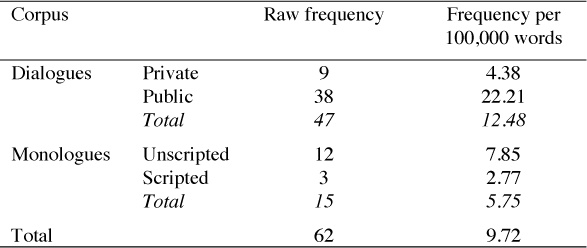
Table 1 presents the distribution of say when it does not function as a genuine directive to speak. It provides the raw number of attestations of say for the ICE-GB as a whole and for each subcorpus, and it also gives the number of attestations per 100,000 words.
The distribution of nonliteral say in the spoken component of the ICE-GB.
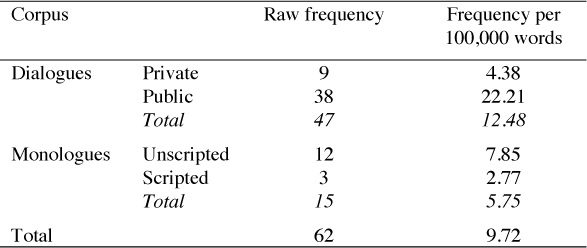
The absolute frequencies are, of course, too low to make any definitive statements about the distribution of say. Still, it is remarkable that the private dialogues, normally the subcorpus where pragmatic markers flourish (see, for instance, Van Olmen Reference Van Olmen2010b:77 on look and listen), contain so few cases. The explanation probably lies in the functions that say fulfills. They are discussed one by one in the following subsections. Special attention is paid to the text types in which a particular function is likely to occur and to the position(s) it occupies in the clause. Syntactic behavior plays an important role in the dynamic-synchronic study of the imperative of say's developments discussed in section 5.
2.1. Clause-Initial Conjunction-Like Marker
In 1a, the imperative of say introduces a supposition in the form of a conditional clause. Example 1b shows that if does not even have to be present, so say exhibits a conjunction-like behavior (see Brinton Reference Brinton2008: 78).
(1)

It is not implausible that this use is favored in contexts where speakers are constructing an argument. The lessons in the subcorpus of public dialogues, for one, fit the description. They contain half of the 14 attestations of this say in the ICE-GB. Unsurprisingly, it does not occur in the corpus of plays.
2.2. Clause-Medial Preposed Marker of Potential Example
Another possible reason for say's infrequency in the private dialogues is its use to characterize something as a potential example. In 2a, for instance, the imperative of say is followed by a rather arbitrary and noncommittal suggestion. Its hypothetical overtones are, to some extent, reminiscent of the examples in 1. In 2b, however, the speaker selects the black painting from a limited number of options, for a specific purpose. The function under discussion is expected to come in handy in lengthy expositions, such as the cross-examinations and lessons in the subcorpus of public dialogues, and the speeches and talks in the subcorpus of monologues. It should not come as a surprise that say is not used in this manner in the parallel corpus.
(2)
According to Brinton (Reference Brinton2008:76), the position of this adverbial say is flexible: “It may be either preposed … or postposed to the word it focuses. It may also refer at a distance.” However, the 33 attestations of this use in the ICE-GB all immediately precede the potential example, which points to a strong preference for this position. Say is flexible in another way: As its position after the head of the prepositional phrase in 2a makes clear, it can easily break up constituents.
2.3. Clause-Medial Preposed Approximative Marker
This function of say, which seems to be related to the one exemplified in 2, can be compared to approximately. Sentence 3a exemplifies the most common context of use: The speaker preposes the imperative of say to a number to indicate that he or she is making an estimate or, in words reminiscent of the function discussed in section 2.2, a potential value. Another context in which this approximative meaning emerges, and which is not mentioned by Brinton (Reference Brinton2008:76), is the combination with a moment in time or a date. Say in 3b is a case in point.
(3)
In the ICE-GB, the use in 3 occurs 14 times (and makes up 5 of the 9 attestations in the private dialogues). The corpus of plays also contains a few cases. So it appears that the spoken language data confirm Brinton's (Reference Brinton2008:80) results: “Say3 [that is, the use in 2] is the majority form … [but] say2 [that is, the use in 3] is fairly common as well.”
2.4. Clause-Medial Marker of Potential Formulation
Brinton (Reference Brinton2008:74–76) does not distinguish between the use of say in 2 and that in 4. Like 3, the latter use—which is found three times in the ICE-GB—does resemble the former use (interestingly, the pragmatic marker is able to break up constituents in all these functions). In 4, too, the imperative of say presents something as a possibility.
(4)
The difference is that say in 2 pertains to some exemplary entity or state of affairs, and in 4 to the choice of words: The movies are said to have a property that could be described as claustrophobic. It becomes clear in section 3 why it is important to make this distinction.
2.5. Additional Functions of Say
The four preceding sections do not cover all uses of say. Brinton (Reference Brinton2008), among others, mentions two more functions. In 5, the American national anthem provides an example of the first function, that of a clause-initial interrogative attention-getter. In this case, the imperative of say acts as a pointer to the question that it introduces and as an additional stimulus prompting to give an answer.
(5)
The second function is that of a clause-initial marker of subjectivity exemplified in 6. Say behaves like a true clause-initial interjection here. It is used “to express a (rather weak) emotional response […] to what is (about to be) said,” as in 6a, and/or “to evoke the hearer's attention” (Brinton Reference Brinton2008:77), as in 6b.
(6)
What is striking is that, with the exception of a few English translations of zeg, the use of say in 5 and 6 is entirely absent from both the ICE-GB and the parallel corpus. This fact undermines Brinton's (Reference Brinton2008:80) claim that “they are the most colloquial of the forms.” This statement was meant to explain their low frequency in her written data. The OED (s.v. say v. 6c) is probably right in writing that the use in 5 is limited to poetic language. With respect to the use in 6, Stvan (Reference Stvan, Hornero, Luzón and Murillo2006:73) may very well have a point: “[It is] used less in current English than in the early 20th century. The current low use is partly accounted for by the use of newer terms [such as hey].”
3. Dutch
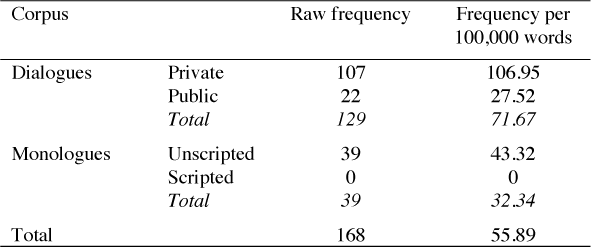
Table 2 presents the distribution of zeg (maar) when it does not function as a true directive to say something. For each subcorpus and for the comparable corpus of Dutch (the corpus similar to the ICE-GB) as a whole, it provides the raw number of occurrences of zeg (maar) as well as the number of occurrences per 100,000 words.
The distribution of nonliteral zeg (maar) in the comparable corpus of Dutch.
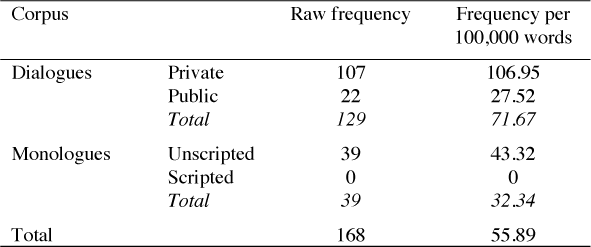
The comparison of tables 1 and 2 shows that, in terms of frequency, the English imperative of say is no match for its Dutch counterpart as a pragmatic marker. Zeg (maar) occurs almost six times more often than say (that is, their relative frequencies are, respectively, 55.89 and 9.72 instances per 100,000 words). Furthermore, of all attestations of the Dutch imperative of say as a pragmatic marker, 135 co-occur with the modal particle maar. This collocation appears to be characteristic of the private dialogues and the (surprisingly informal) news reports in the sub-corpus of unscripted monologues. The dialogues and news reports contain 78 and 29 cases, respectively. Thus, zeg (maar) also differs greatly from say in terms of distribution despite the fact they have a number of functions in common. This overlap becomes apparent in the one-by-one treatment of zeg (maar)'s uses in the following subsections. As in section 2, particular attention is given to the text types in which say tends to fulfill a specific function and to its position(s) in the clause.
3.1. Clause-Medial Preposed Approximative Marker
Zeg maar in 7a and 7b has roughly the same meaning as say in 3. Van der Wouden (Reference Van der Wouden2006:260), on the one hand, rightly points out that this approximative use can break up constituents, as 7c makes clear. In the comparable corpus of Dutch, on the other hand, all 24 attestations of this use are found before the constituent that they pertain to.
(7)
Interestingly, this approximative function can also be fulfilled by zeg without maar. The noun phrase in 8 can serve as an example.
(8)
This use of zeg is attested neither in the comparable corpus of Dutch nor in the corpus of plays but, intuitively, it has exactly the same positional properties as zeg maar in 7.
3.2. Clause-Medial Marker of Potential Formulation
This function is exemplified in 9. In this sentence, zeg maar, just like say in 4, introduces a potential formulation, a neologism to be precise. How-ever, as its 70 hits in the comparable corpus suggest, this use is much more established in Dutch. In English, it is probably better regarded as a rather marginal extension of the use in 2.
(9)
In 9, the imperative of say is preposed to the constituent for which “de spreker het juiste woord of de juiste omschrijving zo gauw niet kon vinden” (Stroop Reference Stroop2006:5).Footnote 7 That is not always the case, though. In 10a and six other attestations of this use, zeg maar defies constituent boundaries. What is more, in 10b,c and 41 other attestations, it follows the potential formulation, possibly at the end of the clause.
(10)
Note that this last position is by far the most popular one in the private dialogues: It occurs in 22 of the 27 attestations of this zeg maar.
3.3. Hedge
Unlike say, zeg maar can be employed as a hedge. The answer in 11, for instance, does not include any value that has to be described as an approximation; nor does it contain a word that has been chosen for lack of a better term. The speaker adds the pragmatic marker to mitigate his utterance (consider the use of ik denk ‘I think’ and niet echt ‘not really’ as well). The statement is presented as one of a number of possible statements, as provisional and uncertain. Zeg maar allows the speaker to hide behind a half-hearted commitment to the proposition in case the latter is challenged (see Landsmeer Reference Landsmeer2007:29, too).
(11)
Stroop (Reference Stroop2006:5) claims that this use of zeg maar is often associated with the clause-final position. However, examples such as 12 make up almost half of its 41 attestations in the comparable corpus of Dutch. Still, the proportion drops to just seven out of 30 hits in the private dialogues. This subcorpus appears to be the discourse type in which the (probably newer) nonpreposed position of zeg maar thrives (see section 3.2 as well). Van der Wouden's (Reference Van der Wouden2007:260) claim is confirmed: As a hedge and as an introducer of a potential formulation, zeg maar respects the constituent boundaries.
(12)
Following Landsmeer Reference Landsmeer2007:28, one could say that in 9 and 10, zeg maar has to do with the form of a single constituent, while in 11 and 12, it relates to content of the whole sentence. She also points to a possible bridging context, a context that is vague between the two functions. In 13, the speaker does not draw on zeg maar because he cannot think of the correct expression for homosexual. It is clear from the preceding reference to Pinkeltje—a helpline for gay, lesbian, and bisexual youth—that the speaker knows what he is talking about. The pragmatic marker seems to be used primarily to present the perhaps not entirely unproblematic word homo ‘homo’ in a careful, noncommittal manner.
(13)
‘Chris he works at such uh at Pinkeltje by the way … For if you yeah if you are say gay and then yeah just not yeah you do not know how you have to talk about it with your parents or something like that you know then you can call them.’
The emphasis is still on the form, as in 9 and 10 (for that reason, this example and some ten similar cases are counted as instances of the function discussed in section 3.2). Just as in 11 and 12, however, the speaker's low degree of commitment plays a crucial role here.Footnote 8
3.4. Clause-Initial Attention-Getter
The imperative of say in Dutch also occurs as a pragmatic marker without maar. Resembling say in 5 and 6, zeg is sometimes found at the beginning of a clause to attract the addressee's attention, as in 14a. Somewhat surprisingly, this use accounts for only 5 of the 33 remaining attestations in the comparable corpus of Dutch. The Dutch plays contain an additional 14 examples. De Vriendt (Reference De Vriendt1995:157) is right in pointing out that this zeg can be followed by any clause type.
In 14a, it precedes an interrogative and serves as an attention-getter and—in line with its original meaning of telling someone to say some-thing—as an extra stimulus to answer the question. Zeg here looks a lot like say in 5 but seems much less old-fashioned.Footnote 9 In 14b, the marker is followed by an imperative. The speaker is trying to attract the addressee's attention as well as trying to get a reaction out of him or her, not in words this time but in deeds, or at least some sign of compliance. In 14c, zeg is used before a declarative. In this case, the marker indicates “dat de spreker het meegedeelde opmerkelijk genoeg vindt om onder de aandacht van de aangesprokene te brengen: wat na zeg1 komt, is voor de spreker ‘reactiewaardig’” (Schermer Reference Schermer2007:379).Footnote 10
Interestingly, the English imperative of say can combine with a declarative as well, as in 6, but it does not have the same effect as its Dutch counterpart. Say in 14d may resemble zeg in 14c in functioning as an attention-getter, but it does in no way attempt to draw a reaction from the addressee. The speaker in 14d is mainly concerned with expressing his or her disbelief, astonishment, or joy, which is not true for 14c. It appears, in other words, that say is more subjective than zeg, and zeg is more interpersonal than say. Moreover, this second difference explains why the combination with an imperative is strange in English, as 14e makes clear.
(14)
Note, finally, that, notwithstanding 14b,c, there is a clear preference for interrogatives in Dutch. All nineteen attestations of the clause-initial zeg conform to the pattern in 14a.
3.5. Clause-Final Prompt to React
Unlike say, the Dutch imperative of say without maar is found in clause-final position. In the comparable corpus, it occupies this position in 21 of the 33 attestations (the parallel corpus contains just a few examples). Schermer (Reference Schermer2007:379–380) gives a good description of this use:
In overeenstemming met de positie aan het eind van de zin of uiting ontbreekt het aandachttrekkende aspect; de spreker heeft zich al tot de toegesprokene gericht, dus het is niet meer nodig diens aandacht te trekken. Wel wordt nog een reactie verwacht op het voorafgaande.
In accordance with its position at the end of a clause or utterance, the attention-getting aspect is missing; the speaker has already addressed the hearer, therefore it is no longer necessary to attract his or her attention. The speaker still expects a reaction to what precedes, though.Footnote 11
However, her claim that “vragen en aanmaningen … bij zeg2 … evenzeer voor[komen] als bij zeg1” (Schermer Reference Schermer2007:380) is not borne out by the data.Footnote 12 Cases such as 15a are not found in the comparable corpus of Dutch and even sound somewhat peculiar to me. The only interrogative in the material, that is, 15b, has more of an exclamatory character.Footnote 13 This also holds for the 10 declaratives, the five exclamatives, and the five elliptical instances, which are illustrated in 15c, 15d, and 15e, respectively. This fact should not come as a total surprise: When one thinks that something is worthy of the addressee's reaction, one is probably involved in the matter emotionally (see Schermer Reference Schermer2007:381). Occasionally, zeg's subjectivity even gains the upper hand. In 15e, for example, the marker does not really ask for a response any more.
(15)
In fact, the utterance itself is a positive reaction to what the interlocutor has just said. According to Schermer Reference Schermer2007:382, in such a case zeg signals that the speaker regards the addressee to be “een geschikte ‘reactie-gever’ […] [of, anders gezegd,] een passend ‘klankbord’.”Footnote 14
3.6. Free-Standing Subjective Clusters
In each of the seven remaining attestations of zeg without maar in the comparable corpus of Dutch, it is part of a free-standing cluster of interjections (though it can fulfill the present function on its own as well). The examples in 16 are cases in point.
(16)
By means of such a cluster, the speaker reacts to a statement or an event and can express, inter alia, his or her surprise or disapproval as in 16a. Not infrequently, this use appears to imply a further utterance. In 16b, for instance, the second speaker seems to make some tacit appeal to the first one to stop talking in that way. Note, for the sake of completeness, that say does not share this function of its Dutch counterpart either.
4. Intermediate Summary
Figure 1 gives an overview of the various functions of say and zeg (maar). It is solely for clarity's sake, and not intended as a semantic map à la Haspelmath Reference Haspelmath and Tomasello2003 but just sums up the similarities and the differences in usage between the two languages.
Figure 1 is to be interpreted as follows. First, the dashed line delineates the English uses, the full line the Dutch ones. Second, the subscripted numbers refer to the examples in sections 2 and 3. Third, the partial inclusion of the upper left function alludes to the fact that in English, presenting a potential formulation is a rather peripheral extended use of the imperative of say (see sections 2.4 and 3.2). Fourth, the clause-initial attention-getter use is split into an interrogative and a non-interrogative case to reflect the fact that say can only precede questions, while zeg can precede other clause types as well.
The usage of say and zeg.

5. Development
As mentioned in the introduction, this section investigates what the comparison of English and Dutch in figure 1 can reveal about the development of the imperative of say into a pragmatic marker, and about its further evolution. It also takes diachronic material into account, though.
5.1. Clause-Initial Conjunction-Like Marker
Brinton (Reference Brinton2008:89) writes that the conjunction-like say is attested as early as the 16th century; it results from an evolution which is completely independent of the English imperative of say's other developments: “[It] is fossilized in form and reduced syntactically from a matrix clause to a subordinating conjunction.” Her claim is confirmed by the fact that zeg (maar) shares both adverbial and interjection uses with say but cannot serve as a conjunction-like marker (if there was a link between the former functions and the latter function, one would expect zeg (maar) to exhibit this conjunction-like use too).Footnote 15 Still, it is hard to deny the semantic resemblance between this use of say and its use as an introducer of a potential example, as in 1b and 2a, respectively. It would not be unreasonable to suppose that the hypothetical meaning of the former in the 16th century had some influence on the development of the latter, a 17th century innovation (see Brinton Reference Brinton2008:83), and that the absence of one function in Dutch explains the absence of the other. Consider 17, though.
(17)
The fact that in the past zeg could actually be used to present a hypothesis is at odds with the supposed link between the absence of the two functions.
5.2. Potential Formulation and Example, Approximation, and Hedging
Concerning say as an introducer of a potential example and approximative say, Brinton (Reference Brinton2008:89) argues: “[They] are likewise fossilized and reduced syntactically, here from matrix clause to an adverb. This change […] is contingent on the prior change of the imperative say from a main verb to a parenthetical.” Strangely, no possible connections and/or differences between the adverbial functions are mentioned. For Dutch at least, the following scenario seems very plausible. Originally, zeg maar occurs exclusively before a potential formulation. The imperative occupies its normal position and its lexical meaning—in combination with maar, zeg could be paraphrased as ‘there are no objections to saying, it is allowed/possible to say …’—is still palpable.Footnote 16 Subsequently, the marker is increasingly associated with the speaker's caution and uncertainty, as in 13. The focus shifts from form to content. The imperative is finally reanalyzed as a parenthetical and thus positionally more flexible item—in other words, a “comment clause” (see Brinton Reference Brinton2008:2)—and functions as a hedge.
Unfortunately, this hypothesis (see Landsmeer Reference Landsmeer2007, too) is hard, if not impossible, to verify. An exploratory study of a diachronic corpus of drama and fictional prose, the Compilatiecorpus (CC, see Coussé Reference Coussé2010), the 38 Miljoen Woorden Corpus (38MWC, see Instituut voor Neder-landse Lexicologie 2011a), and the Eindhoven Corpus (EC, see Instituut voor Nederlandse Lexicologie 2011b) suggests that zeg maar fulfills all functions at the same time, in its first attestations in the EC data from 1960–1976 (but see Valstar 2010:5 for an example dating back to 1906).Footnote 17 One possible explanation for this is that zeg maar rapidly goes through the various stages under pressure of or by analogy with some existing construction. Zal ik maar zeggen ‘I will just say’ in the EC seems a likely candidate. Compare 18a to 7a, 18b to 9, and 18c to 11.
(18)
Strikingly, in the EC, zal ik maar zeggen is still 2.5 times more frequent than its imperative twin. However, in the comparable corpus of Dutch, it has a rate of occurrence of only two cases per 100,000 words, while zeg maar's relative frequency has gone up to 45 cases. The imperative of say may be regarded as the quick successor of the construction in 18. Both serve as some type of stopgap, and the frequent use of such a marker is extremely conspicuous. Stopgaps often even cause irritation (see Stroop Reference Stroop2006:5, who characterizes zeg maar as a “wauwelwoord” or prattle word). Therefore, they can feel outdated and fall into disuse quite fast, and other, more recent forms can fill the “functional lacunae” that they leave behind (see Van Oostendorp & Van der Wouden Reference Van Oostendorp and van der Wouden1998 on the bad press received by the particle combination best wel ‘quite’, Van der Wouden & Caspers Reference Van der Wouden and Caspers2010:55–56 on its popularity in the 1970s and 1980s and its infrequency in present-day Dutch, and Van der Wouden 2002:10 on the 30-year rise and demise of ergens ‘somewhere’ as a mitigator). The not unproblematic nature of zal ik maar zeggen as a stopgap is nicely illustrated in 19.
(19)
With respect to the approximative use of zeg maar, it is important to note that it need not have developed straight out of its other adverbial uses, despite the semantic contiguity. Zeg without maar has the meaning ‘approximately’ too, as in 8, but it seems to be fairly rare nowadays (see section 3.1). From the fact that the WNT (s.v. zeggen ww. and zeg tw.) makes no mention of this use of zeg, it could be inferred that it is a 20th-century innovation as well. Its first and only attestation in the afore-mentioned diachronic corpora and in the dictionary quotation banks, in 20, provides supporting evidence for this hypothesis.
(20)
This example is earlier than the first occurrence of zeg maar as an approximator in the present data. Interestingly, in the more recent GWNT (s.v. zeggen ww), the approximative use is still attributed exclusively to zeg, and zeg maar is characterized solely as introducing a potential formulation. This description could be interpreted as a reflection of this attested difference in timing.Footnote 18 If the approximative zeg indeed predates the approximative zeg maar, it is possible that the latter marker has received its meaning from the former—as well as from zal ik maar zeggen, of course—(partly) as a result of the formal similarities. In this respect, it is worth noting that the approximative say appears two centuries after say as an introducer of a possible example, in the middle of the 19th century to be exact (see Brinton Reference Brinton2008:82).
5.3. Clause-Initial Attention-Getter and Marker of Subjectivity
The comparison of clause-initial say and its Dutch equivalent seems to indicate that they do not have the exact same history. Evidently, they do both originate from a directive to provide the answer to the subsequent question. Brinton's (Reference Brinton2008:89) claim that the development involves “a syntactic reversal of matrix and subordinate clause” needs to be questioned. This scenario, the so-called “matrix clause hypothesis” (Brinton Reference Brinton2008:36), includes a stage at which the clause following the imperative of say is subordinate to it, as in 21a. However, already in Old Dutch and Old English, one finds examples such as 21b, where the imperative of say precedes not the subordinate but the main clause.Footnote 19
This fact points to a source construction different from 21a, namely 21c, which is to be preferred for two reasons. First, if 21b developed out of 21a, it remains to be explained what motivated the reanalysis of matrix clause + subordinate clause as parenthetical + main clause. Second, it is not clear how it could happen in the first place, given the difference in word order between a subordinate clause (that is, the verb in final position) and an interrogative main clause (that is, the verb in initial or second position).
In contrast, if 21a developed out of 21c, word order poses no problem and, in line with Waltereit's (Reference Waltereit2002:999) argument that “functional change may be provoked by speakers who use a form in a new way that serves a frequently occurring communicative purpose,” speakers can start exploiting the parenthetical imperative of say for specific discourse objective as a trigger for its further development. Interrupting counts as such an objective. In 21d, for instance, the knight Gawain makes optimal use of the appealing nature of the imperative sege ‘say!’ to get the attention of a passerby.
(21)
Present-day say and zeg differ with respect to the clause types that can follow them. The Dutch options can be linked to one another in a neat way. Preceding an interrogative, the pragmatic marker urges the addressee to react verbally. In the case of an imperative, according to the WNT (s.v. zeg tw. 2), the second most common context of use, the type of reaction constitutes an action, or, more generally, a sign of compliance or disobedience. It is not difficult to think of a bridging context for the two uses: Many a question has an unmistakably directive function. Finally, when heading a declarative such as 14c, zeg is reduced to a stimulus to acknowledge the speaker's message. In the VMNW and WNT citations and the aforementioned diachronic corpora, the first truly pragmatic cases of clause-initial zeg surface in the 17th century. As expected, the imperative of say patterns exclusively with the interrogative here, as in 22a. The 18th-century data contain an occasional ambiguous combination with an imperative, such as 22b, and even one with a declarative serving as a question, such as 22c (in both cases, zeg could also relate to the preceding question, see example 15a). Only from the 19th century onward does the imperative of say introduce non-interrogatives on a regular basis. In addition, zeg appears to extend to all clause types at once, including the imperative in 22d, the inquisitive declarative in 22e, the asserting declarative in 22f, and the exclamative in 22g. The explanation lies in the fact that, by its very nature, the diachronic material makes it impossible to document the detailed history of as colloquial a phenomenon as zeg—which, in a way, licenses the present article's dynamic-synchronic approach.
(22)
The scenario sketched above does not apply to say, though. The English imperative of say cannot really co-occur with imperatives. In all probability, declarative instances such as in 6 have a different origin, that is interaction with I say. This marker was already used as an attention-getter in the 17th century and, like the older form say, it could fulfill this function in combination with interrogatives (see Brinton Reference Brinton2008:85). As a result of this overlap, the imperative of say must have also sometimes served as an alternative to I say in the latter's more recent “emotive function” (Brinton Reference Brinton2008:84). What is more, this scenario can explain the difference in subjectivity between say and zeg, in particular in combination with declaratives (see section 3.4). Unlike say, zeg has not been influenced by a marker in which the speaker takes center stage (that is, is overtly expressed as I) and which conveys his or her attitude. It originates straight from an additional stimulus to answer the question that follows and is therefore more interpersonal than subjective.
5.4. Clause-Final Prompt to React and Free-Standing Subjective Clusters
In Schermer Reference Schermer2007, the clause-final zeg is argued to derive from its clause-initial use. For her, the fact that zeg at the end of a clause requires no intonation break, carries no accent, and cannot cluster with other interjections or particles is
een blijk van verdergaande grammaticalisatie, want ook imperatieven, het “startpunt” van de grammaticalisatie, staan—geaccentueerd— vooraan en kunnen vergezeld zijn van partikels en vocatieven.
a sign of more advanced grammaticalization, because imperatives too, the “starting point” of the grammaticalization process, are located at the beginning of the clause, are accentuated, and can be accompanied by particles and vocatives. (Schermer Reference Schermer2007:379)
However, already in the earliest Dutch sources, the imperative of say occurs in clause-final position, as 23 shows.Footnote 20
(23)
One should not dismiss the possibility of a parallel evolution of the two uses (see Van Olmen Reference Van Olmen2010a:237 on kijk). It is not implausible that the clause-final zeg originates from contexts such as 23. In this example, the imperative of say is used to repeat the appeal—inherent to the foregoing interrogative—for an answer. Its primary purpose is to add emphasis to the stimulus prompting the reaction to the preceding inquiry, and it is precisely this pragmatic effect that is exploited in uses such as 15. More-over, this additional call for reaction is not necessary from a strictly informational point of view. As a result, the clause-final zeg may be understood as more than just a call on the addressee to react, and its subjective connotations in modern Dutch may be accounted for. The diachronic data provide supporting evidence, for what it is worth. The first clear cases of the pragmatic clause-final zeg date from the same period as those of its clause-initial counterpart, as the comparison of 22a and 24a shows. In addition, 24b suggests that the further developments of both functions are simultaneous, too.
(24)
Finally, as part of a cluster of interjections or on its own, zeg re-sembles the clause-initial use in that a further clause often seems to be implied. For example, toe zeg in 25 could be argued to suggest a directive to stop doing something, which becomes explicit later on. Its high level of subjectivity is reminiscent of the clause-final use.
(25)
The earliest attestations of zeg in clusters or on its own in the diachronic material, one of which is given in 25, coincide with 22b to 22g and 24b.
6. Discussion and Conclusion
Figure 2 is a summary of the developments of say and zeg (maar) as discussed in section 5 and may be considered as an elaboration on Brinton Reference Brinton2008:89, whose map has been described in the previous section. It charts the paths that the imperative of say has followed in English and Dutch. The vertical and diagonal lines connect a source function at the top end to a target function at the bottom end, and the horizontal lines connect a source function at the left end to a target function at the right end. For instance, the vertical line between “clause-initial interrogative attention-getter” and “clause-initial non-interrogative attention-getter” indicates that the latter has evolved out of the former. The figure also allows the author to distinguish between the two languages under examination: In Dutch, the clause-initial interrogative attention-getter gave rise to the noninterrogative one, while in English, it developed into the clause-initial marker of subjectivity. Note that in figure 2, the white and grey boxes are used for functions exclusive to Dutch and English, respectively; the striped boxes represent functions the two languages have (or had) in common (see 4 and 17 for “clause-medial marker of potential formulation” and “clause-initial conjunction-like marker”).
A number of comments are in order here. First, in no way does figure 2 represent the precise timing of the developments. For example, the fact that “hedge” and “clause-initial interrogative marker” are situated at the same height does not imply that these developments are simultaneous. It is clear from section 5 that this is not the case and, more generally, that the chronologies of say and zeg (maar) are just too different to be captured in one figure in a straightforward way. Second, the bold lines stand for links in English and Dutch that have been established under the influence of other forms. These include zal ik maar zeggen, the approximative zeg, and I say for the respective connections between imperative of say and “clause-medial marker of potential formulation”, “clause-medial marker of potential formulation” and “clause-medial approximative marker,” and “clause-initial interrogative attention-getter” and “clause-initial marker of subjectivity.” Third, the dashed lines represent cases of influence for which the arguments are inconclusive, such as the so-called hypothetical link between “clause-initial conjunction” and “clause-medial marker of potential example.”
The developments of the imperative of say.
The three bold lines in figure 2 show that the history of the imperative of say has been affected by a range of other forms of the verb say. Denoting a basic speech act, this verb appears to be a continuous source of various new markers (see Brinton Reference Brinton2008:73–110 on let's say, I daresay, (as) you say, and that is (to say), Güldemann Reference Güldemann2008 on quotative indexes in African languages, and Chappell Reference Chappell, van der Auwera and Nuyts2012 on attitudinal discourse markers in Sinitic). For the diachronic investigation of say and zeg (maar) and, for that matter, all pragmatic markers that derive from verbs with basic meanings (do, make, etc.), this means that one should not study each of them in isolation. The present article has tried to take items related to say and zeg (maar), such as I say and zal ik maar zeggen, into account as much as possible. For future research, it may be interesting, or, perhaps, even necessary to take this approach a step further and examine all pragmatic markers based on verbs of saying together instead of focusing on those of imperatival origin.
Together with figure 1 and table 1 and 2, figure 2 makes it clear that apparently similar pragmatic markers in two languages can differ in frequency, distribution, usage, and historical developments (see Van Olmen Reference Van Olmen2010:91). At various points in this article, the corpus study of the historical developments is argued to be rather tricky. As mentioned in section 1, the paucity of attestations in diachronic corpora and the difficulty in interpreting them make a “rigorous quantitative study of pragmatic markers … not feasible or fruitful” (Brinton Reference Brinton2008:19). In addition, section 5 touches upon, inter alia, the potentially distorting impact of verse in the oldest texts of a language (see section 5.4 and note 20) and the fact that, when a particular pragmatic marker finally surfaces in the data, it appears to fulfill all functions at the same time (see section 5.2). In the present article, I hope to have shown that a dynamic-synchronic approach or, in other words, “a comparison of DMs […] in several languages” indeed “provide[s] interesting insights into the typical sequence of changes” (Waltereit Reference Waltereit2002:1008) and constitutes a valid alternative or, rather, complement—this article takes historical data into consideration as well—to purely diachronic studies.
The developmental paths of the imperative of say represented in figure 2 are based on only two languages and need to be tested against other languages. However, this task is left for future research. Here it is sufficient to illustrate the potential fruitfulness of this approach and draw attention to some (dis)similarities between say and zeg, on the one hand, and Lower Rhinelands German sach (ens) ‘say (once)’ (see Bergs Reference Bergs2003) and French dis (donc) ‘say (thus)’ (Dostie Reference Dostie2004), on the other hand. As 26a shows, sach (ens) resembles say and zeg in that it can serve as a clause-initial attention-getter. The similarity between sach (ens) and zeg goes even further, as the German marker occurs in clause-final position in 26b as well (it is not clear whether it can combine with clause types other than the interrogative). Lamiroy & Swiggers (Reference Lamiroy, Swiggers, Fleischman and Waugh1991:139) point out that dis (donc), too, is able to occupy both the clause-initial and the clause-final position.
(26)
The examples in 27 indicate that the French marker has more than one function in common with its Dutch counterpart.Footnote 21
(27)
According to Dostie Reference Dostie2004:88, dis donc in 27a serves to change the topic, to attract the addressee's attention, and to encourage her to answer the question. The similarities to say in 5 and zeg in 14a are obvious. The French marker can also be used as a response to unexpected propositions or behavior and to invite the addressee to consider and/or explain what the marker introduces (see Dostie Reference Dostie2004:90–92). As 27b, 27d, and 27e demonstrate, dis donc is not unlike zeg in 14b,c in that it can be followed by directives, exclamations, and statements respectively. In 27e, dis donc is in clause-final position and the speaker indicates: “Cette situation, à laquelle je ne me serais pas particulièrement attendu, suscite chez moi un certain questionnement et me laisse perplexe [comme si je demandais qu'on me dise pourquoi les choses sont ainsi]” (Dostie Reference Dostie2004:92).Footnote 22 This use is close to that of zeg in 15c–e.
The aforementioned similarities raise the final question that this study wants to address: To what extent is the development of clause-initial and clause-final uses of the imperative of say in English and Dutch an areal phenomenon or, put differently, due to language contact? Bergs (Reference Bergs2003:8), who investigates whether the imperatives of visual and auditory perception and say can serve as pragmatic markers, observes that “look appears to be the crosslinguistically most common, followed by say and, finally, hear.” His (rather small) sample of languages in which the imperative of say fulfills one of the pragmatic functions in the two rightmost branches of figure 2 includes English, French, Lower Rhine-land German, and Spanish. In Greek and Italian, the imperative of say does not seem to exhibit any of these functions.
The present article adds to the sample the Indo-European languages Afrikaans (Breed, p.c.), Dutch (see section 3), Lithuanian (Jasionyt?, p.c.), and Polish (Fiuk, p.c.); the Niger-Congo languages Ewe (Gbegble, p.c.) and Rundi (Nizonkiza, p.c.) and the Sino-Tibetan language Mandarin Chinese (Duan & Xu, p.c.).Footnote 23 Interestingly, only in Dutch can the imperative of say be used as a clause-initial attention-getter and a clause-final prompt to react. In some of the other languages, it can only serve as a full-fledged directive to give an answer to the question that it precedes, as in 21a–c. In the remaining languages even this use is absent.
Lithuanian sakyk ‘say.SG’ is a case in point. Its status as a full-fledged imperative is also evident from the fact that it needs to be pluralized when the question is addressed to more than one interlocutor, as in 28. As Lamiroy & Swiggers (Reference Lamiroy, Swiggers, Fleischman and Waugh1991:134) show for Romance, “in the case of imperatives [as what they call discourse signals], agreement in person with the addressee is not obligatory.” They are more interjection-like in this way.
(28)
In Rundi, it is not the imperative of vuga ‘say’ but that of ‘tell’ which can be used to introduce an interrogative. Example 29 also differs from 28 in that the imperative here requires an indirect object.
(29)
These data, though still limited, suggest that the imperative of say as a clause-initial or -final pragmatic marker is not a frequent phenomenon crosslinguistically, which makes its concentration in Western Europe all the more remarkable.
A positive answer to the question about areal influence is not implausible for two reasons. First, the area under consideration is known for the many properties its languages have in common. Haspelmath (Reference Haspelmath1998) refers to this phenomenon as the STANDARD AVERAGE EUROPEAN SPRACHBUND (henceforth SAE). He regards continental West Germanic and Gallo-Romance as its nuclear members and situates the other Germanic and Romance languages close to the center, too. The shared features include the existence of both definite and indefinite articles and the formation of the perfect by means of have and the passive particle (see Haspelmath Reference Haspelmath1998:275–281 for an additional nine properties). Haspelmath (Reference Haspelmath1998:285) argues that the origin of this Sprachbund can be traced back to “the time of the great migrations at the transition between antiquity and the Middle Ages” (see van der Auwera's Reference Auwera, van der Auwera and Baoill1998:824 Charlemagne Sprachbund) but acknowledges “the possibility (or even likelihood) that different SAE features are due to different historical circumstances.”
Second, pragmatic markers constitute a domain in which languages seem to influence one another quite easily. The body of literature about their borrowing, for instance, is fairly extensive (see Brody Reference Brody1987, Salmons Reference Salmons1990, Fuller Reference Fuller2001, and many others). On Matras' (Reference Matras, Matras and Sakel2007:61) frequency-based hierarchy of categories borrowed crosslinguistically, discourse markers are the third most common category (nouns and conjunctions are ranked first, verbs second). In addition, Matras' (Reference Matras1998:307) pragmatic detachability scale—that is, the less content-oriented and the more operational the marker, the easier it is borrowed—suggests that the imperative of say as an attention-getter or a prompt to react is not an unlikely candidate. Obviously, to prove that some of the developments of the imperative of say in Western Europe indeed result from contact, one needs to compare in detail all the languages involved and look at diachronic data for all of them, as done for English and Dutch in sections 4 and 5. However, the fulfillment of either requirement is beyond the scope of the present article.