The study of political advertising has largely been the study of television advertising. Scholars have given relatively little attention to understanding the nature, content, or targets of digital political advertising, despite the fact that campaign spending online is increasing (Barnard and Kreiss Reference Barnard and Kreiss2013). In 2012, presidential candidates spent $78 million on online ads, including $52 million by the Obama campaign alone; this is more than three times what was spent in 2008 (Stampler Reference Stampler2012). The growing body of research examining other online communication platforms—candidate websites, political blogs, and social media—tends to conclude that online campaign strategy is aimed primarily at turning existing supporters into donors and activists (e.g., Herrnson, Stokes-Brown, and Hindman Reference Herrnson, Kai Stokes-Brown and Hindman2007). As Baum (Reference Baum, Fox and Ramos2013, 195) explained, “[t]he new media are ideal vehicles for preaching to the choir.” Does this statement hold true for online political display ads, those that are placed alongside website content?
Given differences in the potential audience of web ads compared to other online (and offline) communications, we might expect that online political ads could be used for both engaging the base and persuading undecided voters. In this article, we analyze a sample of 840 unique campaign display ads from the 2012 presidential campaign to shed light on the communication strategy used in digital political advertising. Our analysis suggests that the campaigns pursued a diverse communication strategy that targeted different messages to different audiences, reaching far beyond core supporters. As one consequence of this strategy, we see minimal issue engagement—that is, candidates talking about the same policy issues in online political ads—contrary to what scholars have observed in television advertising (Kaplan, Park, and Ridout Reference Kaplan, Park and Ridout2006).
BACKGROUND AND EXPECTATIONS
With the rise in Internet campaigning since the late 1990s, a rich scholarship has emerged that examines a diverse set of online communication platforms, including candidate websites, campaign e-mails, political blogs, Twitter feeds, and Facebook pages (Cogburn and Espinoza-Vasquez Reference Cogburn and Espinoza-Vasquez2011; Druckman et al. Reference Druckman, Lynn Hennessy, Kifer and Parkin2010; Foot and Schneider Reference Foot and Schneider2006; Gibson et al. Reference Gibson, Margolis, Resnick and Ward2003; Gulati and Williams Reference Gulati, Williams and Panagopoulos2009; Williams and Trammell Reference Williams and Trammell2005; Williams et al. Reference Williams, Trammell, Postelnicu, Landreville and Martin2005; Xenos and Foot Reference Xenos and Foot2005). One of the most consistent conclusions from this research is simply that individuals who encounter online candidate messages tend to be the most politically knowledgeable and partisan (Baum Reference Baum, Fox and Ramos2013; Bimber and Davis Reference Bimber and Davis2003). Therefore, it is thought that messages are aimed primarily at turning these existing supporters into campaign donors and activists (Foot and Schneider Reference Foot and Schneider2006; Kaye Reference Kaye2010).
Candidates understandably will “preach to the choir” on campaign websites or social media because they mostly reach an audience of supporters on these platforms. However, we contend that the pervasiveness of the Internet, coupled with declining television audiences, has made online ads an increasingly attractive medium for reaching beyond the base, including nonvoters and undecided voters. It is much less expensive to create and distribute ads on the Internet than on television. It also is much faster to do so, allowing campaigns to react quickly to opponent attacks and current events. Most important, the fragmentation of the Internet allows for flexibility in targeting. The vast number of active websites, projected to surpass 1 billion in 2016 (Lafrance Reference Lafrance2015), allows for sophisticated microtargeting of specific messages to narrow audiences, not unlike ground-war strategies (Hillygus and Shields Reference Hillygus and Shields2008). Footnote 1 Of course, some websites attract a broad audience, necessitating a more general campaign message. Thus, web ads have the potential for a diverse communication strategy that includes both engagement and persuasion messages, tailored to particular audiences.
As one of the first of its kind, this analysis is exploratory. However, the constraints and capabilities of this communication medium offer specific expectations about the patterns of campaign messages that we should observe. Messages aimed at engaging core supporters and persuading undecided and swing voters should differ not only in their intended goal, but also in their content and site placement. Given the targeting potential of digital political advertising, we expected to find mentions of divisive wedge issues as well as broad valence issues on which the candidate might have a strategic advantage. Footnote 2 This should lead to candidates talking past one another, in contrast to the issue convergence found in offline campaign communications (Sigelman and Buell Reference Sigelman and Buell2004; Simon Reference Simon2002).
DATA
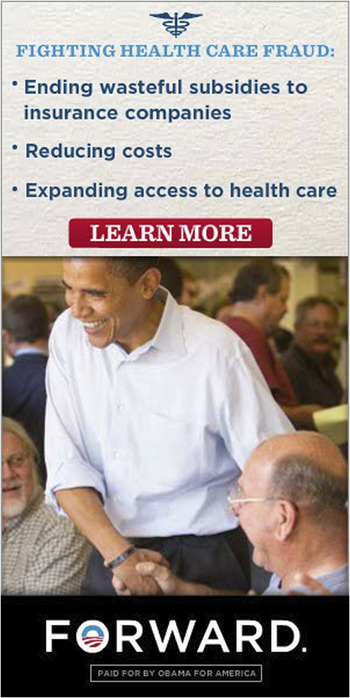
The fleeting nature of Internet advertising makes studying online political ads difficult. As one journalist stated, “It is near impossible to get a comprehensive view of which online ad messages the campaigns are targeting where and to which voter segments” (Kaye Reference Kaye2012). We explored online advertising strategy using a set of 840 unique online display ads from the 2012 presidential campaigns compiled by Moat Ad Search, a search engine that aggregates online advertisements. Footnote 3 Moat compiled daily indexes of media advertisements (i.e., “creatives”) from the web, cataloged the unique ads, and reported the two websites on which an ad was most recently placed. We captured all of the indexed Obama and Romney ads from June 2011 until Election Day, November 6, 2012. The resulting 737 Obama ads and 103 Romney ads were then coded using a set of criteria similar to that used by the Wisconsin–Wesleyan Advertising Project to code television ads. Footnote 4 Figures 1 and 2 offer examples of web display ads used by Obama and Romney, respectively.
Example of Obama Display Ad
Source: moat.com/advertiser/barack-obama?report_type=display&creative_md5=c7517b6a6d2973ba3905ec85d94a5735. Last accessed May 5, 2016.

Example of Romney Display Ad
Source: moat.com/advertiser/romney-victory?report_type=display&creative_md5=ad2e40b78929caf71f3cc04394a93940. Last accessed May 5, 2016.

We explored online advertising strategy using a set of 840 unique online display ads from the 2012 presidential campaigns compiled by Moat Ad Search, a search engine that aggregates online advertisements.
This dataset enabled one of the first explorations of communication strategy in online political ads, but it is admittedly an imperfect sample. First, our dataset captured only a subset of display ads—that is, contextual display ads rather than those behaviorally targeted via browsing history, search-engine results, and Facebook “likes.” Second, we did not capture every display ad produced or placed by the candidates—arguably an impossible undertaking—although all data-quality checks, reported in the online appendix, provide reassurance that we do not have systematic biases in our sample. Footnote 5 Third, although we know the last two websites on which a certain ad was captured, we do not have exhaustive information on either ad placement or frequency of views. The unique ads in our sample may have been shown a few times or dozens of times, on a wide range of websites or only a few. Footnote 6 As such, our analysis focuses on the nature and content of unique ads rather than the quantity of advertising online. While not ideal, this approach parallels some television advertising research (e.g., Spiliotes and Vavreck Reference Spiliotes and Vavreck2002).
THE NATURE OF CONTEXTUAL ONLINE DISPLAY ADS IN THE 2012 PRESIDENTIAL CAMPAIGN
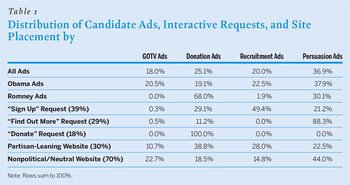
We first discuss primary ad goals as coded into four mutually exclusive categories: get-out-the-vote (GOTV), persuasion, donation, and campaign recruitment. Footnote 7 As reported in table 1, attracting donations was indeed an integral part of online advertising strategies in 2012 but far from the singular goal: only 25% of all ads attempted primarily to solicit donations. The three remaining goals accounted for the clear majority of all ads (i.e., 18% GOTV ads, 20% recruitment ads, and 37% persuasion ads). Obama ads were especially likely to have a diverse communication strategy with more GOTV and recruitment ads, perhaps reflecting the fact that some of his mobilization targets—especially the young and minorities—could be easily reached online using particular websites. Nevertheless, the considerable percentage of persuasion appeals in both Romney and Obama ads suggests that online advertising was used to communicate beyond core supporters.
Distribution of Candidate Ads, Interactive Requests, and Site Placement by

Note: Rows sum to 100%.
To verify this initial result, we next examine variation in the content and placement of the ads. It is worth noting that the majority of ads (i.e., nearly 80%: 77% for Obama and 91% for Romney) contained interactive elements, such as urging viewers to click on a link to “get the facts.” The three most common interactive elements were a “sign up” request (39% of all interactive ads), a “find out more” request (29% of all interactive ads), and a “donation” request (18% of all interactive ads). Footnote 8 Table 1 indicates that, as expected, these requests corresponded with the coder classification of ad goals. “Sign up” requests were found most commonly in recruitment ads, “find out more” requests were more common in persuasion ads, and “donate” requests were obviously most common in donation ads. Ad placements also followed an expected pattern, with more donation ads placed on partisan-friendly websites and more persuasion ads placed on nonpolitical and neutral websites. Footnote 9 Perhaps more telling is simply that the majority of all ads were last seen on a politically neutral or nonpolitical site. Footnote 10
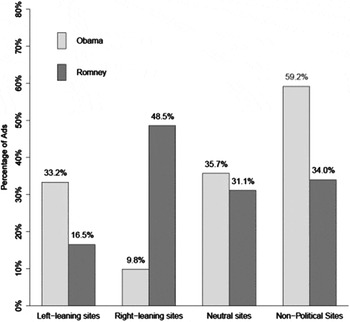
Figure 3 shows the overall distribution of ad placements by candidate. Reported are the percentages of candidate ads that were placed on partisan-friendly websites (left- or right-leaning), politically neutral websites, and nonpolitical websites. (The total percentages exceed 100% because ads could be seen on more than one website.) The pattern again highlights the broad communication strategy in Obama ads: only approximately 33% of all Obama ads were last seen on a partisan-friendly site, leaving the majority (67%) last seen on websites that could reach a broader swath of voters. Although this trend was less pronounced for Romney ads, 49% of ads were found on partisan-friendly websites at least once, which means that a slim majority appeared on other websites that would appeal to non-Romney supporters.
Candidate Ad Placement by Website Ideology
Note: Reported are the percentages of candidate ads appearing on each type of website. Because individual unique ads could appear on multiple website, percentages exceeded 100%.

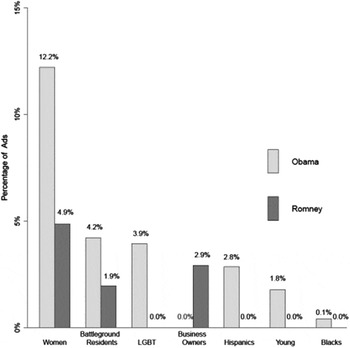
Analysis of the visual and verbal content of the ads also found that Obama ads were more likely than Romney ads to appeal to identifiable groups within the electorate. As shown in figure 4, 30% of Obama ads appeared to be targeted toward a specific group of voters, compared to just 10% of Romney ads. Footnote 11 For example, 12% of Obama ads appeared to appeal to women compared to 5% of Romney ads. Our sample of Obama ads also included many examples of ad content and ad placement being matched. For example, 20% of the Obama ads targeted to women were found on websites appealing to this demographic, such as cafemom.com, sheknows.com, and oprah.com.
Subgroup Appeals in Candidate Ads
Note: Reported are the percentages of candidate ads that appear targeted to a specific subgroup in the electorate based on an ad’s visual and verbal content. Not reported are the “other” and “not targeted” categories.

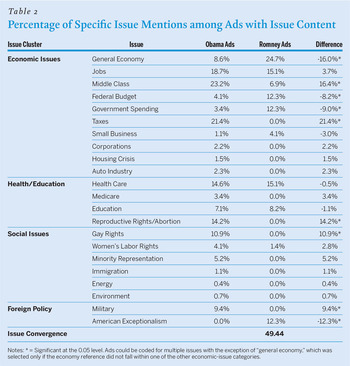
Finally, we investigate the attention given to specific issues by each candidate in table 2. First, the range of issues mentioned in Romney ads was far less diverse than in the Obama ads. Second, whereas mentions of the general economy were more common in Romney ads, ads for both candidates gave attention to the issue, which likely reflects its importance in every campaign and the fact that it did not clearly benefit either candidate in 2012. Footnote 12 Similar to Sides (Reference Sides2006), we found that the candidates framed the issue in ways consistent with party strengths. Romney economic ads focused on the general state of the economy, whereas Obama used a “middle-class” or “jobs” frame.
Percentage of Specific Issue Mentions among Ads with Issue Content

Notes: * = Significant at the 0.05 level. Ads could be coded for multiple issues with the exception of “general economy,” which was selected only if the economy reference did not fall within one of the other economic-issue categories.
Additionally, the comparison of issue mentions found support for issue-ownership theory (Petrocik Reference Petrocik1996; Petrocik, Benoit, and Hansen Reference Petrocik, Benoit and Hansen2003). Romney ads were more likely than Obama ads to mention classic Republican issues, such as the federal budget deficit, American exceptionalism, and patriotism. Obama ads were more likely to mention classic Democratic issues, such as the environment and the wedge issue of reproductive rights and abortion.
It appears that digital political advertising is used for both engagement and persuasion appeals, tailored to specific website audiences.
We also found less issue convergence for online campaigning compared to previous research on television advertising (Kaplan, Park, and Ridout Reference Kaplan, Park and Ridout2006; Sides Reference Sides2006). To more directly quantify the extent of issue convergence, we calculated the Sigelman and Buell (Reference Sigelman and Buell2004) estimate, a statistic that captures the extent to which competing candidates discuss the same issues. Footnote 13 We found a convergence coefficient of 49.4 in online advertising in 2012—a value that is lower than those in presidential campaigns studied previously, which averaged 71.4 from 1960 to 2000 (Sigelman and Buell Reference Sigelman and Buell2004), and is lower than that for television advertising in 2012. Using estimates from the Wisconsin–Wesleyan Media Project that coded television advertising in 2012 (Fowler and Ridout Reference Fowler and Ridout2013), we found an issue convergence estimate of 57.9 for the 2012 presidential television ads. Footnote 14 Thus, candidates are more likely today to talk past one another than in the past—and this is especially the case in digital political advertising, which better enables targeted messaging to narrow audiences.
DISCUSSION
Whereas previous studies examining online political campaigning concluded that candidates used mainly online communication to engage existing supporters, our analysis of contextual display ads in the 2012 election suggests a broader communication strategy in website ads. It appears that digital political advertising is used for both engagement and persuasion appeals, tailored to specific website audiences. Our analysis also suggests that online advertising—in contrast to previous conclusions about television advertising—fails to promote campaign dialogue on policy issues, instead contributing to a fractured and contentious campaign environment.
More generally, our analysis provides a first systematic perspective on strategies being used in online display advertising. Capturing and analyzing digital political advertising is a challenge, but it is critically important given its increasing role in campaign communications in contemporary elections.