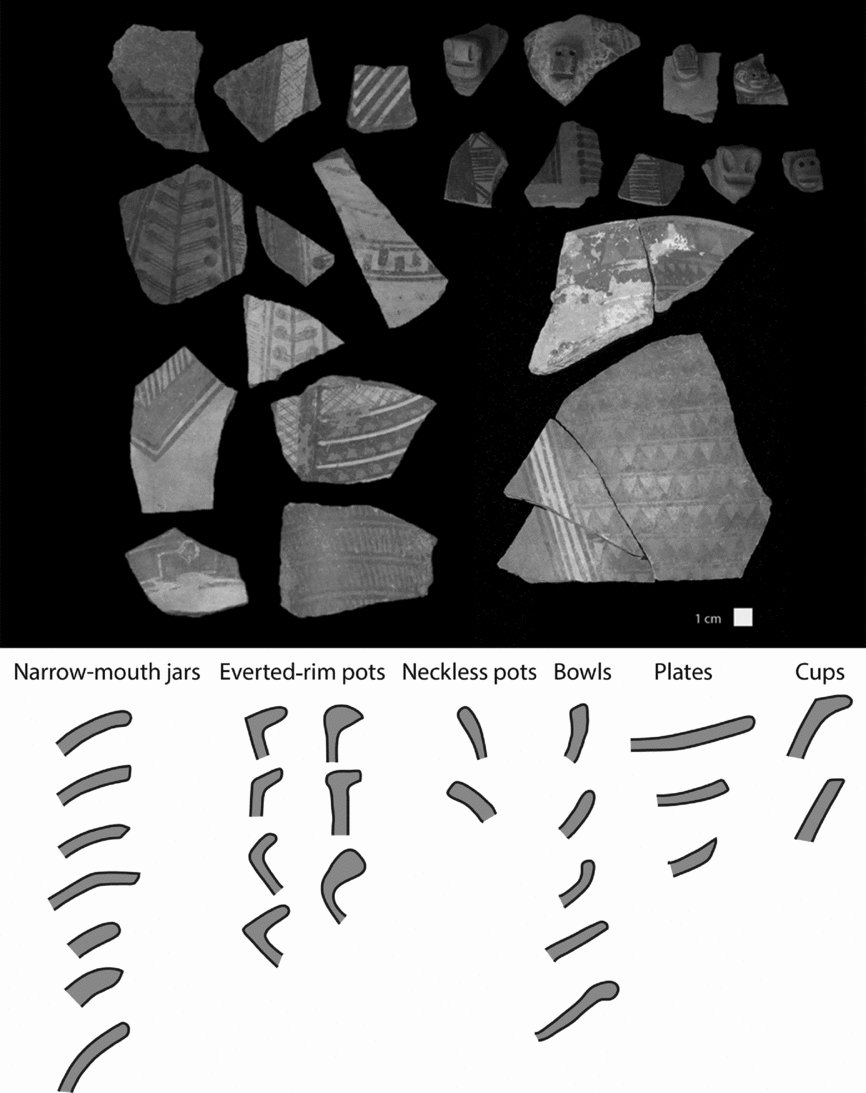
Inka imperial-style (“Cuzco-Inka”) pottery is a highly visible material correlate for the colonizing power of the Inka and an essential tool for communicating the generosity of imperial institutions to provide for subjects (Costin Reference Costin and Costin2016). It is a standardized style following canons of paste composition, surface finish, decoration, morphological forms, and firing techniques (Bray Reference Bray2000; Pardo Reference Pardo1939; Rowe Reference Rowe1944:47--49; Valcárcel Reference Valcárcel1934, Reference Valcárcel1935; Figure 1). What is not yet understood, however, is how state control over production actually operated. Who produced these goods and how?
Cuzco-Inka sherd examples from Cheqoq and Cuzco-Inka rim forms identified at the site.

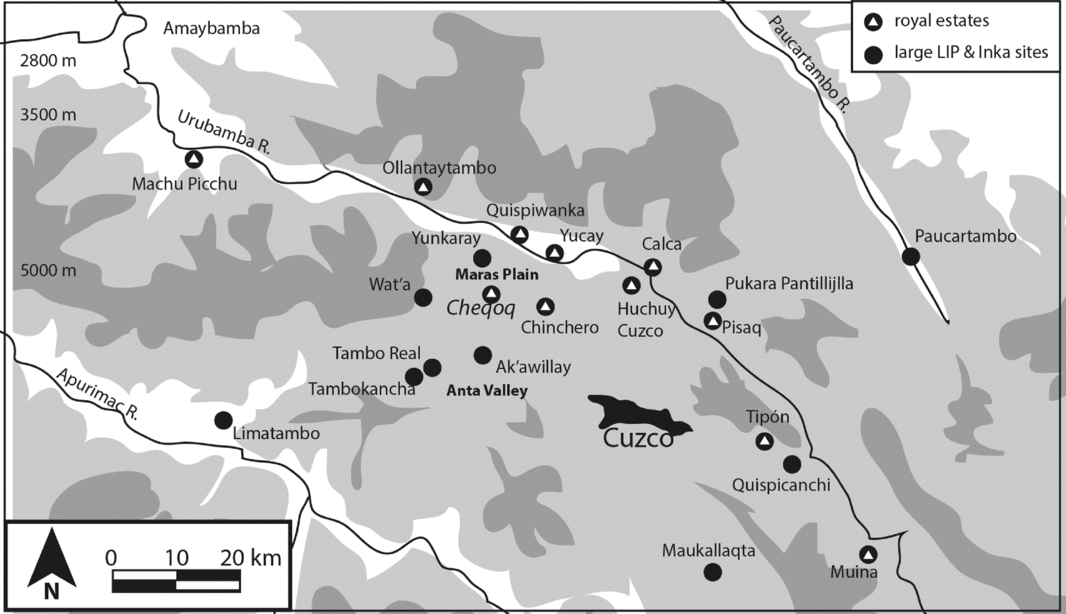
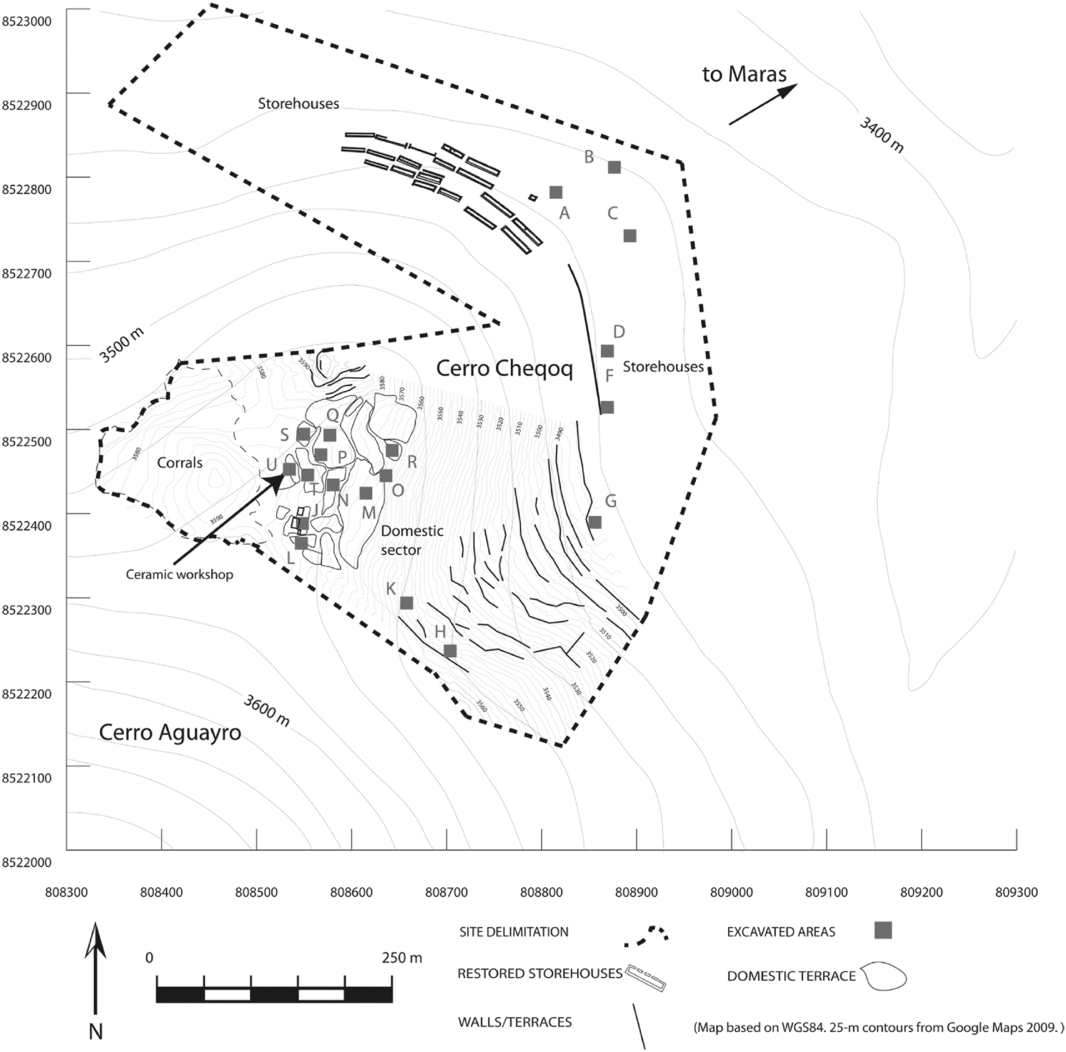
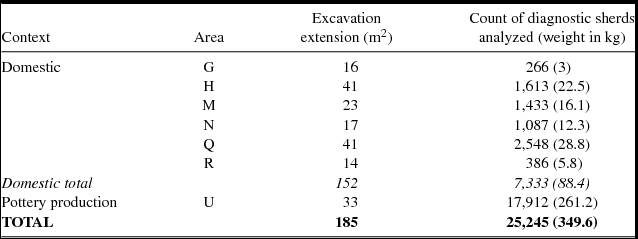
This report summarizes archaeological data confirming the presence of a workshop producing imperial-style pottery at Cheqoq, a royal estate site northwest of Cuzco on the Maras Plain (Figure 2). Cheqoq is the largest (22 ha) Inka-era village identified outside Cuzco city. It was the residence of an ethnically pluralistic community of retainers forcibly resettled on behalf of the Inka ruler Wayna Qhapaq's noble lineage (Quave Reference Quave2012). Excavations (252 m2) in 2009–2010 revealed large, well-preserved storehouses, 14 ha of households (Quave et al. Reference Quave, Pilco Vargas, Pierce Terry, Kurin and Gómez Choque2013), and a ceramic workshop (Figure 3; Table 1).
Map of the Cuzco region.

Map of excavations at Cheqoq.

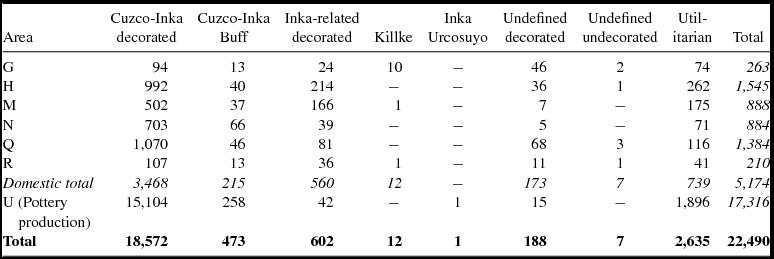
Excavated Areas Included in Analysis of Pottery Remains.

In the absence of extant evidence in the Cuzco region, researchers previously suggested that Cuzco-Inka pottery was produced under close state supervision within the municipal boundaries of Cuzco or in other elite-controlled areas of the heartland (Covey Reference Covey, Manzanilla and Chapdelaine2009:251). Potters lived in the modern Cuzco districts of San Sebastián and San Gerónimo in the early colonial period (Bauer Reference Bauer2004:91), where they may have fabricated Cuzco-Inka wares, but no archaeological evidence has yet been identified there or elsewhere in the Cuzco basin. Beyond the Cuzco basin, imperial pottery production has been reported archaeologically in two heartland locales with sparse detail (Farrington Reference Farrington2013:232): an area of densely distributed wasters decorated in the imperial style and remains of possible open firing areas at Tambokancha-Tumibamba, and a large waster pile at Quispiwanka. At Cheqoq, nevertheless, there are facilities, by-products, tools, and raw materials, which together lend greater confidence to its identification as a production locus for imperial goods.
Imperial pottery produced and consumed in Cuzco—including Cheqoq—was crafted from a recognizable fabric characterized by a clean orange- to salmon-colored body with nonplastic inclusions of consistent sizes (~0.4 mm), shapes, and densities, including basalt-andesite, mica, and granitic types (Ixer et al. Reference Ixer, Lunt, Sillar and Thompson2014). Vessel forms include consistently proportionate jars, pots, cups, and plates (Bray Reference Bray, Jennings and Bowser2008; Rowe Reference Rowe1944:48). These broad functional categories were used in ceramic analysis at Cheqoq, with rim sherds classified into finer categories by proportions of neck and body length, neck length and mouth width, shape of neck and/or mouth, angle of neck and mouth, and thickness of the body/neck/lip relative to each other (following Morris and colleagues [Reference Morris, Alan Covey and Stein2011]).
Evidence for Inka Ceramic Production
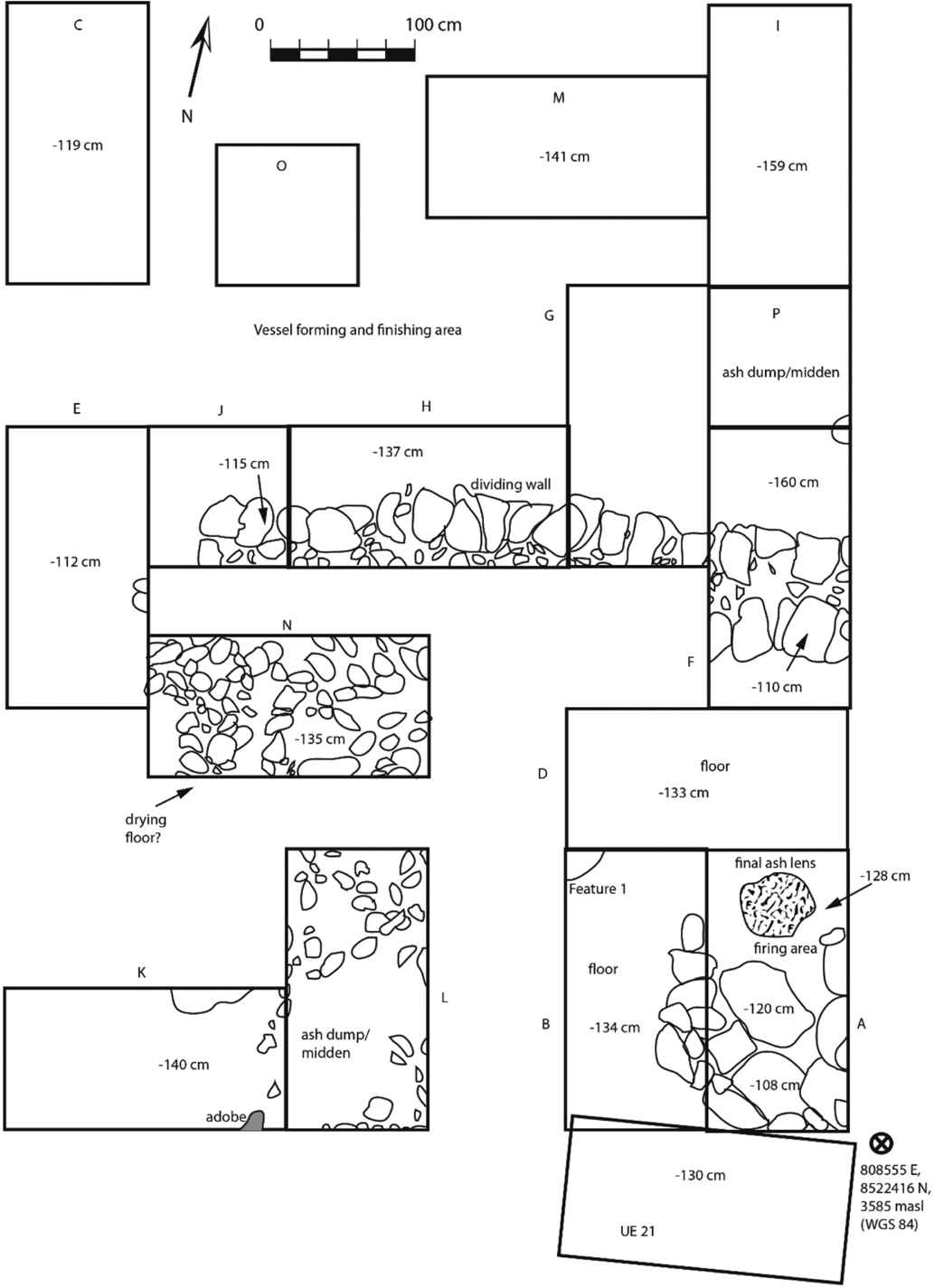
The production of imperial-style or Cuzco-Inka ceramics at Cheqoq occurred in a nucleated, restricted terrace (48 m2) located between the domestic sector and camelid corrals. The terrace was separated from other areas by double-sided 1 m wide fieldstone and mortar (pirca) walls on three sides (Figure 4). The context was identified due to extremely high densities of surface materials coupled with the presence of abundant superficial ash and waster sherds (overfired or misfired vessel fragments with visible signs of bloating, slumping, crazing, and fusion with other vessels). A test excavation of 2 m2 initially revealed remains from a primary production context, and the area exposed was extended to 31 m2 (64.4% of the horizontal space of the 48 m2 terrace with evidence for primary production) to sample features within the area. The extent of the workshop was established by assessing the presence of ashy sediment and the dense pottery scatter on the surface, and confirmed through a series of 2 m2 test pits around and beyond the ashy area. The depth of the workshop area below the modern surface was 70 cm on the southeast side (firing area south of the east-west dividing wall), 110 cm on the northeast side (forming and finishing area north of the east-west dividing wall), and 30 cm on the west side. Located behind the rear walls of the domestic terraces, the workshop was upwind from households and adjacent to a large group of corrals that probably supplied camelid dung as firing fuel.
Plan view of excavated workshop area.

The very high density of pottery fragments and production debris on the surface continued into the subsurface strata. When quantifying excavated “diagnostic” sherds (decorated or slipped body sherds, and any rim, base, or handle sherd), the production locus yielded 558 sherds/m2, while the site overall yielded 29 sherds/m2 (subsurface depths were relatively consistent across Cheqoq's excavation units). All diagnostic pottery was analyzed by coding for surface decoration and finishes, morphology, and fabric characteristics (color, texture, inclusions, porosity, heterogeneity, firing evidence), with use of an optical microscope and/or hand loupe. Diagnostic pottery other than Cuzco-Inka/imperial Inka wares (identified following Meyers Reference Meyers1975; Pardo Reference Pardo1939; Rowe Reference Rowe1944:47--49; Valcárcel Reference Valcárcel1934, Reference Valcárcel1935) was categorized as “Killke” (Bauer and Stanish Reference Bauer and Stanish1990; Rowe Reference Rowe1944:49--50), “undefined decorated,” “Inka-related decorated,” or as other known styles.
At Cheqoq, 71.2% (n = 3,683) of the diagnostic pottery assemblage in domestic contexts was categorized as Cuzco-Inka, along with a small quantity of Killke sherds (n = 12). At other excavated Inka heartland villages, we found a range of 18%–24% Cuzco-Inka pottery in domestic contexts (Quave and Covey Reference Quave and Alan Covey2015). In the ceramic workshop area at Cheqoq, 88.7% (n = 15,362) was identified as Cuzco-Inka sherds, and we also found a single sherd of Urcosuyo pottery with a distinctive paste (a ware produced near Lake Titicaca) (Table 2). Much of the pottery recovered in the workshop area appears to have been produced on site, as evidenced by the presence of waster sherds in the same strata as well-fired vessel remnants.
Counts of Diagnostic Sherds by Ware Type and Context.

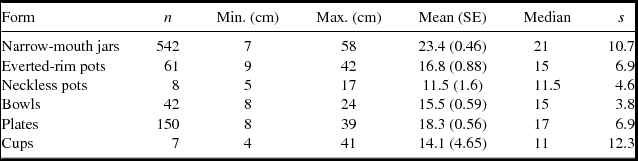
The most commonly identified Cuzco-Inka vessel form in the Cheqoq workshop was the narrow-mouth jar (also called an aríbalo). Narrow-mouth jars are associated with dry storage, but also with the secondary fermentation, storage, and serving of aqha (Bray Reference Bray, Jennings and Bowser2008). It is also the most commonly found imperial-style form within the bounds of the empire. Classic forms of plates and shallow bowls were the next most common form at Cheqoq, followed by pots with everted rims (Meyers's Form 10 [Reference Meyers1975:14]); these were typically used for food preparation and serving. There was a minority of neckless pots at Cheqoq, while cups or keros were the least commonly found form (Table 3).
Cuzco-Inka Rim Sherd Counts and Descriptive Statistics of Diameters for Fragments Recovered in the Workshop.

SE = standard error
Through excavations, we found that the workshop terrace was subdivided by a 1 m wide pirca wall like the exterior walls, with a higher floor elevation on the southern side. On the northern side, excavations produced evidence for vessel forming and finishing as well as an ash dump. South of the dividing wall, we identified a stone-enclosed firing area just east of another ash midden and possible drying patio.
The material correlates for a ceramic workshop include raw materials, manufacturing facilities and tools, and by-products (Arnold Reference Arnold1993; Chávez 1984–Reference Chávez1985; Hayashida Reference Hayashida1999; Sillar Reference Sillar1996). At least two out of the three of these categories must be present to argue for in situ production. There is strong evidence for all three at Cheqoq. Evidence for forming pottery includes raw clay caches; clay scraps; unfired coils; molds; sherds and stones for smoothing, polishing, and burnishing; and/or bone or stone scraping tools. Direct evidence for painting pottery is found in finished vessels and the tools and raw materials associated with paint manufacture, including crushed or ground pigment, unworked nodules, and grinding stones. European updraft kilns were introduced after colonization, so there is no expectation of a formal kiln structure. There should be evidence of an open pit: the co-occurrence of ash, firing furniture, burnt earth, and burnt clay, surrounded by a stone lining. Firing features should be accompanied by firing by-products such as vitrified clay and waster sherds. All of the above material expectations were met in the Cheqoq workshop except molds; vessels were coil-built.
It is unclear whether paste preparation took place at Cheqoq. There are no large stone slabs or block supports for rocker grinders or other evidence, but a large clod of prepared clay (7 kg) recovered inside the east exterior wall indicates curation of prepared paste. The vessels produced at Cheqoq were made with the same andesite-tempered fabric found at other Cuzco region sites with Cuzco-Inka pottery.
Pigment crushing and preparation are inferred in production contexts by the presence of handheld andesite mortars and pestles. On the north side of the workshop, we recovered hammerstones (n = 4) of granite, andesite, and limestone, as well as smaller netherstones (n = 4), and handstones (n = 6) of granite, andesite, feld-spathic quartzite, and quartzitic sandstone. Additionally, fragments of specular iron ore (n = 3), an exceptionally heavy rock, were found with red pigment on them, as if used for crushing. Possible red and white pigment nodules were recovered throughout the workshop, as well as a concentration of dried self-slip clay the color of Cuzco Buff.
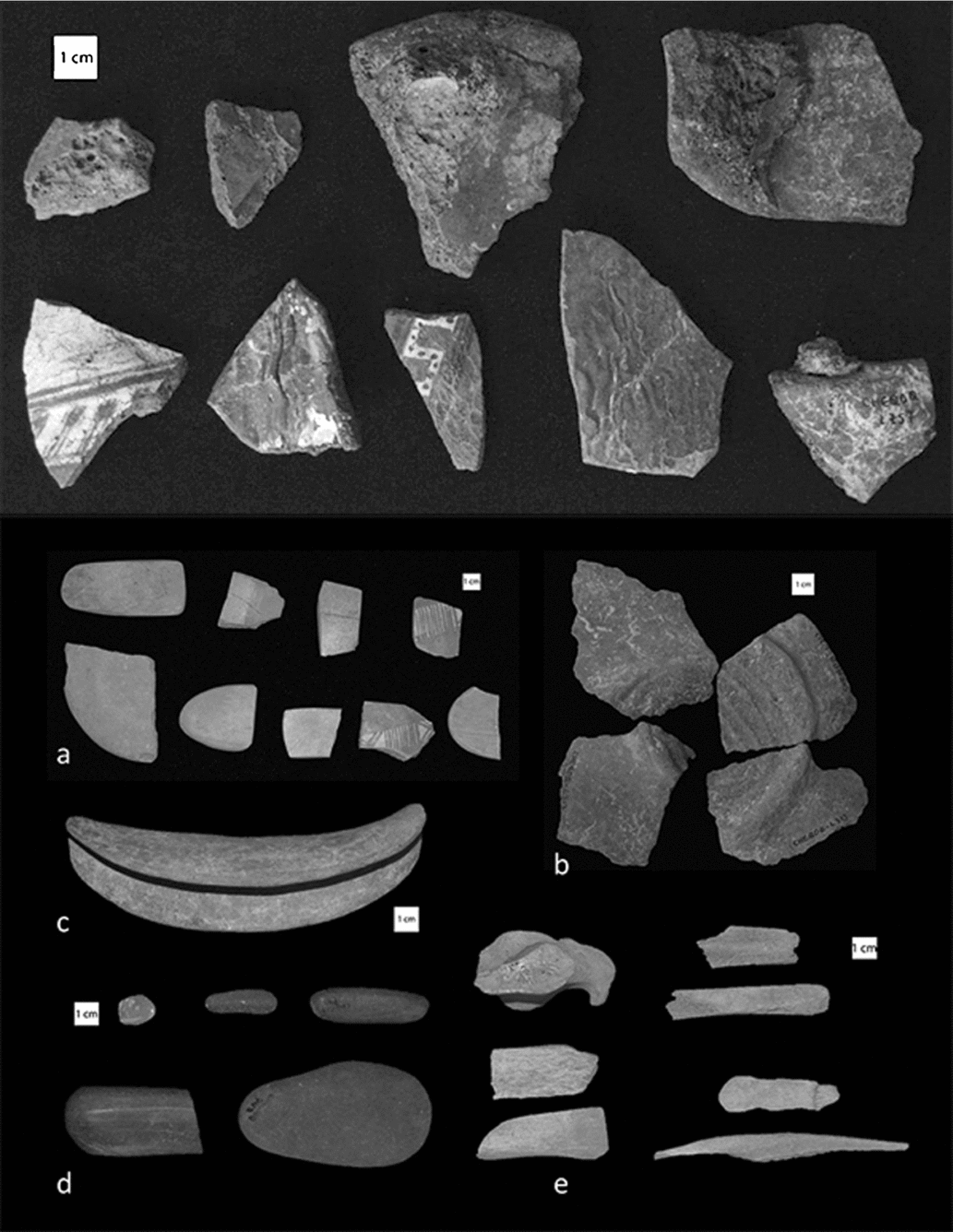
Evidence for forming activities including coiling, shaping, cutting, and smoothing were mostly found on the north side of the workshop (Figure 5). Expedient scrapers and informal tools were fashioned from fragments of bone and Cuzco-Inka and utilitarian sherds, including wasters. Bones for scraping and forming green vessels included worked artiodactyl ribs and scapulae (n = 8). Twenty-eight highly worn polishers or burnishers were made of andesite, quartz, quartzite, quartzitic sandstone, basalt, and diorite, and weighed between 1.2 g and 90.6 g, representing a wide variety of sizes and shapes. Prior to firing, vessels were possibly dried on a paved patio south of the dividing wall.
Recovered Cuzco-Inka wasters and tools for forming and finishing vessels: a.) reutilized sherds, b.) possible potter's plate, c.) possible neck-forming tool, d.) polishing stones, and e.) bone scrapers.

A semicircular, burned, stone-lined, ashy area of 4 by 2.5 meters was clearly used for firing and is comparable to Andean open-air firing areas (Hayashida Reference Hayashida1999:343; Sillar Reference Sillar1996:261). High-temperature burning in a primary context in the Cheqoq workshop is evidenced by red scorched earth in and around the pit (Munsell 2.5YR 3/3 dark reddish brown), dense carbon, ash lenses (Munsell 10YR 7/1 light gray), and sooty, fire-affected stones within the pit.. Stratigraphically, the firing pit contained a series of compacted, flat ash lenses and the results of multiple cleaning events around its periphery (Supplemental Figure 1). Firing by-products—fired clay, burnt clay, vitrified clay, and hardened ash—were dispersed throughout and were especially dense around the firing pit and middens. The total mass of the lightweight vitrified clay (recovered with ¼” screen) was 13.65 kg. Other by-products of ceramic production included discarded fragments of prepared clay formed into small coils (raw and fired). Waster sherds were abundant (n = 606), as were sherds fused with lumps of slag. Dried dung, grasses, and straw fueled this type of firing set-up, while wood was a less preferred option (Chávez Reference Chávez1984–1985). Organic fuel remains were recovered in and around the firing pit and middens, including grasses, cacti, sedges, and flowering plants. The most abundant plant remains in the firing area were coca seeds (n = 67), perhaps resulting from ceremonial firings.
The Cuzco-Inka ceramic remains in the Cheqoq workshop reveal a stylistically and technologically standardized product consistent with Cuzco-Inka pottery from heartland and major provincial administrative centers. Within the Cheqoq workshop, just 42 of 17,316 diagnostic sherds (0.2%) approximated the Cuzco-Inka style and technology, yet varied slightly (by fabric, morphology, surface finish, or surface decoration, or some combination thereof). All Cuzco-Inka sherds were composed of the imperial style andesite-tempered fabric. Most Cuzco-Inka sherds were finished with a high exterior polish (n = 15,327 or 99.8%), and all polychrome sherds were painted with some combination of well-defined red, black, and white. Rim morphologies indicated consistency within subcategories of jars, pots, bowls, plates, and cups.
Conclusions
Workshop remains at Cheqoq signal that imperial ceramic production in the heartland probably occurred at multiple, small-scale specialist workshops. Reconstructing the production process here helps Inka researchers establish a baseline for evaluating affinities to the Cheqoq production style in other archaeological cases of production to determine how homogeneous crafting was under imperialism. Furthermore, the presence of this workshop at a large storage facility staffed by royal estate retainer laborers indicates that Inka noble lineages individually controlled aspects of imperial craft production, which has implications for modeling the heartland economy in relation to royal estates. Continued analysis of domestic and production contexts at Cheqoq will provide further insight into the Inka ceramic economy and the roles played by forcibly migrated subjects.
Acknowledgments
This research was supported by the National Science Foundation (Dissertation Improvement Grant BCS-938453), the National Geographic Society Committee for Research and Exploration (Young Explorers Grant 8691-09), the Fulbright Institute for International Education, and Southern Methodist University. Excavations were permitted by the Instituto Nacional de Cultura-Cusco (Resolución Nacional 1579/INC, 2010). Thanks are due to Lic. René Pilco V. and Lic. Stephanie Pierce T. for their co-directorship, as well as the community of Maras Ayllu. I am grateful for helpful feedback from five anonymous reviewers.
Data Availability Statement
All portable physical remains on which this research is based are kept in the storage facility of the Ministerio de Cultura-Cusco in Tipón, Peru. Materials may be accessed through written request to the Ministerio de Cultura. The digital data on which this research is based are maintained by the author and may be accessed through written request.
Supplemental Materials
For supplementary material accompanying this paper, visit https://doi.org/10.1017/laq.2017.41.
Supplemental Figure 1. Stratigraphic profile of workshop firing area, walls, and midden.