Introduction
Treatment for advanced laryngeal cancer has evolved to include larynx-preserving interventions such as chemoradiotherapy or radiotherapy (RT), as well as traditional surgical techniques such as total laryngectomy or pharyngolaryngectomy. Trials have shown that chemoradiotherapy, with careful patient selection, can provide survival rates that are broadly comparable with laryngectomy.Reference Hillman, Walsh, Wolf, Fisher and Hong1, Reference Lefebvre and Ang2
Patients need to be made aware of the short- and long-term morbidity risk associated with these treatment options. These treatments have implications for swallowing ability. This is a major issue for head and neck cancer patients.Reference Lovell, Wong, Loh, Ngo and Wilson3, Reference Wilson, Carding and Patterson4 Up to 72 per cent of laryngectomees report long-term swallowing problems.Reference Maclean, Cotton and Perry5 Swallowing transit time can become prolonged once the larynx is removed. Some patients may present with specific problems such as fibrosis or strictures, which further hamper functionality. Patients who have undergone pharyngolaryngectomy may have additional problems depending on the extent of resection and the nature of reconstruction.Reference Keereweer, de Wilt, Sewnaik, Meeuwis, Tilanus and Kerrebijn6
Studies examining swallowing outcomes of chemoradiotherapy often include patients on the basis of reported swallowing difficulty. Furthermore, tumour sites are often combined, which makes it difficult to extract findings relevant to laryngeal carcinoma specifically. These studies report significant deterioration in swallowing following chemoradiotherapy,Reference Logemann, Pauloski, Rademaker, Lazarus, Gaziano and Stachowiak7, Reference Hutcheson, Barringer, Rosenthal, May, Roberts and Lewin8 with side effects such as oedema, reduced sensation and long-term fibrotic changes that markedly affect functioning. Furthermore, rates of aspiration are as high as 84 per cent,Reference Hutcheson, Barringer, Rosenthal, May, Roberts and Lewin8–Reference Dworkin, Hill, Stachler, Meleca and Kewson10 which can result in complications such as pneumonia. Some patients may depend on a long-term feeding tube, which is a major determinant of poorer quality of life in head and neck cancer patients.Reference Terrell, Ronis, Fowler, Bradford, Chepeha and Prince11 Where disease is still present, or has recurred, a salvage laryngectomy may be necessary. Evidence suggests that despite dual modality treatment, the majority of patients are able to manage a soft to normal diet.Reference Fung, Lyden, Lee, Urba, Worden and Eisbruch12 A small number of post-chemoradiotherapy patients may be offered a laryngectomy because of a severely dysfunctional larynx, in the absence of disease. Patients undergoing this procedure need to be carefully counselled about the subsequent impact on function. A single case study suggested that a laryngectomy for a dysfunctional larynx had little effect on the patient's diet.Reference Lazarus, Logemann, Shi, Kahrilas, Pelzer and Kleinjan13
A comparison of the outcomes reported by laryngeal cancer studies is difficult because swallowing can be measured in different ways, ranging from a description of the pathophysiology based on videofluoroscopy findings, to self-report and quality of life measures. Many of the standardised videofluoroscopy measurements, such as hyolaryngeal elevation, cannot be used with laryngectomy patients because of anatomical differences. This makes comparisons between surgical and non-surgical groups more problematic. Furthermore, clinician-reported and patient-reported dysphagia outcomes can vary;Reference Jensen, Bonde Jensen and Grau14 both of these perspectives need to be included in descriptions of swallowing status.
The current study aimed to investigate swallowing outcomes following laryngectomy, and/or chemoradiotherapy or RT for advanced laryngeal cancer.
Materials and methods
Patients
Patients were eligible for inclusion in the study if they had been diagnosed with advanced laryngeal cancer and had been treated with one of five interventions: total laryngectomy only; total laryngectomy with RT; radical RT only; chemoradiotherapy; or total laryngectomy and chemoradiotherapy.
Patients were consecutively recruited via multidisciplinary head and neck cancer clinics held at two hospitals in North East England over a five-month period (September 2010–January 2011).
Patients were only included in the study if they had been disease-free for at least six months following their last treatment. Patients were excluded if they had significant cognitive impairment, or had difficulty understanding English and were therefore unable to complete a questionnaire. Patients with conditions that may impact on swallowing such as stroke were also excluded.
Assessments
Three clinical swallowing assessments were administered as follows.
In the water swallow test,Reference Patterson, Hildreth, McColl, Carding, Hamilton and Wilson15 patients were asked to drink 100 ml of water as quickly as was comfortably possible. The test was timed and a measure of swallow capacity (millilitres swallowed divided by time taken) was derived. The test was not performed if the patient reported choking on fluids, in which case a score of zero was given. Patients who choked during the test were asked to stop immediately. Valves were checked for leakage and changed prior to assessment if necessary.
Patients completed the normalcy of diet subsection of the Performance Status Scale, which is a validated, clinician-rated scale of diet for Head and Neck Cancer Patients.Reference List, Mumby, Haraf, Siston, Mick and MacCracken16 Scores range from 0 (nil by mouth) to 100 (indicating a full, unrestricted diet).
Patients also completed the M D Anderson Dysphagia Inventory.Reference Chen, Frankowski, Bishop-Leone, Hebert, Leyk and Lewin17 This 20-item swallowing questionnaire was designed specifically for head and neck cancer patients. A total score is calculated by summing all responses (excluding one global question response), computing the mean score and then multiplying the result by 20. Scores range from 20 to 100. A higher score represents a better self-reported outcome, with 80 points or more suggestive of minimal swallowing difficulties.
Statistical analysis
The three measures of swallowing provided continuous data; the treatment groups were therefore compared using one-way analysis of variance. Post-hoc tests were conducted using the Bonferroni correction. Data analyses were performed using the Statistical Package for the Social Sciences version 17.0 software (SPSS Inc, Chicago, Illinois, USA).
Ethical considerations
Ethical approval was given for the patients receiving non-surgical treatments as part of a separate prospective study. In addition, the outcome measures used in this study are routinely collected, with patient consent, as part of a patient's clinical assessment. These assessments were carried out by speech and language therapists, and students, as part of our ongoing service provision evaluation. Therefore, approval from the local ethics research committee was not required for this particular study.
Results
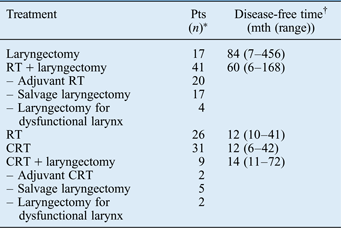
In total, 141 patients were eligible for inclusion in the study. Data sets were collected from 124 patients, with one patient completing only the M D Anderson Dysphagia Inventory. Patients who underwent RT alone were treated using three-dimensional conformal RT: 63 Gy in 30 fractions. None of the patients received intensity-modulated RT. Chemoradiotherapy involved six-weekly cycles of cisplatin (30–40 mg/m2). Treatment for both the RT plus laryngectomy group and the chemoradiotherapy plus laryngectomy group included salvage laryngectomy, laryngectomy for a dysfunctional larynx, and adjuvant RT or chemoradiotherapy. Overall, eight patients underwent a pharyngolaryngectomy. The groups therefore comprised patients who received different treatments; this was done to ensure adequate group sizes for the purpose of data analysis. Patient details are summarised in Table I.
Patient treatment data

*Total n = 124 (102 males, 22 females), aged 43–87 years (mean 66 years). †Median time post treatment. Pts = patients; mth = months; RT = radiotherapy; CRT = chemoradiotherapy
There were more males than females in the sample (a ratio of 4.6 to 1). A significant age difference was found between the groups (F = 4.325, p < 0.05); the chemoradiotherapy patients were younger (mean = 62 years old) than the laryngectomy patients (mean = 70 years) and the RT patients (mean = 69 years old). There was a significant difference between groups in terms of the duration of disease-free time since the last treatment (F = 12.818, p < 0.05); laryngectomy patients had the longest amount of disease-free time post-treatment compared with the chemoradiotherapy group and the RT group (see Table I).
Swallow capacity
Norms for swallow capacity are different for males and females.Reference Patterson, Hildreth, McColl, Carding, Hamilton and Wilson15 As there were just a small number of females in the total sample, only male patient data were analysed. This revealed a significant difference between the treatment groups (F = 2.7, p = 0.03) (Figure 1). Post-hoc testing indicated that the RT group had significantly better swallow capacity than the chemoradiotherapy plus laryngectomy group (a mean difference of 9.9 ml).
Mean swallow capacity and treatment type error bar plot for males (95 per cent confidence interval). RT = radiotherapy; CRT = chemoradiotherapy; pts = patients
Normalcy of diet
Four patients in the sample were nil by mouth (2 per cent) and 40 patients had a full oral diet (32 per cent). There was a significant difference in normalcy of diet scores between groups (F = 5.155, p < 0.01) (Figure 2). Post-hoc tests revealed that the chemoradiotherapy group and the chemoradiotherapy plus laryngectomy group had significantly lower mean scores than the RT group (mean differences of 24 and 36 points respectively). The chemoradiotherapy plus laryngectomy group showed the greatest range of scores and had the smallest number of participants. There was only a small range in scores within both the RT group and the laryngectomy plus RT group, as demonstrated by Figure 2. A large majority of the RT group were managing a full oral diet (84 per cent), with some requiring a drink with meals. Just under half of the chemoradiotherapy patients (45 per cent) were able to manage this level of diet.
Normalcy of diet mean scores and treatment type error bar plot (95 per cent confidence interval). RT = radiotherapy; CRT = chemoradiotherapy; pts = patients
M D Anderson Dysphagia Inventory
The total score was used to summarise the M D Anderson Dysphagia Inventory results. There was no significant difference between the five treatment groups (F = 2.244, p > 0.05) (Figure 3). Patients in the chemoradiotherapy plus laryngectomy group showed the largest range of scores and the lowest mean score. In order to demonstrate differences in M D Anderson Dysphagia Inventory scores between groups, with a minimum standardised effect size of 0.07 with 90 per cent power, a power analysis estimated that a sample size of 282 patients would be required.
Patient-reported M D Anderson Dysphagia Inventory mean scores and treatment type error bar plot (95 per cent confidence interval). RT = radiotherapy; CRT = chemoradiotherapy; pts = patients
Discussion
This study aimed to assess swallowing outcomes following different treatments for advanced laryngeal cancer. Three simple clinical swallow tests were administered to patients at least six months after treatment, after which time swallowing function begins to stabilise following the acute impact of treatment.Reference Wilson, Carding and Patterson4 These tests provide different perspectives on swallowing outcomes, including swallowing performance, dietary restrictions and patient self-report.
The majority of this sample had some degree of swallowing difficulty. Patients treated with chemoradiotherapy combined with laryngectomy consistently had the poorest mean scores across all assessments. There was no clear benefit of surgery or organ preservation treatment with respect to the water swallow test results or patient self-reports. Overall, patients receiving only RT showed better swallowing performance than the other groups in the water swallow test. In addition, the majority of the RT group were able to return to a full oral diet, whereas only half of the chemoradiotherapy group achieved this level of functioning. Patients who had undergone a laryngectomy with or without RT had similar dietary restriction scores. There was a trend for higher M D Anderson Dysphagia Inventory scores in the single modality treatment groups. Approximately half of the patients in the RT group (57 per cent) and in the laryngectomy group (47 per cent) scored themselves over 80 on the M D Anderson Dysphagia Inventory, indicating minimal swallowing problems. This dropped to 35 per cent in the RT plus laryngectomy group and was even lower for patients treated with chemoradiotherapy (19 per cent). There was a large variation in outcomes for patients who underwent a laryngectomy because of a dysfunctional larynx. The patient with the best function in this subgroup had not required a flap reconstruction.
The 100 ml water swallow test is a relatively new test for head and neck cancer patients. Normative data on healthy males of similar ages (with a mean swallow capacity of 18.7 ml),Reference Hughes and Wiles18 and results of pre-treatment head and neck cancer patients (mean swallow capacity of 16.8 ml),Reference Patterson, McColl, Carding, Kelly and Wilson19 suggest that treatment for advanced laryngeal cancer results in poorer swallowing performance. Swallowing difficulties following chemoradiotherapy have been well described in the literature.Reference Logemann, Pauloski, Rademaker, Lazarus, Gaziano and Stachowiak7, Reference Dworkin, Hill, Stachler, Meleca and Kewson10, Reference Logemann, Rademaker, Pauloski, Lazarus, Mittal and Brockstein20–Reference Lazarus, Logemann, Pauloski, Rademaker, Larson and Mittal22 These studies have shown biomechanical problems and reduced strength, which affect swallowing performance and safety (i.e. aspiration). Swallowing dysfunction identified on videofluoroscopy is associated with poorer swallow capacity.Reference Wu, Chang, Wang and Lin23 Therefore, the poorer scores for the chemoradiotherapy patients in the present cohort may be associated with treatment-induced changes to the swallow physiology.
No previous study has reported on the 100 ml water swallow test in total laryngectomy patients. The physiology of swallowing is altered in this group too; the reconstruction of the pharynx results in a smaller lumen, which may account for a reduction in swallow capacity. In addition, lower pharyngeal pressures have been recorded, which reduce bolus propulsion and clearance.Reference Szczesniak, Maclean, Cotton, Cook and Perry24 However, it has been suggested that surgical patients suffer less from dysphagia than those treated with chemoradiotherapy.Reference Francis, Weymuller, Parvathaneni, Merati and Yueh25 That particular study did not describe subgroups, so information on laryngectomy as distinguished from organ preservation treatment could not be extrapolated. The swallowing of solid food may be problematic for the total laryngectomy group.Reference Szczesniak, Maclean, Cotton, Cook and Perry24 This difficulty may not be evident based on the results of a water swallow test, but may be inferred from normalcy of diet scale results.
In line with the findings of the current study, previous papers have reported that RT only patients have minimal dietary restrictions,Reference Dworkin, Hill, Stachler, Meleca and Kewson10, Reference Allal, Dulguerov, Bieri, Lehmann and Kurtz26, Reference Agarwal, Dutta, Palwe, Gupta, Laskar and Budrukkar27 and that chemoradiotherapy patients have significantly poorer outcomes in terms of diet.Reference Logemann, Pauloski, Rademaker, Lazarus, Gaziano and Stachowiak7 Intensity-modulated RT patients are more likely to return to a normal diet than patients receiving other treatments,Reference Feng, Kim, Lyden, Haxer, Worden and Feng28 but research has so far predominantly reported on oropharyngeal cancer patients. For the laryngectomy patients, the addition of RT did not have much impact on diet in the present sample; this supports the findings of our previous study.Reference Oozeer, Owen, Perez, Jones, Welch and Paleri29 However, adjuvant RT has been identified as a strong predictor of increased dietary restrictions in a study where patients were divided into three broader groups of diet outcome.Reference de Casso, Slevin and Homer30 Dietary restrictions may not be due to dysphagia alone; dietary changes have also been associated with other issues specific to RT, such as xerostomia and dental clearance.Reference Allal, Dulguerov, Bieri, Lehmann and Kurtz26
In the current study, the chemoradiotherapy group and chemoradiotherapy plus laryngectomy group had lower M D Anderson Dysphagia Inventory scores than the other treatment groups, but there were no statistically significant differences. Gillespie et al. Reference Gillespie, Brodsky, Day, Lee and Martin-Harris31 also reported a trend for lower M D Anderson Dysphagia Inventory scores in laryngeal cancer patients treated with chemoradiotherapy versus those treated with surgery. In a quality of life study, chemoradiotherapy patients reported more difficulty swallowing than those who had undergone laryngectomy, whereas the laryngectomy group had more problems with communication and shoulder function.Reference LoTempio, Wang, Sadeghi, Delacure, Juillard and Wang32
Clinical implications
The outcome measures used in this study are simple, inexpensive and quick to collect in an out-patient review clinic, with excellent patient compliance. These data can provide outcome benchmarks for future comparisons.
This is the first study to report 100 ml water swallow test scores of laryngectomy patients. These results can be used to provide more accurate expectations of eating and drinking abilities following treatment. On the basis of these findings, laryngeal cancer patients referred for RT alone may be given higher expectations regarding the possible impact of treatment on diet, whereas chemoradiotherapy patients will need to be counselled regarding the likelihood of permanent dietary restrictions.
In the current study, patients who underwent chemoradiotherapy plus total laryngectomy had the poorest outcomes. This is perhaps not surprising given that this was the most radical form of treatment. In cases where this treatment is used, there is likely to be a trade-off between long-term functional problems and an increased chance of survival.Reference Lazarus, Logemann, Shi, Kahrilas, Pelzer and Kleinjan13 Eating and drinking ability following laryngectomy for a dysfunctional larynx is hugely variable. Placing expectations on the basis of these results is difficult. Those requiring a flap reconstruction may be particularly vulnerable.
• Surgical and non-surgical treatments for advanced laryngeal cancer have long-term effects on swallowing
• Laryngectomy with chemoradiotherapy is associated with the poorest swallowing outcome
• Laryngectomy with or without radiotherapy, or radiotherapy alone have a minimal effect on diet
• Swallowing outcomes of different head and neck cancer treatments can be assessed using simple clinical tests
• Salvage laryngectomy for chronic dysphagia necessitates careful patient selection and counselling
Limitations
Swallowing performance and self-reports are subject to individual variation; therefore, the cross-sectional study design is one limitation of this investigation. A further limitation concerns the fact that patients were at different time points post-treatment, although it had been at least six months since their last intervention. This variation reflected the introduction of chemoradiotherapy as a treatment option for advanced laryngeal cancer. Given the relatively small population and the projected M D Anderson Dysphagia Inventory power calculation, a prospective longitudinal study is likely to be too time-consuming and expensive. Some potential variables were not taken into account as subdividing the groups further would have produced too few patient numbers. For example, swallowing ability in laryngectomy patients may differ according to the type of surgical closure performed or flap reconstruction requirements. These problems indicate the need to collect multi-centre data. Furthermore, patients were not randomly allocated to their treatment group; the type of treatment depended on the nature of the disease and comorbidities.
Conclusion
Swallowing outcomes were worse for those patients who received the most radical treatment for advanced laryngeal cancer (i.e. laryngectomy plus chemoradiotherapy). Surgery and organ preservation techniques had no significant swallowing advantage over one another; however, those receiving RT alone were likely to have fewer dietary restrictions and better swallowing performance compared with other treatment groups. Further research on swallowing outcomes following treatment for advanced laryngeal cancer is warranted.