INTRODUCTION
Disturbance from typical best-practice hydrocarbon drilling is generally from sedimentation and some chemical stress to benthic communities rarely measurable beyond 250 m of the drilled area (Jones et al., Reference Jones, Wigham, Hudson and Bett2007b). With increasing drilling activity in deeper waters (Pinder, Reference Pinder2001), and in environmentally sensitive areas, disturbance from drilling is an increasing threat to benthic ecosystems across the globe. Venezuela has some of the largest hydrocarbon reserves in the world and drilling activities for oil and gas offshore are increasing (Redden, Reference Redden2010). The effects of such developments on global deep-water ecosystems are poorly understood. Deep-sea organisms are traditionally thought to receive relatively low levels of physical disturbance and may be particularly susceptible to perturbation (Kukert & Smith, Reference Kukert and Smith1992).
Most marine biological work off Venezuela concentrates on the shallow waters of the Caribbean coast, to the north of the country (Bone & Klein, Reference Bone and Klein2000; Villamizar, Reference Villamizar2000; Bone & San Martin, Reference Bone and San Martin2003). The abyssal or deep bathyal (sensu Gage & Tyler, Reference Gage and Tyler1991) communities of the Venezuelan Basin (Caribbean Sea) have also been studied (Kuznetsov et al., Reference Kuznetsov, Rass, Pasternak and Bulatov1974; Pasternak et al., Reference Pasternak, Moskalev and Fedikov1975; Richardson, Reference Richardson1983; Anderson et al., Reference Anderson, Crabtree, Carter, Sulak and Richardson1985; Baird & White, Reference Baird and White1985; Richardson et al., Reference Richardson, Briggs and Young1985; Woods & Tietjen, Reference Woods and Tietjen1985; Young & Richardson, Reference Young and Richardson1985; Tietjen, Reference Tietjen, Rowe and Pariente1992; Briggs et al., Reference Briggs, Richardson and Young1996; Lutz & Ginsburg, Reference Lutz, Ginsburg, Lumsden, Hourigan, Bruckner and Dorr2007). These studies have typically found low species richness and low abundance of megafauna related to limited flux of organic carbon (Briggs et al., Reference Briggs, Richardson and Young1996).
The deep oceanic Atlantic waters of Venezuela (i.e. outside of the Caribbean Sea) are very poorly explored. Furthermore, it is suggested that the Caribbean Sea and the oceanic Atlantic waters at comparable latitudes are zoographically distinct with limited megafaunal affinities (Anderson et al., Reference Anderson, Crabtree, Carter, Sulak and Richardson1985; Briggs et al., Reference Briggs, Richardson and Young1996). There has only been one biological study beyond SCUBA depths conducted in the oceanic Atlantic waters to the east of Venezuela, on macrofauna (Bone et al., Reference Bone, Chollett and Rodriguez2007). To the authors' knowledge no work on the megafauna of the area has been published. The nearest studies on bathyal megafauna at comparable depths are from the Gulf of Mexico (Agassiz, Reference Agassiz1888; Staiger, Reference Staiger1970; Rowe & Menzel, Reference Rowe and Menzel1971; Rowe et al., Reference Rowe, Polloni and Horner1974; Pequegnat et al., Reference Pequegnat, Gallaway and Pequegnat1990).
The communities on the continental shelf and slope of Atlantic Venezuela are subject to high sedimentation rates of terrigenous material from the major South American rivers (Bowles & Fleischer, Reference Bowles and Fleischer1985). Bathyal communities subject to high sedimentation are relatively uncommon, but can be found close to shore in fjordic environments (Jones et al., Reference Jones, Bett and Tyler2007a). The effects of disturbance from anthropogenic sedimentation on deep-water communities already living in conditions of naturally high sedimentation are unknown. Adaptation to such natural sedimentation events may alter the impact to deep-water benthic communities of additional sedimentation from drilling activity. Exploration and production of hydrocarbon reserves provides a medium-scale (<1 km) disturbance to the seafloor in increasingly deep waters (Jones et al., Reference Jones, Wigham, Hudson and Bett2007b), currently to nearly 4000 m depth. As the drilling impact is discrete and measurable, this provides useful experimental treatment for assessing the response of benthic communities to a sedimentation disturbance event. Here we quantify a benthic megafaunal assemblage prior to a sedimentation disturbance and shortly after to assess assemblage level responses to this event. The main objectives of this study are: (1) to describe the composition of a megafaunal assemblage in a deep-water site in the Atlantic waters of Venezuela; and (2) to determine the effect and extent of physical disturbance from drilling operations on benthic megafauna.
MATERIALS AND METHODS
Study site
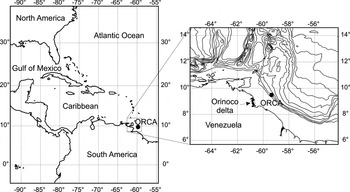
The Orca well was located west-north-west of Venezuela on the Orinoco Fan (Figure 1; 09°49′07.98″N 59°44′16.35″W). Water depth at this location is 543 m and the bottom water temperature was recorded as 3°C (26 July 2007). Seabed currents observed in remotely operated vehicle (ROV) video were extremely slow for the duration of the study (<1 m min−1). In addition, there were no seabed features, such as ripples, that would have indicated recent higher-current events.
Map of the Orca area, Venezuela; inset map shows the position of the study site and bathymetry in the region (contours at 200 m, 500 m and every subsequent 500 m).

The major influence on the benthic environment on the shelf and slope of eastern Venezuela is terrigenous sedimentation from the Orinoco River (Bowles & Fleischer, Reference Bowles and Fleischer1985). The outflows of the major South American rivers move northwards with the Brazilian current (Lalli & Parsons, Reference Lalli and Parsons1997) and result in high primary production (Bonilla et al., Reference Bonilla, Senior, Bugden, Zafiriou and Jones1993) and sedimentation (Longhurst, Reference Longhurst1998) throughout the study area.
Drilling operation
The well at Orca was drilled by the mobile semi-submersible drilling rig ‘Transocean Sovereign Explorer', which was also the base for all of the described work. The rig was moved into position and a guidebase installed (12 July 2007) prior to all ROV survey work. The guidebase is a 3 × 3 m square metal plate placed on the seafloor with a ~1 m diameter central hole used for drill positioning. It was lowered slowly to the seafloor by crane and positioned by ROV. The installation of the guidebase was necessarily slow and controlled and its likely impact was limited to smothering the fauna directly underneath it and potentially some low additional sedimentation associated with ROV movement near the seafloor. The drill was then lowered to the seafloor and passed through the guidebase structure (the drill first touching the seabed after ROV pre-drill surveys on 14 July 2007). The first stage of drilling, tophole drilling, deposits sediment directly on the seafloor. No drilling mud was used for this phase (seawater jetting was sufficient to drill through the soft sediment) so the disturbance was from sedimentation alone. Approximately 375 m3 of sediment was displaced during this tophole drilling phase. Once tophole drilling was completed (<2 days at Orca; ending 16 July 2007) a well-control structure, the blow out preventer (BOP), was installed and all rock cuttings from subsequent drilling were recirculated with drilling mud back to the rig where they were cleaned and discharged at the surface. Model results suggest that very little of this material (<1 mm coverage) would be deposited within 100 m of the drill site at this water depth (Statoil, personal communication).
Data collection
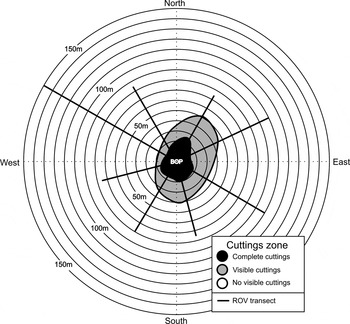
The exploration activities at the Orca location allowed for two surveys to take place, before and after tophole drilling (Hyne, Reference Hyne2001). Data were collected using a Centurion HD work class ROV. Its colour video camera (Remote Ocean Systems) enabled high quality video to be obtained of the seafloor. The camera was mounted on a pan and tilt unit at the front of the ROV, which enabled oblique video to be taken. Before each transect the video was zoomed out to maximum extent and the camera was set to its most vertical angle (47° from the vertical). Video transects were conducted so that they radiated from the source of disturbance on eight major headings (30°, 75°, 210°, 165°, 210°, 255°, 300° and 330°; Figure 2), 030° and 210° representing the major axis of current flow. The ROV was run in a straight line, on a set bearing, at a constant speed (0.3 m s−1) and set altitude (0.2 m). Transects were typically ~80 m in length, representing the maximum safe length of ROV tether deployment. The width of the transect (0.6 m) was calculated from the camera acceptance angles and vehicle altitude (Jones et al., Reference Jones, Hudson and Bett2006); it was also verified by passing over objects of known size on the seafloor. This allowed the derivation of total surface area covered by each transect (in m2) with precision of ±1 m2. These video transects were conducted before drilling operations commenced (14 July 2007) and then repeated after drilling (26 July 2007; 12 days after drilling).
Remotely operated vehicle video transects conducted after tophole drilling at the Orca field, Venezuela, showing the extent of the visible drill spoil, centre of disturbance (blow out preventer (BOP)) and zones radiating from source of disturbance.

For the purposes of this study, the seabed around the source of disturbance was divided into five 20 m zones radiating from the BOP. Before drilling the guidebase for the BOP was used for navigation. This structure had a square footprint of <2 m × <2 m and was installed with minimal disturbance by slowly lowering to the seafloor (installed 10 July 2007). The distance of the ROV from the BOP/guidebase was measured using sonar fixes on this clear sonar target. The position of the ROV was verified using ultra-short baseline navigation. The extent of drill cuttings were characterized as follows: ‘complete cuttings’ (>95% cuttings coverage); ‘visible cuttings’ (where patches of cuttings were visible on ROV video); and ‘no cuttings’ (where no cuttings could be seen on the ROV video). The seabed drilling activity caused the physical disturbance examined in this study.
An additional pre-drilling seabed assessment of the Orca location was also undertaken. The box core samples obtained were subjected to physical, chemical and macrofaunal analysis (D. Bone, unpublished data).
Video analysis
Video transects were replayed at half speed and visible organisms were counted along the entire transect. Only organisms that typically live on the seabed (benthic organisms) were included. The optical resolution of the cameras permitted all organisms larger than 50 mm to be reliably counted. With a central camera and oblique video the area of seafloor imaged was an isosceles trapezoid. The shortest length of this, corresponding to the base of the frame in analysis, had the highest resolution and the best lighting; therefore, it was defined as the transect width. Individual animals were recorded only if they passed through the bottom of the frame. All whole live animals were recorded if the entire body was visible in the video picture. Infaunal species, when seen, were counted if enough of their body was visible for identification. Identification of organisms was based on further close-up video inspections or specimen capture. Megafauna were divided with respect to motility into mobile and sessile taxa. No highly mobile taxa were observed (speed > 0.3 m/s). Abundances were standardized to numbers per m2. Each transect was partitioned into 20 m zones and analysis was carried out on data from each of the 5 zones. Counts for each individual transect 20 m zone formed the sampling unit. If the video image was obscured by resuspension of the fine sediments transect was repeated where possible. If not possible to repeat, the affected sampling unit was removed from all subsequent analysis (only one sample was removed: 0–20 m on the pre-drilling transect at 165° heading). Transects were used as replicates for disturbance regime.
Data analysis
Most of the analyses have been run for total fauna and then repeated for motile and sessile fauna separately. This was because the initial stress response in motile organisms is movement, which, by definition, is not possible for sessile organisms. It was expected a priori that the stress response resulting from drilling-related disturbance would be different for these different elements of the megafaunal assemblage. Data from the 80 to 100 m zone were excluded (owing to limited data prior to drilling) from all subsequent statistical analysis.
Community analysis was based on densities of all taxa; a fourth root transformation was applied to buffer the influence of dominant taxa (Field et al., Reference Field, Clarke and Warwick1982). Similarities were calculated using Bray–Curtis coefficients (Bray & Curtis, Reference Bray and Curtis1957). The similarity values were subjected to ordination (non-metric multi-dimensional scaling (MDS)) and hierarchical clustering using the software PRIMER (Clarke & Warwick, Reference Clarke and Warwick2001). Discriminating taxa were determined with the similarity percentage procedure (SIMPER) (Clarke & Warwick, Reference Clarke and Warwick2001). The analysis indicates the contribution of each species to the average dissimilarity between groups (Clarke, Reference Clarke1993).
Permutational multivariate analysis of variance (PERMANOVA) (Anderson, Reference Anderson2001) was used to assess differences between all sampling units in a two-way crossed analysis with two factors: disturbance regime (fixed factor with two levels: pre-drilling and post-drilling) and distance (fixed factor with 4 levels corresponding to the distance zones and orthogonal to the previous factor). Pairwise a posteriori tests permitted significance testing of different distance zones (Anderson, Reference Anderson2005). PERMANOVA does not accommodate unbalanced sample designs; therefore, individual sample units were randomly removed to balance the sample sizes (to 6 sample units for each distance treatment).
A 2-factor analysis of variance (ANOVA) univariate model was applied to total megafaunal densities, as well as total densities of mobile and sessile organisms separately, to test for significant differences attributable to the factors listed above. Hence, ANOVAs tested the same hypotheses described for multivariate data, but in a univariate context. All data were log transformed prior to ANOVA in order to fulfil the assumptions of normality and homoscedasticity. When the factor ‘distance from drilling’ was significant pairwise a posteriori Tukey's tests were used. Univariate statistical tests were implemented in Sigmaplot version 11 (Systat Software Inc.).
RESULTS
Seabed environment
Prior to drilling the sediment at Orca was dominated by fine mud with extensive bioturbation (burrows, tracks and holes of various sizes, probably associated with the abundant fish and decapod megafauna). The sediment surface had a slightly roughened appearance. Core samples suggest this was a result of macrofaunal activity (macrofaunal densities of 33–200 ind m−2) which were predominantly polychaetes (4–13 ind m−2) and meiofauna, including foraminiferans and nematodes (authors' observations). Sediment in core samples consisted predominantly of mud (<63 µm; 97.03 ± 0.07%; mean ± 95% confidence interval) with a small proportion of sand (63 µm–2 mm; mean 2.95 ± 0.23%). The total organic carbon content of the sediment samples was 0.79 ± 0.11%.
After drilling, in the immediate vicinity of the well, the seabed was characterized by smooth, recently deposited sediments with additional larger sized fragments of consolidated clay (clasts) on the sediment surface. It was not possible to accurately assess the thickness of the newly deposited sediments, although they appeared to be <1 m in thickness. The horizontal extent of these deposits was greatest to the north-west of the drilling activity (Figure 2). The recently deposited sediment could be distinguished from the background sediment by a slightly lighter colour, lack of bioturbation, cleared ‘halos’ around sessile organisms and a smooth appearance. The areas beyond the visibly impacted zones (by drilling sediments) were not distinguishable from predrilling/background sediment and comprised fine muddy sediment with extensive bioturbation. In total approximately 1000 m2 of seabed was completely covered in drilling-derived sediment and an additional approximately 3000 m2 of seabed had visible evidence of drilling-derived sediments (Figure 2).
Faunal patterns
In the pre-drilling ROV survey a total of 265 megafaunal organisms (0.7 m−2) were observed at Orca (supplementary material) along all 8 transects (380 m2). In the post-drilling survey 263 organisms (0.6 m−2) were observed in all 8 transects (444 m2: Table 1; Figure 3). A total of 25 megafaunal taxa were seen in transects at Orca (an additional 2 taxa were observed in baited traps and other ROV observations). Most taxa were observed at the pre-drilling stage (22 taxa). After drilling reduced taxon numbers were observed (17 taxa) although two taxa were observed that had not been seen in the pre-drilling survey (Chaunax pictus and Soleidae).
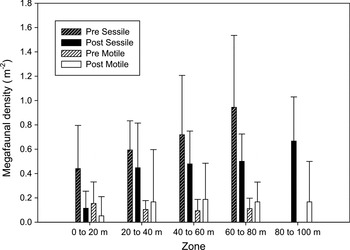
Densities of motile and sessile megafauna at Orca, shown pre- (hatched bars) and post-drilling (solid bars). Error bars represent 95% confidence intervals.

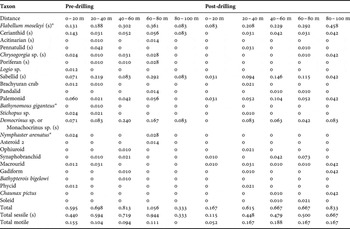
Densities (m−2) of megafauna observed during surveys at Orca (s, sessile). *, indicates that identifications are from physical specimens.

Additional species noted: Deltocyathus cf italicus*, Mixine macoskeri* and Mixine robinsi*. Photographs of some taxa available in supplementary material.
In the undisturbed assemblage (pre-drilling), cnidarians were most common (44%) being predominantly represented by the caryophylliid cup coral Flabellum moseleyi (31%) and a cerianthid (10%). There were almost equal numbers of echinoderms and annelids (22%). Echinoderms were represented predominantly by isocrinid crinoids (19%) and annelids solely by sabellids. Crustaceans (6%), fish (3%), poriferans (1%) and cephalopod molluscs (0.3%) comprised the remainder.
After drilling the assemblage composition displayed some changes. Cnidarians were still the most common group, constituting 51% of all organisms observed (3% reduction in abundance from pre-drilling). Annelids represented the next most common group (42% reduction) while echinoderms accounted for 10% of the total organisms (60% reduction). The abundance of fish (13%) and crustaceans (11%) had increased (increase of 270% and 50% respectively) after disturbance. Poriferans and molluscs were not observed after disturbance in the post-drilling survey. The taxa recorded in the 0 to 20 m zone after drilling were either scavengers or occurred only in the areas of this zone with partial cuttings coverage.
Univariate analyses
Results of the ANOVA show that distance from drilling was a significant factor for total faunal density (Table 2). When this was examined further, significant pairwise differences only occurred between the 0–20 m zone and the other zones (t > 3.5, P < 0.01). This result appeared complicated by simultaneous reductions in density in some sessile elements of the assemblage and increases in density in motile forms. Sessile organisms, when analysed separately, showed similar trends to total megafaunal density (they make-up a large percentage of the total density). Sessile megafauna occurred in greater densities further from the source of impact independently of time of sampling and at greater densities before drilling independently of distance (Figure 3). Analyses of motile organisms showed no significant differences in distance, time of sampling or the interaction between the two (Table 2). Density of motile megafauna prior to drilling appeared to slightly decrease as distance increased. After drilling the density of motile megafauna displayed the opposite trend. Neither trend was significant (Figure 3).
Summaries of F ratios from univariate two-way analysis of variance for total (Total), motile (Motile) and sessile (Sessile) megafaunal density before and after drilling (Drill) and at different distances from drilling (Distance). Significance: not significant (P > 0.05) = ns; significant *P < 0.05, **P < 0.01. Data were log transformed prior to analysis.

Multivariate analyses
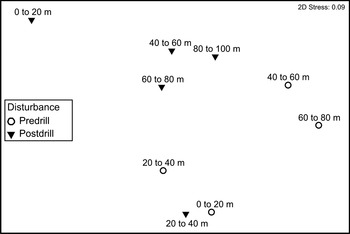
Multivariate techniques revealed large and significant differences in the composition and structure of the megafaunal assemblage at Orca for the different factors. The MDS plot (Figure 4) revealed a clear separation of the megafaunal assemblage of the post-drilling 0–20 m zone (50.0% similarity from cluster analysis) from the predrilling assemblages of this zone and the zones further away from the source of disturbance. Those treatments had a more similar assemblage (61.3% similarity from cluster analysis) with no clear separation of pre- and post-drilling assemblages. PERMANOVA revealed significant main effects of drilling regime and distance from disturbance but no significant interaction (Table 3). Examination of the MDS ordination and t-values of the a posteriori test suggests that differences between distance zones were primarily from the post-drilling transects, which showed large differences in assemblage composition between those in close proximity and those at further distance from the drilling activity (Figure 4). SIMPER analysis revealed the dissimilarity between pre- and post-drilling samples was principally a result of changes in abundance of 4 discriminating taxa (cumulatively explaining 51% of the dissimilarity between groups): isocrinids (13.7%), Sabellidae (13.5%), Flabellum moseleyi (12.6%) and palemonids (11.3% contribution). The same taxa were also primarily responsible for multivariate dissimilarity between distance groups.
Multidimensional scaling ordination (based on Bray–Curtis similarities computed from fourth root transformed average abundances) of megafauna from remotely operated vehicle video footage in 20 m zones from drilling disturbance at Orca field, Venezuela.

Non-parametric permutational multivariate analysis of variance on Bray–Curtis dissimilarities for total (Total), motile (Motile) and sessile (Sessile) megafaunal density before and after drilling (Drill) and at different distances from drilling (Distance). Significance: not significant (P > 0.05) = ns; significant *P < 0.05, **P < 0.01. Comparison is by pair-wise a posteriori tests among distance treatments.

If the assemblage is split into motile and sessile organisms and PERMANOVA repeated the analysis reveals differences between the groups of organisms. For motile organisms only distance from drilling has a significant effect (Table 3). For sessile taxa only disturbance regime has a significant effect (Table 3).
DISCUSSION
Megafaunal abundance at the Orca site was significantly reduced after drilling. Megafaunal numbers were very low in disturbed areas and close to the disturbance source. As this study was completed within 10 days of the initial disturbance it reflected the immediate disturbance of the communities by physical smothering and burial of organisms by sedimentation also observed in other studies (Jones et al., Reference Jones, Hudson and Bett2006, Reference Jones, Wigham, Hudson and Bett2007b). There was no additional chemical disturbance, as the well was drilled by jetting with seawater. Highly motile organisms responded by moving away from the disturbance, as has been previously noted (Bluhm, Reference Bluhm2001), and in some cases by moving in to the disturbed area after disturbance, possibly in search of carrion. There was also some evidence of lower densities of sessile organisms and higher densities of motile organisms pre-drilling close to the proposed drill centre than observed further away, perhaps in response to increased activity of the ROV observing the installation of the guidebase structure and causing minor sediment disturbance in this area. Alternatively, mobile fauna may have been attracted to the structure as an ‘artificial reef’, as found on shipwrecks in the Gulf of Mexico (Kilgour & Shirley, Reference Kilgour and Shirley2008).
From the multivariate analyses it was apparent that the assemblage composition of sessile taxa was altered by the drilling activity, and univariate analyses suggested that the total density of sessile fauna increased with distance from disturbance. The responses of common sessile taxa would have driven overall patterns in total density, but multivariate analyses (with a fourth root transformation) account for changes across the whole assemblage, including the rarer taxa. These analyses suggest that there was a significant effect of drilling on sessile fauna, but the varying sensitivities of taxa do not allow any significant interaction to occur as a result of distance and drilling. Sessile organisms' disturbance avoidance responses are variable (Hall, Reference Hall1994). The immediate effects of drilling, including displacement of sub-seafloor sedimentary material, were of sufficient magnitude to usually overwhelm avoidance responses and cause smothering of sessile and infaunal organisms. In the time frame of this work it would have been impossible for a new complement of sessile animals to settle, establish and grow to the sizes seen in the video. Fauna only buried by a thin layer of sediment or buried for a short time may be less impacted (Trannum et al., Reference Trannum, Nilsson, Schaanning and Øxnevad2010) and be able to clear sediment or recover relatively quickly. An example of this may be seen by ‘halos’ of cleared sediment around caryophylliids in areas with lower sediment thicknesses in the post-drilling survey. The morphology of taxa also appears to be important, e.g. tall sabellids seem to suffer less impact than other ‘flatter' organisms (e.g. asteroids). In general, megafaunal animals, as a result of their size, may be less impacted than smaller organisms. The numbers of individual animals and different taxa observed within the 20 m zones before and after drilling was likely a function of drilling-related sedimentation depth as well as the morphology and sediment clearing abilities of specific taxa.
Megafaunal diversity at Orca was reduced by drilling activity but only in those areas where sedimentation completely covered organisms (see ‘disturbed’ zone in Figure 2). Motile species or those morphologically resistant to high sedimentation could survive the sedimentation event, as has been found in other environments exposed to high sedimentation (Hall, Reference Hall1994; Wlodarska-Kowalczuk et al., Reference Wlodarska-Kowalczuk, Pearson and Kendall2005). With only a small area affected by this disturbance and the apparently high abundance of species it is unlikely that the drilling event will have had any major effects on the ecosystem at a landscape scale. Within the disturbed area there may be a change in community functioning resulting from selective removal of sessile taxa. Most sessile taxa identified here are thought to be suspension feeders, which provide important functions in benthic systems (Rossi et al., Reference Rossi, Gribsholt, Middelburg and Heip2008). Reduction in suspension feeder numbers and diversity may have reduced the ability of the biota of disturbed areas to effectively assimilate available food resources (Hughes & Petchey, Reference Hughes and Petchey2001) and potentially have caused shifts in community structure or even have reduced the rate of faunal recovery. This would be especially important with the repeated disturbance likely if the area is subsequently developed as an oil extraction area.
The changes in assemblage structure observed at Orca in response to anthropogenic disturbance from sedimentation have also been found in other areas (Bluhm, Reference Bluhm2001; Jones et al., Reference Jones, Hudson and Bett2006, Reference Jones, Wigham, Hudson and Bett2007b). The major difference was that in a high depositional area, such as Orca, the subsurface material that was resuspended by disturbance appeared to be very similar in composition to that naturally occurring on the seabed. The changes in assemblage density and structure were similar to those observed, elsewhere, although there was less apparent reduction in faunal density or structure in the partially disturbed areas. In an area such as Orca, where naturally high sedimentation is typical (Moscardelli et al., Reference Moscardelli, Wood and Mann2006), some of the common sessile fauna exhibited effective behavioural adaptations to high sedimentation (observed in caryophylliids and sabellids), which have not been seen to the same extent elsewhere (Bluhm, Reference Bluhm1994; Jones et al., Reference Jones, Hudson and Bett2006). It is likely that benthic assemblages at Orca face a selection pressure to be tolerant of sedimentation, potentially explaining the comparatively limited impact of disturbance. It is unclear if the absence of a chemical disturbance at Orca, where no drilling lubricant was used, was a factor in the limited extent of faunal change observed compared to other studies where chemical lubricants were used (Terzaghi et al., Reference Terzaghi, Buffagni, Cantelli, Bonfanti and Camatini1998; Neff, Reference Neff2005; Schaanning et al., Reference Schaanning, Trannum, Øxnevad, Carroll and Bakke2008; Santos et al., Reference Santos, Lana, Silva, Fachel and Pulgati2009).
It was not possible to ascertain whether the megafaunal assemblage outside the area directly disturbed was typical for the local area, or even the region, owing to limited background information. Most species that were identified to species level (i.e. those where specimens were collected by ROV) had been previously recorded in Venezuelan waters. The only exception was one of the two species of hagfish trapped in this study, Myxine robinsi, which was a new record for Venezuelan waters (Wisner & McMillan, Reference Wisner and McMillan1995). The natural megafaunal assemblage at Orca (observed pre-drilling and distant from disturbance) was dominated by cnidarians, echinoderms and annelids. At similar depths in the Gulf of Mexico the megafaunal assemblage was, in contrast, dominated by decapods and fish (Pequegnat et al., Reference Pequegnat, Gallaway and Pequegnat1990). The extensive bioturbation observed at Orca may be evidence that infaunal decapods were present. The infauna are likely to be better represented in boxcore and megacore samples than, as here, in visual assessments.
The megafaunal densities observed at Orca were two to three orders of magnitude higher than the maximum so far recorded for the Gulf of Mexico at comparable depths (Pequegnat et al., Reference Pequegnat, Gallaway and Pequegnat1990). They were also an order of magnitude higher than found in the deep bathyal and abyssal zones of the Venezuela Basin (Briggs et al., Reference Briggs, Richardson and Young1996). Some of this variation may be accounted for by methodological variation, photography generally revealing higher megafaunal densities than trawls (Thurston et al., Reference Thurston, Bett, Rice and Jackson1994; Bett et al., Reference Bett, Malzone, Narayanaswamy and Wigham2001). Methodological variation is unlikely to account for such large differences. The high surface production and associated flux of organic material to the seafloor is probably responsible for high faunal densities observed in this area (Lampitt et al., Reference Lampitt, Bett, Kiriakoulakis, Popova, Ragueneau, Vangriesheim and Wolff2001).
Disturbance is known to affect the function of benthic communities. In this instance the nature and function of the megafaunal assemblage only appears to have been impacted over a small area and probably for a limited time. The impact may be lower than found elsewhere because the assemblage is adapted to conditions of regular sedimentation disturbance. Further work is required to understand how the entire assemblage changes and recovers after the initial perturbation investigated here. Recovery potential from anthropogenic disturbance in the deep sea remains relatively unknown and is difficult to predict. It may be affected by many parameters including intensity of disturbance (Dernie et al., Reference Dernie, Kaiser, Richardson and Warwick2003), sediment type (Thrush et al., Reference Thrush, Hewitt, Cummings and Dayton1995), temperature (Childress, Reference Childress1995), faunal composition (Loreau et al., Reference Loreau, Naeem and Inchausti2002), reproduction rates (Tyler, Reference Tyler1986) and seasonal effects (Tyler, Reference Tyler1988; Billett et al., Reference Billett, Bett, Rice, Thurston, Galeron, Sibuet and Wolff2001). Further study of community patterns and the ecology of deep-water species are urgently required, especially with ever increasing anthropogenic activity in areas that are poorly understood.
ACKNOWLEDGEMENTS
We wish to thank Statoil, Subsea 7 and Transocean for supporting and hosting this visit. We thank Sheila Marques Pauls and others at the Museo de Biología, Universidad Central de Venezuela for identifications of specimens. Particular thanks to N. Aas, E. Conteras, A. Gates, H. Igeltjørn, L.P. Myhre, A. Myhrvold, J. Rosas and R. Zumaya for help. The work was carried out as part of the SERPENT project. Thanks to B. Bett for constructive comments on the manuscript. This work was funded in part by the Natural Environment Research Council (D.J., grant number NE/C508518/1). This work was also funded by Statoil (D.J., funding to SERPENT).
Supplementary materials and methods
The supplementary material refered to in this paper can be found online at journals.cambridge.org/mbi.