Economic power, rather than domination, increasingly set the relation between notable and villagers . . . Deals, trade-offs, and bargains became much more pervasive than in earlier situations, and client politics flourished on a new level . . . It was undeniably a form of mobilization . . . that brought a greater portion of the masses into a meaningful relation with the center.
—Şerif Mardin
In 1973, Şerif Mardin's famous article “Center–Periphery Relations: A Key to Turkish Politics?” was published in the journal Daedalus.Footnote 1 Although not extensively referenced until the 1980s, it is now indisputably one of the foundational works on Turkish politics, and arguably the most influential single work. For forty years, it has provided a useful metanarrative for almost any topic related to Turkish politics or society. Scores of academic articles and books published through 2012 on a range of topics in Turkish studies referred either explicitly to the seminal article or to the foundational conceptualization it proposed, as it has been most commonly understood.Footnote 2 No other article in the field of Turkish politics can boast more than a fraction of the shelf life of this study.
The work itself, as a narrative of the history of relations between the state and society that focuses primarily on the Ottoman Empire, makes a number of important and nuanced arguments. But its general outline, as it has been popularly understood and appropriated, runs as follows. The Turkish Republic inherited from the strong state tradition and educational peculiarities of the Ottoman Empire a significant sociocultural cleavage between a modernizing military–bureaucratic center and a heterogeneous mass periphery. The secularized and Westernized lifestyle of the central elites, who had privileged access to secular education, created a “wedge” between them and the rest of society, which was more comfortable with its existing religious symbolism and hierarchy. With the advent of multiparty politics in 1945, the periphery appeared to find its voice in the vehicle of the Democrat Party (DP), while the sociopolitical center remained true to the Republican People's Party (Cumhuriyet Halk Partisi [CHP]). The military coups of 1960 and 1971 (Mardin's article predates the 1980 intervention) are interpreted as a reassertion of the center over the burgeoning power of the periphery.Footnote 3
Although many of the ethnologies, political and historical studies, and empirical data on Turkey prior to the 1980s present a strong challenge to this interpretation, subsequent scholars of Turkish politics have frequently taken this division as explanatory of an electoral cleavage within the Turkish party system, with so-called “center-left” parties representing the views of the center and the parties of the “right,” both center and extreme, along with the de facto Kurdish parties, manifesting the political desires of the heterogeneous periphery. As an illustration of the framework's persistence, in the 2012 Handbook of Modern Turkey, a collection of essays by prominent scholars of Turkish culture and society, Ali Çarkoğlu's chapter on “Voting Behavior” includes a section entitled “Center vs. Periphery: The Cleavage that Shapes the Turkish Polity.” After attributing the first application of the cleavage framework in the Turkish context to Mardin, Çarkoğlu writes that “the cultural divide has remained deep, despite urbanization and the relatively recent opening of Turkish society via the adoption of a market-led economic policy.”Footnote 4 He concludes that the “center–periphery” cleavage “appears to shape worldviews and cultural groupings in Turkish society. Party preferences are clearly differentiated across constituencies that have a distinct position in reference to this cleavage.”Footnote 5
Although the substance and boundaries of this powerful-versus-powerless sociocultural dichotomy have been described in various ways—since the rise of the Islamist Welfare Party (Refah Partisi) in the mid-1990s, for example, scholars have often substantively defined the center–periphery cleavage as a secularist/Islamist or modernist/traditionalist divideFootnote 6—the cleavage has been widely maintained as an underlying framework through which electoral and other political behavior is explained.Footnote 7 The essential question, then, is whether or not this narrative of an essential cleavage effectively explains the behavior of the Turkish party system. Does the “center–periphery” cleavage concept, as it is widely employed in comparative sociological and political science literature, conform to the data on voting behavior in Turkey from its first fair elections in 1950 through 2011?
In posing these questions, this article does not address whether or not a “social center” exists in Turkey that largely establishes the normative values and practices that then trickle down through society, nor does it ask whether or not there are observable sociocultural differences in lifestyle and outlook correlating with existing political boundaries. Such phenomena have been widely observed in many polities, including so-called “advanced industrial” democracies. My concern is with whether or not the widely known center–periphery conceptualization of a battle between dominating elites and weaker, peripheral masses can explain how parties are formed, who they are formed by, why voters cast their votes, and how change has occurred in Turkey. Are there better ways to explain the Turkish party system? Would another approach to electoral competition have greater explanative power?
The next section examines the substance of the theoretical concept of center and periphery in Mardin's article and related foundational works by other scholars. I then turn to a close empirical investigation of the initial period of the multiparty system, when the vast rural population achieved democratic suffrage in Turkey and a massive competitive cleavage between a center and periphery was the most likely—as suggested by the logic and theory on which Mardin's particular conceptualization is based. The final section will examine the evidence of electoral changes in subsequent years, raising additional questions about the usefulness of the concept.
THE CONCEPTUALIZATION OF “CENTER AND PERIPHERY”
Besides the seminal article by Mardin, there are two other widely known theoretical works that have informed the conceptualization of a center–periphery cleavage in Turkish politics: a 1961 essay by Edward Shils and the introduction to a 1967 volume of collected works by Seymour Martin Lipset and Stein Rokkan.Footnote 8 Mardin begins his article by quoting from the first sentence of Shils’ essay—“Society has a center”—and he notes that his “initial formulation is derived from” this work.Footnote 9 He also refers briefly to the study by Lipset and Rokkan in a note citing works on social cleavages in western Europe. Despite Mardin's own insistence that he relied more explicitly on Shils’ essay, most works referring to Mardin's center and periphery formulation assume an electoral cleavage interpretation more in line with Lipset and Rokkan's analysis. Hence, it is beneficial to consider each of these works while seeking to understand the center and periphery concept as generally attributed to Mardin. Both works provide logical comparative frameworks that encourage the application of the concept to particular cases, but both conceptualizations encounter important logical problems when applied to voting behavior and elections throughout Turkish history.Footnote 10
Shils’ “central system values” concept, which establishes the boundary between the “center” and “periphery,” does not primarily establish a clear value division between the two groups but rather makes a distinction between those who are able to shape society's central values and those who are not. In most cases, he anticipates that the values of the center have been inculcated to the masses since the very purpose of these central values is to establish social order. Therefore, he posits a clear and extensive division between the “peripheral” masses and the sociocultural “central” elite in two contexts: (1) a period prior to the processes of centralization, universal education, and democracy or (2) an authoritarian regime where the distance between those in power and the masses are so great that their differing value systems have little occasion to come into contact. In this conceptualization, democracy (through the need to acquire the masses’ consent to govern) and universal education (through indoctrination of central values) drastically reduce the power distance between elites and masses,Footnote 11 so that, from a Shilsian perspective, parties that have internalized the rules of the system and are strongly positioned to win elections are embedded within the central system and merely wrestle over the priority and interpretation of values, all of which are central.Footnote 12 In this vein, a discussion of “peripheral” parties would be limited to marginal groups who either seek to overturn the existing order or are so small that their values and desires are easily disregarded by the majority of society. Thus, the major political parties competing in elections in Turkey do not fit Shils’ “periphery” categorization. Only Kurdish parties, the far left parties, and politically unrepresented ultra-Islamists could serve as good examples of “outside the system” peripheral elements in the Turkish case if we adhere to Shils’ substantive understanding of center and periphery.Footnote 13
In contrast to Shils’ conception, Lipset and Rokkan conceive of the center and periphery as political oppositions that might arise, at least initially, in electoral contest. This is possible because, in their conceptualization, the center–periphery power divide is realized both territorially and nationally. The cleavage is territorial in the sense that some geographic locations (often industrialized urban centers) have a dominating relationship over peripheral spaces, based on competing or exploitive socioeconomic structures. The authors emphasize the national basis of the cleavage in the sense that the territorial designation is binary; local communities—however otherwise distinct they may be—mobilize collectively to oppose the dominant center and its efforts to centralize the nation-state and its economy.Footnote 14 This juxtaposition of oppositional groups, considered the likely product of a national revolution, is presented by the authors as “the conflict between the central nation-building culture and the increasing resistance of the ethnically, linguistically, or religiously distinct subject populations in the provinces and the peripheries.”Footnote 15 Though this provides reasonable grounds on which to propose an electoral cleavage, there are nonetheless important logical objections to applying this “center–periphery” framework to the Turkish case.
One problem is that Lipset and Rokkan base the possibility of a national “center–periphery” cleavage on a particular stage of modernization in which the not fully consolidated nation-state is in the process of completing state centralization over waning feudal substructures. During this process, the elites associated with the centralizing state are in combat with local notables who attempt to keep the existing sociopolitical and economic structures intact. Prior to suffrage for the peasants, elections could be seen as a contest between two sets of elites—those associated with the powerful force of the centralizing nation-state and those aligned with the waning power of the feudal lords. Therefore, the authors embed the concept of a national center–periphery cleavage in a contingent historical process. Furthermore, they argue that the cleavage cannot “survive the extensions of the suffrage” to peasants, because the interests of the rural peasant masses cross-cut the division between the dominating central state and the fading power of locally dominant landlords.Footnote 16 Thus, though they anticipate different causal mechanisms and a more gradual process, Lipset and Rokkan also anticipate the muddling of the cleavage with the expansion of democratic institutions.
Can the Turkish electoral landscape be explained as a persistent contest between centralizing national industrialists and the remains of a feudal class and its socioeconomic substructures? As Mardin himself asserts, even during the Ottoman era there was no oppositional “feudal class” of powerful landed elites who could counter central urban authority, since the economy was firmly in the hands of the state.Footnote 17 Even if one adopts the classical modernization theory paradigm—operating in all three works discussed here—and assumes the possibility in Turkey of a late development through the same stages of modernization historically experienced by the West, the fit is problematic at best.
It is for these complicating reasons that the national center–periphery cleavage concept is rarely employed to discuss recent phenomena in countries other than Turkey. One would be hard pressed to find it applied in any other context as a national cleavage—that is, one that divides the entire nation into two directly competing groups (center and periphery). When it is used in party system literature, the cleavage refers to the existence of marginalized regions that, for ethnic, religious, or economic reasons, have been left out of the national debate.Footnote 18 Indeed, for a periphery to persist on one side of a cleavage, it has to perpetually lose—that is, be ineffectual or socially marginal—which in the Turkish context could only be argued, as mentioned above, to apply to the communist parties and those supportive of Kurdish nationalists.
Considering that the theoretical conceptualizations of a “center–periphery” divide as outlined by Shils and by Lipset and Rokkan encounter serious logical difficulties as an explanation of an essential electoral cleavage in Turkish politics, one might ask what Mardin intended in using this concept in his article. Mardin has long had a tendency to paint broad and profound, if often vague, portraits of the Turkish landscape, generating much debate over the finer points of the analysis while remaining silent as to his own intentions, and the article in question is no exception. Nonetheless, a reasonable assumption is that he intended to highlight, through the center–periphery concept, a division between elites and the masses that was primarily sociocultural rather than territorial, regional, or socioeconomic—in other words, his analysis is closer to that of Shils than of Lipset and Rokkan.
This assumption is supported by the direct reference to Shils in the article's first sentence and endnote. It is also consistent with the emphasis placed in Mardin's other works on a cultural divide between the dominant bureaucratic class and the people, in which he focuses on the critical differences in “worldviews” or values that developed among ruling elites and the populace toward the end of the Ottoman era, the boundaries of which were maintained at the level of religious discourse and symbolism.Footnote 19 Thus, he prioritizes distinctions in values and norms—that is, Shilsian “central system values”—as the determining boundary between the elites and the masses. This seems far from the electoral interpretation of the concept as employed by Lipset and Rokkan, though many have, while referencing Mardin's work, employed such an interpretation.
Moreover, since Mardin's work primarily employed the concept in the context of the late Ottoman Empire and the early republican period prior to the advent of a multiparty electoral system (and as the quote from his article presented in the epigraph of this essay clearly suggests), an interpretation of his work that strongly emphasizes a center–periphery electoral cleavage would be ill advised. Mardin acknowledges that the advent of democratic elections after 1945 narrowed the gap between the elites and the peripheral masses, and that this occurred because the elites engaged the electorate through the voters’ materialistic and economic, not sociocultural, concerns.Footnote 20 This strongly calls into question the usage of an electoral cleavage that explicitly pits elite society against the masses, suggesting instead that what actually occurred was an accommodation strategy focused on material interactions to bridge an existing gap between the social center and the periphery.
What all of these conceptualizations have in common is that the cleavage relates to the power or authority of a center to impose its will on the political, social, and/or economic structures of society. In each conceptual usage, if we are not talking about a struggle between a dominating and a weaker class, we are not, in substance, referring to a “center–periphery” cleavage. This is one reason why the current use of religiosity as an index of this supposed cleavage is so ill advised.
Though conceptual problems with the center–periphery framework to describe a national cleavage abound, its persistent usage in interpretations of Turkish politics for the past forty years requires us to examine the empirical evidence for it in the Turkish case. If it does indeed describe a functional cleavage operating in the Turkish party system, such a cleavage would most likely—based on all conceptual accounts—be found in the electoral contests of the early multiparty period, the contingent environment of which most closely corresponds to the theoretical framing of the concept. Furthermore, if the cleavage is an effective explanatory framework for the operation of elections and the party system throughout the multiparty period, we would anticipate a fair amount of electoral stability and predictability without major regional or demographic shifts in voting behavior. The following sections turn to these questions.
EVIDENCE FOR AN INITIAL CENTER–PERIPHERY CLEAVAGE IN THE TURKISH PARTY SYSTEM
The previous section has shown that there are significant reasons to believe that a “center–periphery” gap—whether socioeconomic or value-based—would have been weakened and complicated by the institutionalization of democracy and universal suffrage in Turkey. But if it has persisted, beginning with the contests between the central CHP and the peripheral DP, as has been widely proposed, how might it be observed empirically? The cleavage framework suggests that voters are intentionally making voting decisions that favor either the periphery or the center, based on knowledge that the recipient of their vote clearly represents the interests of their side of the cultural divide.Footnote 21 Thus, the sociocultural background of party elites becomes important; peripheral parties would be more likely to be led by elites tied to the periphery—such as local notables—than would the “center” party.Footnote 22 One might also anticipate that the discourse and other vote-influencing strategies of the parties would clearly emphasize a powerful versus powerless sociocultural positioning, rather than, for example, economic, material, or developmental promises. In other words, there would logically need to be some sort of evident element that would enable the maintenance of the oppositional cleavage if it is to be lasting. Most obviously, one would assume that areas and voters with the least beneficial interaction with and the greatest distance from the power of the center—that is, the least nationalistic and centralized—would be the most likely to vote in greater numbers for the peripheral party.Footnote 23 Finally, for it to be an essential (i.e., diachronic) sociocultural cleavage, one would anticipate that there would be some measure of stability in how votes are cast; in other words, significant changes in the distribution of votes across the population would not be observed.Footnote 24
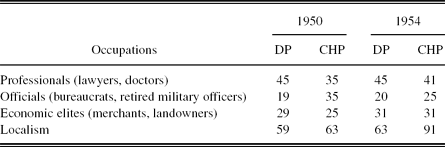
For the initial period of multiparty elections—spanning the advent of fair elections in 1950 to the first military intervention on 27 May 1960—the backgrounds of the party members of the Turkish Grand National Assembly are well documented. One trait that remained stable during this period across all political parties was a high level of secular educational attainment among the party elites.Footnote 25 While there was a slight occupational difference observed between the CHP elite and the DP in the initial turn-over election of 1950—deputies representing the CHP were slightly more likely to have a military or bureaucratic background while those from the DP were more likely to come from “professional” occupational backgrounds (as lawyers, doctors, businessmen, etc.)—this difference became negligible in subsequent elections (see Table 1).Footnote 26 Furthermore, the distinction between bureaucrats and professionals should be interpreted not as a distinction between elites and nonelites but rather as an indication that “elite occupations” in Turkey were undergoing a shift. During the late Ottoman and early republican periods, bureaucrats with secular educations effectively administered the affairs of state. There were no better claimants to a modern, Westernized, and skilled statecraft than those civil and military officials educated for that purpose. The values of modernization and Westernization were inculcated to the masses in the early republic, and these new values began to raise the social status of other professions. Lawyers and doctors in particular represented progressive society, and thus, when the selection of political elites through the voting franchise was left to the masses, it is no surprise that both parties began to recruit heavily from these professional positions based on the preferences of the electorate. As a multiparty political system was implemented, these socially elite occupational groups began to assume greater political prominence.Footnote 27 It is similarly no coincidence that one begins to see the rise of the engineer and the technocrat in politics beginning in the 1960s.Footnote 28 The social desirability of the occupations of the DP placed them in the social center, not the periphery, as some have claimed.Footnote 29
Percentages of occupational and local representation in parliament

Source: Frederick Frey, The Turkish Political Elite (Cambridge, Mass.: Massachusetts Institute of Technology Press, 1965), 357, 359.
An even more significant complicating factor arises when “localism” is taken into account. Although both parties, with the advent of the multiparty system, sought to increase their degree of local representation, the CHP outperformed the DP in this area.Footnote 30 Many DP parliamentarians were residents of the Marmara and Aegean regions (as were CHP representatives during the single-party period), while the CHP deputies in the elections of the 1950s were increasingly drawn from local notables in peripheral central and eastern Anatolia. Therefore, it would be hard to suggest, based on the overall composition of the competing parties, that the rural (peripheral) voters would have been able to make a clear choice of party based on their status in relation to the periphery. To the extent to which the parties were not largely mirrors of one another in terms of the elite status of their leaders, it could be suggested that the CHP offered greater incentive to the rural peasants.
The background of the DP leaders was no mystery to the populace; they had all been leading members of the CHP and had sprung from the same elite class.Footnote 31 Thus, if these parties became the channels reifying a national center–periphery divide, it was unlikely that the background of the deputies was a decisive factor. Some researchers have detected hesitancy and uncertainty regarding the DP in the rural areas. Richard Robinson, an observer of the critical 1950 elections as they transpired in villages, writes: “The Democrats won in the villages by a surprisingly narrow margin [in comparison to their huge wins in the big cities] . . . It was as though many trusted the Democrats even less [than the CHP].”Footnote 32
A typical justification for interpreting the DP as the party of the periphery in relation to the “centrist” CHP is the claim that the DP mobilized the masses by asserting itself as the spokesman of the peasant, while the CHP maintained its position as the defender of republican reforms and values.Footnote 33 The DP, according to this analysis, represented the discourse of alternative values as a challenge to the central system values embodied in the principles of Ataturk and Kemalism. To what extent might such an oppositional discourse explain a center–periphery electoral cleavage? There are a number of reasons such an interpretation is problematic. A close inspection of the behavior, discourses, and programs of the two parties reveals that their approaches to electoral contestation were more complex than the cleavage assumes, and often resembled each other.Footnote 34 In fact, an analysis of party manifestos and campaign speeches suggests that the CHP made more specific appeals to the villagers and their plight than did the DP, which consistently emphasized general interests.Footnote 35 Though this analysis contradicts many historical summations of the period, it might be logically predicted by the fact that the DP came into existence in order to prevent the state from distributing land to poor peasants in a land reform program. The party did not have a strong basis to appeal ideologically to peasants; its success relied on distracting them from its free-market industrialization platform through other means.
If we assume that these other means involved exploiting the religious sensibilities of the masses, the picture remains complicated and inconclusive. For example, the “center” CHP strategically took the lead in liberalizing legal rights to religious expression during the years immediately preceding the DP victory in 1950. Though such liberalization was likely a value of the periphery in this period, both parties seemed willing to negotiate when electoral fortunes were at stake, and both parties had clear limitations on how far they would liberalize in this regard.Footnote 36 It was the advent of multiparty politics itself, and not any particular party's platform, that seemed to lead to a measure of liberalization of religious expression; that is, it was the result of the need of elites to gain the approval of the peripheral masses, a need that was understood by both major parties.Footnote 37
Furthermore, the effect of national political discourse on voters assumes its broad dissemination across the targeted society. How would elements of the periphery, especially those most distant from the center, be exposed to political discourse in this period? In the 1950s, a low level of radio access and insufficient educational opportunities made it very difficult for the periphery to be directly aware of national discourse between the parties.Footnote 38 The vast majority of people who read newspapers and listened to the radio during this period fit the profile of those near the social center. As indicated in studies undertaken at the time, the periphery likely received much of its national information through local word of mouth.Footnote 39 Localized filters of interpretation were thus at play when rural voters went to the ballot box, and likely produced a variety of understandings of what a vote for the CHP or the DP meant. Such realities in the peripheral provinces make it difficult to imagine that these rural villagers were effectively aware of and mobilized by a nationwide cultural struggle against the center. It was much more likely that in “peripheral” areas, “village and regional loyalties superseded national loyalty.”Footnote 40
Was there an observable trend of the periphery supporting a particular “party of the periphery” at the expense of a party representing the interests of the center elite? The answer to this question is “no.” At the advent of the multiparty political system, there is wide scholarly agreement that there was a significant separation between the western regions of Turkey and the central and eastern Anatolian regions in terms of centralization, development, and “values.” Power, wealth, and advanced education were largely located along the Marmara and Aegean coasts in the west. The largely rural residents of the eastern parts of the country had very little access to the center but were subjected to the control of the institutions of power located in the west.Footnote 41 Thus, one would expect that the western provinces would have been the citadel of the “center” party and, conversely, that the eastern areas most distant from the institutional centers of power and their accompanying culture would have been the bastions of the “peripheral” party vote.Footnote 42
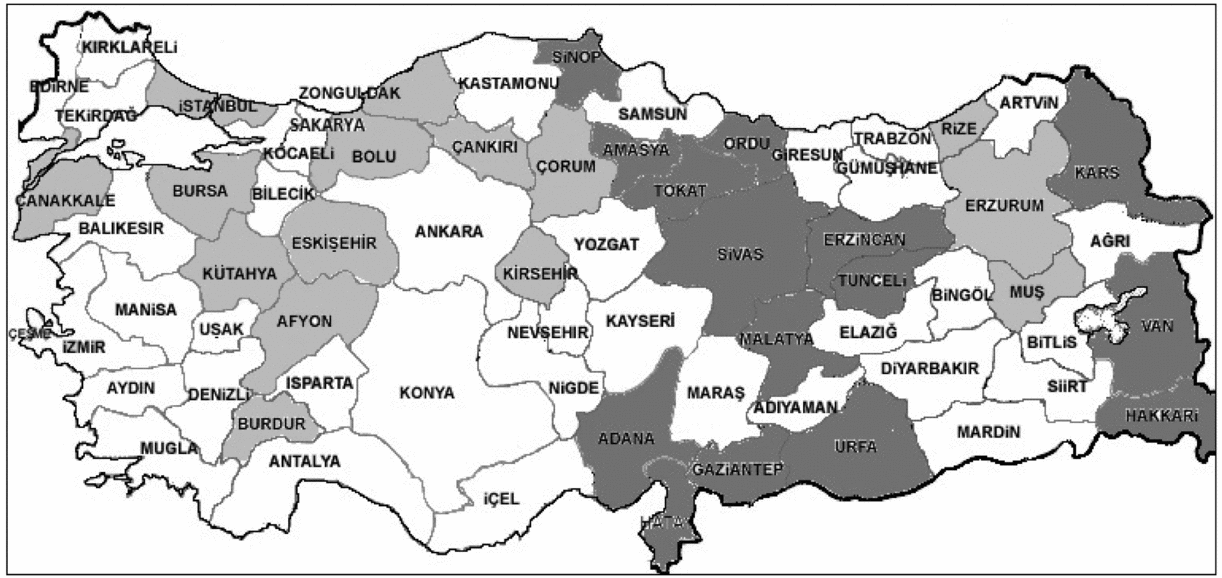
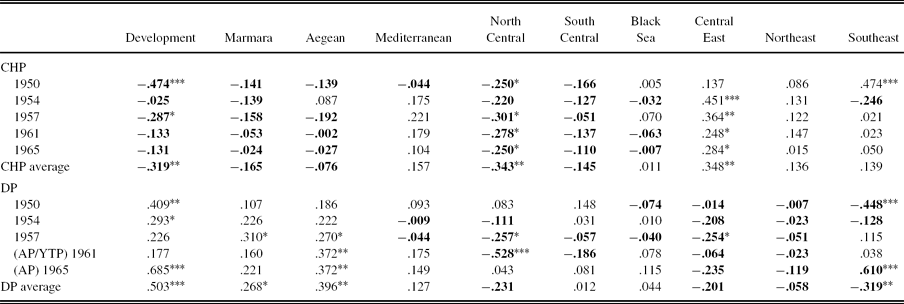
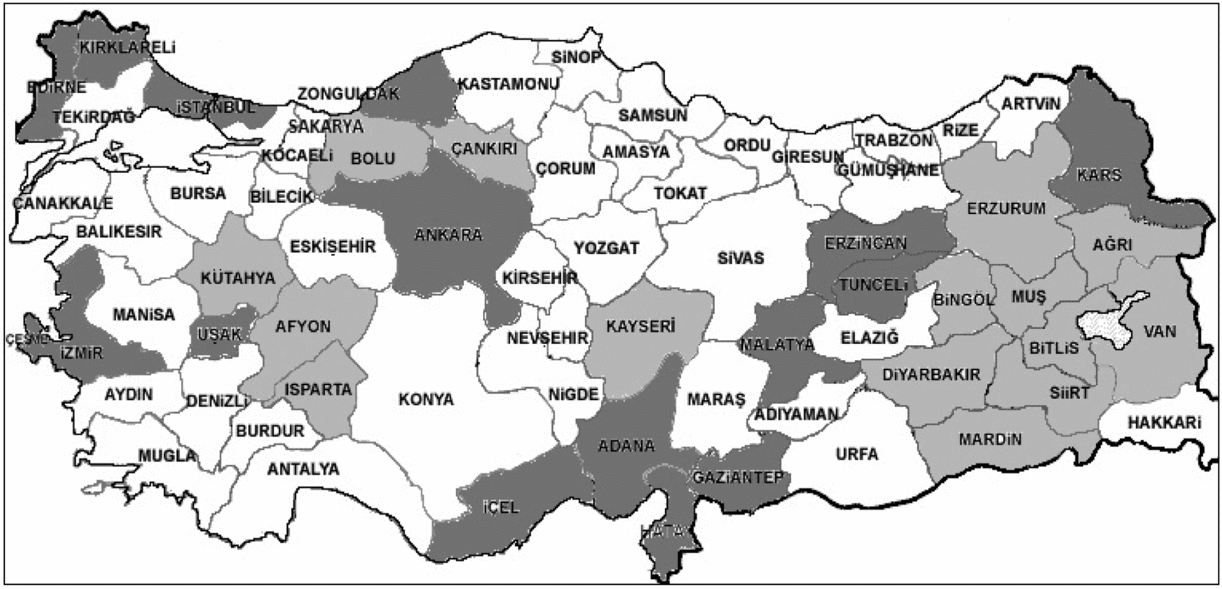
The electoral geography (see Figure 1) and provincial correlations (see Table 2) completely bewilder such an anticipated result. The fifteen provinces (in dark grey, Figure 1) garnering the highest average vote for the “center” CHP in the three elections from 1950 to 1957 are all in the eastern “peripheral” regions while the fifteen provinces (in light gray, Figure 1) providing it the least support are predominantly western. The central-eastern and southeastern regions of the country were the least centralized and the home to large portions of Kurds and Alevis, whose peripheral values and prerepublic socioeconomic structures placed them the furthest from the center and its social values and institutions. Yet these provinces were the mainspring of the CHP's electoral support in Turkish elections until 1965. None of the top fifteen provinces that supported the CHP were west of Sinop, located in the central Black Sea region.Footnote 43 In Table 2, the standard nine regional divisions of the country widely employed during that period are laid out in order of commonly accepted relative levels of regional development for the period in question. Development was simply measured by this ordinal weighting. These measurements generally establish that, outside of the Mediterranean region, the DP and its successor, the Justice Party (Adalet Partisi [AP]), performed more strongly in the more developed regions while the CHP was relatively more successful in the regions of less development.
The fifteen highest (dark gray) and lowest (light gray) average vote totals by province for Cumhuriyet Halk Partisi (1950–57). Data taken from Milletvekili Genel Seçimleri 1923–2007 (Ankara: Türkiye İstatistik Kurumu, 2008).
Correlations of party support with development and regions
Note: Negative correlations are in bold. CHP, Cumhuriyet Halk Partisi; DP, Democrat Party; AP/YTP, Adalet Partisi/Yeni Türkiye Partisi. All provincial electoral data are taken from the publication of the Turkish Statistics Institute, Milletvekili Genel Seçimleri 1923–2007 (Ankara: Türkiyeİstatistik Kurumu, 2008), 29–95.
*p < 0.05, **p < 0.01, and ***p < 0.001. Pearson two-tailed correlations.
THE ELECTORAL STRATEGIES THAT CROSS-CUT THE CENTER–PERIPHERY DIVIDE
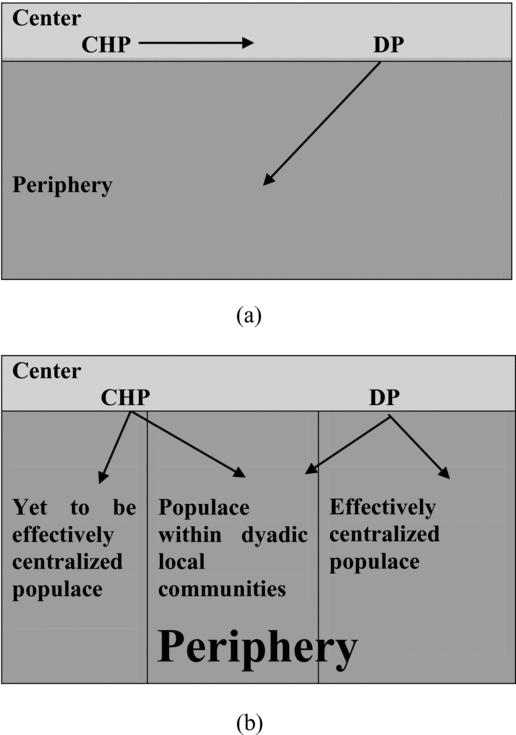
What then can explain the outcomes of these early national electoral contests? They cannot be empirically explained by existing social cleavages between the mass and elites but rather by the electoral-mobilization strategies the parties used. Instead of one party catering to elites while the other party courted the peripheral masses, as the classic center–periphery electoral cleavage would have it (see Figure 2a), the parties, all of which were firmly in the hands of social elites, employed different patron–client strategies (see Figure 2b), which provided the victorious DP huge advantages in subsequent elections.
(a) Classic “center–periphery” electoral cleavage and (b) cross-cleavage competition for peripheral votes.
The CHP pursued a strategy that had enabled its control over local communities during the single-party years: it mobilized votes by recruiting “proxies”—namely, local notables.Footnote 44 For obvious reasons, the mobilizing power of such relationships (see Figure 3, party A) was inversely correlated to the region's degree of centralization. Furthermore, while the CHP's initial investment in the community was relatively low cost, it also ensured that the party's ties to the communities via these proxies were extremely volatile. If the proxy chose to shop for a new party, the communal votes simply transferred with their local leader, leaving no trace of party organization behind.Footnote 45 Particularly in this early period of electoral competition, the “fortress” of votes for the CHP came largely from the provinces in the far eastern and the fertile Mediterranean regions, where such mobilization arrangements were much easier than in other areas.Footnote 46
The DP, meanwhile, initially seemed more adept at political clientelism and successfully used brokerage strategies to mobilize votes instrumentally (see Figure 3, party B). The party often enlisted local professionals to visit towns and villages as party representatives and determine what the local voters wanted, and then made promises in those areas in return for votes.Footnote 47 The accounts of research done primarily in inner Anatolian villages during the 1950s, particularly in the western and central regions, are filled with very pragmatic and instrumental declarations of villagers regarding their processes of electoral decisionmaking. Lerner records a villager as saying:
The Demokrat men came to Balgat and asked us what was needed here and told us they would do it when they were elected . . . We all voted for them . . . and the new men did what they said. They brought us this road and moved out the gendarmerie . . . We are all Demokrat party here in Balgat now.Footnote 48
When conditions permitted, and while still engaged in unequal and hierarchical patron-client relationships, the DP mobilizers interacted with their clientele, the rural farmers and urban periphery, directly through brokerage. The reciprocity was based on promised, and often delivered, material benefits—roads, mosques, schools, farm equipment, and the removal of the gendarmerie—in return for support at the ballot box.Footnote 49 In this regard, as Sayarı notes, the party mobilized votes according to a strategy closely resembling “machine politics.”Footnote 50 This basic difference in the two parties’ regional tactics is also noted by Özbudun: “While local notables were influential enough to mobilize their supporters in the less developed east, they could not exert much influence upon the more modern peasantry of the west, who were more responsive to the leadership of provincial merchants and professionals.”Footnote 51
Two forms of patron-client relations for political mobilization. In the party B form of patron–client relations, the broker may indeed rely on his/her own local-level resources in his/her dealings with clients, a phenomenon often observed in the Turkish case. The distinction, however, is that the proxy in the party A relationship has acquired patron status prior to and independent of his/her connection to the party, and it is for this very reason that the proxy was recruited by the party.
Moreover, in villages where there were preexisting social cleavages, the party lines fell conveniently along these divisions.Footnote 52 At the beginning of multiparty competition, members of the leading faction, usually connected to the headman (muhtar) embodying local governance, often became supporters of the CHP, while those of the opposing faction supported its primary challenger, the DP.Footnote 53 This phenomenon has been noted by many scholars of politics and village behavior in Turkey.Footnote 54
The determinants of voting behavior thus operated predominantly at the local level for the vast majority of voters in Turkey during this period. This was consistently recognized by students of Turkish politics and society until the 1980s, when the alternative national-level “center–periphery” interpretation began to gain prominence in the literature, apparently abandoning consideration of the empirical electoral data. Returning to this data requires us to recognize the localized nature of politics and electoral strategies during the early multiparty period. As Szyliowicz states, “local events were of much greater significance in shaping an individual's allegiance.”Footnote 55 When the battle was indeed drawn along lines of “us” versus “them,” it was understood within a local rather than national context,Footnote 56 and those paying attention to the behavior of the parties at the national level tended to behave according to instrumental motivations of localized individual or group interests rather than some notion of solidarity at the national level.
The fact that there is little empirical evidence for a national center–periphery cleavage directing electoral outcomes in their initial stages prompts the question of why the assumption of this divide's continuity would shape the scholarly literature after sixty years of multiparty democratic elections. The concept's current usage is even more perplexing given that the so-called “peripheral” parties have held the reins of government for most of this time. A visual illustration of provincial electoral data challenges the notion of continuity in electoral behavior (see Figure 4 and Figure 5). There was a great deal of consensus in the scholarship of the 1970s that Turkey was realigning, that is, that the system and the parties within it seemed to be dividing along new lines of contestation.Footnote 57 Thus, as one can see from Figure 4, although there are a few provinces that continued their strong pattern of support for or opposition to the CHP, there are some striking differences from Figure 1. In contrast to earlier elections, voters in the largest urban centers—Istanbul, Ankara, Izmir, and Adana—as well as in industrialized cities such as Zonguldak began to show strong support for the CHP. Ergüder and Hofferbert, in a study conducted in the 1980s, used factor analysis with electoral data to empirically search for a center and periphery divide that would explain the polarizing opposition between supporters of the CHP and those of the DP's successor, the Justice Party, from 1965 to 1977. What they found instead was a distribution of votes that fell more closely in line with a left-right socioeconomic paradigm.Footnote 58 Furthermore, the eastern provinces of the country, which in earlier elections showed support for the CHP, began to shift their vote against the party.
The fifteen highest (dark gray) and lowest (light gray) average vote totals by province for Cumhuriyet Halk Partisi (1969–77). Data taken from Milletvekili Genel Seçimleri 1923–2007 (Ankara: Türkiye İstatistik Kurumu, 2008).

The highest (dark gray) and lowest (light gray) average vote totals by province for the “center-left” (1999–2007). Data taken from Milletvekili Genel Seçimleri 1923–2007 (Ankara: Türkiye İstatistik Kurumu, 2008).
By the time we reach the three general elections held between 1999 and 2007, represented in Figure 5, the map appears to be a near spatial reversal of the 1950s portrait in Figure 1.Footnote 59 This might be one reason that the notion of a center–periphery political cleavage has successfully been maintained into the 21st century. The idea of a culturally Western and modernized “center,” represented by parties often referred to as the “center-left,” combating the traditionalist, Islamist populace of the central and eastern Anatolian regions seemed to fit the superficial portrait of more recent voting behavior. Without analyzing the earlier electoral data and simply comparing the present picture with a Lipset and Rokkan inspired interpretation of Mardin's work, the existence of such a diachronic power-infused cultural cleavage seems compelling. It thus should not be surprising that Mardin's essay began to take flight in the 1980s, when electoral patterns seemed to begin to fit the broad geographically based interpretation in a rough sense, even if, based on the concept's substantive meaning, we would have to reverse the cleavage as it has been proposed, since the parties supposedly representing the “periphery” have persistently dominated the “center.”Footnote 60
However, as more recent studies of Turkish electoral geography show, there are clear regional divisions in voting behavior, suggesting even distinct party systems rather than one party system with a single explanative national–sociocultural cleavage.Footnote 61 This literature has observed distinct patterns of competition in at least three areas—the western and coastal regions, central Anatolia, and the southeast region.Footnote 62 Rather than revealing a national-level cultural clash, analyses of this regional voting behavior show that parties competing across the regions are being locally reframed and interpreted according to issues and contingencies relevant to the regional context.
Especially since the work of Kalaycıoğlu in 1994, the correlation of religiosity to party preference has led some to assert that a secularist/religious-conservative cleavage is a manifestation of the continuing center–periphery cleavage in more recent electoral periods.Footnote 63 Scholars, particularly since the late 1990s, have identified a relationship between religiosity and votes for the “left” or “right” parties, and posited this as evidence of a center/periphery divide on the basis that it is one of the few demographic variables that has been consistently correlated with voters on the left and right.Footnote 64 Support for this assertion, however, is extremely problematic for several reasons.
First, while it is undoubtedly true that many early republican leaders were more secular in lifestyle and outlook than many of those in the peripheral masses, there is no evidence or empirical means to connect those who are more or less religious today with those who were so in the past. Second, the variable used has always been an aggregate index or individual variable for religiosity, not an attitude toward the secularization of the state. “Religious” and “secular” are not inevitably binary states. In fact, the high value that members of the Turkish public have placed on both religiosity and the protection of the secular state has been noted in a number of studies.Footnote 65 This means that even if we accept that state secularism is a “central system value,” survey data suggest that the vast majority of Turkish citizens have internalized this value, whether they are devout or not. Third, if the issue dividing Turkish society is primarily related to religious and secular culture, and not to a powerful center versus powerless periphery, then it also make little logical sense to use the loaded terminology. If religiosity is the proxy correlated with an electoral divide, the logical conclusion would be to assert a “religious-secular” cleavage during the period we have empirical data for. Fourth, in almost every study in which religion is correlated to voting behavior, if other variables or indices are involved, it is not the strongest correlation; this belongs to economic outlook, which again suggests a dominant sociotropic-egotropic dynamic (i.e., a prioritization of material/economic interests) in voting behavior, not a rigid and static sociocultural one.Footnote 66 Fifth and finally, describing the clustering of highly educated and secular voters on the “left” against religious conservatives on the “right” as a reflection of a “center versus periphery” framework seems to demonstrate a lack of comparative knowledge of other democracies, especially those labeled “advanced industrial democracies,” where similar clusterings have been widely observed.Footnote 67 Consistency would thus require that we refer to all of these systems as primarily reflecting a center–periphery cleavage, given that the same conditions apply. Yet such an application is, of course, untenable for those democracies because it is widely recognized that religiosity is a poor proxy to ostensibly reflect a powerful center versus a weak periphery. The same holds true for Turkey.
Other scholarship in recent years has proposed worldview cleavages that are focused on the current political environment rather than those that explain all electoral behavior over time. Some have emphasized a contingent “secular–religious” cleavage to explain the current environment in Turkey, and certainly such assertions have greater empirical weight than do those of a powerful national center pitted against a massive but weak periphery.Footnote 68 Even this proposed cleavage, however, is arguably a bit misleading. If we are looking at factors that primarily explain the impetus to vote for certain parties, whenever economic considerations are used as a variable in survey data, its coefficient consistently occupies a position of strength above religiosity or other cultural variables for voters on the right; in Turkey today, this applies to voters for the Justice and Development Party (Adalet ve Kalkinma Partisi [AKP]) in particular. Thus, voters on the purportedly “religious” side of the cleavage seem to be emphasizing economic valuations over religious ones.Footnote 69 On the other side of the divide, in some cases variables or indices related to economic considerations have trumped lack of religiosity in strength, but this has not been the case in all studies. Thus, it might be argued that the center-left parties have more actively tried to aggregate voters through cultural and secularist appeals while parties of the right have utilized more pragmatic strategies.
One prominent scholar of Turkish politics, Ziya Öniş, has proposed that the current division in Turkish politics is between “conservative globalists”—that is, the governing AKP—and “defensive nationalists”—the current CHP and the National Action Party (Milliyetci Hareket Partisi [MHP]). This conceptualization confounds the normal left-right divide and places the “center-left” CHP and the “far right” MHP in the same worldview camp, juxtaposed against the “center-right” AKP.Footnote 70 Öniş argues that the polarization between political elites can be explained not by preexisting essential cleavages but rather by the current political and economic environment. Certainly his conceptualization offers explanatory power in regard to the behavior of the political elites and major parties in the past decade, though it might be more of a challenge to neatly spread that divide across the electorate as a whole. Nonetheless, this framework succeeds in emphasizing the worldviews that seem to be immediately shaping voter options and responding to the current global, economic, and social concerns within Turkish society.
CONCLUSION
The well-known center–periphery cleavage as a foundational explanation of how the Turkish party system operates is problematic for several reasons. First, forcing political cleavages in Turkey to conform to a center–periphery concept denies the descriptor any logical, comparative, or substantive value, particularly in relation to how that terminology is used for all other cases. In addition to this, whether we choose to search for the cleavage in terms of values (religious or otherwise) or relative socioeconomic power, we simply cannot find it empirically. Perhaps most important, the persistent summoning of this metanarrative of Turkish politics, intentionally or unintentionally, serves both sides of a current thread of political discourse in Turkey and certain assumptions regarding “non-Western” nations more than it facilitates academic inquiry and explication. Within Turkey, the concept of central elites pitted against the peripheral masses seems to be a ready-made ideological tool appropriated both by those who identify with the Turkish “center-left” and by those who oppose it. Thus, in the current ideological battle, it is not the existence of a center–periphery divide that is in question, but rather the substance of the attributes used to define one's own position and that of the other, thereby contributing to a binary political polemic within the Turkish landscape.
Ultimately, however, the center–periphery focus is problematic because it effectively hides the fact that something much more complex was and is occurring. What needs to be observed is not how the Turkish electorate manifested a preexisting cultural cleavage of power-wielding elites versus the masses, but how and why those elites, when initially confronted with the challenges of multiparty competition, developed divergent strategies to form successful links with those in the periphery whether or not they shared the same cultural values. Democracy pushed the rural, less educated farmer into a previously unknown position of power and shrank the distance between the cultural center and periphery, allowing each group to affect and be affected by the other. The party that proved the most successful initially was the party that offered explicit pragmatic outcomes to the communities it pursued for votes.
The traces of this pragmatic orientation to political contestation among political parties and the electorate are illustrated in the elections of 2011. Election billboards around major cities such as Ankara were exclusively filled with pragmatic policy promises by all major parties, even the so-called “ultranationalist” MHP, the literature of which consistently frames its function in the party system as sociocultural, not socioeconomically populist. In other words, all major parties feel inclined to appeal to new voters not through culture or identity, but through “bread and butter” concerns. At the same time, television news coverage regarding the upcoming elections indicated that voters had similar pragmatic orientations to politics. When news agencies traveled through the provinces to talk to people about the parties and the elections, whether the woman was head-scarved or in a business suit or the man was wearing a tie or a beard and the traditional rural baggy pants, şalvar, people responded with concerns over issues such as jobs, hospitals, schools, and other community development projects.Footnote 71 What was absent from these responses were pronouncements that pitted a powerless periphery against a powerful center. All of this suggests that a richer understanding of Turkish politics might be better served by putting aside essential historical cleavages, which initially appear to provide a simple and clear portrait of Turkish society but do not conform to empirical observation. A focus on instances and patterns of change and how and why such patterns have occurred would be of greater benefit. Such approaches might better reveal the long-sought-after keys to Turkish politics.