INTRODUCTION
Traditional dryland farming, which is entirely dependent on seasonal rainfall, is the major production system in the Sahelian zone of Africa and is the main source of livelihood for 90% of the population (Bationo and Buerkert, Reference Bationo and Buerkert2001). Crop production in this system is characterized by small landholdings, the cultivation of cereal crops like pearl millet and sorghum, highly variable environmental conditions, manual farm operations, little or no use of external inputs and low agricultural output (Osman and Ali, 2009). The productivity of such crops is very low due to poor crop establishment and low soil fertility. Successive droughts, desertification, the abuse of natural resources and the expansion of cultivation on marginal lands have resulted in severe loss of soil fertility and subsequent crop failures. These factors together have resulted in poor food security and abject poverty (DLRC, 2005).
Kordofan and Darfur in western Sudan, where this study was undertaken, are vast regions covering 850 000 km2 and are home to one third of Sudan's population. Over 80% of the 12 million inhabitants of Kordofan and Darfur earn their livelihood from agriculture. The major food crops grown are millet and sorghum while groundnut and sesame are the major cash crops. Other crops grown are watermelon, hibiscus, cowpea, maize, cotton and okra. Gum arabic production and forestry products contribute significantly to the household income for a large portion of the population. Livestock production is based on sheep, goats and camels in the north and cattle and goats in the south.
The main soil type of the region are Goz sands that are very low in nitrogen (N), phosphorus (P) and organic matter (Ibrahim and Madibo, Reference Ibrahim and Madibo1989). Shifting cultivation has historically been practised to restore soil fertility. In this system, the land is continuously cropped until yields become very low, then the land is left in a fallow state of gum Arabic trees (Acacia senegal) in order to restore its fertility. This fallow period might extend to more than 15 years. However, with increasing population pressure, the fallow periods have been reduced, often to less than four years, leading to a deterioration in soil fertility (Osman, Reference Osman2004). Despite the critical role soil fertility plays in relation to increasing crop productivity, it has received limited attention in rainfed agriculture in Sudan. There is no recommendation to apply inorganic fertilizer in rainfed agriculture. This can be explained by priority being given to fertilizer distribution in the irrigated sector, low or no response to fertilizer application in rainfed agriculture (Osman, Reference Osman1983–1988), the lack of availability and low purchasing power of the smallholder for fertilizer.
Micro-dosing is a more efficient way to apply fertilizer than broadcasting. This method consists of the application of small amounts of mineral fertilizer in the planting pocket, and it increases yields at a low cost (Aune and Bationo, Reference Aune and Bationo2008; Aune et al., Reference Aune, Doumbia and Berthe2007; Buerkert et al., Reference Buerkert, Bationo and Piepho2001, Hayashi et al., Reference Hayashi, Abdoulaye, Gerard and Bationo2008; Klaij et al., Reference Klaij, Genard and Reddy1994). Another low cost approach to increase yields under marginal dryland conditions is seed priming, which consists of soaking seeds in water for a specific time period prior to sowing (Aune and Bationo, Reference Aune and Bationo2008; Harris, Reference Harris2006; Harris et al., Reference Harris, Pathan, Gothkar, Joshi, Chivasa and Nyamudeza2001; Reference Harris, Breese and Rao2005). Pot experiments with sorghum and pearl millet have previously shown that priming of seed in a plant nutrient solution (Al-Mudaris and Jutzi, Reference Al-Mudaris and Jutzi1999) or seed coating with P (Karanam and Vadez, Reference Karanam and Vadez2010) can improve germination and increase biomass yield. However, the combined effect of seed priming and micro-dosing has to our knowledge previously not been tested under field conditions in the Sahel. This study examines the effect of seed priming and micro-dosing (the application of small amounts of mineral fertilizer in the planting pocket) on pearl millet and sorghum separately and in combination. The agronomic and economic benefits of these technologies are assessed.
MATERIALS AND METHODS
On-station trials
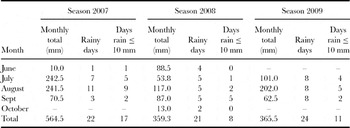
Two on-station trials, one for sorghum and one for pearl millet were conducted in 2007, 2008 and 2009 under rainfed conditions at the research farm at the El-Obeid Agricultural Research Station (lat: 13°10′N, long: 30°14′E, alt. 570 m, 650 km west of Khartoum), North Kordofan State, Sudan. The soil at the experimental site contains more than 90% sand, with very low organic matter (0.112%), organic carbon (0.560%), N (0.030%), available P (4 ppm-HCO3-P), C/N (18) and pH of about 7. It is classified as Quartzipsamments. The total annual rainfall and its distribution during the study seasons are presented in Table 1.
Annual rainfall distribution during the three years of the experiments.

Source of rainfall data: meteorological office at El-Obeid Agricultural Research Station.
Each millet and sorghum seed priming/micro fertilizing trial had a 2 × 4 factorial design, with eight treatments. Micro-dosing treatments were 0.0, 0.3, 0.6 and 0.9 g fertilizer per pocket, and priming treatments were with and without priming (8 hours in water). This corresponds to a fertilizer application rate in sorghum (planting distance 60 cm × 40 cm) of 0, 12.5, 25 and 37.5 kg fertilizer ha−1 and in millet (planting distance 60 cm × 50 cm) of 0, 10, 20 and 30 kg fertilizer ha−1. Sowing in the three years of the trial was in the period from 6 July to 24 July and harvesting was in the period from 9 October to 3 November.
Primed seeds were soaked in water for eight hours, surface dried for about one to two hours and sown. The NPK fertilizer applied was 17-17-17 in the 2007 and 2008 seasons and 15-15-15 in the 2009 season. This choice of fertilizer type was based on availability in Sudan and previous findings that show that NPK fertilizer gives good results (Aune et al. Reference Aune, Doumbia and Berthe2007). Fertilizer was applied with the seeds at sowing.
In each experiment, the eight treatments were laid out in a randomized complete block design with four replications. The experimental plot was 5 m × 3 m. The varieties used were Yarwashsa sorghum (80 days to maturity) and Ashana millet (75 days to maturity). Before sowing, the seeds were treated with Furnisan-D at the rate of 3 g kg−1 seed (after priming). Two seeds were planted per pocket. Hand weeding was done using a hand hoe, two to three weeks after sowing and again a month later.
Data collected were grain and straw yields, plant head weight, plant height, plant population per m2 and vigour score. The plant vigour score was measured using a 1–4 rating scale (score) where: 1 = low, 2 = moderate, 3 = vigorous and 4 = very vigorous.
Analyses of variance were undertaken using the MSTAT-C computer program (MSTAT-C, 1993).
On-farm trials
On-farm trials (farmer-managed) were conducted to study seed priming and micro-dosing in farmers’ fields in order to evaluate the technologies under real farming conditions and to enhance farmers’ appreciation of the technologies.
The number of participating famers in the three participating villages were 14, 24 and 15 farmers (men and women) in 2007, 2008 and 2009 respectively.
The following treatments were tested:
1. Control
2. Seed priming
3. Seed priming + micro-fertilizer (0.3 g per planting hole)
The plot size for each treatment was 360 m2 (15 × 24 m) and one famer represented a replicate in the statistical analysis. All the cultural practises were carried out by the farmers. Yield measurements were taken from the plots of all farmers.
Agronomic efficiency of fertilizer
The agronomic efficiency of fertilizer of the different priming and micro-dosing treatments was calculated as the difference in yield (kg ha−1) between the treatment and control, divided by the amount of fertilizer applied (kg ha−1).
Economic analysis
All the seed priming and micro-dosing treatments were economically evaluated using two methods.
Partial budgeting technique. The gross margin was calculated to assess the economic returns of the different treatments. All monetary values were converted from Sudanese pounds to US$ at an exchange rate of one US$ equivalent to 2.50 Sudanese pounds, and the average yields over seasons and replications in each treatment were calculated.
The average field prices of the crops during the last three years were taken from the grain market where the farmers sell their product. Average prices per kg for sorghum and millet were 0.27 and 0.33 US$ kg−1, respectively. The production cost, obtained from surveys, is the sum of labour and input costs (without fertilizer) (MOA North Kordofan State, 2008). The costs of production (without fertilizer) for sorghum and millet were 60.14 and 68.96 US$ ha−1, respectively. For each of the micro-dose treatments, a cost of 0.80 US$ kg−1 fertilizer was added to the production cost, based on the dose applied. No extra time was added for application of fertilizer because seeds and fertilizer were applied in the same operation.
Value/cost ratio. The value/cost ratio (VCR) for each treatment was calculated using the yield increase of the treatment compared with the control, price per kg grain, kg fertilizer used and price per kg fertilizer, employing the formula:

RESULTS
On-station trials
The on-station results presented show that seed priming and micro-dosing are important technologies to increase crop productivity in sorghum and pearl millet.
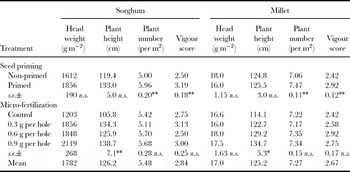
Sorghum. The main effects of seed priming and fertilizer micro-dosing on sorghum plant height, head weight, vigour score and plant number per m2 are presented in Table 2. Seed priming resulted in significantly more vigorous early growth and high stand count. Vigour score and plant stand increased by 28 and 19% respectively, as a result of seed priming. Micro-dosing significantly increased plant height from 19 to 31%. The priming × fertilization interaction was significant only for plant vigour.
Effects of seed priming and micro-fertilizing on sorghum and millet – agronomic traits (average across three years).

n.s.,*,** indicate respectively not significant, significant at p ≤ 0.05 and 0.01
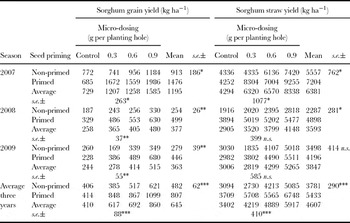
Seed priming increased sorghum grain significantly in all the seasons and the yield across the seasons increased from 482 kg ha−1 to 807 kg ha−1 (Table 3). Priming worked well in all years irrespective of the rainfall conditions. Straw yield also significantly increased in two out of three years, and the average straw yield across the three years increased by 44% as a result of seed priming.
Effect of seed priming and micro-dosing on sorghum grain and straw yields for three years and across three years.

n.s.,*,*,*** indicate respectively, not significant, significant at p ≤ 0.05, 0.01 and 0.001.
Micro-dosing by 0.3 g, 0.6 g and 0.9 g fertilizer per pocket increased grain yield by 50.4, 68.8 and 109.7% respectively, compared to the control (Table 3). The combination of seed priming and 0.3 g fertilizer per pocket more than doubled grain yield, while the combination of seed priming and 0.9 g fertilizer per pocket increased grain yield by 165%. Micro-dosing also increased straw yield, but by a lower percentage than grain yield. No significant interactions between priming and micro-dosing were observed for grain or straw yield.
Pearl millet. Seed priming and micro-dosing had a significant effect on plant number and vigour score (Table 2). Seed priming increased vigour score and plant stand compared to the control by 18 and 8% respectively. Micro-dosing significantly increased plant height, but had no clear effect on plant number and vigour. There was no significant interaction between priming and fertilization for any of the crop growth traits.
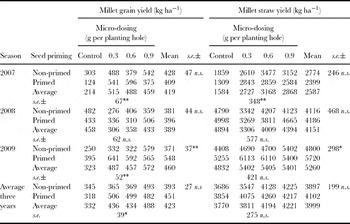
Seed priming was less efficient in increasing millet yield compared to sorghum yield. A significant effect of seed priming was observed in only one of the three years, and there was no significant effect across the years (Table 4). The effect of micro-dosing was also less in millet compared to sorghum. The average yield increase, with applications of 0.3, 0.6 and 0.9 g fertilizer per pocket, was 31.3, 30.7 and 47% respectively. The treatment combining seed priming and the application of 0.3 g fertilizer per pocket increased yield by 46.7% compared to the control. Seed priming and micro-dosing also increased millet straw yield, but this effect was not significant.
Effect of seed priming and micro-fertilizing on pearl millet grain and straw yields for three years and across three years.

n.s.,*,** indicate respectively, not significant, significant at p ≤ 0.05 and 0.01.
On-farm trials
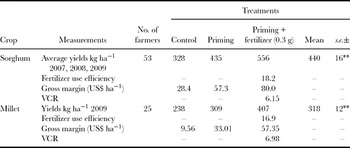
Priming and micro-dosing increased sorghum yield significantly in all three years, and across the years (Table 5). Seed priming alone increased sorghum yield by 32.6% while the treatment combining seed priming and 0.3 g fertilizer per pocket increased yield by 69.5%. Millet was only tested in one year. Seed priming alone increased the millet yield by 29.8% while seed priming and micro-dosing increased yields by 71%.
On-farm trials − effect of seed priming and micro-fertilizing on yield, fertilizer use efficiency (kg grain per kg fertilizer), gross margin and value/cost ratio (VCR) of sorghum and millet.

n.s.,*,** indicate respectively, not significant, significant at p ≤ 0.05 and 0.01.
Agronomic efficiency of fertilizers
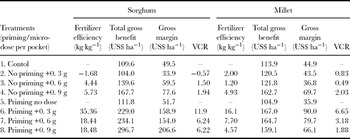
The agronomic efficiency of mineral fertilizer was clearly improved in both crops by seed priming (Tables 5 and 6). Fertilizer use efficiency was generally higher in sorghum compared to millet (with and without priming). Without priming in sorghum, the fertilizer efficiency of the treatments varied from 2 to 6 kg grain per kg fertilizer, whereas with seed priming, the fertilizer efficiency varied from 18 to 35. In pearl millet, the fertilizer efficiency varied from 2 to 5 without priming whereas with priming it varied from 4 to 16. On average, primed sorghum produced 23 kg grain for each kg of fertilizer, while primed millet produced 10 kg grain per kg of fertilizer. Fertilizer use efficiency for both crops was best when combining priming with a micro-dose of 0.3 g. In the on-farm experiment the fertilizer efficiency was 18 and 17 respectively for sorghum and pearl millet.
Agronomic efficiency of fertilizers, gross margin and value/cost ratio (VCR) of the different priming and micro-dosing treatments across seasons in on-station experiments. (Yield data in Tables 4 and 5).

Price per kg sorghum grain, millet grain and fertilizer are 0.27, 0,33 and 0.80 US$, respectively.
Economic analysis
Sorghum seed priming and the application of 0.9 g fertilizer per pocket increased the gross margin in the on-station trials from 49.5 to 206.5 US$ ha−1 while the treatment of seed priming with the application of 0.3 g fertilizer per pocket gave a net revenue of 159 US$ ha−1 (Table 6). Seed priming alone did not give any increased gross margin compared to the control.
For millet, the gross margin in the on-station trials increased from 44.9 in the control to 90.0 US$ ha−1 with the application of 0.3 g fertilizer per hole. The effect of micro-dosing was improved when seed priming was practised (Table 6).
The on-farm experiments confirmed the very positive effect of combining seed priming and micro-dosing of fertilizer (Table 5). For millet, the gross margin increased from 10 US$ ha−1 in the control to 57 US$ ha−1 in the treatment where seed priming and micro-dosing is combined.
Seed priming improves the VCR of both crops, but the effect is more pronounced for sorghum (Table 6). The highest VCR values were recorded in the treatment combining priming with the application of 0.3 g fertilizer per pocket.
The results of the economic analysis reveal that micro-dosing of both sorghum and millet is economically attractive, because it produces higher net revenues and VCR values than the control. The application of a micro-dose of 0.3 g seems to be the most feasible for millet while in sorghum the rate of 0.9 g fertilizer per pocket gave the best economic benefit.
DISCUSSION
The analysis shows that seed priming and micro-dosing produce general positive effects. However, micro-dosing should preferably be combined with seed priming in order to increase the fertilizer efficiency and thereby reduce the risk of fertilizer application. Micro-dosing alone does not give sufficient economic returns. These technologies appear to be robust as the results were consistent across the three seasons tested.
Seed priming alone increased sorghum and millet yields in the on-station experiments by 67 and 15% respectively, and in the on-farm experiments by approximately 30% for both crops. The increased productivity of seed priming was found to be related to an increased number of plants per hectare and improved plant vigour. Harris et al. (Reference Harris, Pathan, Gothkar, Joshi, Chivasa and Nyamudeza2001) also found an average yield increase of seed priming of around 30%. The effect of seed priming has been explained by faster emergence, better and more uniform stand, less need for resowing, more vigorous plants, better drought tolerance, earlier flowering, earlier harvest and higher grain yield (Harris, Reference Harris2006; Harris et al., Reference Harris, Pathan, Gothkar, Joshi, Chivasa and Nyamudeza2001). Seed priming is an interesting option for farmers because it is a technology without any financial cost (Aune and Bationo, Reference Aune and Bationo2008).
Micro-dosing was found to increase grain and straw yield in both sorghum and pearl millet. Sorghum appears to be more responsive to micro-dosing as there was a yield increase of up to 0.9 g fertilizer per pocket, while for pearl millet there was not much yield increase beyond 0.3 g fertilizer per pocket. Micro-dosing of 0.9 g per pocket more than doubled the grain yield of sorghum in the on-station experiments while the same amount of fertilizer in millet only increase yields by 47%. This finding confirms previous results from Mali (Aune et al., Reference Aune, Doumbia and Berthe2007). In Mali, the average yield increase was of 0.3 g fertilizer per pocket was 43 and 57% respectively for sorghum and millet. As in the study in Mali, the yield increase in kg ha−1 was higher in sorghum than in pearl millet because of the higher yield potential of sorghum. Studies in Niger by ICRISAT used rates of 2 g fertilizer per pocket and above (Bationo and Buerkert, Reference Bationo and Buerkert2001; Hayashi et al., Reference Hayashi, Abdoulaye, Gerard and Bationo2008; Tabo et al., Reference Tabo, Bationo, Gerard, Ndjeunga, Marchal, Amadou, Annou, Sogodogo, Taonda, Hassane, Diallo, Koala, Bationo, Waswa and Kimetu2007). Such rates also increased millet and sorghum yields, but the cash outlay and the risks for farmers are considerably higher than when applying less than 1 g fertilizer per pocket. The cost of applying 0.3 g fertilizer in Sudan was 10 US$ ha−1.
The level of P in the soil at the research station was only 4 ppm. This may be the major reason why there was a positive effect with micro-dosing. Muehlig et al. (Reference Muehlig, Buekert, Batino and Romemheld2003) found that a P deficiency is a major constraint to millet growth in the acid sandy soils of the West Africa Sahel. They found that P placement resulted in much faster growth of millet seedlings than did broadcasting fertilizer and concluded that the level of available P in the proximity of the plant stand is more important for millet seedling development than the total quantity of applied P.
In sorghum, the gross margin was increased from 109 US$ ha−1 in the control to 297 US ha−1 with the combination of seed priming and 0.9 g fertilizer per pocket. Without seed priming, the gross margin of the micro-fertilizer treatments varied from 104 to 167 US$ ha−1, while treatment where micro-dosing was combined with seed priming gave a gross margin from 229 to 297 US$ ha−1. Seed priming alone did not increase the gross margin in sorghum. The increase in gross margin as a result of micro-dosing and seed priming was less in pearl millet than sorghum. The gross margin in micro-fertilizer treatment in millet without priming varied from to 44 to 70 US$ ha−1 while for micro-fertilizer combined with seed priming the gross margin varied from 66 to 90 US$ ha−1. The best treatment in millet is seed priming combined with 0.3 g fertilizer per pocket which doubled the gross margin compared to the control. This study therefore shows that micro-dosing should be combined with seed priming in order to increase the economic returns and agronomic efficiency of fertilizer and thereby minimize the risk of fertilizer application. Micro-dosing alone does not give a sufficient return. Another important finding is that if only a small amount of mineral fertilizer is available, or the farmers can afford to use only small quantities of mineral fertilizer, then it is better to apply the fertilizer to sorghum than pearl millet.
This economic assessment probably underestimates the full economic benefit of seed priming and micro-dosing, as the value of the straw is not factored in. The sorghum straw yield more than doubled compared to the control when priming was combined with the application of 0.9 g fertilizer in sorghum, while in millet the effect on straw yield was less clear. The increased straw production as a result of priming and micro-dosing can therefore contribute to strengthening crop−livestock interaction.
The VCR is very high in the treatments where seed priming and micro-dosing are combined. In sorghum, a VCR of up to 11.9 was obtained while in millet the highest VCR was 6.65. The VCR should be above 4 in order to cater for the increased risk of fertilizer application in the Sahelian environment (Koning et al., Reference Koning, Heerink and Kauffman1998). In Mali, Aune et al. (Reference Aune, Doumbia and Berthe2007) found VCR values for sorghum and millet of 9.0 and 7.7, respectively. They found that the VCR varied from 4% to 11.9% in the 0.3 g treatment, and from 0.43 to 1.17 in the 6 g treatment. The application of 0.3 g fertilizer is appealing to farmers because of the good return on investment, the low financial risk, the limited funds needed and the low workload. Hayashi et al. (Reference Hayashi, Abdoulaye, Gerard and Bationo2008) also reported that farmers who fertilized their fields with inorganic fertilizer made more profit than those who did not.
CONCLUSION
This study shows that it is possible to increase productivity in the Sahel at a relatively low cost and at a very moderate risk for farmers. The on-station and on-farm trials demonstrated the biological and economic benefits of seed priming and micro-dosing of fertilizer in improving crop establishment, improving yields and giving positive net return for sorghum and millet. These technologies are simple to apply, with low financial cost, low risk and are affordable to resource-poor farmers in the dry areas of western Sudan. The application of 0.9 g NPK fertilizer in combination with seed priming was the best treatment for sorghum, whereas for millet the best combination appears to be seed priming with 0.3 g NPK fertilizer per pocket. Fertilizer application should be combined with seed priming in order to improve fertilizer efficiency and to reduce farmers’ risks. Based on the outcome of this research project, the National Crop Husbandry Committee of Sudan has now officially approved these technologies. These technologies can therefore now be promoted through the national extension system in Sudan and the government of Sudan, in collaboration with the private sector including agricultural banks, can develop policies to provide mineral fertilizer in the rural areas at a reasonable cost. Such a policy could increase grain production and improve food security, as well as making more animal feed available through increased straw production.
Acknowledgements
The authors would to thank the Drylands Coordination Group in Norway and Sudan for financing and supporting the project. The participating farmers in the projects in North Kordofan are acknowledged for their collaboration in the project.