Introduction
A clinical diagnosis of dementia is typically preceded by several years of accelerated cognitive decline. Little is known about the onset of this acceleration and how the unfolding of changes varies across cognitive abilities in the general population. Population-based estimates of cognitive change before dementia diagnosis should facilitate early identification of subsequent cases and provide a time-window for more successful interventions.
Previous studies directed toward delineating preclinical cognitive changes in dementia vary in sample selection and methodology. Numerous studies have compared cognitive performance before diagnosis for subsequent cases and age-matched controls. A meta-analysis, including 47 of these studies, documented a marked preclinical deficit for episodic memory, executive functioning, and perceptual speed, but smaller deficits for verbal ability, visuospatial skill, and attention (Bäckman, Jones, Berger, Laukka, & Small, Reference Bäckman, Jones, Berger, Laukka and Small2005). The authors concluded that deficits in multiple cognitive domains characterize the prodromal phase of dementia.
Longitudinal studies have compared rate of change in cognitive performance between those who later develop dementia and controls (Bäckman, Small, & Fratiglioni, Reference Bäckman, Small and Fratiglioni2001; Boyle, Wilson, Aggarwal, Tang, & Bennett, Reference Boyle, Wilson, Aggarwal, Tang and Bennett2006; Driscoll et al., Reference Driscoll, Resnick, Troncoso, An, O’Brien and Zonderman2006; Wilson, Beckett, Bennett, Albert, & Evans, Reference Wilson, Beckett, Bennett, Albert and Evans1999). Findings from these studies suggest steeper decline several years before diagnosis among those who later develop dementia, a pattern that is evident across a variety of cognitive abilities (Amieva et al., Reference Amieva, Jacqmin-Gadda, Orgogozo, Le Carret, Helmer, Letennueur and Dartigues2005; Storandt, Grant, Miller, & Morris, Reference Storandt, Grant, Miller and Morris2002). Other longitudinal studies have attempted to identify the onset of acceleration of cognitive decline before diagnosis of dementia and the rate of change within the prodromal phase. Hall, Lipton, Sliwinski, and Stewart (Reference Hall, Lipton, Sliwinski and Stewart2000) and Hall et al. (Reference Hall, Ying, Kuo, Sliwinski, Buschke, Katz and Lipton2001) reported onset of acceleration ranging from 2 years for fluid ability to 8 years for episodic memory (see also Grober et al., Reference Grober, Hall, Lipton, Zonderman, Resnick and Kawas2008). Howieson et al. (Reference Howieson, Carlson, Moore, Wasserman, Abendroth, Payne-Murphy and Kaye2008) found an onset 3 to 4 years before diagnosis for measures of story recall, verbal fluency, and spatial ability. Jacqmin-Gadda, Commenges, and Dartigues (Reference Jacqmin-Gadda, Commenges and Dartigues2006) reported an onset of 4 to 5 years in a measure of episodic memory, and Ming, Xion, and Grundman (Reference Ming, Xion and Grundman2003) an onset of 5 years before diagnosis using the Mini Mental Status Examination.
These findings provide evidence for acceleration of cognitive decline with an onset several years before dementia diagnosis. However, to our knowledge, no study has examined the preclinical trajectories in a sample systematically selected to represent the general population and repeatedly measured over a long period of time on a battery of tests covering a broad spectrum of cognitive abilities. Several key issues remain to be addressed: (1) When is the onset of precipitous decline first evident?; (2) Is the deficit pervasive across cognitive domains or only evident for certain measures?; (3) What is the rate of cognitive decline during the prodromal phase and does it vary across abilities?; and (4) What is the rate of corresponding normative age-related changes that precede the prodromal period, and how do these vary across cognitive domains?
The present study addresses these questions using data from two Swedish population-based longitudinal studies: the Gerontological and Geriatric Population Study (H70) in Gothenburg and the Kungsholmen Project (KP) in Stockholm. Both studies include extensive information about within-person change across various cognitive domains. We conducted separate analyses in each dataset because of differences in sampling design (age-homogeneous 70+ vs. age-heterogeneous 75+), time period for study (30 years vs. 13 years), and retest intervals (ranging from 1 to 5 years). To our knowledge, this is the first time two longitudinal, population-based studies have been combined for investigating cognitive trajectories in the preclinical stage of dementia. A distinct advantage of this approach is that it permits comparisons of findings for comparable cognitive measures and domains between the study samples.
Methods
Participants
H70
The H70 sample included all 70-year-old residents living in the city of Gothenburg in 1971 born on dates ending with 2, 5, and 8. The baseline response rate was 85% (n = 1148; Rinder, Roupe, Steen, & Svanborg, Reference Rinder, Roupe, Steen and Svanborg1975; Svanborg, Reference Svanborg1977). A sub-sample of 460 individuals was randomly drawn for participation in the neuropsychological examinations. Responders were 392, but 10 had already received a diagnosis of dementia at baseline and were thus excluded from the present analyses. The sub-sample used in this study therefore consisted of 382 initially non-demented individuals who participated in the neuropsychological examination and either remained non-demented until death (non-cases) or received a dementia diagnosis (cases). This age-homogenous sample was measured at ages 70, 75, 79, 81, 85, 88, 90, 92, 95, 97, 99, and 100 years.
An extensive medical examination was performed on all participants in the H70 study, including standard medical and ophthalmologic examination, blood and urine sampling, echocardiogram, and X-ray of heart, lungs, and breast. Sub-samples where then drawn for more detailed dental, somatometric, audiometric, psychiatric, and psychological examinations including 1 hour of neuropsychological assessment. Individuals who declined participation did not differ from participants regarding sex, marital status, income, community rent allowance, or proportion registered in the Temperance Board Register (Rinder et al., Reference Rinder, Roupe, Steen and Svanborg1975).
KP
By comparison, a complementary subsample of participants were selected from the Kungsholmen Project, a longitudinal population-based study that initially consisted of all inhabitants aged 75 or older on October 1, 1987 (n = 2368) living in the Kungsholmen parish of Stockholm in 1987 (Fratiglioni et al., Reference Fratiglioni, Grut, Forsell, Viitanen, Grafström, Holmen and Winblad1991, Reference Fratiglioni, Viitanen, von Strauss, Tontodonati, Herlitz and Winblad1997). At initial assessment, a dementia-free cohort (n = 1475) was identified from 1810 participants by means of a two-phase study design. During an initial screening phase, 314 suspected dementia cases (Mini-Mental State Examination [MMSE] score < 24) were identified and invited back for a more detailed clinical assessment together with a random sample (MMSE ≥ 24, n = 354) matched on age and sex with the suspected cases. The clinical protocol included extensive medical, neurological, and psychiatric examinations, a social interview, blood analyses, and neuropsychological assessment. Individuals who refused participation or had moved from Stockholm during the initial screening phase (n = 377, 16%) did not significantly differ from participants with regard to age and sex. Persons who declined participation in the clinical phase (n = 63, 9%) were younger, more often male, and more frequently scored below 24 on the MMSE relative to the examined subjects (Fratiglioni et al., Reference Fratiglioni, Grut, Forsell, Viitanen, Grafström, Holmen and Winblad1991). All participants were invited back for follow-up assessment of the baseline clinical protocol at approximate 3-year intervals.
The subsample of KP participants consisted of 841 initially non-demented individuals (i.e., individuals from the dementia-free cohort) who participated in the neuropsychological examination, received scores over 23 on the MMSE, and either remained non-demented across all subsequent follow-ups or were diagnosed with dementia during subsequent follow-up. Baseline response rate was 76%. This age-heterogeneous sample was measured on up to four occasions, using approximately 3-year retest intervals.
In both studies, data after the time point for a dementia diagnosis were excluded from analyses. The obtained data were collected in compliance with ethics review committees at the University of Gothenburg and the Karolinska Institute.
Dementia diagnosis
H70
Diagnosis of dementia in the H70 study was based on information from psychiatric examinations and interviews with close relative or informant. The DSM-III-R criteria (American Psychiatric Association, 1987) were used for diagnoses and evaluation of dementia severity. The diagnostic procedure involved four steps: (1) diagnosis was set according to both the psychiatric examination and the interview; (2) diagnosis was set according to either the psychiatric examination or the interview, but supported by the observation of the other examination; (3) diagnosis was set according to the interview and confirmed by the MMSE score; and (4) diagnosis of severe dementia was set according to psychiatric examination and no interview. For detailed information about the diagnostic procedures in the H70 study, see Skoog, Nilsson, Palmertz, Andreasson, and Svanborg (Reference Skoog, Nilsson, Palmertz, Andreasson and Svanborg1993). Before 1986, the H70 study diagnoses were based on information about disorientation in time and place or long-standing memory impairment, as measured by rating scales and information from case records or relatives. To evaluate the reliability of the pre-1986 diagnostic procedure as compared with Diagnostic and Statistical Manual of Mental Disorders—Third Edition, Revised (DSM-III-R) criteria, both procedures were used at age 85. The observed agreement for the two diagnostic procedures was 93.3%, with an overall kappa of 0.84 (Sacuiu et al., Reference Sacuiu, Gustafson, Johansson, Thorvaldsson, Berg, Sjögren and Skoog2009).
KP
Dementia diagnosis in the KP study was based on information from interviews conducted by nurses, clinical examinations by physicians, discharge diagnoses from hospitals, and death certificates. As in the H70 study, diagnoses were based on DSM-III-R criteria. A three-step diagnostic procedure was used: (1) preliminary diagnosis was set by the examining physician; (2) all preliminary cases were reviewed by a specialized clinician and a second preliminary diagnosis was set. In cases of agreement between the first and the second diagnosis, the final diagnosis was determined; and (3) in cases of disagreement between the first and second diagnosis, a third opinion of a specialist was sought. More detailed information about the diagnostic procedures in the KP can be found in Fratiglioni et al. (Reference Fratiglioni, Viitanen, von Strauss, Tontodonati, Herlitz and Winblad1997). All diagnoses were set independently of results from neuropsychological tests in both studies.
Neuropsychological Measurements
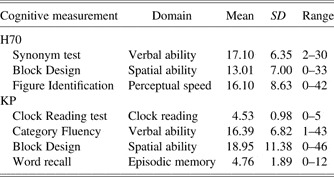
The cognitive tests used in this study index both crystallized abilities (clock reading, verbal ability) and fluid abilities (spatial ability, episodic memory, perceptual speed). By crystallized ability, we refer to the capacity of individuals to provide solutions to problems that are dependent on previous knowledge. In contrast, fluid abilities refer to the capacity of individuals to provide solutions to problems independent of previous knowledge (Cattell, Reference Cattell1971). Baseline average performance and information on the distribution of each of the cognitive tests are reported in Table 1. To facilitate comparisons across the study samples and cognitive domains in the analyses, we standardized the test scores with a mean of 50 and a standard deviation of 10, using the baseline distribution for each of the tests.
Baseline performance and distribution for the cognitive tests used in the analyses

H70
Synonym test
The synonym test is a measure of verbal ability. Participants are asked to match a target word with one synonym among five alternatives. The maximum score is 30, and the time limit is 7 minutes. The words were presented in a magnified form if participants had problems with reading due to visual impairment.
Block Design
The Block Design test is a measure of spatial ability. Participants are given cubes and asked to construct replicas of prototype model designs that are presented in two colors (Wechsler, Reference Wechsler1981; Dureman, Kebbon, & Österberg, Reference Dureman, Kebbon and Österberg1971). The maximum score is 42 within a 20 minute time span.
Figure identification
Figure identification measures perceptual speed. Participants are asked to match, as fast as possible, a target figure with one identical figure placed in line among four other figures. Maximum score is 60 and time limit is 4 minutes. Other detailed information about the tests (Dureman et al., Reference Dureman, Kebbon and Österberg1971) and testing procedures (Berg, Reference Berg1980) in H70 can be found elsewhere.
KP
Clock Reading test
The Clock Reading test consists of drawing, setting, and reading (Tuokko, Hadjistavropoulos, Miller, & Beattie, Reference Tuokko, Hadjistavropoulos, Miller and Beattie1992). In the present study, clock reading was assessed by presenting a series of five clocks with pre-drawn minute and hour hands indicating set times (3:00 a.m., 7:30 a.m., 1:00 p.m., 9:15 p.m., 11:10 p.m.), with the participant asked to read the time. Task scoring awards 1 point for reading the minute hand correctly, 1 point for reading the hour hand correctly, and a final point for identifying the correct time. A maximum score of 15 points (3 points for each of the five clocks) is possible.
Category Fluency
For the Category Fluency task, participants were required to verbally generate as many food items as possible, beginning with any letter, within 60 seconds (Lezak, Reference Lezak1995).
Block Design
A modified version of the Block Design test from Wechsler Adult Intelligence Scale-Revised (WAIS-R; Wechsler, Reference Wechsler1981) was administered according to standard procedures. The modification was implemented to increase the possibility of task completion and scoring for even severely demented persons. The task consisted of seven designs, each involving four blocks. One design was entirely red and another was red-and-white checked. The remaining designs were the first five designs from WAIS-R.
Word recall
Several episodic memory tasks were specifically designed for the Kungsholmen cognitive battery (Bäckman & Forsell, Reference Bäckman and Forsell1994). Free recall was assessed using two word lists, each comprised of 12 unrelated concrete words. One list was presented at a fast rate (2 s/word) and the other at a slow rate (5 s/word). Immediately following presentation of each list, participants were given 2 min for oral free recall. A single word recall composite score was created as performance was highly correlated for rapidly and slowly presented words.
Statistical Analyses
We used χ2 tests and one-way analyses of variance to evaluate baseline differences between cases and non-cases for demographic and health-related characteristics. We then fit a series of piecewise (i.e., two-slope) linear mixed models (Raudenbush & Bryk, Reference Raudenbush and Bryk2002) to the cognitive data and allowed the knot of the spline (i.e., the change point) to vary across models by 0.1-year increments. Before the knot, time was specified as a function of chronological age (i.e., days since birth from each individual measurement). After the knot, time was additionally specified as a function of time to diagnosis (i.e., days to diagnosis from each individual measurement). A profile likelihood method was used to select the best fitting models. More detailed description of the specification of these types of models and the modeling procedure can be found in Hall et al. (Reference Hall, Lipton, Sliwinski and Stewart2000).
Fixed effects in these models refer to average level and rate of linear change and between-person random effects refer to variability in level and rate of linear change. We included a dummy-coded covariate, representing cases and controls, on level of performance and rate of age-related change. In the models fitted to the KP data, we also included age at baseline as a covariate on level and rate of age-related change. Estimates of parameters were based on a full maximum likelihood function and are unbiased under the assumption that missing data are missing at random (Little & Rubin, Reference Little and Rubin1987). The main benefits of the change point modeling approach, as compared with a linear or quadratic polynomial approaches, is that within this approach we obtain point estimates of the onset of acceleration in cognitive decline (i.e., the preclinical period) and separate estimates of within-person change before and within the preclinical period.
Results
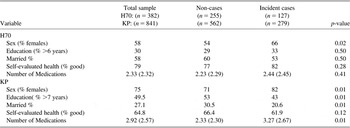
Demographic and health-related characteristics for the two samples at baseline are shown in Table 2. Comparisons between those who developed dementia and those who remained non-demented indicate a larger proportion of females among cases in both studies. In KP, subsequent cases had fewer years of education, were less likely to be married, and consumed more medications. Other baseline comparisons were non-significant.
Baseline demographics and health-related characteristics for the H70 and KP samples

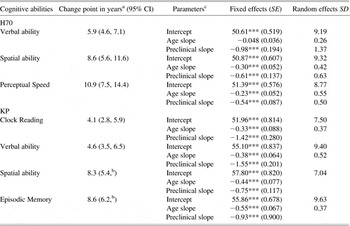
Estimates from the best fitting models are shown in Table 3 (distributions of the likelihood functions are presented in Appendix). Within each study, we aligned the cognitive tests on a scale representing crystallized abilities at the top and fluid abilities at the bottom. Change points refer to average onset of accelerated decline, in years, before dementia diagnosis. In both studies, there is a pattern indicating an earlier onset of decline for fluid as compared with crystallized abilities. For example, the change point is estimated to be 10.9 years before diagnosis for perceptual speed and 4.1 years for clock reading. Fixed effect intercepts and age slopes refer to average performance at baseline and change before the estimated change point. We did not find reliable group differences between subsequent cases and non-cases on these parameters, indicating no group differences in cognitive performance or change before the estimated change points. However, we observed significant age-related decline for most cognitive measures (all except verbal ability in H70). The magnitude of this decline differed markedly across domains. For both studies, there was considerably smaller age-related change for crystallized than for fluid abilities.
Estimates from the best-fitting preclinical change-point models

Note. The KP models are adjusted for age differences at baseline.
aThe change point refer to years before diagnosis of dementia.
bThe upper limit of the confidence interval was not identified for spatial ability and episodic memory in the KP, as we only fit these models over a 10-year period preceding diagnosis (i.e., the upper bound of the CI fell beyond the KP assessment range).
cIntercepts refer to estimated average level of performance at age 70 in H70 and at age 75 in KP. Age slopes refer to average change before the estimated preclinical period and the preclinical slopes refer to acceleration in change within the estimated preclinical period.
*p < .05. **p < .01. ***p < .001.
In H70, following the change point, average annual linear decline (i.e., age slope + preclinical slope) within the preclinical phase increased to 1.03 points for verbal ability, representing more than a 20-fold acceleration of decline relative to age-related change. For spatial ability, annual decline was 0.91 points within the preclinical period. However, this represents only approximately a three-fold increase compared to age-related change. Similarly, for perceptual speed, decline was 0.77 points within the preclinical period, representing approximately a two-fold increase relative to age-related decline. In KP, the corresponding patterns were remarkably similar. A five-fold preclinical increase in rate of decline was observed for clock reading and category fluency, and a two-fold increase was seen for spatial ability and episodic memory.
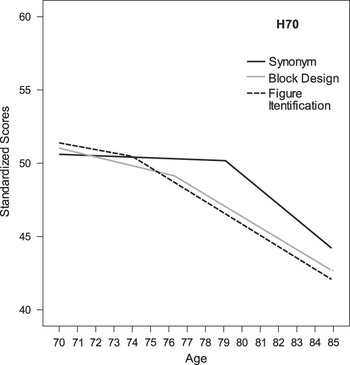
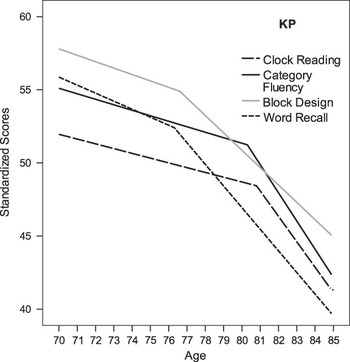
The patterns observed in both samples indicate that, although the onset of accelerated decline occurs further from diagnosis for fluid measures, the deviation from normal age-related decline is considerably larger for crystallized measures. In other words, the onset of the preclinical period occurs later (i.e., closer to diagnosis) for crystallized measures, yet the magnitude of the preclinical deficit is accelerated to a far greater degree than is the case for fluid measures. These patterns are illustrated graphically in Figures 1 and 2, where the fixed effects from the models for the two samples are portrayed. These trajectories represent performance for a prototypical individual who received a dementia diagnosis at age 85.
Estimated average cognitive change trajectories before diagnosis of dementia for a prototypical individual diagnosed at age 85. The estimates are from the H70.

Estimated average cognitive change trajectories before diagnosis of dementia for a prototypical individual diagnosed at age 85. The estimates are from the KP.

As the estimated change points and acceleration in cognitive decline may differ across subtypes of dementia, we used the comparatively larger number of cases in the KP study to conduct additional analyses after excluding all non-Alzheimer’s disease (AD) cases from the sample (AD cases, n = 222). The estimated change points in these analyses were 4.3 years before diagnosis for clock reading, 5.2 years for verbal ability, 9.4 years for spatial ability, and 8.5 years for episodic memory. Thus, the change points for the incident AD cases were similar to those observed for the total dementia sample.
Discussion
We analyzed trajectories of cognitive decline before dementia diagnosis using data from two population-based samples that were measured repeatedly over a range of cognitive tasks. We tested the hypothesis that there is an acceleration of cognitive decline with an onset several years before clinical diagnosis. Findings from both studies provide support for the hypothesis and suggest cross-domain differences in the onset of accelerated decline. Change points were first evident, approximately 1 decade before diagnosis, on measures of fluid abilities (perceptual speed, episodic memory, and spatial ability) and approximately 5 years later in crystallized abilities (vocabulary and clock reading).
Within both samples, the magnitude of the estimated age-related decline was smaller for the crystallized than for the fluid tasks. This is consistent with other findings (Hultsch, Hertzog, Dixon, & Small, Reference Hultsch, Hertzog, Dixon and Small1998; Schaie, Reference Schaie1996). Relative to age-related change, deficits in the preclinical period were accelerated by a factor of 2–3 for the fluid measures, and by a factor of 5–20 for the crystallized measures. Although cognitive decline was accelerated for measures of episodic memory and processing speed up to 10 years before diagnosis, these changes may be difficult to detect, as performance on these tasks also exhibit considerable normative age-related decline. For crystallized abilities, however, the discrepancies between the age-related and preclinical decline become considerably more salient closer to diagnosis.
Our findings of a long prodromal phase of dementia are consistent with findings of early neuropathological alterations, such as hippocampal shrinkage and amyloid aggregation, years before AD diagnosis (see e.g., Petersen & Jack, Reference Petersen and Jack2009). We do not have data to properly distinguish to what degree the observed acceleration in cognitive decline was associated with early AD pathology compared to other neural alterations. However, additional analyses including only cases with confirmed AD diagnosis revealed minimal differences in the parameters estimates. This may suggest that the observed pattern of change reflects AD-related pathology (e.g., Morris, Reference Morris2006). However, brain pathology related to vascular factors often coexists with AD pathology, with findings from previous studies suggesting that the pattern and magnitude of preclinical cognitive impairment in AD and vascular dementia are similar (e.g., Jones, Laukka, & Bäckman, Reference Jones, Laukka and Bäckman2006; Jones, Laukka, Small, Fratiglioni, & Bäckman, Reference Jones, Laukka, Small, Fratiglioni and Bäckman2004; Sacuiu, Sögren, Johansson, & Skoog, Reference Sacuiu, Sögren, Johansson and Skoog2005).
The change points identified are further away from the time of diagnosis than those previously reported (Grober et al., Reference Grober, Hall, Lipton, Zonderman, Resnick and Kawas2008; Hall et al., Reference Hall, Ying, Kuo, Sliwinski, Buschke, Katz and Lipton2001; Howieson et al., Reference Howieson, Carlson, Moore, Wasserman, Abendroth, Payne-Murphy and Kaye2008; Jacqmin-Gadda et al., Reference Jacqmin-Gadda, Commenges and Dartigues2006; Ming et al., Reference Ming, Xion and Grundman2003). This is noteworthy given the fact that both samples were drawn from the general population. Previous studies may have underestimated the length of the prodromal phase of dementia due to inclusion of more selective samples. Other factors that may contribute to the discrepancy are differences in length and numbers of follow-up periods and types of cognitive measures.
There are strengths of our study that deserve to be emphasized. The analyses were conducted using data from two major samples drawn from the general population. Both samples were examined with test batteries covering a range of cognitive abilities, administered at multiple measurements, and with follow-ups that extended over a long period of time or until death. By using two independent samples, we were able to compare analytic models and search for differences that may characterize the particular sample and study design. However, despite sample differences on demographic variables, where the KP sample was older as compared with the H70 at baseline, had a larger proportion of females, and had more years of education, the pattern of findings were remarkably similar across the two studies. For example, they both indicate similar patterns of onset and rate of change on the fluid–crystallized ability continuum. Further underscoring consistency of the findings, for spatial ability, where Block Design served as the marker in both studies, there was only a 0.3-year difference in the estimated change point and a clear similarity in the degree of accelerated decline during the preclinical period.
An implication of our findings is that clinicians attempting to identify subsequent cases of dementia should not limit their usage of psychometric test batteries to cross-sectional comparisons of level of cognitive performance. Individual differences in rate of cognitive change and information about within-person acceleration of decline may add to the accuracy of the identification. If the aim is to identify subsequent cases early in the preclinical stage (e.g., a decade before diagnosis), the focus should be on changes in within-person decline on measures of fluid abilities. If, however, the emphasis is on identification of subsequent cases with high risk of developing dementia (e.g., within the next 5 years), as often is the case in sampling for clinical trials and intervention studies, the focus should also be on changes in within-person decline on measures of crystallized abilities. In this respect, further studies are needed to illuminate how many measurements are required, length of testing interval, and what specific test should be used to reliably identify acceleration in within-person decline indicative of subsequent dementia.
The present study is not without limitations. With the exception of Block Design, the specific measures used in the two samples differed along the fluid-crystallized continuum, hampering direct comparisons of onset and rate of precipitous decline. Second, the relatively long retest intervals in the H70 (varying from 1 to 5 years) and KP (3 years) likely limits the precise identification of the onset of the prodromal period. Third, identification of the exact time point when symptoms become severe enough as to justify a clinical diagnosis is invariably a challenge with the inherent risk of confounding the preclinical and early dementia periods. To help address this concern, in H70, time of diagnosis was corroborated by additional use of information from medical records and interviews with close relatives that should substantially increase the precision. In KP, time of diagnosis was determined as the midpoint between diagnosis and the preceding wave of measurement. Although an approximation, we believe that the imprecision in this estimate is unlikely to be greater than 1 year (on average, the KP retest interval is 3 years with a midpoint of 18 months), and thus does not present a serious threat to our inferences of change within the preclinical period (ranging from 4.1 to 10.9 years). Finally, as with most longitudinal studies, some individuals were assessed on relatively few occasions, thereby influencing reliability of change estimates. With these caveats in mind, we would like to emphasize that the combined relative strengths and weaknesses of each study yielded remarkably similar results.
In conclusion, we have provided evidence of substantial acceleration of cognitive decline before diagnosis of dementia in the general population. The onset of this acceleration occurs in most cognitive abilities several years before the time of diagnosis. Subsequent cases of dementia show acceleration first on age-sensitive measures of fluid abilities, such as perceptual speed and episodic memory, and later on knowledge-based crystallized abilities, such as vocabulary. Future studies need to illuminate how individual characteristics (e.g., demographic, health-related, biological, genetic) moderate and mediate between-person differences in onset of acceleration and rate of change in cognitive performance before dementia diagnosis in the general population.
Acknowledgments
This research was supported by the Swedish Brain Power, the Swedish Research Council, the Swedish Council for Working Life and Social Research, the Bank of Sweden Tercentenary Foundation, the Alexander von Humboldt Research Foundation, and the Michael Smith Foundation for Health Research.
APPENDIX
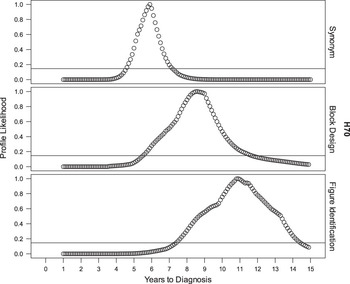
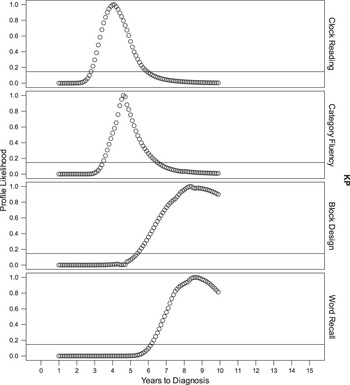
The two figures depict likelihood values from the fitted models to the data from the H70 and KP studies, respectively, as a function of years before a diagnosis of dementia. For each test, the placement of the change point varies by 0.1-year increment. The model with the largest likelihood value provides the best fit to the data. The horizontal lines refer to 95% confidence intervals where values below the line fall outside the interval and values above the line fall inside the interval.
Appendix Figure 1.

Appendix Figure 2.