Introduction
Falls in the elderly are a leading cause of injury-related mortality and morbidity. As a result, falls and fall-related injuries continue to challenge every healthcare organization since their economic cost is likely to be greater than appreciated (Davis et al., Reference Davis, Robertson, Ashe, Liu-Ambrose, Khan and Marra2010). Consequently, research has aimed at identifying the main risk factors that cause or underlie falls as an essential step prior to the development of strategies focused on a significant reduction of their incidence (Ungar et al., Reference Ungar2013).
Several risk factors predisposing to falls in older adults have already been identified. These include depression, medications, comorbid functional disabilities, and behavioral abnormalities (Hartikainen et al., Reference Hartikainen, Lönnroos and Louhivuori2007; Voyer et al., Reference Voyer, Verreault, Mengue and Azizah2007; Sylliias et al., Reference Sylliaas, Selbæk and Bergland2012). Two potential risk factors deserve further study given their prevalence in the elderly: the individual´s place of residence and their level of cognitive impairment.
Fall risk has been observed to be greater among the institutionalized elderly, since they are frailer, more functionally impaired, and present cognitive dysfunction or dementia (Muir et al., Reference Muir, Gopaul and Odasso2012). Nevertheless, despite being a common problem in residential care the evidence on how to prevent falls in this setting is limited and inconsistent (Whitney et al., Reference Whitney, Close, Jackson and Lord2012). Studies regarding fall prevention strategies should be considered separately for community dwelling and institutionalized older adults (Guo et al., Reference Guo, Tsai, Liao, Tu and Huang2014). It is well known that older adults with cognitive impairment and dementia have an increased risk of falling, with an annual incidence of about 60%, which approximately doubles that of older adults with normal cognition and a five-fold increase in the probability of limb fractures (Shaw et al., Reference Shaw2003). The reasons for this increased risk are still poorly understood (Taylor et al., Reference Taylor, Delbaere, Lord, Mikolaizak and Close2013). Nevertheless, the influence of cognitive decline level on fall risk is controversial. Established recommendations suggest that in the absence of dementia there is no need to assess the potential role of more subtle cognitive deficits in fall risk (Kenny et al., Reference Kenny2011). However, it has been suggested that even mild cognitive impairment is associated with an increased risk of falls (Winter et al., Reference Winter, Watt and Peel2013) and some authors report that cognitive function levels might affect falls even in the absence of dementia (Mirelma et al., Reference Mirelman2012). Information regarding the relationship between fall risk factors and the severity of cognitive impairment is still scarce. For instance, Vasallo et al. (Reference Vassallo, Mallela, Williams, Kwan, Allen and Sharma2009) and Delbaere et al. (Reference Delbaere2012) analyzed the relationship between cognition and falling risk in community-dwelling elders but did not take into account the severity of the cognitive decline. In institutionalized individuals, Van Dijk et al. (Reference Van Dijk, Meulenberg, van de Sande and Habbema1993) considered the severity of cognitive dysfunction in their analysis of fall risk but focused on patients with dementia and failed to provide multivariate regression analyses of potential confounders. Capezuti et al. (Reference Capezuti, Evans, Strumpf and Maislin1996) did not find significant differences on the fall risk of institutionalized individuals although they only differentiated between individuals with and without severe cognitive dysfunction. To our knowledge, there is only one report analyzing falls in institutionalized older adults taking into consideration the presence and severity of cognitive dysfunction (Nazir et al., Reference Nazir, Mueller, Perkins and Arling2012). The present study aims to identify fall risk factors depending on the severity of cognitive impairment among nursing home residents.
Methods
Participants
Data was obtained from the Geriatric and Fitness (GER-FIT) research, a multicenter longitudinal intervention study of cognitive function, aging, and exercise performed in elderly individuals living in home-care institutions throughout the region of Galicia (northwest Spain). In the GER-FIT research, participants were recruited through a collaboration agreement between the University of “X” (Spain) and “XX S.A.”, a company for the management of residential care homes. Individuals who met the following criteria were included: (a) older than 65 years old; (b) able to stand and walk for 30 meters without shortness of breath; and (c) independent from the assistance of another person to walk safely. Individuals with other medical conditions that hindered or prevented the participation in evaluation tests were excluded; basically these included cardiac or respiratory diseases with fatigue or dyspnea at rest. The study received the approval of the X Ethics Committee and all participants, their primary caregiver or closest of kin gave their informed consent.
Main outcome measurements
Cognitive impairment severity
Previous studies used the Mini-Mental State Examination (Gleason, Reference Gleason, Gangnon, Fischer and Mahoney2009; Ramírez, Reference Ramirez, Wood, Becho, Owings, Markides and Espino2010) to address the relationship between cognitive deterioration and fall risk. Cognitive status (absence/presence and severity of cognitive decline) was assessed through personal interviews by means of the Spanish-adapted version of this tool (MEC) (Lobo et al., Reference Lobo, Ezquerra, Gómez, Sala and Seva1975). The MEC is composed of 13 elements divided into five sections, which represent different cognitive domains (orientation, registration, attention and calculation, recall, language and copying). The maximum possible score was 35 points. In accordance with the final score, three levels of cognitive impairment were established: mild (20–24) “MCI”, moderate (14–19) “MOCI”, and severe (≤14) “SCI”. Any score above 24 points indicated the absence cognitive impairment (NCI) (Lobo et al., Reference Lobo1999; González-Palau et al., Reference González-Palau2013).
Falls
The number of falls and their particular characteristics were registered for the previous 12 months, as well as their consequences and the type of contact with the health system. To this end, a validated Spanish version of the “WHO questionnaire for the study of falls in the elderly” was employed. This questionnaire defines falls as any event that precipitates the individual to the floor against their will (Vidan et al., Reference Vidán Astiz1993). Individuals were classified as fallers or multiple fallers if they sustained one or several falls (two or more) during the previous 12 months, respectively.
Demographic, medical, and medication risk factors
The age (years), gender (female/male), education level (no studies, Primary, Secondary, University), medical condition, and pharmacological needs of each individual patient were registered. In this regard, the independent variables that were seen to require separate analysis featured psychotropic and cardiovascular drugs, given the correlation between their use and fall risk (de Jong et al., Reference de Jong, Van der Elst and Hartholt2013). Information concerning associated medical conditions was obtained from the medical records available. A modified Self-Administered Comorbidity Questionnaire, tested previously with Spanish populations, was used to determine comorbidity (Ramos-Nino et al., Reference Ramos-Nino, MacLean and Littenberg2007).
Mood and behavioral risk factors
The Spanish validated version of the Cornell Scale for Depression in Dementia (CSDD) (Pujol et al., Reference Pujol, De Azpiazu, Salamero and Cuevas2001; Towsley et al., Reference Towsley, Neradilek, Snow and Ersek2012) was used to assess signs and symptoms of major depression. The validated Spanish version of the Neuropsychiatric Inventory (NPI) (Boada et al., Reference Boada, Tárraga, Modinos, López and Cummings2005; Cummings et al., Reference Cummings, Tribanek and Hoerr2014) was employed to evaluate the frequency and severity of neuropsychiatric disturbances.
Functional and motor risk factors
The Timed “Up & Go” Test (Podsiadlo and Richardson, Reference Podsiadlo and Richardson1991; Nordin et al., Reference Nordin, Rosendahl and Lundin-Olsson2006) was used to assess functional mobility. The participant's ability to perform daily life activities independently was assessed by means of the Spanish validated version of the Katz Index (KI) of Independence in Activities of Daily Living (Álvarez et al., Reference Álvarez1992; Ayán et al., Reference Ayan, Cancela, Gutiérrez and Prieto2013).
Neuropsychological risk factors
The Spanish version of the Fuld Object Memory Evaluation (FOME) was employed to assess immediate and delayed memory (LaRue et al., Reference LaRue, Romero, Ortiz, Liang and Lindeman1999; Loewenstein et al., Reference Loewenstein2009). Cognitive processing speed was assessed by means of the Spanish validated version of the Symbol Digit Modalities Test (Smith, Reference Smith2002; Grundman et al., Reference Grundman2004).
All assessments were performed by the medical staff from each of the seven medical home care institutions involved in the study. Before the evaluations, the research team met and trained the medical staff of the participating centers, which included a neurologist, a physiotherapist, and a psychologist to whom the standard program methodology and evaluation tools were presented.
Data analysis
The present study intends to identify fall risk factors present in the institutionalized elderly and relative to the absence or severity of cognitive impairment. Additionally, it attempts to determine whether the influence exerted by these factors on the probability of falling varies depending on the level of cognitive functionality. As a result, four separate risk assessment models were analyzed. Therefore, before starting the statistical analysis, the sample was stratified according to the absence or level of cognitive impairment, therefore creating four separate groups (NC, MCI, MOCI, SCI), which, in turn, were subdivided into two blocks depending on whether or not the participants had suffered falls for the previous 12 months (Fallers/Non-Fallers). Performing a descriptive analysis, the variables were grouped into four domains: (1) demographic, medical, and medication risk factors; (2) mood, behavioral, and risk factors; (3) functional and motor risk factors; and (4) neuropsychological risk factors in each group (NC, MCI, MOCI, SCI). The analysis was carried out using the total number of participants who attested a certain characteristic, relative to the selected sample, which contributed to determining the magnitude of association between the variables under study and the presence or absence of falls in elderly people using relative risk calculus (RR).
All categorical variables were dichotomized through an identification of the presence or absence of a given parameter. Continuous variables were also dichotomized for each of the four groups (NC, MCI, MOCI, SCI) using optimal specificity and sensitivity calculus for the falls with the help of the Youden index and the receiver operating characteristic (ROC) Curve (Ruopp et al., Reference Ruopp, Perkins, Whitcomb and Schisterman2008). This curve makes it possible to determine the level of diagnostic accuracy of the test that has been employed; a statistically useful method to identify the cut-off point in a continuous scale, where this point stands for the highest level of sensitivity and specificity. In addition, the cut-off point presents the highest Youden index (YI = sensitivity + specificity − 1).
A regression model was used to determine the set of variables best predicting older adults’ falls and RR. One-factor variance analysis (ANOVA) served the purpose of determining statistically significant differences in risk factor profiles for potential falls, relative to the absence or level of cognitive impairment. The Statistical Package for the Social Sciences version 21 (SPSS Inc., Chicago, IL) was used for quantitative analysis. All statistical significance tests were two-sided, and p = 0.05 was considered statistically significant.
Results
A total of 2,336 individuals met the inclusion criteria. Of these, 1,167 (mean age 81.44 ± 8.26 years; 66.4%) completed all tests and provided valid data for further analysis.
Fall history
According to the information gathered in the falls questionnaire, 481 participants were identified as fallers, and 80.4% of those were classified as multiple fallers. 64 falls were registered (34%) among people without cognitive impairment, and 417 (43%) among people with cognitive impairment (MCI: 35%; MOCI: 40%; SCI: 50%).
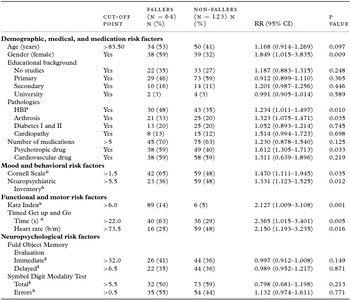
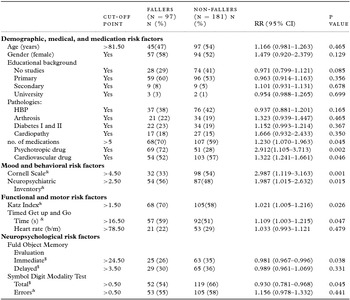
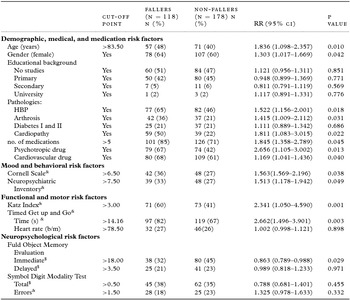
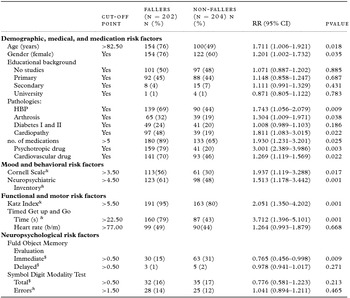
The comparison between participants identified as fallers and those labeled non-fallers relative to the existence and severity of cognitive impairment provided a number of risk factors associated with the number of falls in each case (Tables 1–4).
Variables associated with faller status in elderly people without cognitive impairment (NC; MEC > 24)

This table shows that gender, mood, behavior, and depression can be considered as risk factors in older adults without cognitive impairment.
b/m: beats per minute; HBP: high blood pressure; s: seconds.
&Lower values imply better status; $Lower values imply worse status.
Variables associated with faller status in elderly people with mild cognitive impairment (MCI; MEC ≤ 24 & >19)

This table shows that medication, mood, behavior, and functional autonomy are risks factors in older adults with mild cognitive impairment.
b/m: beats per minute; HBP: high blood pressure; s: seconds.
&Lower values imply better status; $Lower values imply worse status.
Variables associated with faller status in elderly people with moderate cognitive impairment (MOCI; MEC ≤ 19 & >14)

This table shows that age, gender, pathologies, mood, behavior, functional autonomy, and memory function are risk factors in older adults with moderate cognitive impairment.
b/m: beats per minute; HBP: high blood pressure; s: seconds.
&Lower values imply better status; $Lower values imply worse status.
Variables associated with faller status in elderly people with severe cognitive impairment (SCI; MEC ≤14)

This table shows that all selected variables can be considered as fall risk factors in older adults with severe cognitive impairment, being functional autonomy and memory function specially significant.
Yes: presence of parameter; b/m: beats per minute; HBP: high blood pressure; s: seconds.
&Lower values imply better status; $Lower values imply worse status.
With regard to demographic, medical, and medication risk factors it was found that heavily medicated patients (those who consumed more than five types of drug; RR = 1.230–1.930) were more at risk for all three levels of cognitive impairment (MCI, MOCI, and SCI). The use of cardiovascular drugs was also identified as a risk factor in these three groups (NC, RR = 1.302–1.713; MCI, RR = 1.105–3.713; MOCI, RR = 1.005–3.002; SCI, RR = 2.389–3.986), while the use of psychotropic drugs was a risk factor in all of the groups (NC, RR = 1.302–1.713; MCI, RR = 1.105–3.713; MOCI, RR = 1.005–3.002; SCI, RR = 2.389–3.986). Age (RR = 1.711–1.836), female gender (RR = 1.303–1.479), hypertension (RR = 1.522–1.743), osteo-arthrosis (RR = 1.304–1.415), or cardiopathies (RR = 1.811) attested a higher degree of association with MOCI and SCI patients. Fall risk factors observed in participants without cognitive impairment included female gender (RR = 1.849), hypertension (RR = 1.234), and osteo-arthrosis (RR = 1.323).
Also influential in fall risk were factors such as mood and behavior, which were identified through the presence of depression (RR = 1.470–2.987) and neuropsychiatric disturbances (RR = 1.331–1.987), motor and function risk factors, assessed via the participant's levels of functional autonomy (RR = 1.109–3.712) and independence to carry out daily life activities (RR = 1.021–1.937). These were independent from the absence and severity of cognitive impairment.
As for neuropsychological risk factors, both immediate and delayed memory were seen as associated factors that contributed to preventing fall risk in all participants with cognitive impairment, regardless of the level of severity (RR = 0.765–0.981). Conversely, the cognitive processing speed was identified as a fall risk prevention factor only for those participants who had MCI (RR = 0.930).
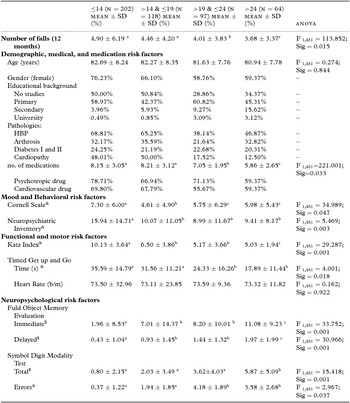
Table 5 shows a number of associated risk factors along with the absence or level of severity of cognitive impairment in elderly people who had registered at least one fall in the previous 12 months. Results show significant differences in the number of falls, which indicates that the higher the level of cognitive impairment, the greater the number of falls (F1,481 = 113.852; Sig = 0.015), although significance was not maintained when comparing MOCI and SCI participants. A similar trend was observed in relation to drug consumption (F1,481 = 221.00; Sig = 0.033). The existence of depression (F1,481 = 34.989; Sig = 0.047) and neuropsychiatric disturbances (F1,481 = 5.469; Sig = 0.003), together with autonomy constraints in daily life activity performance (F1,481 = 29.287; Sig = 0.001) and low functional mobility (F1,481 = 4.001; Sig = 0.018), were all factors closely associated with increased fall risk. There does not seem to be a clear, observable trend that would help justify the existence of a direct correlation between risk factors and increasing levels of cognitive deterioration. Older adults included in the different groups show dissimilar levels of risk factor impact. Analysis of neuropsychological data showed a similar trend in the case of immediate and delayed memory (F1,481 = 33.752; Sig = 0.001; F1,481 = 30.966; Sig = 0.001), as well as cognitive processing speed (F1,481 = 15.418; Sig = 0.001).
Comparative analysis of fall risk factors according to the absence or degree of cognitive impairment

This table shows that no clear pattern can be observed between fall risk and the degree of cognitive impairment among nursing home residents.
b/m: beats per minute; HBP: high blood pressure; s: seconds.
&Lower values imply better status; $Lower values imply worse status; a,b,c Groups that attest significant differences within themselves for the same variable.
Discussion
In the present study, four separate risk assessment models were analyzed whereas other reports focused on the comparison of only two models (presence/absence of cognitive impairment). Although clinically useful, dichotomizing measures of global cognition may lead to a remarkable loss of efficiency or even reduced power to find associations with fall risks especially when cognitive impairment is the main focus (Muir, Reference Muir, Gopaul and Odasso2012). Therefore, this approach may help to enhance risk estimation and precision when considering the magnitude of association and facilitate the process of transference into clinical practice. In this report, we indicate which factors are related with fall risk taking into account the level of cognitive dysfunction and how they could be evaluated in this clinical setting. This may permit the identification of those individuals with a higher falling risk and thus develop strategies for their prevention.
The first relevant finding of this study is that the use of psychotropic medications, depression, neuropsychiatric disturbances, functional mobility, and participants’ level of independence in daily life activity performance were identified as risk factors for all four models. Other authors have identified these same factors as predictors of falls in institutionalized older adult populations with and without cognitive impairment, even though analysis were not as detailed with regard to the severity of cognitive impairment attested in the sample (Voyer et al., Reference Voyer, Verreault, Mengue and Azizah2007; Sylliias et al., Reference Sylliaas, Selbæk and Bergland2012).
The number of medications prescribed was seen as a risk factor only for those participants with cognitive impairment, an apparently contradictory finding. It is relatively frequent to find this risk factor in individuals with cognitive impairment (Taylor et al., Reference Taylor, Delbaere, Lord, Mikolaizak, Brodaty and Close2014). When the number of different types of medication is five or higher, as reported in this study, this fact would then stand as a likely marker of ill health and has frequently been associated with increased risk of suffering falls, particularly in cognitively intact populations (Hartikainen et al., Reference Hartikainen, Lönnroos and Louhivuori2007).
The influence of memory as a risk factor is a controversial topic. In samples of community-dwelling elderly, memory tends not to be strongly associated with fall risk among without dementia older adults (Mirelman et al., Reference Mirelman2012), which is in line with the results of this study. Some authors hold that immediate memory may be the strongest risk factor for recurrent falls (Van Schoor et al., Reference Van Schoor, Smit, Pluijm, Jonker and Lips2002). Working with the institutionalized elderly, Whitney et al. (Reference Whitney, Close, Jackson and Lord2012) analyzed fall risk among those having MCI to find that those who performed worse in cognitive tests involving memory functions showed a greater fall risk, arguing that impaired memory may increase fall risk from failure to recall previously learned safety strategies.
Another factor mentioned, cognitive processing speed, might also be associated with cognitive impairment. Some authors did not detect any influence on fall risk among people without cognitive impairment (Van Schoor et al., Reference Van Schoor, Smit, Pluijm, Jonker and Lips2002) while other authors believe it is a factor to be taken into account (Chen et al., Reference Chen, Peronto and Edwards2012). In the present study, cognitive processing speed proved to be a protective factor only for participants with MCI. Mild cognitive impairment is conceptualized to be the earliest feature of a cognitive disorder and a prodromal/intermediate transition between normal cognition and dementia, which is why the results obtained suggest that this particular stage originates a loss of functionality, therefore leading to more severe cognitive impairments. This factor would no longer be protective in cases such as MOCI and SCI. In this regard, it should be mentioned that there is a series of associated fall risk factors that are well described in the specialized literature, such as female gender, arthrosis, and arterial hypertension (Peláez et al., Reference Peláez, Ausín, Mambrilla, Gonzalez-Sagrado and Pérez Castrillón2014; Rodrigues et al., Reference Rodrigues, Fraga and Barros2014). These factors were identified in all the models that were subject of analysis, with the exception of participants with MCI, whose physical health was remarkable in comparison with the other three groups. This might contribute to clarify dissimilar behaviors in the MCI model.
Only a few studies have focused on the relationship between the absence, presence, and level of severity of cognitive impairment and the probability of suffering falls. Vasallo et al. (Reference Vassallo, Mallela, Williams, Kwan, Allen and Sharma2009) found that cognitively-impaired patients were more likely to be fallers than cognitively intact patients, which agrees with the data gathered for the present study. Specifically, it accepts that cognitively impaired older people fall twice as often as their cognitively intact counterparts (Taylor et al., Reference Taylor, Delbaere, Lord, Mikolaizak and Close2013). Along these lines, Delbaere et al. (Reference Delbaere2012) suggested that the incidence of falls among people with MCI is nearly twice that of people with normal cognitive functioning, a difference that is much higher than the one reported here, even if the focus were placed exclusively on a sample population with severe cognitive impairment. Moreover, these results originate from studies that were carried out among community-dwelling older adults, who generally show better health profiles and lower fall risk (DeSure et al., Reference DeSure, Peterson, Gianan and Pang2013). In this respect, establishing the ability to walk independently for a distance of 30 meters without suffering fatigue as an inclusion criterion for the present study may have affected the population by providing a sample that was considerably healthier than expected among populations who reside in assisted living institutions. In consequence, this might possibly influence the total number of falls.
It may be anticipated that the risk for falling is higher in individuals with more advanced cognitive dysfunction. Ramirez et al. (Reference Ramirez, Wood, Becho, Owings, Markides and Espino2010) suggested that lower scores on MMSE domains are most predictive of falls, while Gleason et al. (Reference Gleason, Gangnon, Fischer and Mahoney2009) reported a 20% increase in fall risk for each point reduction in the MMSE score among community-dwelling older adults. The results reported here follow this same line. A pattern was identified where, with lower scores in MEC, a higher number of falls was registered. In this regard, it has been suggested that the neurodegenerative process is a probable direct source of much of the increased fall risk in people with cognitive impairment (Shaw et al., Reference Shaw2003). Therefore, the increased fall risk in this population may be related to deterioration in cognitive function and, more specifically, to the presence of established risk factors such as judgment, gait, visual-spatial perception, and the ability to recognize and avoid hazards (Van Doorn et al., Reference Van Doorn2003), which become more apparent as cognitive dysfunction progresses. Additional reasons may be related to a lower physical activity in individuals with greater cognitive deficits; physical activity may be a protective factor for falls (Allan et al., Reference Allan, Ballard, Rowan and Kenny2009).
However, we highlight the fact that, when analyzing the risk factor models for the four groups, no significant differences were observed in all the cognitive levels under consideration, since residents with MOCI and SCI presented the same fall risk. Hence, the resulting association found between the level of cognitive dysfunction and the probability of falling may be qualified statistically as significantly non-linear. The fact that the falling risk was not significantly different between MOCI and SCI may suggest that after a certain level of cognitive dysfunction fall risk stabilizes.
The few reports to date on the relation between fall risk and the level of cognitive function have yielded somewhat contradictory results. Nazir et al. (Reference Nazir, Mueller, Perkins and Arling2012) found a non-linear relation between falls and cognitive impairment; although residents with MOCI showed a greater fall risk than those residents with MCI and NCI, it was observed that this risk was similar for subjects with SCI and NCI. These authors indicated that this similarity could be due to the decline in the functional abilities of residents with SCI. In this way, the individuals with a lower functional level spend more time resting and need aid for those movements which may carry more risk, such as sitting or standing up, so the fall risk is reduced in these situations.
In our study, the inclusion criteria implied that the functional level of SCI individuals was not much affected and therefore the level of inactivity was possibly not as elevated as to equate their fall risk to individuals without cognitive dysfunction, as occurred with the report mentioned above. In this respect, Amar et al. (Reference Amar, Stack, Fitton, Ashburn and Roberts2015) also found a non-linear association in individuals with PD, observing prospectively that falling was less frequent in participants with MCI and higher in NCI and MOCI, and suggested that the evaluation of mobility levels is the best indicator of fall risk for this population. In consequence, it seems logical to consider that in cognitively impaired older adults, the level of motor decline predominates as a risk factor over the degree of cognitive deficit (Härlein et al., Reference Härlein, Dassen, Halfens and Heinze2009). In reference to the influence that the different risk factors hold over the fall risk in relation to the level of cognitive dysfunction, we did not find a clear tendency and could not confirm that as cognitive function deteriorates the influence of risk factors is higher. These results could be due to the fact that the decline in cognitive function occurs non-uniformly across domains (Martin et al., Reference Martin2013) which is why the presence of a higher level of cognitive impairment severity does not necessarily indicate a worse organic and functional status and, therefore, a remarkable increase in the effect of the factors involved in fall risk.
In relation to the influence that the setting (institutionalized vs. non-institutionalized) may exert on the fall risk factor, we should emphasize that most – for example, depression, motor and function autonomy, and the independence to carry out daily life activities – have also been observed in community-dwelling older adult populations. In the same way, risk factors found in individuals with cognitive impairment, (medication and memory), have also been attested previously in non-institutionalized populations with cognitive dysfunction (Taylor et al., Reference Taylor, Delbaere, Lord, Mikolaizak, Brodaty and Close2014). However, other risk factors found in this study have not been identified as such in other investigations performed in community-dwelling older adults. Hypertension, for instance, turned out to be a risk factor in NCI, which differs from the results reported in non-institutionalized populations (Klein et al., Reference Klein2013). Similarly, neuropsychiatric disturbances constituted a fall risk factor in this same group; an aspect which, to the authors’ knowledge has not been observed in non-institutionalized populations without cognitive impairment.
The present study showed an interest in intrinsic fall risk factors and examined their correlation with the degree of cognitive impairment in institutionalized elderly people. The results that were gathered confirm the multifactorial nature of fall risks in this population, and identified four risk factor models according to the absence, presence, and severity of cognitive impairment. Our results suggest that in individuals with cognitive dysfunction the influence that risk factors hold on the probability of falling are not directly proportional to their severity.
We acknowledge a number of methodological limitations derived from the design of this study and thus the generalization of our results. First, mobility levels of the sample were not very low and no distinction was drawn between participants with one fall and more than one fall even though a considerable proportion of participants were multiple fallers. Second, registration of falls was done retrospectively which differs from prospectively documented falls. Third, due to the statistical analysis the comparison between cognitive groups may have some limitation as subsample specific cut-offs were used and risk factors may be associated to each other. Besides, it should be noted that dichotomization may lead to loss of power and residual confounding. Fourth, details such as the regulation of gait, especially under complex and challenging conditions or the level of physical fitness (i.e., weakness) also contribute to fall risk, and it would have been useful as a complete evaluation of executive function and the amount of physical activity participants performed. Finally, information on the type of cognitive impairment (amnesic/non-amnesic) would have been useful to complete the risk factor models presented here.
Nevertheless, the findings of this research show several potentially modifiable risk factors that should be targeted in future studies on the subject of fall-prevention, and also indicate the need for tailored interventions to better address them, taking into account the absence, presence, and degree of severity of cognitive impairment in older adult populations, since there is a number of risk factors that are related to the participants’ level of cognitive function.
Conflict of interest
None.
Description of authors’ roles
M. Seijo supervised the study and co-wrote the paper. J. Cancela designed the study and analyzed the data. C. Ayán assisted in writing the paper. H. Vila assisted in analyzing the data. S. Varela assisted in writing the paper.
Acknowledgments
We would like to thank the “Geriatros” Company for their contribution to this research.