


7.1 Introduction
What drives people to defect from or rally to social democratic parties? Much vote switching is likely to be motivated by personal (dis)taste for candidates, nudging by campaign symbols and gimmicks, the economic cycle, politicians’ crisis management and scandals, and a host of other coincidental factors shaping electoral choices. But throughout this seeming chaos of cues, the competing parties’ systematic, repeated, persistent appeals to deeply held voter dispositions, anchored in social and economic experiences of upbringing and ongoing everyday life, may leave a lasting imprint on people’s partisan support.
While such stable voter dispositions have typically been associated with the acquisition as well as the consequence of lasting party identification, they may also be relevant for vote switching. Elections exhibit not only stability and random flux of electoral behavior but also predictable patterns: If citizens discover that a party they have previously supported propagates issue positions that are inconsistent with their own dispositions, they may as well change their party choice, provided the policy issues in focus are sufficiently salient to them and the representation gaps between their own and that party’s views are sufficiently large. If defections from – or accession to – political parties have programmatic roots, then parties may venture to improve their balance of departures and arrivals of voters by modifying their appeals, even if results only surface with considerable temporal lag.
Other chapters in this volume demonstrate the magnitude of the flux of electoral support among social democratic parties and their competitors. This chapter examines whether the coming and going of voters is in any way anchored in programmatic considerations that relate voters’ dispositions to parties’ appeals. Do vote switchers choose parties of destination that close the gap between their own preferences and those of the politicians they elect as their representatives, when compared to the programmatic appeals of switchers’ parties of origin? It is important to test this argument, a micro-foundation of spatial voting analysis, as this basic proposition has been questioned by principled critics of the idea that programmatic messages matter in party competition and that, consequently, responsible partisan government is impossible (Achen and Bartels Reference Achen and Bartels2016). Is there some validity to the conventional spatial proximity hypothesis according to which switching in and out of social democratic party vote choice has something to do with voters’ information processing about party positions? Is switching a deliberate process associated with the comparison of voter preferences and party objectives?
The second goal is to probe into specific life experiences that condition voters’ political dispositions and vote switching choices concerning Social Democracy. How do voters exposed to different occupational and market experiences and engaged in different collective bargaining practices in the economy choose between Social Democrats and competitors? Are similar or different considerations influencing their partisan choice?
Chapters 1–6 that map the flow of voters into and out of social democratic parties show that Social Democrats lose votes in all directions – to a moderate center-right, an ecological libertarian left, a Radical Left, and a Radical Right, with descending quantities in this order starting with the center-right. This chapter demonstrates that these departures come indeed with social democratic party switchers’ policy considerations, contingent upon their distinctive party of origin or destination, that are qualitatively similar across all party systems observed.
The research question and empirical strategy documented in this chapter brackets how specific modulations of social democratic party strategies affect the magnitude of Social Democrats’ voter support, one key question addressed by chapters in the third part of this book. Party strategy is indeed likely to influence the quantity of flows between different parties, provided voters do respond to parties’ strategic signals. This chapter, however, explores only whether there are differences in the quality of preference profiles that drive social democratic vote standpatters and switchers, namely, whether switchers have distinctive preferences, contingent upon the party to which they move from Social Democracy (“out-switchers”) or the party from which they come and join Social Democracy (“in-switchers”). Basically, switchers out of Social Democracy moving to moderate conservative parties or to radical right parties are expected to exhibit different preference profiles than those who defect to green left or radical left parties, if robust party “brand” recognition matters. Likewise, switchers into Social Democracy are expected to show different profiles depending on their party families of origin. Strategic modulation of appeals by individual parties, however, may affect the quantity of such flows at the margin.
This chapter will first sketch how we distinguish groups of vote switchers and theoretically attribute motivations to them, both at the individual and the aggregate levels (Section 7.2). We then explain our data (Section 7.3). In Section 7.4, we validate findings reported in other book chapters about the general pattern of voter movements in key European countries but show that they can be replicated with a different dataset. Additionally, we do draw attention to the difference between gross flows and net balances of movements between different party families (Section 7.4.1). Next, we explore how the programmatic orientations of social democratic out-switchers and in-switchers relate to the basic brand profiles of such switchers’ parties of destination or origin (Section 7.4.2). Our concluding Section 7.5 provides some prospects for future analysis.
7.2 Reasons for Vote Switching Out of the Social Democratic Center-Left: From Industrial to Knowledge Society
7.2.1 Switching and Spatial Proximity
Our first hypothesis is that voters – in the aggregate – support parties that are close to their political preference schedules, as defined by basic dispositions. There is considerable evidence for this hypothesis (Jessee Reference Jessee2012; Goren Reference Goren2012; Lau et al. Reference Lau, Patel, Fahmy and Kaufman2014). To be sure, many, if not most, voters fail to process and act on specific information about party stances on individual policy issues or bias their positions in favor of what they believe the party leaders endorse (Zaller Reference Zaller1992; Taber and Lodge Reference Taber and Lodge2006). Moreover, voters are unlikely to react instantly to party messages (Adams Reference Adams2012). Yet with some delay, and at the aggregate level where individual mistakes of voters tend to cancel out each other, “wisdom of crowds” logic yields an impressive level of representational congruence between voters and parties on most salient issues in advanced democracies (Rohrschneider and Whitefield Reference Rohrschneider and Whitefield2012; Rohrschneider and Thomassen Reference Rohrschneider and Thomassen2020).
This congruence is constantly threatened by new issues or the rise of entire issue dimension. Time and again disequilibria appear that either prompt an adjustment of popular preferences to political parties or an adjustment of party appeals to new preferences, or – if parties do not respond because they face trade-offs losing established constituencies by embracing new demands – opportunities for the entry of new parties, subject to institutional entry costs. This is where vote switching comes in: On issues important to voters, they are likely to change party choice rather than adjust their opinions to their existing party identification (Carsey and Layman Reference Carsey and Layman2006; Evans and Neundorf Reference Evans and Neundorf2020).Footnote 1
If this general pattern also holds for vote switching in and out of Social Democracy, party switchers are expected to hold distinctly different issue preferences compared to social democratic standpatters on policy issues (dimensions) that are salient to them. Moreover, these distinctive preference profiles can be predicted contingent upon switchers’ parties of origin or destination. Thus, social democratic out-switchers to libertarian ecology parties are likely to be motivated by more pronounced libertarian positions of their parties of destination but less likely by their disagreement with Social Democrats on questions of economic distribution, as both Social Democrats and Greens have a rather similar basic brand appeal on the latter. If out-switchers leave social democratic parties because of the parties’ economic-distributive issue stances, such switchers are more likely to defect to the Radical Left, if they want more redistribution, or to the Moderate Right, if they prefer a more free-market approach. And those social democratic voters who find Social Democrats’ positions on immigration too permissive may subsequently opt for radical right populist parties.
Likewise, social democratic in-switchers may still betray residues of the “brand” appeal of their parties of origin and differ a bit from social democratic standpatters but generally be closer to them than the out-switchers defecting from Social Democracy. This for example, should apply to social democratic in- and out-switchers headed toward/arriving from radical right parties: Both switcher groups will be quite different from social democratic standpatters on questions of immigration, but out-switchers are likely to display more intense and extreme anti-immigration views than in-switchers, even though – on average – such in-switchers may still remain distinctive from social democratic standpatters.
The magnitude and balance of social democratic losses through switching depend on social democratic supply-side strategic choice along the lines discussed in subsequent chapters of this volume. A strategy of centrist moderation may make more Social Democrats become out-switchers defecting toward ecological left, radical left or even radical right parties, while such policies may enable Social Democrats to attract more switchers from the moderate center-right (“in-switchers”). Likewise, social democratic parties moving toward left-libertarian parties should lose fewer voters to that competitor, but social democratic out-switchers will then leave for moderate center-right and radical right parties.
7.2.2 Socioeconomic Groups, Political Preferences, and Party Switching
Our second hypothesis drills down more precisely into patterns of social democratic vote switching. The hypothesis is that specific voter groups, endowed with distinctive average preference profiles, furnish greater or lesser proportions of social democratic in- and out-switchers coming from/going to specific political parties.
Our attention in this chapter is focused on working-class voters, compared to all other voters, operationalized here for reasons of data availability as voters with lower incomes and lower education. This category includes a great deal of the traditional core constituency of Social Democracy throughout the twentieth century, namely, low-to-intermediately skilled wage earners in manual, clerical, or service occupations in subordinate positions within organizational hierarchies.
On the economic-distributive dimension, control of economic resources (productive assets, skills/education), work autonomy, and position in authority relations of office or factory shape preferences over redistribution and influence party choice. Lower skilled wage earners clearly tilt more toward redistributive preferences than any other group.Footnote 2 On the second, societal dimension of concerns about the extent to which libertarian-individualist and participatory social and cultural governance should prevail and the societal community should be tolerant to different cultural identities and ways of life, levels of education, and epistemic nature of education and occupational task structures – more socially client-interactive, symbolic, and interpretive or more object manipulating, numerical and strategic – influence policy positions. Because libertarian and cosmopolitan positions are more associated with higher education and with symbolic-interactive, client-oriented task structures, working-class wage earners tilt toward more authoritarian parochial conceptions on the societal issue dimension.Footnote 3
How will this basic disposition distinguish working-class vote switchers in and out of Social Democracy from other standpatters and from switchers belonging to other socioeconomic categories? Given the aggregate preference distribution of working-class voters, they probably furnish a larger proportion of social democratic switchers who head toward – or come from – radical right-wing and radical left-wing parties. There is likely to be a greater proportion of working-class out-switchers that is attracted to radical right parties’ authoritarian and exclusionary societal dimension appeals than in other socioeconomic categories. Likewise, there may be a greater proportion of working-class out-switchers going to the Radical Left because of their intense redistributive concerns. Working-class social democratic in-switchers from these parties may still betray some of their party of origin’s basic “brand” appeal, when compared to social democratic standpatters. Conversely, nonworking-class social democratic voters are more likely to subscribe to political preferences that make them head toward green and left-libertarian parties than working-class voters, if they switch out. Likewise, social democratic in-switchers from green and left-libertarian parties are more likely to come from nonworking-class voters.
Nevertheless, while working-class Social Democrats may be more tempted to switch to radical right parties than other Social Democrats, even for working-class Social Democrats the attractiveness of radical-right parties for working-class voters is severely limited. Such voters would find that option unambiguously attractive only if radical right parties combined an authoritarian and culturally exclusionary position on collective ethnic identities with a redistributive economic appeal. Empirically, however, none of the radical right parties has consistently located itself in the left-authoritarian ideological field, a fact that is likely to seriously constrain their working-class appeal, although it may still be greater than the acclaim such parties may receive from highly educated professionals.Footnote 4
Finally, workers may consider the Radical Left, provided they are concerned about too much economic distributive centrism in social democratic programs and policy. But radical left parties may also have a penchant to embrace libertarian second dimension stances, rendering them risky for working-class voters who tend to be less libertarian.
7.2.3 The Conditioning Role of Political-Economic Institutions and Democratic Institutions
The introduction to this volume provided several systemic conditions that may affect the demand side for policy positions and the supply side of strategic opportunities for social democratic parties to position themselves such as to garner greater or lesser electoral constituencies. They concern the proximity of countries to the global knowledge innovation frontier, the size and redistributive impact of welfare states, and the institutional conditions of party competition, shaped by the electoral systems and working through the fragmentation of party systems. All these factors may affect the quantity and the direction of vote switching flows in and out of Social Democracy. Thus, in first-past-the-post plurality single-member district electoral systems, national elections probably will not exhibit much vote switching between Social Democrats and marginalized radical right and green left or radical left splinter parties. The concern of the current chapter, however, is the quality of the flow of vote switchers: What are the policy preference schedules that inspire different kinds of switchers into and out of Social Democracy?
In this regard, the spatial theoretical argument we develop does not predict systematic cross-national differences. In first-past-the-post single member district (SMD) systems, just as in systems of proportional representation (PR), those who leave social democratic (labor) parties for the Green Left probably will subscribe to more radical preferences on the second dimension policy dimension. There may just be a much larger quantity of such switchers in PR than in SMD systems. We have tested for the quality of regional- and country-level specificities of vote switchers’ preference profiles as much as our data permit us, and we were unable to identify systematic differences across political contexts. We therefore will not report empirical details of this inquiry here.
7.3 Data
We want to explore the dynamics of changing electoral behavior at the individual- and group-level over several decades, for as many rich democracies as possible. Our hypotheses reference several variables, including vote choice, vote choice in the previous election, education, income, age, as well as economic and noneconomic policy attitudes. To our knowledge, no cross-sectional/time-series dataset exists that ticks all these boxes. After evaluating the trade-offs of different second-best solutions, we decided to rely on the European Election Studies (EES) from 1999 to 2019 (Schmitt et al. Reference Schmitt, van der Eijk, Scholz and Klein1997, Reference Schmitt, Bartolini, van der Brug, van der Eijk, Franklin, Fuchs, Toka, Marsh and Thomassen2009, Reference Schmitt, Hobolt, Popa and Teperoglou2016, Reference Schmitt, Hobolt, van der Brug and Popa2019; Eijk et al. Reference Eijk, Franklin, Schönbach, Schmitt, Semetko, Brug, Holmberg, Mannheimer, Marsh, Thomassen and Wessels2009). We will next explain how we operationalize our key variables – and the compromises we had to make in the process.
7.3.1 Policy Attitudes
The main reason we chose the EES – despite the various downsides explained later in this chapter – is that it contains items that are detailed enough to measure economic and noneconomic attitudes, at least for 2009, 2014, and 2019. To form scales for the economic and noneconomic dimension(s), respectively, we take the average of select items. We are able to rely on the same items for 2014 and 2019, but the number and content of items selected for each dimension differ somewhat for 2009 – Appendix 7.A1 contains the details.Footnote 5 In our abovementioned discussion and in previous work (Kitschelt and Rehm Reference Kitschelt and Rehm2014), we distinguish between sociocultural and immigration issues, but later we average them to a “second dimension” of “noneconomic” attitudes.
7.3.2 Vote Choice
We are interested in individual vote choice in two consecutive national elections. The EES has several drawbacks on this front. First, the EES is not in individual-level panel format, and we therefore have to rely on a recall item that reports a respondent’s vote choice in the last national election. Second, the EES is not a national election study, and we therefore have to derive current vote choice from a Sunday question (“If there were a ‘General Election’ tomorrow, which party would you support?”). Third, the Sunday question is not available in 2019, and we therefore must rely on the vote choice in that year’s election for the European Parliament. Fourth, because of these shortcomings, there is also no reasonable way to construct a turnout variable for two consecutive elections. Finally, because the EES is only available for countries that participate in elections for the European Parliament, the number of countries covered increases over time. We restrict the analysis to the EU-15 West European countries.
Hence, there are serious deficiencies with respect to how we can measure vote choice. However, we have no reason to believe that they influence our conclusions – especially since we are not interested in single elections but broad trends in the longue durée. Moreover, for some countries, we have national election studies covering several decades – some even in election-to-election panel format – and we find broadly similar patterns using these sources.
We rely on the mapping of parties into party families that was presented in the introduction of this volume (Döring and Manow Reference Döring and Manow2019).
7.3.3 Socio-demographics
Because the EES does not have sufficiently detailed occupational variables, we rely on two variables to identify working-class respondents: education and income. As argued elsewhere (Kitschelt and Rehm Reference Kitschelt and Rehm2019), the group of respondents with low (below-average) income and low (non-College) education largely overlaps with the working class. But even with this simple proxy, we run into problems with the EES.
Our preferred cutoff between high and low education is a college degree (or equivalent). Yet, only the EES surveys from 2009 and 2019 report this information. However, all EES years report education in the form of age at which a respondent left (full-time) schooling. In the earlier years, this category is top coded at age 21+, which is the cutoff we employ throughout (in 2014, it is age 20+, due to lack of more fine-grained information). For respondents still studying, we code them into the “high-education” category if they are at least twenty years old; otherwise, they are dropped from the analysis.
Our preferred cutoff between high and low income is the 67th percentile of disposable household income since the rich are roughly in the upper third of the income distribution. Unfortunately, there are no objective income variables for the survey years 2009, 2014, and 2019. In these years, we must rely on subjective variables of income (see Appendix 7.A2). Since the income information in the EES is sometimes coarse and since our “high-income” category is relative, we take the following approach to classify respondents into high vs. low income: We sort respondents by income and high education and a random variable. We then classify respondents into the “high-income” group if n/N > 67th percentile, where n identifies a respondent position in the sorted variable, and N is the number of observations. This assures that the “high-income” group is of correct size, though it does rely on some random classification around the threshold.
We code as “working-class” respondents characterized by low education and low income, as defined earlier.
7.3.4 Empirical Strategy
We will evaluate our hypotheses using the EES 1999–2019. Not all country-years are in the sample in all tests because of missing values. In some of the analysis, we run into small-N problems. The small-N problem is particularly prevalent when we analyze vote switching at the level of education-income groups because vote switching is a rare event. We therefore sometimes pool observations across countries and/or several survey years. As the hypotheses make clear, we are primarily interested in broad patterns over intermediate periods of time, measured in decades, not single elections.
7.4 Results
7.4.1 Is Vote Switching Programmatically Motivated? (Hypothesis 1)
We first attempt to replicate with the EES dataset the finding that other chapters have reached with different data resources, namely, that in recent years center-left Social Democrats shed votes to all sides in the space of programmatic party competition. Drawing on the vote recall question in the EES surveys, we have merged all respondents in the 1999 through 2019 surveys into dyads signifying vote choice in the current and the previous election. Those who indicate having voted for the same party as their current intent to vote again are “standpatters.” Those who indicate having voted for a party different from their current preference are “switchers” with different parties of origin and destination.
Figure 7.1 presents the distribution of standpatters and switchers involving center-left social democratic parties in the fourteen West European countries on which data are available.Footnote 6 We need to distinguish gross flows and net balances of movements between the different parties of origin and destination.
Voter movements (EES)

In terms of gross flows into and out of voting for Social Democrats (SD), it is clearly the Green Left (GL) and Moderate Right (MR) that exhibit the greatest total movement. About 1,200 voters flow between SD and MR, while about 1,400 flow between SD and GL, compared to roughly 9,400 social democratic standpatters. Far behind these exchanges are the about 350 floating voters between Social Democrats and left socialist and communist (RL = Radical Left) parties. The exchange with the Radical Left is similar in gross volume when compared to that of Social Democrats with radical right (RR) parties. The EES data thus confirm that much of the movement of voters among parties happens between parties that are “adjacent” to Social Democrats, namely the center-left and center-right, not with peripheral or “niche” parties. The traffic connecting Social Democrats to the Radical Left and Right, respectively, is much smaller.
Let us now turn to our first hypothesis, namely, that switchers move to parties that are closer to their personal ideal preference schedules than their party of departure on at least one dimension. Conversely, in-switchers should be closer to their parties of destination than out-switchers. Let us disclose the implicit theoretical premise of our empirical approach to testing the spatial hypothesis. We presume that – in line with responsible partisan governance and a great deal of research about the congruence of parties and their electorates in terms of preferences – the social democratic standpatters reflect the party elites’ supply-side strategic appeal better than any of the out-switcher types. The difference between out-switcher preferences and standpatter preferences, therefore, is an indirect measure of the “unhappiness” of out-switchers with the center-left party positions, as expressed by their leaderships. If a spatial account of party competition is correct, this gap in preferences should be particularly large among those who are leaving the party. Out-switchers are expected to be clearly alienated from the social democratic mainstream. Conversely, in-switchers should be closer to the center-left’s mainstream, but they may also still exhibit tracers of dissidence. After all, they found reason to consider and actually support an alternative to Social Democracy previously. While their disagreement with their parties of origin may have grown larger than those with center-left parties, it is plausible that they also form their parties of destination in some regards, showing up in a discrepancy between positions of social democratic standpatters and in-switchers.
Figure 7.2 plots the average attitudes on economic and noneconomic issues for groups of voters characterized by a specific electoral conduct. We standardize the attitudinal variable so that they have a mean of 0 for the SD-SD group, and a standard deviation of 1. In the figure, groups to the left (L) of the zero line (i.e., to the left of the SD-SD standpatter group) have more “left-wing” attitudes (more in favor of redistribution, more libertarian). Conversely, groups to the right (R) of the zero line have more “right-wing” attitudes (less in favor of redistribution, more authoritarian). The figure also shows 95% confidence intervals.
Attitudinal correlates of vote switching by party family: determinants of switching out ((a): “out-switchers”) and into Social Democracy ((b): “in-switchers”)
Note: Economic and noneconomic attitudes are standardized so that they have a mean of 0 for the SD-SD pattern and a standard deviation of 1. 95% confidence intervals. L indicates left positions, and R indicates right positions.
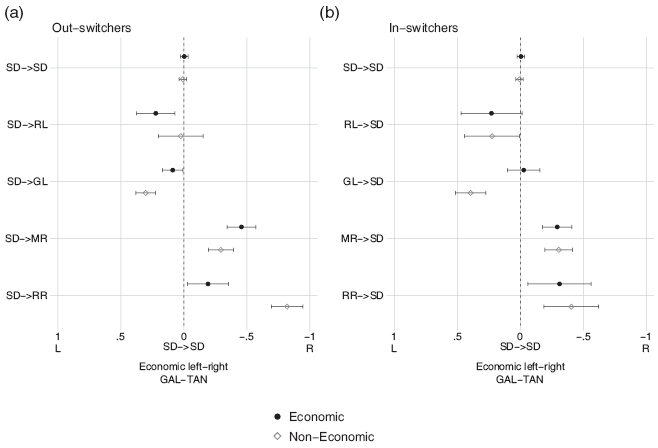
Figure 7.2(a) shows out-switchers from Social Democracy. As expected, voters who abandon Social Democracy in favor of radical left parties disagree with their parties of origin mostly on questions of economic redistribution and those who join the green and left-libertarian parties disagree with social democratic standpatters most sharply on the party’s position on societal issues. As a mirror image, former Social Democrats who move toward center-right parties disagree with social democratic standpatters most sharply on economic issues, while those who gravitate toward radical right parties differ from social democratic standpatters mostly on societal issues, such as immigration and family issues.
How about in-switchers coming to Social Democracy (Figure 7.2(b))? They exhibit essentially the same pattern of divergence from social democratic standpatters, but except for the radical left social democratic in-switchers who actually are more removed from the social democratic standpatters than out-switchers in the opposite direction. In most instances, however, on the dimensions where distance counts most for a competitor of Social Democracy, those who abandon other parties to join the center-left electorate embrace positions closer to social democratic standpatters than do the out-switchers in the opposite direction: Those coming from the Radical Left are less sharply on the redistributive side of economic policy than those who defected from Social Democracy. Likewise, social democratic joiners from green and left-libertarian parties are less different from social democratic standpatters on the societal dimension than are out-switchers. Once again, the same pattern of divergence applies with regard to in-switchers toward Social Democracy coming from the Moderate Right and the Radical Right: These in-switchers tend to inherit some of the positions of their parties of origin.
A note of caution must be added to these interpretations of Figure 7.2. As the confidence intervals surrounding the standpatters’ and switchers’ positions on issue dimensions show, there are indeed many instances where these two sets of voters exhibit opinion differences in a statistically robust way. This does not, however, extend to the comparison of social democratic out-switchers with in-switchers, where the confidence intervals typically overlap.
Our investigation of vote switchers thus provides robust evidence in favor of a spatial logic of vote choice where voters move toward party families that approximate their own ideal-typical preference profile better than the party they have abandoned. Substantively, the analysis highlights the difficulties Social Democrats face in strategic terms. Their voters defect in all directions, and with diverse good reasons. Switchers are – on average – engaging in deliberate moves to align choices with preferences leading them either to left and libertarian or right and authoritarian competitors of Social Democracy. This makes it all the harder for Social Democrats to win back big chunks of their net losses. The “issue yield” (Sio and Weber Reference De Sio and Weber2014) by moving programmatic appeals in one direction rather than another is severely constrained. Moving in any direction may dissuade some voters from defecting but may encourage all the more voters to depart in a different direction. Given the density of flows, the best promise to contain social democratic losses may be held out by moving either in a centrist direction, while shedding votes to the array of more radical parties, or by going after left-libertarian voters, well realizing that this might increase the outflow to authoritarian-parochial radical right and moderate right parties if not also to the Radical Left.
7.4.2 Are Working-Class Switchers Different? (Hypothesis 2)
As a baseline, our investigation establishes that political issue dimensions matter for vote switchers. But do policy considerations matter for voters in more precise ways, such that socioeconomic groups with different preference profiles mobilize different considerations, when switching in or out of Social Democracy? For reasons of data limitations, that is, the relatively small number of social democratic in-switchers, this more detailed analysis of socioeconomic groups confines itself to the largest category available, the broad working-class category of switchers out of Social Democracy. As mentioned earlier, we operationalize this group – which is comprised of lower skilled manual, clerical, and service wage earners – as survey respondents in the lower two-thirds of household income and without a tertiary educational certificate.
As an initial step, let us once again start with the flow of working-class voters between parties with a scheme replicating just for lower-education/lower-income voters in Figure 7.3 the information about vote switching contained for the entire electorates in Figure 7.1. At first sight, the patterns revealed by the two figures look very similar. Upon closer inspection, however, there are striking differences in terms of the percentages of working-class out-switchers that flow to the different destination parties, compared to the same movements by the nonworking-class groups. These percentages are displayed in Table 7.1 (left panel, columns 1 and 2). The table also displays the ratios of out-switcher percentages that each of the destination party families collects from the two different socioeconomic groups of former Social Democrats (Table 7.1, left panel, column 3). Finally, incorporating in-switching, the right panel of the table reports the difference (net flows) between out-switchers and in-switchers in the two different groups, expressed as percentage of all in- and out-switchers in that group.
| Out-switchers’ parties of destination | Out-flow (% of switchers leaving SD) | Net flow (Difference between in-switchers minus out-switchers: negative scores = net SD loss, % of all switchers/column) | ||||
|---|---|---|---|---|---|---|
| (1) Working-class | (2) Nonworking-class | (3) Ratio of (1):(2) | (1) Working-class | (2) Nonworking-class | (3) Ratio of (1):(2) | |
| Radical Right | 15.6 | 9.0 | 1.7 | −10.9 | −4.1 | 2.6 |
| Moderate Right | 33.3 | 28.8 | 1.2 | −8.4 | −3.3 | 2.6 |
| Radical Left | 11.1 | 10.7 | 1.0 | −4.9 | −5.6 | 0.9 |
| Green Left | 40.0 | 51.6 | 0.8 | −27.6 | −27.8 | 1.0 |
| No. of switcher observations | 912 | 1,282 | 1,351 | 2,041 | ||
| No. of all occupational observations | 5,874 | 6,888 | ||||
Voter movements, low-education/low-income group

Both working-class and nonworking class voters have roughly the same share of switchers (1,282/6,888 = 18.6% in the case of nonworkers; 912/5,874 = 15.5% in the case of workers). But the distribution of the outflows is quite different. As expected from the hypothesized average preference disposition of people in the working-class category, a larger share of social democratic working-class out-switchers accrues to radical right parties than is the case among nonworkers (15.6% vs. 9%). Conversely, the share of nonworkers to defect to green and left-libertarian parties is larger than that of workers opting for that destination. Interestingly, working-class switchers appear to favor radical left parties as a destination the least attractive option. Also, the propensity of working-class switchers to go for radical right parties is less pronounced than that for the Moderate Right, even when compared to nonworking-class voters. This pattern suggests that it would be wrong to consider the Radical Left and/or the Radical Right the natural ideological harbors of working-class dissenters from Social Democracy.
The general pattern is confirmed by the right panel of Table 7.1 reporting the net flow of switchers to and from Social Democracy for each party dyad. But there is more interesting information here. Social Democrats lose to all partisan camps, but once they lose workers, they are less likely to ever return. Working-class backflows to Social Democracy from radical right and moderate right parties are miniscule among workers, but large among non-workers, yielding a large net loss among working-class Social Democrats to the Moderate and Radical Right. Conversely, non-working-class out-switching yields large net losses to the Green Left among nonworkers, as few nonworkers can be persuaded to return Social Democracy, once having abandoned the Center Left. Social democratic parties appear to be more competitive to win workers back from the Radical Left and especially the Green Left, whereas Social Democrats appear to be more competitive to win non-workers from the center-right, if not marginally also from the Radical Right.
Our second hypothesis suggests that at least right-ward moves of working-class constituencies toward moderate or radical right parties should be primarily motivated by noneconomic societal dimension considerations (authoritarian parochialism). This should set working-class Social Democrats programmatically apart from other strata, particularly highly educated, high-income professionals, concentrated in business, technology, and finance pursuits.Footnote 7 Figure 7.4 reports the same information as Figure 7.2 (average positions of sociodemographic education-by-income groups defined by voting patterns), but disaggregated by select education-income groups. Figure 7.4(a) shows average attitudinal positions of low-education/low-income social democratic out-switchers, while Figure 7.4(b) displays the positions of high-education/high-income out-switchers. Differences between the two patterns tend to confirm the hypotheses, but with relatively small numbers of observations and small differences we are taxing the robustness of statistical analysis.
Attitudinal correlates of party family switching out of Social Democracy by select education-income groups
Note: Economic and noneconomic attitudes are standardized so that they have a mean of 0 for the SD-SD pattern of the respective education-income groups, and a standard deviation of 1. 95% confidence intervals.

Comparing the positions of social democratic working-class and nonworking-class out-switchers from Social Democracy, working-class out-switchers who defect to moderate or radical right parties are particularly more right-wing on the societal dimension, whereas for nonworking-class switchers out of Social Democracy economic considerations are setting them apart from social democratic standpatters more so than working-class defectors. Preference differences between social democratic standpatters and out-switchers are negligible when it comes to the Radical Left either for working-class or nonworking-class defectors. The social democratic out-switchers of sociodemographic categories exhibit the same reasons to join green and left-libertarian parties. Overall, the data about social democratic switcher preference profiles are consistent with the theoretical expectations.
7.4.3 Does Political Context Matter?
We have run disaggregated calculations by regional groups of countries, characterized by different economic prowess, welfare states, and electoral institutions, as well as by deleting individual countries. The quantities of defection from the various competitor parties differ substantially across countries and regions. Both in Anglo-Saxon first-past-the-post electoral systems and in Mediterranean Europe, there is very little defection of Social Democrats to the Green Left, but more to the Radical Left (Mediterranean) or the Moderate Right (both Mediterranean, Anglo-Saxon countries). Likewise, the Radical Right is not always a relevant competitor with which Social Democrats exchange any relevant share of votes.
Because of small numbers of observations, estimates become less reliable the further the disaggregation of data. Results reported in Table 7.1 are difficult to reproduce at the level of regions, let alone individual countries, because of the vanishing small number of observations available at those levels for many of the relevant switching pathways. Regardless of how we sliced the data, however, no striking qualitatively different patterns of out-switcher or in-switcher preference profiles appear across the different regions or individual countries compared to those reported at the aggregate level of all fifteen countries. Party switchers follow a spatial voter rationale such that their parties of destination are closer to their positions than those of their parties of origin.
7.5 Conclusion
Overall, the EES data lend much support to the proposition that vote switchers are motivated by programmatic considerations, comparing their own preference profiles to those advertised by competing parties. In this regard, the “folk theory” of “responsible partisan government” rings true no matter how much Achen and Bartels (Reference Achen and Bartels2016) may rail against it.
Our empirical findings offer little consolation to social democratic party strategists with the ambition to find a formula of appeal that will rally voters and push the needle of party support once again upward of 30% or even 40% of the whole electorate. At least in systems of PR with relatively low entry thresholds of new parties, realizing this ambition appears to be outside the strategy feasibility set. Voters have abandoned social democratic parties in very different directions that would require contradictory appeals to reassemble them again. Parties will have to choose which subset of lost voters they might want to chase, but the whole set of lost voters is beyond reach.
The findings of our investigation also pour cold water on the idea that out-switchers from Social Democracy, and especially working-class Social Democrats, are primarily antagonized by the parties’ economic and social policy moderation on the distributive policy dimension. This reasoning applies at most to a small segment of the mostly nonworking-class out-switchers, and even for the social democratic out-switchers to radical left parties, our data analysis could not unambiguously establish that the loss is because such voters harbor more leftist, redistributive policy preferences than the average social democratic standpatter. It appears that even for them, other considerations, and maybe not just policy-based ideas and sentiments, drive them away from Social Democracy.
At the same time, our study confirmed that the exchange with moderate right parties is critical to understanding social democratic party fortunes, as the highest share of voters is lost or won for such parties in the center of the preference space. We suspect that, in addition to spatial programmatic considerations, this electoral volatility in the center of the issue dimensional space is also driven by nonprogrammatic, short-term considerations that may have to do with valence/competence of parties in government office, political personalities, and other contingent factors. Vote switching to and from the more radical, peripheral parties on the field of party competition, however, are more clearly informed by programmatic considerations. But we could not investigate this question in the current chapter. It is possible that a fair share of voter defection in the center results from Social Democrats serving in government office, particularly in bad economic circumstances (cf. Chapter 12).
In this vein, the worst scenario for Social Democracy may feature the following elements: (1) The party faces a moderate contender to its center-right, while simultaneously (2) several other more “specialized” parties in the left-libertarian sector (left-socialists, left-libertarians, and even centrist-libertarian radicals) are awaiting disaffected social democratic defectors with open arms. Furthermore, (3) Social Democracy is in executive government office, during (4) a bad economic spell and (5) delivers a fiscal austerity treatment that retrenches social benefits. This configuration for sure will make social democratic voters run away in all possible directions. The Dutch election of 2017 may be the most extreme empirical realization of this scenario.
Let us finally remind readers that vote switching is, of course, only one mechanism that contributes to the changing vote share and alignment of parties in a democracy. A second one is generational replacement which we have not analyzed here, but which likely contributes to the decline of social democratic vote shares. At least with US data, we find that each subsequent generation of the old industrial society’s core center-left voter group – low-education/low-income voters – has a lower propensity to vote for such parties in the era of knowledge society. A third mechanism is the movement of past partisans into the pool of nonvoters who then later become supporters of other parties. Data constraints did not permit us to probe into this with EES data. But estimations for the United States reveal a pattern of behavior very similar to what we have found here for direct vote switchers. In any case, what we document in this chapter is just a first glimpse at the micro-dynamics of vote choice for social democratic parties.
8.1 Introduction
The relationship between social democratic parties and labor unions is of interest for the entire era of labor mobilization since the nineteenth century. Both labor unions and social democratic parties benefited from a close, interlocking relationship in Western Europe in several ways: Trade unions generated long-lasting and tightly knit networks of mobilization (Gingrich and Lynch Reference Gingrich and Lynch2019); trade unions and social democratic parties exchanged and cumulated organizational and financial resources; their interconnections also contributed to the programmatic alignment of voters and members on the Left and to socialization processes into a joint programmatic orientation. The question today, however, is whether we observe an increasing dealignment between trade unions and social democratic parties in terms of constituencies, as well as in terms of programmatic orientations. The middle-class shift in the employment structure of West European countries, the emergence of highly salient sociocultural issue dimensions, as well as the pluralization and fragmentation of the “left field” into social democratic, radical left and green and left-libertarian parties raise several questions in this regard. Have the constituencies of left parties and trade unions developed in parallel or have trade unions remained anchored in the working class while left parties increasingly attract support from elsewhere? Consequently, do the average preferences of trade union members and left voters align or diverge when it comes to redistribution, cultural liberalism, and immigration policies? Do unionized left voters sort increasingly into radical left, social democratic, or green and left-libertarian parties? Eventually: Do trade unions remain a connecting force in an organizationally and programmatically realigned left field?
Historically, trade unions and social democratic parties reinforced each other through a variety of channels in both directions: Bartolini’s (2007: 290–97) detailed empirical examination suggests that at the very beginning of the labor movement, European social democratic parties did not significantly benefit electorally from early unionization. Rather, it appears that party growth in the late nineteenth century induced union mobilization, which, in turn, became most beneficial for Social Democrats later in the temporal sequence. Throughout much of the twentieth century, however, interlocking cross-linkages between unions and parties, particularly in the presence of (quasi-)monopolistic union federations dominated by operatives who combined union and party offices, clearly boosted electoral partisan mobilization (Bartolini 2007: 294).
A variety of channels may have come into play in the virtuous circle between labor unionization and social democratic electoral fortunes. Working-class youths, entering apprenticeship or shop-floor unskilled labor relations at age 14 or 15, were likely to encounter unions first and join them at a much younger age than when they gained eligibility to vote at age 21. If unions were densely organized on the shopfloor as well as closely connected to social democratic parties, labor unions also provided a venue for youths to engage in party politics, first in party youth organizations and then through party membership and electoral participation. Unions created the social networks to socialize teenagers into partisan politics. Moreover, they tended to shape young workers’ political preferences to make them receptive to social democratic programmatic appeals. Both social network mechanisms and ideological formation are probably so closely intertwined that they are hard to separate analytically. This dual political accelerator further strengthened in all those instances in which unions had formal or informal claims to organizational representation inside social democratic parties all the way up from boards of party grassroot units to the organs of party leadership and legislative representation. The overlap between union and party offices was often substantial. A familiar sight were social democratic legislators who originated from working-class families, started out in blue-collar jobs, became union operatives, and then combined their elected parliamentary office with serving as secretary of a local union branch.
If that gives a flavor of the historical template of union–social democratic party relations at the electoral and organizational levels, how have relations evolved in recent decades and with what consequences for social democratic electoral fortunes? The loss of union members, particularly among the young, is likely to have weakened bonds of working-class voters to social democratic parties as well. The enfeebled parties, in turn, may then have been less successful in protecting or promoting the institutional centrality of labor unions in industrial relations systems, thereby undercutting unionization and alienating union members. At the same time, the influx of university educated voters into social democratic and other left parties may have further contributed to loosening the alignment between labor organizations and parties both organizationally and with regard to preferences.
In this chapter, we will address the subject of union–party relations and how it relates to social democratic fortunes with microlevel data on membership, political preference profiles, and electoral behavior. The chapter explores the extent to which unionized and nonunionized social democratic voters converge or diverge in their programmatic policy preferences. We also probe into differences in political views between labor unionists supporting different left-wing parties. Moreover, the chapter examines the “loyalty,” “inertia,” or “clinginess/identification” of union voters to social democratic parties through the lens of interparty switching behavior in elections. Does union membership create a distinctive incentive to maintain social democratic partisan loyalty?
The historical expectation is that the party-affiliated labor unions are the stalwarts of sustaining social democratic electoral support. But – at the micro-level of voter behavior – is this expectation still empirically borne out? After all, there are radical left and green and left-libertarian alternatives in many party systems that also embrace labor demands. Does this differentiation among political parties imply a stronger preference heterogeneity between unionized and nonunionized left voters, as well as among unionized voters of different parties in the left field? Therefore, can Social Democracy still claim to be the party of the labor movement in many advanced knowledge societies? Or, if unionists no longer have strong motivations to remain loyal to Social Democracy, are they exhibiting distinctive patterns of switching to other parties? For example, given that the bread-and-butter issue of labor unionism is the struggle for income redistribution, are labor unionists less likely to defect to the Green Left, with an emphasis on many other issues, but more likely to defect to the Radical Left, making economic distribution its most salient political cause?
Our findings concerning these questions confirm and extend empirical evidence gathered in investigations over the past decade. Several results stand out. First, trade unions have experienced a higher-education shift in the composition of their membership that is very similar to the shift within the electorates of social democratic parties. However, among social democratic voters – and among the constituencies of other parties on the Left, as well – unionists and nonunionists remain very close in programmatic terms. In particular, unionized nonworking-class members are just as left-wing when it comes to economic-distributive attitudes as working-class members. Second, if there are differences in political preferences, we find them within the subgroup of unionized social democratic voters: higher-educated unionists are programmatically more progressive than their working-class counterparts on second dimension issues such as LGBT rights or, in particular, immigration. This substantial tier of nonworking-class union members – most prevalent in (public) service sector unions, particularly in Northern Europe – now tilts toward green and left-libertarian positions.
Third, turning to labor unionists’ loyalty to Social Democracy or party switching, unionized voters are still more likely to support Social Democracy than nonunionists. But contingent upon region, unionists also provide strong support to distinctive left competitors of Social Democracy as well. In Northern and Continental Europe, where there is a strong supply of green and left-libertarian parties, these competitors to Social Democracy also disproportionally attract unionists. In Mediterranean Europe, the main electoral competitor of Social Democracy in the hunt for union voters, however, is the Radical Left. Fourth, where green and left-libertarian competitors attract substantial shares of unionists, they do so particularly among highly educated unionists. In a dynamic perspective, this pattern is confirmed by unionists’ switching to green and left-libertarian parties, although numbers of observations are too small to be statistically confident. But the writing may be on the wall: Green and left-libertarian competitors of Social Democracy appear to gain momentum among unionists particularly in the countries with the highest levels of unionization and in the socioeconomic occupations with the most promising numerical prospects in terms of future labor market demand, namely college educated professionals.
This chapter is structured as follows: In Section 8.2, we review existing evidence concerning the political outlook and partisan behavior of unionized voters compared to nonunion members. We also present descriptive data on changes in the class composition of trade union membership and voting patterns among union members. The chapter then outlines three theoretical propositions with regard to the changing relationship between trade union constituencies and party electorates on the Left and derives expectations regarding political preference patterns and vote switching. The empirical sections evaluate the plausibility of these theoretical expectations in two ways: The first empirical section examines political preferences among unionized and nonunionized voters of social democratic and other left-wing parties. The second empirical section analyses variations in unionists’ and nonunionists’ voting support for Social Democracy and other party families on the political Left. Are unionists more likely to be social democratic standpatters or are they switchers opting for alternatives on the Left and beyond?
8.2 The Context: Class Composition and Voting Patterns among Trade Union Members
Most existing contributions diagnose weakening bonds between trade unions and social democratic parties (Allern and Bale Reference Allern and Bale2012, Reference Allern and Tim2017; Gumbrell-McCormick and Hyman Reference Gumbrell-McCormick and Hyman2013). Scholars have nominated two reasons for this development: changing employment structures and programmatic shifts of social democratic parties.
First, the changing employment structures – deindustrialization and the massive expansion of occupations in middle- and higher skilled service jobs – are well documented (Oesch Reference Oesch2013; Boix Reference Boix, Beramendi, Häusermann, Kitschelt and Kriesi2015). They are at the root of both decreasing trade union density overall, as well as a massive expansion and diversification of the highly educated, which are an increasingly important constituency of the Left (Kitschelt Reference Kitschelt1994; Kriesi Reference Kriesi, Kitschelt, Lange, Marks and Stephens1999; Gingrich and Häusermann Reference Gingrich and Häusermann2015; Häusermann Reference Häusermann, Manow, Palier and Schwander2018; Oesch and Rennwald Reference Oesch and Rennwald2018). This development alone raises the question if a diverging class composition of trade union constituencies and left party electorates drives these organizations apart. Second, social democratic parties have allegedly moved away from pro-welfare and pro-redistribution policies toward more centrist positions, which may have alienated trade union members from social democratic parties. Moreover, the emergence of cultural liberalism as a core issue of left politics may increase such an alienation: Trade unions are rooted in the production working class, who tends to be more culturally conservative than other supporters of left parties. It is this sociocultural divide that has motivated speculations about a new “natural” alliance between right-wing nationalist organizations and trade unions in favor of social protectionism, anti-free trade, or welfare chauvinism.
But there are also reasons to believe that the link between unions and social democratic parties remain strong. After all, trade unions may be exposed to the same sociodemographic and programmatic transformations as social democratic parties. As higher-education occupations spread and expand, so may trade union membership within them. Thereby, unionized left voters may align with the culturally progressive orientation of the Left. At most, there may be growing internal tension within trade unions between more conservative (working-class) and more progressive (highly educated) members.
In this first section of the chapter, we provide an empirically informed overview of the development of the class composition of trade union membership over time, and of the average electoral choices of trade union members. We show that trade union constituencies have experienced a higher education shift that is similar to the one experienced by social democratic parties. We also show that while social democratic parties on average remain the most prevalent choice among unionized voters, union members increasingly also vote for other left-wing parties of either the radical left or the green and left-libertarian party families.
8.2.1 Changes in the Sociodemographic Composition of Unionists and Unionization
Even with continuing high propensity of unionists to support Social Democrats, a big driver of social democratic electoral decline might simply be the shrinkage of labor unions that can be observed in all Western countries. But there is unlikely to be a direct and linear relationship between union and party decline (Rennwald and Pontusson Reference Rennwald and Pontusson2021: 40). Moreover, the decline of unions itself is starkly heterogenous. It unfolds from different starting points and with different slopes of membership decline (for data, see Hassel Reference Hassel, Beramendi, Häusermann, Kitschelt and Kriesi2015: 236–38 and 255–56). In the Nordic countries, only a small decline occurred from very high levels of unionization (upwards of 70% of wage earners). In Continental Europe, the decline was more substantial starting from an only intermediate level of wage earner union enrollment (from 30–40% down to 20–30% union density from the 1980s to the 2000s averages). A similar pattern pertains in Mediterranean Europe, albeit in a somewhat more pronounced way, beginning at slightly lower levels than the Continental European group and dropping a bit further. Finally, the membership drop is most pronounced in Anglo-Saxon countries, starting with a relatively high average of greater than 40% union density in the 1980s and dropping to one near 25% by the first decade of the 2000s. Moreover, especially in the Mediterranean countries, but also to a lesser extent elsewhere, a large share of unionists is among the retirees and unions experience little membership replenishment among young wage earners.
Other over-time changes in unionization that may affect Social Democracy have to do with the sectoral and sociodemographic structure of unionism. Unionism has increasingly become a middle-class phenomenon in the sense that more highly paid, educated, and service-sector employed wage earners show the comparatively strongest inclination to join unions (Hechter Reference Hechter2004; Kjellberg Reference Kjellberg2008; Becher and Pontusson Reference Becher, Pontusson and Brady2011; Ebbinghaus et al. Reference Ebbinghaus, Göbel and Koos2011; Mosimann and Pontusson Reference Mosimann and Pontusson2017, Reference Mosimann and Pontusson2022; Arndt Reference Arndt2018). In occupational terms, in recent years sociocultural professionals often display higher rates of unionization than either blue-collar workers in production and services or other lower-skill clerical wage earners (Rennwald and Pontusson Reference Rennwald and Pontusson2021). These developments also show up in a finding by Mosimann and Pontusson (Reference Mosimann and Pontusson2017), who demonstrate that European unions have, on average, become less low-income inclusive between 2002 and 2016.
These trends are reflected in Figure 8.1. Based on a dataset combining Eurobarometer (EB) and European Social Survey (ESS) waves from the late 1980s to present, Figure 8.1 shows how the class composition of trade union membership has changed over time. Prepared by Gingrich and Häusermann (Reference Gingrich and Häusermann2015), the EB/ESS dataset combines the 1972–2002 EB trend file with seven waves of the ESS from 2002 to 2014.Footnote 1 Within this combined dataset, a question pertaining to respondents’ union membership status is available in the EB data from 1988 to 1991 and 2001 and is also available in the ESS waves from 2002 onwards.Footnote 2
Changes in the class composition of trade union membership
Note: Calculations for the employed population aged 18 and over.

Among the West European countries for which we have data on any of these waves, we select the twelve countries that have participated several times in the earlier period (1988–94) based on EB data and in the later period (2001–14) based on EB and ESS data. We sort these countries into four regions.Footnote 3 At the individual level, the sample is restricted to employed respondents aged 18 and over, that is, the pool of potential union members in most West European countries.
To observe changes by class, we group respondents based on their occupation and educational attainment. We define manual workers as working class. We label as “middle class” respondents with upper secondary education who work in sociocultural professions, technical professions, associate and higher management occupations, as well as office employees with upper secondary education.Footnote 4
Figure 8.1 shows how the relative shares of unionized working- and middle-class respondents have developed over time. By 2014, middle-class members have become by far the main constituency of trade unions in all regions. While the gap across classes has become widest in Northern and Mediterranean Europe, it has remained somewhat smaller in Continental and Anglo-Saxon Europe. The finding that unions become predominantly composed of middle-class employees over time holds for all countries in our sample.
This change in membership composition is due to declining working-class unionization on the one hand and structural occupational changes on the other hand. As a result, the picture we see for unions in Figure 8.1 closely resembles the one that has been documented for left-wing parties in general and social democratic parties in particular (Gingrich and Häusermann Reference Gingrich and Häusermann2015; Häusermann Reference Häusermann, Manow, Palier and Schwander2018).Footnote 5
8.2.2 Political Preferences of Trade Union Members over Time
The shift in the occupational and income profile of European labor unionists is likely to coincide with an evolving profile of union members’ political preferences. Existing empirical research shows that labor unionists and social democrats share a strong concern for redistributive income policies (Mosimann and Pontusson Reference Mosimann and Pontusson2017, Reference Mosimann and Pontusson2022; Macdonald Reference Macdonald2019) and support other policies with distributive implications (Hadziabdic and Baccaro Reference Hadziabdic and Baccaro2020) as well as social insurance policies (Häusermann and Kriesi Reference Häusermann, Kriesi, Beramendi, Häusermann, Kitschelt and Kriesi2015; Bledow and Busemeyer Reference Bledow and Busemeyer2021). Likewise, unionists, as well as social democrats, on average embrace progressive positions on societal issues concerning gender/sexual orientation, environmental protection, or civil liberties. Most notably, recent studies find that labor unionists also on average tend to support liberal immigration policies more than nonunionists (Kitschelt and Rehm Reference Kitschelt and Rehm2014; Donnelly Reference Donnelly2016).
It is likely, however, that there may be considerable internal heterogeneity in opinions on such issues among trade union members. This heterogeneity, in turn, is also likely to affect their vote choices in an increasingly differentiated and fragmented left field. Still, empirical studies show a general tendency for labor unionists to be disproportionally supportive of, and loyal to, social democratic parties (Arndt and Rennwald Reference Arndt and Rennwald2016; Rennwald and Pontusson Reference Rennwald and Pontusson2021).
Figure 8.2 confirms this tendency of unionists to vote social democratic. Based on the same EB/ESS dataset as Figure 8.1, Figure 8.2 shows the share of trade union members voting for social democratic, other left and non-left parties over time. The coding of parties follows the coding in this book with some minor deviations.Footnote 6 Parties are sorted into one of six party families: social democratic, green and left-libertarian, radical left, liberal and conservative, Christian democratic, and populist right. Contrary to the coding of parties in this book, we differentiate between Christian democratic and other moderate right parties, because of special ties between the former party family and the (Christian) labor movement (Arndt and Rennwald Reference Arndt and Rennwald2016; Allern and Bale 2017).
Changes in voting patterns among union members
Note: Calculations for the employed population aged 18 and over.

Figure 8.2 provides at least three important findings. First, voting social democratic has been and still is the most likely party choice among union members across Continental and Anglo-Saxon Europe. In Northern and Southern Europe, Social Democrats experience stiffer competition for unionists’ vote from moderate right parties. Second, about 60% of trade union members vote left in Northern and Continental Europe across the period under investigation, and that share even reaches 70% in Mediterranean Europe. Moreover, vote patterns for social democratic and other left parties develop in complementary ways, suggesting that electoral volatility plays out within rather than across ideological blocks. A third finding addresses speculations about a massive authoritarian shift of (unionized) working-class voters toward the Radical Right. Contrary to such speculations, the share of unionists voting for the Radical Right is extremely low and stably so across Europe.
At the microlevel, sectoral and occupational differences among unionists come into play in shaping unionists’ actual partisan vote choice as shown in Figure 8.2. Unionized blue-collar and clerical workers (industrial, service) may be more likely to stick with Social Democracy than unionized wage earners in nonworking-class occupations. Rennwald and Pontusson (Reference Rennwald and Pontusson2021: 45) find that “cross-class” appeals of social democratic parties, indicated by the parties’ ability to attract a higher proportion of nonworkers, actually keep blue-collar unionists more loyal to the party than other social democratic voters. Unionization still appears to exert a powerful affective bonding effect on workers who thereby stick with Social Democracy, even when it appears to cater to other demographic categories’ preferences. A similar loyalty is not evidenced by the electoral behavior of unionized nonworkers. They tend to be more likely to affiliate with the Green Left, and in a dynamic perspective, they are also more likely to switch from Social Democracy to the Green Left but particularly when Social Democrats focus their appeals on working-class voters rather than a cross-class message (Rennwald and Pontusson Reference Rennwald and Pontusson2021: 45).
Rennwald and Pontusson’s (Reference Rennwald and Pontusson2021) study of vote switching thus also suggests an asymmetry among the electoral choices made by working-class and nonworking-class unionized social democrats. The latter find it easier to abandon Social Democracy and particularly to switch to moderate right or green and left-libertarian parties. Working-class unionists have a slightly higher propensity to support radical right parties, when leaving Social Democracy. In Rennwald and Pontusson’s (Reference Rennwald and Pontusson2021) analysis, however, all categories of union members have a somewhat greater tendency to switch to radical left parties than nonunionists because of such parties’ advocacy of more redistribution.
Labor unionism seems a mixed blessing for Social Democracy in the twenty-first century. On the one hand, labor unionists prop up social democratic parties and provide less volatile support than nonunionists. This is because of a confluence of redistributive policy preferences as well as a habitual affective affinity created by organizational involvement and interaction. On the other hand, the size of the industrial labor force joining traditional unionism with close ties to social democratic parties has been shrinking. At the same time, new unionists with higher educational skill levels and/or income affiliated with sectors that are expanding and were not previously unionized bring in political actors that are harder to line up with social democratic parties both in their policy preferences and in their willingness to switch parties based on a strategic – or even a short-term tactical – calculus. On balance, labor unionism may no longer be a sure pillar of support for Social Democrats. Our empirical analysis aims at demonstrating the Janus face of unionism and social democratic party relations in further detail.
8.3 Theoretical Propositions
Both the theoretical abovementioned discussion and the descriptive data on the changing class profile of trade union constituencies and diversifying party choices raise the question whether these developments constitute a problem for social democratic parties or not. Such a problem could take the form of either stronger internal heterogeneity of policy preferences between their unionized voters and their nonunionized voters or an increasing tendency of unionized voters to switch away to other parties.
To assess the extent to which social democratic parties and trade unions have diverged or still ally, we sketch three alternative scenarios or hypotheses on the relationship between labor unions and social democratic parties in contemporary knowledge capitalism. Each of them has specific empirical implications regarding preference profiles and vote switching/loyalty that we subsequently explore.
A first scenario is continued social democratic / moderate left union loyalty. This hypothesis postulates that labor unionists are primed to demand economic solidarity and hence income redistribution, just like social democratic voters. In this scenario, we would expect to find hardly any differences in the programmatic preferences of unionized and nonunionized (social democratic) voters, regarding both economic-distributive and sociocultural policy issues. In addition, long-term affiliation with Social Democracy among labor unionists strengthens affective identification and makes electoral defection unlikely. Across economic branches and occupational subgroups of labor unionized wage earners, this hypothesis thus expects a continued elevated level of support for Social Democracy among those organized in labor unions.
A second scenario is radical left defection of union members. According to this hypothesis, unionized voters insist on a more radical leftist economic agenda of income redistribution than nowadays offered by social democratic parties. Therefore, we would expect radical left unionized voters to exhibit decidedly stronger pro-redistribution attitudes than the unionized voters in the social democratic and green and left-libertarian electorates. As these unionists would show a high propensity to defect to available radical left alternatives to Social Democracy, we would expect to see substantive vote switching from social democratic to radical left parties. Alternatively, short of being able to support a credible Radical Left, such workers may withdraw from voting (Evans and Tilley 2012).
A third scenario is the green and left-libertarian defection of union members. According to this hypothesis, many green and left-libertarian parties are receptive to redistributive concerns and additionally offer a number of progressive political and cultural policy prospects that may particularly attract specific categories of wage earners within the unionized labor movement, such as the numerically expanding cohorts of educated sociocultural service professionals. Consequently, over time green and left-libertarian parties may claim a growing share of unionized (middle-class) wage earners and compete with Social Democrats on what the latter considered their very own turf. In terms of empirical implications of this scenario, we would expect to see green and left-libertarian union members to hold clearly more strongly progressive preferences than unionized voters of social democratic or radical left parties. We would also expect to see substantive patterns of vote switching from social democratic to green and left-libertarian parties, especially among the middle class.
In principle, two additional, scenarios are theoretically possible. First, it could be that union membership has become entirely irrelevant for party choice (i.e., a complete decoupling of parties and unions). In an environment of eroding labor union enrollment and dealignment of voters from political parties, this hypothesis predicts a zero impact of labor union membership on partisan choice. But while labor union membership has declined everywhere, it still varies sharply across countries (Hassel Reference Hassel, Beramendi, Häusermann, Kitschelt and Kriesi2015). Moreover, Figure 8.2 has ruled out this scenario from the start. Second, it could be that unionists have become disaffected by conventional parties and now vote for radical right parties in protest and/or in alignment with second dimension authoritarian and xenophobic anti-immigrant preferences. The evidence in previous chapters (e.g., Chapter 3 by Abou-Chadi and Wagner, or Chapter 5 by Bischof and Kurer) and discussed earlier (incl. Figure 8.2) demonstrates that there is no massive defection to the Radical Right in the working class at large, or among unionized voters. Hence, these two alternative scenarios seem (so far) implausible, and we do not pursue them further empirically.
There are at least two types of modifiers that may indicate the polities and socioeconomic groups to which one or the other of these three hypotheses may apply with particular empirical force. The first concerns divisions among different categories of unionized wage earners. As already indicated when discussing hypotheses 1 and 2, the divisions may be based on sectoral and occupational conditions differentiating the wage earner population. Employment in shrinking manufacturing sectors with high, but declining shares of manual labor may well motivate their unionized lower-skilled workforce to defect from Social Democracy by either moving right, abstaining, or moving to the Radical Left. Other unionized sectors and occupations may tilt more to green and left-libertarian alternatives. As indicated, this propensity may be particularly pronounced among more highly educated wage earners concentrated in social, educational, health, and cultural services.
The second modifier resides in the different countries’ party supply and aggregate voter demand for partisan programmatic positions. Electoral laws constrain the supply side of political alternatives. In the presence of single-member district plurality, electoral laws – such as in Britain or the United States – it is difficult to establish a partisan competitor to existing moderate left parties that could attract voters based on more radical economic-redistributive or more cosmopolitan and libertarian second dimension issue positions. Barriers to the entry and effective legislative representation of new parties in these systems are sufficiently high to dissuade rational voters from abandoning social democratic party labels and supporting new alternatives. Within this institutional setup, therefore, hypothesis 1 (loyalty of labor unionists to established moderate left parties) may plausibly capture empirical voter conduct most accurately. By contrast, where multimember district electoral systems of proportional representation that is permissive to the entry of new parties are in place, unionists may more easily abandon conventional moderate left Social Democrats in favor of radical left (H2) or green and left-libertarian parties (H3).
The institutional supply-side facilitator of unionists’ defection from Social Democracy comes with a complementary political-economic demand-side accelerator. It is a robust empirical relationship that systems of proportional representation redistribute more income through more encompassing welfare states (Iversen and Soskice Reference Iversen and Soskice2006). Encompassing welfare states often involve more social service public and nonprofit sector employees (particularly in health, social assistance, and education), thereby magnifying the share of the electorate with professional profiles and occupations receptive to green and left-libertarian demands.
Northwest European welfare states and party systems thus should turn out to be most conducive to making green and left-libertarian parties strong contenders for the union vote: In these countries, labor union density is still comparatively strong,Footnote 7 welfare states and the “de-commodification” of social work have gone further than elsewhere, and all of these countries have electoral voting systems of proportional representation. In these countries, then, the union realignment pattern postulated in H3 may be borne out particularly clearly. In other systems of proportional representation, with less redistributive welfare states, and lower unionization, and further removed from the global knowledge society innovation frontier – evidenced by smaller cohorts of sociocultural professionals – political-economic conditions may not favor the defection of many unionists to green and left-libertarian parties, but more so to radical left parties (H2). Particularly in the face of precarious labor market conditions, such radical left parties – rather than green and left-libertarian competitors – benefit from the waning appeal of Social Democracy.
Putting country-level and group-level indicators together, different configurations of institutional and political economic conditions should make it more likely to validate one or the other hypothesis about vote switching among labor union members. The union social democratic standpatter H1 may be borne out particularly well in Anglo-Saxon democracies with single-member district electoral systems, reinforced by a high salience of economic redistribution in environments of limited welfare states and high-income inequality. The radical left unionist defection hypothesis (H2) may empirically apply more to democracies with proportional representation, but weak green and left-libertarian parties for reasons of socioeconomic development and political economy. The green and left-libertarian unionist defection hypothesis (H3), finally, comes into force in systems of proportional representation in Northwestern Europe with encompassing welfare states and strong green and left-libertarian party alternatives. Table 8.1 summarizes this argument.
| Election-to-election voting behavior of unionized SD voters | Conditionality: Switching pattern most likely when | ||
|---|---|---|---|
| Supply side: Electoral system | Demand side: Knowledge society | Context: Welfare state | |
| H1: more likely to remain SD standpatters | Restrictive | More or less advanced | More or less encompassing and progressive |
| H2: more likely to become out-switchers to Radical Left | Permissive | Less advanced | Less progressive |
| H3: more likely to become out-switchers to Green Left | Permissive | More advanced | More encompassing and progressive |
We note that our predictions regarding the loyalty of union members to social democratic parties in different countries overlap with predictions made by Arndt and Rennwald (Reference Arndt and Rennwald2016) and Mosimann and Pontusson (Reference Mosimann and Pontusson2017). Their proposed mechanism, however, is different: Loyalty is high where middle-class unionists will be “socialized” into working-class unionists’ preferences in favor of redistribution, particularly when combined under the same union umbrella numerically dominated by the blue-collar membership. There are two countries, however, where this “union socialization hypothesis” and our reasoning make contrasting predictions: Austria and Germany. Because of institutional and political-economic conditions, and the presence of strong green and left-libertarian parties, the demand-and-supply argument predicts a high defection rate of unionists from Social Democracy toward green and left-libertarian or moderately conservative partisan alternatives, particularly among high-skill labor unionists, and consequently a high level of unionists supporting nonsocial democratic parties. By contrast, following the union socialization account of redistributive preference formation, Austria and Germany should exhibit rather low middle-class unionist defection rates toward rival parties: After all, encompassing single union federations with majority blue-collar membership dominate the union landscape in both countries, and these federations are quite strongly intertwined with Social Democracy in terms of activists and political operatives.
8.4 Findings I: Preferences of Labor Unionists and Social Democratic Voters in the Early Twenty-First Century
To study individual-level programmatic attitudes, we rely on data from the ESS 2016 to capture preferences of unionized and nonunionized voters of left-wing parties in general and social democratic parties in particular (ESS Round 8 2016). The ESS 2016 includes a module on political preferences that allows us to evaluate preference profiles regarding different political dimensions. Informed by our theoretical discussion earlier and our observations in Figure 8.2, we compare the average preference profiles of unionized and nonunionized voters of the Social Democrats, the Green Left and the Radical Left regarding both distributive questions, that is, redistribution support, and second-dimension issues, that is, adoption rights for homosexual couples and immigration.Footnote 8 The question we want to answer is whether left electorates differ in their preferences across union membership status and across different party families or not.Footnote 9
In this analysis, we want to know how similar or different preferences of trade union members and nonmembers among the constituencies of left-wing parties are. In other words, we do not want to know if trade union membership or left voting leads to certain preferences. Since compositional effects driving differences in preferences are an integral part of what we are interested in descriptively, we simply regress preferences on an interaction between union membership and party choice without including control variables.
In line with H1, Figure 8.3 shows that all voter subgroups exhibit highly similar policy preferences across all regions and preference dimensions. It also shows that unionized and nonunionized voters of the Left alike are in general more in favor of redistribution, LGBT rights, and immigration than other voters whose average preference is indicated by the reference line. There are only two cases in which preferences differ substantially across union membership status. Union members among radical left voters in the Anglo-Saxon countries are more likely to support immigration than nonmembers (but the 95% confidence intervals overlap slightly), and union members among green and left-libertarian voters in Northern Europe are significantly more likely to support redistribution than nonmembers. In all other instances, preferences between union members and nonmembers overlap.
Predicted probabilities of policy support on three dimensions
Note: Based on models 1–12 in Table 8.A1.


Most left-wing constituencies are, on average and irrespective of union membership status, in favor of redistribution and liberal when it comes to minority rights. Importantly, support for immigration is quite restrained – especially among social democratic voters and irrespective of union membership status. Both unionists and nonunionists within left-wing electorates are, however, in general more supportive of immigration than the electorate at large. The important exception being social democratic voters in Northern Europe whose likelihood to support immigration is below the average likelihood of immigration support in this region. This pattern may very well be explained by the fact that we can expect less ideological sorting into unions in the Nordic countries with their strong institutional incentives to join unions because of their so-called Ghent systems of unemployment insurance.
Figure 8.3 indicates that unionized voters of the Left are on average not more culturally conservative than nonunionized voters of the Left. In support of the hypothesis on a green and left-libertarian defection of union members (H3), we also find that unionized green and left-libertarian voters are generally more culturally progressive than unionized social democratic or radical left voters. Conversely, Figure 8.3 does not support the notion of a radical left defection of union members (H2) in as far as redistribution support does not vary systematically across unionists belonging to different left-wing electorates.
We are also interested in the heterogeneity of preferences among unionized voters of the Left. Figure 8.4 thus shows preferences on the same dimensions as Figure 8.3 for unionized working- and middle-class voters of the Social Democrats, the Green Left, and the Radical Left separately. The estimations for Figure 8.4 rely on the same type of regression analyses as before, and we use the class scheme by Oesch to get at the “typical” representatives of social democratic working- and middle-class voters, that is, production and service workers, sociocultural professionals, and technicians and managers (Oesch and Rennwald Reference Oesch and Rennwald2018). We show findings pooled across regions because of the small sample size on which these analyses rely on.
Predicted probabilities of policy support among unionized voters
Note: Based on models 1–3 in Table 8.A2.

For redistribution preferences, levels of support among different working- and middle-class electorates on the left are about the same, as shown in Figure 8.4. All sub-constituencies favor generous distributive policies and their likelihood to support redistribution clearly surpasses this likelihood in the entire electorate indicated by the reference line. For redistribution, class alliances within either party family seems to hold firmly. When it comes to minority rights and immigration, preference gaps between the working class and the middle classes are more pronounced especially among unionized social democratic voters. Among unionized social democratic voters, support for LGBT rights or immigration is less likely from the working class than from either of the middle classes depicted in Figure 8.4.
The observed pattern of findings confirms that many labor unionists remain closely associated with Social Democrats’ core preferences (hypothesis 1), but that some are more closely situated near the green and left-libertarian alternatives (hypothesis 3). Unionized supporters of the Radical Left, however, do not express distinct preference profiles, contrary to hypothesis 2.
8.5 Findings II: Labor Union Members’ Electoral Choice and Party Switching Movements (1999–2014)
We next examine whether the general proximity of unionists to the preference profile of social democratic party supporters, as well as the heterogeneity in political orientations among labor unionists, leave an imprint on the dynamic of unionists’ voting behavior, compared to nonunionists, in advanced capitalist democracies. The focus of interest is the extent to which labor unionism electorally promotes or undermines Social Democracy, and the conditions under which this might occur. As in the Kitschelt/Rehm chapter on motivations of vote switchers (Chapter 7 of this volume), we explore these questions with evidence from the European Election Studies surveys 2009–19 (Egmond et al. Reference Egmond, Brug, Hobolt, Franklin and Sapir2017; Schmitt et al. Reference Schmitt, Hobolt, Popa and Teperoglou2016, 2020), because this survey contains measures of political preferences and also makes it possible to construct vote switcher and standpatter variables based on a recall question about the respondents’ previous, rather than current electoral choice.
Table 8.2 contains information on unionized and nonunionized respondents’ dynamic voting behavior, separately for three groups of countries associated with our theoretical argument (see Table 8.1): Northwestern Europe, Mediterranean Europe, and Anglo-Saxon countries. Table 8.2 shows the level of unionization, followed by three types of election-to-election voting patterns: first the standpatters of one of the left parties (Section 8.1: SD, GL, and RL), then the switchers into the various left parties (Section 8.2) and finally the defectors from left parties to the Moderate Right or Radical Right (Section 8.3).Footnote 10
| Northwestern Europe (AUT, BEL, DEU, DNK, FIN, NLD, SWE) | Mediterranean Europe (ESP, FRA, GRC, ITA, PRT) | Anglo-Saxon Europe (GBR, IRL) | ||||
|---|---|---|---|---|---|---|
| Non-TU | TU | Non-TU | TU | Non-TU | TU | |
| Level of unionization | 8,058 (53.4%) | 7,048 (46.6%) | 6,475 (86.1%) | 1,041 (13.9%) | 2,329 (74.7%) | 789 (25.3%) |
| 100% | 100% | 100% | 100% | 100% | 100% | |
| 1. Summary standpatters within the left field | 32.4 | 41.4 | 39.9 | 49.7 | 25.3 | 33.7 |
| 1.1. Social democratic standpatters (SD → SD) | 18.3 | 23.8 | 25.4 | 31.4 | 17.6 | 26.5 |
| 1.2. Green Left standpatters (GL → GL) | 10.3 | 13.7 | 1.4 (91) | 1.5 (16) | 2.2 (52) | 2.5 (20) |
| 1.3. Radical Left standpatters (RL → RL) | 3.8 | 3.9 | 13.1 | 16.8 | 5.5 | 4.7 |
| 2. Summary left switchers (toward SD, GL, RL) | 8.9 (715) | 9.6 (675) | 10.0 (646) | 11.8 (123) | 9.0 (209) | 12.7 (100) |
| 2.1. Left switchers → SD (from MR, RR, GL, RL) | 3.7 (284) | 3.9 (272) | 3.7 (237) | 3.6 (37) | 3.0 (69) | 6.1 (48) |
| 2.2. Left switchers → GL (from MR, SD, RL) | 4.1 (333) | 4.7 (332) | 2.6 (171) | 3.0 (31) | 2.9 (67) | 3.3 (26) |
| 2.3. Left switchers → RL (from MR, SD, GL) | 1.2 (98) | 1.0 (71) | 3.7 (238) | 5.3 (55) | 3.1 (72) | 3.3 (26) |
| Summary all left party supporters (RL, GL, ML) (all parties’ standpatters and in-switchers) | 41.3 | 51.0 | 49.9 | 61.5 | 34.3 | 46.4 |
| 3. Summary right switchers (toward MR, RR) | 2.8 (219) | 3.5 (249) | 4.7 (197) | 4.9 (51) | 6.4 (149) | 8.2 (65) |
| 3.1. Right switchers → MR (from GL, SD) | 2.3 (177) | 2.6 (183) | 2.5 (163) | 3.9 (42) | 4.4 (103) | 5.7 (45) |
| 3.2. Right switchers → RR (from GL, SD) | 0.5 (42) | 0.9 (66) | 0.5 (34) | 0.8 (9) | 2.0 (46) | 2.5 (20) |
| Summary all non-left party supporters (MR, RR, nonclassified) (all parties’ standpatters and in-switchers) | 58.7 | 49.0 | 50.1 | 38.5 | 65.7 | 53.6 |
The results in Table 8.2 confirm that union density is much greater in the Northwest European countries (46.5% of respondents) than in the Anglo-Saxon countries (25.3%) and especially the Mediterranean countries (13.9%). Unionization is thus likely to make a large electoral difference for Social Democracy primarily in that first group of countries.
Turning to the partisan standpatters next (section 1 of Table 8.2), one piece of evidence appears to be clearly supporting the hypothesis that unions are generally promoting social democratic electoral support (H1). Among social democratic standpatters, unionists are always and everywhere overrepresented. Although the percentage gap of support for Social Democracy between unionists and nonunionists is smallest in Northwestern Europe, that margin of extra electoral support makes a bigger difference for Social Democrats in that region than greater margins of difference do for moderate left political parties in the Mediterranean and Anglo-Saxon regions because of the much higher union density in the Northwest.
Other pieces of evidence in Table 8.2, however, also make plausible H2 and H3. There is a substantial share of unionized Green Left standpatters, and it is highest among unionists in the Northwest European subset (H3). Conversely, in the Mediterranean region, green and left-libertarian parties attract next to no unionists. But in that region a substantial share of unionists rally around radical left parties (H2). Finally, in the Anglo-Saxon countries, represented here only by the United Kingdom and the institutionally not quite fitting Ireland, neither green and left-libertarian nor radical left parties attract much electoral support so that Social Democracy remains the focal point for unionist electoral support.
Section 2 of Table 8.2 lets us inspect the dynamic process of vote switching into and out of left parties. Most important for the analysis of unionists: Their probability of switching tends to be as high or higher than that of nonunionists, a piece of evidence speaking in favor of H2 and H3 rather than H1. Unionists are not natural standpatters of Social Democracy. There is a somewhat stronger tendency of unionized vote switchers to move into green and left-libertarian parties than Social Democrats only in Northwestern Europe, in conformity with H3. Likewise, radical left parties benefit from unionized vote switchers primarily in the Mediterranean countries, where there is little supply of green and left-libertarian parties and the constituency of such parties would be more limited (H2). And unionists flock most strongly to Social Democrats only in the two Anglo-Saxon countries where electoral laws make it difficult to establish electorally viable alternatives.Footnote 11
Unionists are no more loyal to the leftist block of political parties than nonunionists, when it comes to defection to parties of the Right (section 3 of Table 8.2). Whether unionist or not, former left voters are more inclined to switch to moderate rather than radical right parties. Unionists are no more immune or susceptible to the Radical Right than nonunionists (section 3.2 of Table 8.2).
As an intermediary status report, the empirical patterns revealed in Table 8.2 suggest that unionism certainly has not lost its electoral impact on Social Democracy, in conformity with H1. Whether these patterns help Social Democracy, however, is partially conditioned by electoral systems, supply of rival left parties, and the political-economic settings of individual countries. In highly unionized Northwestern Europe, Social Democrats still appear to reap a substantial benefit from union voters. But a new rival is rising fast and challenging them in this region. Green and left-libertarian parties attract a sizeable share of unionists. Moreover, unionists’ switching conduct suggests that the Green Left may grow at the expense of Social Democrats, a question we will examine more closely later in this section, when scrutinizing the types of union voters opting for either of the two party families in the left camp. Social Democracy is most endangered in the Mediterranean region, where unionized voters are much more likely to move to the Radical Left than the Green Left. In the Anglo-Saxon countries, the union impact on Social Democracy is constrained by relatively low levels of union density but boosted by the absence of alternative party options within the left camp.
The standpatter and switcher conduct of unionists and nonunionists is also consistent with their policy preferences. Figure 8.5 reports the mean preference scores and standard deviations for all conceivable standpatter and switcher dyads between partisan blocks, pooled for all countries. The attitudinal indices for redistribution, societal governance, and immigration have been constructed in the same vein as reported in the Kitschelt/Rehm chapter on vote switchers (Chapter 7 of this volume). Because the number of observations is so much larger for the standpatter dyads, standard deviations of group preferences are small here and differences between unionists and nonunionists are often statistically significant.
Standpatters’ and switchers’ policy preference stances on three dimensions

What jumps out in Figure 8.5 is the fact that identical switcher or standpatter unionist or nonunionist dyads do not diverge much in their preferences on each of the various policy dimensions. There is, however, a general tendency among almost all dyadic configurations that, compared to nonunionists, unionists tend to be more redistributive on the economic dimension, yet also more libertarian and universalist on the societal governance dimension and more inclusive on the immigration dimension. This difference between union and nonunion respondents belonging to the same vote standpatter/switcher dyads for many issue dimensions for the standpatters of parties that attract substantial shares of unionized voters (i.e., social democratic, green and left-libertarian, and moderate right parties).
Among the dyads of party switchers, typically with quite small numbers of observations each, there is a pretty close match in the preferences of nonunionists and unionists and few differences are statistically significant because of large standard deviations. But those that are significant do show unionists preferring more radically redistributive, libertarian or inclusive policies (e.g., SD-GL switchers on economic distributive preferences).
Let us finally examine the pattern of unionists shifting to green and left-libertarian parties in Northwestern Europe. Respondents are disaggregated by binary education and income groups. On education, the cut point is receipt of a lower-tier college degree. On income, the divider is between the lower two-thirds and the upper third of the income distribution, with the latter situated above the mean household income and thus presumably averse to income redistribution, if a pure myopic logic of economic self-interest prevailed. Traditional labor unionists in manufacturing and clerical occupations are primarily situated in the largest category, the low-education/low-income one, followed by the low-education/high-income category. These two groups may exhibit a high propensity to be social democratic standpatters. By contrast, higher education labor unionists, and especially those with lower incomes among them, may go for green and left-libertarian parties. These voters are concentrated in the social and cultural service sectors, often in public employment.
Table 8.3 reports the percentage of unionists and nonunionists who are standpatters of the three left party families in Northwestern Europe. Most of the switcher types by education/income categories have too few observations (<20) to be meaningful, so we depict here only the direct switching between the Green Left and the moderate social democratic Left. As expected, the Green Left scores well among highly educated unionists, and particularly with those who receive lower to middle incomes. The unionized high-education/low-income group provides the overall highest share of standpatters supporting the three left party families taken together (45%). The unionized high-education/high-income support for the entire Left is lowest (37%) while the low-education union members are somewhere in between (42% for low income, 38% for high income). The dynamic patterns of party switching among union members confirm the comparative static results about different levels of support: High-education/low-income unionized voters have the most pronounced propensity to switch from Social Democracy to the Green Left, followed by the unionized high-education/high-income group. While the numbers and percentages – here covering three surveys in the 2009–19 period – appear to be small, consider this a long-term, cumulative process yielding a big shift of union voters toward green and left-libertarian parties over several decades.
| Low-education/low-income (“working class”: manual, clerical, service) | Low-education/high-income (skilled crafts) | High-education/low-income (many sociocultural professionals) | High-education/high-income (business & finance & managerial and some sociocultural professionals) | |||||
|---|---|---|---|---|---|---|---|---|
| Non-TU | TU | Non-TU | TU | Non-TU | TU | Non-TU | TU | |
| Level of unionization | 3,187 (59.9%) | 2,134 (40.1%) | 866 (63.3%) | 503 (36.7%) | 2,045 (45.2%) | 2,480 (54.8%) | 1,960 (50.4%) | 1,931 (49.6%) |
| 100% | 100% | 100% | 100% | 100% | 100% | 100% | 100% | |
| Social democratic standpatters (SD → SD) | 20.3 | 29.6 | 18.8 | 27.0 | 17.8 | 21.2 | 15.4 | 19.8 |
| Green Left standpatters (GL → GL) | 7.3 | 7.5 | 7.0 | 6.2 | 14.3 | 19.9 | 12.1 | 14.7 |
| Radical Left standpatters (RL → RL) | 4.4 | 4.8 | 2.5 | 4.8 | 5.0 | 4.0 | 2.2 | 2.5 |
| Switchers SD → GL | 1.7 (54) | 2.1 (44) | 2.1 (18) | 1.6 (8) | 2.8 (61) | 3.2 (80) | 1.9 (37) | 2.7 (53) |
| Switchers GL → SD | 0.7 (21) | 1.0 (21) | 0.8 (7) | 0 | 1.1 (24) | 1.8 (45) | 1.4 (28) | 1.7 (33) |
Note: Northwestern Europe (AUT, BEL, DEU, DNK, FIN, NLD, and SWE).
The patterns revealed by Table 8.3 are in line with H3. In the most advanced knowledge economies with encompassing and redistributive welfare states and permissive electoral laws facilitating the partisan differentiation of the left political spectrum, union support shifts incrementally in favor of green and left-libertarian parties, and in the most pronounced fashion among the categories of highly educated union members. Already in the 2010s, these groups provided the numerically strongest contingent of unionized voters and the by far highest level of union density, as revealed by the first row of Table 8.3. At least in the very long run, this pattern does not forebode well for Social Democracy: It appears to be losing its status as the harbor of union support.
Does the middle-class union socialization hypothesis modify our interpretation? In other words, in countries with relatively low middle-class union shares and high enrollment of unionists under the umbrella of just one blue-collar dominated union federation, are “middle class” higher educated and/or higher income unionized voters more likely to stick to Social Democracy? We explored this by examining standpatters and switchers in Austria and Germany, the two crucial cases where indeed an all-but-monopoly union federation coincides with a comparatively low share of middle-class unionists. But we could find no supporting evidence here for the middle-class union socialization hypothesis. In both countries, highly educated unionists are just as likely to flock to the Green Left as in Northwestern European countries with divided union federations and/or higher levels of middle-class union enrollment.
8.6 Conclusion
In this chapter, we have appraised the extent to which there is a continuing overlap and convergence between union membership and social democratic party support, as well as its underpinnings in terms of a convergence and parallel development of labor unionists’ and social democrats’ policy preferences. We have explored these topics descriptively, based on observational and cross-sectional data.
The patterns of union and social democratic party affiliation revealed in our analysis highlight which speculations about union–left party relations are probably wrong because they are inconsistent with the correlational patterns revealed by the data. First of all, unionism has not faded away in a roundabout, global fashion but is alive and well in pockets of the labor force and in some countries more prominently than in others. Critically, these labor unionists everywhere have a disproportionate tendency to support parties of the Left, and particularly those belonging to the social democratic party family. And nowhere do labor unionists opt in significant numbers for parties of the populist Radical Right. Consistent with the theme of this volume, labor unionists are as little receptive to the appeals of radical right parties as social democrats.
Second, the bond between labor unionists and social democratic voters is anchored in a rather close similarity and convergence of policy preferences. This proximity of beliefs is not limited to questions of economic redistribution and social protection but also covers policy issues concerning societal governance and even citizenship and immigration. In many instances, unionists are – on average – more libertarian on questions pertaining to the dimension of societal governance and more inclusive and universalistic on questions of citizenship than nonunionized social democratic voters.
Third, however, unionists in general – and more specifically the labor unionists working in new, dynamic, growing sectors of the economy employing high-skilled labor and paying intermediate or even high salaries – are progressively less an uncontested electoral preserve of Social Democracy. Quite to the contrary, exactly in countries where Social Democrats most decisively contributed to shaping the current political economy and among wage earners in the most promising, growing employment sectors, these parties are most at risk of passing the union banner on to green and left-libertarian parties. The partisan differentiation of the left electorate does not stop at the doors of labor union offices anymore.
9.1 IntroductionFootnote *
The current crisis of West European social democratic parties has led to a renewed interest in the electoral fate of this party family. While we observe a general decline of social democratic vote shares in the past twenty years, large variation exists between countries. Political science research thus needs to address both which factors determine the general downward trend of social democratic parties, and at the same time the factors that explain variation in support for these parties across countries and time.
A large amount of research has identified the structural transformations that have led to increasingly difficult electoral context conditions for social democratic parties (see Chapter 1, this volume, for a discussion). As many studies have argued and shown (e.g., Kitschelt Reference Kitschelt1994; Gingrich and Häusermann Reference Gingrich and Häusermann2015; Häusermann and Kriesi Reference Häusermann, Kriesi, Beramendi, Häusermann, Kitschelt and Kriesi2015; Oesch and Rennwald Reference Oesch and Rennwald2018), socioeconomic changes of postindustrial societies such as changing occupational structures, higher education, and the changing role of women in society have deeply transformed the demand side of political competition in Western Europe by affecting both the composition and size of sociostructural electoral potentials as well as voter demands and preferences. More specifically, a shrinking industrial working class, the emergence of a core left-wing constituency of middle-class voters, and the politicization of second-dimension issues across all countries of Western Europe have created pressures for social democratic parties to adjust their programmatic profiles to changing demands of their old and new electoral constituencies, both with regard to economic policies, as well as with regard to increasingly salient sociocultural issue positions (Kriesi et al. Reference Kriesi, Grande, Lachat, Dolezal, Bornschier and Frey2008; Dalton Reference Dalton2018; Benedetto et al. Reference Benedetto, Hix and Mastrorocco2020). These programmatic-strategic decisions in a multidimensional space may even come with electoral trade-offs (certainly across the entire electorate, but to a weaker extent also within the left electorate, see Abou-Chadi et al. Reference Abou-Chadi, Häusermann, Mitteregger, Mosimann and Wagner2022), as appealing to certain voters might not resonate with, or even alienate, other voters.
Hence, social democratic parties in the first half of the twenty-first century find themselves in a pluralized issue space and an electorally fragmented party system, which entails generally smaller vote shares for mainstream parties, particularly where electoral systems have allowed new challengers such as green and left-libertarian and radical right parties to become established political actors. The chapters in the first part of this book (e.g., Chapters 3, 5, and 6, this volume) show that social democratic parties have lost voters in substantive shares to all sides, but most strongly so both to the moderate right parties and to the other parties on the left. This new context makes it very difficult for social democratic parties to achieve the high vote shares they were able to hold in the twentieth century, not primarily because of strategic mistakes, but for more structural reasons.
That being said, and within certain boundaries, social democratic parties are not just victims of long-term macrostructural trends, but they also have agency to position themselves in the transformed political space, and to thereby shape and form new electoral coalitions. Different ideological-programmatic strategies are likely to appeal to different electoral groups, and the size and behavior of these groups will, in turn, affect the electoral support for social democratic parties. The introduction to this book (cf. Häusermann and Kitschelt, this volume) discusses both the current positioning and the hypothetical strategic options for social democratic parties in detail. In this chapter, we operationalize these strategic options and study the support they receive among the entire electorate and among the potential social democratic voters.
Indeed, much public and political debate has focused on how social democratic programmatic strategies might affect their electoral fate. However, only few studies directly and empirically examine the support yielded by various social democratic programmatic strategies, and the conditioning factors of these yields (e.g., Arndt Reference Arndt2013; Karreth et al. Reference Karreth, Polk and Allen2013; Rennwald and Evans Reference Rennwald and Evans2014; Abou-Chadi and Wagner Reference Abou-Chadi and Wagner2019, Reference Abou-Chadi and Wagner2020; Rennwald Reference Rennwald2020; Abou-Chadi et al. Reference Abou-Chadi, Häusermann, Mitteregger, Mosimann and Wagner2022; as well as the chapters by Karreth and Polk and by Bremer, this volume). Furthermore, the study of voter reactions to programmatic shifts is very difficult to study, since observational variation across time and space is rather limited and correlates with further contextual factors. As a result, while we have abundant knowledge about how individual-level preferences on several dimensions of political conflict have changed (and how their relationship with electoral preferences for different parties has changed, see, e.g., Häusermann and Kriesi Reference Häusermann, Kriesi, Beramendi, Häusermann, Kitschelt and Kriesi2015) in postindustrial societies, it remains still rather unclear how these preferences play out in relationship and in reaction to variation in Social Democrats’ programmatic positions: Which programmatic profiles are most strongly supported? Are economically progressive voters alienated by culturally progressive positions? Do culturally progressive voters support or reject decidedly left-wing economic positions? Is a Centrist strategy at all supported by voters in the left field? And how much support is there indeed for a Left National programmatic strategy (in the general electorate, as well as in the potential social democratic electorate)?
Several contributions in this volume use observational data to help us better understand which groups of voters social democratic parties have lost and where these voters have gone (see the chapters in Part I of this volume). However, the question of how these voter flows are related to programmatic choices by social democratic parties themselves is indeed difficult to study with observational data, since social democratic parties in West European countries have so far mostly adopted programmatic strategies that are either Centrist or a mixture of Old and New Left (cf. Figures 1.6 and 1.7, Chapter 1, this volume). For this reason, we instead use original survey data (Abou-Chadi et al. Reference Abou-Chadi, Häusermann, Mitteregger, Mosimann and Wagner2022) to analyze voters’ responses to different social democratic programs through vignettes. We presented respondents in six countries (Austria, Denmark, Germany, Spain, Sweden, and Switzerland) with stylized social democratic programs that vary in terms of their positions on nine key policy issues and asked respondents to rate these different programs.
Based on these data, we provide evidence on the support levels for four strategic issue bundles: Old Left, New Left, Centrist, and Left National. We also study how these programs play out against the four specific (matched) programmatic competitors (Old Left vs. Radical Left; New Left vs. Green Left; Centrist vs. Moderate Right; Left National vs. Radical Right); in other words, we study how voters would choose between two matched competing programs. Thereby, we want to gauge the elasticity to programmatic choices, that is the extent to which and the conditions under which programmatic strategic choices by social democratic parties indeed matter for pivotal voter groups.
We find that the popularity of the four different social democratic strategies varies strongly between the electorate as a whole on the one hand and the potential social democratic electorate on the other. In short, Centrist and Left National programs are popular in the overall electorate, but the support for these programs mostly stems from people who see it as unlikely that they would ever vote social democratic and/or who place themselves clearly on the right of the left–right ideological spectrum. Among the potential social democratic/left-wing electorate, however, the New Left and the Old Left programs generally enjoy clearly higher levels of support. We corroborate and develop this finding further by showing that Old and New Left programs are strongly supported by left-wing voters in general. Both economically and socioculturally progressive voters support social democratic parties for advancing pronouncedly left-wing positions on both axes. We find little evidence overall for a trade-off between “redistributive politics” and “identity politics,” as left-wing voters support both Old and New Left programmatic orientations of social democratic parties. By contrast, more conservative voters (on either economic or sociocultural issues) are unlikely to react positively to social democratic programs geared toward their programmatic preferences. They seem overall hardly responsive to the programmatic offer of social democratic parties, at all. These findings seem to suggest that (limited) vote gains in the center-right spectrum of the ideological space may be due to factors other than programmatic supply (such as competence-attributions and campaign effects).
Finally, identifying the potential social democratic electorate and using ideological preferences as a determinant of support for different programmatic strategies also highlights important differences across countries in the extent to which the left–right divide has realigned around a definition of progressive politics in both sociocultural and economic terms: In the strongly (and early) realigned countries (Austria, Sweden, and Switzerland), where social democratic parties have taken clearly progressive positions on both dimensions over the past decades, left-wing voters clearly support both Old and New Left programs equally strongly, and they demarcate themselves quite clearly from Centrist and Left National programs; by contrast, programmatic preference profiles are less differentiated in Germany, Spain, and Denmark, where in general Old Left programs enjoy rather high levels of support throughout the ideological spectrum, and where Centrist and Left National programs yield higher relative levels of support even among more centrist potential social democratic voters.
9.2 Four Social Democratic Strategies and Expected Yields
Conceptualizing the four potential social democratic programmatic strategies (see Figure 1.5) in terms of concrete policy positions raises the question of which issues to select to validly approximate these strategies across countries. First, while traditional economic-distributive questions over the extent of state control over market processes and market outcomes (such as social insurance transfers, employment regulation, and taxation) remain important, another, equally economic-distributive set of policy issues that encompasses questions of social investment versus social consumption now structures political preferences as well, especially among left-wing middle-class voters (Beramendi et al. Reference Beramendi, Häusermann, Kitschelt, Kriesi, Beramendi, Häusermann, Kitschelt and Kriesi2015; Abou-Chadi and Wagner Reference Abou-Chadi and Wagner2020; Bremer Reference Bremer, Garritzmann, Häusermann and Palier2022). Social investment policies seek to increase social security and social welfare by producing, mobilizing and preserving human capital and capabilities (Garritzmann et al. Reference Garritzmann, Häusermann and Palier2022). Early childhood education and care policies, active labor market policies, or educational investments are typical examples of such social investment policies, which by now have become integral parts of the welfare politics agenda alongside the more traditional policies of income (re-)distribution (Morel et al. Reference Morel, Palier and Palme2012; Hemerijck Reference Hemerijck2013). Hence, in approximating programmatic strategies we need to include redistributive, regulative, as well as investive social policy appeals.
Second, we also need to include a range of issues to reflect positioning on the sociocultural dimension of party competition. While the “new social movements” of the 1960s and 1970s mobilized issues around basic principles of societal organization and self-determination (Kitschelt Reference Kitschelt1994; Kriesi Reference Kriesi, Kitschelt, Lange, Marks and Stephens1999), the past thirty years have seen the increasingly salient emergence of a broader range of issues that can be related to different aspects of equality and universalism (e.g., with regard to gender equality, minority rights, inclusiveness more generally) and very prominently also include questions of immigration and multiculturalism policies/integration (Kriesi et al. Reference Kriesi, Grande, Lachat, Dolezal, Bornschier and Frey2008; Bornschier Reference Bornschier2010). Environmental policies have been politicized by the new social movements from the 1980s onwards along the same lines as questions of universalism more generally, which is why they have tended to load on the same dimension of political conflict in most countries (Kriesi et al. Reference Kriesi, Grande, Lachat, Dolezal, Bornschier and Frey2008). However, with the broader and more recent politicization of climate change policies, this area of policymaking has received a more regulative and economic connotation, as well, so that it will be an empirical question to see if voters respond to appeals on environmental protection along the same or different patterns as to more traditional sociocultural appeals.
Based on these key issues, we devise four ideal-typical programmatic bundles to approximate programmatic strategic options for social democratic parties, and we develop general expectations about their electoral yield among particular (sub-)groups of voters. We will present the exact operationalizations in the subsequent section on data and research design.
(1) Old Left. The positions that determine the Old Left strategy focus on decidedly progressive positions when it comes to economic redistribution, market regulation, and especially social consumption-oriented social policies. With regard to questions of social investment or second dimension issues, an Old Left strategy allows for more leeway (except for excluding a decidedly restrictive-particularist stance). We expect an Old Left strategy to appeal most strongly to the traditional support base of social democratic parties, which is interested in redistribution. It is an open question, however, to what extent culturally progressive voters would support such a strategy. We also expect the Old Left strategy to be most strongly supported in contexts where electoral realignment (i.e., the focus of party competition on radical right vs. green and left-libertarian politics) has come about late (as, for instance, in Germany), and where welfare states are generally under-developed (e.g., Spain).
(2) New Left. A New Left programmatic strategy is characterized by a combination of investment-oriented social policies and progressive positions on questions such as gender equality, multiculturalism, and immigration, as well as a strong position on measures countering climate change. Parties with a New Left program should particularly attract the support of voters that favor progressive second dimension positions. The question is to what extent it alienates other voter groups, such as traditional, economically left-wing voters. We expect the strongest levels of support for New Left strategies in contexts that are characterized by strong electoral realignment (e.g., Austria, Switzerland, and to some extent Sweden and Denmark).
(3) Centrist Left. Centrist social democratic parties take moderate positions on economic redistribution and equally moderate positions on second dimension issues. They are thus less economically left-wing than the Old Left and less culturally progressive than the New Left. They favor social investment over social consumption. Centrist Left parties aim at attracting moderate voters and potentially the median voter position. While we expect Centrist programs to resonate more strongly with center-right voters, we also know from the existing literature that Centrist positions are likely to yield only modest and volatile electoral gains (e.g., Karreth et al. Reference Karreth, Polk and Allen2013; see also the Chapters by Bremer and by Karreth and Polk, this volume), because electoral choices “in the center” tend to be based on other factors than purely programmatic appeals as well (e.g., competence, experience, cf. Green and Jennings Reference Green and Jennings2017). Therefore, we expect rather moderate levels of support among left-wing voters across all countries.
(4) Left National. Left National (or left-authoritarian) social democratic party strategies combine positions that favor economic redistribution and social consumption but take decidedly less progressive positions on second dimension issues and environmental policies, and especially emphasize more restrictive policies on immigration and multiculturalism. Left National strategies are aimed at voters that hold economically left-wing positions but more nationalist and authoritarian positions on the second dimension. The interesting question is whether these programs indeed resonate with voters who self-position on the left economically, and the extent to which they alienate culturally progressive voters. We would expect the strongest overall potential support bases for Left National programs to emerge in those countries where welfare politics have reached a certain saturation, and where second dimension politics are strongly established (most likely in Denmark and Sweden).
These programmatic bundles also address specific competitors of Social Democracy. We identify four key rivals of social democratic parties, which have to varying degrees been successful in attracting former or potential social democratic voters: the Radical Left, the Green Left, the Moderate Right, and the Radical Right. We chose these four rivals because they are key components of the pluralized and fragmented party systems in Europe: most social democratic parties, particularly in highly proportional systems, face a couple of rivals on the left and a couple of rivals on the right. They are also the parties that are the key competitors of the Social Democrats on either side of the economic dimension (Radical Left and Moderate Right) and on either side of the cultural dimension (Green Left and Radical Right).
We see each of our four strategies as most directly relevant to competition with one of these four rivals. Thus, the Old Left strategy is one that is most threatening to radical left parties, who campaign on economic redistribution and social consumption. The New Left strategy is closest to that of green and left-libertarian parties, who share a similar mix of progressive cultural positions mixed with social investment. The Centrist Left strategy may be successful in stealing voters from moderate right parties, who are moderate on liberal-authoritarian issues and on the economy. Finally, the Left National strategy might be a way to counter the success of radical right parties, who share a clearly conservative stance on second-dimension issues (particularly immigration) but are more moderate on economic issues (often described as welfare chauvinist or welfare authoritarian, see, e.g., Roeth et al. Reference Roeth, Afonso and Spies2017; Enggist and Pinggera Reference Enggist and Pinggera2022; Rathgeb and Busemeyer Reference Rathgeb and Busemeyer2022). It is important to emphasize, however, that all four social democratic strategies are distinct from the competitor programs. For example, Left National programs are economically more to the left and culturally more moderate than the ideal-typical program of actual radical right parties.
9.3 Data and Measurement
We use original data from a survey conducted in six West European countries with 2,000 respondents each in Austria, Denmark, Germany, Spain, Sweden, and Switzerland (Abou-Chadi et al. Reference Abou-Chadi, Häusermann, Mitteregger, Mosimann and Wagner2022). The fieldwork was conducted in cooperation with a professional survey institute (Bilendi) using their online panels. The target population was a country’s adult population (>18 years). The survey sample was based on population quotas for age × education and age × gender. The total sample counts 11,647 completed interviews that were conducted between October 2020 and March 2021.
In the survey, we implemented a set of questions aimed at eliciting attitudes toward different party programs. The part of the survey using the vignettes was fielded right at the beginning of the survey in order not to prime respondents with other questions asked about political attitudes or electoral preferences. At the start of the survey, we told respondents that we would present them with two potential programs of the social democratic party in their country; the precise wording asked respondents to imagine that two candidates are in the running for leader of the social democratic party. Each of them presents their program for the party. We then asked respondents which of the two programs they would rather support. Each respondent completed four of these comparisons and indicated both a choice variable and a rating of both presented vignettes (scale 1–7, used for the analyses in this chapter). In the second part of the vignette study, we asked respondents to compare a hypothetical program of the social democratic party of their country with the program of a different party, which we did not label. Again, respondents completed four comparisons and gave both a choice answer (which we use in the second part of the analysis in this chapter) and a rating of each vignette. This survey design can be used both for conjoint analyses (in the fully randomized version, cf. Abou-Chadi et al. Reference Abou-Chadi, Häusermann, Mitteregger, Mosimann and Wagner2022), as well as for observational vignette studies, as we do in this chapter, since we oversampled combinations of policy positions that reflect the four potential strategies of social democratic parties.
For these vignettes, we formulated the specific versions of our four ideal-typical social democratic programs, shown in Table 9.1. These ideal-typical programs are based on positions on nine policy areas. We chose these with the aim of covering the key policy debates in contemporary European polities. For some policies, we did not identify specific positions but deliberately let the position vary randomly, if the programmatic orientation does not require a particular position but might allow for vagueness or variance on the issue (e.g., the New Left profile on public subsidization of early retirement; or the Old Left profile with regard to a ban on head scarves for civil servants). In some cases, we narrowed the possibility for random variation down to a narrower subset of options (e.g., the Centrist profile on public subsidization of early retirement was allowed to vary randomly between “abolish” or “leave unchanged” but excludes the option of expanding early retirement schemes for everyone).
| Social democratic programs | ||||
|---|---|---|---|---|
| “Old Left” | “New Left” | “Centrist Left” | “Left National” | |
| Public subsidization of early retirement | Expand for everyone | Randomized (expand, leave or abolish) | Leave unchanged or abolish | Expand for everyone |
| Public childcare services | Randomized position | Expand strongly | Expand strongly | Leave unchanged |
| Inheritance tax on private wealth | Increase | Increase | Increase or leave unchanged | Increase |
| Immigration regulation | Controlled, without upper limit | Controlled, without upper limit | Controlled, with or without upper limit | Controlled with upper limit or reduction |
| Ban on head scarves for civil servants | Randomized (yes or no) | No | Randomized (yes or no) | Yes |
| Legal quota for women on executive boards | Randomized (none, 30% minimum or 50% mandatory) | 50% mandatory | 50% mandatory or 30% minimum | 30% minimum or none |
| Taxation of CO2 emissions | Randomized (no, moderate or massive increase) | Increase massively | Increase moderately or no increase | Increase moderately or no increase |
| Employment protection in manufacturing | Increase strongly | Leave unchanged | Leave unchanged | Increase strongly |
| Public control of rent prices in urban areas | Ban or slow down rent increases | Ban or slow down rent increases | Slow down or leave unchanged | Ban or slow down rent increases |
In the second part of the vignette study, in which we had the respondents compare a social democratic to a matched competitor program, we showed only the vignettes (Table 9.2) for the competitor programs (hence no randomization for the competitor programs) and we oversampled the social democratic vignette programs in a way as to ensure to have at least 500 direct comparisons between the social democratic variant and its matched competitor per country. In this scenario, respondents were told that they are about to compare the program of the main social democratic party of their country to the program of a competitor party (without naming which one this was).
| Competitor programs | ||||
|---|---|---|---|---|
| “Radical Left” | “Green Left” | “Moderate Right” | “Radical Right” | |
| Public subsidization of early retirement | Expand for everyone | Leave unchanged | Abolish | Leave unchanged |
| Public childcare services | Leave unchanged | Expand strongly | Leave unchanged | Leave unchanged |
| Inheritance tax on private wealth | Increase | Leave unchanged | Reduce | Leave unchanged |
| Immigration regulation | Controlled, without upper limit | Controlled, without upper limit | Controlled, with upper limit | Reduction |
| Ban on head scarves for civil servants | No | No | Yes | Yes |
| Legal quota for women on executive boards | 50% mandatory | 50% mandatory | None | None |
| Taxation of CO2 emissions | Increase moderately | Increase massively | Increase moderately | No increase |
| Employment protection in manufacturing | Increase strongly | Leave unchanged | Leave unchanged | Increase strongly |
| Public control of rent prices in urban areas | Ban rent increases | Slow down rent increases | Leave unchanged | Leave unchanged |
Thus, we asked respondents to choose between an Old Left and a Radical Left program; between a New Left and a Green Left program; between a Centrist Left and a Moderate Right program; and between a Left National and a Radical Right program. For each of these specific comparisons, we also presented respondents with a set of entirely random social democratic profiles, so we can compare (for instance) how a New Left program matches up against a Green Left program with how a random social democratic program matches up against a Green Left program. The random profiles are fully randomized in all attribute levels that are in the realm of social democratic programs (see Table 9.1).
In our analyses, we also make use of two preference dimensions. These are constructed by extracting the first rotated factor from a factor analysis of a set of attitude questions (agree–disagree statements); the factor analyses were run separately on each set of questions and for each country. The questions making up each preference dimension are shown in Table 9.3.
| Preference dimension | Agree–disagree statements |
|---|---|
| Economy |
|
| Culture |
|
9.4 Analyses
The analyses are structured as follows. We start with a presentation of the findings of the pooled sample of data across all six countries (Section 9.4.1), because the main patterns of support are similar across all country contexts. This first section compares the relative support the four different programmatic strategies receive in the electorate as a whole and within the social democratic electorate. We then delve deeper into the analysis of relative support among specific subgroups of voters, defined by ideological self-placement and by attitudes on economically or culturally progressive policies to show that there are no significant trade-offs between Old and New Left strategies within the progressive electorate. We end this first section of the analysis studying the determinants of choice between social democratic programs and their matched competitors, showing that targeted programmatic appeals yield reactions within the left field but do not seem to yield substantive responses among conservative and right-wing voters. In a second part of the analysis (Section 9.4.2), we discuss program support by left–right self-positioning differentiated by countries in order to show how the electoral realignment of the left field has progressed to different extents in the six countries.
9.4.1 Overall Support for Social Democratic Strategies
The findings shown in this section are based on linear regressions predicting the rating of program vignettes (see Tables 9.1 and 9.2), controlling for education, sex, age, and income. Figures 9.1 and 9.2 jointly show how strongly the popularity of different social democratic strategies varies between the electorate as a whole and the potential social democratic electorate. Figure 9.1 reports predicted levels of support (on a scale from 1 to 7) for the four social democratic program types in the pooled sample. Within the entire electorate, a Left National social democratic program enjoys the highest level of support, followed by the Centrist Left program and then the Old Left program. New Left programmatic appeals resonate significantly less in the overall electorate. This main finding, that is, the overall relatively higher support level for Left National and Centrist Left programmatic strategies as opposed to New Left strategies in particular, is confirmed across all country contexts (not shown): Left National and Centrist Left programs also yield the highest levels of support in most countries (Austria, Switzerland, Sweden, and Denmark in particular), while Spain and Germany also exhibit almost equally strong support levels overall for Old Left social democratic strategies. New Left programs received lowest average support in all countries in the entire electorate.
Support for four social democratic programmatic strategies in the entire electorate (all voters)
Data: Abou-Chadi et al. (Reference Abou-Chadi, Häusermann, Mitteregger, Mosimann and Wagner2022).
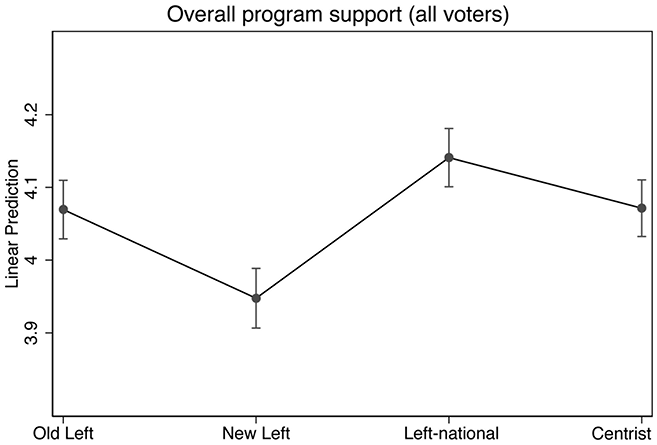
Support for four social democratic programmatic strategies among the potential social democratic electorate (sample: all voters with a propensity to vote (ptv) social democratic >5 and/or left–right self-positioning <5).
Data: Abou-Chadi et al. (Reference Abou-Chadi, Häusermann, Mitteregger, Mosimann and Wagner2022).
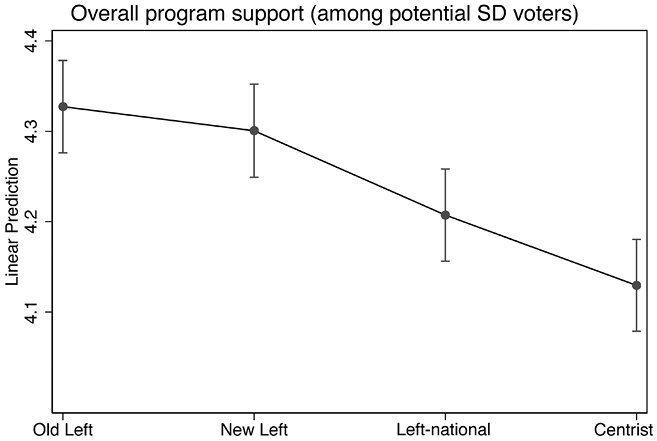
At first glance, these findings suggest that there might indeed be a very large “demand” for a Left National programmatic strategy. However, Figure 9.2 then shows that these patterns do not adequately reflect the attitudinal profile of potential social democratic voters. We define potential social democratic voters as those who fulfill one (or both) of the following conditions: (a) They indicate a voting propensity of 5 or higher for the social democratic party (on a scale from 0 to 10 for voting propensities). While voting propensities necessarily introduce a certain level of endogeneity to the analysis, we think that the propensity to vote (ptv) score captures whether a voter would in general seriously consider voting for this party family. (b) We add to this group all voters who self-position at a level below 5 on an ideological scale ranging from 0 (left) to 10 (right). We define the potential social democratic electorate in this very broad way in order to include also voters who self-position on the left but may disagree with the situational, current orientation or leadership of the social democratic party. Our definition of the potential social democratic electorate thereby encompasses 54% of the entire sample.
Figure 9.2 then clarified that the relatively stronger support for the Centrist Left and Left National programs as observed in Figure 9.1 stems to an overwhelming degree from responses by voters who are outside the potential electorate for the social democratic party. Among potential social democratic voters, however, New Left and Old Left programs are clearly more strongly supported than Left National and Centrist Left programs. This patterns again broadly holds across country contexts. However, we do see differences that are consistent with what we know about the more strongly realigned social democratic electoral potentials in Austria, Switzerland, and Sweden, as opposed to Germany and Spain (see Chapter 1 for a presentation and discussion of the different distributions of social democratic voting propensities across these countries). In the former three countries, New Left programs receive the strongest levels of support among the potential social democratic electorate, while Old Left programs are most favorably evaluated in Germany and Spain. Only in Denmark do we see indistinctive levels of support for all four programmatic orientations, with no significant differences in the levels of support. The main point here, however, is that the patterns of programmatic preferences look quite different when we focus on the electorate overall, as compared to the potential social democratic voters. Hence, average support levels for Centrist Left and Left National orientations may give an erroneous impression about the likely payoffs of such strategies, given that we know that electoral markets are segmented (Bartolini and Mair Reference Bartolini and Mair1990; Bornschier Reference Bornschier2010) and that voters tend to choose parties not across the entire spectrum but from a predefined “consideration set” (Oscarsson and Rosema Reference Oscarsson and Rosema2019).
The fact that Old and New Left programs resonate most strongly with voters in the broadly left spectrum of the electorate is also confirmed when we predict program rating by left–right self-positioning. Figure 9.3 shows how ideological self-positioning relates to support for program orientations in the full sample. The figure also includes the relevant information about the distribution of voters in the ideological spectrum, both for all voters and for potential social democratic voters. Only the combination of the estimated support and the distribution of voters allows us to gauge likely payoffs of different strategies. Very clearly, one can see that potential social democratic voters are predominantly situated in the center-left ideological spectrum, and we can see that both Old and New Left programs on average receive distinctively more support in this section of the electorate than Centrist Left and Left National social democratic programs (remember that our vignettes define even these more conservative programs in ways that are still consistent with generally moderate or left-wing positions on all issues). We also observe that the New Left program polarizes slightly more than the Old Left program, a finding that will be corroborated across country contexts in the comparative analyses in Section 9.4.2. On the other hand, both Centrist Left and Left National program receive similar levels of support in the center of the ideological spectrum, as well as clearly on the right.
Support for four social democratic programmatic strategies by left–right self-positioning (sample: all voters except ptv social democratic = 0)
Data: Abou-Chadi et al. (Reference Abou-Chadi, Häusermann, Mitteregger, Mosimann and Wagner2022).
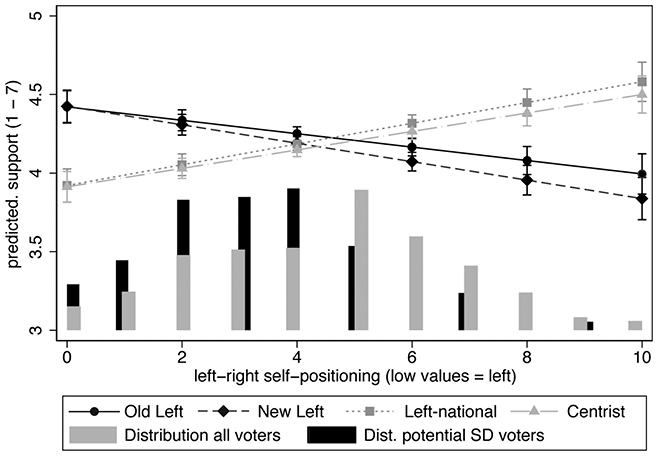
We continue the abovementioned analysis with a focus on more specifically defined groups in terms of attitudes. We thereby look at the economic dimension of attitudes and the sociocultural dimension of attitudes, because academic and political debates oftentimes focus on an alleged dilemma that might emerge between Old and New Left strategic appeals: They debate the question whether social democratic parties should either try to appeal to voters with more radically left-wing economic positions on redistributive and regulative issues, or whether they should rather appeal to a culturally progressive electorate. The assumption is that voters who are economically strongly to the left might be alienated by a focus on New Left (so-called identity politics) appeals, while culturally progressive voters may resent a too radical economically left-wing program.
Our analyses in Figures 9.4 and 9.5 show that there is no trade-off between these two programmatic options from the perspective of voters: Both economically and culturally progressive attitudes clearly predict support for both Old and New Left strategies. Figure 9.4 in particular underlines that economically progressive (i.e., radical left) voters also support New Left programs, while showing somewhat lower levels of support for Left National programs (which – importantly – are equally progressive economically, and deviate only to the more conservative side on sociocultural issues) and clearly lowest levels of support for (economically) Centrist Left programs. In all countries, Old or New Left options receive the highest levels of support. The weakest support for Centrist Left orientations holds in all countries. Only in Denmark and Germany is the difference in support for the New Left and Left National option (as second ranked) not significant. These analyses defy the widespread narrative that economically left-wing voters are alienated by New Left policy positions. Quite the contrary: Economic leftist voters are on average even the staunchest supporters of New Left programmatic orientations in Austria, Switzerland, and Spain.
Support for four social democratic programmatic strategies by position on the economic dimension (sample: all voters except ptv social democratic = 0)
Data: Abou-Chadi et al. (Reference Abou-Chadi, Häusermann, Mitteregger, Mosimann and Wagner2022).
Support for four social democratic programmatic strategies by position on the cultural dimension (sample: all voters except ptv social democratic = 0)
Data: Abou-Chadi et al. (Reference Abou-Chadi, Häusermann, Mitteregger, Mosimann and Wagner2022).
We also see that economic attitudes polarize less when it comes to programmatic preferences than sociocultural attitudes, by comparing Figures 9.4 and 9.5. Figure 9.5 shows the same analysis for sociocultural programmatic preferences. Again, Old and New Left programs both garner the highest levels of support among the culturally left-wing voters, among which most potential social democratic voters can be found. Here, the New Left orientation comes out on top, a finding that holds in all countries (only in Germany and Spain does the Old Left orientation receive the same level of high support among culturally very progressive voters as the New Left orientation). A key finding from Figure 9.5, however, refers to the polarizing effect of both New Left and Left National programs depending on cultural attitudes: The New Left program is least supported among culturally conservative voters (consistent in all countries), whereas the Left National program comes out on top. The strong polarization around the Left National program is of particular relevance, as it highlights that such a program seems to appeal mainly to voters outside of the social democratic potential and that it implies the risk of alienating large shares of voters within this potential.
The analysis so far has focused on the levels of support for different social democratic programs in the overall electorate and among subgroups defined by attitudinal profiles. However, the payoff of a programmatic strategy not only depends on the support level but also on the question whether voters – and which voters in particular – would indeed choose the social democratic version of a particular program when compared to the relevant competitor party. In other words, even though we know that many economically left-wing voters show high support for a New Left program, the question is whether they would really prefer a New Left social democratic party if voting for a green and left-libertarian party is also an option? In this final section, we ask precisely this question, predicting choices between matched party vignettes based on the party profiles interacted with the same attitudinal variables as mentioned earlier.
For this analysis, we presented respondents with two vignettes to choose from: One was a fixed “competitor” program (Green Left, Radical Left, Moderate Right, or Radical Right, see Table 9.2), while the other one was either the “matched” social democratic variant (respectively, New Left, Old Left, Centrist Left, or Left National, see Table 9.1) or a program randomly composed from all the possible programmatic elements within the realm of the social democratic programs. We did tell respondents that one of those was a social democratic program, but neither of these two programs were explicitly labelled in terms of a party. Hence, the respondent did not know which of the vignettes was supposed to refer to the social democratic profile and which one to the competitor. We asked respondents to indicate which of the two programs they would prefer. Each respondent saw four comparisons.
This design allows us to compare the probabilities of choosing the matched social democratic program over the competitor program to those of choosing a random social democratic program over the competitor program. In intuitive and substantive terms, this means that we can evaluate whether and how much the particular programmatic profile of a social democratic party matters for voters’ choice between the social democratic option and the “original.” If the choice probabilities between the random and the competitor programs differ from the choice probabilities between the specific and the competitor program, programmatic appeals indeed matter and there is actual competition on these programmatic grounds. If they do not, then the actual programmatic choices by social democratic parties seem much less relevant (because voters may go for the “original” in any case or because the social democratic party may not even belong to their consideration set). Our estimations again exclude those respondents indicating a voting propensity of 0 for Social Democrats.
We present the findings separately for the four competing party families. Since there are too many possibilities of comparison to show them all, we show only the theoretically most interesting ones and discuss the others in the text. These are the key findings: Our estimates show that the New Left and Old Left party strategies indeed manage to increase the chances for social democratic parties to be chosen compared to their green left and radical left competitors both among culturally and economically progressive voters. When competing with moderate right or radical right parties, however, it does not seem to make as strong a difference whether the Social Democrats propose any (random) program or the specifically matched profile: Regardless of the particular programmatic profile of the social democratic vignette, economically and culturally more conservative voters generally prefer the moderate and radical right options over the Social Democrats anyway. This finding reinforces the abovementioned findings according to which the chances of attracting new voters seem much better among center-left voters than among the more conservative parts of the electorate.
We start with the choice between a green and left-libertarian and a social democratic party. For this comparison, we are interested whether progressive voters would indeed be more likely to choose the social democratic party over a green and left-libertarian party if the social democratic party were to propose a New Left program. For this comparison, both the behavior of socioculturally left-wing voters (the core electorate of the green and left-libertarian parties) and of economically left-wing voters (potential gains within the left field) are of relevance. Figure 9.6 shows the estimates for these two groups side by side. For economically left-wing voters (Figure 9.6(a)), the probability of choosing a social democratic party as opposed to the Green Left increases well beyond 50% in case of a New Left program. These voters are then more likely to vote social democratic than Green Left, whereas their propensity to vote social democratic remains around 50% for a random social democratic program. Among culturally progressive voters (Figure 9.6(b)), the New Left program is also much more attractive than a random social democratic program. However, among these voters the green and left-libertarian party always remains the first choice, even if the social democratic competitor “emulates” its program.
Social Democrats vs. Green Left: predicted probabilities of choosing the social democratic party over the green and left-libertarian option by attitude (sample: all voters except ptv social democratic = 0)
Data: Abou-Chadi et al. (Reference Abou-Chadi, Häusermann, Mitteregger, Mosimann and Wagner2022).
Figure 9.7 presents the same estimations for the comparison between social democratic and radical left programs, again focusing on voters on the left of the ideological spectrum. We turn first to economically left-wing voters (Figure 9.7(a)). Among these voters, an Old Left program is much more popular than a random social democratic program, and the probability for it to be chosen lies well above 50%. Among voters with strongly progressive cultural attitudes, an Old Left program resonates in general less strongly but is still clearly preferred to a random social democratic program. This is important, as it illustrates that culturally progressive voters also support economically very left-wing programs rather than centrist policy appeals (given that a randomized social democratic program is by definition more moderate than the Old Left program).
Social Democrats vs. Radical Left: predicted probabilities of choosing the social democratic party over the radical left option by attitude (sample: all voters except ptv social democratic = 0)
Data: Abou-Chadi et al. (Reference Abou-Chadi, Häusermann, Mitteregger, Mosimann and Wagner2022).
Figures 9.8 and 9.9 show that positional accommodation in terms of a “matched” program much less strongly affects the choice between a social democratic and a moderate right or radical right program. Here, we again focus on the voters these programs are most likely meant to appeal to. For the Moderate Right, this means looking at voters at or near the center on either economic or sociocultural issues. Among voters with average or slightly progressive attitudes, a Centrist Left social democratic program is slightly preferred slightly to a random social democratic program, but the difference is much less pronounced than in the previous figures. Overall, centrist voters have relatively high propensities to vote for social democratic parties anyways, irrespective of whether they propose a clear Centrist Left program or any program. The choice between Moderate Right and Left therefore seems mostly predetermined for both dimensions of political conflict and possibly also strongly affected by other variables such as competence attributions or party identification. Overall, however, choices for or against this competitor depend comparatively less on the programmatic offer made by Social Democrats, and there seems relatively little to gain or lose via specific targeted programmatic appeals.
Social Democrats vs. Moderate Right: predicted probabilities of choosing the social democratic party over the moderate right option by sociocultural attitude (sample: all voters except ptv social democratic = 0)
Data: Abou-Chadi et al. (Reference Abou-Chadi, Häusermann, Mitteregger, Mosimann and Wagner2022).
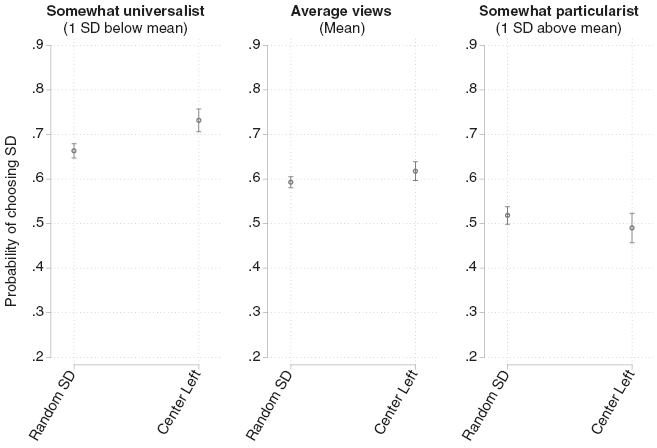
Social Democrats vs. Radical Right: predicted probabilities of choosing the social democratic party over the radical right option by attitude (sample: all voters except ptv social democratic = 0)
Data: Abou-Chadi et al. (Reference Abou-Chadi, Häusermann, Mitteregger, Mosimann and Wagner2022).
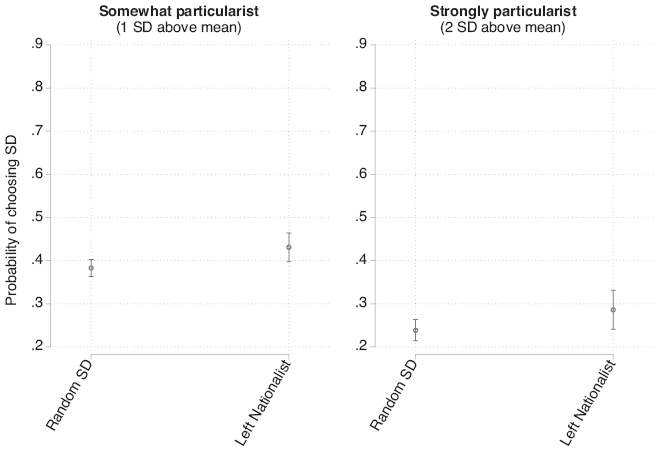
Finally, for the Radical Right, we focus on voters who are either moderately or decidedly conservative regarding sociocultural issues. Figure 9.9 shows that a Left National program barely affects choice for the social democratic parties among culturally conservative voters, that is, the key constituency this program is meant to appeal to. Culturally conservative voters overall have a very low probability to vote for a social democratic program. A specific Left National appeal increases this probability slightly but only among more moderately conservative voters. However, the probability of choosing the social democratic option never reaches 50% and is even below 30% among voters with clearly conservative attitudes. For them, the specific program social democratic parties propose do not seem to make a difference, at all.
9.4.2 Comparative Perspective
We conclude our empirical analysis with a comparative perspective across the different country contexts in our study. As shown and discussed in Chapter 1, earlier strategic positionings and choices as well as country-specific dynamics of party competition have created different contexts for social democratic parties in terms of their current electorates, as operationalized through voting propensities. In Austria, Switzerland, and Sweden, voting propensities for the social democratic parties are clearly and almost linearly linked to left self-placement, as well as to both economically and culturally progressive attitudes. In these countries, social democratic parties and their voters have realigned at the opposite pole of radical right parties. In Germany and Spain, on the other hand, the highest propensities to vote social democratic are found among centrist and left-of-center voters. Hence, the social democratic parties in these countries appeal more to voters with more moderate ideological profiles, and it seems that these parties are perceived as more centrist by voters. By contrast, voters with clearly progressive economic attitudes are less likely to vote social democratic. Finally, Denmark presents a somewhat different picture, as well, but rather with regard to the cultural ideological dimension. As in Germany and Spain, the propensity to vote social democratic is highest among moderately left-of-center voters, but the striking observation is that cultural attitudes do not correlate clearly with social democratic voting propensity: Both progressive and more centrist voters report similar levels of support for the social democratic party. One might think that the very recent shifts of the Danish Social Democratic Party program are at the root of this pattern, since it has moved strongly to the center on both economic and – in particular – cultural positions.
Figures 9.10 and 9.11 show that this differential orientation of social democratic parties across countries is consistently reflected in the extent to which ideological dimensions relate to support for particular strategic profiles, and in the extent to which these strategies polarize the electorate. Figure 9.10 strikingly illustrates how strongly realigned the party competition in Austria, Switzerland, and Sweden is: Support for New Left and Old Left programs strongly increases with left self-positioning, while support for Centrist and Left National programs decreases with left self-positioning. In other words, only voters who self-define as “right-wing” support Centrist Left and Left National programmatic profiles and show decidedly lower support for the Old and New Left programs. However, in those ranges of the ideological spectrum where most potential social democratic voters concentrate, support for Old and New Left programs is clearly highest. This not only implies that social democratic parties in these countries may be unable to appeal to more center-right voters, at all, but it also implies that Centrist Left and Left National appeals may alienate large parts of their potential electorate.
Support for different social democratic programmatic strategies by left–right self-positioning (sample: all voters except ptv social democratic = 0), Austria, Switzerland, and Sweden
Data: Abou-Chadi et al. (Reference Abou-Chadi, Häusermann, Mitteregger, Mosimann and Wagner2022).
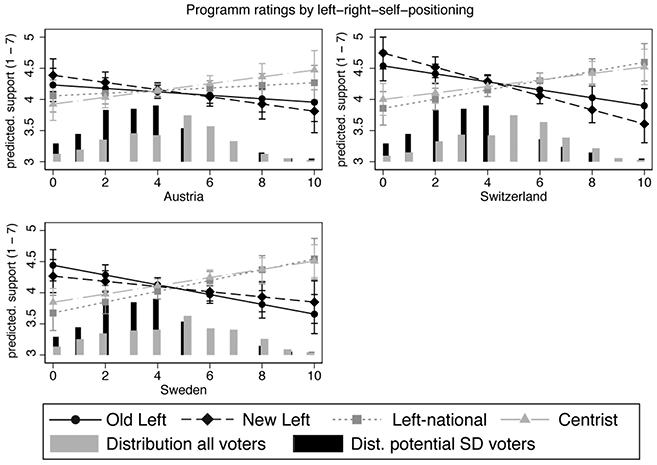
Support for different social democratic programmatic strategies by left–right self-positioning (sample: all voters except ptv social democratic = 0), Germany, Spain, and Denmark
Data: Abou-Chadi et al. (Reference Abou-Chadi, Häusermann, Mitteregger, Mosimann and Wagner2022).
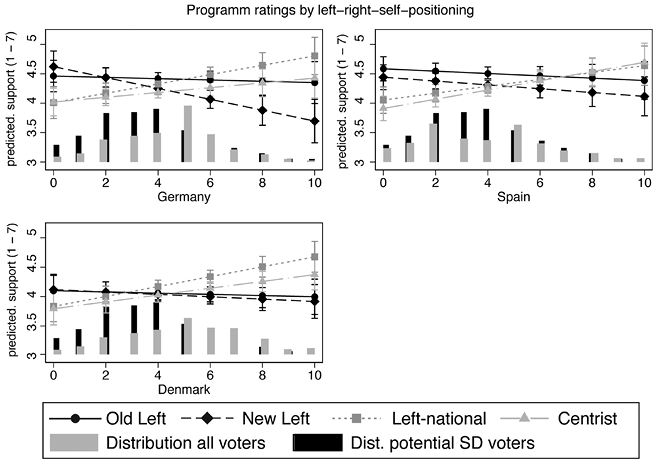
By contrast, left–right self-placement polarizes much less in Germany and Spain (Figure 9.11). In these countries, Old Left programs enjoy overall highest support, across the ideological spectrum. Moreover, left–right self-positioning differentiates more strongly between New Left and Left-National programs than between Old Left and Centrist programs. Overall, the findings for Germany and Spain show that support for an Old Left programmatic orientation is particularly strong in the electorate, including in those parts where the share of social democratic voters is very high. Finally, we again see a somewhat different pattern in Denmark: Most potential social democratic voters have relatively indistinctive preferences between the four party strategies. However, the Left National program is clearly more strongly preferred only among right-wing voters. It is unclear to date if this finding reflects a more fundamental and permanent blurring of a social democratic programmatic profile, or if it reflects a temporary uncertainty about the position and direction the social democratic party is going to follow in the future.
9.5 Conclusions
This chapter’s key contribution is to empirically test the appeal of four ideal-typical social democratic programs. Using a survey vignette design implemented in six countries, we provide new and innovative evidence on the social democratic party profiles that voters find attractive. A first key finding is that Old and New Left party profiles are the most popular profiles among potential social democratic voters. Ideologically, potential social democratic voters are located left of the center, with economically and culturally progressive views. Across the electorate as a whole, Left National and Centrist Left programs are more popular, but we argue and show that the overall popularity of these more conservative programmatic strategies may be less relevant for strategic decisions of social democratic parties, because social democratic parties are outside the “consideration sets” of most conservative voters anyways (both economically and socioculturally). We underline this finding by showing that right-wing voters are generally less responsive to targeted social democratic appeals, that is, a Centrist Left or Left National program does not increase the chances of these voters actually choosing social democratic parties over moderate right or radical right parties. By contrast, we find that New Left and Old Left programs indeed make a difference among left-wing voters’ choice, also compared to radical left or green left programs. Importantly, we find several consistent pieces of evidence that show that economically left-wing voters also strongly support culturally progressive programmatic appeals and vice versa.
These results point to several important lessons. First, the electoral potential of social democratic parties is on the economic and cultural left, rather than only on the economic left. Relatedly, presenting New or Old Left programs creates significant potential for appealing to voters within the electoral potential, while Centrist Left strategies seem largely ineffective, and Left National strategies even seem to generate strong trade-offs or negative payoffs: They are likely to alienate more voters on the cultural and economic left than they newly attract to social democratic parties from the cultural or economic right. Overall, what stands out is the appeal of New and Old Left programs over Centrist Left or Left National alternatives. This also means that there is no apparent trade-off between New and Old Left programmatic options: Both economically and culturally progressive attitudes clearly predict support for both Old and New Left strategies.
One unique aspect of our results is that we can present findings for six countries. While the findings as summarized above broadly hold across these six contexts, it is clear that some countries – here, Austria, Switzerland, and Sweden – show a stronger connection between economic and cultural positioning, with New Left programs being particularly popular (and polarizing across the entire spectrum). In Germany and Spain, social democratic support is still more traditional (i.e., highest for Old Left appeals), while in Denmark, Centrist Left and Left National programs are comparatively more appealing to potential social democratic voters than in the other countries.
Overall, our chapter has attempted to highlight the benefits of using an experimental approach to study potential voter support for ideal-typical social democratic programs. Our approach underlines the importance of distinguishing between the general popularity of different policy programs and the popularity of these programs among voters who might conceivably vote for the Social Democrats. These are distinct groups, and different programs appeal to each. When it comes to vote-seeking strategies, all parties – including social democratic ones – may need to consider which voters they can realistically appeal to and which are essentially out of reach. A second implication of our findings is that the often-cited conflict between economic and cultural goals among Social Democrats (a so-called redistribution vs. recognition trade-off) may be overblown. Instead, what seems most relevant for voter decisions is that Social Democrats pursue a program on the ideological left.


 Open access