INTRODUCTION
Although the spatial systems of all languages make a number of basic distinctions, they also display wide variations (Weissenborn & Klein, Reference Weissenborn and Klein1982; Levinson, Reference Levinson, Gumperz and Levinson1996; Talmy, Reference Talmy2000; Bowerman, Reference Bowerman, Aurnague, Hickmann and Vieu2007; Grinevald, Reference Grinevald, Hickmann and Robert2006). For example, all languages differentiate static and dynamic situations, motion events that do or do not imply location changes, different aspects of path or manner, and whether motion is voluntarily carried out by an agent or caused by an external force. However, they also highlight different dimensions, rely on different reference systems, and provide different lexical or grammatical means of expressing motion and location. A growing number of studies have examined the implications of this cross-linguistic variability for language acquisition, resulting in a debate that opposes two main views. The first one postulates that language partially structures language acquisition and other forms of cognitive organization (Slobin, Reference Slobin, Gumperz and Levinson1996; Bowerman & Choi, Reference Bowerman, Choi, Gentner and Goldin-Meadow2003; Levinson, Reference Levinson, Gentner and Goldin-Meadow2003). The second view argues that language-specific factors have no significant impact on cognition beyond language use itself (Clark, Reference Clark, Gentner and Goldin-Meadow2003; Munnich & Landau, Reference Munnich, Landau, Gentner and Goldin-Meadow2003; Landau & Lakusta, Reference Landau, Lakusta, Hickmann and Robert2006). In the context of this debate, the research presented below examines how children express motion in French and English.
Motion across languages
Talmy (Reference Talmy2000) proposes a typological contrast between satellite- vs. verb-framed languages (hereafter S- vs. V-languages, e.g. Germanic vs. Romance). Thus, speakers typically use manner verbs and path satellites in English, as shown in (1), but path verbs and peripheral manner markings in French (e.g. adverbial expressions, subordinate clauses), as shown in (2).
(1) to walk up, down, across, away, back, into, out of …
(2) monter, descendre, traverser, partir, revenir, entrer, sortir … en marchant/à pied.
‘to ascend, descend, cross, leave, return, enter, exit … by walking/on foot.’
These properties correspond to strong paradigms that run through the language of motion. Three further points should be noted. First, this typological contrast concerns a large but distinct set of events, mostly those implying changes of location. Although displacements in space intrinsically involve kinesis, all languages mark some of these events as implying a state change (resulting location) and others as not implying such a change (motion within a general location). For example, (3) implies that John was somewhere at one point in time and somewhere else subsequently, while (4) does not make such a commitment (notwithstanding possible inferences from context). French manner verbs are typically used as in (4) with general locations (main verb), but as in (3) with location changes (subordinate clauses).
(3a) John ran away.
(3b) Jean est parti en courant. John has left by running ‘Jean left by running.’
(4a) John ran.
(4b) Jean a couru. John has run. ‘John ran.’
Second, a major feature of S-languages is the existence of path particles, typically absent from V-languages (e.g. English up vs. French monter ‘to ascend’). However, French also displays a system of verbal prefixes, which partially function like satellites (Kopecka, Reference Kopecka2004, Reference Kopecka, Hickmann and Robert2006, Reference Kopecka, Cuyckens, De Mulder and Mortelmansin press). For example, the verbs in (5) all contain Latinate prefixes (a, ex, in, trans) that mark spatial and/or temporal–aspectual meanings when combined with particular verb roots. These prefixes are diachronic remnants of an earlier satellite-framed system, suggesting that French is now a ‘mixed’ system combining satellite- and verb-framing properties. As noted by Kopecka (Reference Kopecka2004), however, this satellite-framed subsystem has considerably reduced over centuries and it is now quite limited and unproductive, allowing few permissible combinations among a small set of prefixes and verbs. A few of the roots in these verbs can stand as autonomous lexical entries (e.g. courir ‘to run’ in accourir) and most are derived from other forms but do not constitute independent verbs (e.g. in atterrir the form -terrir does not exist as a verb and is derived from the noun terre ‘earth’). Although mixed, contemporary French is primarily verb-framed with a reduced secondary satellite-framed subsystem.Footnote 1
(5) accourir (‘run quickly to’), atterrir (‘land’), écrémer (‘take cream off’), émigrer/immigrer (‘emigrate/imigrate’), emboîter (‘fit into’), transcrire (‘transcribe’)
Third, although Talmy's typology captures the most prototypical means of expressing changes of location, these are by no means the only possible ways of expressing these events. For example, some Latinate borrowings lexicalize path in English verbs (to exit, to ascend) and some French verbs lexicalize manner and path (grimper ‘to climb up’, dévaler ‘to descend quickly’).Footnote 2 In addition, some French-like structures are grammatical in English (path verb and peripheral manner devices in (6)) and some English-like structures are grammatical in French (manner verb with peripheral expressions in (7)). However, these additional options are semantically, pragmatically and/or structurally more marked than those in (2) above. For example, they correspond to a particular register (English ascend, French dévaler, also see footnote 2) or suggest emphasis on a particular manner, path and/or resulting state (e.g. sliding in (6) and running in (7) are unusual manners of motion in these contexts).
(6) Peter fell on the ice … He crossed the entire intersection sliding on his bottom.
(7) Pierre était très en retard Il a couru à toute vitesse jusqu'à l'école. Pierrewasvery in delay …Hehasrunat all speed until atthe school.' ‘Pierre was very late … He ran at all speed all the way to school.’
In summary, each language provides a range of grammatical options to represent motion, but typological factors partially determine which of these options are least marked in meaning or least structurally complex, so that these options become most accessible and are more readily used. In English (S-language) descriptions of voluntary location changes prototypically lexicalize manner in verbs together with path satellites within the same clause. In French (V-language) they prototypically lexicalize path in verbs, to which peripheral manner information may be added, such as adverbials within the clause or subordinated verbs in more complex structures. We now turn to developmental research that has begun to examine the potential implications of this variability for first language acquisition.
Motion in first language acquisition: Universal and language-specific determinants
Studies examining children's prelinguistic spatial knowledge and/or their subsequent acquisition of spatial language (see a review in Hickmann, Reference Hickmann2003) provide different views of development that highlight either universal or language-specific determinants. Some view spatial knowledge as the result of universal determinants, either based on innate ‘core’ knowledge (Spelke, Reference Spelke1994, Reference Spelke1998, Reference Spelke, Gentner and Goldin-Meadow2003) or driven by universal perceptual/cognitive processes (Mandler, Reference Mandler1988, Reference Mandler, Damon, Kuhn and Siegler1998). In contrast, cross-linguistic differences show that children's spatial language resembles more the adult input they receive than the language produced by same-aged children learning other spatial systems, indicating that language-specific factors have an impact on language acquisition (Allen et al., Reference Allen, Özyürek, Kita, Brown, Furman, Ishizuka and Fujii2007; Berman & Slobin, Reference Berman and Slobin1994; Bowerman, Reference Bowerman, Gumperz and Levinson1996, Reference Bowerman, Aurnague, Hickmann and Vieu2007; Bowerman & Choi, Reference Bowerman, Choi, Bowerman and Levinson2001, Reference Bowerman, Choi, Gentner and Goldin-Meadow2003; Choi & Bowerman, Reference Choi and Bowerman1991; Hickmann, Reference Hickmann2003; Hickmann & Hendriks, Reference Hickmann and Hendriks2006; Hickmann, Hendriks & Roland, Reference Hickmann, Hendriks and Roland1998; Slobin, Reference Slobin, Strömqvist and Verhoeven2003, Reference Slobin, Hickmann and Robert2006).
With respect specifically to motion, comparative studies (Bowerman, Reference Bowerman, Gumperz and Levinson1996, Reference Bowerman, Aurnague, Hickmann and Vieu2007; Choi & Bowerman, Reference Choi and Bowerman1991) of early spontaneous productions show that children from two years on focus on different dimensions depending on their language. For example, following the adult system, young learners of English (S-language) use path particles when expressing all motion events, whereas learners of Korean (V-language) learn a great variety of verbs distinguishing caused and voluntary motion. Utterances about motion in narratives (Berman & Slobin, Reference Berman and Slobin1994; Slobin, Reference Slobin, Gumperz and Levinson1996, Reference Slobin, Strömqvist and Verhoeven2003, Reference Slobin, Hickmann and Robert2006) also show that manner information is more salient for speakers of S-languages (English, German, Turkish), who focus on details of motion and presuppose locations, while V-speakers (Spanish, Hebrew) provide detailed scene-settings and less information about motion. These results can be observed from age three on, notwithstanding some developmental progressions, such as an increasing concern with providing information about sources and goals (Berman & Slobin, Reference Berman and Slobin1994). According to Slobin (Reference Slobin, Strömqvist and Verhoeven2003), cross-linguistic differences result from lexicalization patterns across languages. Although path information is most basic in all languages, for example for the purposes of locating mobile entities, additional manner information is more salient in S-languages (where it is lexicalized in verb roots) than in V-languages (where it is expressed peripherally).
The spatial system of French has been described in some detail, but little information is available concerning motion in French child language. Recent studies do indicate that children's speech about motion follows the pattern expected for V-languages. One study (Hickmann & Hendriks, Reference Hickmann and Hendriks2006) concerning descriptions of caused motion (adults and children of three to six years) showed that spatial information was frequently expressed in French verbs but in English satellites, and that verbs focused on different types of information, e.g. manner of causing motion in English (to push into) and manner of attachment in French (accrocher Lit. ‘to hook’, ‘to put on a hook’, see footnote 1). Developmental progressions also occurred in both languages, showing that children expressed increasingly more spatial information with age. In addition, French children at first used more prepositional phrases than adults, but increasingly more specific verbs as they gradually acquired the verbal lexicon.
Two other studies showed that English vs. French descriptions of motion differed in semantic density. A longitudinal study of early spontaneous productions (Hickmann, Hendriks & Champaud, Reference Hickmann, Hendriks, Champaud, Guo, Lieven, Budwig, Ervin-Tripp, Nakamura and Özçaliskan2008) found that from two years on English learners encoded more information within each clause, e.g. manner+path (run away), cause+manner (fly a kite) or cause+path (put down). In contrast, French learners tended to focus on one piece of information at a time (e.g. manner voler ‘to fly’, path monter ‘to ascend’, cause mettre ‘to put’). Analyses of narratives (Hickmann, Hendriks & Roland, Reference Hickmann, Hendriks and Roland1998; Hickmann, Reference Hickmann2003) produced in French vs. three S-languages (English, German, Chinese; four to ten years, adults) showed that, notwithstanding developmental progressions in all languages, descriptions of motion were denser and more diverse at all ages in S-languages than in French. S-speakers used a large set of manner verbs and combined them productively with satellites (up to five), thereby encoding simultaneously several types of information within their utterances (e.g. to fly from … up … to …, to run down … away from …, to pull down … to …). In contrast, French speakers used a small set of verbs that typically focused on one type of information at a time (e.g. courir ‘to run’, monter ‘to ascend’). As a result, descriptions of motion were less detailed and less dense in French, although two notable exceptions occurred: some complex constructions were used by adults and ten-year-olds (e.g. partir en courant ‘to leave by running’; faire descendre ‘to make descend’); at all ages some verbs lexicalized manner and path information (e.g. s'envoler ‘to fly off’, grimper ‘to climb up’).
The two experiments described aimed at further examining the impact of typological factors on the acquisition of spatial language by comparing how French vs. English children (three to seven years) and adult control groups described voluntary motion in more controlled settings. Several types of ‘target’ stimuli showed motion that took place up/down (Experiment I) and across (Experiment II), as well as arrivals and departures (analyzed qualitatively in both experiments). These events were most basic, familiar to children and easy to manipulate. As described below, they also involved relevant manner and path information implying typologically contrasted English vs. French descriptions. Another set of ‘control’ events maximally highlighted manner and was meant to focus participants' attention on this information (no expected typological contrast). Several hypotheses were tested concerning responses expressing both manner+path (MP) rather than either one alone (M, P).
First, given how stimuli were designed, more MP-responses were expected overall with targets than with manner-oriented controls (expected to elicit M-responses in all groups). Second, it was predicted that manner should be more salient in English (where it is lexicalized in main verb roots) than in French (where it is peripheral to main path verbs). This prediction applied only to targets, where the expected patterns were MP for English and P for French. An interaction between language and event type was therefore predicted, such that MP-responses should differ across languages with targets (English>French), but not with controls (English=French). Third, this language effect on responses to targets was expected to occur among adults and children, but it was also expected that more information would be expressed with increasing age in both languages. An interaction was therefore predicted between age and event type, such that MP should increase with age for targets (adults>children), but not for controls. A final more exploratory hypothesis followed from the existence of some common French verbs lexicalizing manner+path. Since such a verb was only available for upward motion in the present study (see footnote 2), it was expected that French MP-responses should be more frequent with these targets (especially French up>down, English up=down).
EXPERIMENT I: DISPLACEMENTS UP AND DOWN
METHOD
Participants
The experiment included 200 French and English participants, who were seen in the schools or universities of Cambridge and Paris. There were five age groups within each language: adults and children of about three, four, five and seven years (twenty per group, see Table 1).
Participants in Experiment I

Materials
Two sets of six short animated cartoons were constructed from coloured drawings (see Appendix 1). In the first set (up/down targets) an animal moved toward a vertical ground referent, then up and down this referent, and away. Motion to and away from the ground occurred from left to right or the reverse. Manner of motion was either the same throughout (e.g. a squirrel runs to a tree, up/down the tree, and away) or varied with successive motion events (e.g. a mouse tiptoes to a table, climbs up, slides down, tiptoes away). For each target a second version (control items) showed the same character moving forward against a blank screen in a particular manner throughout. Controls showed the very same animation that took place during departure in targets with the background removed.Footnote 3 In contrast to targets, in which manner and path were both relevant, control items maximally highlighted manner in order to focus participants' attention on this information (expected M-responses). Control items had two aims: (a) to ensure that participants could produce manner verbs when they had not spontaneously done so with targets; and (b) to test the hypothesis that language and age effects should occur with one set of events (targets), but not with the other (controls).
Procedure
Participants were tested individually and saw cartoons on a computer screen. They were randomly assigned to ten presentation orders: targets were presented before or after controls and items within each set were presented in five random orders (orders TC1–5 and CT1–5). Participants were asked to narrate events as completely as possible. Children were introduced to a doll and were asked to blindfold her as part of a ‘secret-telling’ game, in which they had to tell her everything that had happened because she could not see. Adults addressed a future naive addressee who would have to reproduce the stories on the basis of the recordings alone. This procedure ensured that participants produced full descriptions. Two training items ensured that they understood the task. The entire session was audiotaped and transcribed.
Coding
A straightforward coding scheme was applied to all responses (95% reliability across two coders).Footnote 4 All responses were segmented into clauses (main as well as subordinate) and coded with respect to all linguistic devices expressing manner and/or path (verbs, particles, prepositions, adverbial phrases). Two main analyses are presented below. A global analysis first focuses on the entire utterance, irrespective of how manner and path were encoded. A specific analysis then examines which devices expressed this information.
Responses fell into three main global types, depending on whether they expressed only manner (M-responses, He's running), only path (P-responses, He goes down) or both (MP-responses, He climbed up the tree; He ran down). A residual class included ambiguous cases (e.g. to go with no further specification) and rare event omissions (overall 4% down, 1% up, none for controls). Manner was coded regardless of how precisely it was expressed (e.g. to walk for crawling). Global types did not distinguish how many M or P devices were used (e.g. in (8) crept[M] back[P] down[P] was coded as MP). Coding disagreements concerned some French expressions, e.g. à gauche marks location (être/courir à gauche ‘to be/run on the left [side]’), notwithstanding possible inferences about path that may stem from its combination with a motion verb. In comparison, unambiguous expressions mark either location or path (courir sur/vers la gauche ‘to run on/towards the left’ [M-/MP-responses]). Examples (8) to (11) show five-year-olds' responses to a target event and its corresponding control item (T5 and C5 in Appendix 1, see main coding features in Appendix 2), particularly (as shown in bold): MP-responses for up/down and for departure in English (8); P-responses for up/down and for arrival in French (9); M-responses for controls in (10) and (11).
(8) That mouse was creeping up the table to get the whole thing of cheese and he crept back down and went out of the house by creeping.
(9) La souris, elle vient, elle monte sur la table, elle pique le fromage, elle redescend.
[‘The mouse, it comes, it ascends on the table, it steals the cheese, it descends again.']
(10) The mouse is walking.
(11) Une petite souris, elle marche.
[‘A little mouse, it's walking.’]
RESULTS
Global analysis: Manner+Path vs. other responses
The analyses were based on responses expressing both manner and path (MP-responses were attributed the score of 1). A mixed ANOVA (with Age and Language as between-subject factors, and with Event-type and Item as within-subject factors) examined the effects and interactions of the following factors on raw MP-scores: Age (five groups of twenty subjects each), Language (English, French), Event Type (up, down, control) and Items (six per event type). The following results were expected: (a) a main effect of event type, such that in all age and language groups MP-responses should occur with targets (up and down) and not with controls (M-responses expected); (b) an interaction between language and event type, particularly a language difference with target events (English>French), but not with control events (English=French); (c) an interaction between age and event type, such that MP-responses should increase with age in both languages with targets, but not with controls; and (d) in French (but not in English) MP-responses were expected to be more frequent at all ages with upward motion than with downward motion (for which P-responses were expected).
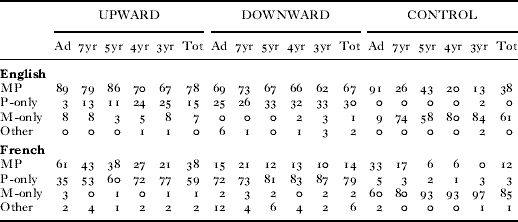
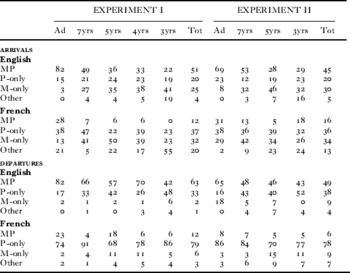
Results are shown in Table 2 (percentages of all response types) and in Figure 1 (percentages of MP-responses). The ANOVA showed significant main effects of Language (F(1, 190)=256·25, p=0·0001, ηp2=0·574, Age (F(4, 190)=18·18, p=0·0001, ηp2=0·277), and Event Type (F(2, 380)=102·02, p=0·0001, ηp2=0·349). MP-responses were more frequent in English (61%) than in French (21%), they increased with age (from 29% at 3 ; 0 to 60% at adult age), and they varied with event types (up 58%>down 41%>control 25%). Planned comparisons showed that targets differed from controls (up>control F(1, 190)=158·42, p=0·0001, ηp2=0·455; down>control F(1, 190)=53·99, p=0·0001, ηp2=0·221), but also from one another (up>down F(1, 190)=65·16, p=0·0001, ηp2=0·255).
Manner+Path responses in Experiment I.

Response types in Experiment I (in %)Footnote a

a P=Path, M=Manner, MP=both, Other=ambiguous, omissions.
Three interactions were also significant. First, there was an interaction between Language and Event Type (F(2, 380)=17·639, p=0·0001, ηp2=0·085). Planned comparisons tested the hypothesis that there should be a language effect for targets, but not for controls. MP-responses were indeed significantly more frequent in English than in French with targets (up 78% vs. 38%, F(1, 190)=98·24, p=0·0001, ηp2=0·341; down 67% vs. 14%, F(1, 190)=276·01, p=0·0001, ηp2=0·592), but an unexpected language difference also occurred with controls (English 38% vs. French 12%, F(1, 190)=53·16, p=0·0001, ηp2=0·219). In addition, it was predicted that up/down targets should differ from controls in both languages (targets>controls), as well as from each other in French (up>down) but not in English. In French up indeed elicited more MP-responses than either down (F(1, 95)=54·65, p=0·0001, ηp2=0·420) or controls (F(1, 95)=48·35, p=0·0001, ηp2=0·337), which did not differ from one another. However, contrary to expectation, all event differences were significant in English (up>down F(1, 95)=14·63, p=0·0003, ηp2=0·133; up>control F(1, 95)=117·57, p=0·0001, ηp2=0·553; down>control F(1, 95)=65·01, p=0·0001, ηp2=0·406). Table 2 shows that down elicited frequent P-responses in French (overall 79%), but also some of these responses in English (30%), where only MP was expected. As for controls, they elicited frequent M-responses in both languages (English 61%, French 85%), but also some unexpected MP-responses, especially in English (38% vs. French 12%).
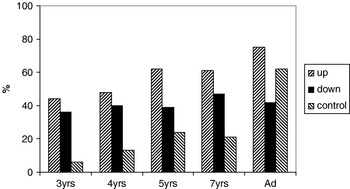
There was also a significant interaction between Age and Event Type (F(8, 380)=8·391, p=0·0001, ηp2=0·150). Recall that MP-responses were expected to increase with age for up/down-targets, but not for controls. However, planned comparisons within each event type showed an age effect with up-events (F(4, 190)=7·370, p=0·0001, ηp2=0·134) and with controls (F(4, 190)=29·677, p=0·0001, ηp2=0·385), but not with down-events. As shown in Figure 2, MP-responses were generally most frequent with up-events and least frequent with controls (up>down>control) except for the adults whose MP-responses were least frequent with down-events (up>control>down). Post-hoc contrasts (Newman-Keuls test) showed that all event differences were significant among adults (up>control, p=0·0219; control>down, p=0·0006; up>down, p=0·00006).
Manner+Path responses as a function of age and event type in Experiment I.

Finally, the three-way interaction Language×Age×Event Type was significant (F(8, 380)=3·555, p=0·0001, ηp2=0·070). Planned comparisons within each language tested the hypothesis that adults should produce more MP-responses than children (treated as one group) with targets but not with controls. Expected age differences occurred for up-targets (English F(1, 95)=5·224, p=0·023, ηp2=0·052; French F(1, 95)=12·28, p=0·0008, ηp2=0·114), but not for down-targets, and unexpected age differences occurred for controls (English F(1, 95)=71·02, p=0·0001, ηp2=0·428; French F(1, 95)=36·572, p=0·0001, ηp2=0·278). As shown in Figure 1 above, MP-responses showed (a) a language difference (English>French) at all ages for targets and only at some ages for controls (age five, adults); (b) different patterns across events for adults (up>control>down) vs. children (up>down>control) within each language; and (c) different patterns among adults in English (up 89%, control 91%>down 69%) vs. French (up 61%>control 33%>down 15%).Footnote 5
Specific analysis: Main verbs vs. other devices
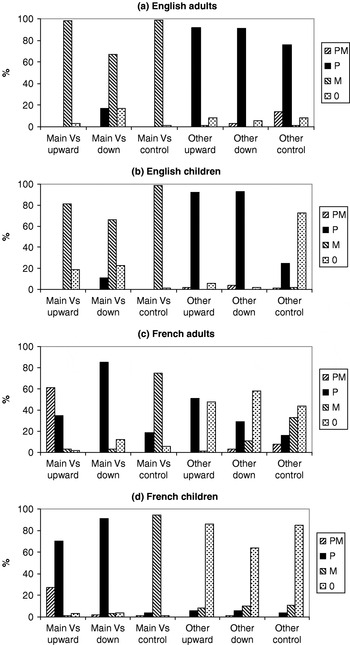
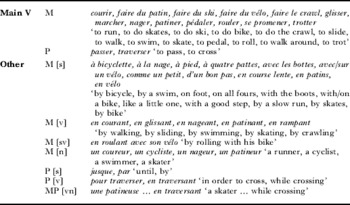
Figures 3a to 3d show which devices expressed relevant information (Manner, Path, both, neither) in responses produced by children (treated as one group by collapsing ages) vs. adults within each language (English 3a–b, French 3c–d), particularly uses of main verbs vs. other devices (subordinate verbs, particles, prepositions, adverbs, subject nominals; examples in Appendix 3).
Information expressed in main verbs vs. other devices in Experiment I.

With respect to targets, most English descriptions contained manner verbs, but somewhat more frequently for up than for down (adults 98% vs. 67%, children 81% vs. 66%), which also elicited some verbs expressing path or mere motion (e.g. to come/go down). Other English devices mostly expressed path with both target types (adults 92% and 91%, children 92% and 93%). French target descriptions were more varied. With up they frequently contained a main manner+path verb (grimper ‘to climb up’), especially among adults (61%, children 27%). Other responses contained a path verb (monter/descendre ‘to ascend/descend’) for up (adults 35%, children 70%) and especially down (adults 85%, children 91%). Other devices were rare among French children, but expressed path among adults (up 51%, down 32%, e.g. jusqu'en haut ‘all the way to the top’) and occasionally manner at all ages (adverbials avec les pattes ‘with the paws’ or gerunds en courant ‘by running’). As for controls, they frequently elicited main manner verbs in both languages (English adults/children 99%, French adults 75%, French children 94%), as well as other manner devices in French (adults 33%, children 11%). When MP-responses occurred with these items (especially English adults 91%, English children 25%, French adults 33%, see Figure 1), path was encoded outside of the main verb root in English, but scattered in French utterances. As shown in adults' responses (12) to (16), prepositions expressed direction in both languages, but English particles also expressed crossing (with the computer screen as reference point).
(12) L'ours marche de droite à gauche.
‘The bear is walking from right to left.’
(13) Une souris avance à petits pas.
‘A mouse is going forward with little steps.'
(14) The squirrel runs from right to left.
(15) The baby crawls across the screen.
(16) The bear is walking across the screen from right to left.
SUMMARY
The results of Experiment I show that MP-responses were more frequent at all ages in English than in French, increased with age in both languages, and were more frequent with targets than with controls. However, language and age affected not only responses to targets (as expected), but also responses to controls (for which M-responses were expected). In particular, unexpected MP-responses occurred with controls, especially among English adults, but also among French adults and English children. Recall that language and age effects were expected with target events, but not with control events, given (a) how stimuli were designed (manner and path were both relevant in targets, manner maximally highlighted in controls), (b) typological properties (expected greater salience of manner in English with targets), and (c) children's growing cognitive capacity (expected increase of MP-responses to targets). The fact that controls invited children to focus on manner shows that the absence of manner information in their responses to targets (particularly in French) was not due to their inability to use manner verbs. Unexpected MP-responses may be due to the fact that path was still too salient in these manner-oriented items, but this would not account for why MP-responses to these items were more frequent in English than in French, especially among adults.
Second, MP-responses were more frequent with up than with down in both languages. A difference between these target events was expected in French, where manner and upward path can be lexicalized simultaneously by means of a common verb, while no such verb is easily accessible for downward motion (see footnote 2). However, no such difference was expected in English. Note that downward motion always occurred after upward motion in target stimuli, so that speakers may have presupposed manner information if they had already mentioned it for upward motion. This variable could have affected responses in both languages, resulting in more MP-responses with up than with down, independently of language-specific lexicalization patterns. Nonetheless, it would not account for why MP-responses to down were more frequent in English than in French at all ages.
Two new sets of stimuli were designed for a second experiment, including targets (crossing events) and control items (manner-oriented as in Experiment I). In addition to being basic, familiar to children and easy to manipulate experimentally, crossing events imply the same typological contrast between English vs. French as did up/down-events in Experiment I. However, French provides no common verb lexicalizing manner+path for crossing (unlike up-events) and these events were not preceded by any other target (unlike down-events which were always preceded by an up-event). It was therefore predicted that crossing events should mostly elicit the following response types: P-responses should occur in French (e.g. traverser ‘to cross’), as they did with down-events (e.g. descendre ‘to descend’), but MP-responses should occur in English (e.g. to run across), as they did with up-events (e.g. to run up). That is, descriptions of crossing events were expected to show a language difference at all ages (MP-responses English>French), as well as an age effect in both languages (increasing MP-responses). No such effects were predicted with controls (M-responses expected), although the results of Experiment I suggested that they might also occur with these items.
EXPERIMENT II: DISPLACEMENTS ACROSS
METHOD
Participants
The sample consisted of 120 new English and French participants in four age groups, who were seen in the schools or universities of Cambridge and Paris: children of about three, five and seven years, and a control group of adults (twenty per group, see Table 3).
Participants in Experiment II

Material
Two sets of animated cartoons were prepared (see Appendix 1). Six items (across-targets) showed a human character entering onto the scene, crossing a ground referent, and leaving. These items systematically varied in the same way as in Experiment I. In particular, the manner of crossing differed across items and each item showed either the same manner throughout (e.g. a baby crawling to a street, across the street, and away) or manner contrasts (e.g. a boy walks to a river, swims across the river, and walks away). A second version of each item (control items) showed the same characters moving forward against a blank screen in the same manner as was used for crossing in the corresponding target.
Procedure
The procedure was the same as in Experiment I. Participants saw animated cartoons and were randomly assigned to ten presentation orders showing Targets or Controls first in different orders (TC1–5, CT1–5), preceded by training items. They narrated these stimuli for a blindfolded doll (children) or a future naive addressee (adults).
Coding
The same coding procedure was used as in Experiment I (92% reliability across two coders). Coding resulted in the same global categories: M (e.g. to swim), P (to cross the road), MP (to swim across), as well as a residual category, comprising rare event omissions (2% with targets, 1% with controls) and ambiguous cases. Examples (17) to (20) illustrate five-year-olds' responses to a target and corresponding control (T4/C4 in Appendix 1; main coding features in Appendix 2), particularly (as shown in bold): in English (17) MP for crossing/arrival, P for departure; in French (18) M for crossing, P for arrival/departure. As shown in adults' responses (19) and (20) (MP-responses), some subject nouns denoting characters contributed manner information (a jogger, un nageur).
(17) Well, he's walking down the road, then he swam across the river, then he went up on the left.
(18) Ça parle d'un petit garçon. Il est venu près de l'eau et il a nagé juste et il est revenu de l'autre côté de l'île.
‘It talks of a little boy. He came near the water and he just swam and he came back to/on the other side of the island.’
(19) A jogger is running across the street.
(20) Un nageur traverse la rivière.
‘A swimmer crosses the river.'
RESULTS
Global analysis: Manner+Path vs. other responses
A mixed ANOVA (with Age and Language as between-subject factors, and with Event-type and Item as within-subject factors) examined the effects of Age (four groups), Language (English, French), Event Type (targets, controls), and Item (six per event type) on raw scores of MP-responses. The following results were predicted: (a) a main effect of Event Type (targets>controls); (b) a Language×Event interaction, i.e. more English MP-responses at all ages with targets (P-responses expected in French); and (c) an Age×Event Type interaction, i.e. increasing MP-responses to targets (but not to controls) with age in both languages.Footnote 6
The response distribution is shown in Table 4 (percentages of all responses) and in Figure 4 (percentages of MP-responses). The results show significant main effects of Age (F(3, 152)=60·57, p=0·0001, ηp2=0·545), of Language (F(1, 152)=117·91, p=0·0001, ηp2=0·437), and of Event type (F(1, 152)=108·29, p=0·0001, ηp2=0·416). As shown in Figure 4, MP-responses were more frequent in English (48%) than in French (19%), increased with age (from 19% to 66%), and were more frequent with targets (49%) than with controls (21%).
Manner+Path responses in Experiment II.

Response types in Experiment II (in %)Footnote a

a P=Path, M=Manner, MP=both, Other=ambiguous, omissions.
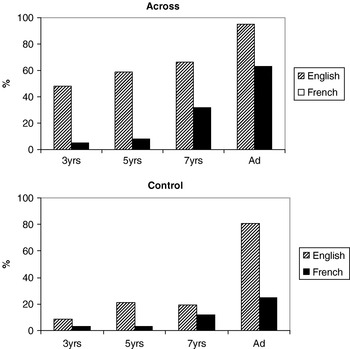
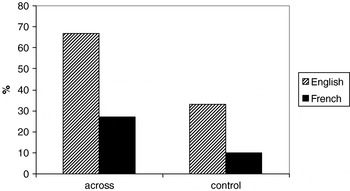
There were also three significant interactions. First, Language and Event Type interacted (F(1, 152)=13·45, p=0·0004, ηp2=0·081). However, planned comparisons only partially showed the predicted pattern. As expected, MP-responses were more frequent with targets than with controls in both languages (English F(1, 76)=81·29, p=0·0001, ηp2=0·517; French F(1, 76)=29·04, p=0·0001, ηp2=0·276) and they were more frequent in English than in French with targets (F(1, 152)=132·25, p=0·0001, ηp2=0·465). However, contrary to expectation, this language difference was also significant with controls (F(1, 152)=30·14, p=0·0001, ηp2=0·165). As shown in Figure 5 (English targets 67%, French targets 27%, English controls 33%, French controls 10%), targets showed a more striking language difference (English>French) and English a more striking event difference (Targets>Controls).
Manner+Path responses as a function of language and event type in Experiment II.

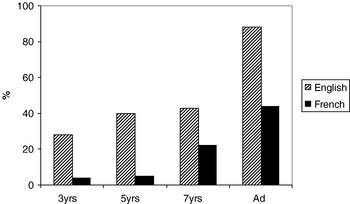
Second, Language interacted with Age (F(3, 152)=3·29, p=0·02, ηp2=0·061). As expected, MP-responses were generally more frequent in English than in French and increased with age in both languages. However, Figure 6 shows that languages differed most among adults (English 88%, French 44%) and five-year-olds (English 40%, French 5%). In addition, children differed at ages three–five in English (28% and 40%) and at ages five–seven in French (5% and 22%), but not at other ages (English five–seven, French three–five).
Manner+Path responses as a function of language and age in Experiment II.

Third, there was a significant Language×Age×Event interaction (F(3, 152)=8·40, p=0·0001, ηp2=0·142). As shown in Figure 4, English MP-responses were more frequent among adults than among seven-year-olds both with targets (95% vs. 66%) and with controls (81% vs. 19%). However, there were no clear age differences among English children: at all ages their MP-responses were relatively frequent with targets (age three 48%, age five 59%, age seven 66%) and infrequent with controls (age three 9%, age five 21%, age seven 19%). In contrast, French MP-responses to targets decreased regularly from adult age (63%) to age seven (32%) and younger (8% and 5%), but MP-responses to controls were relatively infrequent at all ages (three/five 3%, seven 12%, adults 25%).
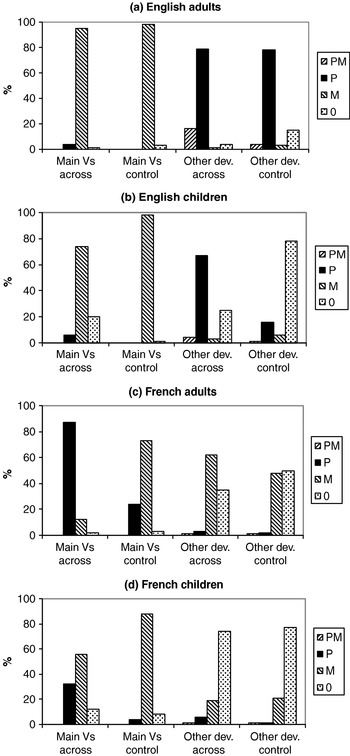
Specific analysis: Main verbs vs. other devices
Figures 7a to 7d show which devices expressed relevant information (Manner, Path, both, neither) in responses produced by adults vs. children in English (7a–b) and in French (7c–d) (examples in Appendix3). In target descriptions, English main verb roots typically expressed manner (e.g. to run, adults 95%, children 74%), but sometimes path or mere motion among children (to cross, to go across). Other English devices mostly expressed path (adults 79%, children 67%), but adults also used them to express further details about manner (16%, e.g. to walk across on all fours). In French target descriptions, adults mostly used main path verbs (87%), but children used these verbs less frequently (32%) than manner verbs (56%, e.g. nager ‘to swim’). French path verbs also differed across age groups, consisting almost always of the verb traverser (‘to cross’) among adults, but of the verb passer (‘to pass’) among children, typically in responses that did not express the crossing of a boundary (e.g. passer sur la route ‘to pass on the road’). Most other French devices expressed manner (adults 62%, children 19%) in subordinated gerunds (used by adults, e.g. traverser en courant ‘to cross by running’) or in various adverbial phrases (e.g. traverser à quatre pattes ‘to cross on all fours’). As for control items, they frequently elicited main manner verbs in both languages (English adults/children 98%, French adults 73%, French children 88%), as well as other manner devices among French adults (48%). When MP-responses occurred with these events (especially English adults 81%, English children 16%, French adults 24%, see Figure 4 above), they typically expressed path with French main verbs (avancer en marchant ‘to go forward walking’) and with other English devices (to walk across).
Information expressed in main verbs vs. other devices in Experiment II.

SUMMARY
In Experiment II, MP-responses generally increased with age in both languages, but were more frequent in English than in French and more frequent with target crossing events than with manner-oriented controls at all ages. As in Experiment I, language and age effects occurred with targets (as predicted), but also with controls (for which M-responses were expected in both languages). With respect to adults' target descriptions, English speakers systematically expressed manner in main verb roots and path in other devices (to run across). French adults also produced MP-responses, using a main path verb and other manner devices, particularly subordinated gerunds (e.g. traverser en courant ‘to cross by running’). However, adults' MP-responses were more frequent in English than in French (where frequent P-responses also occurred, traverser ‘to cross’). As for controls, they frequently elicited M-responses (as expected), but also unexpected MP-responses, especially in English.
With respect to children, their responses to targets in English were generally similar to their adult counterparts at all ages (MP-responses with main manner verbs and path satellites). However, young English children sometimes expressed either only path (to cross, [to go] across) or to a lesser extent only manner (to run). As for French children, they rarely produced MP-responses and often focused either on path alone (passer ‘to pass’) or on manner alone (nager ‘to swim’). This last result is in sharp contrast to the responses obtained with up/down-targets in Experiment I, where few M-responses occurred at any age (in either language). It was not expected, given our prediction that French children should focus on path alone (lexicalized in French verbs), while English children should express both manner (main verbs) and path (satellites). In this respect, two points should be noted. First, since up/down-targets took place along the vertical axis (in Experiment I), it is possible that they highlighted path to a greater extent than across-targets (horizontal axis in Experiment II). Second, young children typically used the path verb (passer ‘to pass’), rather than the most common path-verb available in French for crossing in Experiment II (traverser ‘to cross’, used by adults).
We return to these points below, but first examine additional evidence concerning arrivals and departures, frequently mentioned by participants in both experiments. Descriptions of these events are of interest, since they share general language-specific properties with all other target descriptions in English vs. French (S- vs. V-framed), but involve specifically horizontal motion (like across-targets and unlike up/down-targets).
ADDITIONAL EVIDENCE:ARRIVALS AND DEPARTURES
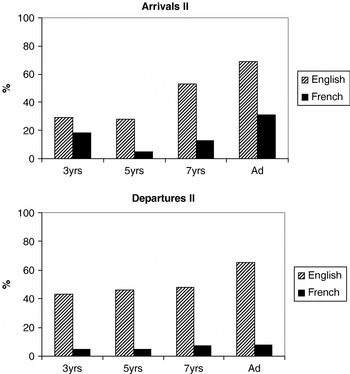
Departures were less frequently mentioned in Experiment II, presumably because they merely extended a forward horizontal motion (crossing then leaving). In contrast, arrivals were less frequent in Experiment I, in which some items began with characters already on the scene, whereas all items showed them entering onto the scene in Experiment II. Arrivals were also generally more heterogeneous in content than departures and increased with age along with other stage-setting utterances. Expressed information for each of these events is shown in Table 5 (all responses), and in Figures 8 and 9 (MP).
Manner+Path responses for arrivals and departures in Experiment I.

Manner+Path responses for arrivals and departures in Experiment II.

Response types for arrivals and departures in both experiments (in %)Footnote a

a P=Path, M=Manner, MP=both, Other=ambiguous, omissions.
With arrivals, MP-responses increased with age in both languages, but were more frequent in English (51% Exp-I, 45% Exp-II) than in French (12% Exp-I, 16% Exp-II). P-responses occurred in both languages, but more frequently in French (37% Exp-I, 36% Exp-II) than in English (20% Exp-I and Exp-II). With departures, English speakers produced frequent MP-responses (63% Exp-I, 49% Exp-II), which increased with age, whereas French speakers predominantly produced P-responses at all ages (79% Exp-I, 78% Exp-II). M-responses were rare with departures and mostly occurred with arrivals both in French (32% Exp-I, 34% Exp-II) and in English (25% Exp-I, 30% Exp-II). With both arrivals and departures English responses typically contained main manner verbs and path satellites (e.g. to crawl in/away, to run in/off). Most French responses contained main path verbs and no manner (e.g. arriver ‘to arrive’, s'en aller, partir ‘to leave’), but some specified manner peripherally (mostly adults, e.g. arriver/partir en courant ‘to arrive/leave by running’).
GENERAL DISCUSSION
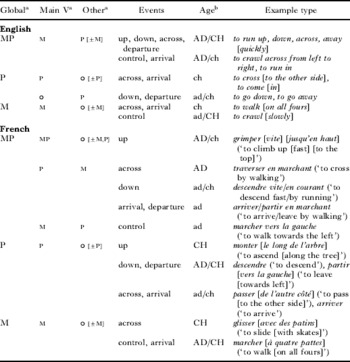
Two experiments examined how English vs. French speakers described voluntary motion. Language and age effects were expected with target events, in which manner and path were both relevant (up, down, across, as well as arrivals/departures), but not with control events (manner-oriented). Given typological properties and previous results, manner+path (MP) descriptions of targets were expected to be more frequent in English than in French and to increase with age in both languages. Table 6 provides an overview of main response patterns among adults and children for each language and event type.
Summary of main preferred response patterns (Experiments I and II)

a M=Manner; P=Path, MP=both, 0=neither. Brackets in ‘other’ devices indicate variants (e.g. 0 [±P]=no other device or Path-alone).
b Event types show which responses characterized adults and/or children (ad, ch, ad/ch); capitals show predominant patterns within groups.
Manner and path across languages: Typological factors
As predicted, MP-responses were more frequent in English than in French at all ages and with all target events. English adults and children typically expressed manner in main verbs and path in satellites. However, MP-responses were more frequent with up-events than with down-events, which also elicited P-responses (Experiment I). More generally, some other responses occurred: verbs occasionally expressed path or mere motion (especially among children) and other devices occasionally provided further details about manner (especially among adults). French MP-responses were age and event-specific. At all ages up-events elicited the most MP-responses, typically responses containing a manner+path verb (grimper ‘to climb up’). Other events elicited either P-responses at all ages (e.g. descendre ‘to descend’, traverser ‘to cross’, partir ‘to leave’) or MP-responses with a main path verb and peripheral manner markings, but mostly among adults (e.g. traverser en marchant à quatre pattes ‘to cross by walking on all fours’). French children rarely produced MP-responses, with the notable exception of up-events (lexicalized Manner+Path in the verb). Additional evidence shows similar language and age effects for arrivals and departures as for main target events (up, down, across). However, MP-responses were generally more frequent with departures than with arrivals, which elicited some M-responses (all ages, both languages).
Cross-linguistic differences follow from typological properties. English (S-language) lexicalizes manner in verb roots and encodes path in satellites, while French (V-language) lexicalizes path in verb roots, throwing manner to the periphery of the sentence. As suggested by Talmy (Reference Talmy2000) and Slobin (Reference Slobin, Strömqvist and Verhoeven2003, Reference Slobin, Hickmann and Robert2006), lexicalization patterns across languages invite speakers to construct different verbal representations by foregrounding lexicalized information, thereby highlighting manner to different degrees (English>French). In both languages children from three years on followed the adult system, despite the increasing density of their utterances (manner+path, rather than either one alone, see below). French speakers were more likely to express manner and path when they could lexicalize both in a common verb (up-events, all ages), otherwise focusing on path alone (all ages) or using complex structures with peripheral manner information (adults). The greater complexity of subordinated structures accounts for why MP-responses were less frequent among children than among adults in French, as well as less frequent in French than in English.
It should be stressed again that these typological factors do not follow from speakers' obedience to any strict obligatory grammatical rule. Both English and French provide a variety of structures, all of which are entirely grammatical, to express motion. Some of these structures are possible in both languages (a French manner verb combined with a path device, see example (7) above) and others are only possible in one language (English path particles do not exist as such in French). Although all are grammatical, typological constraints account for why only some are preferred and predominant in a given language and not in another.
Finally, although control events were meant to maximally highlight manner and to elicit M-responses, irrespective of age and language, some MP-responses occurred with these events in both languages. It is possible that our manner-oriented stimuli did not sufficiently highlight manner and/or minimize path. However, this factor cannot account for why MP-responses to these events were particularly frequent among English adults, who in fact produced such responses more frequently with controls than with down-targets. We turn below to other factors that may partially account for this response pattern.
Discourse factors
Discourse factors may partially account for the different responses that were observed, particularly because of the order in which target events occurred in the stimuli. Recall that in all age and language groups P-responses were more frequent with down-events than with up-events (Experiment I), as well as more frequent with departures than with arrivals (both experiments). These results may be related to the fact that down-events always occurred after up-events and departures at the end. In particular, speakers may not have expressed manner at some point in discourse if they had already mentioned this information in earlier utterances. This point may account for why MP-responses were more frequent for up-events than for down-events not only in French (where this difference was expected), but also in English (where MP-responses were expected with all target events). It may also account for why these responses were more frequent with departures than with arrivals (both of which were expected to elicit French P-responses and English MP-responses). Nonetheless, manner was more frequently expressed in English than in French with all event types, including with downward motion and with departures, which elicited the most P-responses in both languages.
A qualitative look at responses to targets also shows a different type of discourse organization across languages, particularly among children. Children compactly expressed manner and path within English utterances, but tended to distribute information across utterances in French discourse. For example, (21) a six-year-old describes manner for a target crossing event (nager ‘to swim’) and path information in surrounding utterances (arriver à l'autre bout ‘to get to the other end’). Such examples suggest that French children did notice and recall manner and path information, despite the fact that they did not always compactly express both within utterances. It is therefore possible that French invites children to construct and string partial representations, thereby gradually building up a global discourse representation allowing the addressee to reconstruct event sequences.
(21) Il a plongé dans la rivière et il a nagé et puis il est arrivé à l'autre bout.
‘He dived into the river and he swam and then he got to the other end.’
Developmental changes
Although MP-responses were more frequent in English than in French at all ages, they increased from three years on in both languages. This developmental progression presumably reflects two types of general cognitive factors. First, structures that combine path and manner are formally richer as well as semantically denser, and therefore more complex, than those that express only one type of information. Second, in comparison to manner, path is a more basic property of motion, if only because it provides essential information to localize entities in the universe of discourse (also see Talmy, Reference Talmy2000). An age effect was therefore expected in relation to manner (but not to path). Indeed, children in both language groups were more likely to focus on path, rather than on manner, when they expressed only one component.
However, young children sometimes focused on manner alone. This response type was mostly observed with crossing events and to a lesser extent with arrivals, but not with other events (up, down, departures). Furthermore, M-responses to crossing events were observed among the youngest children in both languages, although they were more frequent in French than in English in all children's groups. Two factors may account for these results. First, it is possible that path was highlighted to a greater extent when motion occurred along a vertical axis (up/down) than when it occurred horizontally (across). Previous studies have recurrently invoked the high perceptual and cognitive salience of the vertical dimension, presumably linked to gravity, for example to account for the order in which spatial markers are acquired in many languages, e.g. prepositions along this dimension are among the first to be acquired (see an overview in Johnston, Reference Johnston, Stiles-Davis, Kritchevsky and Bellugi1988). However, this factor would not account for the higher frequencies of M-responses with arrivals as compared to departures.
Second, crossing events mainly elicited one common path verb among French adults (traverser ‘to cross’), but this verb practically never appeared among children, who used the path verb passer (e.g. Il est passé [sur la route] ‘He passed [on the road]’) or manner verbs (glisser ‘to slide’) with goal markings (passer/nager jusqu'à … ‘to pass/swim/go until/to … ’). It is therefore possible that the most relevant verb for crossing events is not part of children's productive verbal lexicon by age three, which would explain why they often expressed manner for crossing, rather than path (which was their main focus with other events). This apparent lexical gap is surprising, given that children presumably hear this verb in the adult input and even produce it in some situations, as indeed indicated by anecdotal evidence from a subsequent interview (e.g. Faut pas traverser la rue! ‘Must not cross the street!’). Further research on children's lexical knowledge is therefore necessary in studies examining both their early productions (see available findings for English vs. French in Hickmann, Hendriks & Champaud, Reference Hickmann, Hendriks, Champaud, Guo, Lieven, Budwig, Ervin-Tripp, Nakamura and Özçaliskan2008) and their early comprehension of motion verbs.
Depending on the language, then, learning to express motion partially depends on the acquisition of different structures. English invites children to learn structures in which they can productively combine manner verbs with path satellites. In contrast, French invites them to learn structures in which the main verb lexicalizes path, except when an available verb lexicalizes manner and path. In the former case, subordination provides one obvious way to add manner to a main path verb. The greater complexity of subordinated structures explains why they were more frequent among adults than among children in French and why MP-responses were generally less frequent in French than in English. French children also distributed manner and path across utterances in discourse, whereas English children compactly expressed them within utterances. Thus, although general (and presumably universal) cognitive determinants influence how children express motion in all languages, typological factors constrain the ways in which they learn to organize information. Further research requires complementary measures that go beyond children's speech (e.g. gestures, see Gullberg, Hendriks & Hickmann, Reference Gullberg, Hendriks and Hickmann2008) in order to explore whether these cross-linguistic differences reflect deeper differences in their underlying event conceptualization.
CONCLUSION
English and French speakers do not talk about motion in the same way. English invites them to express both manner and path in compact structures. In French they focus on path, except when verbs lexicalize manner and path (upward motion), when they can construct complex structures (adults), or when particular path verbs are not available to them (children). In both languages discourse factors partially account for different responses across event types and cognitive factors account for the increasing semantic density of children's utterances. However, only typological factors can account for the cross-linguistic differences that were observed at all ages and with all event types. These findings suggest that typological factors strongly contribute to how speakers organize their verbal representations across languages from three years on. Further research must determine whether these factors have a deeper impact on event representations beyond language use.
APPENDIX 1
MATERIALS USED IN EXPERIMENT I
Up/down target items

(T1) A squirrel runs to a tree, up into and out of a hole in the tree, down, and away.
(T2) A caterpillar crawls to a plant, up the stalk to eat a piece of leaf, down, and away.
(T3) A bear walks to a tree, climbs up to a beehive to get some honey, climbs down to eat it, and walks away.
(T4) A cat runs to a telephone pole, jumps up to a bird's nest, drops an egg, jumps down to lick the egg, and runs away.
(T5) A mouse tiptoes to a table, climbs up to take a piece of cheese, slides down, and tiptoes away.
(T6) A monkey walks to a banana tree, climbs up to take a banana, then slides down and walks away.
Control items
(C1) squirrel running; (C2) caterpillar crawling; (C3) bear walking; (C4) cat running; (C5) mouse tiptoeing; (C6) kitten running.
MATERIALS USED IN EXPERIMENT II
Across-target items

(T1) A man runs to a country road, runs across the road, and runs away.
(T2) A girl rides to railroad tracks on a bicycle, rides across the tracks, and rides away.
(T3) A baby crawls to a street, crawls across the street, and crawls away.
(T4) A boy walks to a river, swims across the river, and walks away.
(T5) A boy walks to a frozen river, slides across the river on his boots, and walks away.
(T6) A girl walks to a frozen lake with skates on, skates across the lake, and walks away.
Control items
(C1) man running; (C2) girl riding bicycle; (C3) baby crawling; (C4) boy swimming; (C5) boy sliding; (C6) girl skating.
APPENDIX 2
EXAMPLES OF MAIN CODING FEATURESa
Experiment I (examples 8–11 in text)

Experiment II (examples 17–20 in text)

am=manner, p=path; mp=both, 0=neither.
APPENDIX 3
EXAMPLES OF MAIN VERBS AND OTHER DEVICES EXPRESSING MANNER AND/OR PATH IN PARTICIPANTS' RESPONSESa
Experiment I: English

Experiment I: French

Experiment II: English

Experiment II: French

a ‘Other’ included a variety of devices outside of the main verb, such as verbs in subordinated clauses [v], subject nominals [n], and a third group [s] comprising satellites and related devices (particles, prepositions, adverbials).