Introduction
Tropical and neotropical ant–acacia systems have emerged as an important study system for testing mutualism theory (Bronstein, Reference Bronstein1998; Heil and McKey, Reference Heil and McKey2003), and the ecology of ant–acacia mutualisms in Central America has been of significant interest to biologists for over 50 years (Janzen, Reference Janzen1966). Typically, trees promote the colonization of ant species by producing extrafloral nectaries (Barton, Reference Barton1986) and nutritious food bodies (Beltian bodies; Belt, Reference Belt1874), in addition to swollen thorns which ant colonies inhabit (domatia; Fonseca, Reference Fonseca1993). In return, acacia trees are aggressively defended from herbivory by resident ant colonies (Beattie, Reference Beattie1985), and there is often fierce competition between ant colonies for access to acacia tree resources (Davidson et al., Reference Davidson, Snelling and Longino1989; Palmer, Reference Palmer2003). Many plant species are known to associate with ants in tropical regions (e.g. Cecropia spp. (Urticaceae), Leonardoxa spp. (Fabaceae), etc.; Janzen, Reference Janzen1973; Gaume and McKey, Reference Gaume and McKey1999), and ant-associated plants have been termed ‘myrmecophytes’. Although the interaction between ants and myrmecophytes is considered largely obligate in several associations (Bronstein, Reference Bronstein1998), tree traits are thought to ultimately promote and maintain the persistence of the mutualism through time (Willmer and Stone, Reference Willmer and Stone1997; Palmer et al., Reference Palmer, Stanton, Young, Goheen, Pringle and Karban2008).
In an African myrmecophyte, herbivory has been shown to be an ecological factor that mediated the functionality and distribution of tree traits important to the mutualism (e.g. number of swollen thorns, number of nectaries; Palmer et al., Reference Palmer, Stanton, Young, Goheen, Pringle and Karban2008). When browsing pressure from large ungulates was reduced, trees gradually senesced traits that facilitated inhabitation by ants (Palmer et al., Reference Palmer, Stanton, Young, Goheen, Pringle and Karban2008). However, locally heterogeneous environmental conditions can also regulate the expression of tree traits (Agyeman, Reference Agyeman1994; Poorter, Reference Poorter1999; Rosati et al., Reference Rosati, Esparza, DeJong and Pearcy1999). The density of woody plant species may be an especially important aspect of the local environment. Basal area is an easily measured environmental variable that describes the cross-sectional area of woody plants per unit area, and is a convenient surrogate measure of tree biomass in neotropical forests (Phillips et al., Reference Phillips, Malhi, Higuchi, Laurance, Núñez, Vásquez, Laurance, Ferreira, Stern, Brown and Grace1998). Forest basal area is correlated with numerous environmental factors, including thermal variability (D'Souza et al., Reference D'Souza, Reiter, Six and Bilby2011), water and nutrient availability (Bergh et al., Reference Bergh, Linder, Lundmark and Elfving1999), light regime (Montgomery and Chazdon, Reference Montgomery and Chazdon2001), and tree competition (Bella, Reference Bella1971). These relationships make basal area a useful and broadly informative measurement regarding correlated environmental variables, tree biomass and microsite conditions (Phillips et al., Reference Phillips, Malhi, Higuchi, Laurance, Núñez, Vásquez, Laurance, Ferreira, Stern, Brown and Grace1998). While ant–acacia systems have been studied across environmental gradients (Rico-Gray et al., Reference Rico-Gray, Garcia-Franco, Palacios-Rios, Diaz-Castelazo, Parra-Tabla and Navarro1998), the effects of tree size and forest basal area on ant behaviours and tree traits are rarely explored (but see Agrawal, Reference Agrawal1998).
Here, we ask the question ‘Does myrmecophyte size or forest structure influence ant behaviours or functional tree traits?’ To investigate this question, we tested two hypotheses: (1) ant responses to tree disturbance vary across gradients of tree size and forest basal area; and (2) tree traits that affect ant behaviours vary across these gradients. We tested these hypotheses by extensively surveying the morphology of the myrmecophytic Collins acacia (V. collinsii Saff. (Fabaceae), formerly Acacia collinsii) inhabited by the ant P. spinicola Emery (Hymenoptera: Formicidae), and evaluating ant behaviours with simple experimental disturbances. We found that, on average, ants tended to respond to experimental disturbances in dramatically higher abundances when large trees were disturbed, and most tree traits were consistently distributed across tree size classes and forest basal area classes. Our findings have implications for studies of ant behaviours in neotropical ant–plant associations, and we suggest that myrmecophyte size may be an important factor to consider in future work.
Materials and methods
Study system
We performed all studies near the village of Merida, on Ometepe Island, Nicaragua (co-ordinates: 11°25′12.6″N, 85°32′41.5″W) during the dry season (March 2010) in a mixed forest–agricultural landscape. The region is characterized by dry tropical forest and volcanic soils, and typical tree genera include Guazuma (Malvaceae), Psidium (Myrtaceae), Solanum (Solanaceae), Cecropia (Urticaceae), Bursera (Burseraceae) and Vachellia (Fabaceae). Vachellia collinsii in the area are typically colonized by one of two ant genera, Pseudomyrmex spp. or Crematogaster spp. Voucher specimens of P. spinicola from our studies were deposited in the Colorado Plateau Museum of Arthropod Biodiversity (Flagstaff, AZ, USA). Pseudomyrmex spinicola is an obligate inhabitant of acacia thorns in Central America, as are P. ferruginea, P. nigrocincta and P. flavicornis (all Hymenoptera: Formicidae) (Janzen, Reference Janzen1966), which are also common to the study area. All work reported here took place on the south-eastern aspect of the island.
Tree traits and ant responses to disturbance
Prior to commencing our studies, we established a length distribution for branches of V. collinsii by measuring the lengths of all branches on 39 randomly selected trees (n = 295 branches in total). Branch lengths were skewed in their distribution, and 75% of branch lengths were ≤ 50 cm (Fig. 1).
A frequency distribution histogram of branch lengths (cm) for 39 Vachellia collinsii trees (n = 295 branches). The dotted lines show the quartiles of the distribution (Q1: 0th–25th percentile; Q2: 26th–50th percentile; Q3: 51st–75th percentile; Q4: 76th–100th percentile).

We used this knowledge of branch length distribution to select branches for measurement on randomly selected study trees, and on each study tree, we measured one branch from each of five length categories: (1) the 0th percentile (smallest branch); (2) the 25th percentile (~10 cm); (3) the 50th percentile (~26 cm); (4) the 75th percentile (~45 cm); and (5) the 100th percentile (largest branch). We also measured the diameter (cm) of each tree at the base of the trunk flush with the ground surface (diameter at root collar (DRC)). We classified trees between 0 and 1.6 cm DRC as small (0–33rd percentile), between 1.6 and 4.3 cm DRC as intermediate (34th–66th percentile) and trees >4.3 cm DRC as large (67th–100th percentile). The mean height of study trees was 3.4 m ( ± 0.3 m SE). At each study tree, we also quantified forest basal area using a basal area prism and variable radius plots. We classified areas of < 35 m2/ha as having low basal area, 35–60 m2/ha as medium basal area and >60 m2/ha as high basal area.
On each branch, we censused the number of extrafloral nectaries, food bodies, seedpods and thorns. While nectaries, food bodies and thorns are plant traits important to ant behaviours, the numbers of seedpods may represent plant fitness. We performed a visual census of the number of ants patrolling each branch prior to disturbance (Agrawal, Reference Agrawal1998; Gaume and McKey, Reference Gaume and McKey1999). We then experimentally disturbed each branch by lightly shaking the branch for 5 s from the distal end (modified from Palmer and Brody, Reference Palmer and Brody2007), and we counted the number of ants recruited to the branch for 2 min. Multiple observers counted ants, and we averaged the counts from each observer. Each experimental disturbance was performed separately, and we allowed ants to return to a patrolling state between each trial (usually ~5–7 min). Previous studies indicated that ant ‘memory’ of disturbance events is related primarily to residual effects of volatile emissions from damaged plant tissues (Agrawal, Reference Agrawal1998). We divided the number of ants counted for 2 min following disturbance by the number of ants initially patrolling each branch to provide an estimate of per cent increase as our metric of ant response to disturbance. We averaged all ant responses and tree traits for each tree to yield tree-level mean values for numbers of nectaries, food bodies, seedpods, thorns and per cent ant increase on branches. The above measurements and ant disturbance trials were performed on a total of 33 trees inhabited by P. spinicola.
Statistical analyses
All statistical analyses assume a type I error rate of α = 0.05 and we computed all statistics using the software package JMP 8.0 (SAS Institute). We analysed tree size class (small, intermediate and large) and forest basal area class (low, medium and high) as fixed effects on the response variables of mean ant response to disturbance (per cent increase), mean number of nectaries, mean number of food bodies, mean number of seedpods and mean number of thorns on each tree. We did not test for an interaction between tree size class and basal area class since the tree size × basal area interaction was not replicated for small-diameter trees in high-density forests. Also, we performed least-squares linear regression of per cent ant increase on DRC. Prior to statistical testing, we checked response variables for normality using a Shapiro–Wilk test, and we visually assessed residuals for homoscedasticity of variance. All responses were found to conform to these assumptions.
Results
Does tree size or forest basal area affect ant response to disturbance?
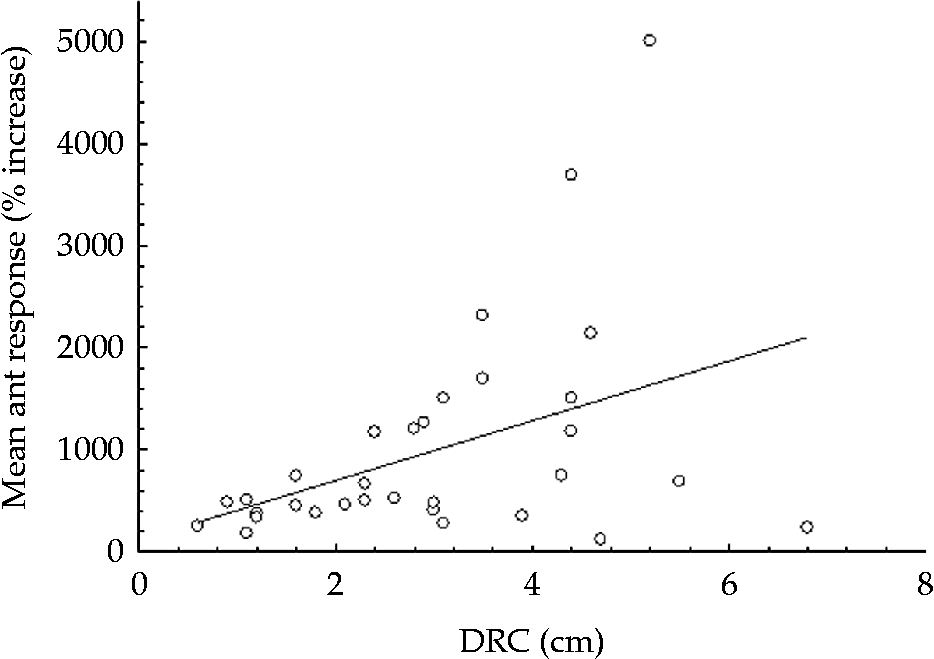
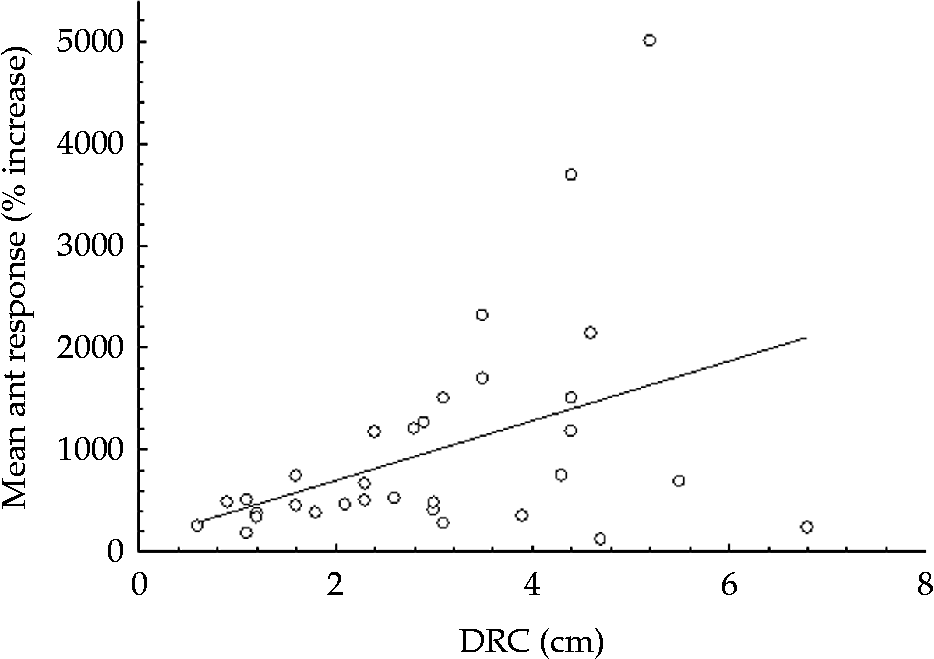
We found that the mean per cent increase in P. spinicola on branches following experimental disturbances was higher for large-diameter trees than for small- and intermediate-diameter trees (F 2,27 = 5.153, P = 0.012). The mean per cent ant increase was 1815.7% ± 317 SE (range 116–5000%) on large-diameter trees, 867.6% ± 222 SE (range 272–2309%) on intermediate-diameter trees and 412.0% ± 352 SE (range 176.8–738.2%) on small-diameter trees. Tree diameter was positively correlated with mean per cent ant increase, where larger trees tended to have a higher increase in the number of ants on branches following disturbance (Fig. 2).
A least-squares linear regression of the standardized ant response to disturbance (% increase) on tree size (DRC). As DRC increased, so did the mean response of ants to experimental disturbances (F 1,30 = 6.404; P = 0.016; r 2 = 0.18). Equation: (mean % ant increase) = 114.56+292.36 (DRC).
In contrast, forest basal area had a statistically marginal effect on per cent increase in P. spinicola on experimentally disturbed branches (F 2,27 = 2.785, P = 0.078). The mean per cent ant increase was 1536% ± 354 SE (range 272–5000%) in high basal area locations, 540% ± 267 SE (range 116–1500%) in medium basal area locations and 1184% ± 316 SE (range 403–3683%) in low basal area locations.
Are tree traits predictable by tree size or forest basal area?
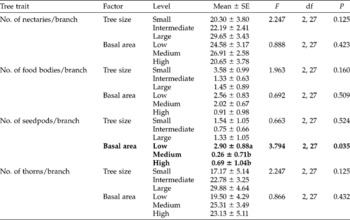
The mean number of nectaries per branch on V. collinsii did not vary by tree size or forest basal area. Similarly, the mean number of food bodies and thorns per branch was not found to be variable across tree size or forest basal area classes. However, we did find that the mean number of seedpods per branch was significantly higher in areas of low basal area than in areas of medium or high basal area, while tree size class had no effect on the mean number of seedpods per branch (refer to Table 1 for statistical summary). In addition, we found no correlation between tree DRC and forest basal area (F 1,30 = 0.421, P = 0.521, r 2 = 0.013).
ANOVA summary of the effects of tree size and forest basal area on the means of four functional tree traits

Significant effects are shown in bold, and letters show separation of means using Tukey's HSD test.
Discussion
Our studies support the hypothesis that tree size (V. collinsii) is correlated with ant (P. spinicola) behavioural responses to disturbance in an ant–acacia system, but not forest basal area. We found that as tree DRC increased, so did the relative number of ants that responded to disturbances (Fig. 2). This finding suggests that ant responses to minor disturbances (surrogate herbivore-mediated responses) are not equivalent across a gradient of tree sizes. This should be tested with other obligate plant–ants as well, as there is evidence from African ecosystems that ants vary in their effectiveness as deterrents to herbivores (Martins, Reference Martins2010). While both arthropod and mammalian herbivores likely exert pressure on acacias in the neotropics, our experimental disturbances probably most closely resembled disturbance by browsing ungulates. Conversely, forest basal area exhibited, at best, a statistically marginal correlation with ant responses. However, the variance we observed in ant responses across forest basal areas could potentially correspond to practical ecological consequences for acacias growing in forests of differing structural types. Surprisingly, mean ant responses were highest in locations with low and high basal areas, and substantially lower in areas of medium basal area. This could indicate that acacias in forested areas of medium basal area (35–60 m2/ha) may be more susceptible to herbivore damage than in areas of low ( < 35 m2/ha) or high basal area (>60 m2/ha).
One hypothesis to explain the result we report for ant behaviours is related to ant colony size. Large trees have more domatia than small trees, and may simply house more ants per unit area than smaller trees. Previous research has demonstrated that ant colony size is a critical factor in shaping ant behaviours (Palmer, Reference Palmer2004). However, the mean number of domatia per branch was standardized to branch length, and we did not observe that a significant difference in the mean number of domatia per branch was attributable to tree size. Thus, we did not expect a disproportionately greater response in the per cent increase of P. spinicola following experimental disturbances. So, although tree morphology and functional traits were conserved across tree size classes, ant responses to disturbance were not. Alternatively, there may be correlations between ant colony aggression, colony condition, and colony size or structure that would account for the differences we observed in ant responses across tree size class (Fonseca, Reference Fonseca1993). For example, large trees might support healthier or more aggressive ant colonies than small trees, since larger trees could conceivably provide resident ant colonies with a greater abundance of resources or nesting space. Also, there is evidence from other studies to suggest that colonies of Pseudomyrmex spp. can be polygynous (Kautz et al., Reference Kautz, Pauls, Ballhorn, Lumbsch and Heil2009), which could contribute to localized variations in colony behaviours. However, it is generally thought that P. spinicola colonies are monogynous (Ward, Reference Ward1993), so a multiple-queen hypothesis is improbable to explain our results.
Our results do not support the hypothesis that functional myrmecophyte traits vary across gradients of tree size or forest basal area. Three myrmecophyte traits related to the ant–plant interaction (nectaries, food bodies and domatia) did not vary across tree size or forest basal area classes, although we did observe an increase in the mean numbers of seedpods per branch on trees in locations with low basal area. Factors mediating seed production in V. collinsii and other similar ant–plants deserve further attention, and should be assessed over standardized time intervals. We found that trees in low basal area conditions had approximately 11.1 and 4.2 times as many seedpods per branch, on average, than trees in medium and high basal area conditions, respectively (Table 1). Previous studies showed that plant volatiles cause ants to generally avoid inflorescences, and it has been proposed that ants may not directly contribute to seed-set as a result (Ghazoul, Reference Ghazoul2001). Furthermore, seedpod production can be entirely independent of ant colony defensive behaviours (Palmer and Brody, Reference Palmer and Brody2007), and we predict that local environmental factors (sun exposure and inter-tree competition) and phenology regulate seedpod production to a greater extent than ant behaviours.
Basal area is a widely used forest management measurement that is correlated with many environmental factors, and forest basal area could alter various aspects of ant–plant mutualisms. For example, Davidson and Fisher (Reference Davidson, Fisher, Huxley and Cutler1991) demonstrated that light regime mediates interactions between a myrmecophytic Cecropia sp. and resident ants. In tropical forests, light availability is strongly related to forest basal area (Montgomery and Chazdon, Reference Montgomery and Chazdon2001). Similarly, environmental factors that promote or inhibit the performance of V. collinsii are likely to indirectly influence P. spinicola colonies, and these factors may be predictable by forest basal area. An assessment of specific environmental factors associated with varying levels of forest basal area and their influences on neotropical tree traits would be useful for a broad-spectrum evaluation of microsite conditions and tree morphologies.
Conclusion
Our studies argue that ant responses to disturbance are variable across a gradient of tree sizes in a neotropical ant–plant association, but forest basal area was not correlated with ant responses. Also, we found no evidence to suggest that tree functional traits (V. collinsii) that relate to mutualism maintenance respond to variation in tree size or forest basal area, although we did observe significantly more seedpods on trees in low-density areas. Thus, the quantities of nectaries, food bodies and domatia appear to be uniformly distributed on V. collinsii in the region we surveyed, and the expression of functional traits was conserved across tree size classes. It is possible that the variation we detected in ant responses due to tree size was related to ant colony size or some other ecological factor. However, future studies of ant behaviour in ant–myrmecophyte associations should consider tree size as a factor that may introduce variation to observations of ant behaviours.
Acknowledgements
The authors are grateful for the assistance of Y. Ortiz and R. Molina, and the staff of the Ometepe Biological Field Station. K. London and R. Hofstetter provided several iterations of review and commentary for this manuscript. Funding for this study was provided by a Hooper grant to N.E. Foote, an N.S.F. I.G.E.R.T. fellowship to T.S. Davis, and an S.F. A.Z. fellowship to K.C. Grady. We also appreciate the efforts of two anonymous reviewers who provided helpful comments on this manuscript.