This volume publishes the papers and correspondence of the Hotham family during the civil wars and interregnum. The head of the family and first baronet, Sir John Hotham, is well known in the national narrative because of his critical role in denying the king entry to Hull on 23 April 1642. This episode ignited much contemporary controversy, raising the stakes in a pamphlet war between the king and his parliamentary opponents, and making armed conflict far more likely. It has attracted considerable attention from constitutional historians who have debated its legal ramifications, while political and military historians have recognized that the king's failure to seize the large arms magazine at Hull badly undermined the royalist war effort. Yet, despite their national importance in 1642, the Hotham family's papers have only rarely been utilized by academics. Late twentieth-century historians such as J.T. Cliffe, Barbara English, and Peter Roebuck drew upon the collection to inform their work on the wider theme of Yorkshire gentry landowners,Footnote 1 but few others have been to Hull to access the archive. This also reflects a relative neglect of northern England in civil war historiography. There has been no biography of either of the Hothams, and their most recent family histories date from as long ago as the First World War.Footnote 2 This is unfortunate, because Sir John Hotham and his eldest son were extremely colourful and enigmatic figures, whose letters reveal much about the cultural attitudes of the English gentry in the 1640s.
This volume seeks to redress this imbalance and restore the centrality of the Hotham family to the parliamentary cause. Reuniting the Hotham archive with surviving letters in other collections will deliver a comprehensive edition, making their papers fully accessible for the first time. The papers constitute an outstanding primary source for the build-up to war and the allegiance dilemmas faced by Yorkshire's inhabitants before the king raised his standard at Nottingham on 22 August 1642. They detail the war's conduct in the north, illuminating the government of Hull and the parliamentarian administration of the East Riding. At the same time, they are useful for historians of allegiance because they richly demonstrate the family feud with the Fairfaxes of Denton, and an increasing dissatisfaction with the parliamentary cause.Footnote 3
The present work includes transcriptions of all of the papers in the DDHO/1 classification of the Hotham family archives. These are supplemented with letters written by or to the Hothams that are now held in other archives, principally the British Library, the Bodleian Library, and the Hull city records. Most of the letters written by Sir John Hotham were penned in Hull and sought to protect the town and his estates to the north of it, either by pleading for reinforcements, pay, and supply from his Westminster contacts, or through clandestine negotiations with the enemy general, the earl of Newcastle, to spare the East Riding from a royalist occupation. His correspondents included William Lenthall, Speaker of the House of Commons, and such prominent MPs as John Pym and John Hampden. The other papers written by Sir John were connected to his trial in December 1644 for attempting to betray Hull to the royalists. He penned several drafts of a defence, interrogatories for the witnesses, and a general autobiographical account of his governorship of Hull.Footnote 4 These papers were retrospective, written during his imprisonment in the Tower of London. Their purpose was to save his life and their audience encompassed Sir William Waller and the members of the court martial who were judging him, as well as other members of parliament to whom Sir John might appeal.
The letters by Sir John Hotham's eldest son, John Hotham, were written from his military headquarters in Cawood and Beverley, and during his campaigning in Durham, Lincolnshire, Nottinghamshire, and the North Riding of Yorkshire. The majority of them were addressed to the earl of Newcastle and they constitute a nationally important source for the English gentry's politics of honour. These will prove of wider interest to literary scholars and cultural historians because they utilized a language of honour to court Newcastle's affections. They raised the prospect that the Hotham family would change sides as soon as they could do so without betraying their trust or impugning their reputations. There are several further letters and papers penned by Sir John's fifth son, Durand Hotham, who defended him during his trial, and his grandson John Hotham, his successor as second baronet. These were largely concerned with preserving the family estates after the executions of John and Sir John Hotham on 1 and 2 January 1645 respectively.
The Hotham family
As one of the leading county families in the East Riding of Yorkshire, the Hothams were a natural choice to head the parliamentarian war effort in the region, and their careers are ably summarized by David Scott's entries in the Oxford Dictionary of National Biography. Sir John Hotham was born in 1589, the son of John Hotham of Scorborough, esq. and Jane, the daughter of Richard Legard of Rysome. During the 1580s John Hotham had served as high sheriff of Yorkshire and MP for Scarborough and Hedon. In 1609 Sir John succeeded to his father's large estates and he was knighted on 11 April 1617. He gained brief military experience serving under Count Ernst von Mansfeldt in the Rhineland in 1619 and may have served at the Battle of the White Mountain in 1620. By 1621 he had returned to Yorkshire, where he was quickly appointed a justice of the peace, and he purchased a baronetcy in 1622. He soon became a patriarch, fathering many children, including his eldest son, John Hotham, the parliamentarian lieutenant-general, born in 1610.Footnote 5
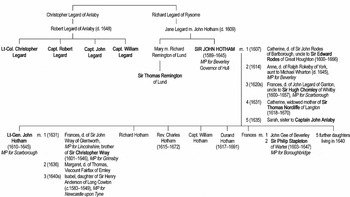
Sir John and his eldest son had married eight times between them before the outbreak of civil war. They may have enlarged the family estates through these marriage settlements to embrace a swathe of land across the Yorkshire Wolds stretching from Beverley to Driffield. Like most East Riding gentry, their wealth was rooted in agricultural rents. The gross annual rental of Sir John's estates on the eve of war reached an impressive £3,000, making him one of the richest men in Yorkshire. It included land in Allerston, Beswick, Fylingdales, Hutton Cranswick, Howsham, Lockington, Scorborough, Pickering, Risam, and Wilton.Footnote 6 Their virile loins, large family, and numerous offspring placed the two men at the head of a remarkably wide kinship network of northern parliamentarian gentry (see Figure 1), and their early activism for parliament influenced many of these gentry into falling in behind them. Sir John's administrative experience was vast. He had served as MP for Beverley since 1625, and was governor of Hull during Charles I's wars in 1628. He was added to the North Riding bench in 1631,Footnote 7 and was high sheriff of Yorkshire in 1635, proving an energetic collector of ship money. He was colonel of a regiment of East Riding trained bands during the First Bishops’ War in 1639.Footnote 8 He was also governor of Hull that year, but was personally affronted when the king entrusted the Hull magazine to Captain William Legge.Footnote 9
The kinship network of the Hotham family, 1642–1643. Names in bold denote parliamentarian officers.

Despite his support for the Caroline regime in the 1630s, Sir John Hotham had also crafted a reputation for himself as a champion of ‘country’ liberties. He was removed from the commission of the peace and imprisoned for refusing to pay the forced loan in 1627. He grew irritated by the king's increasing demands upon Yorkshire to raise, billet, and pay for the royal forces during the Bishops’ Wars. By 1640 his opposition was vocal. Alongside Sir Hugh Cholmley, he led opposition to ship money in the East Riding. His speeches as MP for Beverley during the Short Parliament of April 1640 attracted the censure of the Privy Council and he was ejected from all his commissions and briefly imprisoned in the Fleet from 8 to 15 May.Footnote 10 During the Second Bishops’ War that summer, he solicited petitions concerning Yorkshire grievances, provoking the king to warn that if Hotham did not desist he would hang him.Footnote 11
Sir John remained MP for Beverley during the Long Parliament and became one of its most active members. David Scott has shown that he was named to over 100 committees between November 1640 and March 1642, often allying himself with John Pym and other leading opponents of the king.Footnote 12 During 1641 he participated in the dismantling of the Council of the North and other instruments of royal prerogative power, easing the burden on his locality when the royal army was finally disbanded and Hull's garrison and governor were discharged.Footnote 13 Despite his identification with opposition politics, several contemporaries noted his distaste for puritans. Sir Henry Slingsby commented that Hotham ‘was manly for the defence of liberty of the subject and privilege of Parliament, but was not at all for their new opinions in Church government’.Footnote 14 Sir Hugh Cholmley noted Hotham's antipathy to puritan ministers and even Clarendon conceded that Hotham was ‘not disturbed by any fancies in religion’.Footnote 15 Although he was no friend to the Godly, his virulent anti-Catholicism and hatred of the earl of Strafford could be counted upon by the opposition grandees. He gave evidence against Strafford and on 19 July 1641 supported a parliamentary proposal to geld priests and Jesuits.Footnote 16
In addition to the context of Sir John's pre-war political activities, a familiarity with contemporary notions of honour is essential to a thorough understanding of the Hotham papers. By 1642, an increasing variety of notions of honour influenced gentry behaviour. Older, traditional conceptions stressed ancient lineage, blood, pedigree, outward display, and hunting. These ideas persisted alongside a more recent tradition that emphasized virtue, education, sobriety, restraint, magistracy, godliness, and public service.Footnote 17 Yet these traditions were not mutually exclusive and were often blended or appropriated for different purposes and audiences. Richard Cust has recently contended that, by the 1620s, Renaissance humanism, classical republicanism, and English Calvinism had melded to generate an image of the virtuous, incorruptible ‘public man’. Drawing upon the writings of the Stoics, such as Plutarch, Seneca, and Cicero, this political culture stressed virtue and constancy, remaining steadfast to one's principles and conscience, as paramount determinants of nobility. In theory, the gentry were supposed to refrain from private interests and to prioritize their duty to serve the public.Footnote 18
The Hotham letters suggest that by 1642 both father and son had dabbled in this fashion for neo-Stoic ideas. Their self-fashioning espoused restraint, duty, and constancy, but they could not eschew the traditional stress on blood, pedigree, and lineage. This is no surprise, because the Hothams boasted an unbroken lineage of direct succession from father to son stretching back to the twelfth century. Such continuity of lineage was held to prove a family's virtue, as longer, purer pedigrees concentrated levels of noble blood.Footnote 19 In part because of this, they were notoriously sensitive to perceived slights. When Sir John Hotham took offence to a change in the order of precedence of justices at the East Riding quarter sessions, he retired to write a hostile account of proceedings.Footnote 20 The earl of Strafford had cautioned the king against upsetting Sir John, considering him ‘extreme sensible of honour, and discourtesies perhaps a little overmuch’, while in 1642 the parliamentary leaders John Pym and John Hampden had to send placatory letters reassuring Sir John that his reputation remained unquestioned.Footnote 21 This temperament led Sir Hugh Cholmley to comment that, in later life, Sir John became ‘so much wedded to his own humour, as his passion often overbalanced his judgment’.Footnote 22 This trait, so evident in the letters, did much to bring about his death. On the scaffold he was required to orate that for ‘rash words, anger and such things, no man has been more guilty’.Footnote 23
Hull and the East Riding in 1642
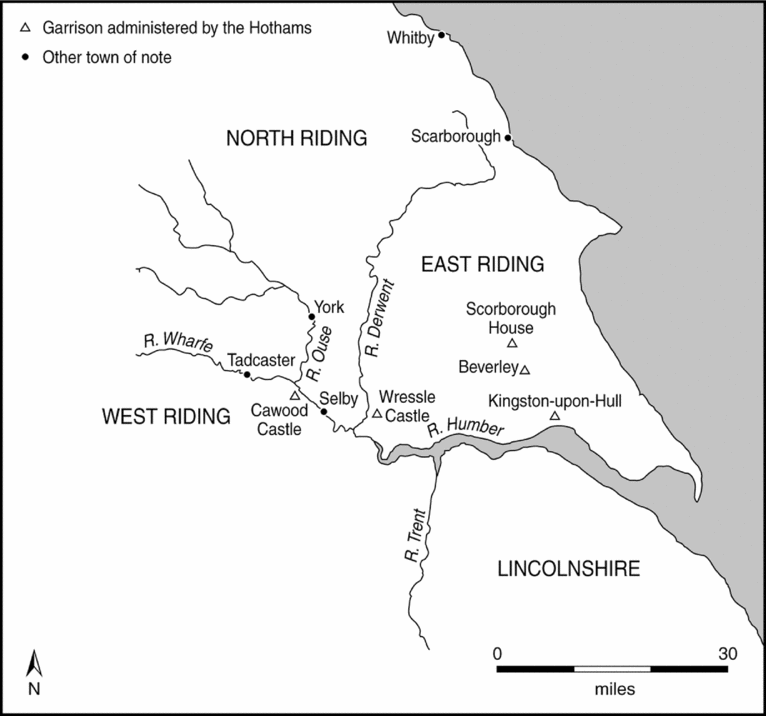
The East Riding was an overwhelmingly agricultural county. Anthony Fletcher characterized it as a ‘basically centralized county’, comparable to Essex.Footnote 24 With a population of up to 80,000 it was the smallest and least populated of Yorkshire's three Ridings.Footnote 25 It consisted of three geographical regions: the low-lying, fertile plains of Holderness east of the river Hull, the rich sheep pastures of the Yorkshire Wolds in the centre, and a lowland area of no predominant character to the west, bounded by the Ouse and Derwent rivers, the Howden marshes, and the limestone hills north-east of York.Footnote 26 The burden of taxation to maintain the Hothams’ network of garrisons fell most heavily upon Holderness and the Wolds. The wapentake of Holderness was separated into three divisions – north, middle, and south – while the Wolds were encompassed within the wapentake of Harthill, which was separated into four divisions: Holme Beacon, Hunsley Beacon, Bainton Beacon, and Wilton Beacon.Footnote 27 Each of these divisions in Holderness and Harthill was headed by a high constable responsible to the high sheriff for collection of ship money and to the deputy lieutenants for mustering the trained bands. Sir John Hotham had experience in dealing with such office-holders in both of these capacities, and the survey of all the foot arms in the East Riding was taken before him in 1636.Footnote 28
The garrisons administered by the Hothams, 1642–1643.
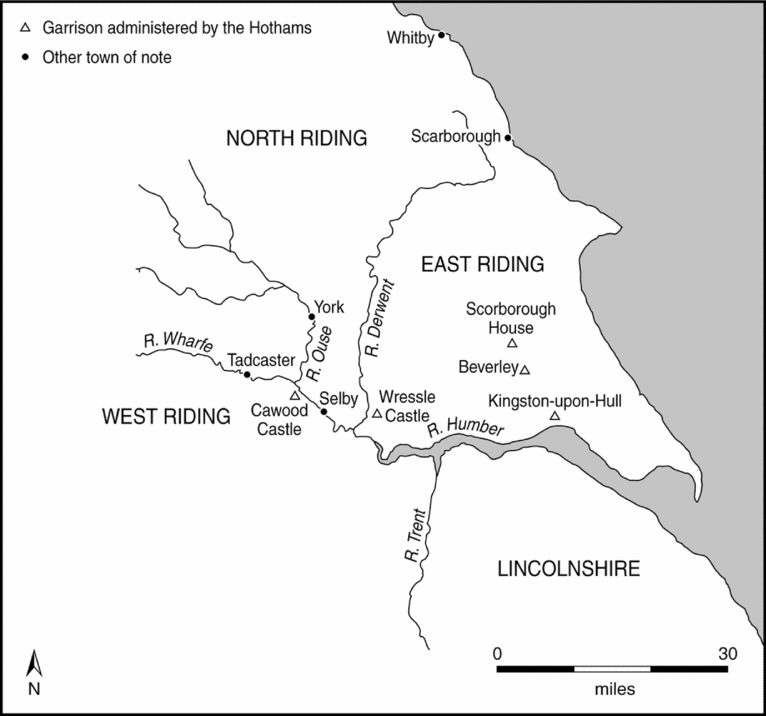
Beverley, with its soaring minster and brick gatehouses, was the East Riding county town, with a population of just three thousand.Footnote 29 Its tiny electorate of twenty-six facilitated Sir John's long incumbency as one of Beverley's two MPs.Footnote 30 Although the Quarter Sessions occasionally still met at Pocklington, by the mid-seventeenth century the court usually met in the sessions’ chamber in Beverley's Hallgarth.Footnote 31 No wall protected Beverley, but the medieval town ditch was broadened in 1642, with footbridges installed at the end of each lane into Westwood.Footnote 32 In October 1642 the corporation ordered the bars to be repaired, as well as locked and guarded each night.Footnote 33 Despite lacking fortifications, Beverley was important to the Hothams as a place to quarter their soldiers. It also played a critical role as a fund-raising centre, as discussed in Appendix II.
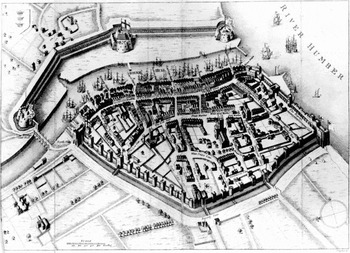
Six miles southward lay the independent borough of Kingston-upon-Hull, a separate county in its own right. Its population had reached seven thousand, making its size second only to York in all Yorkshire.Footnote 34 The extensive river networks of the Trent and Ouse formed a lucrative hinterland and facilitated the export of cloth from the West Riding through Hull into continental Europe.Footnote 35 The inhabitants took civic pride in Hull's walls, their municipal liberties, and the achievements of the corporation.Footnote 36 As a consequence of the Bishops’ Wars, Hull was arguably the strongest fortress town in England. Its natural defensive situation at the confluence of the rivers Humber and Hull was enhanced by the possibility of exploiting the high Humber tides to flood besieging forces. Hull's medieval walls were protected by twenty-five towers and modern fortifications that included an outer ditch, the ‘Bush Dyke’, along with angled bastions, blockhouses, earthworks, forts, and half moons that were rare for England in 1642. A drawbridge had recently been constructed outside the Beverley Gate. Across the river Hull, the town's eastern side was protected by the castle, linked on either side to two blockhouses by a massive wall that was twenty-four feet high and fifteen feet thick.Footnote 37 The town could be supplied and reinforced by sea, while the crews and artillery of naval vessels could contribute to its defence. Furthermore, Hull housed England's second largest magazine, with arms for 20,000 men, 7,000 barrels of powder, and 120 pieces of artillery. Plans were originally formulated in February 1642 to send this magazine to equip government forces against the rebels in Ireland, but both parliament and king soon sought to acquire it for their forces in England.Footnote 38
Wenceslaus Hollar, engraving of Hull, 1640.

In contrast to the divided situation in the rest of Yorkshire, the MPs in the south of the East Riding all sided with parliament. Hull returned two MPs to Westminster, as did the East Riding boroughs of Beverley and Hedon. Sir John Hotham and Michael Wharton sat for Beverley, Sir Philip Stapleton and John Alured for the small town of Hedon, and Sir Henry Vane the younger and Peregrine Pelham for Hull.Footnote 39 Although Wharton changed sides and Hotham attempted to do so, the rest remained committed parliamentarians, with Alured and Pelham even becoming regicides.
The region also had a deep-rooted puritan presence. Godly Protestants were firmly established in Beverley, Hull, and adjacent villages such as Cottingham, Rowley, and Sculcoates. The ministers in Hull had persisted in nonconformity during the 1630s, and had frequently been called before the High Commission at York.Footnote 40 Yorkshire clergymen with similar reputations sought protection inside Hull after the outbreak of hostilities.Footnote 41 Many puritans in Rowley migrated with Reverend Ezekiel Rogers to Massachusetts in 1638,Footnote 42 while Samuel Winter's ‘awakening and piercing’ ministry at Cottingham was sponsored by Lord Fairfax.Footnote 43 J.T. Cliffe has pointed out that there was also considerable puritan strength in several parishes across the northern margins of the East Riding, in the wapentakes of Dickering and Buckrose.Footnote 44
The Hothams at war
Contrary to popular accounts, it was not Sir John Hotham who seized Hull for parliament but his eldest son. He did so in opposition to the king's envoy, the earl of Newcastle, who had been refused entry on 15 January 1642. John Hotham arrived before Hull on 18 January with about three hundred men from his father's East Riding trained bands. When the corporation rebuffed him, he threatened to send to parliament a list of the names of refractory aldermen. Encouraging rumours that the Catholics of Holderness were arming themselves and that the Spanish intended to land, John Hotham utilized the politics of emergency to gain admittance and establish his government in Hull.Footnote 45 He was aided by kinsmen and local gentlemen such as Christopher Legard of Anlaby, William Goodricke of Skidby, John Anlaby of Etton, and Matthew Appleyard of East Halton, who soon held commissions in the garrison.Footnote 46
Control of Hull became even more critical when the king, having fled London, established his court at York on 18 March. Sir John Hotham arrived in Hull during the same week, and on 22 March was ordered not to admit any forces into Hull without orders from both houses of parliament.Footnote 47 Attempting to seize the magazine before its contents could be shipped to London, Charles appeared before the Beverley Gate on 23 April. Sir John had notice of his approach and, fearing the king intended his execution, prepared to defend the town. Charles demanded entrance, but Hotham, standing on the low wall next to the gate, replied that he could not admit him without betraying his trust to parliament, and ‘incurring to me and my posterity the odious name of villain and faith-breaker’. A brief discussion followed before the heralds proclaimed Hotham a traitor and the garrison were invited to throw him off the walls.Footnote 48
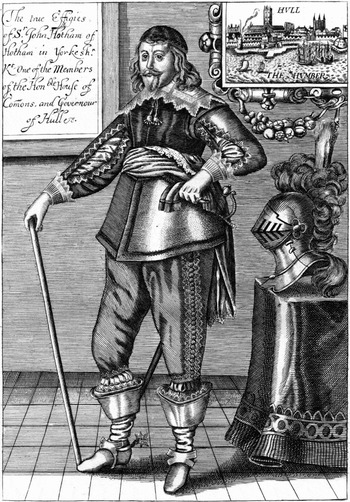
Portrait print of Sir John Hotham.

This affair intensified the propaganda war. Sir Philip Warwick recalled that John Hotham brought the news of his father's stand to parliament with the inflammatory proclamation: ‘Thus hath my father and myself served you; fall back, fall edge.’Footnote 49 Sir John was transformed into a national figure as parliament declared the king's treatment of him a breach of privilege. On 23 May he delivered a speech justifying his actions to a meeting in Hull. This was published as a pamphlet in London four days later, and parliamentarian sympathizers were soon referred to as ‘Hothamites’.Footnote 50 Sir John's example invited seditious talk and polarized debate. On 10 June the Commons ordered that a scandalous picture of him that appeared to suggest he was the king's superior should be burned by the common hangman.Footnote 51 Fears for his life persisted, and on 30 April parliament ordered that John Hotham be appointed governor if his father should die.Footnote 52 On 7 May Margaret Eure called Sir John a ‘poor wretch’ who was ‘affrighted if anything comes but near him’.Footnote 53 To prevent his garrison deserting, Sir John warned them that the king had authorized constables and justices to hang soldiers caught outside Hull.Footnote 54 He requested that parliament despatch a committee of MPs to share in his dangers and responsibilities. On 24 May parliament assented, sending John Hotham, Sir William Airmyn, Sir William Strickland, John Alured, Michael Wharton, Henry Darley, and Peregrine Pelham.Footnote 55
During the summer of 1642 Sir John foiled several plots to deliver Hull to the king. The first, by Mr Beckwith of Beverley, intended to bribe two garrison officers, Lieutenant Fowkes and Captain Lowinger, into betraying the town.Footnote 56 Lord Digby, disguised as a Frenchman, also gained an audience with Hotham in early July. According to Clarendon, Digby persuaded Sir John to deliver Hull if the king appeared in force before it.Footnote 57 Despite lacking the military strength for a proper siege, the king appeared before Hull on 7 July with around 2,500 men.Footnote 58 In the meantime Hotham changed his mind, doubting his capacity to deliver a successful surrender. During the ensuing siege, he was reinforced by two powerful second rate warships, three companies of foot recruited in London, and the Scots commander, Sir John Meldrum, which swelled the garrison to 2,200 men.Footnote 59 Hotham flooded the approaches to Hull by cutting the sluices holding back the Humber and his soldiers vanquished the besiegers in numerous sallies until the king lifted the siege and withdrew.Footnote 60
Despite Sir John's successful defence of Hull, and the king's departure from Yorkshire in August, a general parliamentary mobilization in the county did not follow. As late as September, parliamentarian military preparation elsewhere in Yorkshire was virtually non-existent. Although Ferdinando, Lord Fairfax was proclaimed leader of the West Riding parliamentarians at Leeds on 19 September, he signed a truce with local royalists ten days later to keep Yorkshire out of the war. Understandably, the Hothams were outraged.Footnote 61 Anxious that they would be sacrificed if a premature peace was negotiated, they resented the treaty's conclusion – without their involvement – by those who had risked far less than they had. Both Hothams published vehement declarations against the treaty and John Hotham launched a military campaign to make it unworkable.Footnote 62 He captured Selby on 1 October and then Cawood castle three days later, tightening a stranglehold on the river network upon which York depended for its trade.Footnote 63 The royalists could not permit this to continue and the treaty was broken. On 21 October Fairfax was forced into armed conflict when his Bradford headquarters were attacked, and two days later John Hotham joined Fairfax's men in sweeping local royalists back towards York.Footnote 64 York was blockaded quickly, leaving Fairfax free to despatch Hotham on 9 November to rally the North Riding and defend the Tees crossings against Newcastle's large army gathering in Northumberland and Durham. Although Hotham assured Fairfax that he could prevent Newcastle from coming south that winter, on 1 December Newcastle's royalists routed Hotham's force at Piercebridge and poured south to relieve York. Fairfax withdrew to Tadcaster where Hotham rejoined him, by now mustering around 2,000 men. Newcastle attacked Tadcaster on 6 December, but Fairfax and Hotham held the town until nightfall before slipping away to establish new headquarters at Selby and Cawood respectively.Footnote 65
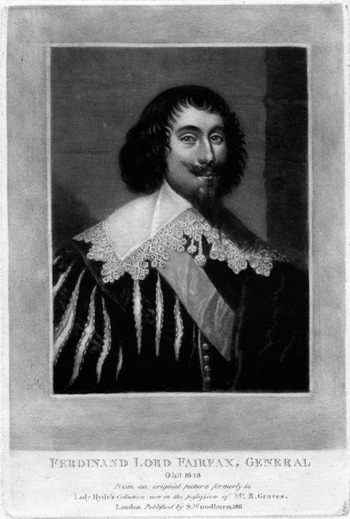
Ferdinando, Lord Fairfax.

Further west, a series of popular uprisings against the royalists was ignited at Bradford on 18 December, when a party of royalists tried to force their way into town. The Pennine clothing districts around Leeds, Bradford, and Halifax faced subsistence crisis as royalist troops prevented them from transporting their cloth to Hull and receiving foodstuffs from the vale of York.Footnote 66 This populous region soon mustered double the numbers that Lord Fairfax had at Selby and began to dictate his strategy. Many recruits were cloth-workers armed with clubs and were so celebrated in London that one newsbook urged all England ‘to rise and execute Bradford Club Law upon the Cavaliers’.Footnote 67 Gentry who had engaged for parliament principally to defend their estates from arbitrary power now feared whether victories for Fairfax's rabble were preferable. In the face of the ‘club-law’ uprisings and his disagreements with Fairfax, Sir John became inclined to a negotiated settlement with the king. On 10 January 1643, the House of Commons ordered that a letter from Sir John Hotham to Lenthall, dated 4 January, should ‘be kept that no man might see it’, implying that it had urged peace.Footnote 68 John Hotham experienced these doubts too, and sought to play upon them by establishing a remarkable correspondence with the earl of Newcastle from mid-December 1642 until his arrest at Nottingham in June 1643.
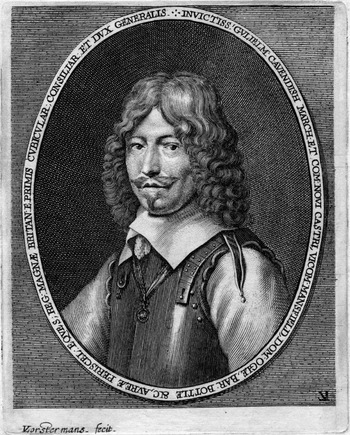
William Cavendish, earl of Newcastle.

By January there was open hostility between the Fairfaxes and the Hothams. John Hotham continued to flout Lord Fairfax's authority, defying the orders of a parliamentary committee and Fairfax's commission as commander-in-chief of the northern counties.Footnote 69 On 12 January a letter from Lord Fairfax ‘concerning some difference in the superiority of commands, between himself and Mr. Hotham’ was read in the House of Commons. The House subsequently ordered that all forces drawn out of Hull should be under Fairfax's command and they desired the Lord General, the earl of Essex, to make a similar declaration.Footnote 70 Instead, Essex ordered the opposite. He instructed Fairfax that the Hothams could recall any of their forces to Hull and that John Hotham, who was commissioned lieutenant-general, would be permitted to continue with his troops as governor of Cawood castle.Footnote 71 Yet Sir Hugh Cholmley later reflected that Hotham was still unsatisfied with this rank, ‘thinking himself not so absolute as before for his father keeping Hull, he commanded in chief in that field, and ranged the country without control’.Footnote 72
This fractured command structure was permitted to continue, and Fairfax complained to parliament on 26 January that Sir John Hotham had hindered him raising money by way of loans upon the public faith.Footnote 73 The next day John Hotham joined Lord Fairfax's son, Sir Thomas Fairfax, at Wakefield, witnessing the clubmen army at first hand after their triumph at Leeds on 23 January. Hotham's presence provoked Sir Thomas to complain to Lord Fairfax: ‘When he saw your lordship's order, he called for pen and ink to copy it out, it seemed by his peevish humour to have taken some advantage by it, but he did not. No order will be observed by him but what he please.’Footnote 74 Reports in London newsbooks that Fairfax and Hotham had reconciled their differences were wishful. The royalist newsbook, Mercurius aulicus, was more accurate, identifying the split on 17 January and reporting on 7 February that it was ‘growing wider every day’.Footnote 75
Lord Fairfax's status as leader of the West Riding Godly deepened this rift, as Sir John Hotham disapproved of puritans and ejected the Godly minister John Shaw from Hull.Footnote 76 Fairfax subsequently allowed Shaw to preach to his army at Selby that his outnumbered troops were ‘the people of God’, who had been ‘scorned and nicknamed a long time for Waldenses, Hussites, Lollards, Lutherans, Huguenots, Precisians, Puritans (or all in one), Round-heads’.Footnote 77 The Hothams were further antagonized by Fairfax's promotion of the sectarian John Alured of Sculcoates to a colonelcy in the spring of 1643. Alured was a former captain in the Hull garrison, from where he had emerged as a vocal critic of Sir John Hotham.Footnote 78
The queen's landing at Bridlington on 22 February further deteriorated the Fairfax–Hotham relationship. Instead of contesting her passage to York, John Hotham waited upon Newcastle at Bridlington under cover of exchanging prisoners, reportedly kissing the queen's hand.Footnote 79 On 9 March Sir John Hotham's son-in-law, Sir Philip Stapleton, reported that, if parliament directed Fairfax to send a thousand men to John Hotham at Beverley, Hotham would ‘hazard a battle with the Earl of Newcastle’ and prevent the queen's passage to York. The Commons subsequently ordered Fairfax to join Hotham in person or to send at least one thousand men.Footnote 80 Reluctant to divide his forces further, Fairfax disobeyed. Nevertheless, suspicions of Hotham grew in parliament that he had complained in a letter to Fairfax that if he were not sent ‘some succours he and Sir Hugh Cholmley must bee forced to take new counsels’.Footnote 81
This threat proved prophetic, as Cholmley (John Hotham's cousin and parliament's governor of Scarborough) declared his change of sides on 25 March. Like the Hothams, Cholmley distanced himself from the Fairfaxes and had previously urged parliament to negotiate peace.Footnote 82 To prepare the ground for his defection, on 20 March Cholmley secretly met the queen at York, before returning to convert a majority of Scarborough's garrison. Sir John Hotham sent Captain Browne Bushell to regain the castle for parliament but was thwarted when Cholmley persuaded Bushell to join him.Footnote 83 The Hothams were angered that their close friend and kinsman had successfully changed sides without co-ordinating his plans with them, and John Hotham vented his disapproval in letters to Newcastle. On 2 April Sir John Hotham's report describing Cholmley's treachery was read in parliament, and Cholmley was impeached for high treason.Footnote 84
Despite having spent months fortifying the place, Fairfax's army abandoned Selby on 30 March. This was partly in response to Cholmley's defection and to fears that the Hothams would follow. Fairfax marched to Leeds in order to join the clubmen in defending the clothing districts, thereby surrendering to Newcastle a passage southward. During the withdrawal, Sir Thomas Fairfax's rearguard was broken and captured on Seacroft Moor. Lord Fairfax blamed the ‘Lincolnshire forces forsaking him’ for his son's defeat.Footnote 85 Desperately short of cavalry, Fairfax was subsequently besieged in Leeds, and one royalist newsbook gloated that John Hotham was much blamed for not coming to his aid.Footnote 86
According to Cholmley, in April John Hotham was invited into Lincolnshire ‘by his alliance and friendship with the Wrays’.Footnote 87 He joined the local parliamentarians with five troops of horse and around two hundred foot, but was defeated at Ancaster Heath on 11 April.Footnote 88 Reporting the royalist victory, Mercurius aulicus alleged that some of the Hothams’ letters to John Pym had been intercepted. A godsend for royalist propaganda, these letters allegedly declared that, owing to Fairfax's secretary, ‘Master Stockdale and his accomplices’, all men of courage had left Fairfax's army ‘but their own clan’.Footnote 89 On 13 April John Hotham's forces again failed to distinguish themselves, deployed alongside Cromwell at Belton. Hotham arrived in Lincoln soon after and wrote several letters to Newcastle about his negotiations with Lincolnshire parliamentarian leaders to lay down their arms. On 5 May Hotham, now styled ‘Lieutenant General of the forces in Lincolnshire’, complained to Speaker Lenthall that Ayscough, Wray, and he had been wrongly accused of failing to prosecute the war vigorously.Footnote 90 Anguish at their suffering reputations, blackened further by military defeats and allegations over the loyalty of their officers, invited these Lincolnshire gentlemen to reconsider their allegiance.Footnote 91 Hotham's reputation was further undermined when Lord Fairfax's report that he had disobeyed orders and deserted him was read in the House of Commons on 22 April.Footnote 92 Hotham was defeated once more, outside Grantham on 17 May, before he crossed into Nottinghamshire intending to delay the planned reinforcements for Fairfax.Footnote 93
Arrest and trial
On 2 June John Hotham was at Nottingham, antagonizing the other parliamentarian commanders. Lucy Hutchinson recalled that, when her husband criticized the misbehaviour of Hotham's troops, Hotham replied ‘he fought for liberty, and expected it in all things’. While Hutchinson and Cromwell wrote to warn parliament that they suspected him of treachery,Footnote 94 the disunity at Nottingham was so notorious in Oxford that Sir Edward Nicholas rejoiced ‘that Hotham and Cromwell are ready to cut each other's throats’.Footnote 95 The Committee of Safety were informed that Hotham held private correspondence with the royalists in Newark, plundered the well-affected, and offered to turn his artillery on Cromwell and give battle to Lord Grey over the latter's refusal to allow Hotham's troopers horse feed. The earl of Essex granted a warrant for Hotham's arrest.Footnote 96 On 22 June Hotham was dragged from his bed and incarcerated in Nottingham castle. There he penned a letter to the queen, delivered by his servant John Keys, inviting her to arrange his rescue. A troop of Lord Grey's horse was guarding him to Leicester, en route to London, when Hotham escaped, allegedly warning Captain Rossiter that ‘we had better be subject to one than 300 tyrants’, and ‘you shall see in a short time that there will be never a Gentleman but will be gone to the King’. He rode to Lincoln, where he discoursed with Lord Willoughby, Captain Purefoy, and others, allegedly remarking that ‘now he had got out of the protection of the Parliament he would keep out’.Footnote 97
The queen, who had known of Hotham's correspondence with Newcastle since at least April, informed Newcastle on 27 June ‘I hope now, that he will be prudent: better late than never.’ The same day she wrote to the king that Hotham ‘hath sent to me that he would cast himself into my arms, and that Hull and Lincoln shall be rendered’.Footnote 98 At Lincoln, Hotham wrote to his father of his escape and prepared the ground for his defection by writing a letter of protest to Speaker Lenthall on 24 June. It was read in the Commons three days later and noted by Sir Simonds D'Ewes. It complained that his arrest constituted an attack on his gentility that was doubly grievous because he had been the first man in arms for parliament.Footnote 99
The House responded by ordering his fathers-in-law, Sir John Wray and Sir Henry Anderson, to write to Hotham to induce him to surrender his person at Westminster.Footnote 100 Instead he returned to Hull, where on 25 June Sir John had responded to his son's note: ‘Your letter came joyful to me, both for the manner & the matter, that you have freed yourself from those false villains [. . .] They little think but that great Anabaptist hath you sure [. . .] I would see you here: we have a great game to play.’Footnote 101 Once reunited with his father, Hotham wrote to Newcastle on 28 June that he had been so maltreated by parliament that ‘no man can think my honour or honesty is further engaged to serve them’. He promised to attend Newcastle as soon as he could, but was unable to do so because his return to Hull had disastrous consequences for his father's government.Footnote 102
Suspicion had already mounted upon Sir John Hotham for his refusal to let ships leave, and for his release of Browne Bushell to Cholmley for an inconsiderable exchange.Footnote 103 The testimony of the Hull gunner, Thomas Coatsforth, suggests that John Hotham's kissing of the queen's hand at Bridlington was known in Hull, while the fortification of the Hotham seat at Scorborough, and Sir John's redeployment of his heaviest artillery in the castle and south blockhouse to dominate the town and docks, had already excited rumour and suspicion. Despite this volatile atmosphere, Sir John prevailed upon Hull's council of war to sign an aggressive letter to parliament demanding justice against Cromwell for having arrested his son. Warning that they now reserved the right to reconsider their allegiance, the letter threatened ‘we shall be excused both before God and man, to do the best we can for our own preservation’.Footnote 104 Captain Lawrence Moyer of the garrison warship Hercules was the only officer who refused to sign, so Sir John ordered his ship to depart. This confirmed Moyer's suspicion of Hotham, previously instilled by a letter from parliament.Footnote 105 He sent a letter to Mr Robert Ripley, asking him to acquaint the mayor of a plot against Hull. Ripley and Moyer organized the seamen and, from 5 a.m. on the morning of 29 June, they seized the Hothams’ officers. Moyer's crew led companies of townsmen into the blockhouses to seize the soldiers’ arms, where Lieutenant-Colonel Christopher Legard was taken after brief resistance. John Hotham was also quickly captured but his father fled towards the Beverley Gate, requisitioned a horse, and rode out. A musket and artillery piece fired after him ‘made him set spurs and gallop as fast as he could’.
Sir John was unable to cross the tidal river Hull into Holderness, having tried at Stone Ferry and then at Wain Ferry, so a servant of Sir Matthew Boynton reached Beverley before him with a note to Boynton's son, Colonel Francis Boynton, to arrest Hotham. As Sir John rode into Beverley, he assumed command of the first company he met, but was soon faced with Colonel Boynton, who, according to one pamphlet account, ‘took his horse by the reins and told him, Sir John, you are my kinsman, and one whom I have much honoured but I must now waive all this & arrest you for a traitor to the kingdom’. Hotham allegedly replied ‘Cousin I will be your true prisoner’, before attempting to escape. He was clubbed from his horse by one of Boynton's musketeers and carried prisoner into Hull.Footnote 106 Later that day, Boynton's soldiers fought off a suspiciously timed attempt from Sir Hugh Cholmley to capture Beverley.Footnote 107 Around a week later, by order of Hull's committee for defence, both Hothams were conveyed on board the Antelope to London.Footnote 108
The two Hothams had arrived in London by 24 July, accompanied by Sir William Fairfax and others who had come from Hull to testify against them.Footnote 109 On 21 August 1643, Gilbert Millington, the MP in charge of the evidences in the Hotham case, reported the examinations of John Hotham and then the witnesses against him, who included Fairfax's secretary at war, Thomas Stockdale, and two of John Hotham's own servants, John Keys and Thomas Hunter. D'Ewes noted that, to save his own neck, Keys accused his master of receiving intelligence from the queen in Yorkshire and at Newark, and that Sir John Hotham intended to deliver Hull to the earl of Newcastle. D'Ewes noted that, although ‘Mr Hotham did answer with a great deal of subtlety and tergiversation’, it nevertheless emerged that he had failed to prosecute the war against Newcastle's army and had frustrated Fairfax from doing so. Then one of John Hotham's letters to Stockdale was read out, in which ‘he did express much spleen & indignation against him’. Another of his letters to Lord Fairfax was read out, stating that he would meet Newcastle at Ferrybridge to discuss a prisoner exchange and would not be bound by a council of war's vote to the contrary.Footnote 110 With the evidence growing against him, on 25 August John Hotham refused to answer further questions, arguing that, ‘in his conscience, he ought not to answer any question that concerned his life, or might accuse himself’.Footnote 111
On 6 September 1643 Sir John Hotham was moved from Alderman Bunce's house to the Tower, where none were to speak with him without his keeper's presence.Footnote 112 The next day he was brought to the bar of the House of Commons ‘not kneeling’, where he alleged his innocence and orated the services he had done parliament. He requested that his wife and papers might be returned to him and then, according to Sir Simonds D'Ewes, ‘he fell a weeping like a woman & could scarce continue speaking’. Sir John appears to have made an enemy of Pym by suggesting that he had secretly transported money and plate overseas. At Pym's request, Lenthall asked Hotham if he knew anything concerning these rumours. Hotham allegedly replied in ‘a fawning flattering way’ that he knew nothing, and ‘if I had said so I had told a famous lie’. According to D'Ewes, this shamed Hotham's own well-wishers. Millington then produced Sir John's unsigned examination, in which he confessed to a written correspondence with Lord Digby. This was enough for him to be ejected from the House and returned to the Tower.Footnote 113
Detained ‘by a real or pretended sickness’ on 7 September, John Hotham was brought to the bar the following day. Like his father, he magnified his service, claiming to have been the first man in arms for parliament. He admitted disobeying Fairfax's orders but claimed that he held his commission directly from parliament. He denied holding correspondence with the queen and Newcastle but said that ‘he wanted not temptations from the said Earl, who proffered him a free pardon & to command a third part of his army, and to be a baron if he would have joined with him’. He pleaded forgiveness for his errors and implored parliament to trust him again with further employment. Instead he was ejected from the House and returned to his imprisonment in a citizen's house before his transfer to the Tower was ordered on 3 October 1643.Footnote 114
Initially it was thought that Essex delayed the Hothams’ trials by refusing to grant a commission of lord president for the necessary council of war. When Essex suggested that John Hotham be tried by the earl's own colonels, some in the House of Commons feared that he intended an acquittal, and further debate was postponed on 12 October.Footnote 115 Essex set the date for the trials as 8 December 1643 but the Commons responded that this was too soon for all the witnesses to be ready.Footnote 116 The political struggle over the Hothams’ fate grew violent when a key prosecution witness, Colonel Francis Boynton, who had arrested Sir John, was assaulted in New Palace Yard in February 1644 by three sons of Sir Christopher Wray.Footnote 117 The Hotham cases languished until 4 June 1644, when Sir John Wray launched a motion for his son-in-law, John Hotham, to either stand trial or be released. After a long debate it was resolved to send him to Lord Fairfax in Hull, as many of the witnesses remained in the north.Footnote 118 Yet this order was never carried out and evidence against the Hothams mounted when three of their letters, allegedly offering to betray Hull, were taken from Newcastle's coach on Marston Moor and delivered to Gilbert Millington.Footnote 119
A court martial under the chairmanship of Sir William Waller was eventually prepared to try the two Hothams. Thirty-three letters concerning Hull and the Hothams were delivered to the judge advocate on 19 October 1644 and nine more on 29 November.Footnote 120 On 2 November Sir Philip Stapleton procured parliamentary approval for Durand Hotham to help prepare the defences of his father and brother.Footnote 121 Durand was to act as Sir John's amanuensis throughout the trial and Sir John was permitted to call any MP as a defence witness. The charges laid against Sir John on 30 November were that he had betrayed his trust and adhered to the enemy. They incorporated refusing to supply Fairfax with powder, uttering scandalous words against parliament, and endeavouring to betray Hull. Sir John's incriminating letter to his son of 25 June 1643 was also included.Footnote 122 Among the prosecution's thirty witnesses were Thomas Stockdale, Colonels Francis and Matthew Boynton, the naval captains Lawrence Moyer and John Lawson, and the minister John Saltmarsh, as well as John Bernard, Maccabeus Hollis, and Thomas Coatsforth, a Hull alderman, merchant, and artillery officer respectively. They further included the servant John Keys and one Mr Rolston, secretary to the earl of Newcastle.Footnote 123 The defence's notes and interrogatories for witnesses survive among the family papers, although some of the notes are fragmented and in poor condition.Footnote 124
Sir John crafted an elaborate defence. Conducted on 2, 3, and 4 December, several drafts and a polished version of this survive.Footnote 125 He denied that he intended to betray Hull, magnified his services to parliament, accused Lord Fairfax of backwardness, and argued that Thomas Stockdale and John Alured had been manipulated by the royalists into orchestrating a conspiracy against him. He explained that his correspondence with Newcastle was a strategy he had learned from Count Mansfeldt to deceive the enemy during the Thirty Years’ War. His defence witnesses included his sons William and Charles Hotham, Commissary Lionel Copley, Sir Henry Anderson, Sir Thomas Remington, Lieutenant-Colonel Christopher Legard, Lieutenant Prestman, John Blackwell, Thomas Hunter, and several others. John Hotham's wife, Isabel, was prevented from testifying in her father-in-law's defence, as it was alleged that she had been involved in correspondence with Newcastle.Footnote 126 John Lambert warned Sir Thomas Fairfax that Hotham's defence had been so persuasive that he had ‘left nothing unsaid or undone which may save his life’.Footnote 127 Nevertheless, Sir John was found guilty on 7 December and sentenced to be beheaded.Footnote 128 His wife's petition for his life was laid aside by the Commons four days later.Footnote 129
The court martial began his son's trial on 9 December. John Hotham was charged with betraying his trust, adhering to the enemy, embezzling contributions, disobeying Lord Fairfax, and corresponding with Newcastle and the queen. Unlike the plentiful defence papers in the family collection for Sir John Hotham, none survive for his son, perhaps reflecting his untenable position and the greater certainty among contemporaries of his guilt. John Hotham's trial must therefore be pieced together from other sources. The twenty-seven prosecution witnesses were examined on 10 December and included one lord, one lieutenant-general, six colonels, a lieutenant-colonel, two majors, and four captains, namely Lord Grey of Groby, Oliver Cromwell, Edward Rossiter, Thomas Stockdale, Francis Boynton, Andrew Carter, and William White. There was also damning testimony from four family servants, including John Keys, and a statement from the late Sir William Fairfax that Hotham had attended the queen soon after she landed at Bridlington. John Hotham conducted his defence on 12 December, behaving submissively and seeking in vain to deflect blame onto his father. Of the twenty-six defence witnesses he called upon, all but six were his relatives, servants, or military subordinates. The judge advocate found against him on 21 December and he was sentenced to death on 24 December.Footnote 130
Just before her stepson's sentence, Lady Hotham petitioned the Commons for her husband to have more time to settle his estate and prepare for death. Sir John also petitioned the Lords for a reprieve, ‘seeing that his son's trial is not yet perfected, the doubtful issue of which hath much hindered the settlement of his affairs, and driven him to great anxiety of mind’. He was granted a reprieve of a week longer by eighty-five votes to sixty-five, with Cromwell as teller for those against it. On 28 December Sir John petitioned the Lords to spare his life or his son's, so that ‘his whole family, that was the first that drew their swords in this Cause, may not be cut off root and branch’. The Lords recommended clemency but the Commons, by ninety-four votes to forty-six, refused to concur.Footnote 131 Sir Philip Warwick later believed that these eleventh-hour appeals were because both Hothams had been misguided into thinking that only one of them would be executed, and so ‘the father endeavoured to sacrifice the son, & the son the father’.Footnote 132
On 31 December the Lieutenant of the Tower brought Sir John Hotham out towards Tower Hill, when
a man that had rid very hard came posting to him, with an order from the lords to stay his execution whereupon the throng of the people grew so violent and tumultuous, that all he could do was little enough to save his prisoner from being gotten away, he being got into the press a good distance from him.
The Lieutenant returned Sir John to the Tower, and by the time parliament had been sent word they had risen from sitting.Footnote 133 The next day, on 1 January 1645, John Hotham petitioned the Commons that he was prepared to pay £10,000 and undergo banishment if they would spare his life. This was rejected. Accompanied by his brothers he was taken to be beheaded on Tower Hill. He died unrepentant, refusing to acknowledge his offences, and in his last moments began to speak out against the council of war and parliament.Footnote 134
With his son executed, on 2 January Sir John put another motion to the Commons to spare his life, ‘& it endured some debate in the House, many moving for it’. It failed, however, and Sir John was beheaded on Tower Hill at about 1 p.m.Footnote 135 His scaffold speech proclaimed that he had never betrayed parliament's trust, but that he deserved death for his sins, especially ingratitude and inclination to rash words and anger. In a calculated demolition of Hotham's notion of honour, Hugh Peter informed the crowd that Sir John wished to commend to them ‘the vanity’ of ‘wit, parts, prowess, strength, friends, honour, or whatever else is merely of a terrestrial nature’.Footnote 136 Warwick's memoirs agreed with contemporary newsbooks that Sir John expected a reprieve on the scaffold ‘but when he began to despair of that, he was desirous to have spoken somewhat more unto the people; but was not permitted: and therefore it might be easily judged, in what confusion of spirit he died’.Footnote 137 After the executions, some mercy was extended to the Hotham family. In May 1645 both Houses agreed to lift the sequestration on the Hotham estates, as it was settled that ‘no attainder lay upon them to corrupt the blood of their heirs upon a judgment of martial law: as if they had been condemned by the Common Law’.Footnote 138
The significance of the trial and execution of the Hothams has been overlooked by many civil war historians, hampered by a lack of concern to connect northern affairs with Westminster. This affair was highly political and conducted at a pivotal moment for the parliamentary cause. Simultaneous with the courts martial, on 11 December 1644 the Self-Denying Ordinance was brought before the House of Commons. Successful prosecution of the Hothams became a test of strength for those in favour of the new modelling of parliament's armies. In this way, the Fairfax interest became allies of Viscount Saye and Sele, Oliver St John, Oliver Cromwell, and the anti-Essex interest. This helped bring the many northern MPs connected with Lord Fairfax into sympathy with the war party and the Independents, who were prepared to take a tough stance on the Hothams. Conversely, those who urged clemency for the Hothams opposed the new army and Sir Thomas Fairfax as its commander, in particular the earl of Essex's supporters and emerging Presbyterian interest, who were often headed in the Commons by Sir John Hotham's son-in-law and the commander of Essex's lifeguard, Sir Philip Stapleton. When the Commons voted to reject clemency for Sir John, predictably Cromwell was teller for the anti-Hotham vote, with Stapleton opposing him.Footnote 139
In their victory over the Hothams, the Fairfaxes knew how to add insult to injury. Sir John Hotham's garrison regiment of foot was reorganized to become Lord Fairfax's own regiment of foot. Fairfax appointed Thomas Stockdale to inventory the Hothams’ confiscated possessions, and, in a calculated affront, their rich apparel was sold to Fairfax's officers in lieu of their weekly allowance.Footnote 140 Isabel Hotham's will of 8 October 1651 complained that ‘all mine and my husband's money, plate, jewels, goods, and personal estate, to the value of £7,000 at the least, was unjustly seized and taken away at Hull for satisfaction’.Footnote 141
Sir John's government of Hull had been highly autocratic, and few outside his family mourned his passing. His confrontational temperament proved ill-suited to the testing demands of the parliamentary cause. In the face of siege, his co-operation with the corporation extended to pulling the mayor's gown over his head and setting a guard upon his house.Footnote 142 He accused Hull's MP, Peregrine Pelham, of uttering scandalous words against him and procured an order for Pelham's servant to be sent to parliament as a delinquent.Footnote 143 After Sir John's arrest, the corporation were quick to accuse him of tyrannical government and obliteration of their liberties.Footnote 144 One local minister lamented the ‘harsh usage’ that Sir John had meted out on the Godly, and declared that his arrest was an occasion of ‘great joy’ in the town.Footnote 145 Sir Hugh Cholmley later marvelled that, during the coup against him, Sir John could not find ‘so much as one man to lift a hand in his behalf’. Cholmley attributed this to Hotham's notorious ‘straight-handed’ manner with his garrison's pay, when it was well known that he was ‘rich in purse’. Bulstrode Whitelocke agreed that Hotham's ‘rough carriage’ towards his own soldiery alienated them. Sir John might have avoided this, considering that his personal estate in 1643 has been estimated at £10,000, of which at least £4,800 was in ready money. According to Cholmley, Sir John was ‘of a rash and hasty nature’, while Wentworth concurred that he was ‘extreme sensible of honour, and discourtesies perhaps a little overmuch’.Footnote 146 The Hothams’ place among the most status-obsessed of gentry families was therefore a key factor in their ruin. Next was their realization that they had so disobliged the king that only by delivering him an exceptional advantage would their defection be satisfactorily accepted. Yet their procrastination indicates that a conspiracy to deliver Hull, Beverley, and Lincoln to the king was beyond even their impressive network.
The Hothams’ unique position, as well as their temperament, was inclined to polarize factional conflict within the parliamentary cause. Both had been forced to choose their allegiance at a very early stage, when armed conflict still appeared unlikely. Sir John grew despondent as the destructive effects of war became apparent, and increasingly quick to take personal affront when parliament found paying his garrison difficult. Gardiner explained the falling away of the Hothams from parliament as happening because they had taken up arms ‘from political rather than from religious motives’, and that therefore they ‘felt themselves ill at ease as the cause for which they fought showed itself as more distinctly Puritan’. The most prominent Yorkshire turncoats, such as Cholmley and the Hothams, certainly tended to be religious moderates.Footnote 147 Yet the seeds of their disaffection also lay in the fractured and contested parliamentary command structure in Yorkshire, their disdain for the Fairfaxes, and their suspicion of an army of clubmen mobilized in the West Riding clothing districts.
In response to mounting perceived slights, and prompted by fears for their persons and estates, the Hothams considered the ultimate sanction of changing sides. Clarendon remarked that Sir John was ‘a man apt enough to fear his own safety’,Footnote 148 and this is hardly surprising given the plethora of reported assassination attempts against him and his son.Footnote 149 There had been much talk among royalists of seeing him hanged, and from June 1642 he remained among the few parliamentarians exempted from pardon.Footnote 150 There was little sympathy from royalists after his arrest; Sir Edward Nicholas declared that both Hothams deserved punishment, ‘for falser men then he & his son live not upon the earth’. Likewise, hoping to portray his own trimming in a more positive light, Lord Savile echoed condemnations of Sir John: ‘how infamous, how inconstant, how detestable a traitor that man was’. Whitelocke considered Hotham ‘high and morose’, while Clarendon recalled him as ‘a rough and rude man; of great covetousness, of great pride, and great ambition; without any bowels of good nature, or the least sense or touch of generosity’.Footnote 151 This chorus of contemporary abuse from across the political spectrum indicates the full cost of miscarriage for failed turncoats. Sir John Hotham and his son paid for their change of heart not just with their lives but also with their posterity.
By 1643 the Hothams’ notion of injured honour undermined their allegiance. This sense of honour militated them towards royalism after they had chosen to support parliament; their notions of self-worth and concept of honour were unable to adapt to the horrors of popular uprisings, yeomen captains, and sectarian officers. They also lacked restraint in dealing with subordinates. Sir John Hotham's refusal of the king at the Beverley Gate on 23 April 1642 was the parliamentarians’ greatest strategic achievement that year. Yet, only the following year, had the Hothams’ attempted defection been better co-ordinated, their conspiracy might have proved fatal to the entire parliamentary cause. They planned to surrender three thousand men, plus the towns of Hull, Beverley, and Lincoln, just when parliament's fortunes were on the verge of collapse. Having saved the parliamentary cause in 1642, in 1643 they might have destroyed it. Their examples demonstrate better than any the fluid nature of allegiance during the English Revolution.
Provenance
Since 2010, the Hotham papers have been held in the Hull History Centre as part of the archives of the University of Hull; further letters survive in the British Library and the Bodleian Library at the University of Oxford. The civil war letters, papers, and tracts that remained in the Hotham family were deposited by Henry Frederick Hotham, 7th Lord Hotham, in the East Riding Record Office in 1954. The collection was transferred to the Brynmor Jones Library and Archive at the University of Hull in 1974, before its recent transfer to the new Hull History Centre. The collection is primarily made up of manuscripts and pamphlets, with few larger printed books because Sir John Hotham's books were taken by Thomas Raikes, mayor of Hull, after his arrest and passed on to Lord Fairfax, who later donated them to York Minster Library as part of his failed attempt to establish a university in the north.Footnote 152 The large family collection of printed pamphlets in DDHO/2 is discussed and listed in Appendix I.
The part of the manuscript collection dealing with the civil wars and the interregnum encompasses eighty-six items dated between 1641 and 1660. There are letters addressed to Sir John Hotham from prominent parliamentarians such as John Pym, John Hampden, and Ferdinando, Lord Fairfax. There are also many papers relating to the trial of Sir John Hotham in December 1644, which together formed the materials used in his defence: these include an early draft of Sir John's defenceFootnote 153 and an altered and rewritten version in his own hand for delivery during his trial,Footnote 154 as well as drafts of part of his defenceFootnote 155 and two copies of the defence made in a later, eighteenth-century hand.Footnote 156 There are further papers handling the disposal and inheritance of his estates. Most of the collection is in good condition, although some of the defence notes relating to the trial are torn and fragmented. Of central interest is a series of sixteen copies of letters written by Sir John Hotham and John Hotham to the royalist general William Cavendish, earl of Newcastle. The dates on these copies range from 18 December 1642 to 26 April 1643, and historians have often confused father and son in attempts to ascribe authorship.Footnote 157 This uncertainty can be resolved by knowledge of the military narrative and attention to the place of writing. Letters signed at Hull were usually written by Sir John Hotham, while his son's letters were penned from his campaign headquarters at Cawood, Beverley, or Lincoln. The originals of many of these letters survive in the Nalson collection in the Bodleian Library, the purpose of the copies that survive in the family collection being to inform Sir John Hotham's defence. As the Hothams’ papers were seized and confiscated at their arrests, Barbara English has suggested that these papers were copies that the prosecution supplied to Sir John's defence, headed by his son Durand Hotham. This might explain the absence from the collection of the Hothams’ more incriminating and less defensible letters written in May and June 1643, with Durand eschewing items that could not be accommodated in the defence or that might prove embarrassing for posterity.Footnote 158
The Hotham letters that survive in the Nalson and Tanner collections of the Bodleian Library are primarily original letters written by John Hotham to the earl of Newcastle, and by Sir John Hotham to William Lenthall, Speaker of the House of Commons. The broken seals remain on many, along with evidence of numbering and heading by notes in another hand on their reverse sides, suggesting that they were subsequently used by the prosecution during Sir John Hotham's trial. On 29 August 1644 the House of Commons ordered that all papers concerning the Hothams were to be delivered to the judge advocate of their court martial;Footnote 159 thirty-three letters were accordingly delivered on 19 October and nine more on 29 November.Footnote 160 These included the three letters taken from the earl of Newcastle's captured coach after the battle of Marston Moor, which were read in parliament and used to press for the Hothams to be brought to trial.Footnote 161 Too late to have been used in the trial, a further letter from John Hotham to the earl of Newcastle dated 3 April 1643 was taken by Sir Peter Wentworth after the surrender of the royalist garrison in Pontefract castle on 21 July 1645.Footnote 162 Wentworth obtained this letter by 5 August and delivered it to the House of Commons on 1 October 1645, along with other letters from both Hothams addressed to Newcastle.Footnote 163
After the trial and execution of the Hothams, these original letters were retained in the office of the Clerk of Parliament, prior to their removal by the royalist historian the Reverend John Nalson for his intended publication of An Impartial Collection of the Great Affairs of State (London, 1683). After Nalson's death in 1686, part of his collection eventually passed to Bishop Thomas Tanner, while the rest went to Nalson's grandson, Philip Williams, who by 1730 had arranged them into bound quarto volumes. Williams also transcribed copies of several of the Hotham letters now in MS Nalson XI. The letters then probably passed to the Reverend William Cole of Ely, son-in-law of Zachary Grey, and then to his brother, Charles Nalson Cole. Their history thereafter remains obscure until Maxwell Lyte discovered them in a cupboard in the duke of Portland's library at Welbeck Abbey in 1885. They were calendared for the Historical Manuscripts Commission by 1891,Footnote 164 and were deposited at the Bodleian Library in 1945 before being donated to the Bodleian in 1987.
Editorial decisions and practice
The objective has been to provide a clear and readable version of these manuscripts, in order to render them accessible to a wide audience. Throughout the text and appendices, therefore, capitals, spelling, and punctuation have been modernized, with abbreviations silently expanded. Where the manuscript source is damaged and words partially obscured, I have endeavoured to supply the legible characters, as they appear. Footnotes have been used to point to other manuscript copies and published transcripts of the documents, and also to identify individuals and provide context for events discussed in the text. Words crossed out within the text are marked with angle brackets, <. . .>, and insertions with asterisks, *. . .*. Where the accuracy of transcription is uncertain the word(s) are embraced by question marks, ?. . .?. Dates are given in ‘old style’, but new years are taken to commence on 1 January.
For ease of reference, the archival shelf number for each document has been given in bold, followed by the author, recipient, and the place and date of its writing. Rather than reproducing the documents in order of their archival references, the transcriptions have been arranged in chronological order. It is hoped that this merging of the Hothams’ papers from a range of archives will facilitate a deeper understanding of their position in the context of the rapidly changing events of 1642 and 1643. While this codification and arrangement has been possible for most documents, a number remain unidentified and undated. Some of these have been approximately dated by their content or by evidence from elsewhere, but, where it has not been possible to date documents beyond reasonable doubt, they have been grouped in a separate section at the end of the text.