Introduction
Poultry feeds generally contain all the main groups of nutrients; carbohydrates and fats for energy, protein for growth and maintenance, as well as vitamins and minerals for metabolic, anabolic, immune and repair processes. The success or failure of a poultry project to a great extent depends on the feeding of the birds. Feed costs alone constitute the greater percentage of total costs of production of poultry meat and eggs, and the relationship between feed ingredients and animal products is both direct and obvious. Conventional feedstuffs can be expensive and scarce, because animal production is in competition with human food resources, which command higher priority and can pay higher prices than compound feed industry (Esonu, Reference ESONU2000).
Marketing consists of business related activities that seek to anticipate demand, help in developing and making the goods and services available to the satisfaction of the consumers or users, at a profit to the organization (Anyanwu, Reference ANYANWU2000). Marketing involves transferring goods from the producers to the consumers in the right place, form and time.
The quality of poultry feed available for use by farmers depends on how marketing systems for feed function in terms of cost and returns for the various operations involved. In Nigeria, expansion through the establishment of large scale industrial schemes to increase production of poultry depends on the efficiency of marketing system. Marketing efficiency could provide a tool in analysing profit made by poultry feed marketers. Results from this study can help design appropriate policies and programmes, both at state and national levels, for improved poultry feed production and marketing.
Feed marketing problems
Poor marketing arrangements, which results in inadequate incentives for producers to increase production, is believed to be a serious problem confronting poultry feed marketers. Marketing has been assigned a passive role in the development process of the economy, with the result that gains in production have been lost through inefficiencies in marketing.
The quantity of feed available for consumption by the birds and the prices paid by the farmers largely depends on how efficient and organised the marketing system is. Since there are often large differences between the price paid by the poultry farmers and that received by the feed marketers, the issue of high marketing costs, which reduces the margin earned by the traders and increases the prices earned by the poultry farmers, arises.
The need for continuous production of poultry feed to meet the demand in poultry farming cannot be overemphasised, but low investment in poultry feed marketing has resulted in feed not being available to poultry farmers and at affordable prices. The price of poultry feed is getting beyond the reach of people in the state, and yet less people seem to be engaged in the marketing business. There is an urgent need to investigate the marketability and profitability of poultry feed in Imo State. This is because if findings show that investment in the business is attractive, such information could attract more people into the business, thus raising investors’ income level as well as their standard of living. The study was set out to achieve the following specific objectives.
1. to examine the socio economic characteristics of poultry feed marketers
2. to describe the organisation of the marketing system, including the marketing channels available for poultry feeds in the study area.
3. to estimate the costs and returns of the enterprise and hence the profitability in the state.
4. to identify the constraints facing the marketers in the study area.
This work was done on the premise that poultry feed marketing is not profitable within the state.
Details of the survey
The survey covered the three agricultural zones of Imo State. The zones are Owerri, Orlu and Okigwe. From each zone, two local government areas (LGAs) were purposively selected; due to the high concentration of poultry feed marketers. In each local government area, two major markets were chosen because of their high involvement in the distribution and marketing of poultry feeds. From each market, a list of registered marketers was drawn up and this gave a total of 99 marketers distributed across the zones, i.e. 35 for Owerri, 30 for Okigwe and 34 for Orlu. Proportionate random sampling was used to draw 60% from each of the registered marketers which gave a sample size of 59 respondents. The study used mainly primary data generated through the use of structured and validated questionnaire distributed to the marketers on a face to face manner with assistance of field assistants. The questionnaire sought information on the socio-economic characteristics of the marketers, purchase and sales prices and quantities purchase and sold.
Data were analysed with the use of descriptive statistics to achieve objectives one, two and four, while objective three was analysed using enterprise analysis and profitability measures following Emenyonu, et al. (2007). The following profitability measures were calculated.
1. Return to management, labour, capital or net income (RMLC) given as RMLC = Total value of sales (TVS) less total fixed costs (TFC) less total variable costs (TVC).
2. Rate of return to investment (RRTI), given by RRTI = ( RMLC/TC)x100%.
3. Return on fixed cost of marketing (RFC) or gross margin (GM) given by RFC= gross revenue (GR) less total variable costs (TVC).
4. Rate of return on fixed costs (RRFC) given by RRFC= (RFC/TFC) x100%
5. Rate of return on variable costs (RRVC) given by RRVC= (GR-TFC) x100%.
The fixed costs of marketing, such as stall rental, tables and scales, were depreciated using the linear method.
Socio-Economic characteristics of respondents
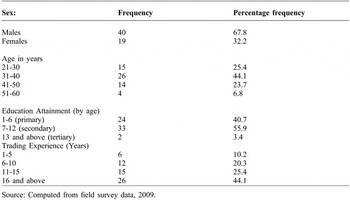
The 59 respondents consisted of 67.8% men and 32.2% women, which indicated that poultry feed marketing is dominated by men (Table 1). The active participation of women indicated that, although the business is dominated by men, women could still do well in the business. The mean age of poultry feed marketers was estimated to be 37 years, this indicated that the business is embarked upon by men and women who are physically and mentally fit to face the challenges that come with the poultry feed marketing. About 41% of the marketers had completed primary education and 56% had experienced secondary education which implies that most of the marketers were literate. This literacy level without doubt, helped them to adapt to changes that are usually associated with poultry feed marketing without having such changes affect their profit negatively. Moreover, the mean trading experience was found to be 15 years, and around 44% of the poultry feed marketers had over 15 years trading experience, while about 20% had less than 11 years trading experience. This suggests that many of the marketers have been in the business for a considerable time and are experienced in predicting possible problems and likely solutions that result in higher income from their enterprises. The summary results of the socio economic characteristics of the respondents are as shown in Table 1.
Socio economic characteristics of poultry feed marketers.

Source: Computed from field survey data, 2009.
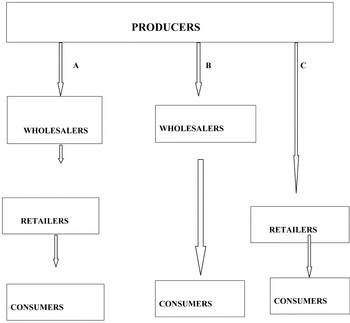
Figure 1 represents typically the marketing channels for poultry feeds in Imo State. From the figure, it can be seen that there are three channels, represented by A, B and C. Channel A forms the main route to sale as it is the most common one used in the area. Here, the feeds move from the producers, to the wholesalers, wholesalers to the retailers and retailers to the consumers. In channel B, the wholesalers buy from the producers and sell directly to the consumers; here the movement of the feeds is from producers to the wholesalers and from the wholesalers to the consumers. In channel C, the retailers buy directly from the producers and sell to the consumers.
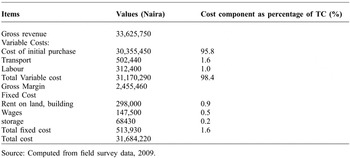
Table 2 shows the data analysis of the costs and returns accrued by an average poultry feed marketer in Imo State in 2009. It indicates that an average poultry feed marketer invested about N 537, 020.70 K in the enterprise. Cost of initial purchase of the feed constituted the greatest share of the total cost, at about 96%. This was followed by transportation cost (1.6%), and labour (1%). The variable cost items constituted about 98%, while the fixed cost items represented only 2%. This implied that poultry feed marketing in this region required minimal capital investment. Furthermore the table shows that a gross revenue of N 33, 625,750 was earned by the marketers, translating to N 569, 927.96 K per farmer. This revenue was earned from the sale of different kinds of poultry feed in the state. A calculated profitability index of 1.06 indicated that the marketers earned N 1.06 on every Naira invested in the business, and signalled that poultry feed marketing is profitable in the region.
Marketing channels for poultry feeds in Imo State.

Costs and returns of poultry feed marketing in Imo State.

Source: Computed from field survey data, 2009.
Profitability analysis
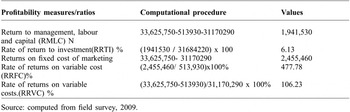
The results of data analysis as presented in Table 3 showed that the rate of return on fixed costs was estimated to be 478%. This implies that, on a yearly basis, every N1 (one naira) cost incurred on fixed assets generated about N4.78K. If this were to be compared with the rate of return to variable costs that was estimated to be 106%, it can be deduced that improving profitability in poultry feed marketing in the study area will require that more effort be put into increasing the efficiency of use of variable inputs. This is in line the findings of Douglas and Stern (Reference DOUGLAS and STERN2006).
Returns to management, labour and capital was estimated to be N161, 794.17 on monthly basis, while rate of return to investment was 6.1%.
Profitability analysis of poultry feed marketing in Imo State.

Source: computed from field survey, 2009.
Constraints to poultry feed marketing.
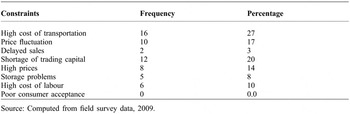
Seven constraints, as shown in Table 4, were identified by the marketers. These included high cost of transportation, price fluctuation, delayed sales, shortage of trading capital, storage problems and high cost of labour. Twenty-seven percent of the respondents considered high cost of transportation of the feed as the most pressing problem. This agrees with the findings of Inyanga, (Reference INYANGA1998), that because the roads are very poor, transporters now refuse to travel to places of manufacture to collect feeds.
About 20% of feed marketers complained about shortage of trading capital, while about 14% were constrained by the high cost of initially procuring the feed. Delayed sales were the least of the problems encountered by the marketers.
Constraints to poultry feed marketing.

Source: Computed from field survey data, 2009.
Conclusions
The findings of this study showed that poultry feed marketing is a profitable venture in this Nigerian state. To make this venture more profitable and attractive to both marketers and potential investors, the following recommendations can be made;
1. Given that the study showed high cost of transportation as one of the major constraints, the government should endeavour to make the roads more useable, where none exist, new roads need constructing.
2. Almost all the marketers started the enterprise with personal savings and about 20% of these respondents complained of shortage of trading capital. Therefore, the government and corporate bodies such as banks should assist through the provision of soft loans to reduce or ameliorate this problem.