

Ward politics tends to keep issues on a local rather than on a citywide basis. When a city undertakes to reconstitute its political system by dropping ward in favour of at-large elections, the change is fundamental, not procedural; elected officials find that they must represent the city, not the ward.
This quotation from the classic text on city politics by Banfield and Wilson (Reference Banfield and Wilson1963: 52) illustrates a foundational point of agreement between opponents in the ongoing debate over the use of ward versus at-large systems of election for city councillors. The point of agreement is that the system of election influences the subsequent representational perceptions and behaviours of councillors. The use of wards incentivizes a representational preoccupation with neighbourhoods and geographically defined areas within cities. In contrast, at-large systems lead councillors to diversify their representational activities in order to represent what they perceive to be the best interests of their cities as wholes (see Berger, Reference Berger2004: 28), which may in fact cloak representational preoccupations with privileged city interests such as land-based private business interests (Elkin, Reference Elkin1987: 36–60). To employ the terminology of the literature on representational attitudes, the unit of election is expected to shape the representational focus of councillors (which is defined simply as the population councillors choose to represent), with ward councillors focused on certain geographic segments of the city and at-large councillors focused on their cities as wholes (on the focus of representation, see, for example, Eulau and Karps, Reference Eulau and Karps1977).
The representational consequences of electoral institutions are well accepted by advocates of both ward and at-large systems of elections; indeed, it is these consequences that make up a significant portion of both sides’ arguments in favour of their preferred systems. Beginning in the late eighteenth century, the US municipal reform movement advocated at-large systems of election explicitly to rid cities of what members viewed as party-associated corruption and the shortsighted parochialism of councillors focused on particular geographic segments of their cities. The use of at-large systems, it was thought, would root out neighbourhood machines and force councillors to take a wider, citywide view in their representational activities; in other words, the change to at-large systems was thought to lead to a necessary and desirable alteration to councillors’ foci of representation.
In contrast, defenders of ward systems note that at-large systems privilege particular segments of cities and allow councillors to ignore entire tracts of their cities, and can point to judicial decisions ruling that at-large systems discriminate against minority communities (Dhindsa, Reference Dhindsa2012; Packer, Reference Packer1982; Scarrow, Reference Scarrow1999: 557; Smith and Stewart, Reference Smith and Stewart1998; Trounstine and Valdini, Reference Trounstine and Valdini2008). These defenders see the perpetuation of both non-partisan local politics and at-large systems as an outcome of the self-interest of sitting elected officials rather than any idealistic focus of representation (Magnusson, Reference Magnusson, Magnusson and Sancton1983: 10). The goal of ward systems of elections is therefore explicitly to incentivize representational focus on certain geographic sections of the city in order to ensure that all citizens, including underprivileged sections of the city, are represented at city hall. The substantial literature focused on the descriptive representation of African Americans, Hispanics and women on US city councils supports this particular consensus, as at-large systems are understood to produce poor representational outcomes for these groups (Bullock and MacManus, Reference Bullock and Macmanus1991; Herrick and Welch, Reference Herrick, Welch and Barker1992; Sass, Reference Sass2000; Taebel, Reference Taebel1978; Tolley, Reference Tolley2011; Welch, Reference Welch1990; but also see Clark and Krebs, Reference Clark, Krebs, John, Mossberger and Clarke2012).
Other studies directly test the relationship between elective institutions and foci of representation. Early work such as the study by Eulau and Prewitt (Reference Eulau and Prewitt1973) found that the vast majority of councillors surveyed in American cities held a citywide representational focus; however, Eulau and Prewitt do not control for unit of election, and the vast majority of councillors surveyed were elected in at-large systems.
In contrast, Welch and Bledsoe (Reference Welch and Bledsoe1988) provide evidence that institutions do shape representational foci. They draw on a survey of American councillors across a range of institutional settings and find that councillors are most likely to report either a citywide or geographic community focus of representation as “Very Important” (79% and 49% respectively). Furthermore, Welch and Bledsoe demonstrate that differences in representational foci are clearly related to institutional differences. At-large units of election are positively related to citywide foci, but are negatively related to neighbourhood orientations. These studies of representational foci are related to the broader literature outlined above, which is concerned with the linkage between elective institutions on the one hand and democratic responsiveness on the other (Brack et al., Reference Brack, Costa and Teixeira2012; Clark and Krebs, Reference Clark, Krebs, John, Mossberger and Clarke2012; Pilet et al., Reference Pilet, Freire and Costa2012).
In this study, we add empirical evidence from Canada to the existing academic literature, which demonstrates the importance of elective institutions to shaping councillors’ representational perceptions. This research builds upon a vibrant homegrown literature that explores and assesses the benefits and drawbacks of both at-large and ward systems of election in Canadian cities (Berger, Reference Berger2004; Dhindsa, Reference Dhindsa2012; Mellon, Reference Mellon1993). We draw on 52 original interviews and a survey of Canadian councillors to test the proposition that electoral institutions shape councillors’ representational focus. We address the following research question: To what extent do the presence of ward and at-large units of election in Canadian cities influence the adoption by councillors of representational foci on specific geographic areas within cities versus their cities as wholes?
This research is grounded in an institutionalist framework. Institutionalist approaches explain the behaviours of political actors by exploring the roles of institutions in shaping both the perceptions and behaviours of those actors (Thelen, Reference Thelen, Steinmo, Thelen, Steinmo and Longstreth1992). In this study, city councillors as representatives are situated in institutional contexts (particularly related to the system of election present) that produce strong incentives for certain representational foci over others. Canada is a particularly useful laboratory in order to study the influence of institutions on representational foci of councillors because, like the US, city government in Canada is characterized by diversity in the institutions used to elect councillors (Sancton, Reference Sancton2011: ch. 9). In addition to their election in wards or at-large, councillors may, for example, represent very populous or sparsely populated wards. Further, some councillors act as representatives within the shadow of amalgamations that created “super cities,” such as Toronto and Montreal, whereas other councillors, such as those in Vancouver, act as representatives within institutional settings characterized by local governments that are much smaller in scope (Sancton, Reference Sancton2008). Further, elective institutions have consequences for democratic outcomes of crucial importance, particularly turnout, which have been understudied in the Canadian context (but see Couture et al., Reference Couture, Breux and Bherer2014).
Both the framework and the relevant literature generate two easily testable hypotheses. First,
H1:
Councillors elected in wards are more likely to have a geographic representational focus.
And, conversely,
H2:
Councillors elected in at-large systems are more likely to have a citywide representational focus.
This study adds further empirical clarification for the role of institutions in shaping both the representational perceptions and behaviours of city councillors. This is achieved in a non-traditional context for the study of city councillors, Canada, and therefore expands this topic of study to different comparative contexts. Furthermore, this study expands our understanding of institutions and the roles of councillors in local democracy: in contrast to members of Parliament, there is very little understanding of the day-to-day perceptions and activities of Canadian city councillors (Mévellec, Reference Mévellec2009; Taylor and Eidelmann, Reference Taylor and Eidelman2010). While this paper does not report on the activities of councillors, it elucidates an important psychological orientation of councillors that affects their subsequent behaviours.
We first describe the interviews and survey that make up the data for this multi-method project. The analysis tests the above hypotheses, first, through a bivariate analysis, then in a multivariate analysis where several control variables are included. The conclusion ends by outlining the paper's contribution to both the literature and the ongoing debate on ward and at-large systems of representation in Canada and elsewhere.
Methodology and Case Selection
A multi-method research design involving interviews with and a survey of municipal councillors in Canada was developed for this project. A multi-method design was used to leverage the unique advantages of both small-n and large-n approaches. Very little has been written about processes of representation in Canadian cities; as a result, a qualitative approach employing interviews was appropriate to generate theory regarding this phenomenon (see, for example, Lijphart, Reference Lijphart1971: 685). The data collected through these interviews, however, were not representative of all Canadian councillors. Furthermore, hypotheses concerning the influence of elective institutions on councillors’ focus of representation could not be adequately tested with only interview data. Accordingly, a survey was employed to achieve these goals.
The multi-method approach employed is a sequential exploratory multi-method design (Creswell, Reference Creswell2003: 211). Such a multi-method approach is designed in such a way that qualitative data collection and analysis takes places prior to quantitative data collection. The advantages of such an approach for this research are threefold. First, phenomena uncovered during the exploration of a small number of cases can inform the design of the subsequent quantitative inquiry. Second, causal relationships suggested through qualitative data analysis can be further explored and, more importantly, tested through the use of large-n data in subsequent quantitative analysis. Finally, triangulation—comparing results from different data sources or by using different methods of data collection (Mays and Pope, Reference Mays and Pope2000: 51)—can strengthen the validity of findings in qualitative research.
Interviews with councillors were conducted both in person and by telephone throughout 2012 and 2013. The interview schedule was semi-structured in order to ensure comparable data were produced but also so that new themes could be explored. The danger of an unstructured interview format is that data cannot be compared; this potential problem was addressed by the addition of a structured component to the interviews (Small, Reference Small2009). Councillors were asked to speak to a number of themes but, in accordance with the semi-structured approach, were given wide latitude to expand on their answers and take the interviews in unanticipated directions. All interviews were recorded and subsequently transcribed.
Councillors were invited to participate in order to achieve variation on a number of institutional and ecological variables related to the cities they served within. All 179 sitting councillors from Montreal, Ottawa, Toronto and Greater Vancouver (Burnaby, Coquitlam, Delta, Richmond, Surrey and Vancouver) were invited to participate in the interviews for this study.Footnote 1 Fifty-two councillors agreed to be interviewed for the project, for a response rate of 29 per cent. Variation on all key variables—including individual-level variables such as gender and time spent in office—was achieved.
The second phase of data collection involved an online survey of all sitting councillors in Canadian cities with populations over 20,000 residents. The survey was conducted in February 2014; 589 out of 1841 councillors responded to the invitation to participate, for a total response rate of 32 per cent. An online survey format was selected because the vast majority of councillors in Canadian cities with populations over 20,000 provide email addresses on city websites. The potential for bias to result from under-reporting of councillors without email addresses or online access, which is a potential problem associated with online surveys, was therefore ruled out (Van Selm and Jankowski, Reference Van Selm and Jankowski2006: 436).
Councillors were asked a range of questions about their representational perceptions and practices.Footnote 2 During the interviews for this project, representational foci were probed through asking three types of questions. First, direct questions were designed to elicit groups that councillors were particularly focused on (for example, “Who do you seek to represent as a councillor? Do you see yourself as representing any particular group of people within your city?”). Second, one question related to conflict between ward and citywide interests was employed to determine the extent to which ward councillors prioritized the needs of their wards versus those of their cities (for example, “Has there ever been a time when what's best for the city and what's best for the ward came into conflict? How did you deal with that?”). Finally, open-ended policy questions were designed to elicit the policy priorities of councillors, which could then later be coded as primarily geographic or citywide in nature.
The responses to these questions informed three sets of questions in the survey that explored councillors’ representational foci. The first was a direct question asking councillors how important their representation of particular groups was, including “a geographical area of the city or a neighbourhood” and “the city as a whole.” Second, a conflict question asking “When voting, do you feel you should be more concerned with the needs of your ward/district or the needs of the city as a whole” was put to councillors elected in wards. Finally, a closed policy question was formulated by combining responses to the opened-ended question asked in the interviews: “In your opinion, how important are each of the following policy areas to you as a council member?” In this and other closed questions asked in the survey, the options available to respondents were generated inductively from semi-structured questions asked during the interviews with councillors that came beforehand.
While we had three measures of representational foci available to us from the survey, we have selected the direct measure for analysis only for three reasons. First, the conflict question in the survey was asked only of councillors elected in wards and so could not be used to address the research questions in this paper. Second, it was not always clear in coding responses to our policy questions which answers indicated a geographic focus and which indicated a citywide focus. Finally, the use of the direct measure only was conducive to addressing our research questions within the context of a relatively short article.
Analysis
The research question for this paper is to what extent does the presence of ward and at-large units of election in Canadian cities influence the adoption by councillors of representational foci on specific geographic areas within cities versus their cities as wholes. This section provides two examples of these different foci and tests the two hypotheses presented in the first section.
The interviews for this project revealed examples of both geographic and citywide representational foci. The interviews also provide anecdotal evidence in support of our two hypotheses. When asked whom they sought to represent, councillors elected in wards tended to mention citizens within the geographic confines of their wards whereas councillors elected at large tended to mention all residents of their cities. There was, however, important nuance evidence in councillors’ replies to these questions.
In the 2004 report of the Vancouver Electoral Reform Commission, Justice Berger wrote, “I have come down in favour of wards because…they provide for neighbourhood representation and accountability” (Berger, Reference Berger2004: 49). Councillors who were elected in wards often affirmed Berger's argument by reporting geographic foci of representation. Councillor Adam Vaughan, elected in a Toronto ward, provides a good example of a councillor with a local geographic focus. “My job is to represent the residents who live in the neighbourhoods that comprise Ward 20 that I represent. And my job is to make sure that they get city services they have been promised and have paid for and created through their taxes but also to make sure the city services they need or want are delivered to them…in the best way possible.”
In contrast, councillors may also take a citywide focus of representation. The Vancouver Electoral Reform Commission found local support for councillors adopting this representational focus, reporting, “Supporters of the at-large system argue that it results in the election of city councillors with a citywide vision. This was, aside from the more general assertion that the present system was working well, the most forcefully advanced endorsement of the present system” (Berger, Reference Berger2004: 28). Councillor Bruce Hayne, who was elected at large in the British Columbia city of Surrey, emphasizes just such a citywide focus. “[I represent] all of the city as a whole, absolutely. We have to make decisions that are absolutely in the best interest of all of Surrey.”
Geographic and citywide foci of representation are not mutually exclusive; councillors may not view themselves as concerned with the interests of the city as a whole over particular geographic areas or vice versa. Instead, councillors often explained how they reconcile their representational concern for these two units of representation. Councillor Frank Di Giorgio from Toronto, for example, exhibits concern for both units, but, despite his being elected in a ward, ultimately he identifies a citywide focus as his primary focus of representation. “First of all, you're an elected representative of people in an area in the city so you represent the interests of that area. But you also serve as a member of a larger group, council, which presumably has the interests of the city at large at heart. So, notwithstanding that you represent the interests of a particular sub-group, I believe that…your main responsibility is to look after the interests of the larger group.”
Councillor Rick Chiarelli from Ottawa similarly balances the needs of his ward and the city as a whole. For Chiarelli, representation of ward interests takes place through his own work on citywide issues, and his primary representational focus, in contrast to that of Di Giorgio, is undoubtedly on his own ward: “I think my role is to protect the interests of my ward residents and to promote individual strategic initiatives within the ward. … So in every major city issue, there will be nuances that impact each ward differently. So I have to be on top of that. But [I] also find out where individual ward initiatives fit within the city's overall plans and make sure they get [addressed] in a way that has the best chance of succeeding.”
Councillor Peter Chernushenko, also from Ottawa, identifies a clear geographic focus of representation, but presents this as a logical implication of his residence in the area rather than as a result of any electoral imperatives. “It's only natural that I would be aware of and have a soft spot for the issues that are closest to home. That's the neighbourhood, the street that I like to shop on, so I want it to do well. That's the route that I cycle on frequently or the park that my kids play at. There will naturally be a desire to defend, protect and improve those sorts of things.”
Similarly, even when councillors are elected at large, they may report a representational preoccupation with geographic areas they have a particular connection to, especially those in which they reside. Councillor Sylvia Bishop from Delta provides an example of such a representative. “I live in Tsawwassen so I get the mood of Tsawwassen just by being out in the community. To get the same feeling from North Delta is more difficult because I'm not there every day. … [But] at the end of the day, I think the role is to represent the whole community.”
Even Councillor Hayne, who identified a citywide representational focus within the context of Surrey's at-large system, alluded to a particular representational connection to his own geographic community. “I think everybody has some affinity to the geography of where they live. I live in Cloverdale so I tend to be around Cloverdale a lot, shop around Cloverdale. That sort of thing.” These results suggest that while at-large systems may provide incentive for a citywide focus of representation, councillors may still find themselves focusing their representational efforts on certain geographic areas of their cities, which reinforces some critiques of the at-large system (see, for example, Dhindsa, Reference Dhindsa2012).
As noted, our interviews hinted at the presence of a relationship between electoral institutions and representational foci, which would confirm the finding of Welch and Bledsoe (Reference Welch and Bledsoe1988) from their survey of American councillors. However, these findings are not representative and, furthermore, it is possible that self-serving bias may result from councillors’ own accounts of their representational foci. We therefore further explore our research question through the use of our survey dataset, specifically t-tests, to determine whether differences in representational foci are statistically significant between councillors elected in wards and at large and subsequently in a multivariate logistical regression model.
Figure 1 summarizes the percentages of councillors who report a geographic or citywide focus of representation as “Very Important” divided into two groups, those who were elected in wards and those who were elected at-large.
Representational Foci of Councillors Elected in Wards and At-Large

There are significant differences in the extents to which councillors elected in wards and at large rate geographic and citywide foci of representation as very important to them. Seventy per cent of councillors elected in wards report a geographic focus, whereas only 21.6 per cent of councillors elected at large report such a focus. The difference between the two groups is 48.4 per cent, and the difference is statistically significant in a t-test (p = 0.00, two-tailed). In addition, 95 per cent of councillors elected at large reported a citywide focus of representation, whereas 72.6 per cent of councillors elected in wards reported such a focus. The difference is 22.4 per cent, and the difference is again statistically significant in a t-test (p = 0.00, two-tailed).
While these bivariate tests substantiate both hypotheses, it is possible that other variables are related to the distinction between geographic and citywide foci of representation. It is therefore necessary to include several control variables to test the strength of ward and at-large systems on focus of representation. This is achieved through the estimation of two binary logistical regression models with several control variables included as independent variables in addition to an indicator for unit of election to explore the main effects of interest. All control variables have been found in previous studies to affect both representational attitudes and behaviour. These control variables can be separated into three groups: institutional, ecological and individual level.
Three institutional variables are included. First, Population by Chamber Size is a measure of representational load derived by dividing the city population by the size of the council chamber (Downey and Williams, Reference Downey and Williams1998). Second, councillors’ salary is one indicator of professionalized legislative institutions, with higher pay associated with both full-time employment and professional rather than amateur councillors (Squire, Reference Squire2007).
Third, we argue that the presence of parties or slates in city elections is an institutional characteristic of those cities that may act to shape councillors’ representational perceptions. Parties and slates add both structure and a need for co-operation to councillors’ elective and representational behaviours. Furthermore, local voters may use party labels as heuristics in guiding their vote choice (Cutler and Matthews, Reference Cutler and Matthews2005: 363–64), rendering the representational behaviours of individual councillors less important for re-election than in cities where parties or slates are characteristics of local democracy. There is substantial diversity in the presence of parties and slates in Canadian cities; among the largest cities in this sample, for example, Montreal and Vancouver are characterized by entrenched party systems, whereas Toronto is not.
One ecological variable is included: the population of the city in which councillors are elected. Large and small cities impose different representational requirements and obligations on representatives and so are expected to lead to different representational perceptions on the part of councillors. (Ellickson and Whistler, Reference Ellickson and Whistler2001; Johannes, Reference Johannes1984; Thomas, Reference Thomas1992). Stewart (Reference Stewart1997) makes this point in a Canadian context, finding that population is related to citizen engagement and thus the expectations of local representatives. Accordingly, a variable is included indicating the population of the city councillors are elected in (by 1000).
Finally, five individual-level variables are included in the model. First, councillors’ gender is included as a variable since gender influences overall representational approaches (Richardson and Freeman, Reference Richardson and Freeman1995). Second, the total years served in office by councillors is included. Third, the representational style of councillors is included. Style is understood in the literature on representational attitudes to address the extent to which representatives consider themselves delegates—faithful servants of constituents’ opinion—or trustees who are tasked with using their judgment in approaching representational challenges (Eulau et al., Reference Eulau, Wahlke, Buchanan and Ferguson1959). Finally, two variables measuring the ambition of councillors are included. Static ambition refers to councillors who intend to remain in their current positions, whereas progressive ambition refers to councillors who wish to advance to higher office (Herrick, Reference Herrick2011).
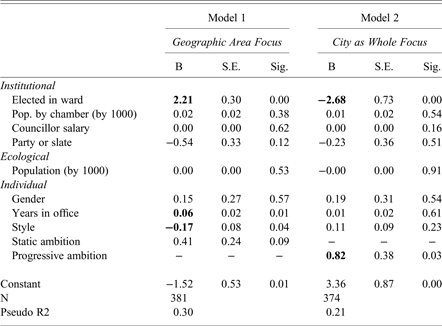
Table 1 illustrates two logistical regression models with the binary response of “Very Important” for geographic areas and cities as wholes included as dependent variables. Model 1 uses geographic focus as the dependent variable, whereas Model 2 employs a citywide focus as the dependent variable. Descriptions of all variables included can be found in appendix 1.
Influence of Ward Election on Likelihood to Adopt Geographic Area and City as Whole Focus of Representation (Binary Logistical Regression)
Note: Bolded values are significant at the P < 0.05 level.
Both models perform reasonably well in explaining variation in the dependent variables, although the first model performs better at explaining variation in focus on geographic areas (31%) than the second model performs in explaining variation in citywide focus (21%).
This multivariate analysis confirms the substantiation of both hypotheses. The presence of wards (and, conversely, at-large systems) has a statistically significant effect on the likelihood of councillors adopting either geographic or citywide foci of representation. Furthermore, both coefficients are in the anticipated direction, with a positive coefficient indicating that wards increase the likelihood of geographic focus and a negative coefficient indicating that at-large systems increase the likelihood of citywide focus. The finding of a relationship between elective institution and focus of representation withstands the inclusion of control variables.
It is worth pointing out the presence of three control variables that also exercised statistically significant effects on the dependent variables. First is years in office, which is related to a higher likelihood of adopting a geographic focus of representation. Second is representational style. Given the coding of this variable (see appendix 1), the positive direction on this coefficient suggests that a willingness to follow one's conscience in making representational decisions is also related to increased focus on geographic areas. Finally, progressive ambition is related to a citywide focus of representation. It is likely that councillors who envision themselves in higher office expand their overall focus of representation to include new groups and neighbourhoods in cities to court future electors. This intriguing preliminary finding is further interrogated below.
Conclusion
This paper explored the role of elective institutions— particularly the use of ward and at-large systems of election—in shaping the representational foci of councillors in Canadian cities. This research provides substantiation for the view that elective institutions are crucial to shaping the representational foci of city councillors. Furthermore, this understanding is derived from an analysis of councillors in a democracy in which the representational perceptions and behaviours of city councillors have not often been studied. The addition of this comparable case reiterates the finding that elective institutions matter for councillors’ foci of representation, with consequences for their representational priorities and behaviours. Further research could expand this finding to other states and institutional settings in order to enhance our understanding of the role of institutions in shaping representatives perceptions and behaviours.
The multivariate research in this article also suggests a further avenue of research: the role of ambition in shaping the representational foci of councillors. It was found that progressive ambition—aspiring to higher office—is related to a citywide focus of representation among Canadian councillors. Councillors who hope to run for higher office as mayor or perhaps to sit in the provincial or federal legislatures as elected officials are more likely to focus their representational activities on their cities as wholes than are councillors who lack such ambition. The explanation underlying this is likely that rational councillors are laying the groundwork for higher office while still in their present positions by reaching out to communities beyond individual wards or geographic areas and that this is reflected in councillors’ own representational foci. Future research could explore the interaction of institutions and individual ambition in shaping representational perceptions and behaviours in city politics.
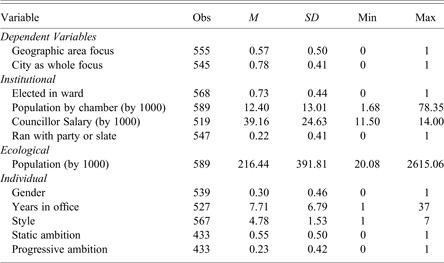
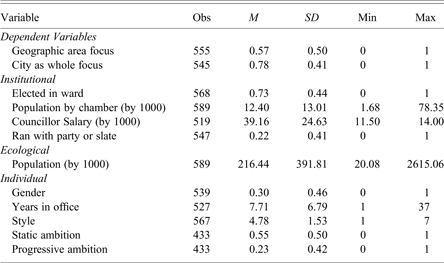
Appendix 1: Descriptive Statistics and Survey Questions for Independent Variables
Descriptive Statistics
Elected in Ward. Survey question: “Are you elected at large or in a ward/division?”
Councillor Salary. Survey question: “What is your annual gross salary as a council member?”
Party or Slate. Survey question: “In the last election, did you run as a candidate with a particular party or slate?”
Years in Office. Survey question: “Including the current year, how many years in total have you served as a council member?”
Style. Survey question: “When you think there is a conflict between what you think is best and what you think people want, do you think you should follow your conscience or follow what the people want?” Responded answered on a 7-point scale where “1” meant “Always what the people want” and “7” meant “Always conscience.” The wording for this question is from Herrick (Reference Herrick2011).
Progressive and Static Ambition. Survey question: “Which of the following best describes what you plan to do be doing five years from now?” The available responses include “Remain on council,” “Hold a higher elected office,” “Hold a lower elected office,” “Hold no elected office,” “Don't know.” This variable was recoded into two dichotomous variables. For the variable indicating progressive ambition, “Hold a higher elected office” was recoded into “1” whereas all other responses were recoded into “0.” For the variable indicating static ambition, “Remain on council,” was recoded into “1” whereas all other responses were recoded into “0.” The wording for this question is from Herrick (2011: 156).