I. INTRODUCTION
For a variety of reasons, and with a sense of urgency heightened by rising concerns about the security of crude oil availability and the safety of nuclear installations, there has been a recent shift in emphasis towards a reevaluation of solar energy as a potentially major contributor to meet the global energy demand. It is congruous to recall that the rate of supply of energy from the Sun to the Earth is almost 104 times greater than current global power requirementsReference Jacobson1; yet traditional photovoltaic solar cells remain disappointingly expensive and inefficient. Nature, however, presents us with numerous examples of high-efficiency molecular systems to harness the energy of sunlight, built on complex arrays of light-harvesting chromophores. The successful determination of many of their structures has spurred on efforts to produce synthetic materials that can emulate the photon capture principles, achieving similarly high levels of efficiency. In consequence, there has been a new focus on developing relatively inexpensive and synthetically reproducible molecular materials designed to emulate the organizational and mechanistic principles that operate in photosynthetic systems.Reference Andrews, Curutchet and Scholes2–Reference Adronov and Fréchet7
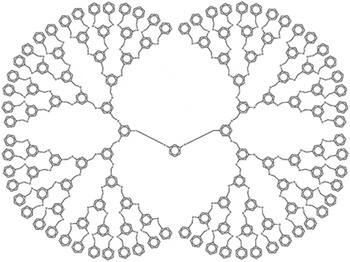
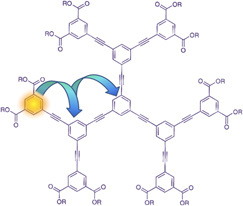
One key to many of the successes in this area has been the design, synthesis, and characterization of dendrimers, which are also known as functional cascade molecules.Reference Dykes6–Reference Palma, Atas, Hardison, Marder, Collings, Beeby, Melinger, Krause, Kleiman and Roitberg17 These materials have a large number of chemically similar chromophores bonded together in a quasi fractal geometry. Often built around a core that acts as a trap for the excitation, they approach an ideal type of structure for solar energy harvesting, expediting highly efficient, ultrafast energy transport.Reference Ranasinghe, Varnavski, Pawlas, Hauck, Louie, Hartwig and Goodson11, Reference Palma, Atas, Hardison, Marder, Collings, Beeby, Melinger, Krause, Kleiman and Roitberg17 Typically, such dendrimers are chemically synthesized by successive peripheral functionalization.Reference Dykes6 Built outwards through successive generations, each expansion forms a new outer shell with additional groups. One typical chemical structure is shown in Fig. 1; other varieties are formed by self-assembly around a lanthanide ion core.Reference Balzani and Vögtle18–Reference Giansante, Ceroni, Balzani and Vögtle21 The increasing proliferation of chromophores on higher generation dendrimers necessarily comes at a cost of larger volume, and hence a reduced concentration of excitation traps per dendrimer. Nonetheless, there remain advantages to the deployment of a dendrimeric antenna structure. Although smaller units could be utilized at higher concentrations, severe complications are often then associated with the increasing effects of aggregation—or crystallization, in the case of solid media. It is therefore a matter of playing off the light-harvesting efficiency of individual dendrimers against the losses, due to exciton coupling and relaxation pathways that arise for systems that are too closely packed together.
Sixth-generation dendrimer, a polymer of 3,5-dihydroxy-benzyl alcohol. Adapted from representation by Kralj and Pavelic.Reference Kralj and Pavelic22 Note that such planar depictions misrepresent the three-dimensional folding that increasingly takes place with successive generations.

II. CUES FROM PHOTOBIOLOGY
The purpose of man-made light-harvesting materials is not in general biosynthesis, but rather a means of achieving the storage of chemical energy derived from sunlight, in readily usable form. Both types of system, nonetheless, deploy the same types of mechanism in the primary stages of energy harvesting, commencing with photon absorption and leading through energy transfer to the population of an electronic excited state—from which electron transfer will often be the next stage. To this end, artificial and natural systems share a common need to capture and efficiently channel acquired optical energy to a suitable repository site. With this commonality of function, important cues can be learned from the structure and operation of photobiological systems,Reference Ball23–Reference Andrews25 enabling ready identification of the following, key components of any molecular light-harvesting system:
(1) Photon absorption: requires structures containing a high density of light-absorbing chromophores with the capacity to act as efficient antennas.
(2) Resonance energy transfer (RET): the provision of a mechanism for the rapid transfer of excitation from the light-absorbing chromophores onwards towards a trapping site.
(3) Intramolecular relaxation: some degradation of the energy from each photon as it travels onwards by steps towards the trap, its direction driven by a spectroscopic gradient.
(4) Local symmetry determines the selection rules for the acquisition and release of photon energy by each component between the antenna and trap chromophores.
(5) Geometric layout determines the efficiency of each energy transfer step, being governed by the spacing and relative orientation of successive components.
(6) Collection of excitation energy at the trap: pooling of the energy from several photons produces the sought electronic activation.
Each of these design principles is put to highly effective use in the dendrimeric species that are used for light harvesting. First, these dendrimer compounds are commonly built from chromophore units with a large absorption cross-section in the visible range. The fractal structure of the polymer tends to produce a proliferation of chromophores on the outermost surface, supporting high efficiency of photon capture. Suitably disposed with respect to each other, the inner building-block chromophores can also act with high efficiency as transient hosts for the excitation energy en route to a trap, often sited at the core. In ideal cases, a spectroscopic gradient directed towards the core assists inward transport of the acquired energy; such a feature can be established with a generation-dependent, varying electronic environment for successively encountered, yet chemically similar chromophores.Reference Shortreed, Swallen, Shi, Tan, Xu, Devadoss, Moore and Kopelman26–Reference van Patten, Shreve, Lindsey and Donohoe30
Most dendrimer structures utilize 3- and 4-fold branching, based on trisubstituted benzene,Reference Archut and Vögtle8 and porphyrin rings,Reference van Patten, Shreve, Lindsey and Donohoe30 respectively. The convergence of the dendrimer branches towards the core assists the pooling of energy from more than one photon initially captured on the outer surface. Often, fullerenes are used as electron acceptors; partly because of their bulk, and also to be accessible to species extrinsic to the dendrimer, these traps more often tend to be located on one of the arms of the dendrimer rather than at its core.Reference Gust, Moore and Moore31, Reference Guldi, Martin, Andrews, Scholes and Wiederrecht32 Another recent development has been the construction of dendrimers whose internal cavities host smaller dye molecules. Exploiting not only intramolecular but also intermolecular (dendrimer—dye) energy transfer, harvesting efficiencies estimated at around 80% have, for example, been reported for eosin embedded in a dendrimer with chromophore groups of four different types.Reference Hahn, Gorka, Vögtle, Vicinelle, Ceroni, Maestri and Balzani33
Understanding the multistep flow of excitation energy in these systems is crucial for better material design. This presents a considerable challenge, requiring a framework of theory that can accommodate fundamental principles from photophysics, implemented with the deployment of structural information and data on energy level and transition dipoles derived from computational quantum mechanics, along with statistical modeling. Despite the daunting complexity, real progress is now being made in this area; some of the key elements and conclusions are described in the following Sections.
III. KEY PHOTOPHYSICS
For dendrimeric molecules the criterion for efficient absorption of radiation is straightforward; it demands that the antenna chromophores—very often the chemical species from which the whole structure is constructed—should display a strong absorption in a suitable part of the electromagnetic spectrum. If necessary, adjunct chromophores can be accommodated to expand the effective absorption range. The molecular property that determines absorption strength is the transition moment, and in most cases this will be a transition electric dipole,  in Dirac notation, where μ is the dipole operator and each ψ is an electronic state wave function: here D designates a chromophore that in its subsequent decay is to become the excitation donor, the asterisk indicating the associated electronic excited state. The transition dipole is a vector quantity with a fixed angular disposition relative to the chromophore; its magnitude can be computed using quantum chemistry software, or calculated from spectra, but its orientation is only accessible from the former. However, since dendrimers carry a multitude of antenna units, each generally at a different angle, the orientation of each individual transition dipole with respect to the electric vector of the input radiation need not usually be a concern.
When a chromophore becomes electronically excited, there is commonly a considerable degree of engagement with the energy levels for local vibrational modes. These molecular vibrations are usually sufficiently numerous that their own quantum levels overlap in a broad continuum; in consequence there is a significant frequency width to the absorption band. Franck-Condon factors generally dictate that, in its excitation, a chromophore will be promoted to a vibrationally excited state within its upper electronic level. Ultrafast intramolecular vibrational redistribution or relaxation (IVR) then ensues, with the result that the most populated energy level in the electronic excited state is generally lowest in its vibrational continuum.
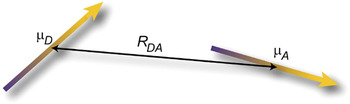
Attention now focuses on the much more intricate mechanism by means of which the acquired excitation energy transfers from one chromophore to another, by a mechanism known as RET. In dendrimers, the presence of nonconjugated spacer linkages precludes significant molecular orbital overlap between its members, and hence interchromophore couplings are primarily Coulombic; moreover electron exchange within the dendrimer is essentially negligible.Reference Tretiak, Chernyak and Mukamel34, Reference Poliakov, Chernyak, Tretiak and Mukamel35 As we shall see, the efficiency of transfer from any given donor, to any specific acceptor with a suitably positioned excited state, has an inverse sixth power dependence on the donor-acceptor separation R DA. To secure the detail, RET can be formulated in terms of quantum electrodynamics,Reference Andrews, Curutchet and Scholes2, Reference Avery36–Reference Salam41 a theory that delivers results applicable to energy transfer across arbitrarily large distances, for systems of arbitrary constitution. The result is a quantum amplitude for the transfer process which, given that the donor-acceptor separations are much smaller than the wave lengths of visible radiation, can be cast in terms of a dipole-dipole coupling V dd as illustrated in Fig. 2, explicitly given by the following expression;

Coupling of transition dipoles moments, μD the decay transition dipole for the donor and μA the corresponding excitation dipole for the acceptor.

where  is the excitation dipole of the acceptor. Based on the Born-Oppenheimer approximation, the transition dipole for the donor decay has the same modulus and orientation as for the donor excitation, vibrational structure having been factored out in each case. However, those vibrational factors are not assumed to be identical; they are separately built into the rate equation that will be exhibited below: details of the derivation are given by Juzeliūnas and Andrews.Reference Juzeliūnas and Andrews39 The term in square brackets in Eq. (1) is known as an orientation factor and usually represented by a kappa, κ. Its presence indicates that for internal energy transfer the orientations of groups within the dendrimer are important (compare the case of the initial excitation)—and that one cannot expect realism from any calculation based on a naïve planar representation. To account for the exact disposition of each chromophore relative to its neighbors, it is necessary to ascertain the three-dimensional folding of the dendrimer, as it clearly must play a significant role. For the donor or the acceptor transition moment in molecules of sufficiently high symmetry, it can also happen that either one or the other is not uniquely identifiable with a particular direction in the corresponding chromophore reference frame. Specifically, the electronic transition may then relate to a transition involving a degenerate state—as can occur with square-planar complexes, for example the study by Galli et al.Reference Galli, Wynne, Lecours, Therien and Hochstrasser42 The considerable complication which each of these effects brings into the analysis of RET has been extensively researched and reported on by van der Meer.Reference van der Meer, Andrews and Demidov43
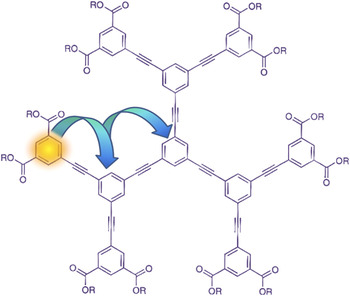
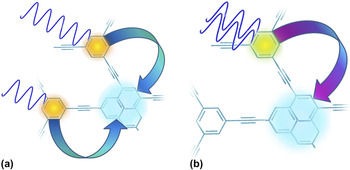
It is the inverse cubic dependence on the distance R DA in Eq. (1) that leads, in the associated rate, to an inverse sixth power, since the latter is given by the square of the quantum amplitude. This determines the fact that any process resulting in the overall migration of excitation, to a trap remotely positioned within the dendrimer, will mostly operate through a series of short hops between closely neighboring chromophores, rather than one long hop. In each step, the unit that has previously acquired electronic energy either by direct photon activation, or through playing the role of acceptor, now acts as donor—see Fig. 3. For most dendrimers, all of the constituent chromophores are chemically similar, though differences in local electronic environment may produce significant spectral shifts. Exploiting such shifts can impose directionality to the multistep flow of energy within the structure.
Second-generation phenylacetylene dendrimer, schematically depicting initial electronic excitation of a peripheral phenyl group, which then acts as donor in transferring excitation energy to a neighboring first-generation acceptor; this chromophore then acts as donor for excitation transfer to the phenaline core.

From this starting point the theory now gives an expression for the rate of pair-wise energy transfer, w, in exact agreement with earlier formulations produced in pioneering work by Förster.Reference Förster44 The following formula is for systems where a host medium for the donor and acceptor has a refractive index n, at an optical frequency corresponding to the mean transfer energy:

In this expression, τD is the radiative decay lifetime of the donor, related to the measured fluorescence lifetime τfluor through τfluor = ητD, where η is the fluorescence quantum yield; ω is the optical frequency in radians per second (ω = 2πν, with ν in Hz) and c is the speed of light. Also featuring in the result is a donor-acceptor spectral overlap represented by the integral. Here, F D(ω) is the normalized spectrum of donor fluorescence, and σA(ω) the linear absorption cross-section of the acceptor. Each of these spectral profiles is expressible in terms of electronic transition properties of the relevant chromophore, taking into account vibrational structure:


Here the indices m, n, p, r in Eqs. (3) and (4) are generic labels denoting vibrational sublevels, ϕ represents an associated wave function and E the corresponding energy; each ρ denotes a population distribution function for the initial state of each species.
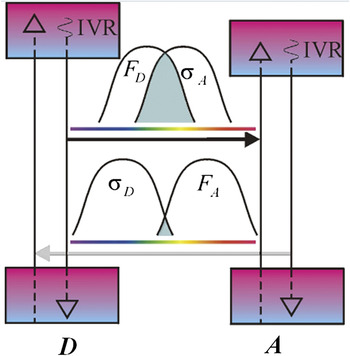
The main physical significance of the spectral overlap in Eq. (2) is that it indicates how efficient energy transfer demands a significant overlap of the donor emission and acceptor absorption spectra. In any energy transfer event for which the donor and acceptor are chemically different—or, if they are of the same constitution, where they are subject to significantly different local electronic environments—there will be identifiable differences between the corresponding absorption and emission profiles. Moreover, as a consequence of the IVR that usually follows each transfer event, and also because fluorescence spectra are generally Stokes-shifted with respect to their absorption counterparts, the propensity for forward transfer, D → A, is usually significantly greater than that for backward transfer, A → D; there can be a sizeable difference in the spectral overlaps for the two processes. Figure 4 illustrates a typical scenario, illustrating why forward transfer is favored.
Energetics for pair-wise RET, and associated spectral overlaps: top for transfer from D to A; below, potential backward transfer, A to D: F—fluorescence spectrum; σ-absorption spectrum; IVR—intramolecular vibrational (or thermal, host-mediated) redistribution/relaxation/dissipation.

In the context of a multistep process of excitation transfer through a dendrimer, it is clearly important to channel the energy efficiently to a purpose-built trap. A random walk would be extremely inefficient, and the unnecessarily long timescale to reach the target would engender an unacceptable level of dissipative losses, especially in a three-dimensional system. So, it is important that structures and mechanisms are in place to impose a directed character upon the energy transfer stages. The fractal dimension of the overall transfer route should be less than that of the dendrimer itself. It is important to observe that for each transfer step between chromophores, there is a close similarity of form between the equations for ‘forward’ transfer as given in Eq. (2), and a ‘backward’ counterpart. The transfer distance is clearly identical; the quadratic involvement of the orientation factor on the unit displacement vector means that this, too, is the same for energy transfer in either direction. Thus it is evident that the key to intrinsic directedness is powerfully influenced by differences in the donor and acceptor spectral profiles.
To quantify the relative rates or propensities for forward and backward transfer it has been found convenient to introduce a dimensionless relative directional efficiency,Reference Andrews and Rodríguez45 defined by:

The combination of intrinsic Stokes shifts and a spectroscopic gradient—namely a downwards displacement in energy of the electronic excited state for the acceptor, as compared with the donor (see Fig. 4), means that values of ε > 1 are commonly attainable—especially where there are extensive differences in the local electronic environment for chemically similar chromophores. The latter feature is extensively evident in natural photosynthetic systems, where the directional efficiency of energy transfer towards a reaction center exploits variations in substituent groups and the steric positioning of chromophores within different regions of a protein host. Although it is less simple to engineer such features in dendrimers, since these systems are by their nature largely composed of identical units, any intergenerational dependent value of ε > 1 can assist the directed channeling of energy towards the core, obviating inefficient of ‘random walk’ transfers; a classic proof of this principle was convincingly made in early work by Shortreed et al.Reference Shortreed, Swallen, Shi, Tan, Xu, Devadoss, Moore and Kopelman26
IV. PROPENSITY MODEL FOR ENERGY TRANSFER DYNAMICS
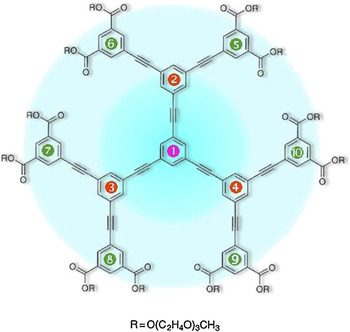
We have seen why it is that energy transfer commonly occurs between nearest neighbor chromophores. An obvious starting point for exploring the dynamics of energy transport through a dendrimer is a model based on the chemical bond connectivity between the chromophore constituents, readily cast in the form of a graph theoretical adjacency matrix.Reference Andrews and Li46–Reference Andrews, Rodrìguez, Bradshaw, Wells, Andrews, Ghiggino, Goodson and Nozik48 The character for the efficiency of transfer between chemically bonded chromophores can then be introduced to give a propensity matrix C, of the same structure, in which a matrix element Crc denotes the relative efficiency of electronic excitation passing to chromophore r from chromophore c. This delivers a construct from which intramolecular population transfer can be modeled—later, we shall consider refinements. For the present, the basic principles are best illustrated by an example; for this we focus on the second-generation dendrimer shown in Fig. 5.
Planar depiction of a second-generation polyphenylacetylene dendrimer, enumerating the ten electronically distinct chromophores, also exhibiting the outwardly constructed shell structure for successive generations.

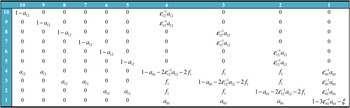
We can define a reasonably small number of parameters to describe the various pathways for energy transfer within this structure; their explicit values are calculable from the dipole-coupling formulae given in Sec. III: a 12 is the propensity for energy transfer to a first generation chromophore from a connected chromophore in the outer, second generation; a 01 is a similar parameter for transfer from the first generation to the core; the corresponding back-transfer propensities are accordingly written in terms of the respective directional efficiencies, defined in Eq. (5), as  and
 . Parameters fg designate a propensity for excitation transfer between neighboring groups of the same generation g, and ξ signifies possible losses from emission or irreversible energy utilization at the core. The elements in the diagonal of the matrix are written in a form that reflects energy conservation, i.e., the sum of elements in each column of the matrix is unity. Hence we obtain the propensity matrix whose explicit form is shown in Fig. 6, which operates upon a vector representation of the initial population conditions; iteration of the procedure models the temporal evolution of energy flow.
Propensity matrix for energy flow within the dendrimer shown in Fig. 5: see text for details.

Such a model in principle affords a means of ascertaining the population dynamics of each and every chromophore within the dendrimer. If the focus of interest is primarily the excitation of a trap at the core, a reduced size matrix based on shell populations can be deployed, with a considerable gain in simplicity.Reference Andrews, Li, Rodrìguez and Slota47 Consistent with earlier works,Reference Bar-Haim and Klafter28 it emerges that for a G-generation dendrimer, the nonzero elements of the adjacency matrix in the shell basis are as follows:
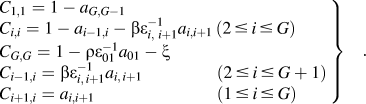
Here ρ is the number of chromophores bonded to the core, and β is the branch multiplicity from the first shell to the periphery; if the central chromophore is identical to the chromophores in each shell, it follows that β = ρ − 1. On this basis the dimension of the propensity matrix is thus reduced to  , the total number of generations, from the number of chromophores given by
 .
There is considerable scope to explore the effects of varying the transfer parameters, to gauge their significance in determining the optimum design criteria for light-harvesting systems. For example, if losses are neglected and a single value is used for the directional efficiency ε between shells, it transpires that the asymptotic population of the core, for the dendrimer shown in Fig. 5, is given by (1 + 9ε−1)−1. Clearly, with no preferred direction of transfer between chromophores, an equal sharing of the excitation would generate a core population of 0.100. It thus emerges that the value of ε is itself a simple and powerful indicator of the improvement in efficiency afforded by introducing a spectroscopic gradient; ε = 1.20 (20% increase) gives a core population increased by 18%; a 40% increase in ε gives a core population increase of 35%. However, closer examination of the model also reveals that if the energy that reaches the trap is irreversibly captured there by any means, a small degree of back-transfer en route to the trap is largely inconsequential.
The simplicity of this approach is beguiling, yet it does have certain deficiencies when dendrimers of higher order are concerned. In larger systems, the onset of significant three-dimensional folding means that energy transfer can no longer be expected to be limited to directly bonded chromophore pairs. Moreover, such folding typically introduces geometrical distortions that undermine the high symmetry cast of the standard propensity matrix. Although modeling based on the latter approach can still in principle be used to assess the extent of folding—as for example by observing experimental departures from the predictions based on a planar model—there are clearly limitations. The adjacency matrix approach is therefore best regarded as a means for exploring the influence of key spectroscopic parameters in a generic fashion, as a means of securing fundamental design principles. Then to address a specific dendrimer system, it makes sense to perform calculations based on the true molecular conformation, as may be derived with the use of quantum chemistry software. There is, of course, a huge increase in complexity and associated calculation time; it is necessary first to optimize the structure and then to determine each of the chromophore pair interactions, based on the photophysics described in Sec. III. However, such an approach introduces another significant refinement; it suggests developing the dynamics within a quantum framework, rather than the population-based propensity method.
V. QUANTUM CHEMISTRY MODEL FOR ENERGY TRANSFER
In seeking to model the detailed dynamics of RET in complex systems such as dendrimers, numerical methods need to be used. Notable examples of the approaches developed for modeling energy flow in other systems include work by Scholes et al.Reference Scholes, Jordanides and Fleming49, Reference Jordanides, Scholes and Fleming50 on photobacterial reaction centers, deploying a generalized Förster approach for Monte-Carlo simulations; also a semi empirical quantum chemical approach used by Wong et al.Reference Wong, Bagchi and Rossky51; master equations used by several groups,Reference Nakano, Kishi, Nakagawa, Nitta and Yamaguchi52–Reference Kim and Cao54 and an extended Redfield approach, by Ishizaki and Fleming.Reference Ishizaki and Fleming55, Reference Ishizaki and Fleming56 For modeling RET dynamics specifically in dendrimers, a wide variety of methods include use of the Pauli master equation by Yeow et al.,Reference Yeow, Ghiggino, Reek, Crossley, Bosman, Schenning and Meijer57 a mixed quantum classical methodology used by Zhu et al.Reference Zhu, May and Röder58, Reference Megow, Röder, Kulesza, Bonačić-Koutecký and May59 and nonadiabatic trajectories deployed by Fernandez-Alberti et al.Reference Fernandez-Alberti, Kleiman, Tretiak and Roitberg60 In a significant survey of the various quantum mechanical methods available for the analysis of RET, Muñoz-Losa et al.Reference Muñoz-Losa, Curutchet, Fdez Galván and Mennucci61 concluded that reasonable estimates could be obtained using moderate basis sets and relatively inexpensive methods, especially when appropriately coupled to realistic solvation models; the choice of the QM level of theory affects the electronic couplings much less than it affects excitation energies.
In more recent work, Andrews and JonesReference Andrews, Jones, Venkatasubramanian, Radousky and Liang62 exhibited preliminary results from an electron dynamics model, evolving a non stationary wave function to model intramolecular energy transfer. This model has previously been used by Jones et al.Reference Jones, Acocella and Zerbetto63 to investigate a wide range of electronic processes, extending from the nonlinear optical properties of fullerenes and electron transfer in DNA photolyase,Reference Acocella, Jones and Zerbetto64 to the photodissociation of water under the influence of an explicit external laser field.Reference Jones, Acocella and Zerbetto65 The application to dendrimer energy flow has three components: first, optimizing the three-dimensional molecular structure; secondly, ab initio calculations of the excitation energies and transition dipole moments; thirdly, the development of a quantum propagator algorithm to simulate the exciton dynamics. The model calculations in this quantum dynamics simulation were performed on a third generation phenyl acetylene dendrimer centered on a phenalene core. This is a molecule that is large enough for steric effects to produce an equilibrium configuration departing from the planar depictions that typically adorn the pages of synthetic organic chemistry journals. As is well known, a small change in a torsion angle near the core can result in groups at the periphery being significantly displaced, and these folding effects can alter the dynamics of energy transfer within the dendrimer.Reference Andrews, Li, Rodrìguez and Slota47 Ab initio optimization of the full molecular geometry is intractable, and instead an ad hoc method was therefore used, introducing torsional rotations about the interior edges of the 2D graph, to obtain a 3D structure. Density functional theory (DFT) and time-dependent density functional theory (TD-DFT) calculations were then performed on the constituent chromophores.
The quantum dynamics simulations used basis functions  corresponding to the chromophores within the dendrimer, the wave function being expanded as
 . In the exciton Hamiltonian, the diagonal elements correspond to site energies, εm, and the off-diagonal elements correspond to dipole-dipole couplings between the chromophores, Δij;
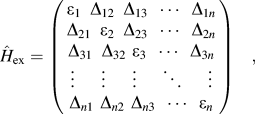

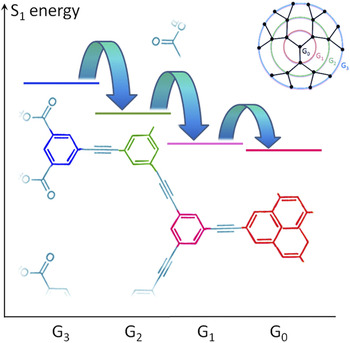
where ρm corresponds to the diagonal element of the density matrix for site m and  are the excited state energies at the chromophore sites, taken from the TD-DFT calculations. For the core the excited state sits 3.3 eV above the ground state, and the third generation chromophores have degenerate excitation energies of 5.3 eV; for the simulation the first and- second generation chromophores were assigned upper limit excited state energies of 3.9 and 4.5 eV, respectively, to give an evenly spaced spectral gradient as shown in Fig. 7. The dipole-dipole coupling terms were calculated explicitly using Eq. (1), based on the optimized dendrimer geometry, with transition dipole moments obtained from the TD-DFT calculations.
Operation of the spectroscopic gradient in successive migrations of energy towards the phenylene core, in a third-generation phenylacetylene dendrimer.

For the dynamics simulation the initial wave function has the exciton localized on a peripheral chromophore and the quantum trajectory can be evolved in time using the Cayley propagator, Reference Press, Teukolsky, Vetterling and Flannery66;

The exciton density within each generation can then be calculated at any time t during the trajectory:

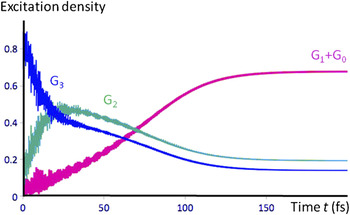
Plotting the summed excitation density for each generation, as a function of time, generates graphs of the form shown in Fig. 8,Reference Andrews, Jones, Venkatasubramanian, Radousky and Liang62 exhibiting a cascading of the excitation density towards the core. The preliminary results are considerably more informative and quantitative than the generic form of earlier propensity studies, but also broadly consistent with those results.Reference Andrews and Li46–Reference Andrews, Rodrìguez, Bradshaw, Wells, Andrews, Ghiggino, Goodson and Nozik48 There is, however, an additional feature in the quantum simulations, not evident in the propensity studies. Very fast beating can be seen, particularly early on in the trajectories. Similar short-time quantum beats have been observed in electron transfer simulations by the Ashkenazi et al.Reference Ashkenazi, Kosloff and Ratner67 although these beats are too rapid for experimental observation. There have been experimental reports of lower frequency beating as evidence of quantum coherence in photobiological systems, where there is a more gradual spectroscopic gradient.Reference Engel, Calhoun, Read, Ahn, Mancal, Cheng, Blankenship and Fleming68–Reference Ishizaki, Calhoun, Schlau-Cohen and Fleming71 Perhaps surprisingly, Zimanyi and SilbeyReference Zimanyi and Silbey72 have had some success in explaining such features using classical electrodynamics. It is therefore a physically appealing conjecture that experimentally resolvable beating might be anticipated in ultrafast spectroscopic studies on other varieties of dendrimer with a gentler energy gradient.
Exciton population density plotted against time. The populations are calculated from the density matrix and the densities of the individual sites are summed to give the total exciton density per generation of the dendrimer.

VI. OPTICAL NONLINEARITY IN DENDRIMERS
Within the wide compass of studies on dendrimeric materials, it is not only their light-harvesting capacity that has aroused keen interest. It has emerged that many such compounds may also display unusually prominent nonlinear optical properties. Reports of exceptionally high two-photon absorption cross-sections and enhanced third-order optical nonlinearityReference Drobizhev, Karotki, Rebane and Spangler73–Reference Wang, Xie and Goodson75 have inspired numerous investigations, and prompted suggestions for the use of such materials in a wide range of applications.Reference Nakano, Kishi, Nakagawa, Nitta and Yamaguchi52, Reference Cho, Choi, Sullivan, Akelaitis and Dalton76–Reference Yan, Xu, Dong, Tian and Li82 It is therefore worth considering the prospect of acquiring the energy of more than one photon, in a dendrimeric system.
In relatively small dendrimers, at low levels of irradiance, it is statistically unlikely for two or more excitation to coexist within the molecule. However in large systems, where the trapping process involves a greater number of energy transfer steps, the typical interval between photon capture by an antenna chromophore and trapping the excitation may approach the mean interval between the capture of successive photons—the latter given by ℏω/Iσ, where I is the irradiance, ω a typical absorption frequency and σ the net absorption cross-section of the entire dendrimer. For ambient solar irradiance (∼1 kW m−2) this condition can apply for trapping times in the microsecond regime; with focused light, the possible copresence of two photons becomes significant on the picosecond timescale. In this connection it is interesting to note supporting evidence from the multiphoton cis-to-trans isomerization observed on infrared absorption in large aryl ether azodendrimers, but not in smaller, related families.Reference Aida, Jiang, Yashima and Okamoto83 Given two or more excitations in a light-harvesting system, there is a possibility that some of the excitations may arrive at a single chromophore through different paths. The rate for such an occurrence depends quadratically on the number of chromophores, becoming quite significant in fifth, sixth or higher generation dendrimers. Multi excitation pooling mechanisms can then be prominent at relatively low light intensities, close to ambient levels, and the associated theoretical representation introduces additional tiers of complexity.Reference Andrews, Bradshaw, Jenkins and Rodríguez84
It is in fact possible to identify and characterize several optically nonlinear mechanisms for directed energy transfer and energy pooling in dendrimers. Such mechanisms fall into two classes: (a) where the excitation of two neighboring donor groups is followed by a collective migration of their energy to a suitable acceptor; (b) where two-photon absorption by individual donors is followed by transfer of the net energy to an acceptor; both are illustrated in Fig. 9. The convergence of excitations in the cooperative pooling process is clearly promoted by the dendrimeric structure. Each transfer process is subject to the usual, minor dissipative losses, but the two mechanisms are subject to quite different conditions. The mechanism favored in any specific system is determined by a balance of factors including the relative positioning of the electronic levels with respect to the photon energy, laser coherence factors, the chromophore selection rules and local architecture, spectroscopic gradient issues and the overall distribution of donors and acceptors. Furthermore, it transpires that quantum interference between different mechanisms can play an important role.Reference Andrews and Bradshaw85
Alternative mechanisms for delivering the energy of two photons, captured by one or more higher-generation or peripheral antenna chromophores, to a neighbor chromophore in a lower generation shell (specific dendrimer components shown only for illustration): (a) the pooling of energy from two outer chromophores, each individually excited by single-photon absorption; (b) direct transfer of the energy acquired by two-photon absorption in a single outer chromophore.

In the detailed quantum electrodynamics of these processes each transfer step is characterized by a form of coupling between ‘donor’ and ‘acceptor’ transition dipoles, similar in structure to the simple case as given by Eq. (1). However, the transition dipoles are typically embedded in electronic response tensors of rank 2 or higher, the rank index correlating with the number of excitations arriving and departing from each involved chromophore; full details are given elsewhere.Reference Andrews, Bradshaw, Jenkins and Rodríguez84, Reference Andrews and Bradshaw85 To gauge the likely significance of each type of mechanism one can start with the assumption that all transition dipole moments and separation vectors are broadly equivalent in magnitude, and that components of each of the rank 2 tensors have similar magnitude to those of the corresponding electronic polarizability. Then, it is possible to show that the relative efficiencies of the processes exhibited in Fig. 9, i.e., w (a)/w (b) = 54α′2/R Reference Dykes6, where α′ is the volume polarizability and R the distance between the participating groups. Assuming the energetics and selection rules allow, the result shows that light-harvesting systems based on small, essentially nonpolarizable chromophores with tightly bound electrons (small polarizability) are generally dominated by the two-photon absorption and transfer sequence, whilst energy pooling is favored by systems with tightly packed donors and acceptors (small separations).
There is one further mechanistic possibility for energy pooling, not illustrated in Fig. 9. It is possible for one chromophore to absorb a photon, passing its excitation on to another neighbor in the same shell which itself absorbs a photon, the combined excitation then transferring to the inner site; this is known as accretive pooling as distinct from the cooperative pooling shown in Fig. 9(a). In principle, accretive pooling is favored for systems with highly polarizable donors, but it is also very strongly influenced by the donor-donor separations. For this reason, it is readily shown that accretive pooling is only likely to become significant in systems with high branch multiplicity β >4; it is seldom important in small dendrimers of 3-fold connectivity such as those illustrated in Figs 3 and 5. However, with the onset of folding in higher generation species the possibility cannot be so easily discounted. Moreover, when selection rules allow, there are distinct possibilities for quantum interference to occur between different mechanisms that lead from the same initially excited to the same trapped-excitation state of the dendrimer.Reference Rebane, Drobizhev, Spangler, Christensson and Stepanenko86
To complete the story on optically nonlinear processes a variety of other mechanisms should be mentioned, although space does not permit their elaboration here. Coherent excitation transfer has already been mentioned; it requires a specialized treatment of theory such as the linearized density matrix method detailed recently by Huo and Coker.Reference Huo and Coker87 However, the most significant departures from Förster transfer, in dendrimeric systems, are probably those processes in which a bridge species serves to mediate the transfer of excitation from one chromophore to another—not by their intermediate excitation but, as described by May,Reference May88, Reference May89 through their electronic influence on the coupling between a given donor and acceptor. In fact energy can transfer even when the usual dipole-dipole coupling entirely fails, for example by engaging with the static field produced by a neighboring, polar chromophore,Reference Daniels and Andrews90 or more generally through the operation of higher order interactions.Reference Andrews and Leeder91
VII. CONCLUSION
Understanding the complex photophysics of excitation transfer in dendrimers is a key to the ongoing design of more efficient light-harvesting materials.Reference Zeng, Li, Chen, Yang and Li92 This article has illustrated some recent developments in the rich tapestry of theory within this arena, drawing upon fundamental principles of electrodynamics, quantum chemistry and computational modeling. With the continued progress in theory taking place alongside advances in synthetic methodology and material characterization, it can be anticipated that dendrimers will continue to occupy an important position in the future of energy materials.
ACKNOWLEDGMENTS
The author is grateful to Dr. Garth Jones for helpful comments. The reported work from the quantum electrodynamics group at UEA is funded by the University, and by the Science and Engineering Research Council.