Introduction
The demographic transition is a set of stages that all societies go through as they develop and modernize. The first stage is characterized by high mortality and high fertility; the next is a transitional stage characterized by low mortality and high (but falling) fertility; finally, the last stage is characterized by both low mortality and low fertility (Lee, Reference Lee2003). Over the process, mean completed fertility falls from pre-transition levels that differ from society to society to a mean of around one or two children per woman in post-transition societies (Morgan, Reference Morgan2003; Hruschka & Burger, Reference Hruschka and Burger2016; Sear et al., Reference Sear, Lawson, Kaplan and Shenk2016). Despite many differences in the timing and pace of change, as well as variation in the factors associated with each stage, the demographic transition has taken place in all of the developed world and is currently underway, with a very few exceptions, in the rest of the world (Hirschman, Reference Hirschman1994; Lee, Reference Lee2003).
Evolutionists remain puzzled about the fact that the demographic transition appears to have created a maladaptive outcome for people (Vining, 1986, Reference Vining2011; Borgerhoff Mulder, Reference Borgerhoff Mulder1998; Sear et al., Reference Sear, Lawson, Kaplan and Shenk2016). High-status men and women in economically developed societies have more resources at their disposal than ever in the history of the world, but they appear not to turn them into the numéraire of evolution–offspring. Instead, they develop their careers, creativity, hobbies and other non-reproductive pursuits (Hirschman, Reference Hirschman1994; Newson, Reference Newson2015). The growing consensus among evolutionists is that this is maladaptive, as people in modern societies appear to no longer maximize fitness in terms of numbers of offspring and consequently numbers of genetic descendants (Kaplan et al., Reference Kaplan, Lancaster, Johnson and Bock1995; Borgerhoff Mulder, Reference Borgerhoff Mulder1998; Goodman et al., Reference Goodman, Koupil and Lawson2012).
This paper takes issue with this emerging consensus. First, while below-replacement fertility is clearly malaptive for the group, it is not necessarily maladaptive for individuals. For individuals of a species what matters for fitness is their share in subsequent gene pools or relative reproductive success, not their absolute fertility (see also Turke, Reference Turke1990; Jones & Bird, Reference Jones and Bird2014). Given this, even if the group is shrinking, an individual is reproductively successful if his or her genes are disproportionately represented in subsequent generations. Even in societies with extremely low fertility, outcomes for high-status individuals are adaptive if those individuals continue to have a greater share of subsequent gene pools.
Individuals compete with each other for social status and resources within their social groups (Alexander, 1987, Reference Alexander1989; Irons, Reference Irons1998). Individuals also probably evolved to invest in their offspring so they will be competitive within the same group (Turke, 1989, Reference Turke1990; Irons, Reference Irons1998; Shenk et al., Reference Shenk, Kaplan and Hooper2016). For these reasons, individuals probably calibrate their number of children and their investments in those children to their group. As Turke (Reference Turke1990) noted: ‘decisions about the distribution of parental resources … depend on how others are distributing such resources’. Such status and resource competition for self and offspring may limit individuals’ absolute fitness, but may not limit their relative fitness in the group.
For humans the relevant group is the endogamous group or breeding population. The endogamous group is a culturally and geographically limited group shaped by cultural products such as marriage rules and national borders, but it has biological consequences for gene pools and consequently inclusive fitness considerations, both in the present (Hamilton, 1971, Reference Hamilton1975; Harpending, 1979, Reference Harpending2002; Salter, Reference Salter2008) and the future (Whitmeyer, Reference Whitmeyer1997; Fox, Reference Fox2015). Thus individuals probably preferentially mate within the endogamous group because it has fitness benefits. The formation of such groups and the favouritism of others within the same group reappear throughout human history. An individual’s children will be competing for mates within this same group, so what matters for individual reproductive success is that they and their children be competitive within this group. From this point of view, the reproductive success, or lack thereof, of other individuals in other groups or populations is irrelevant.
Given the importance of relative fitness, the relationship between status and fertility must be examined within endogamous groups. This paper examines the relationship between status and fertility as revealed by studies of different social groups that may be considered endogamous groups in different parts of the world in each of the three stages of the demographic transition–before the transition, during the transition and after the transition. Fitness is measured as the number of surviving offspring–a measure that predicts long-term fitness (Kaplan et al., Reference Kaplan, Lancaster, Johnson and Bock1995; Goodman et al., Reference Goodman, Koupil and Lawson2012). Measures of individual social status vary by society. It can be assumed that if high-status individuals have more offspring than low-status individuals in the same population, then it is likely that fitness maximization occurs within constraints, as high-status individuals probably have more access to resources and face fewer material and social restraints than low-status individuals.
A novel feature of this paper is that male and female fertility are examined separately, unlike in previous reviews of the relationship between status and fertility (e.g. Skirbekk, Reference Skirbekk2008; Morita, Reference Morita2017). Most previous reviews cover demographic studies of the relationship between status and fertility that overwhelmingly rely on measures of female fertility and not male fertility. Yet theory from evolutionary biology suggests that the relationship between status and fertility will differ for men and women. Given greater female fixed biological investment in offspring coupled with substantial male parental investment, the operation of sexual selection means that females are likely to choose males who are best able to invest in their offspring, while males are likely to be less choosy (Bateman, Reference Bateman1948; Trivers, Reference Trivers1972). In humans, females are likely to choose higher status males as mates as such males are best able to invest in offspring. There is evidence that women across cultures do have a greater preference for status in a mate than men (see Buss, Reference Buss1989; Wiederman & Allgeier, Reference Wiederman and Allgeier1992; Buss et al., Reference Buss, Shackelford, Kirkpatrick and Larsen2001; Henry et al., Reference Henry, Helm and Cruz2013). Throughout history, high-status men have typically far out-reproduced low-status men (Betzig, Reference Betzig1986). For this reason it becomes essential to examine the relationship between status and fertility separately for males and females. Only then can the question motivating this paper–‘Is fertility after the demographic transition adaptive?’–be fully answered.
Pre-transition, traditional societies–high-mortality, high-fertility societies
In pre-industrial societies the reproductive success of high-status men is clear, and often facilitated by polygyny (de facto or de jure) among higher status men (Von Rueden & Jaeggi, Reference Von Rueden and Jaeggi2016). What constitutes status in a particular society differs somewhat from society to society, although it is always associated with increased access to social and other resources.
In small-scale societies such as hunting and gathering, fishing, herding, and horticultural societies, the available data on male fertility show that high-status men in those societies out-reproduce low-status men. For example, among the hunting and gathering group the Aché of Paraguay, a man’s hunting ability was positively correlated with his number of children (Kaplan & Hill, Reference Kaplan and Hill1985; Hill & Hurtado, Reference Hill and Hurtado1996). The same was true among the Meriam hunter–gatherers of Australia (Smith et al., Reference Smith, Bird and Bird2003); and among hunter–fisher trappers in northern Siberia (Ziker et al., Reference Ziker, Nolin and Rasmussen2016). Chagnon (Reference Chagnon1979) presented evidence that among the horticulturalist Yanomamo of Venezuela, who were frequently at war with their neighbours, having killed a man elevated a man’s status and was associated with higher fertility. For the horticultural group the Yali of Papua New Guinea, the source of status for men was number of pigs owned (Sorokowski et al., Reference Sorokowski, Sorokowska and Danel2013). Men with more pigs had more children, and they were also more likely to have multiple wives. Among the Bakharwal of India, men with larger herd sizes had more children than other men (Casimir & Rao, Reference Casimir and Rao1995). Among Caribbean farmers (Flinn, Reference Flinn1986) and among the horticultural Kipsigis of Kenya (Borgerhoff Mulder, 1987, 1988, 1990, 1995, Reference Borgerhoff Mulder1996) it was land ownership that was positively correlated with number of children for men.
In such hunting and gathering, herding, fishing and horticultural societies there is considerable difference in average completed male fertility among the different societies. In Betzig’s (Reference Betzig2012) review, the means for male fertility in such societies are given as ranging from a low of 3.6 children (for the Xavante of Brazil) to a high 12.42 children (among the Kipsigis of Kenya). Variances on completed fertility for men also differ among societies–from a low of 8.07 for the Yomut of Iran to a high of 39.64 among the Yanomamo of Venezuela (Betzig, Reference Betzig2012).
For high-status women in pre-transitional, hunting and gathering, fishing, herding, horticultural societies, average completed fertility for women varies by society, as it does for men, but rarely meets the maximum number of children that women can theoretically have, often given as Hutterite fertility levels of a mean of nearly 11 children per woman (Sear et al., Reference Sear, Lawson, Kaplan and Shenk2016). For example, in a review of literature on means and variances in reproductive success in pre-industrial societies, Betzig (Reference Betzig2012) gave a low completed mean fertility for women of 3.6 children for the Xavante of Brazil and a high of 8.91 children among the Tsimane of Boliva. Variances on completed fertility for women were much lower than for men, as would be expected from evolutionary theory–from a low of 3.57 for the Aché to a high of 12.69 among the Tsimane of Bolivia.
In hunting and gathering and horticultural societies there is evidence that high-status women have more children than lower status women, but the relationship between status and number of offspring is weaker for women than for men. For example, in Papua New Guinea among the Yali tribe, number of pigs was positively associated with both number of children ever born and number of living children, but the correlation was much larger for men than for women (the correlation between number of pigs and number of living children was 0.42 for men and 0.27 for women; Sorokowski et al., Reference Sorokowski, Sorokowska and Danel2013). Among farmers of the Caribbean, amount of land owned was associated with number of children for women as well as men, but the association was much stronger for men (Flinn, Reference Flinn1986).
In larger scale agrarian societies, evidence again shows that high-status men have more children than low-status men. Status in agrarian societies is typically access to economic resources of some sort, although it differs somewhat from society to society, and the measures of status used in studies are also dependent on the available data. In some agrarian societies, elite male fertility is facilitated by polygyny, but even in proscriptively monogamous societies such as pre-industrial Europe, high-status men could have more children through extramarital liasons or through remarriage after the death of a wife. For Krümmhorn farmers in Germany during the 18th and 19th centuries, status was based on land ownership (Voland, 1988, Reference Voland1990; Voland & Dunbar, Reference Voland and Dunbar1995); and men with more land had more children. For men in Lancashire, England, in the 18th century, status was based on occupation and land ownership, with farmers having the highest fertility (Hughes, Reference Hughes1986). Clark (Reference Clark2007) used probate data to determine male fertility for pre-transition England, and found that wealthier men had more children.
In most agrarian societies in Western Europe, marriage for men was dependent on the acquisition of land, wealth and/or an occupation. According to Peterson (Reference Petersen1960), this was expressed in the pre-industrial Netherlands as the principle ‘that a man might not marry until his living was assured’, and this idea that men could not marry until they could afford to support a family was widespread across pre-industrial Europe (Habakkuk, Reference Habakkuk1953). Men with no access to resources (low-status men) by and large did not get married and typically did not have children.
In non-Western agrarian societies there is also evidence that higher status males have more offspring. In pre-modern China, rich men married early and repeatedly, while poor men married later or not at all (Feng et al., Reference Feng, Campbell and Lee2010). In much of pre-transitional sub-Saharan Africa and parts of Asia, the custom of brideprice ensured that only men with means could afford to get married, and only very wealthy men could afford to have more than one wife.
Studies of female fertility in agrarian societies give mixed results, such that in several cases fertility differences between women of different classes are minimal and higher status women do not always have higher fertility (Dribe et al., Reference Dribe, Oris and Pozzi2014b, p. 173). Some studies do show higher fertility among elite women, but the differences between women of different classes are much smaller than for men: for example, Bengtsson and Dribe (Reference Bengtsson and Dribe2014) examined the general marital fertility rates for women aged 15–49 in pre-transition Scania. They found that women in the upper class (measured by the occupation of the family head, i.e. husband) had higher fertility prior to the transition. Differences by status were not great, with a marital fertility rate of about 0.4 children per woman per year for the elites and 0.25 children per woman per year for the lower classes. Vézina et al. (Reference Vézina, Gauvreau and Gagnon2014) examined data on the fertility of women in pre-transition Quebec. They focused on the reproductive history of all women in first marriages, measuring a woman’s status as her husband’s occupational status. They found that before the transition began, the wives of higher status, non-manual workers had the highest numbers of births, although differences between occupational groups were very small. Average number of births per family was 10 children for the non-manual class and 8.5 children for the lower/unskilled class. Evidence from pre-transitional Asia also suggests that high-status women had higher fertility than low-status women (Tsuya et al., Reference Tsuya, Feng, Alter and Lee2010). In north-eastern China between 1789 and 1840, wives of well-off husbands were more likely to have later births, as revealed by household registries (Feng et al., Reference Feng, Campbell and Lee2010). Studies from pre-industrial farming villages in central and eastern Japan found that landholding was positively associated with the fertility of married women (Tsuya & Kurosu, Reference Tsuya and Kurosu2010).
Yet other studies of female fertility in agrarian societies found very little difference in the completed fertility of women by socioeconomic class, and some even found a negative relationship between status and completed fertility. Hilde Bras (Reference Bras2014) used a national data set of married Dutch women aged 15–50 whose reproductive careers spanned the beginning to the end of the demographic transition in the Netherlands (1870 to 1940). She found that in the pre-transition period there were hardly any socioeconomic differences in completed family size among women. Dribe and Scalone (Reference Dribe and Scalone2014) examined socioeconomic fertility differentials in all of Sweden using census data from 1880–1970, covering the entire period of the demographic transition in this country. Their sample contained information on married women, and they measured the woman’s status as husband’s occupational status and measure fertility as the number of children aged 0–4. They found, in general, that the wives of higher professionals and managers had lower fertility than those of other occupational groups before the fertility transition began in Sweden.
For these women in pre-transitional societies their fertility often did not reach Hutterite levels and there was much variation from society to society. In pre-transition Netherlands, the general marital fertility rate (the number of births per 1000 married women aged 15–45) in the Netherlands was about 350, or about 0.35 children per married woman per year (Bras, Reference Bras2014). In pre-transition Scania, Sweden, the general marital fertility rate was only 0.25 children per woman per year (Bengtsson & Dribe, Reference Bengtsson and Dribe2014). In pre-transition Quebec, mean number of total births to women in first marriages was about 8 (Vézina et al., Reference Vézina, Gauvreau and Gagnon2014).
These studies typically relied on measuring the fertility of married women in households, so omitting any consideration of the fertility of women who did not marry. These unmarried women were disproportionately elite women, and their inclusion would have lowered the average fertility of elite women. In 17th century France, it was mostly the daughters of upper-class families that populated nunneries and hence almost always had no children (Jones & Rapley, Reference Jones and Rapley2001). In Florence in the 17th century about 44% of the daughters of aristocratic families were placed in convents before marriage age (Litchfield, Reference Litchfield1969). Among the Portuguese elite in pre-industrial Europe, about 35% of elite women were sent to monasteries (Boone, Reference Boone1986). In China and India, the reproductive success of elite women was limited by the practice of female infanticide, non-remarriage of widows and widow suicide for elite women (Dickemann, Reference Dickemann1979). This persisted into the early 20th century in India, where upper-caste women were frequently not allowed to remarry after the death of a spouse (Banerjee, Reference Banerjee1999.)
In 18th and 19th century India, two elite clans–the Jhareja Rajuts and the Bedi Sikhs–went so far as to kill all their daughters at birth, thus effectively bringing female fertility in these high-status clans to zero. Lower status groups killed only later-born daughters (Hrdy, Reference Hrdy2000). In Japan, widow remarriage was uncommon among elites, and elite women often entered nunneries (Dickemann, Reference Dickemann1979).
In sum, in these pre-transitional societies, it is clear that high-status men out-reproduced low-status men. Particularly in agrarian societies, it is less clear that high-status women out-reproduced low-status women. When there is evidence that high-status women did out-reproduce low-status women, the difference between the fertility of women of various statuses is smaller than for men. Thus, the variance on reproductive success is much lower for women than it is for men in pre-transition societies (Betzig, Reference Betzig2012), as predicted by sexual selection theory (Trivers, Reference Trivers1972).
Transitional, developing societies–low-mortality, high- (transitioning to low-) fertility societies
Most studies of fertility decline in societies undergoing mortality and/or fertility decline have been based on aggregate data, not individual data (Dribe et al., Reference Dribe, Oris and Pozzi2014b), so often disentangling the relationship between individual status and fertility is not possible. When individual data are available, it is usually data on the fertility of women in households. Male fertility has been very little studied. However, in many developing societies, as in pre-transition societies, there remains a strong link between male access to resources (or possession of an occupation) and marriage. For example, in contemporary India, where the demographic transition is very far advanced and fertility levels are now quite low, well-educated, economically stable men are in high demand and can command larger dowries from brides than other men (Bannerjee, 1999). Men without high levels of endowments are likely to be squeezed out of the marriage market–a phenomenon also seen in contemporary China where unmarried men face the burden of high brideprices (Jiang & Sánchez-Barricarte Reference Jiang and Sánchez-Barricarte2012). In transitional societies, as in pre-transitional societies, men who remarry because of the death of a first wife are more likely to have children with a subsequent spouse than women who remarry.
Female fertility in transitioning societies, in contrast, is well studied. The evidence from data on female fertility in transitioning societies in historical Europe show that women in elite and middle-class families (the wives of professionals, managers and clerical and sales personnel) were typically first to limit fertility. For example, Dribe et al. (Reference Dribe, Hacker and Scalone2014a) looked at the relationship between status and fertility in five transitional societies (Canada, Iceland, Sweden, Norway and the USA) using census data from 1900. They examined recent net fertility or the number of own children less than 5 years old living in the household of currently married women aged 15–54. The woman’s status was measured by the occupational status of the husband. They found that low fertility in all these transitional societies was characteristic of the wives of professional and non-manual men, while farmers’ wives had the highest fertility of all. They also controlled for a variety of individual characteristics, and found that women in the labour force had much lower fertility than other women; in fact they found the effect of female employment on fertility was a greater effect than most of the effects of socioeconomic class.
Similarly, in transitioning America, it was the wives of white-collar workers who were first to change their fertility behaviour. Maloney et al. (Reference Maloney, Hanson and Smith2014) examined women’s fertility by differences in husband’s occupations in Utah from the 1850s to the 1910s–a period at the beginning of the fertility transition in this region. They found that women in farming families had the highest fertility at the beginning of the period, but other than that differences between occupational groups in number of children ever born were slight. They also found that the mean number of children for women born in the 1850s in Utah in the very early stages of their transition was 8.95 children per woman. The wives of farmers had a mean number of children of a little over 9 children, and the wives of white-collar workers had a mean of a little over 8 children.
In contemporary transitioning sub-Saharan Africa, which has lagged behind in fertility decline compared with other developing countries, patterns are similar to what have been seen elsewhere. For contemporary Nigeria and Ghana, both societies at the beginning of their fertility decline, it is educated and employed women who have led the way in the fertility transition. In these countries, women in middle-income families have more children than women in the poorest and richest families, although the difference between socioeconomic groups are not great (Olatoregun et al., Reference Olatoregun, Fagbamigbe, Akinyemi, Oyindamola and Bamgboye2014). The total fertility rate (TFR, number of children typically born per woman) in Ghana is about 4.2 and in Nigeria about 5.6 (Olatoregun et al., Reference Olatoregun, Fagbamigbe, Akinyemi, Oyindamola and Bamgboye2014).
In mid-transition Poland, Colleran et al. (Reference Colleran, Jasienska, Nenko, Galbarczyk and Mace2015) examined the fertility of women aged 18–91 living in 21 villages and one town in rural Poland. Completed fertility in this sample reached an average of 3.81 children per woman. They found that wealth, as measured by land and possessions of the respondent, tended to have positive effects on female fertility, while status (measured as education, integration into a wage economy and other characteristics of the respondent) tended to have negative effects on female fertility, although their effects varied by community. This is consistent with findings from other fertility transitions, where women in farming families lag behind other groups in fertility decline.
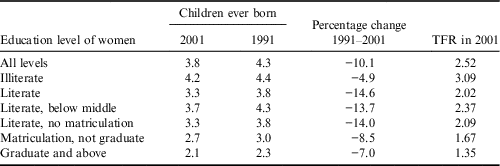
Contemporary India is another society in transition, with fertility levels now almost at Western levels. The 2011 Census of India showed that the TFR had declined from 2.9 in 2001 to 2.62 in 2011 (Jah, Reference Jha2016). Based on a sample of households from 1993–94 and 2004–05, Jah (2016) found that households with more-educated adult women have fewer children under the age of 14, and that households with the highest per capita incomes also have fewer children. As the fertility transition has progressed in India, differences between the completed fertility women of different socioeconomic groups have declined. For example, in 2001, Indian women who were illiterate had a TFR of 3.09 and those with a college degree had a TFR of 1.35 (a difference of 1.74 children; see Table 1). By 2012, illiterate women in India had a TFR of 3.2, and women with a college degree had a TFR of 1.7 (a difference of 1.5; Indian Census, 2012).
Mean number of children ever born for women aged 45–49 and percentage change 1991–2001, India

Source: Indian Census (2001).
In sum, in transitioning societies male fertility has been little studied, but there is evidence that for males economic status is extremely important for entry into marriage and thus is probably positively associated with fertility, if only because of childlessness among low-status men. The evidence for women suggests that women with more education, women in higher income households and employed women tend to have lower fertility than other women in transitional societies, and thus lead the way in the fertility transition (Dribe et al., Reference Dribe, Oris and Pozzi2014b). Because of this, fertility differentials between women of different socioeconomic groups in transitioning societies often initially widen, with women in farming families lagging behind in the adoption of low fertility. This widening variance on completed fertility for women in societies with intermediate fertility has been found generally (Hruschka & Burger, Reference Hruschka and Burger2016). This is the trend in contemporary developing societies; it was also the trend in historical Europe during its demographic transition, with the exception of France (Haines, Reference Haines1992). As fertility dips lower, fertility rates among women of different socioeconomic groups begin to converge and the variance on female fertility lowers.
Post-transition societies–low-mortality, low-fertility societies
In post-transition societies, fertility data are almost entirely data on female fertility rather than male fertility. The data on male fertility that do exist have measurement problems that data on female fertility are less likely to have. For example, in surveys men are more likely to under-report births, and non-marital births are less likely to be reported than marital births (Joyner et al., Reference Joyner, Peters, Hynes, Sikora, Taber and Rendall2012). Most data on the association of status and fertility outcomes in modern societies are also cross-sectional data (as in transitional societies), and this can also be problematic. Stulp and Barrett (Reference Stulp and Barrett2016) noted that cross-sectional data on the relationship between female fertility and personal income in modern societies can be misleading, because women who intend to have children or who become mothers may cut back on working hours, choose less-demanding jobs or suffer pay discrimination at work. So rather than being a cause of fertility, a woman’s personal income may be in part a result of her fertility. Cross-sectional data are less problematic for men for these reasons because men tend not to change their employment behaviour as much as women do after the birth of a child. However, such cross-sectional data are often problematic for male fertility for other reasons. In particular, cross-sectional studies often only collect information on children in the household and frequently do not collect information on children ever born. Men are more likely than women to have children outside of the household from previous unions that are not included in cross-sectional data (Joyner et al., Reference Joyner, Peters, Hynes, Sikora, Taber and Rendall2012). Men are also more likely than women to be living in households with step-children.
When complete data on male fertility are collected, either by longitudinal or cross-sectional studies that collect information on all biological children ever born, results for men on the association between status and fertility are mixed, depending on the society and the measure(s) of status used. However, the measures of status that are direct measures of ability to provide resources (personal income, wealth) are positively related to fertility in all countries. In the US, UK, Norway and Sweden, evidence shows a positive association between personal income and fertility for men (Hopcroft, 2006, Reference Hopcroft2015; Fieder & Huber, Reference Fieder and Huber2007; Nettle & Pollet, Reference Nettle and Pollet2008; Lappegård & Rønsen, Reference Lappegård and Rønsen2013; Stulp et al., Reference Stulp, Sear, Schaffnit, Mills and Barrett2016). In the US and UK, education for men is negatively associated with fertility (Hopcroft, 2006, Reference Hopcroft2015; Nettle & Pollet, Reference Nettle and Pollet2008), while it is positively associated with fertility in Finland, Sweden and Norway (Fieder & Huber Reference Fieder and Huber2007; Lappegård & Rønsen Reference Lappegård and Rønsen2013; Nisén et al., Reference Nisén, Martikainen, Kaprio and Silventoinen2013; Nisén et al., Reference Nisén, Martikainen, Myrskylä and Silventoinen2017). Kaptijn et al. (Reference Kaptijn, Thomese, van Tilburga, Liefbroera and Deeg2010) found evidence that occupational status was positively correlated with fertility for men in the Netherlands, as measured by the number of grandchildren. In the US, Stulp et al. (Reference Stulp, Sear, Schaffnit, Mills and Barrett2016) found lagged wealth from the previous two and three years increased the probability of a first and second birth for white men only.
Part of the mechanism for the relationship between status and offspring for men is multipartner fertility by high-status men. This has been found in Norway (Lappegård & Rønsen, Reference Lappegård and Rønsen2013), Sweden (Forsberg & Tullberg, Reference Forsberg and Tullberg1995), Hungary (Bereczkei & Csanaky, Reference Bereczkei and Csanaky1996) and the US (Jokela et al., Reference Jokela, Rotkirch, Rickard, Pettay and Lummaa2010). In the US, studies suggest multipartner fertility is more prevalent among unmarried men, blacks and Hispanics, and the poorly educated (Carlson & Furstenberg, Reference Carlson and Furstenberg2006; Guzzo, Reference Guzzo2014). The relationship between income and multipartner status, and completed fertility for men and women in the US, has not been well studied. Guzzo and Furstenberg (Reference Guzzo and Furstenberg2007) found the prevalence of multipartnered fertility to be almost twice as high among poor than among non-poor men, although they did not examine finer economic distinctions, nor did they examine completed fertility. It may be that, as Lappegård and Rønsen (Reference Lappegård and Rønsen2013) showed for Norway, there is a non-linear relationship between economic status and multipartner fertility. That is, it may be that multipartner fertility is most common among both very low-status and very high-status men in the US, and least common among men of middle status.
Although multipartner fertility may be one route by which enhanced economic status influences male fertility, it appears that the primary driver of the relationship between status and reproductive success for men in Europe and the US is the greater likelihood of childlessness among low-status men (Fieder & Huber, Reference Fieder and Huber2007; Barthold et al., Reference Barthold, Myrskylä and Jones2012; Goodman et al., Reference Goodman, Koupil and Lawson2012; Hopcroft, Reference Hopcroft2015). For example, 23% of contemporary Norwegian men never father any children at all (as compared with 13% of women who never have children; see Amundsen Reference Amundsen2014)–a number surprisingly close to the 21% of males who failed to reproduce in Bateman’s (Reference Bateman1948) experiment with fruit flies. Thus the relationship between personal income/wealth described for men is not due primarily to high income/wealthy men having large numbers of children so much as the fact that men with low personal income/wealth in modern societies are more likely to have no children at all.
This evidence suggests that it is primarily men’s access to economic resources (wealth, personal income, occupational status) that is positively correlated with fertility for men in modern, post-transitional societies–a finding that is consistent with the findings from many pre-transitional societies. Level of education is uniformly regarded as a status characteristic in modern societies, but as seen in several countries (although not all) there is a negative relationship between education and number of children (e.g. for both men and women in the US and UK, but not for men in Finland, Sweden and Norway). This suggests a trade-off between status based on education and fertility in some countries, but not all (Hopcroft & Whitmeyer, Reference Hopcroft and Whitmeyer2010; Shenk et al., Reference Shenk, Kaplan and Hooper2016). Given the time and expense involved in acquiring education, this is not surprising, particularly for women. This trade-off is less severe for men than it is for women, because education is also correlated with income, which is positively associated with fertility for men in these countries (Hopcroft & Whitmeyer, Reference Hopcroft and Whitmeyer2010).
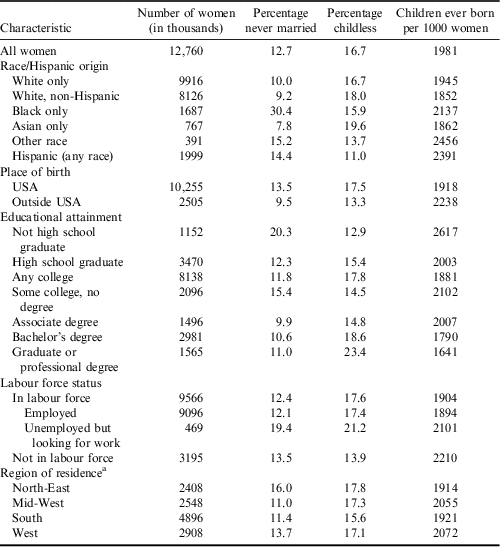
Data on female fertility in post-transitional societies are abundantly available and well-analysed, not least by national census bureau. Census data in the US and other developed countries frequently show lifetime fertility for women (usually aged 40–44 or 45–49) by household income. They show a small negative relationship between household income and children ever born, although variation between women is slight. For women of all different groups – racial, ethnic, employment status, nativity and family income – completed lifetime fertility hovers around 2 in the US (see Table 2). In Europe, highly educated women had an average of 1.5 children, and less-educated women had an average of 1.8 children in 2011 (Eurostat, 2017). This is typical of modern industrial societies (Hirschman, Reference Hirschman1994; Morgan, Reference Morgan2003). Highly educated women are also more likely to be childless than less-educated women.
Completed fertility of women aged 40–50 by selected characteristics, June 2014, US Census 2014

a Region is defined as the four groupings of states (North-East, South, Mid-West and West) established by the Census Bureau in 1942 for the presentation of census data. North-East region: Maine, New Hampshire, Vermont, Massachusetts, Connecticut, Rhode Island, New Jersey, New York, Pennsylvania. South region: Maryland, Delaware, West Virginia, Virginia, Kentucky, Tennessee, North Carolina, South Carolina, Georgia, Florida, Alabama, Mississippi, Arkansas, Louisiana, Oklahoma, Texas. Mid-West region: North Dakota, South Dakota, Nebraska, Kansas, Missouri, Iowa, Minnesota, Wisconsin, Illinois, Michigan, Indiana, Ohio. West region: Washington, Idaho, Montana, Wyoming, Oregon, California, Nevada, Utah, Colorado, Arizona, New Mexico, Alaska, Hawaii.
Source: US Census Bureau, Current Population Survey, June 2014. URL: https://www.census.gov/data/tables/2014/demo/fertility/women-fertility.html
The negative relationship between income and fertility is still observed when a woman’s personal income is used as the measure of status (rather than household income), but the relationship becomes much stronger. Cross-sectional data from the US show that women with the highest personal incomes have the lowest fertility (Hopcroft, 2006, Reference Hopcroft2015; Stulp et al., Reference Stulp, Sear, Schaffnit, Mills and Barrett2016). This negative relationship between personal income and fertility for women has been observed in Sweden (Fieder & Huber, Reference Fieder and Huber2007), the UK (Nettle & Pollet, Reference Nettle and Pollet2008) and in data on all Europeans (Barthold et al., Reference Barthold, Myrskylä and Jones2012). Likewise, education is uniformly negatively associated with fertility for women in Europe, as it is in the US.
As noted previously, cross-sectional data may conflate cause with consequence in the analysis of the relationship between a woman’s own income and her fertility: the negative relationship between fertility and personal income may be simply because women are adjusting their work behaviour to their fertility. Stulp and Barrett (Reference Stulp and Barrett2016) examined a number of longitudinal studies and found a positive relationship between different measures of lagged income and wealth on female fertility (see also Jalovaara & Miettinen, Reference Jalovaara and Miettinen2013). In another study, Stulp et al. (Reference Stulp, Sear, Schaffnit, Mills and Barrett2016), using longitudinal data, found a positive effect of income received 3 years prior to having a first birth, while income in the previous year was negatively associated with the birth of a first, second and third child. Wealth (measured as net worth) in the previous 3 years positively predicted the probability of a first and second birth, and negatively predicted the probability of a third birth. Their findings suggest that current employment itself is often negatively associated with childbirth for women, but economic security in the form of wealth or prior earnings encourages fertility for women.
Multipartner fertility in the US is more common among women than among men. Among people in their 40s, who mostly have completed childbearing, about 13% of men and about 19% of women have children with multiple partners (Guzzo, Reference Guzzo2014). It is concentrated among lower status women. Women with multipartner fertility are disproportionately women who are unmarried, have their first birth at a young age, black women and employed women (Carlson & Furstenberg Reference Carlson and Furstenberg2006).
In sum, in post-transition societies, where fertility is very low, personal income and wealth are positively associated with fertility for men. For women, the relationship is more complicated, with most studies showing that current personal income is negatively associated with fertility, and some studies showing that lagged income and wealth are positively associated with fertility in women. Education and employment are always negatively associated with fertility for women. However, fertility differences between socioeconomic groups, and even by employment status, by woman are slight in post-transition societies. The positive relationship between mean completed fertility and the variance in completed fertility (as mean fertility goes down, so does its variance) is well documented (Hruschka & Burger, Reference Hruschka and Burger2016). Women across post-transition societies have an average of about one or two children (Morgan Reference Morgan2003).
Discussion and Conclusion
High-status men with greater access to resources in pre-transitional societies have more children than lower status men, and thus appear to be maximizing fitness within those societies. This link between status and fertility for men is less clear in transitional societies, and remains understudied. In post-transitional societies, there is evidence from a variety of societies, including the US, that the most resource-relevant status measures–personal income and wealth–are positively associated with fertility for men. As evidence suggests that individuals with more children leave more descendants (Kaplan et al., Reference Kaplan, Lancaster, Johnson and Bock1995; Goodman et al., Reference Goodman, Koupil and Lawson2012), high-status men continue to leave more descendants than low-status men in post-transition societies. So male fertility in post-transitional societies cannot be regarded as non-fitness maximizing and hence maladaptive.
For women things are more complicated. In pre-transitional societies, evidence is mixed that high-status women have higher fertility than lower status women, suggesting at best a weak positive relationship between status and fertility. Variation in completed fertility for women is less for women than it is for men, however. In societies in the midst of the transition from high fertility to low fertility, it is educated, employed women in elite and middle-class families who lead the way in the fertility decline. In these societies there is a negative relationship between status and fertility for women and often a high variance in completed fertility among women of different socioeconomic groups in these societies.
In post-transition societies, educated women, employed women and women in high-income households continue to have the lowest fertility, once again showing a negative relationship between status and fertility (although longitudinal studies suggest this is more complex than it looks). Differences in female fertility between socioeconomic groups are slight on average, however, with most women having just one or two children. Nevertheless, given that women who have fewer children are probably not leaving more descendants, despite the fact that those descendants are likely to be of higher socioeconomic status (Kaplan et al., Reference Kaplan, Lancaster, Johnson and Bock1995; Goodman et al., Reference Goodman, Koupil and Lawson2012), this looks like a ‘maladaptive’ outcome where the link between status and fertility is severed and women are not maximizing their fitness.
Before reaching the conclusion that female fertility in contemporary societies is maladaptive, there are a few issues to consider. Women, more than men, evolved to follow a reproductive strategy that emphasizes offspring quality rather than quantity. This is demonstrated by the phenomenon of menopause. Menopause limits women’s lifetime fertility but allows them to invest in the children and grandchildren they already have (Sear et al., Reference Sear, Mace and McGregor2000). Menopause makes no sense if evolution has favoured the female reproductive strategy of maximizing numbers of children–it does make sense if evolution has favoured women following a strategy of high investment in their offspring. There is of course no male equivalent to menopause. Such reproductive strategies that limit offspring numbers in favour of fewer more successful offspring are known as ‘bet-hedging strategies’ (Boone & Kessler, Reference Boone and Kessler1999). The idea is that a few successful offspring are better able to weather future (unpredictable) crises than a larger number of less successful offspring. The cost of this insurance against future unpredictable disasters is lower fertility. However, over evolutionary time this strategy must have been successful on average, otherwise menopause could not have evolved.
In modern societies, the female reproductive strategy of high investment in offspring is accentuated by an environment that demands long periods of schooling and other intensive investments in the human capital of children. This context encourages both men and women to invest more in their children (Kaplan, Reference Kaplan1996), but consistent with the different reproductive strategies of men and women, women, particularly women with the most access to resources, are doing it more. That is, women with means are disproportionately following a strategy that appears to improve the quality of their descendants (as measured by their socioeconomic position) rather than a strategy that improves the quantity of their descendants (Goodman et al., Reference Goodman, Koupil and Lawson2012).
Yet even though this looks like this may be maladaptive in terms of maximizing fitness, it can be argued that it is premature to come to that conclusion. There is some evidence that women who have children with high-status men as fathers are more likely to have sons than are low-status women (Betzig & Weber, Reference Betzig and Weber1995). For example, there is evidence across 40 years of the American General Social Survey that high-status men father more boys than do low-status men (Hopcroft, Reference Hopcroft2005; Hopcroft & Martin, Reference Hopcroft and Martin2014). Given that these sons are more likely to be reproductively successful than other men, on average, it may be that women who have children with high-status men leave more descendants than do other women. This is an empirical question that, to the best of the author’s knowledge, has not been examined thus far.
Alternatively, another possibility is that modern, class-based societies have effectively split into separate endogamous groups, and that females continue to behave adaptively within those endogamous groups. The idea of modern societies consisting of more than one breeding population is supported by the high levels of homogamy along educational and class lines in advanced industrial societies (Kalmijn, Reference Kalmijn1998; Sweeney & Cancian, Reference Sweeney and Cancian2004; Schoen & Cheng, Reference Schoen and Cheng2006, 2010; Schwartz, Reference Schwartz2010). These considerations call for much more refined empirical examinations of the relationship between individual status, fertility, offspring sex and number of descendants for women and men separately than hitherto.
What can be concluded is that in all societies, maximizing fertility does not mean increasing absolute numbers of offspring, but increasing numbers of offspring relative to others in the population or endogamous group. In contemporary societies status in the form of high personal income and/or wealth (and in some countries education) allows men to do this, so their fertility behaviour cannot be considered maladaptive. Women on average do not use their access to resources (either through their own personal income or their household income) to have more children in contemporary societies. What women do appear to be doing is using their access to resources to invest more in their children, thus better insuring the socioeconomic success of their offspring and descendants. Thus, women appear to be maximizing the quality of their offspring relative to that of other women–a strategy that has probably been adaptive for women over evolutionary time, and may still be adaptive. It remains an open question, pending more detailed research.
This question of whether contemporary fertility behaviour is adaptive or not remains an important one for social scientists to address. If contemporary behaviour is shown to be adaptive, it gives strong support to scholars who contend that humans have evolved adaptations that shape behaviour, and creates problems for those scholars who claim that that evolutionary ideas are entirely inapplicable to modern humans (Turke, Reference Turke1990). For evolutionary social scientists themselves, understanding whether behaviour is or is not adaptive gives insights into the nature of the evolved human psyche, and whether it is composed of highly specific adaptations that can frequently lead to maladaptive behaviour in contemporary environments (Cosmides & Tooby 1987, Reference Cosmides and Tooby1989), or more flexible general adaptations that allow individuals to behave adaptively in novel environments far removed from the environments of human evolution (Alexander, Reference Alexander1989; Turke, Reference Turke1990; Irons, Reference Irons1998).
Acknowledgments
The author would like to thank David Lawson, Lesley Newson, Joseph Whitmeyer and members of the audience at the HBES meetings (2017) for helpful comments on previous versions of this paper.
Ethical Approval. The author asserts that all procedures contributing to this work comply with the ethical standards of the relevant national and institutional committees on human experimentation and with the Helsinki Declaration of 1975, as revised in 2008.
Conflicts of Interest. The author has no conflicts of interest to declare.
Funding. This research received no specific grant from any funding agency, commercial entity or not-for-profit organization.