Introduction
Although specific information about which depressed patients are best treated with medication and which with psychotherapy could provide guidance to practicing clinicians and improve outcomes, only a few studies have reported findings in this regard. In the National Institute of Mental Health Treatment of Depression Collaborative Research Program (NIMH TDCRP), low social dysfunction predicted superior response to interpersonal psychotherapy (IPT; Klerman et al. Reference Klerman, Weissman, Rounsaville and Chevron1984; Weissman et al. Reference Weissman, Markowitz and Klerman2000), low dysfunctional attitudes predicted better response to cognitive therapy (CT; Beck et al. Reference Beck, Rush, Shaw and Emery1979), high work dysfunction predicted superior response to imipramine and higher baseline severity predicted better response to IPT and medication (Sotsky et al. Reference Sotsky, Glass, Shea, Pilkonis, Collins, Elkin, Watkins, Imber, Leber, Moyer and Oliveri1991). In a subsequent report examining only the two psychotherapy conditions, Barber & Muenz (1996) reported that, among ‘completers’, CT was more effective than IPT for those with avoidant personality disorder (PD) features whereas the reverse was true for those with elevated levels of obsessive–compulsive (OC) features. Married and cohabiting patients had better outcomes with CT whereas single patients improved more with IPT.
In the initial report from their study comparing outcomes for CT and antidepressant medication, DeRubeis et al. (2005) noted that the presence of generalized anxiety and the absence of chronic depression were associated with better response among those treated with antidepressants whereas social phobia and absence of melancholia were associated with poorer response to CT. They did not indicate whether any of these variables predicted differential response to medication versus psychotherapy. In subsequent reports based, first, on a priori hypotheses regarding treatment moderation by previous antidepressant exposure and the presence of PD and, second, on a posteriori analyses of potential predictors and moderators, they found that previous antidepressant exposure was associated with poor response to medication but not to CT (Leykin et al. Reference Leykin, Amsterdam, DeRubeis, Gallop, Shelton and Hollon2007), whereas the presence of a PD was associated with better response to medication and poorer response to CT (Fournier et al. Reference Fournier, DeRubeis, Shelton, Gallop, Amsterdam and Hollon2008). Finally, being married, unemployed and having a greater number of recent life events each predicted superior response to CT (Fournier et al. Reference Fournier, DeRubeis, Shelton, Hollon, Amsterdam and Gallop2009). Dimidjian et al. (Reference Dimidjian, Dobson, Kohlenberg, Gallop, Markley, Atkins, Hollon, Schmaling, Addis, McGlinchey, Gollan, Dunner and Jacobson2006) confirmed the hypothesis that higher initial severity would be associated with better response to pharmacotherapy than to placebo and found that it was also associated with superior response to behavioral activation than to the full CT treatment. They did not report analyses of other potential moderators.
In an earlier study, we had found that lifetime panic spectrum symptomatology predicted longer time to remission among individuals with unipolar disorder whose initial IPT treatment was augmented with selective serotonin reuptake inhibitors (SSRIs) in the absence of remission with IPT monotherapy (Frank et al. Reference Frank, Shear, Rucci, Cyranowski, Endicott, Fagiolini, Grochocinski, Houck, Kupfer, Maser and Cassano2000). In the present study, we sought to extend this work to explore whether panic or other mood or anxiety spectrum conditions define treatment-relevant phenotypes moderating psychotherapy versus pharmacotherapy outcome.
The platform for this investigation was a clinical trial in which individuals presenting for treatment of non-psychotic major depression were randomly assigned to a treatment plan that began with IPT or SSRI monotherapy. Participants who had not responded by 6 weeks or remitted by 12 weeks received augmentation with the other treatment. Here we report the primary findings of this study: predictors and moderators of time to remission on monotherapy over 12 weeks of treatment.
Given the exploratory nature of this work, we did not articulate specific a priori hypotheses; however, because we had observed substantial somatic sensitivity among individuals with panic spectrum symptomatology, we anticipated that such patients would have greater difficulty achieving remission with SSRI than IPT. We also expected that higher levels of social phobia or OC spectrum features would interfere with the establishment of a strong psychotherapeutic alliance and therefore lead to greater difficulty achieving remission with IPT than SSRI.
Method
Participants
Participants were out-patients in a DSM-IV-defined episode of major depression as determined by the SCID (APA, 2000), with a minimum score of 15 on the 17-item Hamilton Depression Rating Scale (HAMD-17; Hamilton, Reference Hamilton1960). A primary diagnosis of schizophrenia, schizo-affective disorder, bipolar I or II disorder, current anorexia or bulimia, and antisocial PD constituted exclusions. Patients with current alcohol or substance abuse or dependence were excluded only if their drinking or substance use was unrelated to their depression. Individuals with severe, uncontrolled medical illness, those who had been unresponsive to an adequate trial of escitalopram or IPT in the current episode and women unwilling to practice an acceptable form of birth control were also excluded.
Study procedures were approved by the University of Pittsburgh Institutional Review Board (IRB) and the Ethics Committee of the Azienda Ospedaliero-Universitaria of Pisa. All patients gave their written informed consent after receiving a complete description of the study and having an opportunity to ask questions.
Interventions
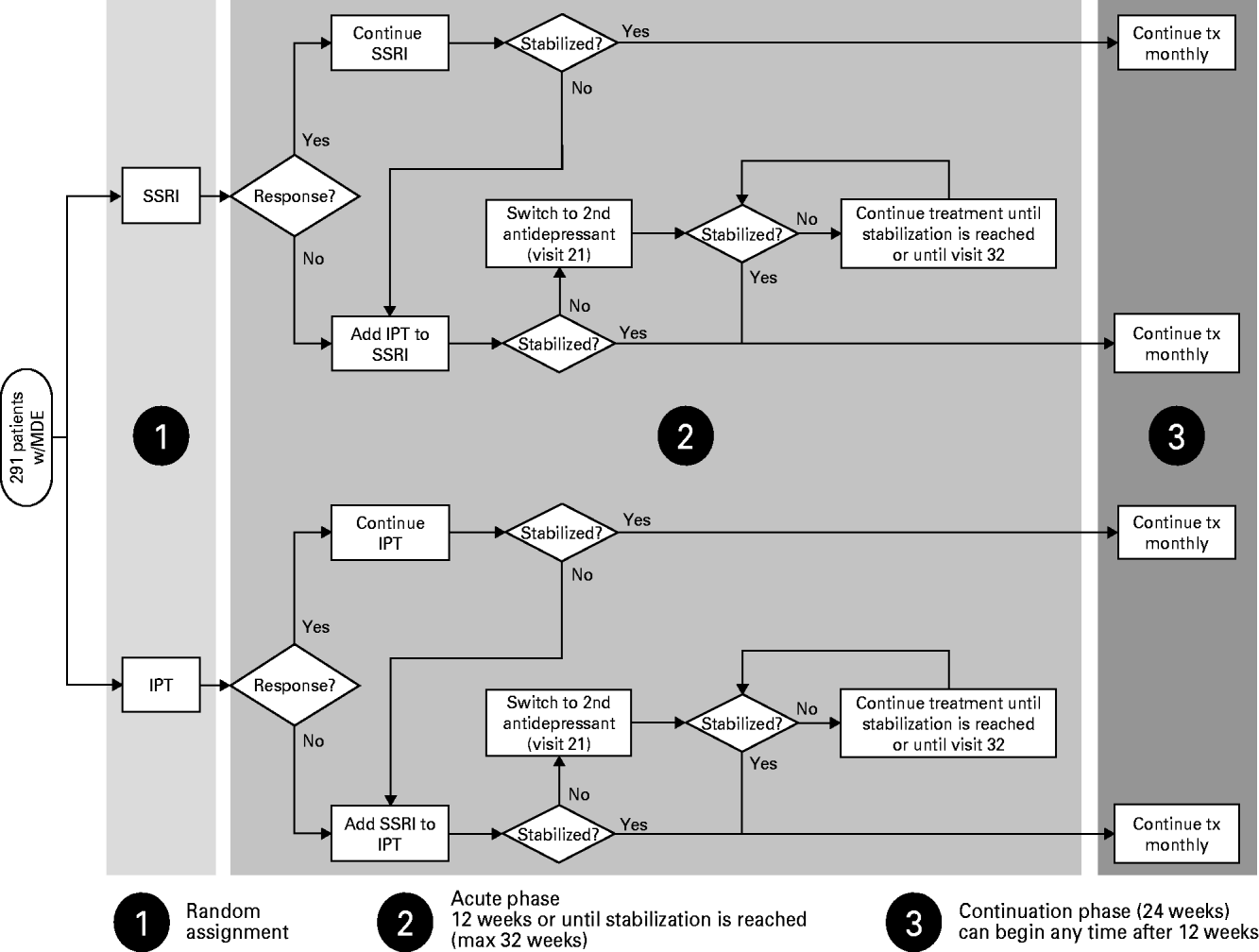
Participants were assigned randomly to a treatment plan that began with IPT (Klerman et al. Reference Klerman, Weissman, Rounsaville and Chevron1984; Weissman et al. Reference Weissman, Markowitz and Klerman2000) or SSRI pharmacotherapy (escitalopram oxalate) monotherapy. If the initial treatment did not bring about a stable remission, the other treatment was added. The study began with a variable-length acute treatment phase, defined as at least 12 weeks of treatment and stable remission (3 weeks during which the mean HAMD-17 score was <7), followed by a 6-month continuation treatment phase (see Fig. 1). The median number of acute treatment visits in both groups was 12 (IPT-first: range 2–45; SSRI-first: range 1–34).
Study design.

Participants assigned to pharmacotherapy were seen by experienced psychopharmacologists for visits lasting 20 to 30 min, during which psychotherapeutic interventions were specifically proscribed. Psychotherapy was provided at Pittsburgh by masters- or Ph.D.-level psychologists or social workers who were trained by G. Klerman, M. Weissman, B. Rounsaville and E. Chevron or by one of two clinicians initially trained by that group (E. F. or D. N. Frankel). Because Italian law only permits non-physicians to perform psychotherapy after completion of a 4-year specialization in the specific form of psychotherapy, and IPT specialization did not exist in Italy at the time of study initiation, Pisa therapists were all psychiatrists trained to research-level competence by P. S. All psychotherapy sessions were tape recorded and rated for IPT specificity by blind raters using the Wagner et al. (Reference Wagner, Frank and Steiner1992) scale. IPT sessions lasted approximately 50 min. Participants allocated to IPT at Pittsburgh also had a physician of record who saw them briefly at baseline and study weeks 6, 12 and 20.
Participants in either condition who complained of sleep difficulties were permitted up to 2 mg of lorazepam until the sleep difficulties resolved. Participants reporting agitation could receive up to 4 mg of lorazepam. The median dose was 1 mg (range 0.25–3 mg). Among participants who had at least one treatment visit, 31.5% of those assigned to IPT-first and 40.8% of those assigned to SSRI-first received lorazepam at some point prior to entering the continuation phase (χ2=2.7, p=0.099).
Escitalopram was started at 10 mg and titrated up or down as needed, with the aim of symptom remission and/or achieving a dose of 20 mg/day. The acute phase included three triage points for augmentation with the other treatment at weeks 6, 12 and 20.
Measures
Lifetime mood and anxiety spectrum psychopathology was assessed using four self-report instruments: the Mood Spectrum (MOODS-SR; Fagiolini et al. Reference Fagiolini, Dell'Osso, Pini, Armani, Bouanani, Rucci, Cassano, Endicott, Maser, Shear, Grochocinski and Frank1999; Dell'Osso et al. 2002 a), the Panic–Agoraphobic Spectrum (PAS-SR; Cassano et al. Reference Cassano, Michelini, Shear, Coli, Maser and Frank1997; Shear et al. Reference Shear, Frank, Rucci, Fagiolini, Grochocinski, Houck, Cassano, Kupfer, Endicott, Maser, Mauri and Banti2001), the Obsessive–Compulsive Spectrum (OBS-SR; Dell'Osso et al. 2002 b) and the Social Phobia Spectrum (SHY-SR; Dell'Osso et al. 2002 b) assessments. These instruments are based on a theoretical approach that gives clinical significance not only to typical symptoms of full-blown mood disorders but also to atypical symptoms, behavioral traits and temperamental features. Furthermore, these symptoms and traits need not cluster in time to have clinical importance; instead, even isolated symptoms or traits that occur over an individual's lifetime may mark clinically important phenotypes (Cassano et al. Reference Cassano, Michelini, Shear, Coli, Maser and Frank1997).
We examined total scores on all instruments and also factor scores on the two factor-analyzed instruments PAS-SR (Rucci et al. Reference Rucci, Miniati, Oppo, Mula, Calugi, Frank, Shear, Mauri, Pini and Cassano2009) and MOODS-SR (Cassano et al. 2009 a, b). The presence of other psychiatric disorders was assessed with SCID-I and SCID-II (APA, 2000) and we used the Work and Social Adjustment Scale (WSAS; Mundt et al. Reference Mundt, Marks, Shear and Greist2002) to assess functioning.
Treatment progress was evaluated with the HAMD-17 (Hamilton, Reference Hamilton1960). To ensure consistency between sites, a bilingual psychiatrist from Pisa was trained over the course of 1 year at Pittsburgh and was certified as the ‘gold standard’ HAMD rater for Pisa. Inter-rater agreement at each site and between sites was recalibrated approximately every 6 months and was maintained at an intra-class correlation coefficient (ICC) ⩾0.85. Because of the nature of the interventions, neither participants nor therapists could be blinded to group assignment. Outcomes were assessed by study clinicians not involved in the patient's treatment.
Response was defined as a 50% reduction in baseline HAMD-17 score, and remission was defined as a mean HAMD-17 of ⩽7 over three consecutive weeks. Augmentation occurred at week 6 in the absence of response on 20 mg of escitalopram or at least five IPT sessions and at week 12 for any participant not in remission.
Outcome measure
The primary purpose of the study was to determine for which phenotypic picture treatment should be initiated with psychotherapy versus pharmacotherapy. Therefore, we examined time to remission on monotherapy up to the 12-week point as our primary outcome as this was the earliest point at which patients could move to the continuation phase and at which both SSRI and IPT monotherapy could be expected to have had a reasonable chance of success.
Sample size
Power calculation for the primary study aim was based on a linear regression model, with HAMD change from baseline as the dependent variable and site, treatment group and spectrum score (dichotomized at the median) entered as independent variables and interacted with one another. Sample size and power were calculated to detect an interaction effect between the potential moderator and treatment in the linear model. With equal cell sizes, the power to detect a moderate effect size (the standardized interaction effect of about 0.5) at the two-tailed 5% level with more than 95% power required 290 subjects, divided equally between the sites and initial treatment groups. Power calculations were performed using Power and Sample Size Calculation, version 2.1.31 (Dupont & Plummer, Reference Dupont and Plummer1997). However, rather than analyses based on a linear regression, we report predictors and moderators of the more clinically interpretable outcome of time to remission.
Statistical methods
We used Cox regression models to analyze the effects of demographic and clinical variables on time to remission in monotherapy by 12 weeks. Data on patients who did not remit in monotherapy (including those who were discontinued for clinical reasons and those who received augmentation) were censored at 12 weeks. Those who dropped out were censored at the date of drop-out. All variables were centered (i.e. binary variables were coded +1/2 and −1/2, and ordinal variables centered at the mean). We used the MacArthur approach to evaluation of moderators of treatment outcome (Kraemer et al. Reference Kraemer, Wilson, Fairburn and Agras2002). According to this conceptualization, non-specific predictors of treatment outcome are pretreatment variables that predict the outcome equally in the two treatments. Moderators, by contrast, predict outcome differently in the two groups, and thus ‘specify for whom or under what conditions [a particular] treatment works … ’.
We identified a priori several demographic and clinical variables to be tested as potential moderators of treatment outcome in individual models. Each model included treatment allocation (T), site (S), one predictor/moderator (M) and their two- and three-way interactions (T×S, T×M, T×S×M). When the main effect of a variable was significant but the interactions T×M and/or T×M×S were not, the variable was considered a non-specific predictor of outcome. When the interactions were significant whether or not there was a significant main effect, the variable was considered a moderator. Site was coded as −0.5 Pittsburgh, 0.5 Pisa and treatment as −0.5 IPT, 0.5 SSRI. Analyses were carried out using SPSS version 16.0 (SPSS Inc., USA).
Results
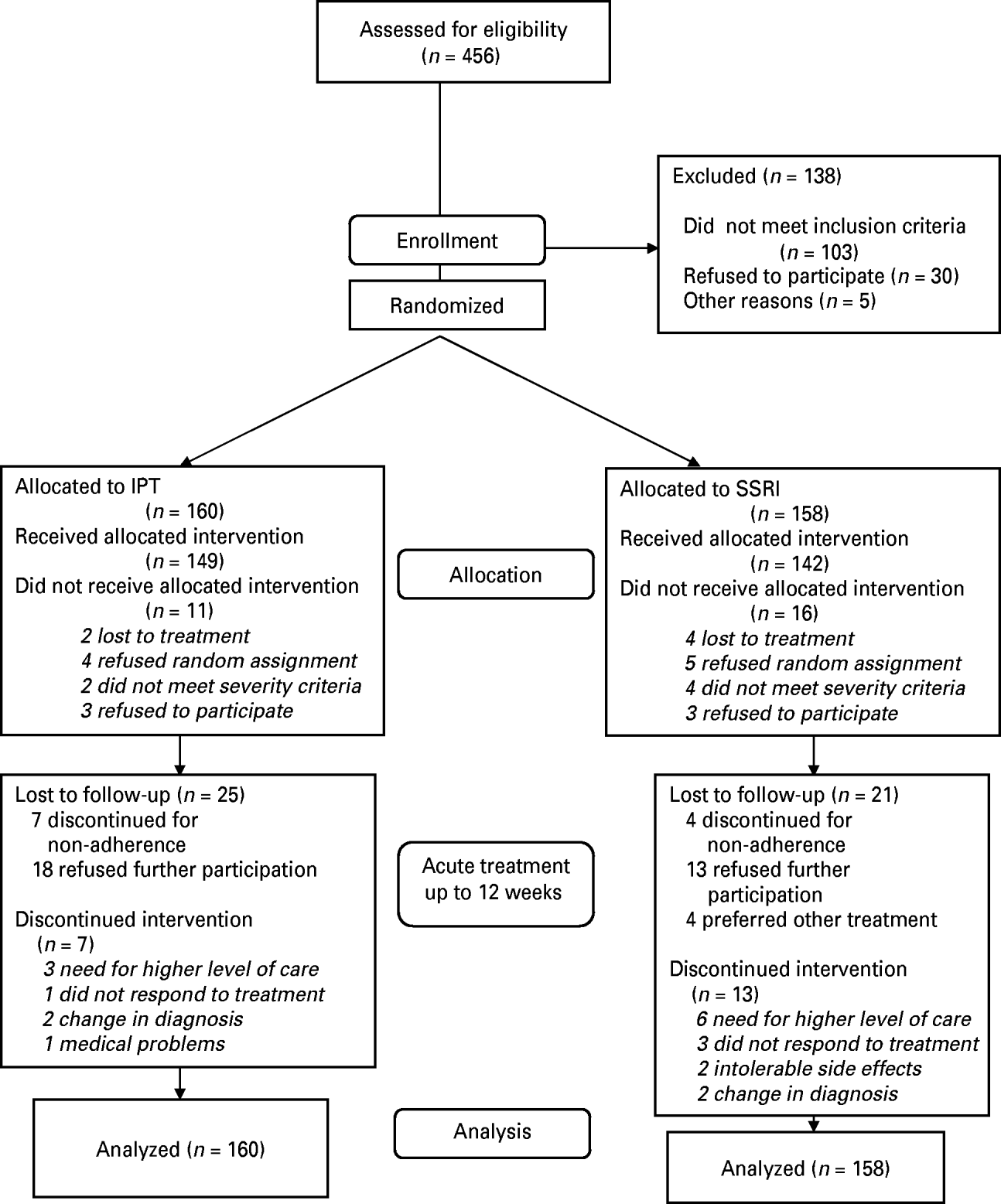
Fig. 1 presents the full acute and continuation phase design and Fig. 2 presents the participant flow. A total of 318 out-patients with unipolar depression were allocated randomly to treatment; 291 received the allocated intervention, 153 at Pittsburgh and 138 at Pisa. Recruitment began in April 2003. Acute phase treatment ended in November 2007 and continuation phase treatment in March 2008.
CONSORT diagram.

Participants had a mean age of 39.2 years and 13.8 years of education. The majority (71.7%) were female and not married (62.1%). The median duration of illness was 7.4 years and the median number of lifetime episodes (including the current episode) was 2 (range 1–21). The mean HAMD-17 score at baseline was 20.0 (s.d.=4.10, range 15–35) and the mean HAMD-25 score was 24.6 (s.d.=5.1, range 15–43). Of the 316 patients for whom illness history was available, 97 (30.7%) were in their first episode of illness, whereas 219 (69.3%) had a history of recurrent depression.
At 12 weeks, the average daily dosage of escitalopram was 12.5 mg/day (s.d.=7.6): 13.3 mg/day (s.d.=8.1) at Pittsburgh and 11.6 mg/day (s.d.=7.1) at Pisa (Mann–Whitney test=2174.5, p=0.139). The mean number of IPT sessions attended in the first 12 weeks was 10.3 (s.d.=2.1) at Pisa and 10.3 (s.d.=2.7) at Pittsburgh.
Attrition and tolerability
Of the 160 participants assigned to IPT, 11 (6.87%) did not receive the allocated intervention, four because they had hoped to receive pharmacotherapy. Thirty (18.75%) were no longer in the trial at 12 weeks (Fig. 2). Among the 19 participants who left the study after a first IPT session, three were discontinued because of change in diagnosis or the need for a higher level of care and 13 were discontinued for non-adherence to the protocol or refusal to participate further. Of the 158 participants assigned to SSRI, 16 (10.13%) did not receive the intervention, five because they had hoped to receive psychotherapy. Thirty-six (22.78%) were no longer in the trial at week 12. Among the 20 patients who left the trial after a first SSRI visit, two were discontinued because of intolerable side-effects, one required a higher level of care and 17 were non-adherent to the protocol or refused to participate. The number of Patient Rated Inventory of Side Effects (PRISE; Rush & O'Neal, Reference Rush and O'Neal1999) items coded 2 (distressing) was 1.00 (s.d.=1.23) and 1.12 (s.d.=1.59) for patients treated successfully with IPT and SSRI monotherapy respectively.
Remission with monotherapy
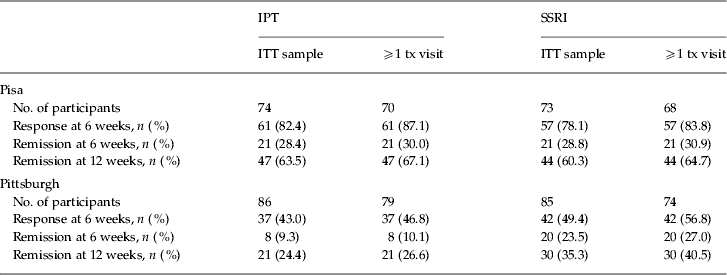
Table 1 reports the proportion of patients responding and remitting by treatment and site in the IPT sample and in those receiving the allocated intervention. There were no significant differences between the treatment conditions at Pisa (mean time to remission was 62 days with both treatments); however, time to remission was significantly longer among patients assigned to IPT versus SSRI at Pittsburgh (80 v. 71 days: log rank test=4.66, p<0.05).
Response and remission with monotherapy at 6 and 12 weeks by treatment and site

IPT, interpersonal psychotherapy; SSRI, selective serotonin reuptake inhibitor; tx, treatment.
Moderators of time to remission with monotherapy
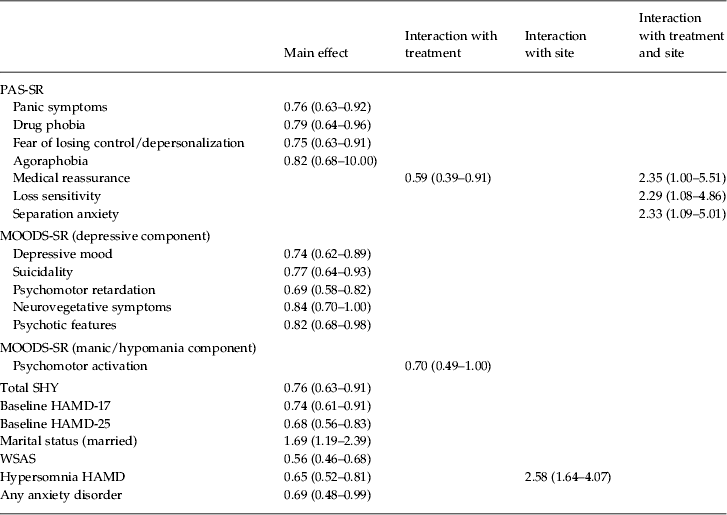
Participants with higher lifetime PAS-SR need for medical reassurance factor scores had more rapid remission with IPT than with SSRI [hazard ratio (HR) 0.59, 95% confidence interval (CI) 0.39–0.91]. Because the HR is below unity, for each additional medical reassurance item endorsed, the likelihood of remitting with SSRI compared with IPT is decreased by 41%. Participants with lower scores on the psychomotor activation factor from the mania/hypomania component of the lifetime MOODS-SR experienced more rapid remission with SSRI than with IPT (HR 0.70, 95% CI 0.49–1.00). Thus, for each additional psychomotor activation item endorsed, the likelihood of remitting with SSRI compared to IPT is decreased by 30%.
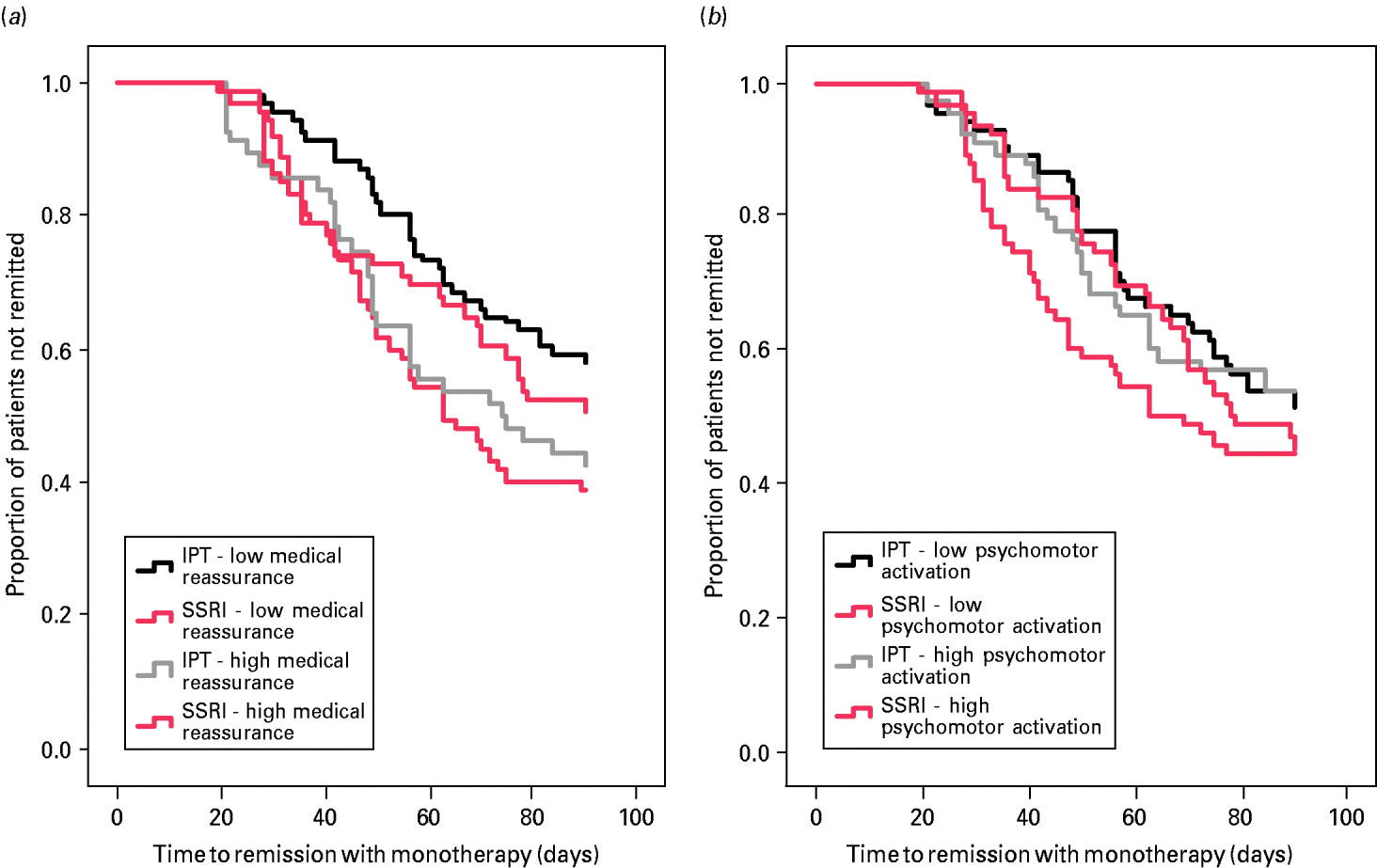
To better clarify the interaction between scores on these measures and treatment outcome, we plotted the survival curves for high and low scorers (using a median split) assigned to each of the two treatments in Fig. 3. Fig. 3 a shows that patients with low need for medical reassurance took a median of 11 days less (64 v. 75 days, log rank=7.3, p<0.01) to remit with SSRI and Fig. 3 b indicates that patients with low psychomotor activation remitted 9 days faster with SSRI (median 63 v. 72 days, log rank=2.5, p=0.11).
Time to remission with monotherapy: influence of (a) the need for medical reassurance factor of the Panic-Agoraphobic Spectrum Self-Report (PAS-SR) and (b) the psychomotor activation factor of the manic component of the Mood Spectrum Self-Report (MOODS-SR).

Two PAS-SR factors, lower lifetime separation anxiety factors scores (HR 2.33, 95% CI 1.09–5.01) and lower loss sensitivity (HR 2.29, 95% CI 1.08–4.86), were associated with longer time to remission with IPT than SSRI at Pittsburgh but not at Pisa. No demographic or traditional clinical characteristics moderated time to remission.
Non-specific predictors of time to remission on monotherapy
As indicated in Table 2, non-specific predictors of longer time to remission on monotherapy and, in general, of the need for combination treatment included the panic symptoms, drug/illness phobia, fear of losing control, and agoraphobia factors of the PAS-SR and the depressive mood, suicidality, psychomotor retardation, neurovegetative symptoms, and the psychotic features factors of the MOODS-SR, in addition to the SHY-SR total score. For a detailed overview of the PAS-SR and MOODS-SR factors, see Cassano et al. (2009 a, b) and Rucci et al. (Reference Rucci, Miniati, Oppo, Mula, Calugi, Frank, Shear, Mauri, Pini and Cassano2009).
Significant predictors and moderators of remission with monotherapy by 12 weeks of treatments: results from Cox survival regression models

PAS-SR, Panic–Agoraphobic Spectrum Self-Report; MOODS-SR, Mood Spectrum Self-Report (MOODS-SR); SHY, Social Phobia Spectrum; HAMD, Hamilton Depression Rating Scale; WSAS, Work and Social Adjustment Scale.
Values given as hazard ratio (95% confidence interval).
Higher baseline scores on the HAMD-17 and HAMD-25, WSAS and a history of any anxiety disorder also predicted longer time to remission on monotherapy. Being married or living with a partner was the only variable that predicted a shorter time to remission.
Discussion
We sought to enhance clinicians' ability to determine which depressed out-patients should be treated initially with psychotherapy and which with pharmacotherapy, with the expectation that measures of broadly conceptualized co-morbidity represented in the Spectrum Project self-reports might lead to improved methods for making this determination (Cassano et al. Reference Cassano, Rucci, Frank, Fagiolini, Dell'Osso, Shear and Kupfer2004). We hoped that these instruments, combined with easy-to-obtain variables such as illness history, and interview or self-report measures of depression severity, would enable clinicians to make more informed decisions about the best way to initiate treatment. This exploratory study identified several non-specific predictors but, contrary to our expectations, few moderators of psychotherapy versus pharmacotherapy outcome. We did, however, find confirmation of our earlier findings regarding the relationship of panic spectrum features to time to remission and some guidance in terms of treatment selection.
Patients with lower need for medical reassurance factor scores on the PAS-SR experienced more rapid remission with SSRI than with IPT and vice versa. Thus, this factor might be used to identify patients who are/are not as likely to benefit from drug treatment. Examining the specific items in the need for medical reassurance factor (repeated requests for diagnostic procedures, laboratory tests or hospital admissions not recommended by the doctor, frequent checking of blood pressure or pulse, use of emergency services or calls to doctor for reassurance, felt need to dramatize symptoms to get reassurance or for others to understand your suffering, etc.), it can be seen how such features might interfere with patients' ability to achieve remission with a potent, alerting SSRI such as escitalopram in the context of relatively brief pharmacotherapy visits. By contrast, the stance of the IPT therapist is that of a non-neutral advocate who is charged with providing reassurance that the symptoms the patient is experiencing constitute a well-known and highly treatable syndrome in medicine, and with offering specific treatment strategies – that have few, if any, somatic effects – for achieving that remission (Klerman et al. Reference Klerman, Weissman, Rounsaville and Chevron1984; Weissman et al. Reference Weissman, Markowitz and Klerman2000).
Those with lower scores on the psychomotor activation factor of the manic/hypomanic component of the MOODS-SR remitted more rapidly with SSRI than with IPT. This dimension reflects core features of mania/hypomania including flight of ideas, pressured speech, increased energy, and reduced need for sleep, activity, assertiveness, impatience, desire to reconnect with people and being noisy, which, as we have reported earlier (Cassano et al. 2009 b), may be experienced as isolated symptoms in patients who have never met criteria for an episode of mania or hypomania. Secondary analyses indicated that seven out of nine (77.8%) patients who experienced hypomania during the study had psychomotor activation scores above the median (⩾5), suggesting that this factor may be useful in identifying patients at risk of switching and confirming the clinical relevance of this dimension. Indeed, Akiskal (Reference Akiskal2007) has described clinical depressions superimposed on hyperthymic temperament (bipolar IV), referring to individuals with subthreshold hypomanic traits rather than episodes.
At Pittsburgh, but not at Pisa, PAS-SR separation anxiety factor scores also moderated outcomes and there was a trend for a similar effect for loss sensitivity factor scores, with those for whom separation issues were less salient having a clearly superior response to SSRI. For those high on these dimensions, IPT and SSRI treatment seemed to be equally successful. At least two studies suggest that separation anxiety is associated with bipolar spectrum conditions and panic disorder (Pini et al. Reference Pini, Abelli, Mauri, Muti, Lazzetta, Banti and Cassano2005; Brückl et al. Reference Brückl, Wittchen, Höfler, Pfister, Schneider and Lieb2007). Thus, the rapid remissions of those with low lifetime levels of separation distress may reflect the presence of a less complicated, more purely unipolar disorder.
The present study replicated and extended earlier findings indicating the utility of the spectrum measurement approach in predicting generally poorer depression treatment outcome (Frank et al. Reference Frank, Shear, Rucci, Cyranowski, Endicott, Fagiolini, Grochocinski, Houck, Kupfer, Maser and Cassano2000). Higher scores on the panic symptoms, drug/illness phobia, fear of losing control and agoraphobia factors of the PAS-SR, the depressive mood, suicidality, psychomotor retardation and psychotic features factors of the MOODS-SR and the lifetime SHY-SR total score were all associated with longer time to remission.
These dimensions may, again, reflect the complexity of the clinical picture in patients endorsing the lifetime experience of these features, complexity that makes remission of depression more difficult to achieve with any monotherapy. In addition, higher depression severity at baseline and the presence of any lifetime anxiety disorder were associated with longer time to remission. These, too, may be considered markers of greater severity and, in general, a need for combination treatment to achieve remission of depression. Souery et al. (Reference Souery, Oswald, Massat, Bailer, Bollen, Demyttenaere, Kasper, Lecrubier, Montgomery, Serretti, Zohar and Mendlewicz2007) identified 11 factors associated with difficult-to-treat depression, of which co-morbid panic attacks and anxiety disorders had the strongest associations. Fava et al. (Reference Fava, Rush, Alpert, Balasubramani, Wisniewski, Carmin, Biggs, Zisook, Leuchter, Howland, Warden and Trivedi2008) proposed ‘anxious depression’ as a discrete clinical subtype leading to poorer response to antidepressants.
Our study is among the first to focus not only on co-morbidity but also on isolated dimensions of panic psychopathology that may permit a better characterization and management of the depressed patient. Among the PAS-SR factors, panic symptoms, agoraphobia, fear of losing control/depersonalization and drug/illness phobia factors predicted longer time to remission. The first two factors correspond to the diagnostic criteria for the diagnosis of panic disorder and should always be explored when examining a depressed patient. The other factors, including fear of losing control/depersonalization and drug/illness phobia, which may have an impact on compliance and treatment response, have been previously overlooked.
Other predictors associated with delayed response were lifetime suicidality, psychomotor retardation, neurovegetative symptoms and psychotic features. These MOODS-SR dimensions correspond to criteria or indicators of subthreshold bipolarity (Phelps & Ghaemi, Reference Phelps and Ghaemi2006). Although higher psychomotor activation factor scores were associated with poorer response to SSRI, they were not a predictor of difficulty in achieving remission across both treatments studied.
In the present study, evaluation by means of factor scores was limited to the panic and mood spectrum (mania and depression) assessments, as these are the only two instruments thus far subjected to factor analysis. Nevertheless, the present data give a clear idea of the range and complexity of depressive presentations, in which several subthreshold psychopathological dimensions may co-occur with syndromal major depression.
By means of the methodological approach adopted in our study, we identified multiple predictors, but few moderators of treatment outcome. Thus, the study offers useful indicators of the characteristics of patients that are generally difficult to treat, but only limited guidance as to who benefits from IPT versus SSRI pharmacotherapy.
Despite the use of identical inclusion criteria and multiple efforts to minimize site differences in the study populations recruited, the US and Italian samples differed significantly in terms of gender and history of illness characteristics. Patients treated in Pittsburgh were more likely to be male, had longer histories of depression and more recurrent episodes and tended to be unmarried. Overall outcomes were better at Pisa, where patients were more likely to be married and to be experiencing their first episode of depression. Although these demographic and clinical characteristics probably played some role in the differential treatment outcomes, it is more likely that unmeasured cultural factors (such as living in one's place of birth and the availability of a network of family members and friends) served to increase the speed of remission at Pisa. Furthermore, as noted in our paper describing the implementation of this trial (Frank et al. Reference Frank, Cassano, Rucci, Fagiolini, Maggi, Kraemer, Kupfer, Pollock, Bies, Nimgaonkar, Pilkonis, Shear, Thompson, Grochocinski, Scocco, Buttenfield and Forgione2008), health system differences between the USA and Italy led to differing incentives for participation (the availability of free treatment at Pittsburgh; the availability of IPT at Pisa) that, in turn, led to very different participant groups. Of note, however, we observed no significant site×treatment interaction effects, suggesting that the administration of the treatments functioned in a similar manner at both sites.
In the present study of out-patients with moderately severe depression, the overall proportion of patients remitting on monotherapy at 12 weeks (44.6%) was higher than in the STAR*D (Rush et al. Reference Rush, Trivedi, Wisniewski, Nierenberg, Stewart, Warden, Niederehe, Thase, Lavori, Lebowitz, McGrath, Rosenbaum, Sackeim, Kupfer, Luther and Fava2006) efficacy/effectiveness trial. This difference is probably attributable to the comprehensiveness of the treatment protocol, which involved weekly visits during the acute phase, and the involvement of patients' family members through inclusion in their initial evaluation and in a psycho-educational workshop on depression and the aims of the study. The 12-week remission rates, however, are roughly comparable to those in other recent US trials conducted in academic medical centers comparing medication and psychotherapy. For example, in the DeRubeis et al. (Reference DeRubeis, Hollon, Amsterdam, Shelton, Young, Salomon, O'Reardon, Lovett and Gladis2005) and Dimidjian et al. (Reference Dimidjian, Dobson, Kohlenberg, Gallop, Markley, Atkins, Hollon, Schmaling, Addis, McGlinchey, Gollan, Dunner and Jacobson2006) studies, 16-week remission rates were 46% and 42% respectively for medication, and 40% for psychotherapy in both studies.
The following limitations must be considered in interpreting our results. First, the clinics in which the study was conducted were established specifically for the conduct of research, meaning that the full focus of clinicians' energy could be on the conduct of the study treatments during the time they spent in the respective clinics and that patients had access to a 24-h on-call system in case of emergencies or urgent after-hours questions about their treatment. Second, although all participants at Pisa were individuals presenting to the out-patient clinic of the hospital for treatment of depression, approximately two-thirds of study participants at Pittsburgh were recruited through public information announcements of the availability of free treatment to those willing to participate in research. Thus, different features of the study made it attractive at each site. At Pisa, the appeal was the availability of IPT for the first time in a department of psychiatry in Italy; at Pittsburgh, it was the availability of free treatment. Of interest, however, participants at Pittsburgh were more likely to have a history of recurrent depression and had a longer duration of illness, suggesting that they were not simply ‘symptomatic volunteers’. Third, other factors requiring more complex or time-intensive assessment that may also be related to the relative success of SSRI pharmacotherapy or IPT (e.g. personality pathology, treatment intensity, as measured by IPT specificity or escitalopram pharmacokinetics) are not discussed in this report. Future reports will examine their relationship to patient outcomes. Finally, it may be that our failure to find moderators is a function of the fact that a substantial proportion of participants in both groups were ‘responding’ to being engaged in a comprehensive treatment protocol, thus producing sufficient noise that any moderation signal was difficult to detect.
Empirical validation of the findings of this exploratory study would require random assignment of patients who endorse high need for medical reassurance and high levels of psychomotor activation to IPT versus SSRI pharmacotherapy.
Acknowledgments
This work was supported by NIMH grants MH065376 (E.F. and G.B.C.) and MH030915 (E.F.), investigator-initiated grants from Forest Research Institute (E.F.) and Fondazione IDEA (G.B.C.).
Declaration of Interest
Dr E. Frank has served as a consultant to Servier, has received grant/research support from the Fine Foundation, the Pittsburgh Foundation and Forest Research Institute, and has received royalties from Guilford Press. Dr Cassano has served as a consultant to Aziende Chimiche Riunite Angelini Francesco ACRAF, Janssen Cilag, Abiogen Pharma, Pfizer Italy, Essex Italy, Eli Lilly Italy, GlaxoSmithKline, Boerhinger Ingelheim Italy, Sanofi Aventis, Sigma-Tau Industrie Farmaceutiche Riunite, Bristol-Meyers Squibb, Lundbeck Italy, and Innova Pharma. Dr Rucci has received research support from Forest Research Institute and Fondazione IDEA. Dr Fagiolini has been a consultant and/or a speaker for Boheringer Ingelheim, Bristol Mayer Squibb, Eli Lilly Italy, Lundbeck, Jannssen, Pfizer, Sigma Tau, and Takeida. Dr Maggi has received honoraria for the teaching of IPT from Lundbeck, Italy. Dr Scocco has served as a speaker for Bristol-Myers Squibb and Eli Lilly and has received honoraria for the teaching of IPT from Lundbeck, Italy.