Introduction
The centennial of the United States of America in 1876 marked the 100th anniversary of the adoption, in Philadelphia, of the Declaration of Independence. The country's signature centenary event was the International Exhibition of Arts, Manufactures and Products of the Soil and Mine, on 285 acres of Philadelphia's Fairmount Park. The first major world's fair in the United States, and also known as the Centennial Exhibition, the Centennial and the Fair, it ran from 10 May to 10 November 1876. Rail access to the fairgrounds; Philadelphia's status as a seaport; and the city's proximity to New York and to New Jersey's seaside resorts helped project the Centennial as the international destination of the year.
William Jennings Demorest and his wife, Ellen Curtis Demorest, were purveyors of the ‘Madame Demorest’ skirt suspenders, skirt elevators and cork bosom pad; corsets purported to be healthful and ‘artistic’; sewing machines; and advice to women seeking equality in the Gilded Age.Footnote 1 Their company was best known for its ‘Reliable’ sewing patterns for women's, girls’ and boys’ clothing. Demorest agents throughout the United States and in London, Paris and other European centres supplied the ‘Reliable’ range to a primarily middle-class, white, female clientele.Footnote 2
The Demorest company was enjoying a high point in the fashion industry in the mid-1870s. Paris couture's influence in North America was still constrained in the aftermath of the Franco-Prussian War. Europe and the United States had been in an economic slump since the crash of 1873. But in 1876 the U.S. was a proud nation keen for innovation. The Demorests were riding the crest of that wave. They secured a space in the Main Building of the 1876 Fair and wanted everyone to come to Philadelphia to see their marvellous display.
Investigating the Demorests' part in the Centennial is a larger research project outside the scope of this article. In these pages I will consider some ideas about interpreting visual elements of 19th-century fashion marketing. To accomplish this, I will concentrate on two images in the 1876 volume of the Demorests' house organ of fashion, travel, opinion and fiction: Demorest's monthly magazine.
The Periodical as ‘Event’
Demorest's monthly had its competitors, chief among them Godey's lady's book and Frank Leslie's lady's magazine. As with Demorest's, in Godey's and Leslie's women provided the editorial substance, and colour fashion plates were highlights of each number. The 1876 issues of Godey's contain significant mention of the Centennial; the two volumes of Frank Leslie's for 1876 have virtually none. An impressive publication from Frank Leslie appeared after the Fair, in the form of the 1877 oversized retrospective extravaganza, Frank Leslie's illustrated register of the United States Centennial Exposition. The 1876 volume of Demorest's stands out from all of these because the Fair at Philadelphia was the heartbeat of the magazine and, in turn, of the Demorest corporate marketing strategy, throughout the centennial year.
Thomas Crombez, in his 2014 article ‘Digitizing artist periodicals’, highlights the benefits of digitally mining art periodical content through semantically-enriched metadata. Crombez discusses querying art periodicals via natural language processing, machine learning and frequency analysis. The goal might be to extract, for instance, individuals’ roles in the performing arts or trends in European painting. Crombez makes an opportune proposal: whereas art periodicals, as documents, report on events (such as exhibition openings), he ‘would like to conceptualize the document as event [Crombez's italics, but I echo the sentiment] in order to transfer something of the dynamics of the event onto the document, which is commonly conceived of rather statically’.Footnote 3 The representative document, Crombez reasons, is the periodical. His ideas are germane to research involving not only art periodicals but also fashion or fashion-heavy periodicals. Forms of his terms ‘dynamics’ and ‘statically’ are remarkably relevant to fractal-concept analysis, a method soon to be presented in this article.
Volume 12 (1876) of Demorest's magazine is a periodical as event, although perhaps not precisely in the way Crombez had in mind. In this case an event, the periodical, in its design and content, is occasioned by and receives energy from ‘the’ event of the centennial year. This occurs through the magazine's promotion of the Fair itself and of the Demorest company as an exhibitor. The dynamism of the Fair swells through the pages of the magazine. As of this writing, unlike the 1876 volumes of Godey's and Leslie's and the post-Centennial Leslie's book, Demorest's for 1876 is not freely available online, although it has been digitized.Footnote 4 I used an original print edition, capturing images with a digital camera. The conditions of my exploration of this volume are not strictly suited to the text- and image-mining aspects of the case study on which Crombez reports but his proposal to understand the periodical as event is exquisitely apropos.
This periodical, this event
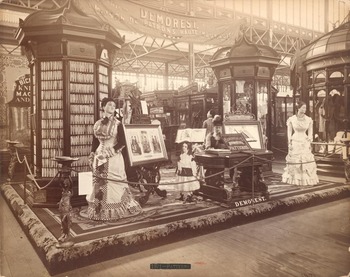
Recovering information on the Demorests' role in the Centennial consists of probing, by analogue means, the analogue content of their 1876 volume as event. From an array of the magazine's images I have chosen an engraving of the Demorest exhibit dais in the Main Building at the Centennial and a fashion illustration depicting travellers bound for the Centennial. I will briefly consider the engraving of the exhibit in a general way and in light of an official photograph of the Demorest installation from the Free Library of Philadelphia (FLP) online digital collections. I will then present an overview of Kenneth L. Wilson and colleagues' fractal-concept method, an analogue tool for the examination of advertising art, and will use that tool to analyze the fashion illustration.
Artist's conception and ‘as-built’ display
The plate of the line engraving of the Demorest exhibit (Fig. 1) provides rich visual data and is an immediate confirmation of this periodical as Centennial event. Textual particulars of the exhibit appear on a different page from the engraving. Even without the descriptive details, the plate would have served, at a time before photography was introduced into magazines, as an unambiguous prospectus of the Demorest presence at the Fair. Another post-Centennial publication, Burr and Burr's Memorial of the international exhibition, now in Google Books, reprised the engraving but without description.Footnote 5 The republication of the engraving might be said to reduce the significance of the 1876 Demorest's volume as event; but it is important to see that volume as the Demorests' corporate promotional package. The magazine covered the Centennial before, during and after that festival as opposed to having been a chronicle of the Fair only after the fact.
Demorest exhibit engraving.
This Redman & Kenny engraving functions as a frontispiece to the June 1876 issue of Demorest's, facing the first page of text. Its placement at the very start of the issue invites readers’ engagement with the Demorests’ role at the Centennial, as does the reference at bottom centre to the description that comes at page 315 in the same issue of the magazine. This image was republished in 1877 in Burr and Burr, Memorial of the international exhibition. https://books.google.com/books?id=Xl7jGwAACAAJ

The FLP's pan/zoom feature allows extraordinary visual access to the Library's photo (Fig. 2) of the Demorest exhibit. With the pair of digital images easily accessible for comparison one might attempt a 3D model or visualization of either or both, or of a conflation of the two, as a study project. But if such a project is not indicated or desired, there are still plenty of data to work with in the 2D versions. For example, the fact that the conceptual drawing does not depict the actual display yields possibilities for understanding the differences between a rendering and an as-built fashion merchandising presentation of the period.
Official photograph of the Demorest exhibit.
This silver albumen print mounted on card stock represents one of over 2800 images produced by The Centennial Photography Company (CPC), the Fair's officially licensed firm. According to the Free Library of Philadelphia's Centennial photographs collection overview at https://libwww.freelibrary.org/CenCol/ov-collection2.htm the production process yielded highly detailed images on glass plate negatives. The image can be viewed using a pan/zoom feature at https://libwww.freelibrary.org/diglib/SearchItem.cfm?ItemID=c021971

The engraving is a perspective view of mannequins, furniture and the Demorest banner on a free-standing platform against a vacant background. The photograph, taken from an alternate angle, shows the Demorest display in situ. Awareness of this difference might prompt consideration of 19th-century principles of perspective drawing, especially scenographic projection; of tonality, sharpness and contrast in the engraving and the photograph as representations of fashion display at an international exposition; and of the technology of magazine design and production in the 1870s.Footnote 6
The ability to view the exhibit in relation to nearby displays, as in the photograph, urges further inquiry into the location of the Demorest exhibit in the Main Building and whether that placement and orientation were advantageous.Footnote 7 This straightforward method of reading the images to glean information about drawing, photography and marketing is stimulating and rewarding, but let's look at another method, one that takes the study of fashion illustration to multiple levels by using a tool dedicated to that very purpose.
Fractal-concept analysis of advertising art
There is a vast body of literature on consumer response to print advertising. Some studies examine the degree and positioning of white space or the placement of an advertisement on the page. Sexualization of adverts for products from cars to cosmetics is an ongoing area of study. To the interpretation of the printed pictorial come-on, scholars have applied reader-response theory and patterns of materialism. They have explored semiotics, iconography, illusion and hip consumerism by a host of means including purely impressionistic critique as well as eye tracking, consumer surveys and other types of data analytics.
A scheme with promising ramifications in fashion history is fractal-concept analysis of art. Not a top-down method, it acts from the inside out. It is not intended to hypothesize creator intent but rather to ‘uncover the conceptual structures that are already implicit in non-iterated phenomena’.Footnote 8 Proceeding from Benoit Mandelbrot's theories of geometric repetition—Mandelbrot (1924–2010) coined the word ‘fractal’ to describe a phenomenon, not necessarily mathematical, that repeats at every scaleFootnote 9 —Kenneth Wilson, Jason Adam Wasserman and Florin Lowndes in a 2009 article ‘unpacked’ three current adverts using the fractal-concept method. This is not a computer-based application. It calls upon visual analysis to discern repeating patterns in a piece of advertising art.
Wilson and colleagues sought concealed meanings that would reveal an advertiser's manipulation of the consumer. Their article liberates visual analysis from being dismissed as ‘postmodern nonsense’, bringing it into the realm of holistic pattern study.Footnote 10 The authors state, ‘Rather than reducing visual images to independent codes, which are then re-assembled into an axiomatic system—a process which we believe is essentially foreign to visual art—fractal-concept analysis looks for observable patterns in the whole image’.Footnote 11 It is this extraction of pattern repetition that yields the fractal concepts.
Multilevel Integrated Cognition
Wilson, Wasserman and Lowndes offer ‘Multilevel Integrated Cognition’ (MIC) for fractal-concept analysis. They take the process through four ontological levels: (1) static, (2) dynamic, (3) evaluative and (4) self/identity or identity-forming. These levels show interrelationships within and between levels. Higher levels always contain lower levels: in an MIC table, level 1 is always the bottom row. In applying MIC fractal-concept analysis to advertising art the authors seek ‘the artist's latent conceptual picture’, which ‘is not reduced to individual conceptual pieces to be re-assembled, … but is instead captured in fractal-concepts'. As the authors explain, ‘fractals, by definition, are self-organized logic systems … .’Footnote 12 The idea is to break apart concepts logically, to find the advertiser's hidden lures.Footnote 13
One of the three ‘MIC generators’ in the Wilson, Wasserman and Lowndes article examines a Gore-Tex hiking-boot advertisement in order to expose the fractal concepts, or messages embedded in repeating patterns. The authors take the work of art, the advert, as the starting point, focussing on the boot (static, level 1) in the foreground. They then cause the work to undergo differentiation, as cells do when they become more specialized, ‘in a manner that promotes re-integration’. At this tier (dynamic, level 2) the authors show that the boot wearer's climbing and jumping render the static object dynamic. Continuing on, they expose and integrate ‘conscious and unconscious visual concepts’ (evaluative, level 3), and come to an end point (identity-forming, level 4), at which they will reintegrate the ‘conceptual-artistic idea as multi-scaled fractal’.Footnote 14 So far they have determined the advertiser's message to be that a static object, the ‘hiking-boot (level 1) can make jumping across mountain peaks possible (level 2), contributing to the consumer's release from the usual limitations (level 3) when the hiking-boot is made by Gore-Tex (level 4)’.Footnote 15
Catiteration
Having arrived at level 4, the authors now engage ‘catiteration’, a term introduced by LariAnn Garner in 2003. Catiteration entails repeated iteration over the levels, up through the level at which the person applying the process simply decides to stop. As Wilson and colleagues explain, ‘[F]ractal iterations of the product-pictures can unpack the latent concepts that actually belong with the pictures. … Catiteration of the exposed picture-concepts, text-concepts and observables (pictures) … [exposes] the precise nature of the ad's manipulation, or, if the ad is honest, [its] harmoniously informative nature’.Footnote 16 Wilson and colleagues apply catiteration across levels 1 and 2 only, deeming this sufficient to validate the method. Through catiteration they create four sublevels within levels 1 and four sublevels within level 2. These four new sublevels within the two levels repeat the pattern of static, dynamic, evaluative, and identity-forming as fractal concepts.
Catiteration applied to level 1 produces levels 1.1, 1.2, 1.3, and 1.4. These new catiterated levels might be written out as static.static, static.dynamic, static.evaluative and static.identity-forming. The authors’ catiteration of level 1 concentrates on the hiking boot as a static object and returns the following fractal concepts: The ‘hiking-boot (level 1.1) flexibly adapts to the forward-moving hiker (level 1.2) and resists water (level 1.3) when made by a toughness-oriented (metallic logo) company (1.4).’ Note that the Wilson team indicates that the advertisement projects certain qualities of the boot that the advertiser wants the consumer to desire. A consumer could thus read a static object's potential to adapt to the wearer's hiking progress as dynamic (level 1.2). Water-resistance (level 1.3) is a quality that might contribute to the consumer's positive evaluation of the boot. The authors acknowledge that ‘toughness-oriented company’ (level 1.4) as a way of characterizing the identity of Gore-Tex could be questioned but they believe it reasonable to apply this description to a corporation that makes boots of this type.Footnote 17
At level 1, the advertising material is still grounded in reality. At level 2, the dynamic level, the advert introduces ‘distortions managed in such a way that the consumer remains unaware of them.’Footnote 18 A pattern such as the one we saw inside level 1 applies as well in level 2. Catiteration in level 2 produces levels 2.1, 2.2, 2.3 and 2.4 (dynamic.static, dynamic.dynamic, dynamic.evaluative, dynamic.identity-forming), making the following dynamic fractal concepts apparent: the person wearing the boot(s) is outsized in relation to the rugged background (level 2.1) and appears to be making near-impossible leaps (2.2) in an energized manner, thus becoming almost superhuman (2.3) thanks to Gore-Tex (2.4). These ‘picture-concepts’ represent implausible circumstances, but the goal of the advertisement is to convince the reader that the product can dynamically transport him or her to a state of pleasure, confidence or other higher sphere of feeling and being. These concepts are now exposed in level 2, thanks to catiteration.Footnote 19
Fractal-concept analysis: Demorest's magazine
The illustration I have selected for fractal-concept analysis is not explicitly an advertisement. Like the plate depicting the Demorest exhibit, it is conjectural and stores manipulative messages. As the Wilson team suggests, fractal-concept analysis of an advertisement assumes that the person performing the analysis can grasp social, temporal and environmental clues based on familiarity with the advert's subject matter.Footnote 20 Several assumptions are in place as the following analysis begins: I have performed background reading on the Demorests and the Centennial; I have some fluency in American fashion illustration of the period; I know that the costumes depicted are representative of Demorest patterns; I have concluded that the illustration I have chosen is promotional.Footnote 21 Now I want to discover how this image quietly functions to bend the consumer to the company's will.
Applying the steps in the fractal-concept analysis of the Gore-Tex advert, and bearing in mind that any image is open to interpretation, I discover these messages: Garments and accessories (level 1) can equip a consumer for travel to the Centennial (level 2), opening up new opportunities for the consumer (level 3) when the garments are cut from a Demorest's pattern and the clothing and accessories are featured as appropriate Centennial-going attire in Demorest's magazine (level 4). Alternatively stated, at level 1 (static) is any article of clothing or any accessory depicted in this illustration. At level 2 (dynamic) three people, presumably a mother, daughter and son, are wearing, carrying or positioned adjacent to these items and are in the process of travelling. Level 3 (evaluative) introduces anticipation of the journey and its purpose. At level 4 (identity-forming) the fact that this illustration appears in Demorest's settles the Demorest identity, or brand, on the design of the clothing. The schedule placard brands the travel destination as the Centennial Exhibition and the mode of transport as the ‘Erie R.R.’ (look closely at the train), in which the Demorests had financial interests.
En route to the Centennial.
Fractal-concept analysis of this Redman & Kenny engraving as advertising art reveals the advertiser's latent meanings. The image can be studied in other ways as well: for example as a means to understanding engraving techniques; fashion accessories; and the vocabulary of fabric and textiles. On the schedule board, the railway car above and to the right of the word ‘TIME’ states ‘ERIE R.R.’, in which company the Demorests had financial interests. The image appeared on page 304 of the 1876 volume.

Level 1 catiteration: all about the garments and accessories (static)
Catiterating over level 1 (static) places the clothing and accessories at level 1.1. At level 1.2 these items, although still static, acquire a dynamic quality because they are contributing to the travellers’ experiences. At level 1.3 the value of the accessories and clothing begins to be revealed, even as some of the accessories almost paradoxically enclose other accessories: an umbrella holder, a coutil satchel cover and a shawl strap all transport and protect other accoutrements. The garments and trappings hold practical value (protection of the people and their personal effects from rain, dirt, and chill) and aesthetic/psychological value (admiration or social standing through modish attire). These travellers can expect to be viewed as both sensible and stylish en route to, and at, the Centennial.
At level 1.4, in which corporate identity should take hold, the factor of subtlety in advertising is key, for even though ‘Centennial’ is stated on the schedule board no Demorest mark exists overtly in the image. The tacit ‘logo’ consists of names and numbers of the patterns (descriptive: ‘Boy's Ulster Coat’, no. 2039; feminine/subjective: ‘Florestine’ polonaise, no. 2423). The reader of 1876 wishing to learn more about the garments and accessories would have read the running text that is visually separated from the image by being typeset as an article, or would have leafed through the issue to find those names and numbers on another page. A regular reader of the magazine would have comprehended that the garments in this image were made according to a Demorest product, the ‘Reliable’ paper pattern.
Level 2 catiteration: the people in the railway station (dynamic)
Wilson, Wasserman and Lowndes carry catiteration through level 2, and we can do the same. At level 2 (dynamic; people travelling), the family is in a railway station, about to board a train (2.1). The sweep of the woman's skirt suggests a stately, flowing movement; the woman holds her ticket as if to offer it to the conductor; the boy's hand finds the listing for the train on which the trio will shortly travel (2.2). The timetable indicates the group's worthy destination; the doorway and the faint delineation of the platform suggest a frisson of anticipation of impending departure (2.3). At last the family are about to cross the boundaries of human experience and, clad in Demorest attire, embark via the Erie Railway for the Centennial, where they will surely visit the Demorest exhibit (2.4). The illustration will have achieved its goal if a customer purchases Demorest patterns and produces, from those patterns, clothing to be worn to the Fair. Those wearing such clothing will have stepped out of the magazine-as-event and become walking commercial announcements for Demorest patterns at ‘the’ event of 1876.
MULTILEVEL INTEGRATED COGNITION (MIC) TABLE for Demorest's monthly magazine fashion illustration depicting travellers to the Centennial, volume 12 (1876), page 304.
Only levels 1 (static-objective) and 2 (dynamic) are catiterated to display further fractal patterns of the advertiser's manipulation of the consumer. Levels 3 (evaluative) and 4 (identity-forming) are annotated with observations regarding the message of the advertisement as reflective of general (not catiterated) level 3 and 4 characteristics in the fashion illustration.

Conclusions
In the tall cases anchoring the Demorest exhibit are what appear to be sewing patterns. The easel stand presents the Demorest dress-cutting system. Across the schedule board in the drawing we have just analyzed, an Erie Railway train chugs along. A recommended fabric for the woman's dress is Louisine. The satchel cover is made of coutil. The shawl strap resembles a handbag. The illustration appeared in the June issue: despite the suggestion that lightweight fabrics might be suitable, the models’ clothing, in vogue as it was, seems stifling for summertime in Philadelphia.
Any of these observations might lead to queries beyond the analysis of latent persuasion emphasized here. One might wish to have an inventory of the patterns in the cases, or to know whether the pattern envelopes were dummies. The diagram on the easel suggests that Demorest patterns were printed with cutting lines for multiple sizes. This information might trigger further research into the history of sewing patterns.Footnote 22 The Erie labelling is part of the latent message, but might stimulate new research on tourist transport. A textile historian might be curious about Louisine and coutil. A researcher interested in the engineering of a shawl strap could trace its patent history. Another scholar might see the proposed Centennial-going attire as evidence of fashion's victory over common sense: long, heavy or constricting clothing in the summer might have contributed to illness or exhaustion. Indeed, a recent study of the Centennial demonstrates that the Fair's administrators did not publicize the number of attendees adversely affected by the heatwave of July 1876.Footnote 23
There are many approaches to the study of fashion periodicals and their advertising content. Fractal-concept analysis presents a motivating framework that can be used in library instruction, fashion merchandising and art historical teaching and learning situations. Despite possible implications of artificial intelligence, fractal-concept analysis remains a piece-by-piece approach that summons visual interpretation of a sort that still requires human knowledge to extract information, as does the comparison of the ways the Demorest exhibit was portrayed in an engraving and a photograph.Footnote 24 The prospects for fractal-concept analysis of advertising art through machine learning are yet to be revealed, but the analogue method is accessible now and ready to trial in the library and the classroom.
I would like to acknowledge the support and assistance of the following: Nicole LaMoreaux and colleagues, Adrian Marcuse Library, LIM College, New York; Tee Quakhaan and Laura Stroffolino, the Free Library of Philadelphia; Jill LeMin Lee, the Athenaeum of Philadelphia; Jim Roan, the Smithsonian Institution Libraries; John Convey, the Catholic University of America; the late Wilcomb E. Washburn, the Smithsonian Institution; Joanna Schneider Zangrando, Skidmore College (emerita); and the staffs of the following entities: the Catholic University of America Libraries; the Washington Regional Libraries Consortium; and Long Branch Library, Silver Spring, Maryland.