Significant Outcomes
GSH levels correlate with earlier age of onset of illness in prefrontal brain in patients with schizophrenia
This finding may reflect a greater, or cumulatively longer, compensatory increase in AODS function in early onset patients, and it suggests a role of the AODS in schizophrenia aetiology
Limitations
This is a cross-sectional study of the AODS and schizophrenia and does not examine longitudinal effects or effects secondary to treatment.
This study has a relatively small sample size of 28 patients with schizophrenia.
This study is limited to patients with chronic schizophrenia and, therefore, the findings may not generalise to patients with recent-onset illness.
Introduction
Neuroinflammation and oxidative stress are two separate but interrelated processes implicated in the aetiology of schizophrenia. Neuroinflammation, the activation of the innate immune system in response to injury, invasion, or stress, can trigger oxidative stress, which in turn can lead to neuronal dysfunction and death. Both neuroinflammation and oxidative stress are thought to be increased in schizophrenia (Steullet et al., Reference Steullet, Cabungcal, Monin, Dwir, O’Donnell, Cuenod and Do2016), and epidemiological, genetic, and molecular studies point to oxidative stress influencing the neurodevelopmental processes associated with schizophrenia (Koga et al., Reference Koga, Serritella, Sawa and Sedlak2016). The antioxidant defence system (AODS) is designed to counterbalance the effects of oxidative stress with enzymatic and non-enzymatic activity. In patients with schizophrenia, both enzymatic and non-enzymatic components of the AODS have been shown to be decreased peripherally and in cerebrospinal fluid (Do et al., Reference Do, Trabesinger, Kirsten-Krüger, Lauer, Dydak, Hell, Holsboer, Boesiger and Cuénod2001; Barron et al., Reference Barron, Hafizi, Andreazza and Mizrahi2017). These findings have led to the theory that schizophrenia may be caused in part by a dysfunctional AODS and that induction or supplementation of the AODS may be beneficial for the treatment of schizophrenia (Berk et al., Reference Berk, Copolov, Dean, Lu, Jeavons, Schapkaitz, Anderson-Hunt, Judd, Katz, Katz, Ording-Jespersen, Little, Conus, Cuenod, Do and Bush2008). Despite this theory, little is currently understood about the AODS in brain of patients with psychotic disorders.
Glutathione (GSH) is one of the most abundant non-enzymatic components of the AODS in brain and can be regarded as a marker of AODS function (Koga et al., Reference Koga, Serritella, Sawa and Sedlak2016). However, technical limitations of magnetic resonance spectroscopy (MRS) have made it difficult to examine levels of GSH directly in brain in schizophrenia, and previous studies measuring GSH in brain in psychotic spectrum disorders with GSH-specific sequences have yielded mixed results. Two studies have reported decreased GSH in patients in medial prefrontal cortex and anterior cingulate cortex, compared to control subjects (Do et al., Reference Do, Trabesinger, Kirsten-Krüger, Lauer, Dydak, Hell, Holsboer, Boesiger and Cuénod2001; Kumar et al., Reference Kumar, Liddle, Fernandes, Palaniyappan, Hall, Robson, Simmonite, Fiesal, Katshu, Qureshi, Skelton, Christodoulou, Brookes, Morris and Liddle2018). One study reported decreased GSH in patients carrying the high-risk variant of the gene encoding the rate-limiting enzyme in GSH synthesis (Xin et al., Reference Xin, Mekle, Fournier, Baumann, Ferrari, Alameda, Jenni, Lu, Schaller, Cuenod, Conus, Gruetter and Do2016). Four studies have detected no change between patients and control subjects (Terpstra et al., Reference Terpstra, Henry and Gruetter2003; Matsuzawa et al., Reference Matsuzawa, Obata, Shirayama, Nonaka, Kanazawa, Yoshitome, Takanashi, Matsuda, Shimizu, Ikehira, Iyo and Hashimoto2008; Brandt et al., Reference Brandt, Unschuld, Pradhan, Lim, Churchill, Harris, Hua, Barker, Ross, van Zijl, Edden and Margolis2016; Da Silva et al., Reference Da Silva, Hafizi, Andreazza, Kiang, Bagby, Navas, Laksono, Truong, Gerritsen, Prce, Sailasuta and Mizrahi2017), though one of those identified an inverse relationship between GSH and negative symptoms in patients (Matsuzawa et al., Reference Matsuzawa, Obata, Shirayama, Nonaka, Kanazawa, Yoshitome, Takanashi, Matsuda, Shimizu, Ikehira, Iyo and Hashimoto2008). Lastly, one study reported increased GSH in patients compared to controls, in a first-episode population (Wood et al., Reference Wood, Berger, Wellard, Proffitt, McConchie, Berk, McGorry and Pantelis2009). These studies focused on group differences, and only one examined the relationship between GSH and age at onset, and found no association (Matsuzawa et al., Reference Matsuzawa, Obata, Shirayama, Nonaka, Kanazawa, Yoshitome, Takanashi, Matsuda, Shimizu, Ikehira, Iyo and Hashimoto2008).
Aims of the study
To elucidate the relationship between the AODS and psychotic illness, we examined the associations between brain GSH levels and age, age at onset of illness, duration of illness, and positive and negative symptoms in a chronic schizophrenia population.
Methods
Twenty-nine subjects were recruited from outpatient clinics at the Greater Los Angeles Veterans Affairs Healthcare System and the University of California Los Angeles Medical Center. All subjects in the study met DSM-5 criteria for schizophrenia or schizoaffective disorder. Subjects were recruited as part of an ongoing study, Treatment of Cognition and Negative Symptoms with N-acetylcysteine in Schizophrenia (NCT02505477). Exclusion criteria included moderate or severe substance use disorder (alcohol and illicit drugs), participation in another experimental drug trial, antipsychotic medication dosage change greater than 50%, or psychiatric hospitalisation, within the prior 3 months. All subjects were on an antipsychotic medication. Positive psychotic symptoms were measured with the 7-item positive symptom subscale of the Positive and Negative Symptom Scale (PANSS). Negative symptoms were measured with the Clinical Assessment Interview for Negative Symptoms (CAINS). Symptom scale interviews were administered by trained raters.
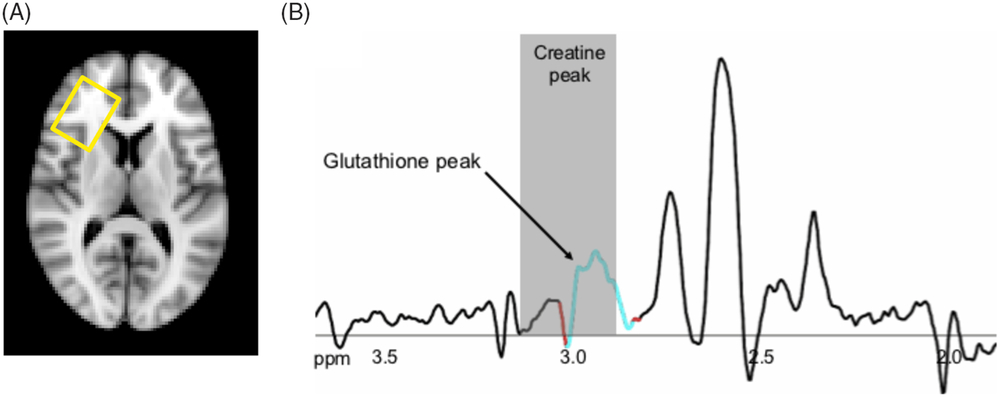
Imaging data were obtained using a 3T Siemens Prisma MRI scanner, using a 64-channel head coil, at the UCLA Ahmanson-Lovelace Brain Mapping Center. T1-weighted MP-RAGE structural images were acquired with the following settings: repetition time (TR) = 2400 ms, echo time (TE) = 2.22 ms, flip angle = 8°, field of view = 256 mm, and slice thickness = 0.8 mm. T1-weighted images were used to guide placement of one voxel in the left dorsolateral prefrontal region (DLPFR) on the left side of the brain. The left middle frontal gyrus, the precentral sulcus, the superior-lateral extent of the cerebrum, and the superior frontal sulcus were used to guide placement of the voxel. Voxel size was 35 × 25 × 25 mm (35 mm in anterior–posterior axis; see Fig. 1(A) for voxel location). Automated shim ‘Brain’ program was used, with manual shimming performed if full width half maximum (FWHM) of the water peak was greater than 14.5 Hz. Optimised gradient order of coronal, 0°, was determined via pilot scanning to minimise outer voxel lipid contamination (Ernst & Chang, Reference Ernst and Chang1996).
Voxel placement and sample MRS spectrum. (A) Left dorsolateral voxel placement on standardised brain (transverse view). (B) Example GSH spectrum from a subject with schizophrenia measured with MEGA-PRESS.

GSH was measured with a MEGA-PRESS, J-difference, editing sequence specifically adapted for GSH (Mescher et al., Reference Mescher, Merkle, Kirsch, Garwood and Gruetter1998; Terpstra et al., Reference Terpstra, Henry and Gruetter2003; An et al., Reference An, Zhang, Thomasson, Latour, Baker, Shen and Warach2009). MEGA-PRESS scanning parameters were as follows: TR = 2000 ms; TE = 131 ms; edit pulse frequency = 4.56 ppm; off-resonance pulse frequency = 4.90 ppm; edit pulse bandwidth = 30 Hz; edit centre frequency = 4.73 ppm; delta frequency = −1.7 ppm; acquisition time, approximately 6 min per acquisition. Eighty-eight water-suppressed spectral averages were collected for each acquisition; two consecutive acquisitions were performed for a total of 176 averages. Because the editing pulse frequency used in this protocol was 4.56 ppm, the GSH signal was not affected by macromolecule co-editing, as this would require an editing pulse near the macromolecular coupled spin at 1.7 ppm.
GSH levels were quantified by peak integration of the MEGA-PRESS difference spectra using LCModel 6.3-1L, jMRUI, and custom software in an operator-independent sequence of processing steps. LCModel was first used to calculate the phase correction for each spectrum. jMRUI was then used to zero-fill (2×), phase correct (with values from LCModel), and apodize the on- and off-resonance spectra from each acquisition. Spectra were then frequency-aligned using custom software developed by R.J.M. and implemented in Microsoft Excel, and subtracted to generate difference spectra, which were summed across the two acquisitions. The edited GSH cysteine resonance at 2.95 ppm was then quantified by linewidth optimised peak integration in the final difference spectrum in Excel. The creatine (Cr) resonance at 3.02 ppm was similarly quantified by peak integration in the final summed spectrum and used to calculate the GSH to Cr ratio (GSH/Cr). LCModel was not used for fitting either GSH or Cr.
Expression of GSH levels relative to Cr concentrations was chosen due to evidence that extracellular free water is increased in schizophrenia compared to controls (Pasternak et al., Reference Pasternak, Westin, Bouix, Seidman, Goldstein, Woo, Petryshen, Mesholam-Gately, McCarley, Kikinis, Shenton and Kubicki2012; Lesh et al., Reference Lesh, Maddock, Howell, Wang, Tanase, Ragland, Niendam and Carter2019). In light of past reports of Cr elevation in schizophrenia (Ongür et al., Reference Ongür, Prescot, Jensen, Cohen and Renshaw2009), we also examined several other metabolites in relation to Cr to evaluate the possibility that changes in GSH/Cr levels could be driven by Cr.
All spectra were evaluated with signal-to-noise ratio (S/N) and FWHM as measured by LCModel, and visual inspection, for data quality control. One subject’s scans were excluded due to excessive motion artefact. Of the 28 subjects who remained, none had spectra with LCModel quality metrics of S/N < 17 or FWHM >0.071 ppm, or values of GSH greater or less than three standard deviations from the mean value of GSH in the sample. A sample spectrum demonstrating clear separation of the GSH peak from its overlapping Cr peak is presented in Fig. 1(B).
Absolute concentration of GSH was estimated from GSH/Cr ratios using an editing efficiency value of 0.74, as reported by a study utilising an editing sequence similar to ours (MEGA-PRESS, J-difference, TE = 130 ms) (Sanaei Nezhad et al., Reference Sanaei Nezhad, Anton, Parkes, Deakin and Williams2017). For these calculations, published values for the T1 and T2 relaxation times of Cr (1320 and 170 ms) (Mlynárik et al., Reference Mlynárik, Gruber and Moser2001; Träber et al., Reference Träber, Block, Lamerichs, Gieseke and Schild2004) and of GSH (400 and 67 ms) (Emir et al., Reference Emir, Deelchand, Henry and Terpstra2011; Sanaei Nezhad et al., Reference Sanaei Nezhad, Anton, Parkes, Deakin and Williams2017) were utilised. These values and a canonical value of 9 mM for Cr were then used to compute an estimated absolute value of GSH (Sanaei Nezhad et al., Reference Sanaei Nezhad, Anton, Parkes, Deakin and Williams2017).
Bivariate correlations between GSH levels and the PANSS positive symptoms subscale, CAINS total score, age, duration of illness, and age at onset of illness were performed with Spearman’s rho (two-tailed) due to non-normality of the sample. The Bonferroni correction for multiple comparisons was also performed.
Results
The study sample was 82% male and had a mean chlorpromazine equivalent (CPZ) antipsychotic medication dosage of 655 mg [standard deviation (SD) 432 mg, range 21–1575 mg]. Out of 28 subjects, 27 were on a second-generation antipsychotic and 2 were on a first-generation antipsychotic (one patient was on both). Two subjects were on benzodiazepines, three on anticholinergic agents, three on mood stabilisers, six on antidepressants, and four on clozapine. The mean age was 52 years (SD 10.6, range 26–65); mean duration of illness was 29 years (SD 11.4, range 8–49); mean age at onset was 24.1 years (SD 10.1, range 7–50); mean of the 7-item positive symptom subscale of the PANSS was 14.6 (SD 4.9, range 7–26); mean CAINS total score was 18.1 (SD 9.3, range 2–39).
MRS data quality was excellent. S/N mean was 24.2 (SD 3.5, range 17–36); FWHM mean was 0.044 ppm (SD 0.008, range 0.028–0.071). The mean GSH/Cr was 0.037 (SD 0.012, range 0.023–0.070). The estimated average absolute concentration of GSH (based on the measured GSH/Cr ratios) was 1.73 mM, assuming an average absolute Cr concentration of 9 mM, which is consistent with the values previously reported (Rae & Williams, Reference Rae and Williams2017).
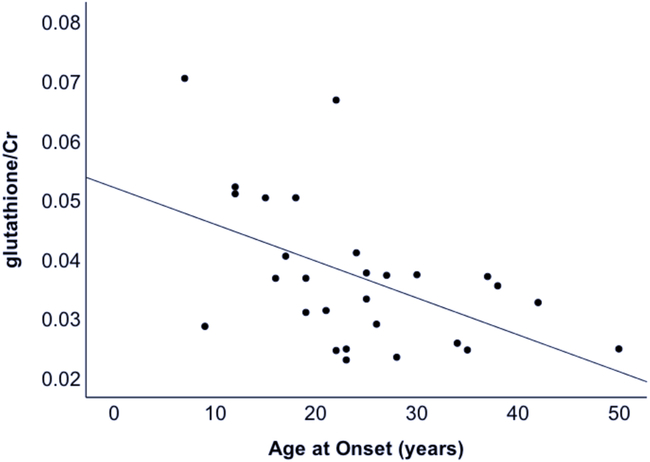
Bivariate comparison with Spearman’s rho between dorsolateral prefrontal GSH/Cr level and age, duration of illness, age at onset, positive symptoms, and negative symptoms revealed a trend-level positive relationship between GSH/Cr and duration of illness (r = 0.34, p = 0.076), and a statistically significant negative correlation between dorsolateral prefrontal GSH level and age at onset (r = −0.46, p = 0.015, see Fig. 2). We tested this relationship with age as a covariate using partial correlation coefficients, and the relationship between GSH/Cr and age at onset remained significant (r = −0.495, p = 0.009). The relationship with GSH/Cr remained significant (r = −0.487, p = 0.010) after partial correlation controlling for CPZ equivalents, as well. Correlations with positive and negative symptoms were not significant. When we apply the Bonferroni correction for multiple comparisons, the relationship between GSH/Cr and age at onset becomes a trend.
Negative correlation between GSH/Cr and age at onset. N = 28, r = −0.46, p = 0.015. If one or both subjects with the highest GSH values are removed, the correlation remains statistically significant.

In subsequent correlational analyses designed to examine the possibility that our results were driven by changes in Cr concentration, we found no significant relationships between the four ratios, glutamate/Cr, glutamine/Cr, N-acetylaspartate/Cr or myo-inositol/Cr, and age, age at onset, or duration of illness.
Discussion
To investigate the role of oxidative stress and the AODS in schizophrenia, we examined the relationships between GSH levels in the DLPFR and clinical and demographic correlates of schizophrenia. Of the five correlations examined, we identified a significant negative correlation between GSH and age at onset of illness, and a trend-level correlation between GSH and duration of illness.
Given the hypothesis that an inadequate AODS has a role in the pathogenesis of schizophrenia and that higher levels of GSH could be protective, the relationship identified here may represent a compensatory response to the neuroinflammation associated with schizophrenia. Increased levels of GSH in subjects with earlier age at onset may reflect a greater or longer cumulative compensatory increase in AODS function in early onset patients. The AODS reduces oxidative stress, protecting against cellular damage and neuronal dysfunction from reactive oxygen and nitrogen species. The AODS also supports N-methyl-d-aspartate (NMDA) receptor function, as NMDA receptors have been shown to be more efficient when surrounded by a less oxidative state (Steullet et al., Reference Steullet, Cabungcal, Monin, Dwir, O’Donnell, Cuenod and Do2016). NMDA receptors have been implicated in cognitive function and positive and negative symptoms in schizophrenia (Steullet et al., Reference Steullet, Cabungcal, Monin, Dwir, O’Donnell, Cuenod and Do2016). This supports a potentially beneficial role of the AODS and GSH in schizophrenia. Indeed, GSH supplementation via oral administration of its precursor N-acetylcysteine has been linked to reduced cognitive impairment and negative symptoms (Berk et al., Reference Berk, Copolov, Dean, Lu, Jeavons, Schapkaitz, Anderson-Hunt, Judd, Katz, Katz, Ording-Jespersen, Little, Conus, Cuenod, Do and Bush2008).
A second possibility is that this association may be due to a longer duration of treatment with antipsychotics in patients with earlier age at onset of illness. Antipsychotic treatment has been associated with increased peripheral levels of GSH peroxidase, a key enzyme in the synthesis of GSH (Tsai et al., Reference Tsai, Liou, Lin, Lin and Huang2013). Although we did not have sufficiently reliable tools with which to measure duration of treatment in this study, both age at onset and duration of illness are proxies for duration of treatment. Our finding may reflect a greater lifetime exposure to the beneficial antioxidant properties of antipsychotics by patients with earlier onset of illness. Correlation of GSH peroxidase levels with age at onset, duration of illness, and duration of treatment of schizophrenia would be valuable in future studies to explore this possibility.
Past reports raise the possibility that our finding is driven by an increase in relaxation times with increasing age (Marjańska et al., Reference Marjańska, Emir, Deelchand and Terpstra2013). However, the results of Marjańska et al. indicate that if there is an increase in relaxation times in older subjects, it is a global effect on all metabolites. Therefore, any effect of relaxation times on GSH signal due to ageing would be neutralised using another metabolite as a reference, including Cr.
This finding is in contrast to one prior study in chronic schizophrenia which found no association between GSH and age at onset, in a different brain region and with different methodology than that applied here (Matsuzawa et al., Reference Matsuzawa, Obata, Shirayama, Nonaka, Kanazawa, Yoshitome, Takanashi, Matsuda, Shimizu, Ikehira, Iyo and Hashimoto2008). There is evidence that metabolites differ among regions in normal brain; this is one potential explanation of the different results between our study and the previous study (Minati et al., Reference Minati, Aquino, Bruzzone and Erbetta2010).
We chose to use MEGA-PRESS J-difference editing over alternative methods (e.g. double quantum filtering, Stimulated Echo Acquisition Mode) to measure GSH because this method has superior S/N and has demonstrated concurrent and predictive validity (An et al., Reference An, Zhang, Thomasson, Latour, Baker, Shen and Warach2009; Mandal et al., Reference Mandal, Saharan, Tripathi and Murari2015; Mischley et al., Reference Mischley, Standish, Weiss, Padowski, Kavanagh, White and Rosenfeld2016). Data collected had excellent data quality markers including S/N and FWHM. We chose Cr as a reference value instead of water because free water values have been shown to be altered between patients with schizophrenia and control subjects (Pasternak et al., Reference Pasternak, Westin, Bouix, Seidman, Goldstein, Woo, Petryshen, Mesholam-Gately, McCarley, Kikinis, Shenton and Kubicki2012; Lesh et al., Reference Lesh, Maddock, Howell, Wang, Tanase, Ragland, Niendam and Carter2019). However, to be complete, we examined several other metabolites in relation to Cr and found no other significant relationships with age, age at onset, or duration of illness. Therefore, we do not believe our finding with GSH is driven by age-related Cr changes.
We were unable to directly compare GSH/Cr level values in the current study to GSH values from previous studies, as prior studies have utilised either water (Do et al., Reference Do, Trabesinger, Kirsten-Krüger, Lauer, Dydak, Hell, Holsboer, Boesiger and Cuénod2001; Wood et al., Reference Wood, Berger, Wellard, Proffitt, McConchie, Berk, McGorry and Pantelis2009; Da Silva et al., Reference Da Silva, Hafizi, Andreazza, Kiang, Bagby, Navas, Laksono, Truong, Gerritsen, Prce, Sailasuta and Mizrahi2017; Kumar et al., Reference Kumar, Liddle, Fernandes, Palaniyappan, Hall, Robson, Simmonite, Fiesal, Katshu, Qureshi, Skelton, Christodoulou, Brookes, Morris and Liddle2018) or n-acetylaspartate (Terpstra et al., Reference Terpstra, Henry and Gruetter2003) as an internal standard, or compared in vivo GSH peaks to those derived from phantoms (Matsuzawa et al., Reference Matsuzawa, Obata, Shirayama, Nonaka, Kanazawa, Yoshitome, Takanashi, Matsuda, Shimizu, Ikehira, Iyo and Hashimoto2008). However, converting GSH/Cr to GSH absolute values using editing efficiency values and standard formulas showed our GSH values to be consistent with those previously reported (Rae & Williams, Reference Rae and Williams2017).
This study is the first to report values from the DLPFR in schizophrenia; prior GSH-specific MRS studies have examined medial prefrontal, anterior cingulate, or temporal cortices. We consider the findings to be preliminary and they should be re-examined in larger data sets, though we note that our sample size is comparable to (Wood et al., Reference Wood, Berger, Wellard, Proffitt, McConchie, Berk, McGorry and Pantelis2009; Da Silva et al., Reference Da Silva, Hafizi, Andreazza, Kiang, Bagby, Navas, Laksono, Truong, Gerritsen, Prce, Sailasuta and Mizrahi2017; Kumar et al., Reference Kumar, Liddle, Fernandes, Palaniyappan, Hall, Robson, Simmonite, Fiesal, Katshu, Qureshi, Skelton, Christodoulou, Brookes, Morris and Liddle2018) or larger than (Do et al., Reference Do, Trabesinger, Kirsten-Krüger, Lauer, Dydak, Hell, Holsboer, Boesiger and Cuénod2001; Terpstra et al., Reference Terpstra, Henry and Gruetter2003; Matsuzawa et al., Reference Matsuzawa, Obata, Shirayama, Nonaka, Kanazawa, Yoshitome, Takanashi, Matsuda, Shimizu, Ikehira, Iyo and Hashimoto2008) sample sizes in prior studies. Other limitations include only being able to report on DLPFR, not cortex alone, as MRS voxels are large and encompass both grey and white matter; lack of a healthy comparison group; and lack of a reliable measure for duration of treatment and lifetime exposure to antipsychotic medication. Nonetheless, we did find correlation between brain levels of a key member of the AODS, GSH, and an important demographic variable, age at onset of illness, which suggests a long-term compensatory mechanism of the AODS in schizophrenia, and merits further study.
Author contributions
YSY: study design and implementation, data acquisition, data analysis, and first draft of the manuscript. RJM: study design, study implementation, and data analysis. JL: study design and data acquisition. HZ: data analysis. GH: study design and data analysis. KLN: study design. SRM: study design and implementation. MFG: study design and implementation and data analysis. All authors contributed to manuscript revisions and gave approval to the final version to be published.
Financial support
This work was supported by a foundation grant to Y.S.Y. from the Friends of the Semel Institute for Neuroscience and Human Behavior.
Conflict of Interest
None.
Ethical Standards
The authors assert that all procedures contributing to this work comply with the ethical standards of the relevant national and institutional committees on human experimentation and with the Helsinki Declaration of 1975, as revised in 2008.