The importance that ancient Mesoamerican peoples attached to maize is difficult to overstate. Maize appears prominently in religious life and in origin stories. Countless genetic strains attest to the efforts to adapt maize to different environmental conditions. Modern peoples inherited a complex technology for preparing maize foods, which improved the nutritional balance of maize-dependent diets—the same technologies employed by ancient peoples to create diverse foods, including tortillas, tamales, pozoles, atoles, and tesguiño.
Because of this importance, it is easy to forget that maize was not always the centerpiece of pre-Hispanic diets. Some periods were too early for dependence on maize agriculture. Some landscapes limited or prohibited dependence on maize. For example, the Otomi of central Mexico inhabited a sparsely populated, arid region north of the Basin of Mexico and were recognized and ridiculed by the Aztecs for consuming green, immature corn with minimal preparation (Brumfiel Reference Brumfiel, Brumfiel and Fox1994). The Otomi's corn thus lacked part of the nutrient content of more mature and fully prepared maize foods, but they could compensate for shortfalls with a broad spectrum of alternative foods. In other cases, the costs of labor and materials imposed by urban life may have limited some households’ ability to prepare maize (Biskowski Reference Biskowski2000; Krause et al. Reference Krause, Tucker, Kuhnlein, Lopez-Palacios, Ruz and Solomons1992).
Previous investigations of Epiclassic and Early Postclassic period (ca. a.d. 600–1200) grinding tools revealed anomalies consistent with a de-emphasis of intensive maize grinding in contrast to Classic and Late Postclassic period practices (Biskowski Reference Biskowski1997). Studies of grinding tools from excavations at Oxtotipac (Good and Obermeyer Reference Good, Obermeyer and Sanders1986), Xometla (Nichols and McCullough Reference Nichols, McCullough and Sanders1986), and the Mezquital Valley (Fournier and Bolaños Reference Fournier, Bolaños, Kowalski and Kristin-Graham2007) identified high frequencies of closed-surface grinding tools—trough metates and mortars—which are less efficient than open-surface tools for intensive, prolonged maize-grinding (Adams Reference Adams1993, Reference Adams1999). Analyses of grinding tools in central Mexico are still few in number, however, and it is not clear whether these cases are local deviations or part of a broad shift in subsistence patterns.
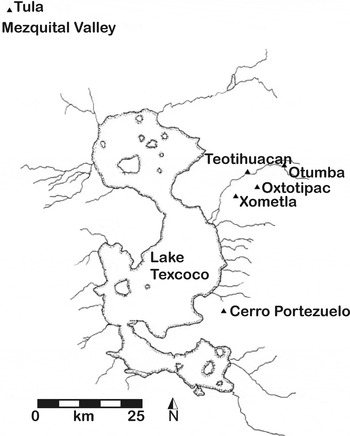
The grinding tools from Cerro Portezuelo (Figure 1) provide an opportunity to study this apparent change in subsistence in a new context. Artifacts from the site range in time of origin from the Classic through the Late Postclassic period and include substantial Epiclassic and Early Postclassic period components. The environment also is less arid than the Teotihuacan Valley and the often-desert-like Mezquital Valley, so subsistence decisions there are less likely to be influenced by marginal conditions for agriculture.
Map of the Basin of Mexico showing sites discussed in this paper.

PORTEZUELO AND ITS GRINDING TOOLS
The artifacts discussed here were collected by a series of projects in the 1950s from the site of Cerro Portezuelo, Mexico (Hicks Reference Hicks2013; Hicks and Nicholson Reference Hicks and Nicholson1964). The grinding tools form part of a larger collection of ground stone artifacts associated with diverse technological and social contexts, including stone effigies, abraders, polishers, plaster smoothers, axes, hammer stones, stone balls, maguey fiber scrapers, and various pieces of worked basalt, andesite, dacite, tezontle, laja, schist, and other stone materials. Ground stone collections generally are heterogeneous because they are formed by subtraction (Biskowski Reference Biskowski, Rowan and Ebeling2008). Pottery, obsidian, and other better-defined categories of artifacts and materials are removed from the field collections, and the ground stone collection often is what is left behind. This is clearly the case with the Cerro Portezuelo “ground stone.”
Consequently, the first step in analyzing the grinding tools was extracting them from this larger set of ground stone objects. This segregation was complicated by the ancient practice of recycling grinding tool fragments for building materials, hammer stones, and other purposes that obscured their original use. In simpler settings, the effects of recycling are manageable because ancient peoples used only a limited range of tools. But the inhabitants of Cerro Portezuelo used many kinds of manos, pestles, and mano-like polishers, abraders, and similar items during more than one thousand years of occupation. Identifying the food preparation implements in the absence of distinguishing wear is difficult, and several objects we could identify only as possible grinding tools.
The practice of recycling is also a source of bias potentially affecting the presence or absence of some types of artifacts. In particular, grinding tools that yield smooth, flat fragments are especially desirable for use in floors and walls. In addition, collection biases, which reflect either an inability to recognize some artifacts or a reluctance to collect and curate them, often manifest themselves in early grinding tool collections. At Cerro Portezuelo, although there are unanswerable questions about the collections and some evidence of recycling (for example, mano ends reused as pestles), the total effect of recycling and collection biases seems to be small. In addition to ground stone artifacts, the Cerro Portezuelo ground stone collection contained building stones and even a substantial sample of unmodified rock. Apparently the field workers collected all potential ground stone materials in their collection units. Since the presence and absence of certain kinds of grinding tools are important for making sense of the grinding tools, the thoroughness of the field collections is a reassuring point.
A less tractable problem with the collection is the difficulty of dating individual artifacts. With a few exceptions, most grinding tools are too generic in form to allow direct dating, so information about the contexts in which they were recovered is vital to identifying their origins. At Cerro Portezuelo, only about 60–70% of the grinding tools can still be linked to any provenience more specific than the site itself. For example, only 29 of 49 manos can be linked to collection locations. For these proveniences, data on the presence of pottery by phase was provided by project ceramicists Sarah Clayton and Destiny Crider. Unfortunately, nearly every grinding tool can be linked to sherds from multiple periods. So, at best, we can make inferences about the probable origins of types of artifacts. Where possible, the interpretations are supported by comparisons to other central Mexican grinding tool collections. For example, certain types of Late Postclassic period manos and metates are readily identifiable from their morphology and material.
DATA COLLECTION
Research over the last 30 years provides the basis for studying variability in grinding tools. The work of Cook (Reference Cook1970, Reference Cook1982) and Hayden (Reference Hayden and Hayden1987a, Reference Hayden and Hayden1987b) helped archaeologists to establish baseline expectations for patterns of grinding tool production, and others (Adams Reference Adams1993, Reference Adams1999, Reference Adams2002; Horsfall Reference Horsfall and Hayden1987; Spink Reference Spink1984) have explored the implications for grinding tool design for different kinds of preparation. A wide variety of additional archaeological, ethnographic, and dietary research has expanded our understanding of the technology and role of maize preparation in pre-Hispanic societies (see, for example, Biskowski Reference Biskowski2000; Feinman Reference Feinman and Isaac1986; Isaac Reference Isaac and Isaac1986; Krause et al. Reference Krause, Tucker, Kuhnlein, Lopez-Palacios, Ruz and Solomons1992; Searcy Reference Searcy2011; Serna-Saldivar et al. Reference Serna-Saldivar, Knabe, Rooney and Tanksley1987; Stein Reference Stein1974; Turuk Reference Turuk2007).
The Cerro Portezuelo grinding tools were subjected to attribute and material analyses. The former work followed a format originally designed by George Cowgill for work with the Teotihuacan Mapping Project (TMP) grinding tools and subsequently expanded to accommodate questions about a larger set of central Mexican artifacts (Biskowski Reference Biskowski1997). The attributes include both morphological and superficial material properties of the grinding tools relevant to understanding the production, exchange, use, consumption, reuse, and discard of these artifacts. More detailed analyses of the geological properties of the stone materials were undertaken in order to identify correspondences in the materials associated with different kinds of artifacts that might inform us about patterns of production and exchange. Lisa Hammersley of the Department of Geology at California State University, Sacramento, conducted petrographic analyses of thin sections.
ANALYSIS
To clarify the following analysis, some classificatory terminology is introduced here. The most basic differentiation is between the active and passive grinding tools. The former perform their work by being moved by hand, and their size and shape are constrained by this usage. Passive tools generally are not manipulated during grinding, so their size and shape are not as limited. Consequently, there is greater latitude in the design of passive tools that can be applied in ways ranging from adaptation to specific functional requirements to the expression of style and symbolism.
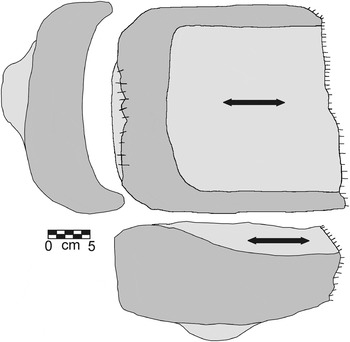
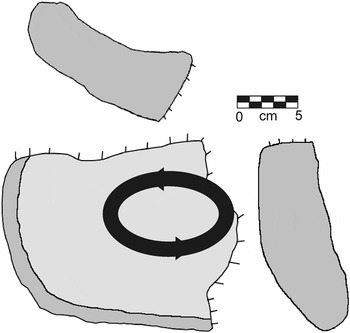
At Cerro Portezuelo, the passive tools are differentiated mainly by the motion of the grinding stroke and the bordering of the grinding surface. Metates characteristically were used with a linear, reciprocal motion, while mortars were used with a rotary motion (Figure 2 and Figure 3). Physically, a reciprocal motion facilitates the application of shearing force with dispersed pressure, which should be especially effective in processing a nonrigid substance (for example, nixtamal). Rotary grinding strokes are more useful in applying concentrated downward pressure to apply crushing force in processing rigid materials. In both kinds of grinding, variability in stone material texture and particle size of foods during processing also influences the efficiency of the application of force: other concerns (for example, the introduction of stone grit into the food) may influence grinding-stroke choices.
Trough metate with reciprocal motion.

Mortar with loose rotary grinding.

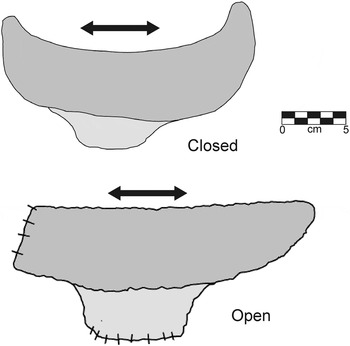
Both metates and mortars can have either open or closed grinding surfaces (Figure 4), although closed surfaces are much more common on mortars. Closed surfaces provide boundaries to the working area of the tool. This closure has the advantage of reducing spillage—especially of large rigid kernels, seeds, or particles—but it also limits the grinding stroke and thus may slow the amount of grinding work accomplished. All the mortars at Cerro Portezuelo have closed surfaces. The metates include both open and closed surfaces, and the closed-surface metates generally have a trough form.
Closed versus open passive tools.

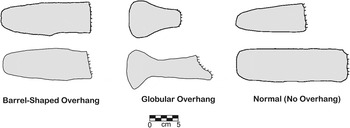
The active tools are mainly differentiated by the use of grinding strokes, which are either reciprocal (manos) or rotary (pestles), although for some smaller tools this distinction is not always clear. Manos may also be categorized by their usage with open versus closed-surface metates, but the evidence often is unclear. For example, the use of manos with closed-surface metates sometimes can be identified from wear on their ends, although the use and reuse of these ends as pestles and for other secondary purposes may obscure the evidence. In addition, overhanging manos wider than their companion open metate provide distinctive wear (Figure 5).
Mano examples: longitudinal profiles with grinding side down.

Within the entire Cerro Portezuelo collection, the proportion of active, hand-held grinding tools (manos and pestles) to passive tools (metates and mortars) is unusual. The proportion of active tools to passive ones is roughly 4:1. As a comparison, in the TMP collections, the ratio is roughly 1:1, and at Otumba the ratio is roughly 2:1. The main reason for this difference is differential fragmentation of the big passive tools. The Cerro Portezuelo specimens recovered by trench excavation are more complete than the TMP and Otumba specimens collected from the often-plowed surfaces of the respective sites.
Passive Grinding Tools
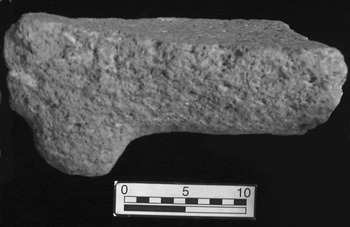
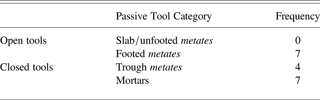
Within the passive tools alone, simple slab metates are conspicuously absent from the Cerro Portezuelo collection (Table 1). These open-surface metates predominated in the Terminal Formative and Classic period collections at Teotihuacan and represented about 85% of the metates in the TMP collections (Biskowski Reference Biskowski1997). Instead, all the open-faced tools seem to be footed (Figure 6). The presence of so many footed metates but no footless slabs at Cerro Portezuelo is an interesting result. One might expect that some slabs should be present simply because of Cerro Portezuelo's early connection with Teotihuacan. The absence of slabs might reflect some of the problems discussed earlier—a small sample, some hidden collection bias, and/or the recycling of these tools in ways that prevented their recovery or identification. But it seems more likely that these simple, basic maize-grinding tools were not commonly used at Cerro Portezuelo during any time period.
Footed metate (GT-61) in longitudinal profile.

Cerro Portezuelo passive tool frequencies by category
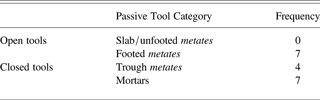
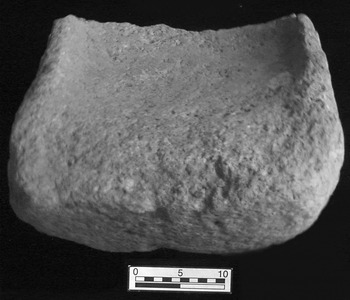
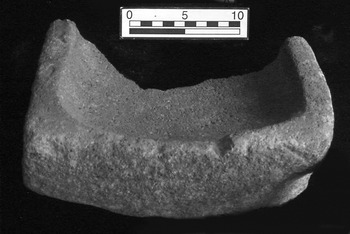
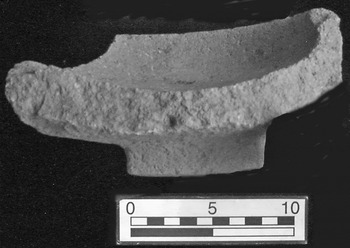
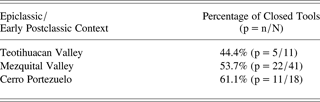
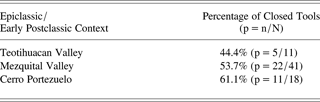
There is a sizeable Late Postclassic presence at Portezuelo, and based on both the ceramic evidence and prior observations of Late Postclassic period grinding equipment (Biskowski Reference Biskowski1997), most of the open, footed metates probably belong to the Late Postclassic period, though one or two might belong to the Classic period. If so, the Epiclassic and Early Postclassic period inhabitants used relatively few open-surface tools. This is significant in many ways. Empirically, in most contexts in central Mexico, closed-tool usage is much less frequent than open tool usage, and sometimes it is entirely absent. The high frequency of closed-surface tools at Cerro Portezuelo, including both trough metates (Figures 7 and 8) and mortars (Figure 9), contrasts sharply with the Teotihuacan and Otumba collections (Table 2). The TMP collection contains no trough metates large enough for grinding maize and a small proportion of mortars. Altogether, closed tools are about 18% of all the TMP passive grinding tools and about 13% of the artifacts from Classic period contexts (Biskowski Reference Biskowski1997:Table 7.2). Additionally, there are no closed tools common in Late Postclassic contexts. At Otumba, an Aztec city-state, exactly one small mortar fragment was recovered among the 49 passive tools recovered by the surface collections. At Cerro Portezuelo, however, 61% (11/18) are closed-surface tools.
Trough metate (GT-05) in lateral profile.

Trough metate (GT-43) in lateral profile.

Mortar (GT-20) in profile.

Percentage of closed-surface tools by location
Reliance on closed-surface tools in central Mexico seems to be focused chronologically among the early farmers of the Formative period and within the Epiclassic and Early Postclassic contexts described earlier. In the earlier case, maize consumption was still supplemented by diverse natural foods, and maize-grinding technology was not as fully developed nor standardized as it became later. For example, in the Early Formative contexts at Coapexco, Tolstoy and Fish (Reference Tolstoy and Fish1975) observed that a combination of informally shaped grinding slabs and handstones were used in addition to fully formed metates and manos. Closed-surface tools were abundant in the Middle to Late Formative period contexts near Apizaco, Tlaxcala (Biskowski and Watson Reference Biskowski and Watson2007). Nearly 40% of the passive grinding tools recovered there were closed-surface tools, and most of these were large trough metates.
But in the absence of a substantial Formative period presence at Cerro Portezuelo, it is likelier that its closed-surface tools belong to the Epiclassic and Early Postclassic periods. Such tools are very common in the other contemporaneous contexts we have examined. In the combined collections from Oxtotipac and Xometla in the Teotihuacan Valley, 44% of the passive grinding tools are closed. In the Mezquital Valley collection, slightly more than 50% of the passive tools are closed (Table 2). Elsewhere in the Mezquital region at Tepetitlan, Mastache and Cobean (Reference Mastache, Cobean, Cobean and Mastache1999:285) encountered other anomalies in the distribution of normal maize-grinding tools, and it is possible that the role of maize in the subsistence economy declined during this time period.
Active Grinding Tools
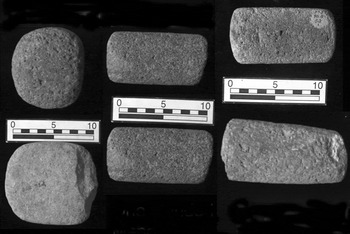
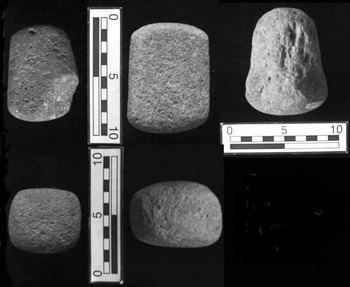
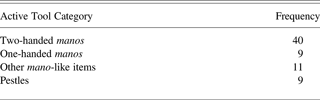
The manos and pestles from Cerro Portezuelo provide evidence that complements and augments some of the trends visible in the passive tools (Table 3). Because there are so many mortars and trough metates in the site collection, the presence of so many complementary one-handed manos (Figure 10) and pestles (Figure 11) is unsurprising. Four pestles are elongated cylinders suitable for providing downward pressure in small molcajetes, including bell-shaped pestles and four-lobed pestles.
One-handed manos in longitudinal profile.

Pestles in profile (grinding surface down).

Cerro Portezuelo active tools frequencies by category
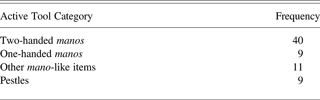
The other pestles have relatively large mano-like grinding surfaces, but their rotary wear differentiates them from small one-handed manos. The one-handed manos are characterized by their reciprocal wear. While they are small enough to be manipulated with one hand, many probably were employed with two hands. Many have trough wear running up from the grinding surface onto the end of the tool. Despite the differences in grinding patterns, it is not clear whether the mano-like pestles and one-handed manos were used for grinding different materials. Both kinds of tools are oriented toward similar low-output grinding.
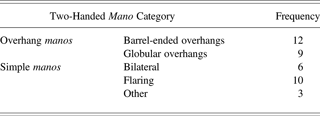
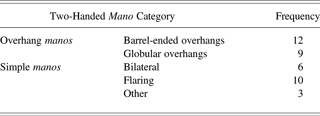
Slightly more than half of the two-handed manos are overhangs (Table 4). An overhang mano, sometimes called a dogbone mano, develops a complex form because the ends of the mano extend beyond the sides of its metate. The mano is reduced only where it occludes with the metate, leaving the overhang mostly intact. Because of this manner of use, they are incompatible with trough metates. In contrast, many of the simple manos show evidence of trough wear. However, most, if not all, of these probably predate or postdate the Epiclassic and Early Postclassic periods.
Cerro Portezuelo two-handed manos frequencies by category
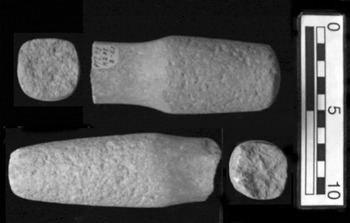
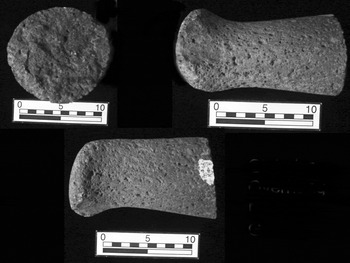
The barrel-shaped overhang manos (Figure 12) are an unusual type that is readily dated to the Late Postclassic period. These distinctive manos are very common at Otumba, Cihuatecpan, Chiconautla, and many other Late Postclassic period and later contexts in the Teotihuacan Valley (Biskowski Reference Biskowski1997, Reference Biskowski2000). They are characteristically gracile—averaging between 3–4 g per mm of axis length—and frequently display quadrilateral reduction symmetry or a variant that collapses one corner. One or two of the more fragmented examples may have post-Conquest origins. Both Late Postclassic and post-Conquest manos tend to be gracile and sometimes are difficult to distinguish. But the majority of these manos clearly belong to the Late Postclassic period.
Barrel-ended overhang manos in transverse and longitudinal profile.

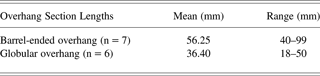
The lengths of the overhang section indicate that the barrel-shaped overhang manos were designed intentionally to be overhang manos (Table 5). Because these manos are so gracile, they were lighter than most simple manos, and this light weight, combined with the extra gripping area on the overhang, facilitated prolonged use. Their lighter weight also made them more prone to exhaustion and accidental breakage than earlier, more robust versions. For this reason, it is important that these manos were readily adapted to the relatively flat grinding surfaces of Late Postclassic metates. The length of the overhang ensures that the mano will span metates of variable width. Thus, a long, barrel-ended overhang mano could be manufactured and exchanged separately, without a companion metate. A new mano could be acquired and adapted quickly to replace an old, worn-out, or broken one to work with a household's existing metate.
Average length of Cerro Portezuelo mano overhangs
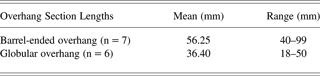
In contrast to the barrel-shaped overhangs, globular overhang manos (Figure 13) are found in most time periods in which open-faced metates were used. “Globular” overhangs were originally labeled by George Cowgill during the initial collection of artifact attribute data from manos from the Teotihuacan Mapping Project (Millon Reference Millon1973). While the extended cylindrical ends of the barrel-ended overhangs seem to be designed to be overhangs, the globular overhangs appear to be the remnants of otherwise normal mano ends altered by overhang wear. Thus, the shape of a globular overhang is highly variable and depends on both the original mano form and the idiosyncracies of subsequent use. But in most of the Cerro Portezuelo specimens, the overhang section has an irregularly spherical appearance, and the overhang lengths are relatively small, indicating that these manos probably were matched to specific metates (Table 5).
Globular overhang mano (GT-31) in transverse and both longitudinal profiles.

Seven of the nine globular overhang manos still have provenience information, and the greatest consistency among the collection locations is the presence of Classic period pottery at six of the seven locations. Similar manos are common at Teotihuacan and other Classic period contexts. This is not overwhelming evidence of Classic period origins, but it is likely that most originate during that time period. A few may come from the Late Postclassic period. At this point, there is no convincing evidence that these manos are associated with the Epiclassic and Early Postclassic periods. Elsewhere, Biskowski analyzed a roughly contemporaneous collection of grinding tools obtained by Patricia Fournier during her research in the Mezquital Valley (Fournier and Bolaños Reference Fournier, Bolaños, Kowalski and Kristin-Graham2007), and globular overhang manos also were infrequent. In that collection, only three of 27 mano end fragments had overhangs. If these manos do belong to the Classic period, they pose a problem since the only metates at Cerro Portezuelo to which they are suited are the open-surface, footed metates. Either some of those metates belong to the Classic and not the Late Postclassic period, or there were Classic period metates (especially slabs) in use but that were not recovered.
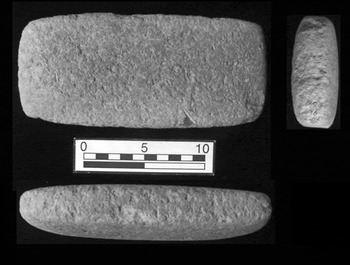
The normal (nonoverhanging) manos mostly fall into two types. The name of the bilateral manos (Figure 14) refers to the symmetry of reduction on two opposite faces. Generally these manos are bar shaped and wide in the grinding surfaces, but because of their design and subsequent reduction, the mano bodies are comparatively thin. Usually these manos are made from coarse vesicular basalt. These extremely simple tools were used for rough-grinding work from the Middle Formative through Late Postclassic periods. But they are more common in the earlier periods because of the less intensive preparation regimens (Biskowski Reference Biskowski1997).
Bilateral normal mano (GT-33) in transverse and both longitudinal profiles.

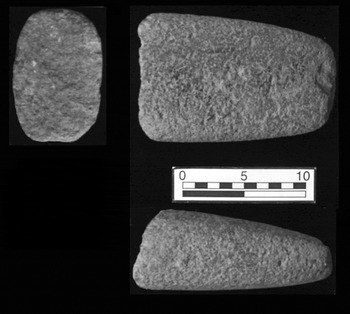
The flaring manos (Figure 15) are named for their tapered ends. While some of these manos also were used bilaterally, they are not explicitly oriented toward such use, and some were used primarily on a single grinding surface. Manos of this kind are found during most periods. Flaring manos are fairly common in the Mezquital collection, and many of the Cerro Portezuelo examples probably belong to the Epiclassic and Early Postclassic periods.
Flaring normal mano (GT-54) in transverse and both longitudinal profiles.

Both the bilateral and flaring manos share important similarities. These simple tools are the only two-handed manos in the Cerro Portezuelo collection usable in large trough metates, and two display polish rising onto their ends, such as might result from wear against a trough wall. The grinding surfaces of these manos are usually wide, with each limited to either a single or two opposite grinding surfaces. These configurations of wear are common in the earliest manos in central Mexico. In the Teotihuacan Valley, they continued to be used infrequently even into Late Postclassic and post-Conquest period times. The early contexts in which they are more commonly found in central Mexico indicate an association with less intensive grinding regimens.
As noted earlier, recycling was common at Cerro Portezuelo and created a situation where distinguishing some former manos from similarly shaped items is no longer possible. Of the mano-like items, at least one or two, and maybe more, are recycled manos, but the fragments are too badly damaged to make a confident determination.
DISCUSSION
Studies of grinding tools are often complicated by many kinds of analytical problems—for example, low frequencies, problematic contexts, and recycling—that can preclude precise conclusions. The situation at Cerro Portezuelo is somewhat worse given that the site is a complicated one, having been occupied for a long period of time. Also, excavations more than 50 years ago followed a strategy that sampled only small portions of the site. Much remains unknown about Cerro Portezuelo that otherwise might facilitate interpretations of the site's grinding tools. Nonetheless, these analyses provide some new information about pre-Hispanic subsistence economies and suggest new areas of investigation.
The most significant aspect of this collection is the large number of closed-surface metates and mortars. While dating these artifacts is problematic, Cerro Portezuelo is one of a growing number of sites with Epiclassic and Early Postclassic components at which closed-surface tools were abundant. The nature of maize preparation may have undergone a broad-based change from Classic period patterns toward less intensive regimens. This might have involved a de-emphasis on nixtamalization (the process of maize preparation for grinding) and perhaps a de-emphasis on maize itself. Trough metates and other closed tools provide different functional advantages than open-surface tools consistent with different priorities while grinding. The cupping provided by the trough walls reduces spillage and facilitates the grinding of looser materials, especially dried maize kernels and the seeds of other plants. Adams's (Reference Adams1999) experimental study showed that trough forms were as efficient in terms of short-term output but observed that they are more fatiguing for prolonged grinding sessions. In this sense, trough metates are more suitable for populations with moderate grinding needs. By the Late Postclassic period, heavy workloads combined with a focus on grinding wet kernels (in the form of nixtamal) probably led to the strong preference for open-surface metates visible at Otumba and other Aztec sites. But something apparently reduced the importance of this kind of grinding work during the Epiclassic and Early Postclassic periods.
Some problematic evidence of decreased maize consumption comes from analyses of the small Cerro Portezuelo skeletal population. Maize-dependent populations generally have problems with dental caries, but only a low percentage of caries was found among the dental remains (Spence et al. Reference Spence, White and Longstaffe2013). However, because of the small size and composition of the sample, it is difficult to differentiate the Cerro Porteuzelo inhabitants from a maize-dependent population.
In the Mezquital Valley region around Tula, anomalies in the distribution of normal maize-grinding tools have led to the suggestion of rural/urban differentiation in staple food use. Although well-made, open-faced, footed metates suitable for intensive maize grinding were recovered from Tula (Diehl Reference Diehl1983:Plate 22; Stroh Reference Stroh1975), normal maize-grinding tools were difficult to find at rural Tepetitlan (Mastache and Cobean Reference Mastache, Cobean, Cobean and Mastache1999:285). One explanation for this shift is a partial replacement of maize by amaranth. In their analysis of subsistence in the lands around Tula, Mastache et al. (Reference Mastache, Cobean and Healen2002:255–260) argue that amaranth was at least as important as maize and, under drought conditions, perhaps more important. Much of the nutritional value of nixtamalized maize can be replaced by eating amaranth seeds (alegria) and greens. Less dependence on maize in favor of amaranth might explain the unusual distributions of Epiclassic and Early Postclassic grinding tools at Cerro Portezuelo and in the Teotihuacan and Mezquital Valleys. Adams's (Reference Adams1999) experimental study observed that amaranth flour was ground more than twice as quickly on a trough metate than on an open-surface tool, so we might expect such tools to be more abundant in settings where amaranth use was important.
The kind of rural/urban differentiation observed in the Mezquital Valley is understandable since maize would receive the most moisture in the irrigated fields near the Tula River, but elsewhere in more rural areas the region is extremely dry. But explaining a more general shift toward amaranth use during the Epiclassic and Early Postclassic period requires more work. Recent paleoclimatic work studying tree rings from Barranca de Amealco (in the state of Queretaro, only 60 km from Tula) identified droughts centered at a.d. 810, a.d. 860, and a megadrought during the a.d. 897–922 period (Stahle et al. Reference Stahle, Diaz, Burnette, Paredes, Heim, Fye, Soto, Therrell, Cleaveland and Stahle2011). Because amaranth grows better in dry conditions, prolonged droughts should have promoted the use of amaranth even in areas of the central Mexican altiplano—normally wetter than the Mezquital Valley—such as the vicinity of Cerro Portezuelo and the surrounding Basin of Mexico. Still, residue analyses of cooking vessels and closed-surface grinding tools need to be performed to test if this hypothesis is viable.
Although adaptation to dryer crop-growing conditions provides one explanation for a shift to amaranth, deforestation should also be considered. Traditional maize preparation is not only laborious, but also consumes an amount of firewood greater than what is consumed for many other staple foods (Cecelski Reference Cecelski1985; see also Evans Reference Evans1984; Masera Reference Masera1995). Deforestation around long-settled areas, when coupled with slowed regeneration of trees due to drought, might also have contributed to greater amaranth use. In the Mezquital Valley, the burning of maguey and other fuel substitutes is part of a well-established adaptation to scarcity. The case for the Basin of Mexico is less clear. Demographic patterns around Cerro Portezuelo are consistent with some kind of regional crisis that climaxed during the Early Postclassic period. Population estimates made from the Basin of Mexico survey data (Sanders et al. Reference Sanders, Parsons and Santley1979:194–200) show a brief population peak in the Texcoco region around Cerro Portezuelo during the Epiclassic period (Second Intermediate Phase One) before collapsing during the Early Postclassic period (Second Intermediate Phase Two). A similar pattern exists for the adjacent Ixtapalapa region and forms part of a broader pattern of population loss in the southern basin.
While this loss of population may be connected to the growth of Tula, environmental degradation may also be involved. Prior to the collapse of Teotihuacan, the Texcoco region was sparsely populated for several centuries, and this should have allowed some regeneration of nearby timber stands lost during the Formative period. After Teotihuacan's collapse, the Texcoco region experienced a nine-fold increase in population—presumably due to emigration from Teotihuacan—under circumstances not likely to involve careful, sustainable management of wood resources. Consequently, deforestation from overexploitation of an initially abundant timber stand combined with the series of droughts after a.d. 800 may have contributed to a shift toward amaranth use around Cerro Portezuelo. Of course, it should be noted that the Epiclassic population was still less than one-third of the Late Postclassic peak, and while the later population esteemed amaranth use and made use of fuel substitutes (for example, maize and sunflower stalks), there is no evidence that amaranth replaced maize use. Still, the cases may not be comparable because of the complex Late Postclassic economy and its ability to draw in resources from further away.
Another important result is that the Cerro Portezuelo grinding tools include a large subset of Late Postclassic period artifacts. In conjunction with the ceramic analyses, the presence of these artifacts highlights a substantial domestic presence. The most distinctively Late Postclassic grinding tools—the barrel-ended overhang manos and some of the footed metates—were extremely well-suited for the complex Late Postclassic regimen of intensive maize preparation. Some of the other manos may belong to the Late Postclassic period, but their number probably is small. The barrel-headed overhang manos by themselves account for more than one-fourth of the Cerro Portezuelo manos, and it is difficult to imagine that a much larger share of manos belongs to the Late Postclassic period.
The presence of these identifiable Late Postclassic manos highlights the fundamental difficulty of dating most of the Cerro Portezuelo grinding tools. While we can infer that many of the footed metates are also Late Postclassic because of these manos, there are obvious limitations to reasoning in this manner. Grinding tools that deviate from Late Postclassic normalcy are likely to be assigned to other periods. At this point, it is still difficult to say much definitively about Classic period grinding because we cannot be certain which artifacts actually belong to the Classic period. This is unfortunate, given the importance of evaluating Cerro Portezuelo's economic relationship with Teotihuacan. The tentative identification of globular overhang manos with the Classic period provides a basis for cautious inferences. These tools possess short overhangs, and the implied pairing of mano and metate sets indicates a different, perhaps less commercial kind of craft industry from what is evidenced at Otumba and other known Late Postclassic period contexts.
FUTURE DIRECTIONS
Compared to the American Southwest, where analyses of grinding tools and concern with their function extend back to the first half of the twentieth century, research in Mesoamerica remains relatively undeveloped. Although recent research has begun to address this deficit, much work remains to be done. Among the more critical needs are experimental studies akin to those already conducted in the Southwest (for example, Adams Reference Adams1993, Reference Adams1999) but tailored to address issues specific to the production and use of grinding tools in Mesoamerica. For example, a comparative study contrasting the advantages of trough versus open-surface metates, while controlling other aspects of form and material, would have aided the study of the Cerro Portezuelo collection. While archaeologists increasingly attempt to understand the broader implications of technology (Dobres Reference Dobres2000), it is unlikely that such research with Mesoamerican grinding tools can go far without first improving our understanding of this technology in its primary role in food preparation. We are hopeful that more experimental work will be addressed in the future.
Despite this problem, current and future analyses of the Cerro Portezuelo grinding tools are adding to a growing number of data points that can be used to improve our understanding of central Mexican subsistence economies. Cerro Portezuelo is particularly important since archaeologists’ characterizations of Epiclassic and Early Postclassic subsistence is based on uncomfortably little evidence. The present work cannot paint a complete picture of maize preparation in these and other periods, but it does fill in some places on the canvas.
The present research is only the first stage of work with the Cerro Portezuelo grinding tools. Analyses of the geological properties are currently underway involving the collection of a combination of macroscopic, petrographic, and geochemical data. These analyses are aimed at studying the production and exchange of these artifacts. But evidence of patterns of stone selection should help address questions of chronology as well. Initial petrographic investigations already show strong resemblances between Cerro Portezuelo artifacts and period-specific sources of stone used in the Teotihuacan Valley. Consequently, the completion of the geological analyses should help us better understand the chronology of grinding tool use at the site.
The image of Epiclassic and Early Postclassic subsistence emerging at Cerro Portezuelo is especially important. The apparent de-emphasis of intensive maize preparation runs counter to most working assumptions about pre-Hispanic subsistence. Whether a less intensive approach to maize preparation was coupled with a greater dependence on amaranth requires additional investigation. Residue analyses of the grinding tool surfaces may help reveal if the closed-surface grinding tools were used for light maize preparation or perhaps for grinding amaranth seeds. The answer will be important to understanding not only the focus of household subsistence activities, but also the economic underpinnings of social and political life after the collapse of Teotihuacan. The pre-Hispanic political economy depended on the ability to mobilize resources through agriculture. Since maize is prized particularly for its high productivity under good conditions, decreased usage—whether for climatological or other reasons—has implications for the organization and capabilities of Epiclassic and Early Postclassic polities. The materials collected from Cerro Portezuelo in the 1950s provide only limited opportunities for resolving these issues. Consequently, additional field research targeting Epiclassic and Early Postclassic sites should recover not only grinding equipment, but also botanical remains to better characterize Epiclassic and Early Postclassic food production in central Mexico.
RESUMEN
El análisis de las herramientas para moler recuperadas de Cerro Portezuelo permite la oportunidad poco común para estudiar los cambios en las prioridades de subsistencia. A menudo los arqueólogos presumen que el maíz era parte medular de la mayoría de las prácticas de subsistencia en Mesoamérica por ser una cosecha altamente productiva y porque la tecnología que se utilizaba para procesarlo era compleja. Otras fuentes de evidencia arqueológica y etnográfica apoyan esta suposición. Sin embargo, se sabe que los aztecas apreciaban otras cosechas, en particular el amaranto, el cual podía haber reemplazado al maíz bajo las condiciones adecuadas. El análisis de las herramientas para moler puede apoyar a la identificación de transiciones temporales y regionales en el uso de plantas comestibles. El moler frecuentemente conforma una actividad importante que requiere de mucho tiempo. Hay variabilidad en los requisitos para preparar el maíz y otras plantas comestibles. Así, cambios significativos en las principales plantas comestibles deben ser indicados por cambios paralelos en el diseño de los atributos funcionales de las herramientas para moler.
Estudios anteriores de las herramientas para moler de los valles de Teotihuacan y Mezquital identificaron diferencias en las herramientas durante los periodos epiclásico y posclásico temprano, los cuales podían ser relacionados con un descenso en el énfasis en la preparación de maíz. Las herramientas para moler recuperadas en proyectos regionales en ambos lugares contenían proporciones inusualmente altas de herramientas para moler de superficie cerrada (es decir, metates y morteros con forma de pesebre), los cuales son menos eficientes para la molienda intensiva de maíz que son las herramientas de superficie abierta que eran más comunes durante los periodos clásico y azteca. Sin embargo, los pequeños tamaños de las muestras asociadas con estas observaciones ocasionaron dudas sobre la validez de estas diferencias.
El análisis de las herramientas para moler en las colecciones de Portezuelo contribuye a una imagen emergente de la subsistencia en los siglos después del descenso de Teotihuacan. Este análisis también incluye una pequeña muestra de artefactos que además es afectado por el alto grado de fragmentación de los artefactos y la pérdida de alguna información sobre su procedencia. Sin embargo, estos artefactos de los periodos epiclásico y posclásico temprano también incluyen una alta proporción de herramientas de superficie cerrada. Estas observaciones pueden deberse a un cambio en la subsistencia donde el maíz fue menos importante que el amaranto y otras cosechas, pero este patrón queda por confirmarse.
ACKNOWLEDGMENTS
We thank George L. Cowgill, Deborah L. Nichols, and Wendy G. Teeter for the opportunity to study these materials, as well as Sarah Clayton and Destiny Crider for sharing their ceramic data. Jessica Jones, Jimi LaForm, and Shawn Ehrichs assisted in the collection of some of the data presented here. This material is based upon work supported by the National Science Foundation under Grant No. 0514187 (Dartmouth College) and No. 0513979 (Arizona State University). Additional support was provided by a Research and Creative Activities grant (California State University, Sacramento). This paper benefited from comments provided by Jenny L. Adams, Gary Feinman, and one anonymous reviewer. All errors are entirely our own.