

Introduction
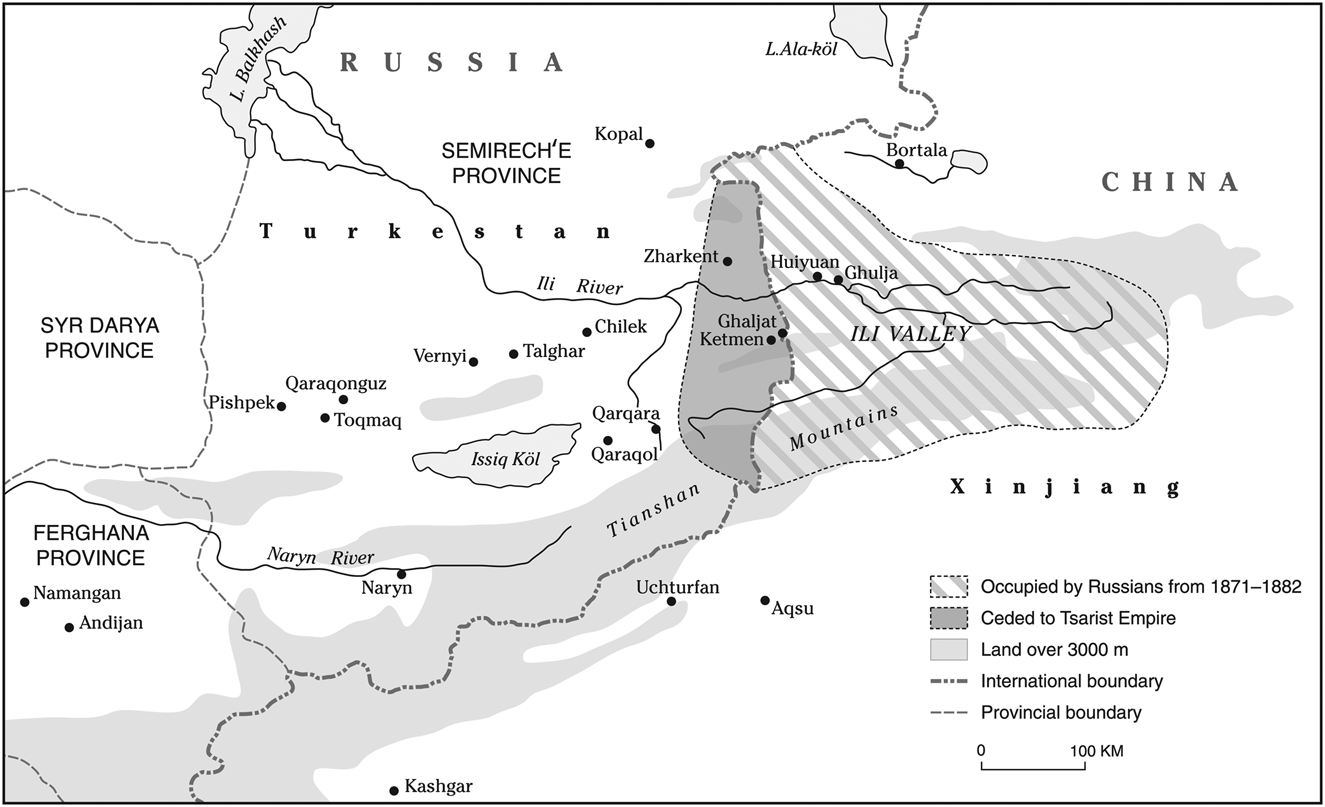
During the first week of March 1904, the head of the Przheval'sk Customs Station composed a worried letter to his superior, Turkestan's chief customs officer. The town of Przheval'sk, named after the Russian explorer Nikolai Przheval'skii, who had died there 16 years earlier, was a small Russian settlement of the Tsarist Turkestan General-Governorship. It was located in a region mostly inhabited by Kyrgyz, around 150 kilometres from the Chinese border (see Figure 1).Footnote 1 Given his cluelessness about the peculiar state of affairs at the border, the Przheval'sk Customs Station head must have been a recent appointment to the position. The problem at hand for him was the following. He had intercepted a significant amount of opium being transported to the state border, destined to be smuggled into Xinjiang and sold. However, it was unclear whether the opium traded to China should have been requisitioned, according to existing administrative regulations. Nonetheless, the head of the Customs Station knew that the Saint Petersburg treaty, signed by the Tsarist and Qing empires in 1881, prohibited opium production and trade. He was therefore inclined to requisition the lot. The opium belonged to local Dungans (‘Hui’ in Chinese: Donggan zu, 東干族, Hui zu, 回族)—part of the large community of Chinese-speaking Muslims who had migrated into Tsarist Turkestan at the beginning of the 1880s and settled in the Przheval'sk region, near Issiq Köl Lake. They were mostly peasants who, among other things, cultivated opium poppies in significant quantities. The population of Turkestan, including the Dungans/Hui, had the right to elect the heads of the lowest Tsarist administrative unit—the district (volost’). The owner of the opium threatened with requisition invoked the help of this administrative figure: the Dungan head of the Mariinskii district. To the great surprise of the head of the Przheval'sk Customs Station, the Dungan district chief had promptly produced a document with a secret order from the highest Tsarist authority in the region, the Semirech'e military governor. The order specified that selling opium in Turkestan extracted from poppies grown locally was forbidden. However, exporting it abroad was allowed, on the condition that a report should be submitted to the administration, indicating the quantity of opium carried to China. The puzzled head of the Przheval'sk Customs Station therefore felt compelled to inform the head of Turkestan Customs. The latter was no more informed than his inferior officer. He then proceeded to write directly to the author of the secret order, the Semirech'e military governor. In his letter, the chief of the Turkestan Customs District naively suggested to the governor that, in order to avoid further problems with customs officials, opium traders should be provided with special police licences from their province (uezd) of origin, specifying the quantity of opium transported.Footnote 2 The archival record on the issue stops here, but the proposal for strict police surveillance over the opium trade was never implemented. The order of the Semirech'e military governor was not secret by chance: the Russian local administration wanted to give the impression, to both Chinese administrators and British consuls beyond the border, that they ignored the existence of the cross-border opium trade.
The Turkestan–Xinjiang borderland in the late nineteenth century. Source: map by Johnson Cartographics Inc.

This episode of everyday borderland legal and administrative fuzziness illustrates a number of points on which this article will focus. First, it shows the existence of an opium trade from Tsarist Turkestan (more precisely, the province of Semirech'e—see Figure 1) to Xinjiang during the late nineteenth and early twentieth centuries. Second, it shows that recent immigrants from Xinjiang were important agents of the trade. Third, and most importantly, it shows that the legality of the trade was intentionally kept ambiguous by the Tsarist colonial administration, in an example of imperial ‘strategic ambiguity’ that allowed them to achieve different aims that would have been mutually exclusive had the administration firmly opted for either the legality or the illegality of the trade.Footnote 3 These aims were helping the regional economy, maintaining good relations with the Qing empire, and—most likely—enriching local administrators through bribes. Thus, for a period, the local military administration did secretly sanction the export of opium to China, with the consequence that even the highest Tsarist Customs officials in Central Asia were kept in the dark. Focusing on the opium trade, this article investigates the effects of imperial border-making between the Tsarist and Qing empires, using archival material produced by the Tsarist administration. The creation of the border, and the migrations related to it, created a peculiar borderland economy in which the local poppy-growers used the state boundary as an indispensable tool for their activities. This situation went on until the First World War, when, for the first time, the Tsarist government tried to create an opium monopoly in the empire.
In my discussion, I will use ‘borderland’ in a narrower sense relative to the prevalent usage in the historiography. ‘Borderlands’ are often set against ‘frontiers’.Footnote 4 The latter are usually described as ‘borderless land’ without clearly defined political edges. On the American frontiers, immigrants backed by imperial (or statal) military, economic, and political structures overpowered local populations. On the Eurasian frontiers, the balance of power between urban and agricultural societies on the one hand and warlike pastoral nomads on the other had often tilted in favour of the latter since ancient times.Footnote 5 On the frontier, mixing, cultural hybridity, and accommodation are as frequent as violent conflict. Borderlands, instead, can be defined as contested territories between imperial domains. They provide more political opportunities for less powerful local groups: ‘in these regions … empires competed for control, and indigenous peoples played imperial rivals off against one another.’Footnote 6 According to Adelman and Aron, defining an area as a ‘frontier’ stresses its intercultural aspects, while labelling a region ‘borderland’ emphasizes the inter-imperial.
This article focuses on a period of boundary delimitation between the Tsarist and Qing empires, in which local Central Asian groups had very little scope for playing ‘imperial rivals off against one another’. However, their agency played out in the use of the new international boundary as an institution. The definition of borderland that I use in this article is thus very much related to the boundary itself, and could perhaps be more precisely termed the ‘boundary-zone’. It is a region that spans both sides of a recognized international border, and is inhabited by individuals and groups who regularly cross the border for their economic and social interactions.Footnote 7 The processes of state-building on both sides of the border entail a parallel process of borderland transformation: the linear character of the boundary does not erase the ‘zonal character’ of the previous inter-imperial region, but does modify its features.Footnote 8 This is the case because ‘the separating qualities of boundaries influence interactions’ between communities separated by the newly created line.Footnote 9 Thus, in this article, ‘borderland’ denotes an ‘interdependent cross-boundary region’Footnote 10—a zone directly influenced by the existence of a porous state border used by the population on both sides for their economic and social aims unbeknownst to (or in cooperation with) the local administration. In this understanding of the term, it is possible to ‘close’ the borderland as it was possible to ‘close the frontier’ in the classic Turnerian sense. This happens when one or both states sharing the boundary effectively seal it to traffic from the other side.Footnote 11
Social scientists usually describe political borders as state devices dividing communities often linked by common cultural, economic, and familial networks. Over time, those political borders weaken or sever those networks. For their part, economists focus on what they call the ‘border effect’, namely the diminished trade rate between two regions, or cities, divided by a state border, in comparison to the trade between two regions/cities within the same geopolitical unit.Footnote 12 Most historians have also considered how the consolidation of imperial borders as institutions cut through vibrant economic exchanges and movements of labour.Footnote 13 However, borderlands histories that focus only on imperial encroachment into a previously unified society, subsequently dividing it by the imposition of borders, miss the very social, economic, and cultural opportunities created by the border for the communities living on its two sides. In this regard, it is especially important that borderlands generate ‘arbitrage economies’, defined by James Anderson and Liam O'Dowd as ‘economic activities for which the border is the raison d’être …. The co-existence of different regulatory regimes on either side of the border generates a form of opportunity structure which invites smuggling, unofficial exchange rates and illegal immigration’.Footnote 14 Borders are therefore ‘institutions that can be made use of’, while borderlands are ‘fields of opportunity for the people inhabiting them’.Footnote 15 In other words, any border, and the peculiar economy and society it helps to shape, is a potential resource that can be exploited, or fail to be exploited, depending on different political, demographic, geographic, economic, and cultural factors.Footnote 16 Some historians have analysed the use that individuals, especially those living at the social and legal margins of colonial societies, made of borders. In his important study, Eric Lewis Beverley showed how, during the nineteenth century, the often poorly defined borders between British India and the Indian princely states created fields of opportunity when individuals crossed them to abscond from the reach of colonial law into a different jurisdiction.Footnote 17
This study adds depth to the existing scholarship because, first, it focuses on the use of relatively well-defined inter-imperial borders, instead of the lines between territories directly controlled by a single European imperial power. Second, it examines the emigration of entire communities, led by their elites, instead of socially marginal individuals. Third, it looks at the dual position of opium: opium production was banned under both systems on both sides of the border at different times, but the trade in opium from one territory to the other was positioned in a state of legal liminality by Tsarist administrators ruling over the borderland. Finally, it shows that state boundaries could be used because they worked as filters: they were a shield from political, fiscal, and military intervention from the other side, but at the same time were permeable to flows of smugglers, traders, nomads, and labourers.Footnote 18 For its potential to shape migration patterns and the territorial reconfiguration of areas of production, distribution, and consumption (in this case of opium), land borderlands are different from the maritime equivalent. The difference is more a matter of degree than of structural difference, as maritime regions also provide groups with the possibility to escape from state suzerainty and political control, while at the same time continuing to orient their economic activity towards the territory of the state they abandoned.Footnote 19 However, land borderlands make this possible to a higher degree, especially because they make the ‘protection’ of rival states and empires more immediately available.
The present case study fills a gap in the literature on the history of opium production and trade. The Tsarist empire and the Soviet Union, as well as Chinese Inner Asia, are usually absent from studies of the global opium trade.Footnote 20 Regional studies do exist, but very few have so far focused on the Tsarist/Soviet side of the border.Footnote 21 This investigation is also relevant for the study of the collapse and reconstruction of imperial administrations in Central Asia on both sides of the border. I start by outlining the situation of the opium trade in the region during the mid-nineteenth century, and how the Tsarist administration of the occupied region of the Ili River (Yi li he, 伊犁河) Valley viewed opium as an economic resource. I will then analyse the Taranchi (Ta lan qi, 塔蘭奇) and Dungan migration from Zungharia (準格爾), or Northern March (Bei Jiang, 北疆, or Tian shan bei lu [Tianshan north route], 天山北路) in the Qing empire to Semirech'e in Tsarist Turkestan, and its consequences for the trade of opium. I then focus on the relationship between the Tsarist administration and the opium trade in the region, and the creation of a cross-border ‘grey market’ in which opium was the most valuable item. I then describe how the First World War changed the economic life of the borderlands. The Tsarist government's attempt to create a state opium monopoly in order to meet the army's demand for opiates (morphine) during the First World War was one major factor leading to the Dungan (Hui) uprising, part of the great Central Asian Revolt of 1916. The Dungans, along with the Kyrgyz, were responsible for the main massacres of Slavic agricultural colonists in the region. The Tsarist regime repressed the revolt, but collapsed within a matter of months.
From 1918 to 1920, civil war ravaged Turkestan and opium remained the most profitable good in the agricultural economy of the region. In fact, the ephemeral powers in the eastern part of Tsarist Turkestan began using opium as currency, just as in other parts of Asia during the twentieth century (especially in the warlord-controlled areas of China during the Republican period). This is the focus of the final part of the article, where I also analyse the reaction of Yang Zengxin's (楊增新) Xinjiang administration to the violent events beyond the border. A new phase started in 1920, after the Bolshevik victory in the civil war and the conquest of Turkestan, when Bolsheviks tried to impose a state monopoly on poppy cultivation, officially outlawing the opium trade. Wartime policies in connection with the Turkestan–Xinjiang border had crucial legacies for Bolshevik policies in the inter-war period. The present article will focus on the period between the delimitation of the Tsarist/Qing border in 1881 and the collapse of the Tsarist empire.
Qing-state collapse and reconstruction in Zungharia and Altishahr
The anti-Qing uprisings and state collapse in Zungharia and Altishahr during the 1860s and 1870s, and the subsequent Qing reconquest of the region, played an important part in the creation of the borderland opium economy. Opium was already produced in Zungharia and Altishahr before the mid-nineteenth-century crisis. But the crisis had three crucial consequences: it brought to the region a more effective anti-opium policy implemented by Zuo Zontang, the Qing general who reconquered the territory after the Yaqub Beg period; it led to mass migration towards the Tsarist empire; and it allowed the Russians to conquer part of Zungharia, with its consistent opium production—a fact that led the Tsarist administration to appreciate the economic expediency of protecting opium production. This was a marked change in policy, since, earlier in the century, Saint Petersburg had not been involved in the trade of opium with China.
During the first half of the nineteenth century, cotton fabrics and tea were the main commodities traded between the Tsarist and Qing empires. Kyakhta (Qia ke tu, 恰克圖), at the border between Siberia and Outer Mongolia, was the hub of this trade. In 1845, 20.2 tons of tea reached Nizhnyi Novgorod from Beijing, crossing Mongolia and Siberia.Footnote 22 As early as 1797, the Tsarist government had issued an edict encouraging illegal (from the Chinese point of view) trade with Ghulja (Yi ning shi [Yining city], 伊寧市) and Chuguchak (Ta cheng, 塔城 or Tarbaghatay, 塔爾巴哈台), the most important towns in Zungharia's Ili River Valley. Saint Petersburg repeatedly requested of Beijing that Russian subjects be allowed to trade across the border to the two towns: first in 1805, then again in 1847, 1848, and 1850, after the First Opium War and the forced expansion of the Qing empire's European trade. The Qing turned down all these official requests.Footnote 23
In the mid-nineteenth century, opium was not a significant item of commerce between China and the Tsarist empire. It was, however, crucial in the trade between China and the Kokand khanate, which signed a trade agreement with the Qing in 1831.Footnote 24 Laura Newby has shown the importance of opium in Kokand–Altishahr trade in the first half of the nineteenth century. To a certain extent, the later Turkestan–Xinjiang opium trade was the direct successor of this earlier trade. Kokandi traders crossed the border and sold opium to Chinese merchants, mostly from Gansu, who then brought the purchased opium to China's interior, the main market for the drug. Local opium smokers in Altishahr were mostly exiled Chinese convicts and Manchu garrison soldiers.Footnote 25 However, unlike the later Turkestan–Xinjiang opium trade, the Kokand–Altishahr one did not entail the strategic migration of entire communities from China to the khanate just across the state borders. In other words, the Kokand–Altishahr opium trade was not a borderland-shaping phenomenon to anywhere near the same extent.
As David Bello has shown, since opium was not an important commodity in Tsarist trade with China before the conquest of Central Asia, Saint Petersburg complied with the Qing ban and, on at least one occasion (in 1839), cooperated with Qing authorities in tracking Russian traffickers of opium in Kyakhta. Nicholas I issued an ukaz on 12 April 1841, signalling formal compliance with the banning of opium in China according to the New Regulations. Shortly thereafter, a Muslim Tsarist subject from Semipalatinsk was charged with smuggling 46 kilograms of opium into Xinjiang (he was travelling from Tashkent with a Kokandi merchant, who was transporting the imposing amount of 373 kilograms of opium). They were condemned to the relatively lenient sentence of two months’ imprisonment in Chuguchak. In total, Qing authorities confiscated 5.47 tons of opium in Xinjiang between December 1839 and January 1841.Footnote 26 Beijing was well aware of the illegal flow of goods from the Tsarist empire. At the same time, Russian expansion in the region and the incorporation of the Kazak Great Juz during the 1840s were directly linked to the attempted expansion of Russian trade with China.Footnote 27 Eventually, on the initiative of Saint Petersburg, a new commercial treaty was signed in 1851 (the Treaty of Ghulja), regulating the trade between Tsarist territory, Ghulja, and Chuguchak. The Qing refused Tsarist suggestions to include Kashgar in the treaty, and therefore Altishahr.Footnote 28 Opium trade from Tsarist to Qing territory was prohibited by Article 7 of the treaty.Footnote 29
The collapse and reconsolidation of Qing power in Altishahr and Zungharia in the mid-nineteenth century had a profound impact on the emergence of the opium borderland economy, because of the emigration waves it caused. The Qing empire was shaken by Muslim uprisings in its western provinces during the 1860s, and by the subsequent creation of Yaqub Beg's Yettishahr independent polity.Footnote 30
It is possible that more than 70,000 Dungans lived in Zungharia and Altishahr in the mid-nineteenth century, mostly in the former.Footnote 31 They had a crucial role in igniting the revolt against Qing rule. Many of those Dungans were actually refugees from the provinces Shaanxi and Gansu, where anti-Qing revolts had erupted in 1862.Footnote 32 Fear of a Qing reprisal against refugees led the Dungans to organize a massive uprising in Kucha (Qiuci, 龜茲) in 1864, closely followed by a rebellion among local Turkic Muslims, armed intervention from Kokand, and the emergence of Yaqub Beg's independent state centred in Kashgar, which proceeded to conquer the other four independent polities that had formed after the collapse of the local Qing administration. One of those was a Dungan khanate centred in Urumqi, headed by the Sufi shaykh Dawud Khalifa (Tuo Ming).Footnote 33 As a consequence of the violence in the Qing empire, in 1865–66, the first group of refugees fled to Tsarist territory: about 16,000 Mongol, Manchu, Solon, and Sibe, many of them banner men. Some of them ended up being included in the Semirech'e Cossack Host.Footnote 34 Yaqub Beg's ‘state of the seven cities’ was barely centralized, and not until the beginning of the 1870s did it manage to control part of the Northern March. Urumqi was conquered in 1872, during an expedition that led to the killing of thousands of Dungans by Yaqub Beg's troops.
According to the Russian official and future minister of war, Aleksei Kuropatkin—who led an embassy to Yaqub Beg in 1876 and described the trade between Russian Turkestan, Zungharia, and Altishahr—the export of goods from Altishahr to Turkestan was significantly higher than the corresponding imports. Opium figured only among the goods traded from Altishahr to Turkestan, and represented a mere 2.2 per cent (19.5 horse-loads) of the total value of commodities imported. These numbers do not tell us much by themselves, but they are evidence of local poppy cultivation and opium production. Geographically, the main route of commerce between Altishahr and Turkestan was via the Toqmaq district (present-day eastern Kyrgyzstan), through which three-quarters of the trade passed in 1876.Footnote 35
Between 1876 and 1878, the Qing statesman and military commander Zuo Zongtang (左宗棠, 1812–85) reconquered Altishahr and Zungharia. After Yaqub Beg died in 1877, its polity collapsed.Footnote 36 Zuo's Hunanese army had the support of a few local Dungan military leaders—former rebels he had enlisted in Gansu.Footnote 37 Thousands of Kashgari and Dungan refugees (probably around 12,000) crossed the border during 1877 into Tsarist-controlled territory in order to escape Qing reprisal: 7,000 stayed in Semirech'e (of these, 3,300 were Dungans), and another 5,000 settled in the city of Osh, in the Ferghana Valley (the political, economic, and demographic core of the khanate of Kokand, dissolved by the Tsarist empire the previous year).Footnote 38 When Qing troops approached Uch-Turfan during October 1877, a group of Dungans living there moved to Tsarist Semirech'e, crossing the border in the region of the Issiq Köl Lake: 1,166 of them reached the lake by the end of the month. After the Qing conquest of Kashgar (5 December 1877), the Dungans in the city also moved to Tsarist Turkestan. The majority of them (3,314 people) were led by Bai Yanhu (白彦虎) and moved to the Naryn region, crossing the mountains under heavy snow.Footnote 39 Bai had fled to Gansu and then to Xinjiang after the repression of the uprising in Shaanxi.Footnote 40 Zuo officially requested his extradition back to Qing territory, but the Russians did not comply.Footnote 41 A smaller group of refugees followed one of Yaqub Beg's sons, Bekkul'bek, into Ferghana Valley. According to a Tsarist report, the Dungans of southern Semirech'e spoke the ‘Gansu dialect’, while at least some of the Dungans who arrived with Bai Yanhu in 1877 were most probably natives of Shaanxi.Footnote 42
After the conquest of Zungharia and Altishahr, Zuo implemented an anti-poppy-cultivation programme, as he had done previously in the neighbouring province of Gansu.Footnote 43 The pillars of this policy were the suppression of transboundary smuggling and crop substitution, mainly of cotton for poppies. Zuo's measures were implemented in the context of a renewed and ultimately unsuccessful Qing effort to limit opium cultivation (defeat in the Second Opium War had forced the Qing to legalize opium in 1858). Zuo shortly proposed to the government an empire-wide policy of punitive taxation on opium, either imported into or produced in China. Zuo's opium-eradication policy in Xinjiang was one of a number of measures intended to revive western China's economy, devastated by years of civil war. They included the creation of military-agricultural settlements, extensive repair and construction of irrigations systems, and plans for expanding mulberry-tree cultivation, silkworm raising, and silk production. These policies, along with re-established political control, were seen by Zuo as a historic opportunity for creating a standard Qing province out of Zungharia and Altishahr, and making their administrative and fiscal practices conform to those in China proper.Footnote 44 Provincialization of Zungharia and Altishahr, unified with the new name of ‘Xinjiang’, was achieved in 1884. However, as David Brophy showed, Qing governance in the new province maintained many specific features, with local intermediaries retaining significant power at the local level.Footnote 45
In 1881, the year he left the region, Zuo claimed that the opium-eradication policy had been successful, especially in the east, at the border with Gansu. However, Zuo was not able to eradicate poppy cultivation in the region completely. David Bello cites an official inquiry of 1890 that highlighted small-scale poppy cultivation ‘for personal use’ in Zungharia. In Altishahr, production and consumption were almost absent, according to Qing officials. Bello advances the hypothesis that the Xinjiang governor was hiding the amount of opium production in Zungharia from Beijing. Thus, local opium revenues could have been effectively controlled by the local Xinjiang administration. According to James Millward, demobilized soldiers from Zuo's army who had remained in Xinjiang after the conquest started to cultivate opium poppies and to market it using the networks of the Gelaohui (哥老會, ‘Brothers and Elders Society’), an anti-Qing secret society created in the eighteenth century. Millward refers to the Qitai region (north-eastern Xinjiang) as the centre of opium production in the province.Footnote 46 Be that as it may, it seems safe to conclude that patches of poppy cultivation and opium production did exist in Xinjiang from the end of the nineteenth to the early twentieth centuries. Opium was imported into Xinjiang from the east (first Kokand, then Turkestan) or the south (Kashmir and other areas of South Asia). The local production was mostly traded farther east, to the main markets of China's interior.Footnote 47 Therefore, the prevailing opinion in contemporary Chinese historiography (as reported by Bello) that ‘large-scale opium cultivation in Xinjiang only occurred as a result of the Russian occupation of Ili in 1871, when a system of opium farms was established in the occupied area of the Northern March’ does not seem supported by the available Qing sources.Footnote 48 Tsarist archival documentation does not confirm this judgement, either. However, it confirms that opium was a factor that Tsarist officers had in mind while governing the Ili River Valley up to 1881, and that opium production increased under Tsarist occupation, as the next section will make clear.
Opium and Tsarist rule in the Ili Valley (1871–81)
As Noda Jin recently summed up, literature on the Tsarist conquest of the Ili region usually frames it as part of the Great Game narrative: Britain's possible advance into Chinese Inner Asia, and their backing of Yaqub Beg's regime, is a factor often emphasized. Other factors sometimes invoked are the preoccupation of Tsarist officials with the strengthening of the Taranchi-led Ili (which was independent from Yaqub Beg) and the consequent absence of control at the Tsarist/Qing border. This concern was magnified by the total absence of any natural barrier between Ili and Tsarist Turkestan (the Ili River ends in Lake Balkhash in present-day Kazakhstan, approximately 700 kilometres west of Ghulja). Finally, Tsarist officials and historians alike also mentioned protection for trade (the Ili Valley was the main avenue for communication between Tsarist Central Asia and Xinjiang's Northern March).Footnote 49 Immanuel Hsü's early contribution underscored the fact that the Ili Valley was the most productive area in the whole of Xinjiang (at least before the destruction brought about by the Muslim uprisings against Qing rule) and was the key for strategic control of the whole region, since it straddled the easiest routes connecting Xinjiang's Northern and Southern Marches (i.e. Zungharia and Altishahr).Footnote 50 Svetlana Gorshenina has recently described the decision-making process leading to the conquest of Ili by the Tsarist army. She showed how the instability of the area beyond the border in Qing Central Asia and the barriers to trade were crucial factors. She also made it clear that the initiative of the governor general of Turkestan, Konstantin von Kaufman, and the Semirech'e military governor, Gerasim Kol'pakovskii, (the man who led Tsarist military operations in 1871 and conquered Ghulja), was crucial in winning government approval of the conquest (in Saint Petersburg, approval was never unanimous anyway, even after the fact). The government discussed at length during 1870 whether the best course of action was to pledge to Beijing that they would return the province, once the Qing were strong enough to control it, or, instead, to create protectorates under Russian control. Von Kaufman favoured the latter option, but Aleksandr II and his ministers decided otherwise.Footnote 51 The existing literature focuses on the importance attributed by Tsarist officials to trade: ‘a particular obsession of Russia in its relation with Xinjiang.’Footnote 52 The obsession is quite understandable, since newly conquered Central Asia (especially the easternmost region of Semirech'e) was separated from central Russia by thousands of miles, but was vitally linked to Xinjiang for its economic well-being. Moreover, Tsarist trade with the Qing empire had been severely hit by the uprisings in Eastern Turkestan and Mongolia.Footnote 53
The fact that von Kaufman had emptied Turkestan's treasury without authorization from Saint Petersburg in order to finance the conquest of the Ili ValleyFootnote 54 possibly factored into the administration's decision to consider opium as a useful source of revenue after the conquest. Kaufman had consistently used Turkestan's treasury in a ‘patrimonial’ way, and even introduced new taxes without Saint Petersburg's authorization. Moreover, the newly conquered territories, including Ghulja, were fiscally under Kaufman's direct control during the 1870s, without supervision from Saint Petersburg.Footnote 55 According to Tsarist officials, opium production and trade between Xinjiang urban centres and China's interior had been an important part of the Ili region's economy for a long time. During the second half of the 1870s, opium production ‘significantly increased’ in the Ili Valley, where not only Dungans cultivated opium, but also Taranchis, Sibe, Solon, and Mongols (Oyrads). The total area of opium-poppy cultivation was estimated at almost 31.7 square kilometres (2,900 desiatiny).Footnote 56 By far the majority of the poppy fields (27.3 square kilometres) were around the town of Shuiding (Shui ding zhen, 水定镇),Footnote 57 previously the main Qing military garrison in the region, located 40 kilometres north-west of Ghulja. In 1879, the Tsarist administration in Ili counted around 12 tons of opium exported from the region, while an unknown quantity crossed the frontier into Qing-controlled territory unregistered. Cultivation also expanded into Tsarist Semirech'e, where the first Taranchi and Dungan immigrants from Xinjiang arrived at the end of the 1870s. The Semirech'e administration explicitly saw opium production as an opportunity to make the region economically self-sufficient, without burdening the state treasury. In 1880, Kol'pakovskii expressed the opinion to von Kaufman that the export of opium from the region should be allowed, even if this went against the letter of the 1851 treaty. Perhaps the need for economic recovery in the Ili Valley, possibly the area of Xinjiang most damaged by previous decades of violence,Footnote 58 played a role. On top of that, he underscored that exporting opium to China proper was highly convenient since it funnelled silver into the region. Kol'pakovskii officially requested approval for this policy from Kaufman, mentioning the fact that the British were exporting huge quantities of opium into southern China to strengthen his point. Kaufman entirely agreed. Tsarist officials estimated that the taxation of 3,000 desiatiny (approximately 33 square kilometres) given over to opium poppies in Ili and Semirech'e could provide the treasury with 100,000 rubles per year, thereby multiplying by ten or so the annual fiscal revenue of the region. Moreover, the tax could be increased to 50 rubles per desiatina, bringing in up to 150,000 rubles. A tax on land used for poppy cultivation was considered preferable to taxing opium production, since the latter would have required much more complex and expensive supervision of the peasantry.Footnote 59
The first attempted agreement to solve the Ili crisis was the treaty of Livadia, signed in 1879 by the Qing envoy to Russia, but not subsequently ratified by Beijing. Interestingly, it stipulated that the main opium-producing areas of the Ili Valley, around Shuiding, would have remained under Tsarist control (and would include the strategically important Muzart Pass). It also stipulated that Russia would acquire extensive trading rights both in the north of China, on trade routes reaching Beijing, and in the south, on trade routes reaching the Yangtze River.Footnote 60 Eventually, a much larger part of the Ili region was returned to China, including both Shuiding and the Muzart Pass, as Saint Petersburg did not deem it worthwhile to risk a war over the issue. A new treaty was signed between the Tsarist and Qing governments in 1881. The treaty raised the indemnity to be paid to Russia,Footnote 61 but also included an article about opium trade that ruined Kaufman's fiscal dreams. However, the migration of thousands of poppy-growers from Xinjiang to Turkestan in the same years changed the economic geography of the borderland.
Displacing the supply: the Dungans and Taranchis move, 1877–83
The years between the late 1870s and the mid-1880s were the watershed during which the Turkestan–Xinjiang borderland economy took shape. This process had three main aspects: the mass migrations from Qing to Tsarist territory of Dungans and Taranchis, and the encouragement the Tsarist administration provided to their settlement; the fact that their economic activity remained strongly (but not exclusively) oriented towards Xinjiang; and the delimitation of the international border between the two empires in the first half of the 1880s. These events were the preconditions for the emergence of an entangled cross-boundary regional economy.
In spring 1878, the Tsarist administration provided the Dungans who ended up in Semirech'e with grain seeds sent from the Ferghana Valley. The plan was to spread the Dungans across the province, in 15 different towns and villages, assigning between 15 and 100 households to each settlement. The administration explicitly hoped that the Dungans could help with the recovery of some towns, such as Kopal, the population of which was declining. However, the Dungans resisted the plan and petitioned not to be separated. They were then allowed to be concentrated in two main settlements: one near Toqmaq (Qaraqonguz), the other near Przheval'sk on the river Irdyk.
Similarly, during the 1870s, around 25,000 Kazaks moved from Qing to Tsarist territory.Footnote 62 But the biggest group of migrants from Xinjiang who settled in Semirech'e were the Taranchis. ‘Taranchi’ was a label (the term simply means ‘peasant’ or ‘land tiller’) identifying a group speaking a Turkic idiom close to the dialects spoken in Ferghana and the Zeravshan Valley. Enacting identical policies previously implemented by the Zunghars, after the latter's extermination, the Qing had settled the Taranchis in the Ili Valley. Starting in the 1760s, approximately 30,000 Turkic peasants moved from the Tarim basin oases to the Northern March.Footnote 63 After the Treaty of Saint Petersburg in 1881, which sanctioned the return of the Ili territory to China, the vast majority of Xinjiang's Taranchis moved to Semirech'e (about 45,373 out of 51,800). As Brophy recently showed, this mass migration was actively encouraged and organized by the Taranchi elite, especially Vali Akhun Yoldashev (also simply known as Vali ‘Bay’, namely ‘the rich’). Vali Bay was a cart dealer who had made a fortune from the grain trade between the Russians and Zuo's advancing army. In 1881, the new Chinese Ili military governor offered him the administrative position (hakim beg) in charge of Taranchi affairs in Xinjiang. However, he preferred to move his operations to Tsarist territory. From there, he could keep selling grain to the Qing across the border at market price, instead of being forced to sell at the fixed price set by the Qing administration.Footnote 64 As a matter of fact, by the mid-1880s, Tsarist administrators had already noted that ‘a huge amount of grain’ was exported to the Ili Valley from Semirech'e.Footnote 65 A new Zharkent uezd was created, close to the border, inhabited by 85,000 Kazaks, 22,000 Taranchis and Dungans, and 1,000 Russians.Footnote 66 The town of Zharkent was founded in 1882 in the Ili River Valley just across the border, on the spot previously occupied by a Qing garrison destroyed during the Muslim uprising. The small number of Dungans living in the Ili region (a few more than 4,000 according to Tsarist estimates) also moved to Semirech'e.Footnote 67 Lands personally owned by Vali Bay were located in the strip of Qing territory around Zharkent that was ceded to the Tsarist empire in accordance with the 1881 treaty. Vali Bay became the intermediary between the Tsarist state and the Taranchi community. As Brophy recently explained, he paid the district taxes to the treasury, after collecting rent from Taranchi peasants. Functionaries in charge of irrigation and the collection of the share of the harvest due to him were on his personal payroll.Footnote 68 Vali Bay had decided to take advantage of the newly created border. He used the border-as-institution as a tool to improve his economic position by physically and politically distancing himself from his main market, which remained in Qing territory.
The position of the Tsarist administration on Dungan immigration shows that colonization plans for Semirech'e were not unambiguously aimed at the creation of a ‘Slavic’ borderland, and that economic and pragmatic considerations were paramount. The above-mentioned Gerasim Kol'pakovskii, military governor of Semirech'e from 1867 to 1882 had encouraged peasant migration from Russia into the region, after the initial Cossack colonization,Footnote 69 but the main aim of the military administration at this point was to expand the region's agricultural base. Initially, the administration had plans of resettling Dungans and Taranchis in central Turkestan, in areas marked for colonization. Eventually, however, they remained concentrated in the Ili River Valley and in the plains to the east of Lake Issiq Köl, in Przheval'sk province. They were allowed to settle close to the border, since the Tsarist administration deemed that the Dungans and Taranchis did not raise security concerns for the Russians, as they were deeply hostile to the Chinese government.
Nonetheless, the Russians had to implement a system of administrative control to keep the Dungans in Semirech'e. This was due, on the one hand, to the fact that some of the migrant population used the state border as a resource for criminal activities. In 1878, organized groups of Dungan robbers moved back to the Ghulja area, when the Ili Valley was still under Tsarist military occupation, and crossed the border into Qing-controlled territory, before returning with the booty. Cossack detachments arrested them and sent them back to their settlements in Semirech'e. On the other hand, the introduction of administrative control was prompted by Dungans escaping from the new, harsh conditions of life in a region that had yet to be colonized. In January 1879, the Tsarist regional administration set a reward of three rubles for every fugitive Dungan caught. In March 1879, 306 Dungans were caught in the Tsarist-occupied Ili Valley and deported back to Semirech'e. A hundred Cossacks were placed in Toqmaq and Qaraqonguz to watch the two main Dungan communities. Despite the Cossacks’ presence, Dungan escapes continued in the following years, until 1883, when the process of returning the Ili region to China, and the creation of a more stable border, was completed (of the original 1,166 Dungans who came to the Issiq Köl uezd in 1877, only 613 remained in 1879, according to a register of the Semirech'e population).Footnote 70 As Aleksei Fride, military governor of Semirech'e from 1882 to 1887, remarked in 1884, ‘at least half of the prison population of the region [Semirech'e] has consisted, over the last few years, of Kashgari Dungans’. Fride explained their ‘propensity to violence and the appropriation of others’ property’ and their being ‘prone to theft and looting’ with the fact that ‘for more than twenty years they had no other occupation except violence, robberies and murderous conflicts with the Chinese’.Footnote 71 The high number of Dungans arrested was also a direct consequence of the strict police surveillance under which they were placed. Lists of Dungan households were created; periodic controls of their presence in the settlement were carried out. According to administrative regulations, Dungans could not leave their uezd of residence without a safe-conduct issued by the uezd chief (who was always a Russian official).Footnote 72 In order to leave even the territory of their village for trips inside the uezd, they were supposed to ask for permission from the local volostnoi upravitel’ (the district chief, in this case always a Dungan). The Dungans were not allowed to legally cross the border with China; nor could they cross, within Tsarist territory, the Ili River in the north, or the Chilik River and the Santash pass in the south.Footnote 73 In the mid-1880s, the Tsarist administration estimated the presence of Dungans in Semirech'e to number between 8,800 and 9,500. About a quarter of them lived in towns, the rest in the countryside. Another 2,500 had settled in two other oblasts of Tsarist Turkestan: Ferghana and Syr-Darya.Footnote 74
The Tsarist administration's interest in keeping the Dungans in the underpopulated province, however, was due to the fact that they were not only prone to theft, but could contribute to the agricultural wealth of the area. They grew rice (the first peasants to do so in Semirech'e), grain, and other crops.Footnote 75 Dungans also started to export their grain from the Toqmaq region to different regions in Turkestan, including the colony's capital Tashkent. Fride noticed that, as early as 1882, namely after the fourth harvest from their arrival in the region, they were able to save the victims of a drought in the Issiq Köl region with grain grown around Toqmaq.Footnote 76 By 1884, Dungans had already started to export agricultural products to Xinjiang: rice from Pishpek uezd to Ghulja, vegetables to the Ili Valley.Footnote 77 Fride was, in fact, an advocate of the economic argument for having the Dungans in Semirech'e. To appease the worries of his superiors, and using the categories that had become habitual by the mid-nineteenth century in Tsarist bureaucratic discourse, he underscored that the Dungans were not ‘fanatical Muslims’, since among them there were no Islamic scholars knowing Arabic, nor even many literate people reading even Chinese. He went as far as to claim that only five Dungans in the whole community living in Semirech'e in 1884 were literate—surely a huge underestimation.Footnote 78
The mid-1880s were also the period in which the entire boundary between Xinjiang and Turkestan was demarcated and signposted. Five different ‘boundary protocols’ were signed by Tsarist and Qing envoys between October 1882 and May 1884, delimiting the different sections of the boundary. The border in the Ili Valley was set at the Khorgos River with the Protocol of Gulimtu, signed on 29 October 1882.Footnote 79 Even if, according to the agreements between the two empires, migrants should have been able to choose between the two subjecthoods, not all Dungans and Taranchis immediately became subjects of the Tsar. In 1891, when the future Nicholas II travelled in the Asiatic part of the empire, the Dungans and Taranchis of Zharkent sent him a petition asking to be accepted as Tsarist subjects. The first signatory of the petition was Vali Bay.Footnote 80 After they became Tsarist subjects, reverse migration across the border continued. In the first half of the 1890s, the Russian consul in Ghulja and administrators inside Tsarist territory were concerned about the ‘loss of prestige’ vis-à-vis the Chinese brought by the ongoing crossing of Dungans and Taranchi into Qing territory.Footnote 81 The border was also crossed by hundreds of Kazaks and Kyrgyz who tried to avoid taxation.Footnote 82 Cossack military expeditions were often sent to Xinjiang to capture fugitive Kazak communities. Sometimes they ended with the killing of the nomads and the requisition of livestock.Footnote 83 Nonetheless, these were demonstrative cases. A systematic surveillance of local communities, either nomadic or sedentary, was not only impossible given the state resources on the border, but also probably unwelcomed by the Turkestan administration. The Tsarist state had only 1,900 Cossacks to guard the 1,600-kilometre-long border between Semirech'e and Xinjiang. Keeping in mind that they did not all serve simultaneously, and that they were concentrated in a number of border posts, it is apparent that the line was not particularly well guarded.Footnote 84 As reports from the early twentieth century show, crossing the border unchecked was extremely easy.Footnote 85
The networks of the secret brotherhood Gelaohui also started to spread into Semirech'e. In 1891, the Tsarist military administration intercepted Gelaohui membership certificates for Dungans of the Qaraqonguz village, and tried (without much success) to interpret the meaning of the allegoric Chinese sentences on the two sides of the white pieces of cloth (most likely pass phrases). According to the Tsarist governor general of the Steppes, society members in Semirech'e received a monthly salary in silver, regularly sent from Ghulja.Footnote 86 Given the involvement of the society in the opium business in Xinjiang, it is possible that it played a role in the transborder opium trade, but I did not find any archival evidence of this.
Poppy cultivation and opium production started as soon as Dungans settled on the new land. In 1879, in the Issiq Köl uezd, 54 acres were cultivated. Smaller extensions of land were sown with poppies in Vernyi uezd from 1879 and in Toqmaq in 1880.Footnote 87 Opium export was extremely lucrative from the start because of Zuo's policies against opium production in Xinjiang, where its price therefore soared. Semirech'e became the most important source of opium for Xinjiang. Inside Semirech'e, volost’ Mariinskii (Przheval'skii uezd) became the most important production area for cross-border trade. Here, the village of Erdek (Mariinskoe in Russian) was founded in 1877, 8 kilometres from the town of Przheval'sk. That year, Dungans started to till the land in the proximity of the village.Footnote 88 Production of opium also started in the Ili Valley's Zharkent uezd, where farmers also cultivated grain and rice. According to a later report, Taranchis there mostly cultivated land closer to the mountains, whereas Dungans tilled the lower areas next to the Ili River, expanding rice cultivation. Taranchis who had lost the opportunity to expand irrigation and grain yields on their land often switched to opium-poppy cultivation. At the beginning of the twentieth century, a significant (but undetermined) part of the Zharkent peasantry, especially Taranchis, were practising a combined grain-poppy cultivation, particularly on a narrow strip at the foot of mountains at a higher altitude from the valley, where the climate was ideal for poppies.Footnote 89
A grey cross-border market, 1881–1914
The interdependent cross-boundary opium economy was only possible because the imperial administrations on both sides did not suppress it. Certainly, the long Turkestan–Xinjiang border was difficult to police. However, Tsarist archival records make it clear that this was not a matter of low state capability; it was instead the outcome of a deliberate policy. Production and export of opium from the region remained in a legal limbo from 1881 to the First World War. The thriving cross-border opium trade was the result of the Tsarist colonial administration's ‘strategic ambiguity’—a posture that allowed officials in Tashkent and Vernyi to achieve aims that were in principle contradictory: respecting the existing international treaties between the Qing and Tsarist empires, and letting the opium trade thrive. This was a consistent but ‘informal’ policy. It was steered from Tashkent and from the Semirech'e administration, but it was never publicly and explicitly formulated, so that part of the provincial and customs administration was not following it in all cases. That this benevolent neglect of the cross-border opium economy was a matter of political choice is clearly shown by the turnaround in Tsarist policies during the brief period in which the Qing launched their opium-suppression drive between 1908 and 1911. The transition from empire to republic in China put an end to this short-lived attempt to phase out the cross-border grey market.
The end of the Tsarist occupation of Ili was sanctioned by the Treaty of Saint Petersburg, signed on 24 February 1881.Footnote 90 According to Article 15 of the treaty (‘Regulations Regarding Land Trade’), the cross-border opium trade (both import into Turkestan and export from the region) was outlawed. Shortly thereafter, a customs regulation in Central Asia of 19 December 1881 specified that the import of ‘drugs’ was outlawed—while no reference to export was made. Moreover, no laws or administrative regulations prohibited poppy cultivation and opium production in Semirech'e. The interpretation of the customs regulation made by successive Semirech'e military governors was that it did not specify the terms of the treaty of February 1881, but supplanted them. Since no mention was made of a ban on exporting opium, the outbound trade could be considered legal.Footnote 91 For diplomatic reasons, no Russian official made this point publicly: officially, the main regulations regarding cross-border opium trade remained those included in the Saint Petersburg treaty, namely the above-mentioned Article 15. Therefore, the legality of opium export remained ambiguous. According to a circular letter of the Turkestan governor general of 8 August 1883, only authorized people could trade ‘poisonous and virulent substances’—opium was not explicitly mentioned, but customs officials did sometimes use the circular to requisition opium on the border. This was the case in the 1904 episode of attempted opium requisition in Przheval'sk recalled at the beginning of this article. This kind of event must have been quite rare, but not unique.Footnote 92 In the archived files of the Przheval'sk Customs Station, only six cases of opium requisition at the border were recorded between 1891 and 1916. Only limited quantities of opium were requisitioned each time. The station was the main customs post in Semirech'e after Khorgos, but it was not the main route for opium smuggling into Xinjiang, as the Ili Valley was a much easier passage. On the basis of the requisition records, we see that opium only passed from Semirech'e to Xinjiang, never in the opposite direction, and that Kyrgyz (the majority of the smugglers caught at customs), ‘Sarts’ (400 grams of opium were requisitioned from a Tashkent merchant in 1895, for instance), and ‘Chinese subjects’ (on one occasion, 332 grams of opium were requisitioned from a trading party in 1892) all participated in the opium trade.Footnote 93
Cross-border socio-economic entanglement is an important aspect of the borderland economy, and one that effectively delimits and defines the territory on two sides of the border as a ‘boundary-zone’. When a porous border divides the space of production and consumption (either because of ‘arbitrage economies’, or for political reasons, or both), then it is likely that flows of capital and labour would create cross-border connections between producers, investors, and local administrators. In the event that the legal, economic, or political conditions on one side of the border change, there are repercussions for the entangled groups on the other side. The Turkestan–Xinjiang borderland possessed this feature. Like the Tsarist one, the Qing administration was, in all likelihood, perfectly cognizant of the trade. As the later correspondence between the first Republican Xinjiang governor and Beijing makes clear, in the early twentieth century, merchants from China financed part of the poppy cultivation in Tsarist Turkestan, most likely with an advance to the peasants in expectation of future profits. Some of them even rented land in Tsarist Turkestan in order to cultivate opium poppies. Moreover, the labour force sowing and harvesting poppies also included thousands of seasonal migrants from Xinjiang (between 5,000 and 10,000 every year).Footnote 94 After the harvest, opium was mostly smuggled to China, where merchants (and, most probably, the local administration as well) took advantage of the lucrative trade.
The situation changed after the new Qing policy aimed at extirpating the opium trade was implemented in Xinjiang. Following a series of bilateral treaties outlawing the trade of opium with France, Germany, and Portugal between 1900 and 1903, the Guangxu emperor's edict of September 1906 prohibited the smoking and import into China of opium. The following year, Britain and China signed the so-called Ten Year Agreement, which set a target of ten years for stopping cultivation and opium use in China. Provided that the Qing government would have successfully implemented the ban, reducing the internal production by 10 per cent every year, Britain pledged to reduce its export of Indian opium to China by 5,100 chests (approximately 350 tons) every year.Footnote 95 The late-Qing programme of opium extirpation ‘was the first coordinated national campaign in Chinese history to bring drugs under control’.Footnote 96 It was also the only late-Qing major reform that was widely supported within Chinese society, and that involved the mobilization of public opinion through the press and civic associations, primarily the Anti-Opium Societies.Footnote 97 The campaign was largely successful in cutting down opium production, thanks to the energetic efforts by governors of the major production regions—especially in Sichuan, which by itself provided approximately 40 per cent of Chinese opium production at the time.Footnote 98 After the first phase of the reform, aimed at decreasing internal production and consumption, the cutting of import came to the fore with the implementation of the Anglo-Chinese agreement, which came into force on 1 January 1908. This also impacted the flow of Turkestan opium into Xinjiang, where late-Qing opium prohibition coincided with administrative reform. For the first time, Han officials were appointed at the highest provincial positions in the region, where previously imperial governance had relied on Manchu and Mongol envoys and local non-Han intermediaries.Footnote 99 Mikhail Fol'baum, Semirech'e military governor between 1908 and 1917, reported to Tashkent in 1912 that ‘starting in 1908, the attitude of the [Chinese] border authorities regarding the import of opium from the Russian border completely changed’.Footnote 100 The governor went on:
When it became clear that continuing to supply opium to China's regions bordering with Semirech'e could lead to an undesirable exacerbation [of diplomatic relations with the Qing empire], with the circular letter 22/30 November 1909 … I ordered the uezd chiefs to inform the population that opium transport to China constitutes an infringement of art. 15 of the 1881 treaty and, obviously, should be prohibited.Footnote 101
The Saint Petersburg treaty of 1881 was therefore ‘resurrected’ out of diplomatic need. The governor also revived the old Great Game narrative, particularly out of place since he was realistically assessing the impotence of the Tsarist colonial administration facing the turnaround of Chinese opium policies:
I must confess to Your Excellency that I do not advocate a sentimental policy, and I fully share the view that it is utterly unfair that the British enjoy a monopoly in providing opium to the Chinese. However, the exceptional conditions in which Semirech'e is in relative to its neighbours, the Chinese, and the complete vulnerability of our borders and the huge dependence of our many nomads and traders on the Chinese authorities at the border … led me to the conclusion that it is necessary to preserve friendly relations with the neighbouring Chinese authorities, and avoid any possible border tension … I find it inexpedient to risk this only to let one specific and alien part of our natives, enemy to us because of their very religion, earn from it every year 100–120,000 rubles, and I consider it absolutely essential to issue a law categorically prohibiting the population of oblast’ Semirech'e from extracting opium from poppies.Footnote 102
In January 1912, while the letter was being written, the Xinhai revolution arrived in Xinjiang, where the Manchu loyalist Zhi Rui (志銳), the last Qing Ili general, was defeated by a revolutionary coalition and executed (the Gelaohui, which had also spread among the military, played an important part in the upheaval). Shortly afterwards, the former Urumqi Circuit Intendant and Commissioner for Judicial Affairs, Yang Zengxin (楊增新), commanding a loyal military force of 2,000 Dungans, seized power in the region, and became the first Republican governor of Xinjiang.Footnote 103 Fol'baum was well aware of the revolutionary change happening in China, but he believed that, whatever new government would have been in power in Beijing, ‘its judgment on the criminal character of opium smoking is unlikely to change’.Footnote 104 The Turkestan military administration was not mistaken in underscoring the importance of cross-border trade and pastoral routes. In the period 1903–05, trade between Xinjiang and the Turkestan province of Semirech'e amounted to 8 million rubles—a full 13 per cent of trade between the Tsarist empire and China. Xinjiang chiefly exported cotton, cotton fabrics, livestock, and livestock products.Footnote 105 The trade was crucial for Xinjiang, too, since the Tsarist empire was its main trading partner: Xinjiang's economic exchange with Turkestan was higher—both in volume and in value—than that with China's other provinces.Footnote 106
Even if the Dungans were the first opium cultivators in Semirech'e, the illegal cross-border trade did not remain a Dungan affair for too long. Kazaks and Kyrgyz were opium smugglers since the very beginning of opium cultivation in the region because, for a significant part of the year, many pastoralists took their livestock deep inside Chinese borders and could sell the drug.Footnote 107 Russian and Ukrainian settlers quickly learned how to cultivate opium poppies from their Central Asian neighbours. The cultivation of poppies by Slavic peasants expanded once they started to arrive in big numbers after the 1905 revolution and the Stolypin reforms. The administration of the Przheval'sk uezd acknowledged that, for the 1911 harvest, two Russian villages, Pokrovskii and Mikhailovskii, produced 2.53 tons of opium, while the Dungans of Mariinskii district had collected around 16.30 tons.Footnote 108 Nonetheless, sources are unanimous in underscoring that Dungans and Taranchis were the most experienced producers. One source describes the Kyrgyz, Han Chinese, and Kashgaris as the ‘cheap working hands’ of the cross-border opium economy.Footnote 109
The new prohibitionist environment after 1909 increased the prosecution of cross-border traders, but the connivance of local administrators continued. In 1913, a group of Kazaks was arrested and indicted for smuggling opium into China.Footnote 110 Confiscated opium often ‘disappeared’ from the storage points used by border guards, to then be sold on the illegal market by customs officials (the usual trick was to file a report claiming that the opium had been destroyed by a fire).Footnote 111 There is no evidence that opium production decreased significantly during the years leading up to the First World War. The collapse of the Qing empire put an end to the anti-opium measures across the border. At the beginning of the First World War, a Przheval'sk dweller wrote an anonymous letter to the military governor of Semirech'e describing the impact of opium cultivation on the economy of the Przheval'sk area:
In the Przheval'sk uezd everybody is sowing poppy to produce opium: Dungans, Sarts, Tatars, Taranchis, Kalmyks, Kyrgyz and Russians. Wherever you look, everywhere poppies and more poppies: in the town, around the town, on the road to Santas, to Tom, around the lake [Issiq Köl], anywhere and everywhere there are poppies. Land rent for urban plotsFootnote 112 reached 30 rubles for one desiatina—and this is all because of the poppy, since nobody would pay such prices to cultivate grain. Obviously, opium provides huge gains.Footnote 113
According to the anonymous writer, only a few dozen ‘wealthy kulaks’ took advantage of the situation, amassing a fortune from cross-border trade since ‘opium in Kashgar, Ghulja, and Urumqi is more expensive than silver’. At the same time, the population was suffering because the land of the region (‘around 5,000 desiatiny of the best land’) was occupied by poppy cultivation, with a consequent decrease of the area cultivated with grain, and a subsequent increase in its price.Footnote 114
The First World War, state opium monopoly, and the great Central Asian uprising of 1916
The First World War was a period of unprecedented state-led social and economic mobilization in the Tsarist empire.Footnote 115 The year 1916 was the apogee of this effort, and the beginning of the end for the century-old Tsarist state structure. The peripheral province of Semirech'e, and its transnational entanglements, were central in the events of that year. The great Central Asian uprising of 1916 against labour mobilization was much more violent in Semirech'e than anywhere else in Turkestan or the Kazak Steppe. Within Semirech'e, the revolt was much more violent in the opium-producing region of Przheval'sk than anywhere else in the province. Earlier in 1916, the government had tried to organize a state opium monopoly, and to concentrate the empire's entire opium production in Semirech'e. This entailed the suppression of the cross-border opium economy. The unparalleled violence in Przheval'sk uezd during 1916 cannot be explained just by existing tensions due to Slavic agrarian colonization, and the June decree for labour mobilization. Here, the borderlanders' anti-colonial and anti-state violence was triggered by the state attempt to turn the boundary from a filter to a barrier, and to destroy the cross-border economy. The following year, the Tsarist state collapsed under the blows of war and revolution, allowing the opium trade to thrive again during the subsequent years of local civil war and statelessness.
Before the First World War, the Tsarist empire imported opium from abroad for its pharmaceutical needs. Between 1900 and 1911, the empire imported approximately 8.15 tons of opium annually for a sum of approximately 92,000 rubles. In 1912, 13.84 tons were imported, for a sum of 192,000 rubles; in 1913, 18 tons were imported for 230,521 rubles.Footnote 116 The war put an end to the trade, since opium had been entirely imported from the Ottoman empire, which was now an enemy (even if half of the imported opium reached Tsarist territory from Germany, whose companies acted as commercial intermediaries). More than raw opium, the empire imported opium alkaloids (morphine, codeine) and opioid derivatives (dionine and heroin). Until the war, the Russian chemical-pharmaceutical industry was not able to compete on the domestic and international markets due to Tsarist tariffs on opium and morphine, which made the import of morphine more convenient than internal production using imported raw opium.Footnote 117 During the war, Tsarist imports were substituted with Indian and Persian opium. Opium became one of the most important items that Persia exported to Russia. Prices continued to grow, since the demand for morphine increased manifold because of the millions of wounded soldiers during the Great War.
Besides imports, during the war, the government eventually tried to increase internal production and to impose a state monopoly on opium purchase. However, the initial wartime measures, taken in 1914, went in the opposite direction. Geographically circumscribed regulations started to limit poppy cultivation for the first time in Semirech'e just after the empire entered the war. The anonymous Przheval'sk dweller who wrote the letter quoted above expressed his satisfaction with the new regulation limiting opium production in Semirech'e, outlawing part of it. However, the regulation was ineffectual and unenforced. During August, the opium harvest went on as usual. The letter writer explained the—quite understandable—reactions of the Dungan opium producers:
The Dungans say that they will harvest their opium anyway, whatever the cost, and that if you really wanted to stop opium production, it was necessary to prohibit the planting of poppies in the first half of spring, and not the collection of opium in late summer, depriving the population of one year's harvest. In that case, they could have planted something different instead of poppies.Footnote 118
The fines for the now-illegal opium harvesting started to be collected in the second half of August. These fines (20 rubles) were ‘worth a laugh’ for ‘people like Niyaz Alimov, who has at the extreme outskirts of the town 8 desiatiny [21.6 acres] cultivated with poppy’.Footnote 119 The military governor of Semirech'e, Fol'baum had requested that the Turkestan governor general in Tashkent prohibit production and consumption of opium altogether, or at least prohibit poppy cultivation in the region, drawing a parallel with the contemporary prohibition on alcohol decreed by the tsar at the onset of the war.Footnote 120 The colonial administration decided instead to limit the area cultivated with opium poppies in Semirech'e to 700 desiatiny (1,890 acres). Specific administrative orders also regulated the matter in the other Tsarist regions bordering China where opium production was concentrated. The following year, an agreement with the Chinese Republican government led Petrograd to promulgate a law on 7 June 1915 totally outlawing opium cultivation in Eastern Siberia and the Russian Far East (the General-Governorship of Amur and Transbaikal oblast’).
However, in Semirech'e, limitations on cultivation ceased in 1916. The year 1916 marked the creation of the first Tsarist state opium monopoly, and the concentration of all legal Tsarist opium production in Semirech'e. After informing the population of this change, permits for opium cultivation were assigned to specific individuals. These cultivators had to sign an official agreement that bound them to give their entire opium production to the state. The exact extent of the area under poppy cultivation was not known to the administration. Plenipotentiaries were sent to Zharkent, Przheval'sk, and Pishpek uezds with the task of examining the area sown with poppies. It turned out that, in Przheval'sk uezd, 5,000 desiatiny were sown; in Zharkent uezd, 500; and in Pishpek uezd, 200. In 1916, the official authorization concerned 3,250 desiatiny in Przheval'sk uezd, 500 desiatiny in Zharkent uezd, and 160 desiatiny in Pishpek uezd.
However, when the sown area was checked, the actual area sown with poppies turned out to be 36 per cent larger than expected (5,310 desiatiny instead of 3,910). The newly discovered 1,400 desiatiny were promptly ‘legalized’, without any sanction for the peasants. The estimated extension of the real opium crops in Semirech'e ranged from 6,000–7,000Footnote 121 to 35,000 desiatiny.Footnote 122 From other sources, we know that Dungans and Taranchis cultivated in Semirech'e 28,000 and 122,000 desiatiny of land, respectively.Footnote 123 Given that all sources agree that poppy cultivation was an important part of the Dungans’ and Taranchis’ economies, it seems likely that the highest estimates of the land cultivated with poppies were closer to the truth.
In order to avoid opium being smuggled into China, as it had been in the previous decades, during the war, the Tsarist administration organized a complex system aimed at controlling the marketing of opium. The head of the Resettlement Administration (pereselencheskoe upravlenie) for each uezd in Semirech'e was responsible for the opium harvest.Footnote 124 Each uezd was divided into a number of areas (six in Zharkent uezd, eight in Przheval'sk uezd, four in Pishpek uezd). Each area was under the control of one supervisor (nabliudatel’), whose task was to register the area sown with poppies, to supervise the harvest, to collect opium, and to preserve it until it was transferred to the treasury. In some cases, supervisors could requisition opium from the population. Each supervisor was aided by two to five horse-mounted guards. There were three centralized delivery points with storehouses, one for each uezd. Attached to them were chemical laboratories for controlling opium quality (essentially, opium's morphine content).
In the whole province, there were 6,000–7,000 individual opium suppliers, well beyond what 18 supervisors could control. A quota corresponding to the average opium production for each desiatina was established: on the basis of this predetermined quantity, each producer should turn in a pre-established quantity of opium, corresponding to the surface he, his family, and/or his labourers were tilling. These methods were similar to those put in place simultaneously to manage the empire-wide grain market during the war, when the army was allowed to set grain prices to be paid to peasants in every region under military operation.Footnote 125 The opium-production norm was fixed at one pud (16.38 kilograms) of opium for one desiatina of cultivated land. If, for some reason (inclement weather, for instance), the production had been inferior to the norm for that particular year, the peasant would have informed the supervisor. The latter would have checked the validity of the claim, and produced an official document of exemption from norm completion. State prices for opium were set on the basis of the morphine content of the produced opium, from seven rubles for one Russian funt (approximately 0.4 kilograms) of opium with 6 per cent morphine content to 15 rubles for opium with 9 per cent morphine content and above.Footnote 126 The competition with demand coming from the Chinese side of the border meant that all of Russia's attempts at control were futile from the start. The cross-border market was much more enticing for opium producers, since Chinese traders in Xinjiang were ready to pay 40 rubles for one Russian funt, independently of morphine content.
The state plan of collecting 5,000 pud (81.9 tons) in 1916 therefore failed, because cultivators successfully hid part of the production in order to smuggle it to China. The failure of the plan was also due to the breakout of the biggest revolt against Tsarist power between the 1905 and 1917 revolutions in any area of the empire. Central Asians were reacting to the decree promulgated by the tsar on 25 June 1916, which mobilized 250,000 Turkestanis aged 19–43 in labour battalions under army control. The toll of the mobilization on Turkestan's male population was approximately 7.5 per cent (precise data about the size of the 19–43 age cohort are lacking). In Semirech'e, the mobilization concerned 13.3 per cent of the native male population, as the pastoral regions bore a heavier toll than the cotton-producing areas, which had to provide fewer labourers. In a society where minors were perhaps half of the total population, possibly half of the men in the age cohort 19–43 fell under the provision of the ukaz.Footnote 127 In this circumstance, and because in Semirech'e Slavic peasant colonization had been massive between 1905 and 1916, the uprising was particularly violent in Semirech'e. Native volost’ chiefs often refused to carry out the order. One of those was the Dungan Bular Mogui, chief of Novo-Nikolaevsk volost’ (the governor general ordered his arrest).Footnote 128 The Dungans were among the most violent participants in the revolt; Przheval'sk, the area close to the Chinese border in southern Semirech'e, was the area where violence by both Kyrgyz and Dungans, and the subsequent Tsarist repression, was by far the bloodiest. Eventually, 87 per cent of the European victims of the uprising in the entirety of Turkestan were concentrated in the comparatively tiny Przheval'sk uezd. In other oblasts of Turkestan (excluding Semirech'e), 196 Europeans were killed. In the other three uezd of Semirech'e, 146 Europeans were killed, 85 were missing. In Przheval'sk uezd alone, 2,179 were killed and 1,299 went missing (most of the missing people were women and children kidnapped and brought to China by fugitive Kyrgyz and Dungans).Footnote 129 The only factor that can convincingly explain why the uprising was much more violent in Przheval'sk uezd than anywhere else in Turkestan and the Kazak Steppe is the cross-border opium economy. It is true that Przheval'sk uezd was an area in which agrarian colonization had been particularly harsh after the 1905 revolution. However, the encroachment of settlers onto Kyrgyz lands was not worse there than in other areas of Semirech'e, such as Pishpek uezd. Historians Dzhamilya Madzhun and Salamat Malabaev have convincingly argued that opium was a major factor in why Kyrgyz, Dungans, and Taranchis chose to revolt.Footnote 130 The Tsarist attempt to create a monopoly, to force opium growers to work only for the state at prices set by the state, and to close the cross-border trade was tantamount to destroying the entangled cross-border economy that had developed since the 1880s. Had the policy been successful, it would have hit economic interests in Xinjiang hard, as merchants from China invested in opium cultivation in Semirech'e, and between 5,000 and 10,000 labourers came to work in Tsarist territory during harvest time every year. Moreover, it is likely that the Gelaohui network, present in Semirech'e at least since the 1890s, had an important role in the marketing of the drug in China. By the First World War, the Kyrgyz were involved in the opium economy as much as the Dungans, especially in the transport of the drug to Xinjiang. The monopoly was as detrimental to them as it was to the Dungans. In the framework of the official inquiry into the causes of the 1916 uprising, Przheval'sk uezd settlers were questioned towards the end of the year. Some of them mentioned the opium monopoly as the most important factor pushing the local population to revolt.Footnote 131
During the revolt, the aide of one of the plenipotentiaries for the opium harvest in Semirech'e was killed, along with 14 of the opium-production supervisors’ guards (i.e. approximately one out of four guards mobilized for this task in Semirech'e was killed by the insurgents).Footnote 132 The Slavic population retaliated, with large-scale massacres of Dungans. Of 1,500 Dungans who lived in the town of Przheval'sk, only eight survived the uprising's repression.Footnote 133 The revolt was bloodily repressed by army detachments. After the massacre, Semirech'e Russian and Ukrainian peasants seized the former lands of dead or fugitive Kyrgyz and, to a lesser extent, Dungans. Hundreds of thousands of Kazaks, Kyrgyz, Dungans, and Taranchis fled across the border to Xinjiang, to save themselves from the Slavic settlers’ retaliation. Chinese administrators on the other side of the border estimated that up to 320,000 Kyrgyz and Kazaks (the latter approximately three-quarters of the total number) had swelled into Xinjiang from Turkestan and the Governor-Generalship of the Steppes, half of them through the Ili Valley.Footnote 134
The opium amassed was preserved from the fury of the uprising but, after the revolt, the whole mechanism of state opium purchase crumbled. Opium that could be found was confiscated. Eventually, only one-quarter of the forecasted harvest was collected, namely 1,300 puds (21.29 tons). This quantity was sent to Petrograd under military escort. A later report underscored how, even if opium collection in Semirech'e was a failure because of the revolt, the market value of those 1,300 puds (1 million rubles) made it possible to offer opium on the Russian market at a relatively low price (850–900 rubles/1 pud), at the very moment when the most accessible opium supply for Russia, Persian opium, had reached the price of 1,600 rubles for one pud. Moreover, the value of the opium collected covered all operative expenses, including the cost of the regional organization for opium collection described above.Footnote 135 In 1917, the regional organization for opium collection requested from the treasury the considerable sum of 4.48 million rubles as credit, on the basis of the wildly unrealistic estimate (many opium producers had fled or been killed) of expanding the sown area to 5,600 desiatiny and, as a consequence, collecting 5,600 puds of opium. Eventually, less than one-tenth of that amount was collected in 1917 (540 puds; 8.84 tons),Footnote 136 also because Semirech'e was still not pacified (Slavic settlers’ bloody retaliation against Kyrgyz and Kazaks continued for the entire year). General Aleksei Kuropatkin, the last Turkestan governor general, put forward a plan to settle the three provinces where the uprising had been the bloodiest with only Cossacks and Slavic peasants, ‘cleansing’ them of the residual Kazaks, Kyrgyz, Taranchis, and Dungans, and preventing the returning refugees from settling in those areas. Two of the provinces were the Przheval'sk and Zharkent uezds, namely the borderland between Semirech'e and Xinjiang, and the area of settlement for most Dungans and Taranchi before the uprising. The new poppy cultivators, now working only for the state, should have been only Russians. However, the revolution in February 1917 halted the plan (five new Cossack settlements were under construction in the Przheval'sk uezd at the time). Kuropatkin was removed as governor general by the Tashkent Revolutionary Council in late March.Footnote 137
Xinjiang administration faces state collapse across the border
The Tsarist attempt to suppress the cross-border opium economy threatened the economic interests of Xinjiang investors in the Semirech'e grey sector, and those of the thousands of Xinjiang seasonal migrants who each year crossed the border to work in the poppy fields. The presence of the latter on Tsarist soil was also made problematic by the anti-Chinese policies in Russia during the first years of the First World War. Critical as these events were, mass violence unleashed by the repression of the 1916 uprising was an even bigger challenge for the Xinjiang administration. An unknown number of Chinese citizens were killed in Semirech'e in 1916, while hundreds of thousands of refugees (Kazaks, Kyrgyz, Dungans, and Taranchis) fled to China trying to escape the indiscriminate massacres by the Tsarist army and the Slavic settlers. Tsarist state collapse in 1917 extended the troubles for the embattled and isolated Republican administration in Xinjiang. However, it also revived the entangled cross-border opium economy. Unlike the Tsarist administration during the First World War, the local power holders during the civil war in Semirech'e did need the Xinjiang opium market to finance their struggle.
With the outbreak of the First World War, even if China kept its neutrality for the first three years of the conflict (and subsequently joined the Entente), Chinese subjects started to be seen by the Tsarist administration as potential spies. Chinese were deported to far from the frontFootnote 138 and, in October 1914, Chinese subjects were banned from entering the Russian empire. However, acute labour shortages later in the war led to both the mobilization of hundreds of thousands of Central Asians, and to the lifting of the ban on Chinese immigration. During 1916 and 1917, the Tsarist government massively imported Chinese labour.Footnote 139 The Chinese were mostly employed in construction work and in mines. In the first half of 1917, approximately 2,500 Chinese labourers were sent westward each month on the Eastern Chinese and Trans-Siberian railroads.Footnote 140 All the Chinese labourers imported into Russia came from Manchuria and north-eastern China—none from western China and Xinjiang.
There is no evidence that this two-year ban had any consequence on the seasonal cross-border migration of opium cultivators into Semirech'e. Even if, in 1917, the region was still engulfed in violence, that same year, the seasonal migration of Chinese labour resumed. Chinese documents from the Xinjiang administration show that seasonal migration was significant in 1917. In a telegram sent to Beijing in June asking for diplomatic measures to protect Chinese subjects in Turkestan, Governor Yang Zengxin explained that there were ‘three categories of Chinese’ across the border at the moment:
The first are those who were hired by the Russians. The second group rented land in Russia to grow opium. The third are those who put up the money to trade the opium. These people are all greedy and they deserve what is happening to them, but mercy shall still be granted to them due to all the losses of lives and property [during the 1916 revolt and its aftermath], and the dangers they are currently facing. Hence, we are requesting that the Ministry discuss the issue with the Russian ambassador. We hope to ask the Russians to carry out the expulsion peacefully. The reckless killings that happened last year … should not happen again. The Russians should do their best to protect the properties of Chinese workers. Their doing so will keep the relationship between Russia and China in good terms. We shall also discuss with them how to stop opium growing in the future so the same thing will not happen again.Footnote 141
According to the Chinese Ili Frontier Commissioner, thousands of Chinese had crossed the border to Turkestan in early spring to sow opium poppies (the number he provided, 20,000, was most probably inflated). According to the Russian consul in Ghulja, 6,000 Dungans were heading in April to the provinces of Zharkent and Przheval'sk.Footnote 142 A section of the Dungans were not seasonal migrants, but refugees who had left Semirech'e because of the repression of the uprising the previous year. As already mentioned, they had been among the most violent participants in the rebellion, and they were the only group whose return to Turkestan had been forbidden by the colony's new administration after the fall of the tsar.Footnote 143 The news about their possible return spread terror among the Slavic population in Semirech'e.Footnote 144 In May, Slavic peasants around Zharkent abandoned the smaller villages and concentrated in the bigger ones, which could be more easily defended. By late 1917, the state administration in the region had collapsed. The weak provisional government representatives were soon overthrown. Moreover, Turkestan was severed from central Russia with the anti-Bolshevik Cossacks controlling the main railway hub connecting Moscow to Tashkent. Local peasant communities in Turkestan, claiming that ‘power should be local’ (vlast’ na mestakh), ceased paying taxes and responding to the government's requests.Footnote 145 Local administrations no longer responded to directives from above. In November 1917, the Przheval'sk foresters (lesnaia strazha) were accused by the uezd commissioner of abandoning their work, and spending their time almost exclusively on the cultivation of poppy and production of opium.Footnote 146
As Justin Jacobs has recently discussed, Xinjiang Governor Yang Zengxin found himself in a new situation, as he ‘stood among the ashes of Russian and Chinese imperial authority in Central Asia’.Footnote 147 In 1917, his main problem was pushing refugees from Turkestan back across the border. Up to 100,000 Kazaks and Kyrgyz did return to Semirech'e, but the violence and lawlessness made this task extremely difficult. Moreover, according to him, the Russian peasant-soldiers who now controlled most of the Semirech'e countryside had devised a peculiar trick in relation to opium: they expelled Chinese subjects from Semirech'e during the summer of 1917 in order to have total control of the opium harvest. Yang Zengxin wrote:
The Russians are now trying to use military means to expel the Chinese people (hua ren) back to China … the Russians’ motivation in this expulsion of the Chinese citizens is only for their own profits and benefit. Since the time to harvest the opium crops is in a month or so, the Russians can just confiscate all the crops after the expulsion and will get all the benefit from this. Those who are expelled are facing hunger on their way. We should ask that food be provided to them. The case regarding the killing and torture of Chinese citizens within Russian borders last year [1916] has not been settled, and we have gone over there again for the investigation.Footnote 148
A peculiar situation emerged during the First World War and, subsequently, during the revolution and civil war in Semirech'e. The Tsarist attempt to monopolize opium production gave a blow to the entangled cross-boundary economy, in a way that the late-Qing prohibitionist policies did not manage to do. As discussed earlier, poppy-growing in Turkestan before the war was partially financed from China, and the labour force sowing and harvesting poppies on Tsarist territory also consisted of seasonal migrants from across the border. The attempts of the Tsarist government and the local revolutionary powers to monopolize production and trade endangered the profits of investors, traders, and local administrators in Xinjiang. Chinese cross-border migration was discouraged, Chinese subjects were expelled just before the harvest, and the opium was then confiscated. The big difference between the crumbling Tsarist administration and local revolutionary powers that controlled the region after 1917 was that the latter still needed Xinjiang as a market for opium, while the former had tried to sever the cross-border trade and redirect the opium trade, under total state control, towards Russia. Therefore, the interdependent cross-boundary region shaped by the opium economy was saved by a second imperial collapse, just five years after the first.
Conclusion
This study has shown the way in which the late Tsarist–Qing border in Central Asia worked as a filter: it was a political shield from state power from the other side but, at the same time, it could be regularly crossed by labour and goods in both directions. This turned it into a resource for the borderland's population, and entire communities crossed the border precisely to use this property of the border-as-institution. The end of the nineteenth and the beginning of the twentieth centuries was a period of imperial expansion on a global scale, and of the consolidation of administrative structures. Imperial frontiers more often became borderlands, divided by political lines the existence of which was enforced by military power.Footnote 149 In the Tsarist–Qing borderlands, border-making and state administrative consolidation did not cut through vibrant economic exchanges and movements of labour—as such processes did, for example, in the case of Southeast Asian trade and migrations studied by Eric Tagliacozzo.Footnote 150 The creation of a political and military border at the Tsarist–Qing frontier was instead a condition of possibility for the significant flow of agricultural and other commodities from Semirech'e to Xinjiang. The delocalization of opium supply from Ili to Turkestan was made possible by the military protection of the Tsarist border. This military protection extended to those communities that were willing to cross the newly created line and become an important productive base for the underpopulated Tsarist borderland in Central Asia. Dungans and Taranchis were not the only case in which borderland minority populations, engulfed in the great mid-nineteenth century rebellions against the Qing, decided to cross China's borders to find a safer environment abroad. Another case was that of the Hmong (Miao), who moved from Southern China to French-controlled North Vietnam in the 1850s and 1860s, fleeing Qing repression and the civil war between Qing armies and Taiping rebels. From the other side of the border, they continued to export opium into China, using the networks of Yunnanese Sino-Muslim (Hui/Haw) merchants.Footnote 151 As a matter of fact, the Turkestan–Xinjiang borderland was just a section of the vast borderland fringe of the Qing empire, which was both maritime and land-based. This imperial fringe, inhabited by ‘borderlanders’ who had very diverse relations with the Qing administration, was characterized by a liminality in terms of territory, suzerainty, and legality. In the South China Sea, pirate communities created hideouts in batches of territories carved out from Qing control, either on the coast or in coastal islands. From there, they traded back into China the booty from their raids, and extracted protection money from traders. Unlike migrant communities ending up under the protection of European empires, they created their own de facto independent areas.Footnote 152 The creation of areas outside the control of any state administration also existed in the land-based borderlands. This was the case in northern Manchuria and the Russian Far East, where a gold rush developed in the last quarter of the nineteenth century on both sides of the border.Footnote 153 As in Turkestan, in the Russian–Manchurian borderlands, the Chinese migrant communities on Russian territory also smuggled opium produced on Tsarist territory back to the Chinese market.Footnote 154 The ‘fringes’ of Qing suzerainty in the borderlands were not necessarily beyond the border. Yunnan native chieftains, where opium production was also common, are an example.Footnote 155 What all these different borderland stories have in common is that their main economic activity, be that opium, gold, or booty, was driven by, and oriented towards, the demand coming from China's heartland.
In the case of illegal drug production in the Turkestan–Xinjiang borderlands, the geographical space of the opium market did not coincide with the political geography of the region after 1881; it was actually dependent on this very political division, and made possible by it. Until the First World War, Tsarist administrators in Turkestan did not hinder, and in some cases supported, transborder social and economic networks. They agreed on opium transportation to and sale on the other side of the border as long as opium was not sold and consumed on Tsarist territory. The dubious legality of the trade was intentional—another example of the flexible ‘strategic ambiguity’ of an imperial administration. As Abdurasulov and Sartori showed, in this, the Russians were no different from the British.Footnote 156 This flexibility allowed the Turkestan administrators to change course in 1908, when the Qing started to seriously clamp down on opium imports. Then, the situation shifted during the First World War, when the Tsarist government attempted to turn a typical transborder market into a state monopoly, turning the flow of goods towards the interior. As both the late Tsarist state and, later, the early Bolshevik administration discovered at their own expense, a state administration determined to go against the flow of commodities had to face almost insurmountable structural problems, since the ‘arbitrage economies’ generated by the state border favoured the cross-border trade. Moreover, the geographical division between production/supply (in Turkestan) and marketing/demand (in Xinjiang) was functional to the connivance of sections of the state administration on both sides of the border towards the continuing opium trade.
This analysis of the Central Asian cross-border opium trade thus turns the economists’ ‘border effect’ upside down. As a matter of fact, the juridical creation and administrative consolidation of the state border through treaties between the Tsarist and Qing empires made possible the continuation of opium production and trade from the borderlands to the central regions of China, and worked as an incentive for communities of poppy-growers to migrate to the Tsarist empire and export their opium back into China. In order for the border to ‘work’ in this way, a number of features had to be present. The border had to be porous to traders, but impermeable to policing from the other side; the regional administration on both sides had to have a certain amount of tolerance for the trade, because of economic (corruption, personal gain) and/or political incentives; and the state administration on both sides had to not be interested in the goods produced. As this article has shown, this combination of factors was present at the Turkestan–Xinjiang border until the First World War. When state consolidation turned into state collapse in 1917, the cross-border opium trade was used by the local power holders in the Turkestan countryside, especially armed Russian peasants who controlled vast areas of Semirech'e until 1920.