Introduction
At the present time, social and political instability have become common situations in many parts of the world. Continued exposure to such stressful and potentially traumatic circumstances can result in psychological distress and psychopathological disorders. A large number of studies have focused on the deleterious short- and long-term impact of different types of disasters on psychological functioning—for example, natural disasters;Reference Briere and Elliott1-Reference Papanikolaou, Leon, Kyriopoulos, Levett and Pallis5 technological disasters;Reference Havenaar, Rumyantzeva and van den Brink6, Reference Murthy and Isaac7 terrorist attacks;Reference Galea, Resnick and Ahern8-Reference Schlenger, Caddell and Ebert10 and refugee status.Reference Neuner, Schauer, Klaschik, Karunakara and Elbert11, Reference Sundquist, Bayard-Burfield, Johansson and Johansson12 However, to the authors’ knowledge, there are no studies in the scientific literature that have examined the psychological effects of internal political and social chaos resulting in a rapid overthrow of the government. In addition, the relationship between certain personal beliefs and psychological distress in these particular chaotic conditions has not been evaluated.
A new dimension in the study of traumatic stress was added with the publication of Rotter's 1966 seminal study dealing with the concept of locus of control, that is, personal beliefs whether the events that happen to one are a result of one's own behavior or other influences.Reference Rotter13 The interrelationship of locus of control and psychopathological symptoms has been investigated in studies on a wide range of conditions, indicating that a person's perceived locus of control is highly correlated with the ability to deal with stress and adjust to stressful situations.Reference Chung, Preveza, Papandreou and Prevezas14-Reference Levenson18 Those with an external locus of control orientation—ie, a belief that external factors, such as powerful others or fate rather than their own behavior, control the events they experience and their general well-being—tend to demonstrate increased levels of anxiety, depression, hostility, somatization, and other psychological dysfunction. On the other hand, an internal locus of control orientation has been found to be associated with greater capability to deal effectively with adverse conditions.
Further examination has shown a relationship between external locus of control beliefs and taking fewer precautions to limit damage and engage in other efforts to cope with the adversities of natural disasters.Reference Anderson19, Reference McClure, Walker and Allen20 As a consequence, there is an increase in the duration and the intensity of the affected population's exposure to adverse circumstances, which could in turn influence mental health status. In addition, the relationship between intensity of exposure to traumatic events and locus of control beliefs has indicated that higher levels of trauma and loss were associated with higher levels of external locus of control belief and greater psychopathology in response to a toxic exposure event,Reference Gibbs21 wildfires,Reference Mellon, Papanikolau and Prodromitis22 and a cyclone.Reference Suar, Mandal M and Khuntia23
On January 25, 2011, an uprising consisting of demonstrations, marches, acts of civil disobedience, and labor strikes took place in Egypt. The primary demand of the protestors was the overthrow of the regime. Violent clashes with security forces were reported; at least 846 people died, and 6,000 were injured.24 Cairo was described as a war zone.Reference Siddique, Owen and Gabbatt25 On February 11, 2011, President Mubarak resigned from his office; however, the protesters continued demonstrating for months thereafter, demanding satisfaction of all their demands and the normal changeover to a non-military regime.
The aim of the current study was to examine the relationship between locus of control beliefs and psychopathology in two groups who experienced physical trauma but differed in whether the cause of the trauma was the continuation of the political turmoil that began with the 2011 Arab Spring revolution in Egypt. The relationship of these factors to perceptions of state interest was also a topic of interest. Participants in both groups had no prior experience in dealing with such adverse political conditions nor had they been able to take precautions to minimize the impact of these stressful and often traumatic experiences.
Method
This survey-based study compared groups of patients who experienced physical trauma but differed in the cause of the trauma. The inclusion criteria were a minimum age of 15 and clinical status following initial treatment judged by the on-site lead researcher to be adequate to provide informed consent to participate. The control group participants were chosen from a larger pool of patients to match the Cairo group as closely as possible on gender, age, education, and marital status. Potential bias in subject selection was minimized by including in the Cairo group all participants able and agreeing to participate, and then matching the control group on demographic characteristics. Further, the psychological assessment instruments used were all standardized measures. The outcome variables of interest were the relationship between personal perceptions of control over the events happening in one's life and psychological distress, and possible differences in this relationship depending on the cause of the physical trauma.
Participants
There were 240 participants in the study. The Cairo group (n = 120) was recruited from patients treated in a Cairo hospital emergency department who were suffering from trauma primarily as a result of injuries incurred during political demonstrations/violence. The control group (n = 120) was recruited from hospital emergency departments in the greater Cairo area from patients who were seen because of physical trauma from other causes.
The study was approved by the Ain Shams University Faculty of Medicine, Cairo, Egypt, administration.
Procedure
The psychological measures were completed during interviews carried out between April 2 and May 20, 2011, approximately three months after the outbreak of the political demonstrations. Potential respondents were asked whether they would be willing to participate anonymously in a study on the psychological and social impact of the revolution of 2011. Those agreeing to participate were given cards upon which the list of items on each psychological inventory were printed. All measures were completed during the same interview. For those participants who were illiterate or of primary educational levels, the questions were read out loud and the responses were recorded by the interviewer. The demographic statistics were self-reported.
Measures
The Brown Locus of Control Scale (BLOCS),Reference Brown26 a modified version of Levenson's Locus of Control Scale (LOC)Reference Levenson18 was used in this investigation. The BLOCS consists of an internal LOC scale and two external scales: the influence that other important persons have on an individual's life, and the effect on one's life of external factors such as fate, chance, abstract authorities, or supernatural forces. There are 25 items on the BLOCS, rated on a 6-point Likert scale ranging from “strongly agree” to “strongly disagree.” The BLOCS has been used in a number of different cultural contexts.Reference Mellon, Papanikolau and Prodromitis22
The Symptom Checklist 90-RevisedReference Derogatis27 (SCL-90-R) was used to assess psychopathological symptoms. The SCL-90-R is a widely used survey instrument assessing specific types of psychopathology; it also provides global indices of psychological distress and has been translated into more than 24 languages. The SCL-90-R consists of 90 items that measure the degree of distress the individual experienced during the past seven days, using a 5-point scale ranging from 0 “not at all” to 4 “extremely.” The SCL-90-R is scored and interpreted in terms of nine primary symptom dimensions and three global indices of distress, the Global Severity Index (GSI) which is the sum of the nine symptom dimensions divided by the total number of responses; Positive Symptom Total (PST), the number of items endorsed with a positive response; and Positive Symptom Distress Index (PSDI), computed by dividing the sum of all items by the PST. Test-retest reliability of the original English-language version ranged from 0.68 to 0.90 across individual scales; convergent-discriminant validity has also been demonstrated.Reference Mellon, Papanikolau and Prodromitis22
An item assessing perceived support by the current government was included: “How much interest, in your opinion, has the official State shown to you?”, rated on a 4-point scale from “none” to “sufficient.”
Data Analysis
Missing data were handled through the two-step expectation maximization (EM) algorithm,Reference Schafer28 based on two steps: in the E step, the conditional expectation of the missing data, given the observed values and current estimates of the parameters, are computed and then the missing data are substituted by these estimates; in the M step, maximum likelihood estimates of the parameters are computed as though the missing data had been filled in.
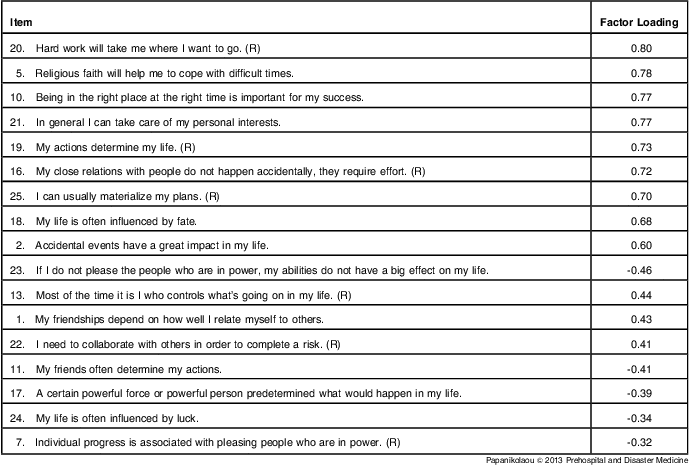
A principal component analysis (PCA), with varimax rotation of the 25 items of the BLOC scale was performed in SPSS predictive analytics software, Version 18 (IBM Corporation, Armonk, New York, USA) to assess the replicability of the two external LOC scales in the current sample. The items loaded on the extracted factors in uninterpretable combinations; therefore, a 17-item single dimension of external locus of control was used for the analyses (Table 1).
Retained Items From the Brown Locus of Control Scale (BLOCS) and Factor Loadings on the Unidimensional Solution

Abbreviation: R, reversed scoring
The nine clinical scales of the SCL-90-R were significantly correlated with each other (P < .01); therefore, the analyses focused on the three global indices. Group comparison analyses were conducted using analysis of variance (ANOVA) procedures.
Results
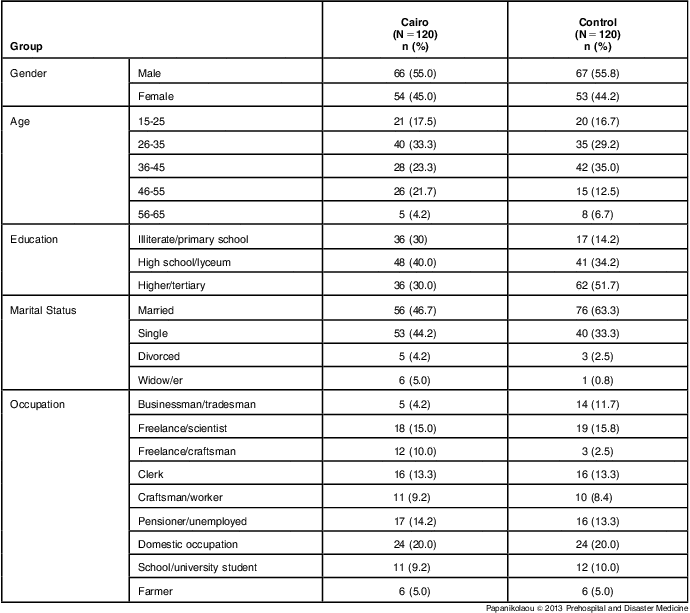
Participant ages ranged from 16 to 70 years. The demographic characteristics of each group are presented in Table 2.
Demographic Characteristics of Each Group
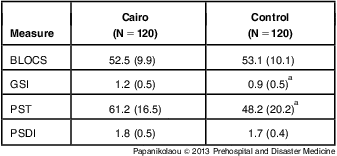
Separate one-way ANOVAs assessed group differences on the BLOCS and the SCL-90-R global indices. There were no significant differences in external locus of control scores on the BLOCS, F (1,238) = 0.24, ns.
The Cairo group scored significantly higher than the control group on the Global Severity Index (GSI), F (1,238) = 22.75, P < .001, and the Positive Symptom Total (PST), F (1,238) = 29.94, P < .001. There were no group differences on the Positive Symptom Distress Index (PSDI), F (1,238) = 1.31, ns. Group means and standard deviations on these measures are presented in Table 3.
Means and Standard Deviations of External Locus of Control and Psychopathology Measures According to Group
Abbreviations: BLOCS, Brown Locus of Control Scale; GSI, Global Severity Index; PST, Positive Symptom Total; PSDI: Positive Symptom Distress Index
aP < .01.
Correlation analysis assessed the association between external locus of control and the SCL-90-R global indices of psychological distress. For the Cairo group, both the relationship between external locus of control and the GSI (r = 0.47) and the PSDI (r = 0.63) were significant (P < .01). For the control group, external locus of control was positively correlated with the PSDI (r = 0.28; P < .05).
The responses on the perceived state interest item were grouped into two categories: those who perceived little or no support from the state and those who viewed state support as moderate or sufficient. Overall, the majority in both groups viewed the state as showing low support; this view was significantly greater in the Cairo group: χ2(1) = 10.679, P < .01. The group breakdown was as follows: Cairo—little/none, 86.6%; moderate/sufficient, 13.3%; control—little/none, 69.1%; moderate/sufficient, 30.8%.
Discussion
The findings of this study showed no difference between groups in beliefs about personal control of life events. For both groups, external locus of control was associated with some indices demonstrating greater psychological distress. In addition, the Cairo group, with a greater intensity of exposure to a traumatic situation in terms of personal injury,Reference Siddique, Owen and Gabbatt25 reported higher levels of psychological distress. This finding is comparable in some ways to the relationship between exposure intensity and psychological distress demonstrated in other types of conflict situations.Reference Solomon, Mikulincer and Benbenishty29 On the other hand, for both groups, externality was associated with greater psychological distress, suggesting an orientation of helplessness in changing life situations.
The lack of difference between groups on external orientation is in contrast with findings on victims of accidental toxic exposure,Reference Gibbs21 cyclones,Reference Suar, Mandal M and Khuntia23 wildfires,Reference Mellon, Papanikolau and Prodromitis22 and combatReference Solomon, Mikulincer and Benbenishty29 in which participants who experienced greater intensity of trauma indicated higher levels of external control beliefs. The differing externality results in the current study may be related to the fact that the traumatic event concerned a political revolution with ramifications for the population of the entire country. Further, it is possible that the perception of locus of control is a more stable trait-like belief system and is not influenced as much by environmental events.
Limitations
A limitation in the interpretation of this study is that the participants in both groups were recruited from patients seen at a hospital emergency department. Therefore, generalizations to other populations need to be made cautiously. In addition, while statistically significant, the overlap in the standard deviations comparing groups on the locus of control and psychopathology measures further suggests caution in generalizing the findings of this study.
Conclusion
The study of traumatic stress is complex, and that different influences affect the variables of interest. In the current study, beliefs about personal control over one's life circumstances were more closely associated with psychological distress than the circumstances in which the trauma occurred. However, the cultural context in which a disaster occurs, the chaos and instability associated with political revolutions, intensity of exposure, and differences in psychological reactions between natural and human-made disastersReference Halpern and Tramontin30 are factors that may differentially affect the persons involved. It is therefore important to continue to evaluate aspects of the setting in which a disaster occurs and its physical effects.