The Developmental Origins of Health and Disease (DOHaD) hypothesis posits that adverse intrauterine and early postnatal exposures have the potential to negatively affect the development and function of the hypothalamic–pituitary–adrenal (HPA) axis in ways that can increase the risk of poorer mental and physical health outcomes across the lifespan.Reference Glover, O’Connor and O’Donnell 1 Perinatal stresses experienced at critical periods of development can produce enduring effects on the fetal brain, the body’s stress response, and one’s emotion regulatory capacities.Reference Schlotz and Phillips 2
These irregular stress responses contribute to the significant vulnerability of extremely low birth weight (ELBW; <1000 g) survivors to later life adversity. Indeed, ELBW survivors are at increased risk for a range of physicalReference Doyle and Anderson 3 and mental disordersReference Van Lieshout, Boyle and Saigal 4 , Reference Boyle, Miskovic and Van Lieshout 5 across the lifespan. As a group, they also tend to be more cautious, risk averse and socially reticent,Reference Schmidt, Miskovic and Boyle 6 which can contribute to problems in relationships, as well as increased social withdrawal and loneliness later in life.Reference Waxman, Van Lieshout and Saigal 7
Childhood sexual abuse (CSA) is a traumatic event that has been found to occur in 8% to 32% of women and 1 to 16% of men.Reference Finkelhor 8 Survivors of CSA are at high risk for developing mental illness across the lifespan, particularly anxiety, mood and substance use disorders.Reference Day, Schmidt and Vaillancourt 9 – Reference Maniglio 12 They also appear to have more difficulties maintaining intimate relationships,Reference Safren, Gershuny and Marzol 13 , Reference Colman and Widom 14 are at higher risk for separation or divorce,Reference Herman, Russell and Trocki 15 and are more likely to report a lower quality of romantic relationships overall.Reference Felitti 16 – Reference Walker, Sheffield and Larson 21 Those exposed to CSA tend to partake in more harsh and detached relationships within the family context, are more introverted, feel more detached from others, and manifest more social isolation and alienation, diminished self-esteemReference Cole and Woolger 23 – Reference Lundberg-Love, Marmion and Ford 26 and social avoidanceReference Tsai, Feldman-Summers and Edgar 27 – Reference Simon, Herlands and Marks 30 than those nonexposed to CSA.
As ELBW survivors are more vulnerable to everyday life stresses, those who are also exposed to CSA may be at a particularly high risk for poor social functioning later in life. We sought to examine the adult social impact of exposure to ELBW and CSA, and to determine if birth weight status moderated the adverse effects of CSA on social outcomes in a group of ELBW survivors and matched normal birth weight (NBW) controls in their early to mid-30s. By studying this unique cohort, we were able to explore the influence of both prenatal and postnatal adversity on social functioning, and thus better understand the influence of adversity on the various facets of social outcomes overall.
Method
Sample
The participants included 397 infants born at ELBW and followed longitudinally from their birth between the years of 1977 and 1982.Reference Saigal, Rosenbaum and Stoskopf 31 Of the original 397 infants born ELBW, 218 died, which resulted in 179 infants surviving to discharge from hospital. A sample of 145 NBW control participants were recruited at age 8 years and matched on age, sex and socioeconomic status (SES) to ELBW survivors.Reference Saigal, Szatmari and Rosenbaum 32 Both groups were assessed at ages 8, 14, 22–26 and 29–36 years. All of the participants were born in southwestern Ontario, Canada. For this study, we utilized data collected at ages 8, 22–26 and 29–36 years. All procedures were approved by the McMaster University Health Sciences Research Ethics Board.
Predictor: CSA
At ages 22–26 years, the participants retrospectively reported whether they experienced CSA before the age of 16 years using a shortened versionReference Tanaka, Wekerle and Leung 33 of the Childhood Experiences of Violence Questionnaire (CEVQ).Reference Walsh, MacMillan and Trocmé 34 The participants reported on whether, ‘before age 16 when you were growing up, did anyone ever do any of the following things when you did not want them to: touch the private parts of your body or make you touch their private parts, threaten or try to have sex with you, or sexually force themselves on you?’. Any frequency above ‘never’ (this item was scored on a five-point Likert type scale with scores ranging from 1=never, 5=more than 10 times), was defined as reporting CSA before the age of 16. This item has been shown to have good 2-week test-retest reliability (κ=0.91), good criterion validity the Childhood Trauma Questionnaire (CTQ)Reference Bernstein, Stein and Newcomb 35 (κ=0.69), as well as good construct validity.Reference Walsh, MacMillan and Trocmé 34
Outcome: social functioning
A number of different measures were used to define the construct of adult social functioning including partner relationship quality, family and social functioning, social support, self-esteem, loneliness, and social avoidance.
Marital and parental status
At ages 29–36 years, the participants completed the Ontario Child Health Study questionnaire,Reference Boyle, Offord and Hofmann 36 which measures a number of different concepts, including if the participants currently had children or a romantic partner.
Partner relationship quality
The participants who responded that they had a romantic partner answered seven questions scored on a five-point scale rating their satisfaction with their relationship with their partner using the Relationship Assessment Scale.Reference Hendrick 37 These questions were summed to create a composite measure of relationship satisfaction, with higher scores corresponding to poorer relationships (α=0.84).
Family functioning
At ages 29–36 years, the participants reported how well their family functioned using the general functioning subscale of the McMaster Family Assessment Device (MFAD-GF).Reference Byles, Byrne and Boyle 38 This questionnaire measures concepts such as whether family members feel they can confide in each other, feel accepted for who they are, and if they feel they can turn to each other in crisis. The 12 questions are measured on a four-point scale (1=strongly agree, 4=strongly disagree) and were summed with higher scores corresponding to better family functioning (α=0.91).
Social support
The amount of perceived social support participants received was measured by the Young Adult Social Support IndexReference McCubbin, Patterson and Grochowski 39 at the ages 29–36 years. This questionnaire measures perceived support from 12 sources including parents, college friends and co-workers. Individual items are scored on a three-point scale (1=no, 2=yes, 3=yes a lot). The scale questions were summed to create a composite measure of social support from multiple sources, with higher scores corresponding to more social support (α=0.96).
Loneliness
The Revised UCLA Loneliness ScaleReference Russell, Peplau and Cutrona 40 is a self-report scale of loneliness completed at ages 29–36 years. The questions measured if participants feel close to people, if they have people to turn to and if they have people who understand them. Its 20 items are measured on a four-point scale (1=never, 4=always), and were summed to create a composite measure of loneliness with higher scores corresponding to more loneliness (α=0.93).
Self-esteem
Self-esteem was measured at ages 29–36 years using the Coopersmith Self-Esteem Inventory.Reference Coopersmith 41 The 25 questions were rated on a two-point scale (0=unlike me, 1=like me). The summed composite was multiplied by 4 and was used in analyses with higher scores corresponding to poorer self-esteem (α=0.90).
Social avoidance
Social avoidance was assessed at ages 29–36 years using the Diagnostic and Statistical Manual of Mental Disorders oriented avoidant personality problems scale of the Young Adult Self-Report questionnaire (α=0.80).Reference Achenbach 42 , Reference Achenbach, Bernstein and Dumenci 43
Covariates
Covariates included child sex, physical abuse and family functioning in the participants’ family of origin, as these variables have been hypothesized to confound associations between early CSA exposure and health outcomes later in life.Reference Chen, Murad and Paras 10 , Reference McEwen 44 , Reference Rind, Tromovitch and Bauserman 45
At birth, ELBW infants’ sex, birth weight and gestational age were collected from their medical charts. For NBW participants, parents reported this information at 8 years of age.
The participants’ parents completed the MFAD-GFReference Byles, Byrne and Boyle 38 when participants were 8 years old as well.
At ages 22–26 years, the participants also reported on their experience of physical abuse before the age of 16 years using the CEVQ-SF.Reference Tanaka, Wekerle and Leung 33 , Reference Walsh, MacMillan and Trocmé 34 The participants answered three questions on a five-point scale (1=never, 5=more than 10 times). They were identified as having experienced physical abuse if they reported experiencing one of the following situations at the minimum frequency or higher: (1) ‘How many times before age 16 did an adult slap you on the face, head or ears or spank you with something like a belt, wooden spoon or something hard?’ (minimum frequency=3–5 times); (2) ‘Before age 16 did an adult push, grab, shove or throw something at you to hurt you?’ (minimum frequency=3–5 times); (3) ‘Before age 16 how many times did an adult kick, bite, punch, choke, burn you, or physically attack you in some way?’ (minimum frequency=1–2 times). The physical abuse questions from the CEVQ-SF have shown to have moderate-to-good 2-week test-retest reliability (κ=0.61), internal consistency (α=0.85), criterion validity with the CTQReference Bernstein, Stein and Newcomb 35 (κ=0.69) and good construct validity.Reference Walsh, MacMillan and Trocmé 34
Participant attrition
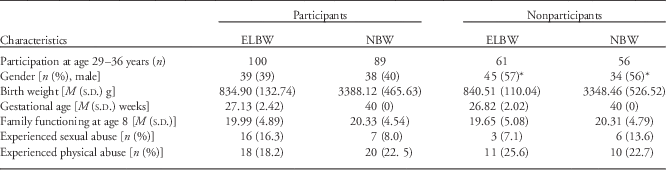
As we followed our study sample into the fourth decade of life, and given that attrition could affect the validity of our analyses, we examined differences between the participants at age 8 years and those who remained in the study at ages 29–36 years (see Table 1). We decided, a priori, to adjust for any differences in these variables to attempt to account for attrition.
Demographic characteristics of participants and nonparticipants at age 29–36 years

ELBW, extremely low birth weight; NBW, normal birth weight.
*P<0.05 difference between participants and nonparticipants.
Within the ELBW sample, those who participated at both the age 8 years and ages 29–36 years visits were more likely to be female than those who only participated at age 8 years [χ2 (2, N=179)=5.72, P=0.017]. They did not differ by gestational age or birth weight. Those who participated at both the age 8 years and ages 29–36 years visits also did not differ on childhood family functioning.
Within the NBW sample, those who participated at both the 8 years visit and ages 29–36 years visit were more likely to be female than those who only participated at the age 8 years visit [χ2 (2, N=145)=6.62, P=0.010]. However, they did not differ by birth weight, gestational age or family functioning from those who participated only at the 8 years visit.
Attrition between the 22–26 years and 29–36 years visit was also analyzed. No significant differences were found between those who participated at both the 22–26 and 29–36 years visits and those who only participated at the 22–26 years visit for the experience of CSA or physical abuse in both the ELBW and NBW samples (data not shown but available upon request).
Data analysis
Analyses were performed using IBM SPSS Statistics 22 (IBM SPSS Statistics, IBM Corporation). First, the moderating effect of preterm birth on associations between CSA and social outcomes was investigated. We created an interaction term by multiplying our CSA variable by birth weight status (as recommended by Cohen et al.Reference Cohen, Cohen and West 46 ). Individual logistic regression analyses were then performed that contained CSA, birth weight status, our interaction term and each dichotomous outcome separately. For continuous outcomes, linear regression analyses containing our predictors and our interaction term were conducted.
Next, in order to preserve statistical power, we preformed the same analyses, without the interaction variable, stratified by birth weight status, to examine associations between CSA and our social outcomes in each birth weight group (ELBW and NBW) separately. In order to add greater support to our significant analyses, we performed post-hoc analyses using bootstrapping (n=5000).
All analyses were performed unadjusted and adjusted for covariates including participant sex, family functioning at age 8 years and experience of physical abuse before the age of 16 years reported at ages 22–26 years.
Results
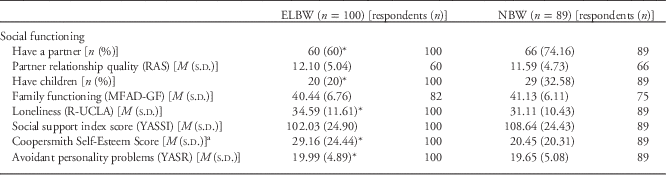
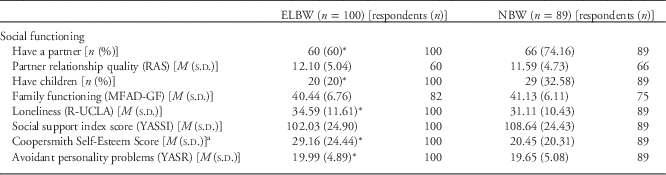
The predictors of attrition in this study can be found in Table 1, and the demographic characteristics of our ELBW and NBW samples are seen in Table 2. As expected, ELBW survivors who participated at ages 29–36 years had a lower birth weight [t(187)=−52.51, P<0.001] and gestational age [t(187)=−50.09, P<0.001] than the NBW comparison group. The ELBW participants also were less likely to have a partner [χ 2 (2, N=189)=4.25, P=0.039] and to have children [χ 2 (2, N=189)=3.88, P=0.049]. Those born at ELBW also reported greater loneliness [t(187)=2.16, P=0.032], poorer self-esteem, [t(187)=2.65, P=0.009] and higher levels of avoidant personality problems [t(187)=3.88, P=0.002]. The two samples did not differ by child sex, age at the 29–36 years visit, experience of physical abuse or family functioning at age 8 years.
Characteristics of participants at age 29–36 years
ELBW, extremely low birth weight; NBW, normal birth weight; RAS, Relationship Assessment Scale; MFAD-GF, general functioning subscale of the McMaster Family Assessment Device; R-UCLA, Revised UCLA Loneliness Scale; YASSI, Young Adult Social Support Index; YASR, Young Adult Self-Report Scale.
a Higher scores represent lower self-esteem.
*P<0.05 difference between ELBW and NBW participants.
Moderation analyses
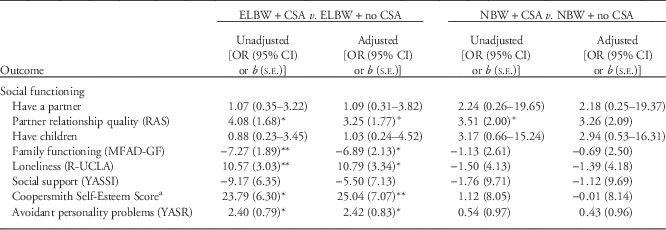
There was significant moderation by birth weight status for loneliness (P=0.021), self-esteem (P=0.032) and moderation approaching statistical significance for family functioning (P=0.06). In these analyses, the association between CSA and social functioning was stronger in the ELBW group than the NBW group. As a result of these significant interactions and in order to preserve statistical power, subsequent analyses examining associations between CSA and social functioning outcomes were performed, stratified by birth weight status (see Table 3).
Childhood sexual abuse (CSA) and adult social outcomes in extremely low birth weight (ELBW) survivors and normal birth weight (NBW) participants

RAS, Relationship Assessment Scale; MFAD-GF, general functioning subscale of the McMaster Family Assessment Device; R-UCLA, Revised UCLA Loneliness Scale; YASSI, Young Adult Social Support Index; YASR, Young Adult Self-Report Scale.
a Higher scores represent lower self-esteem.
+ P<0.10, *P<0.05, **P⩽0.001.
ELBW sample
At the age 29–36 year visit, the ELBW survivors who reported experiencing CSA reported a poorer relationship with their partner (b=4.08, s.e.=1.68), poorer family functioning (b=−7.27, s.e.=1.89), greater loneliness (b=10.57, s.e.=3.03), lower self-esteem (b=23.79, s.e.=6.30), and had higher rates of avoidant personality problems (b=2.40, s.e.=0.79) than ELBW participants who had not been exposed to CSA. After adjustment for covariates, those who experienced CSA continued to report poorer family functioning [b=−6.89, s.e.=2.13, 95% confidence interval (CI), −12.22 to −0.94], greater loneliness (b=10.79, s.e.=3.34, 95% CI, 1.79–19.03), had lower self-esteem (b=25.04, s.e.=7.07, 95% CI, 5.46–43.33) and higher rates of avoidant personality problems (b=2.42, s.e.=0.83, 95% CI, 0.55–4.10).
NBW sample
At the age 29–36 year visit, the NBW participants who reported experiencing CSA generally had numerically but not statistically significantly increased levels of problems with social functioning in adulthood.
Discussion
The ELBW survivors who experienced CSA reported poorer family functioning, more loneliness, lower self-esteem and higher levels of avoidant personality problems than those who did not. CSA exposure was not associated with statistically significant changes in social functioning in the NBW comparison group though this may be due to limitations in statistical power. Birth weight status appeared to moderate the associations between CSA and self-esteem and loneliness such that the impact of CSA was greater in those exposed to significant perinatal adversity (e.g. born at ELBW) relative to those who were not. Similarly, family functioning appeared to be moderated by birth weight status though this result only approached statistical significance.
Until now, the combined effect of exposure to significant perinatal adversity and CSA on adult social outcomes has never been examined. Based on the significant moderating effects seen in this study over a period of more than two decades, it is possible that adverse perinatal exposures programs a particular susceptibility to adverse social outcomes in adulthood.
Additional support for our finding that exposure to significant perinatal stress may amplify the negative effects of postnatal adversity on later life function comes from Jaekel et al.Reference Jaekel, Pluess and Belsky 47 who reported that individuals born at low and very low birth weight and exposed to low maternal sensitivity functioned more poorly academically at 8 years of age than NBW comparison group exposed to sub-optimal parenting. Similarly, others have reported higher rates of delinquency, school problems, poorer physical health, lower quality of life and lower SES in children exposed to the combined effects of low birth weight and child emotional and physical abuse compared with the abused NBW comparison group.Reference Nomura and Chemtob 48
These findings are consistent with the DOHaD hypothesis, which suggests that perinatal adversity can increase the risk or ‘program’ a short- and/or long-term susceptibility to poor health.Reference Entringer, Buss and Wadhwa 49 In this case, adverse perinatal exposures may program a specific emotional and/or behavioral susceptibility that contributes to the vulnerability of ELBW survivors to poor social outcomes when exposed to later stresses such as CSA. As the risk of ELBW births is increased in the presence of significant maternal stress,Reference Nkansah-Amankra, Luchok and Hussey 50 and as maternal stress hormones can be transmitted to the developing fetus,Reference Mulder, Robles and Huizink 51 these hormones may affect the rapidly growing neuronal connections of the fetal brain.Reference Weinstock 52 Such exposures may disrupt the normal development of emotion regulation and HPA functioning in ELBW survivors.Reference Heim, Newport and Heit 53 Indeed, dysregulation of the HPA axis has been linked to low self-esteemReference Pruessner, Baldwin and Dedovic 54 and problems with emotion regulation that predict myriad serious difficulties in social functioning including impaired social behavior.Reference Eisenberg, Fabes and Guthrie 55 CSA has also been linked to subsequent impaired social functioning due to altered HPA axis functioning and cortisol dysregulation.Reference Alink, Cicchetti and Kim 56 Such dysregulation may be amplified in those exposed to perinatal adversity who may already have problems with stress and emotion regulation.
Resilience is often thought of as an attribute that makes one more resistant to the effects of life stressors.Reference Ingram and Luxton 57 Characteristics associated with resilience to the effects of CSA include positive self-esteem, extraversion and social support.Reference Heller, Larrieu and D’Imperio 58 Unfortunately, being born ELBW has been linked to reduced self-esteem and increased social rejectionReference Blond, Whitaker and Lorenz 59 and may therefore reduce ELBW survivors’ resilience to the effects of CSA. Positive peer relationships have also been found to mitigate the negative effects on self-esteem of CSA.Reference Rickards, Kelly and Doyle 60 As ELBW survivors also struggle to form strong social relationships,Reference Bolger, Patterson and Kupersmidt 61 a lack of these resilience factors may also contribute to the more negative effects of ELBW status on social outcomes in the presence of CSA exposure.
Limitations
In this longitudinal study spanning nearly 30 years, participant attrition reduced our sample size and statistical power. We attempted to account for this by adjusting for predictors of attrition in our statistical analyses. However, we did not have the statistical power to be able to control for multiple analyses. Moreover, the participants were born over 30 years ago and given that neonatal care has improved since they were born, future research should attempt to replicate our findings in more contemporary cohorts. It is also important to note that the birth variables of the NBW comparison group were obtained from parental reports at age 8 years, whereas ELBW birth data were derived from their medical charts. Furthermore, the participants were born in Canada where healthcare and high-quality education is universally accessible, which may affect the generalizability of our findings. Finally, CSA was elicited retrospectively, though reports using this method have been shown to be valid.Reference Nelson, Lynskey and Heath 62
Conclusions
Utilizing a cohort of ELBW survivors followed for over 35 years, we report that ELBW survivors exposed to CSA appear to have more social problems in adulthood than those who were not, and that exposure to significant perinatal adversity may amplify the negative social effects of CSA. In particular, ELBW survivors who experience CSA are at much higher risk for low self-esteem and loneliness in adulthood than similarly exposed NBW comparison group. Therefore, ELBW CSA survivors may be a group that is especially susceptible to social problems in adulthood, and may benefit from increased monitoring and early intervention.
Acknowledgments
The authors thank the many participants and their families for their continued participation and Nicole Folland, Paz Fortier, Karen Mathewson, Sue McKee, Barbara Stoskopf, Jordana Waxman and Shirien Yunus for their help with data collection and organizing the assessments. This research was supported by Canadian Institutes of Health Research Grants CIHR: TMH-103145 (to L.A.S.) and CIHR: MOP42536 (to S.S.), National Institute of Child Health and Human Development Grant NICHD: 1-R01HD40219 (to S.S.).