Carbon monoxide (CO) has the potential to cause a major toxicological mass casualty event.Reference Valerio, Verzè and Marchiori 1 There have been many reports of indoor combustion leading to multiple patients with CO poisoning.Reference Valerio, Verzè and Marchiori 1 - Reference Cone and Koenig 9 The mainstay of CO poisoning treatment is removing the patient from exposure and administering high oxygen concentrations to reduce the half-life of carboxyhemoglobin (HbCO). Hyperbaric oxygen therapy (HBOT) may also be used to treat severely affected patients because it can reduce the HbCO level more quickly, although its indication is still debated.Reference Buckley, Juurlink and Isbister 10 Collective intoxication can lead to serious difficulties on-site and within hospitals, including communication problems between the numerous personnel, lack of sufficient human and material resources (oxygen in particular), and a lack of space to take care of the many patients.Reference Valerio, Verzè and Marchiori 1 , Reference McGuffie, Wyatt and Kerr 3 Before hospital care, dispatch and on-site triage have the potential to avoid unnecessary transport to hospitals, thereby sparing emergency departments (EDs) that are often already filled to capacity.Reference Mortelmans, Populaire and Desruelles 2 Conventional triage algorithms are dedicated to trauma patients; however, mass casualty triage of patients with CO intoxication may require a different approach. Medical triage priorities are notably different from trauma because of the potential for respiratory or neurological compromise.Reference Cone and Koenig 9 No standard triage algorithm or principles exist that specifically address CO poisoning, and the roles of some diagnostic tools or treatment options are unclear. In this report, we describe a major incident involving 77 people that occurred near 2 university hospitals. The aim of this report is to discuss the difficulties encountered performing triage on-site and the lessons learned.
METHODS
Our primary goal was to describe a case of collective CO poisoning, to describe the triage option chosen on-site, and to analyze the consecutive patient flow. Data were extracted from the advanced medical posts and hospital charts, from the ambulances, and from the dispatch center by one of the authors (MP) who was also the head emergency physician on-site. The following data were collected: age, gender, number and type of symptoms, patient comorbidities including smoking status, and HbCO levels. The HbCO level was measured for all patients on-site either transcutaneously (SpCO; Masimo Rad-57 Pulse CO-Oximeter, Masimo Corporation) or in expired air (ETCO; ToxCO, Bedfont Scientific Ltd). The HbCO level at the hospital was obtained by arterial blood gas measurement. When a patient was transported to a HBOT facility, the reason for this decision was recorded. The following times were collected: admission and discharge times for patients transferred to and from the advanced medical post and/or the hospital. The follow-up was limited to hospital discharge for patients who benefitted from an ED evaluation or treatment, including HBOT. For all others, we did not collect information after their discharge from the medical post.
The descriptive statistics included frequencies, the mean and SD, or median and interquartile range (IQR). Groups were compared by using Pearson’s chi-square or Fischer’s exact tests, Student’s t-test or Wilcoxon rank-sum test, or Kruskal–Wallis test, as appropriate. A bilateral P value <0.05 was considered indicative of a significant difference. Stata version 14 (Stata Corporation) was used to perform the statistical analyses.
RESULTS
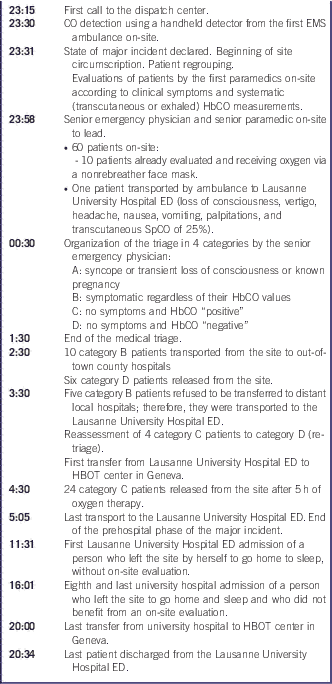
The incident took place in December in a basement where a party was held around a gas barbecue. Its location was a 5-min drive to Lausanne University Hospital ED (an urban tertiary center also providing ED primary care for the area). After being notified of this incident, the dispatch center activated the deployment of the dual prehospital command and control team following predefined criteria. The team was composed of a senior emergency physician and a senior paramedic.Reference Carron, Reigner and Vallotton 11 The closest hyperbaric chamber was located at Geneva University Hospital, 60 km (or 37 miles) away. Sixty patients were regrouped into a neighboring fire station that served as an advanced medical post. The chronology of the whole incident is detailed in Table 1.
Chronology of the IncidentFootnote a

a Abbreviations: CO, carbon monoxide; ED, emergency department; EMS, emergency medical services; HbCO, carboxyhemoglobin; HBOT, hyperbaric oxygen therapy; SpCO, measurement of the carbon monoxide in arterial blood (Masimo).
On-Scene Triage and Dispatch: Strategic Options Chosen by the Head Emergency Physician On-site
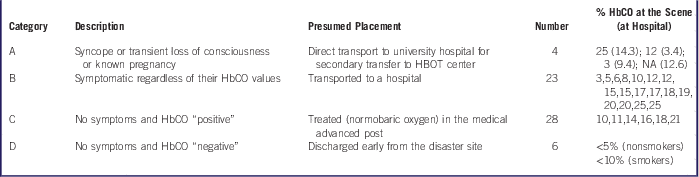
Once on-site, the senior emergency physician established and organized triage and placement strategies according to the following improvised criteria: category A patients included those with syncope, transient loss of consciousness, or known pregnancy. Once identified, they were prioritized for the 5-min transport to the Lausanne University Hospital ED for reevaluation and secondary transfer to the HBOT center, if necessary. All symptomatic patients were classified as category B regardless of their HbCO values and were to be transported to various hospitals. Category C patients were asymptomatic and HbCO “positive”; they all received normobaric oxygen and were kept in the medical advanced post. Category D patients were not symptomatic and HbCO “negative” (assumed to be <5% for nonsmokers and <10% for smokers). These patients were to be discharged early from the site.
Results of the On-Scene Triage and Dispatching
Sixty-one patients were triaged at the advanced medical post (Table 2). All but 9 patients were dispatched as planned. Five category B patients refused to be transferred to a regional (40 km) hospital and were instead transported to Lausanne University Hospital, and 4 category D patients developed symptoms several hours after the initial triage (re-triage) and were transported to the hospital. All 4 patients identified from the site for potential HBOT treatment (transient loss of consciousness) were immediately transported to the university hospital and then to the HBOT center. No patient was directly transported from the site to the HBOT center.
On-site Triage CategoriesFootnote a

a A negative HbCO value was assumed to be <5% for nonsmokers and <10% for smokers. Abbreviations: HbCO, carboxyhemoglobin; HBOT, hyperbaric oxygen therapy; NA, not available.
Patients Who Left the Site Without Being Seen
Eight patients who left the site before being seen went to the university hospital ED by their own means during the night. Two of them were transferred later for HBOT: one asymptomatic pregnant patient at 24 weeks of gestational age (HbCO 12%) and one symptomatic patient with a previously unknown pregnancy at 6 weeks of gestational age (HbCO 15.7%). Eight additional patients consulted the university hospital ED the next day from 11 AM to 4 PM after having slept at home. Two of them were transferred for HBOT: one for persisting symptoms (nausea, vomiting, vertigo, and headache) after 6 h of normobaric oxygen therapy, and one man who was seen 12 h after the event with palpitation, an elevated blood troponin level (0.41 μg/L; normal cutoff: <0.04 μg/L), and 7.1% HbCO.
Patients’ Characteristics
The characteristics of all patients evaluated at the advanced medical post (n=61) as well as in the hospital are described in Table 3. Eight patients were transferred to the HBOT center.
Overall Characteristic of the Patients According to HBOT Administration (Including Those Who Left Without Being Seen On-site)Footnote a

a Abbreviations: CO, carbon monoxide; HbCO, carboxyhemoglobin; HBOT, hyperbaric oxygen therapy; IQR, interquartile range.
b Medical information was unavailable for 4 patients.
DISCUSSION
In this study, we analyzed the rationale for the different strategies chosen as well as the difficulties encountered to improve the global management of such an event, should it happen again.
Identification of the Offending Agent: Diagnosis of CO Intoxication
The first critical step in a toxicological mass casualty incident is to identify the offending agent.Reference Cone and Koenig 9 This step is essential, as it will be the basis for the triage options and the exposure prevention for rescue teams. Intoxication by CO can be suspected depending on the context (exposure) and symptoms. The gold standard to confirm a clinical diagnosis of CO intoxication is an elevation of blood HbCO levels, which is usually not available on-site.Reference Hampson and Dunn 12 , Reference Hampson, Piantadosi and Thom 13 In our case, the first paramedics on-site were equipped with handheld CO detectors, which set off an alarm. The suspicion was further confirmed by the first patient’s CO oximetry (25% HbCO). Both methods allow rapid identification of CO intoxication.Reference Roth, Bayer and Schrattenbacher 14 - Reference Nilson, Partridge and Suner 17
Triage Using Individual Symptoms
Symptoms of CO intoxication are numerous, nonspecific, and not directly correlated with blood HbCO levels.Reference Ely, Moorehead and Haponik 6 , Reference Hampson and Dunn 12 , Reference Henz and Maeder 18 , Reference Hampson and Hauff 19 The most prominent symptoms include headache, nausea, dizziness, weakness, and chest pain.Reference Klasner, Smith, Thompson and Scalzo 4 , Reference Ely, Moorehead and Haponik 6 , Reference Paulozzi, Satink and Spengler 7 During a mass pediatric exposure, only symptomatic patients were transported to the hospital.Reference Klasner, Smith, Thompson and Scalzo 4 Our triage option was somewhat similar, asymptomatic “CO-negative” patients were eligible for discharge directly from the site. However, CO intoxication symptoms can develop after a latency period of several hours.Reference Henz and Maeder 18 This was illustrated by 4 of the 28 category D patients, who were initially asymptomatic but developed symptoms hours after the event (“re-triage”).
Triage is necessary when needs exceed resources. In a situation where there are sufficient human resources and oxygen, all asymptomatic patients should receive normobaric oxygen for some time. They would be instructed to present immediately to the nearest ED in case of delayed symptoms. An electrocardiogram and measurement of cardiac biomarkers is also suggested for moderately to severely intoxicated patients, although the evidence supporting this recommendation is only moderate and the role of cardiac evaluation is unclear in less severely intoxicated patients.Reference Wolf, Maloney, Shih, Wolf, Maloney, Shih, Shy and Brown 20
Triage Using Transcutaneous CO Oximetry and Exhaled Breath Analyzers
Measurement of on-scene HbCO levels with breath or transcutaneous analyzers is noninvasive and allows quicker results compared with blood samples, either on-site or at the hospital.Reference Mortelmans, Populaire and Desruelles 2 These triage tools have some significant limitations. A major drawback is the elapsed time between the exposure and the HbCO measurement. When delayed, initial HbCO levels may be underestimated as HbCO decreases over time, especially if supplementary oxygen is quickly administered, as recommended.Reference Mortelmans, Populaire and Desruelles 2 , Reference Hampson and Dunn 12 , Reference Weaver 21 This delay is especially relevant in the case of collective intoxication, where a large number of patients have to be tested with a limited number of devices. Another limitation is that HbCO levels are probably not representative of CO absorption by tissue and the toxic effects. The deleterious effects of CO may continue, even when HbCO levels have returned to normal.Reference Weaver 21
CO oximetry has been used as a screening tool to detect occult toxicity.Reference Roth, Herkner and Schreiber 22 , Reference Suner, Partridge and Sucov 23 However, the performance of this device is insufficient to rule out CO intoxication.Reference Wolf, Maloney, Shih, Wolf, Maloney, Shih, Shy and Brown 20 , Reference Roth, Herkner and Schreiber 22 - Reference Touger, Birnbaum and Wang 25 Although CO oximetry has been used in mass intoxication situations, CO levels were not used when making triage decisions.Reference Bledsoe, Nowicki and Creel 26 Exhaled CO was also a tool available on-site in our disaster; however, the correlation with blood HbCO values is poor.Reference Lapostolle, Raynaud and Le Toumelin 27 This technique is difficult for patients to use and is time-consuming.Reference Lapostolle, Raynaud and Le Toumelin 27 Furthermore, the conversion from the measured CO concentration in parts per million to HbCO is based on limited evidence and a small number of patients with only low to moderate HbCO levels.Reference Hampson, Piantadosi and Thom 13 Again, in our case, the benefit is low for making triage decisions based on an objective CO measure on-site. At best, using this measurement was falsely reassuring, and at worse, it could lead to erroneous decisions, especially regarding time and resource use.
Normobaric Oxygen Therapy
The treatment mainstay in CO intoxication is to remove the patient from the exposure and administer high-concentration oxygen (100%), which significantly reduces the half-life of HbCO.Reference Hampson, Piantadosi and Thom 13 Normalization of the HbCO level and symptom relief usually occurs in the first 6 h when using 100% normobaric oxygen therapy.Reference Hampson, Piantadosi and Thom 13 Oxygen was quickly provided to all patients in our case. We therefore discharged symptom-free patients from the site who also had normal or normalized HbCO levels. Although debatable, this method has been previously applied in cases of mass intoxication.Reference Klasner, Smith, Thompson and Scalzo 4 , Reference Paulozzi, Satink and Spengler 7 Although intoxicated patients should usually be transported to an ED,Reference Weaver 21 in collective intoxication, treating patients on-site during the first 6 h and discharging them home once they are asymptomatic seems to be a reasonable option.
HBOT Therapy
The use of HBOT may lower the incidence of persistent residual symptoms and neuropsychological sequelae after CO intoxication.Reference Mortelmans, Populaire and Desruelles 2 , Reference Ely, Moorehead and Haponik 6 , Reference Henz and Maeder 18 , Reference Weaver 21 The use of HBOT should be considered for CO intoxication with the following features: pregnancy, patients who are 36 years of age or older, transient or prolonged unconsciousness, ischemic cardiac changes, neurological deficits, significant metabolic acidosis, or HbCO levels above 25%.Reference Hampson, Piantadosi and Thom 13 , Reference Weaver 21 , However, the benefit and impact of HBOT versus normobaric oxygen therapy is controversial.Reference Wolf, Maloney, Shih, Wolf, Maloney, Shih, Shy and Brown 20 , Reference Clarke, Stephens and Farhan 28 A Cochrane review on existing randomized trials failed to prove there was a reliable benefit of HBOT in severe CO poisoning, although the studies in the review were diverse.Reference Buckley, Juurlink and Isbister 10 The only study that met all Consolidated Standards of Reporting Trials (CONSORT) quality criteria showed a significant improvement in long-term neurocognitive dysfunction, supporting that HBOT should be used.Reference Rose, Wang and Xu 29 In our case, only 2 criteria (pregnancy and transient loss of consciousness) were identified on-site. Those patients were classified in the A Category. Despite the low evidence supporting the benefit of HBOT, we decided to let the ED physicians at the closest university hospital make the transfer decisions due to the burden of organizing these transports from the site and the geographic location of the incident. We were then able to use all our resources to perform triage and provide normobaric 100% oxygen to all patients as soon as possible.
Lessons Learned
Sixty-one patients benefitted from an evaluation at the advanced medical post. Medical triage allowed the release of 31 patients from the site, including 24 who received oxygen for up to 6 hours. This lessened the burden on local EDs.Reference Valerio, Verzè and Marchiori 1 On-site triage also avoided the unnecessary use of ambulances, as 13 patients were transported to distant hospitals using mass transport vehicles (buses) equipped with oxygen.Reference Valerio, Verzè and Marchiori 1 Re-triage upgraded 4 patients to a higher category, as they became symptomatic. Therefore, they were transported to the hospital even though they were initially planned to be release from the site after oxygen administration. Among all patients that benefitted from HBOT, only 4 were medically checked on-site and all were identified clinically as having criteria for HBOT. The other HBOT patients left the site without being seen and later went spontaneously to the hospital.
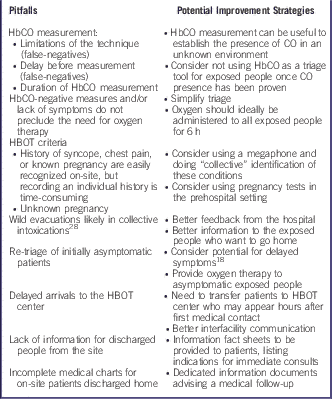
The analysis and debriefing of this mass casualty CO intoxication identified areas that could be improved (Table 4). The most relevant suggestions were to simplify and accelerate the on-site triage and improve communication between the hospital ED and the site regarding the number of patients to be directly transported to the hospital. Knowledge of this number would certainly have changed the number of patients dispatched to the closest hospital by the medical head emergency physician on-site. A system to better inform patients on-site of their clinical situation, notably those who were discharged directly from the site of the incident, would also have been helpful. Medical information was incomplete, which is a hallmark of mass situations,Reference Valerio, Verzè and Marchiori 1 but has potential consequences in terms of quality of care and for insurance or legal reasons.
Lessons Learned From This Mass Intoxication EventFootnote a

a Abbreviations: CO, carbon monoxide; HbCO, carboxyhemoglobin; HBOT, hyperbaric oxygen therapy.
CONCLUSION
CO is a cause of mass intoxication. Our report of a major incident underlines some important issues in managing such events. The critical analysis of this case underlines pitfalls and provides potential solutions for improvement. We hope that our contribution will help to establish future recommendations for the management, triage, treatment, and placement of collective CO intoxication victims.
Acknowledgments
We thank all the prehospital teams on-site for their help dealing with this major incident. We thank all the personnel of the advanced medical post, as well as all firefighters involved on-site. We are especially grateful to Jean-Gabriel Clouet, chief paramedic officer of the advanced medical post, and Eric Paus, senior paramedic on-site, for their successful management of the event, as well as their valuable contributions to critical decisions. Finally, we thank the Geneva Hospital hyperbaric chamber team and Anne Miéville, chief resident of the Lausanne University Hospital ED, for their collaboration.