1. Introduction
Global experience with nuclear power development indicates that 14C is continuously released into the environment from nuclear power plants (NPPs) during their normal operation, is present in high concentrations in irradiated graphite, persists in spent nuclear fuel, and will therefore be disposed of in geological repositories for long-lived high-level waste in the form of spent fuel or radioactive waste generated during spent fuel reprocessing (IAEA 2004; Povinec et al. Reference Povinec, Kontul’, Ješkovský, Kaizer, Richtarikova, Šivo and Zeman2024; Zhang et al. Reference Zhang, Liu, Li, Li, Wei and Xu2021).
Based on the fundamental properties of 14C in biogeochemical cycles, we can consider 14C as one of the most powerful environmental tracers of the nuclear era. Due to the biological importance of carbon isotopes (12C, 13C and 14C) and hence the biological incorporation of 14C during photosynthesis, measurements of 14C in the environment of nuclear facilities are of great interest, especially since 14C is not always monitored in emissions from NPPs during their operation. The 1⁴C activity of terrestrial and aquatic plants can differ from the background atmospheric 1⁴C/1 2C ratio, and this variability has led researchers to conduct many studies to use vegetation as a bioindicator of atmospheric and aquatic 1⁴C released from NPPs (Barisevičiūtė et al. Reference Barisevičiūtė, Mažeika, Maceika, Juodis, Rakauskas, Jefanova, Ežerinskis, Šapolaitė, Butkus and Remeikis2023; Janovics et al. Reference Janovics, Kern, Güttler, Wacker, Barnabás and Molnár2013; Levin et al. Reference Levin, Kromer, Barabas and Münnich1988; Loosli and Oeschger Reference Loosli and Oeschger1989; Magnusson et al. Reference Magnusson, Stenström, Skog, Adliene, Adlys, Hellborg, Olariu, Zakaria, Rääf and Mattsson2004; Mazeika Reference Mazeika and Tsvetkov2010; Milton et al. Reference Milton, Kramer, Brown, Repta, King and Rao1995; Povinec at al. Reference Povinec, Kontul’, Ješkovský, Kaizer, Richtarikova, Šivo and Zeman2024; Stenström et al. Reference Stenström, Erlandson, Hellborg, Wiebert and Skog1996; Svetlik at al. Reference Svetlik, Fejgl, Turek, Michalek and Tomaskova2012).
The main aim of this study was to investigate how terrestrial and aquatic vegetation, as well as in water dissolved inorganic carbon (DIC), can restore 14C activity excess over the contemporary 14C background level in the vicinity of the newly commissioned BelNPP and the decommissioned INPP. The 14C activity excess data make it possible to evaluate the order of magnitude of gaseous and liquid release rates associated with NPPs operation, what can partially substitute direct 14C release monitoring data and provide basis for approximate dose estimates.
2. Sampling sites, materials and methods
The study area in eastern Lithuania included vicinities of two nuclear power plants located relatively close to each other (98 km): the Belarusian NPP (BelNPP) in the northwest of Belarus and the Ignalina NPP (INPP) in northeast of Lithuania.
The BelNPP has been in operation for five years now, with the two units currently in operation: Unit 1 since November 2020 (industrial operation since November 03, 2020), Unit 2 since April 2022 (industrial operation since November 01, 2023). The BelNPP is located near the town of Ostrovets in western Belarus, in the Neris (Viliya) River catchment, approximately 20 km from the border with Lithuania. The Neris (Viliya) River also flows through the capital of Lithuania, Vilnius, located approximately 90 km downstream of the BelNPP. The facility comprises two VVER-1200 pressurised water reactors with a combined installed capacity of approximately 2400 MW. The plant’s designed service life is 60 years (Belarusian Nuclear Power Plant 2026).
The INPP is in northeastern Lithuania, near borders with Belarus and Latvia. The INPP operated for only 26 years. For its technical needs, the plant used Lake Drūkšiai as a natural reservoir for cooling and receiving permitted wastewater containing radionuclides. The INPP consisted of two RBMK-1500 reactor units: Unit 1 and Unit 2, commissioned in December 1983 and August 1987, respectively. The rated thermal power of one reactor was 4250 MW, and the rated electrical power was 1300 MW. The RBMK is a graphite-moderated boiling water channel-type reactor. As part of Lithuania’s obligations under the European Union Accession Treaty, Unit 1 of INPP was shut down on December 31, 2004, and Unit 2 on December 31, 2009. The INPP has currently been in the process of decommissioning for over 15 years. The operational history of the INPP and data on radiation in the environment indicate that the INPP has been operated safely and has benefited the society (Ignalina Nuclear Power Plant 2026).
In the period 2016–2025, we conducted a study of the distribution of 14C in terrestrial and aquatic biota and in water in the area of the BelNPP both during the pre-operational stage and the initial period of operation, as well as in the area of the INPP, which had been shut down for decommissioning.
To study 14C in terrestrial ecosystems, eight sampling sites were selected near the Belarus-Lithuania border in a semi-regular arc approximately 60 km long, belonging to forest ecosystems on Arenosols, common in the Lithuanian part of 30-km zone of the BelNPP. The areas in Belarus closest to the BelNPP were inaccessible for our research under the current circumstances. To observe terrestrial ecosystems of the INPP, 4–5 sampling points were selected in the immediate vicinity of the industrial zone (0–5 km) and 8–10 sites in the zone further from the INPP (5–30 km). Sampling of terrestrial biota for 14C determination was carried out at the end of the growing season, namely in August or September. Mugwort stems (Artemisia sp.) represented terrestrial biota.
To study the aquatic biota (macrophytes) under the influence of the BelNPP, a monitoring site was selected on the Neris River near the state border with Belarus. The studied aquatic biota included: arrowhead (Sagittaria sp.), flowering rush (Butomus umbellatus), water-plantain (Alisma sp.), sedge (Carex rostrata), European bur-reed (Sparganium sp.), pondweed (Potamogeton sp.), common reed (Phragmites australis), frogbit (Hydrocharis morsus-ranae), Canadian waterweed (Elodea canadensis). Similar species of aquatic biota were also collected from Lake Drūkšiai at several monitoring sites in the case of the INPP. Aquatic biota samples for the determination of 14C were collected at the end of the growing season, namely in August or September. Macrophytes were taken according to standard radioecological methods using a special hook (Marčiulionienė et al. Reference Marčiulionienė, Lukšienė, Montvydienė, Jefanova, Mažeika, Taraškevičius, Stakėnienė, Petrošius, Maceika, Tarasiuk, Žukauskaitė, Kazakevičiūtė and Volkova2017).
To determine 14C in the water of the Neris River, in the case of the BelNPP, water samples were collected in two places—in the same place where biota samples were collected, as well as at a sampling point in Vilnius, and in the case of the INPP—also from Lake Drūkšiai at several monitoring sites. The frequency of water sampling varied depending on the project and the analysis method, and ranged from once a year, once a month, and even once every two days for some experiments. To determine the activity of 14C in water, dissolved inorganic carbon (DIC) was precipitated from large (320 L) or small volume (1 or 20 L) water samples using appropriate quantities of NaOH and CaCl2 as described in (Arslanov Reference Arslanov1987).
After standard pre-treatment of the relevant material, the specific activity of 14C in biota samples and DIC in water were measured by liquid scintillation counting (LSC) (Arslanov Reference Arslanov1987). The conventional benzene synthesis procedure was used (Skripkin and Kovalyukh Reference Skripkin and Kovalyukh1997). To measure 14C in DIC with normal precision using the benzene synthesis method, we collected 320 L of water containing approximately 50 mg/L of inorganic carbon. This theoretically yields 16 g of pure carbon, which can be used multiple times to obtain 3 mL of benzene as a standard measuring form for 14C determination in our laboratory, even for dating requirements. The following steps were performed: (1) reaction of a carbon-containing sample (CO2 for DIC and charred carbon for biota samples) with Li in a reactor under vacuum at 600–700 °C to produce Li2C2, (2) hydrolysis of Li2C2 to produce C2H2, (3) synthesis of benzene by cyclotrimerization of C2H2 using an aluminous-silicate catalyst activated with V2O5, (4) purification of benzene from residual moisture by addition H2SO4 and by vacuum sublimation, and (5) addition scintillation agents PPO and POPOP. The beta-spectrometric system performance for 14C in benzene form (3 mL) with 7 mL glass vials was as follows: background count rate of 0.67 ± 0.05 CPM; counting efficiency of 71.3 ± 0.8%; and 1 sigma uncertainty of less than 1 pMC for most samples. This conventional benzene-synthesis procedure for was applied to all biota samples and part of DIC samples.
The remaining DIC samples were converted to CO2, which was captured in a scintillator for absorbing and counting labelled CO2 (OXYSOLVE C-400, 1 mL of cocktail absorbs 2.8 mmol of CO2). The inorganic carbon extraction efficiency was close to 100%, as confirmed by spike-recovery experiments using 14C under the same conditions as for the routine samples. A water sample (about 1 L) or wet carbonates precipitated from 20 L of water were placed in a three-necked flask, treated with 8 M HNO3, slowly heated to 90–110 °C and purged with nitrogen (gas flow about 80 mL/min); the evolved CO2 was captured in Drexler traps using OXYSOLVE C-400. The 14C extraction process took approximately 1 hour. From the first trap (containing 30 mL of OXYSOLVE C-400), 20 mL of solution was dispensed into 20 mL measuring vial of the beta spectrometer. The beta spectrometric system performance for 14C in OXYSOLVE C-400 form (20 mL) measured in 20 mL plastic vials was as follows: background count rate of 2.29 ± 0.09 CPM; counting efficiency of 63.8 ± 3.5%. Using two sample sizes with OXYSOLVE C-400 provided different capabilities for 14C determination. Frequently collected 1 l water samples allowed for a rough (qualitative) assessment of the potential increase in 14C levels in DIC due to NPP impact, since for these low-carbon samples (0.05 g), the detection limit (8.0 Bq/m3) was only slightly below the current background level of 14C in the studied river (8.2 Bq/m3), and, for the small subset of measurable samples in the full data set, the uncertainty was very high—up to 80%. Satisfactory performance was achieved using 20 L samples, which theoretically allow recovery of 1 g of inorganic carbon from the river water being analysed. This amount, captured in the OXYSOLVE C-400, enabled the determination of 14C in river water with a detection limit of 1 Bq/m3 at a background level of 8.2 Bq/m3 and an uncertainty in the range of 10–20%.
3. Results and discussion
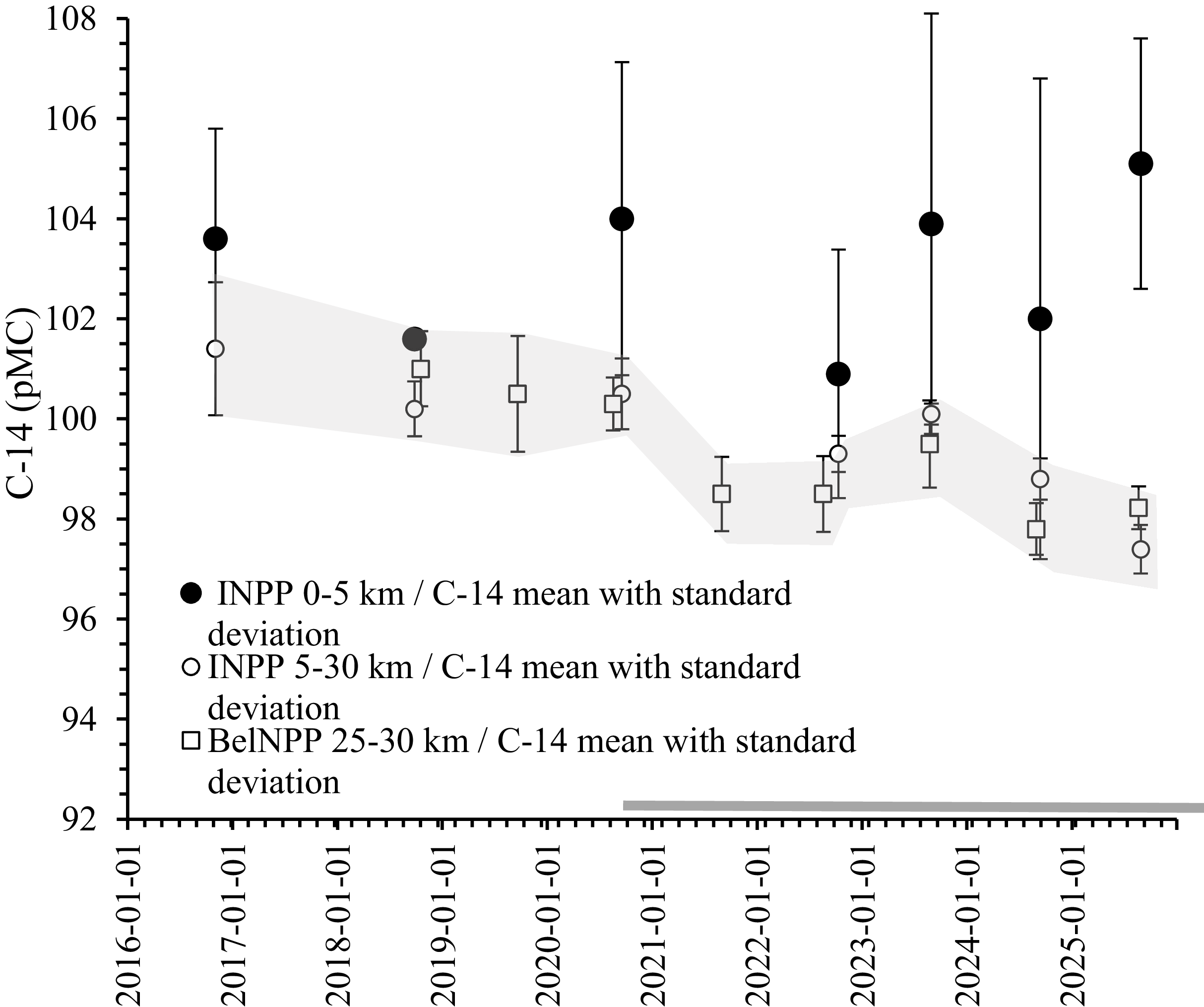
The data on 14C specific activity in terrestrial plants (Artemisia sp.) in Lithuanian part of the 30-km zones around the BelNPP and INPP for the period of observations 2016–2025 are presented in Figure 1.
Specific activity of 14C in terrestrial plants (mugwort, Artemisia sp.) from the Lithuanian part of the 30 km zone of the BelNPP during the pre-commissioning and operational periods of the BelNPP and from the vicinity of the INPP 6–15 years after shutdown of the INPP for decommissioning. Mean values and standard deviations were calculated from several sampling sites (up to 8). The period of BelNPP operation is shown by the horizontal bar. The gray band shows the range between –1SD and +1SD for the BelNPP (25–30 km distance) and INPP data (5–30 km distance).

A comparative analysis of 1⁴C content in annual terrestrial plants was conducted between the edge of the BelNPP’s 30-km zone and two zones within the INPP’s 30-km area. For both NPPs, data from distal sites (shown in gray) showed no significant difference in plant 1⁴C content, with variations falling within the standard deviation. Specifically, the 1⁴C specific activity in Artemisia sp. across all studied sites in the 30-km zones of both plants in the same year varied insignificantly. The standard deviation across these background sites was only marginally greater than the 1-sigma uncertainty of a single measurement. In all samples of 2016–2025 from areas more distant from the BelNPP and INPP, the specific activity of 14C ranged from 101.4 ± 1.7 (SD, standard deviation) in 2016 to 98.2 ± 0.5 (SD) pMC in 2025, what is slightly lower than the level of 14C of cosmogenic origin ∼100 pMC (Hua et al. Reference Hua, Turnbull, Santos, Rakowski, Ancapichún, De Pol-Holz, Hammer, Lehman, Levin, Miller, Palmer and Turney2022). Predictions (Sierra Reference Sierra2018; Zhang et al. Reference Zhang, Liu, Li, Li, Wei and Xu2021) that background 14CO2 levels due to CO2 emissions from burning fossil fuels will, depending on reduction scenarios, reach pre-1950 levels (i.e. 14CO2 < 100 pMC) by 2021 in the Northern Hemisphere have been confirmed by observations.
In stark contrast, the near zone of the decommissioned INPP showed a persistent and variable 1⁴C excess. Between 2016 and 2025, 1⁴C content in Artemisia sp. consistently exceeded 100 pMC, with group standard deviations 2–3 times larger than at background sites. Notably, no temporal decline was observed; the highest value of 105.1 ± 2.5 pMC was recorded in 2025.
This post-operational 1⁴C excess is consistent with the historical record from pine tree rings (Ežerinskis et al. Reference Ežerinskis, Šapolaitė, Pabedinskas, Juodis, Garbaras, Maceika, Druteikienė, Lukauskas and Remeikis2018; Mazeika et al. Reference Mazeika, Petrosius and Pukiene2008), which documented 1⁴C dynamics throughout the INPP’s operational lifecycle. The tree-ring data showed an initial excess of 3–6 pMC during the first 14 years of routine operation (1983–1997), followed by a larger excess of 6–14 pMC (1998–2003) coinciding with major maintenance on fuel channels.
The continued 1⁴C excess of up to 6 pMC during the decommissioning phase confirms its efficacy as a sensitive tracer for terrestrial ecosystems in the near-field of nuclear facilities, despite atmospheric dilution. The absence of analogous data for the BelNPP near zone is a limitation of the present study, highlighting a critical area for future monitoring.
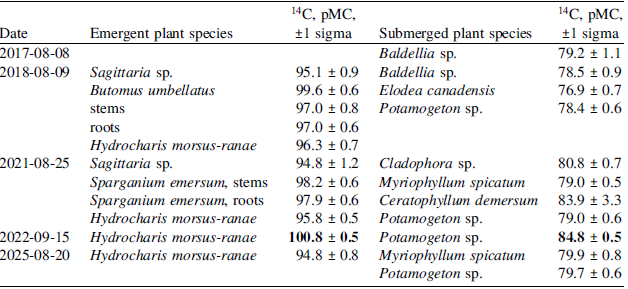
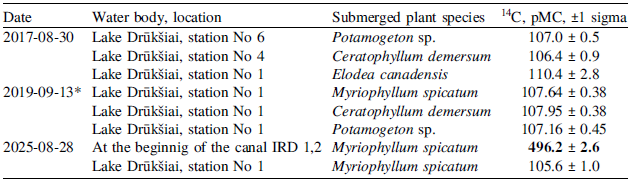
Data on 14C in macrophytes in the Lithuanian part of the 30-km zones of the BelNPP and INPP for the observation period 2016–2025 are detailed in Tables 1–2.
Specific activity of 14C in macrophytes taken from the Neris River in Lithuanian part of the 30 km zone of the BelNPP, Belarus.

Table 1. Long description
A table comparing the specific activity of carbon-14 in macrophytes taken from the Neris River in the Lithuanian part of the 30km zone of the Belarussian Nuclear Power Plant (BelNPP). The table has 6 rows and 4 columns. The columns are labeled as follows: Date, Emergent plant species, 14C, pMC, ±1 sigma, Submerged plant species, 14C, pMC, ±1 sigma. The table presents data for different dates: 2017-08-08, 2018-08-09, 2021-08-25, 2022-09-15, and 2025-08-20. For each date, the table lists the species of emergent and submerged plants along with their corresponding carbon-14 activity levels and standard deviations. Row 1: 2017-08-08, Baldellia sp., 79.2 ± 1.1. Row 2: 2018-08-09, Sagittaria sp., 95.1 ± 0.9, Baldellia sp., 78.5 ± 0.9. Row 3: 2018-08-09, Butomus umbellatus stems, 99.6 ± 0.6, Elodea canadensis, 76.9 ± 0.7. Row 4: 2018-08-09, Butomus umbellatus roots, 97.0 ± 0.8, Potamogeton sp., 78.4 ± 0.6. Row 5: 2018-08-09, Hydrocharis morsus-ranae, 96.3 ± 0.7. Row 6: 2021-08-25, Sagittaria sp., 94.8 ± 1.2, Cladophora sp., 80.8 ± 0.7. Row 7: 2021-08-25, Sparganium emersum stems, 98.2 ± 0.6, Myriophyllum spicatum, 79.0 ± 0.5. Row 8: 2021-08-25, Sparganium emersum roots, 97.9 ± 0.6, Ceratophyllum demersum, 83.9 ± 3.3. Row 9: 2021-08-25, Hydrocharis morsus-ranae, 95.8 ± 0.5, Potamogeton sp., 79.0 ± 0.6. Row 10: 2022-09-15, Hydrocharis morsus-ranae, 100.8 ± 0.5, Potamogeton sp., 84.8 ± 0.5. Row 11: 2025-08-20, Hydrocharis morsus-ranae, 94.8 ± 0.8, Myriophyllum spicatum, 79.9 ± 0.8. Row 12: 2025-08-20, Potamogeton sp., 79.7 ± 0.6.
Specific activity of 14C in submergent species of macrophytes taken from the Lake Drūkšiai and industrial rain drainage canal No. 1,2 (IRD 1,1), draining part of the INPP industrial site.

Table 2. Long description
The table presents data on the specific activity of 14C in submergent species of macrophytes taken from Lake Drūkšiai and the industrial rain drainage canal No. 1,2 (IRD 1,1), which drains part of the INPP industrial site. The table includes columns for the date, water body and location, submerged plant species, and 14C activity in pMC with a plus-minus sigma value. The data spans from 2017 to 2025 and includes various species such as Potamogeton sp., Ceratophyllum demersum, Elodea canadensis, Myriophyllum spicatum.
* Data taken from Barisevičiūtė et al. (Reference Barisevičiūtė, Mažeika, Maceika, Juodis, Rakauskas, Jefanova, Ežerinskis, Šapolaitė, Butkus and Remeikis2023).
The data on 14C in macrophytes in the Neris River (Table 1) showed significant variability depending on the ecological group of macrophytes. Emergent species tend to have 14C values close to those in atmospheric CO2. For example, the 14C content in the Neris River in Sagittaria sp. in 2018 was 94.8 ± 1.2 pMC (1 sigma uncertainty) and in Hydrocharis morsus-ranae in 2022—100.8 ± 0.5 pMC. Submerged species tend to have 14C values close to those in DIC of river water. For the Neris River dataset, the 14C content in Elodea canadensis was 76.9 ± 0.7 pMC in 2018 and 84.8 ± 0.5 pMC in Potamogeton sp. in 2022. The range of 14C from 77 to 80 pMC is typical for the Neris River drainage system for the period 2012–2020, i.e., before the start of operation of the BelNPP (see Figure 2). Regarding the 14C content, submerged macrophytes are more susceptible to the influence of the so-called freshwater reservoir effect (FRE) than emergent ones. This effect, known for many lakes and rivers (Philippsen Reference Philippsen2013), is determined by the presence of dissolved ancient carbonates in the catchment area and the age of the groundwater entering the river or lake. For the Neris River, it is estimated to be at least 20 pMC. Even with the dilution of 14C in the Neris River due to FRE, based on the elementary statistics of the data presented in Table 1, the 14C excess in macrophytes due to the influence of the BelNPP can be restored to 4.5 ± 0.8 pMC for emergent plants and 6.4 ± 0.8 pMC for submerged plants at the Neris River monitoring point located 32 km downstream of the BelNPP.
Specific activity of 14C (with 1σ measurement uncertainty) in DIC of surface water samples collected from the Neris River (Buivydžiai station) in the Lithuanian part of the 30 km zone of the BelNPP during the pre-commissioning and operational periods, and from the Lake Drūkšiai near the INPP during the pre-commissioning, operational and decommissioning periods. Earlier data (before 2016) were taken from (Mazeika Reference Mazeika and Tsvetkov2010; Mažeika et al. Reference Mažeika, Jefanova, Petrošius, Lujanienė and Skuratovič2022). The 14C excess for the Lake Drūkšiai relative to declining background values is shown in gray. As atmospheric baseline the 14C specific activity in P. sylvestris tree rings from the background areas were taken as reported in (Mazeika et al. Reference Mazeika, Petrosius and Pukiene2008; Pabedinskas et al. Reference Pabedinskas, Maceika, Šapolaitė, Ežerinskis, Juodis, Butkus, Bučinskas and Remeikis2019). The periods of BelNPP and INPP operation are shown by horizontal bars.

Figure 2. Long description
A line graph showing the specific activity of carbon-14 in surface water samples from the Neris River and Lake Drūkšiai over time, with periods of nuclear power plant operations indicated. The horizontal axis represents the years from 1975 to 2026, and the vertical axis represents the specific activity of carbon-14 in percent modern carbon (pMC), ranging from 70 to 160 pMC. The graph includes multiple data series: Lake Drūkšiai before INPP operation, Lake Drūkšiai during INPP operation, Lake Drūkšiai after INPP shutdown for decommissioning, background trees, Neris River before BelNPP operation, and Neris River during BelNPP operation. The periods of INPP and BelNPP operation are shown by horizontal bars. The data series for Lake Drūkšiai before INPP operation and other related background water bodies is represented by a solid line, while the data series for the Neris River before BelNPP operation is represented by a dotted line. The graph shows a general decline in carbon-14 levels over time, with notable fluctuations during the periods of nuclear power plant operations. The 14C excess for Lake Drūkšiai relative to declining background values is shown in gray.
Among macrophytes in Lake Drūkšiai, submerged plant species predominated, and they did not show significant differences in 14C content in the same sampling year (Table 2).
14C has most frequently been measured in Myriophyllum spicatum, making this species convenient for comparison. The highest 14C activity in this species at the end of INPP operation in 2010 (Mazeika Reference Mazeika and Tsvetkov2010) was observed in industrial rain drainage canal, IRD 1,2, (387.2 ± 1.0 pMC), which receives wastewater from INPP and discharges it to Lake Drūkšiai. There, 14C is further diluted to levels only slightly above background, by up to 6–7 pMC, during the period of 2017–2025. Fifteen years after the start of INPP decommissioning, the 14C content in Myriophyllum spicatum from IRD 1,2 canal in 2025 was even higher at 496.2 ± 2.6 pMC, indicating a significant 14C excess in aquatic ecosystem in near-field zone of the nuclear facility. This observation is likely attributable to a single event related to decommissioning activities and associated radioactive waste management practices (Ignalina Nuclear Power Plant 2026). This sampling point is located at the head of a canal draining water from an industrial site housing radioactive waste reprocessing and storage facilities. The short hydrological pathway with low flow rate ensures minimal dilution of the 14C-containing wastewater.
Regarding 14C changes due to the freshwater reservoir effect, it appears that the 14C content of macrophytes in Lake Drūkšiai has never been below 100 pMC, confirming the neglect of FRE in this lake.
Data on 14C in DIC of surface water from the Lithuanian part of the 30-km zones of the BelNPP and INPP for the observation period 2016–2025, supplemented by data from previous publications describing situation since 1975, are shown in Figure 2.
Figure 2 presents all available data of normal precision (based on benzene counting), including published elsewhere (Mazeika Reference Mazeika and Tsvetkov2010), on 14C for the DIC of the Neris River and Lake Drūkšiai. We begin by examining the background curves of 14C decline in the studied river and lake. The first 14C measurements in the DIC of both water bodies date back to 1975 (Mazeika Reference Mazeika and Tsvetkov2010), when 14C values of 139.6 ± 1.9 pMC for Lake Drūkšiai and 109.4 ± 1.8 pMC for Neris River were obtained. The difference between 14C in the lake and river at the beginning of the measurements was 30.2 ± 1.9 pMC. The 14C decline in the DIC of lake does not differ significantly from the 14C values in tree rings, indicating small FRE, as well as lake recharge by streams and groundwater, which are formed from modern carbon sources. The 14C in DIC of river declined to value of 79.1 ± 1.2 pMC by 2020, immediately before the start of BelNPP operation, and at that time the difference between the lake and the river 14C values was 21.1 ±0.8 pMC. The background water bodies feeding Lake Drūkšiai and the Neris River including the Žeimena River, its main tributary, maintained 14C levels over time close to the background curves shown in Figure 2. Since Lake Drūkšiai is a water body with a short water turnover time (2–3 years), the long-term trend in 14C content follows the depletion of atmospheric 14C after nuclear weapons testing in the 1960s. This is confirmed by the tree-ring 14C curve, which closely matches the combined 14C curve for the selected water bodies. A similar trend in 14C, though, modifieded by groundwater baseflow, is also characteristic of the Neris River.
After the start of the BelNPP operation, 14C activities exceeding background values were occasionally observed in the DIC of the Neris River, and the maximum was reached on 2022-09-15 with a 14C value of 618.9 ± 1.2 pMC. This value corresponds to an excess of 14C in DIC in the Neris River of 56.5 Bq/m3. Using the same dilution factor as in the paper (Skuratovič et al., Reference Skuratovič, Mažeika, Petrošius, Jefanova, Romanenko, Paškauskas, Adamovich and Erturk2025), the liquid 14C release rate can be estimated as 0.3 GBq per event (for annual rate, this value or slightly higher can be taken). For other pressurized water reactors (PWR), the liquid 14C release rate has a similar magnitude: for the Paks NPP (Hungary)—from 1.76 to 3.65 GBq/year; for the Indian Point NPP (USA)—2.6 GBq/year; for the Ginna NPP (USA)—0.3 GBq/year; for the Daya Bay NPP (China)—20.2 GBq/year (European Commission 2026; Rout et al. Reference Rout, Yadav, Pulhani and Kumar2024). Based on the ICRP, 1991 approach, and assuming peak 14C activity is present in drinking water—very conservative and unrealistic assumption for the critical group in the general adult public—it is nevertheless possible to estimate a maximum effective dose from 14C ingestion with drinking water of 1.9×10⁻⁵ mSv/year (which is significantly lower than the regulatory dose constraint of 0.2 mSv/year).
Tracing the 1⁴C content in the DIC of Lake Drūkšiai throughout the entire period of the INPP operation reveals that the highest 1⁴C concentration was observed in 2006, reaching 141.6 ± 1.0 pMC, while the 14C excess reached 36.3 ± 1.5 pMC. The 14C content in DIC of the lake in 2025 was 106.7 ± 0.9 pMC, which corresponds to 14C excess of 6.7 ± 1.7 pMC. In the less diluted aquatic environment, in a IRD 1,2 canal, the 14C content in DIC in 2025 was 324.6 ± 1.8 pMC, which corresponds to a 14C excess of about 225 pMC. Such values were not observed here even in the last years of the INPP operation.
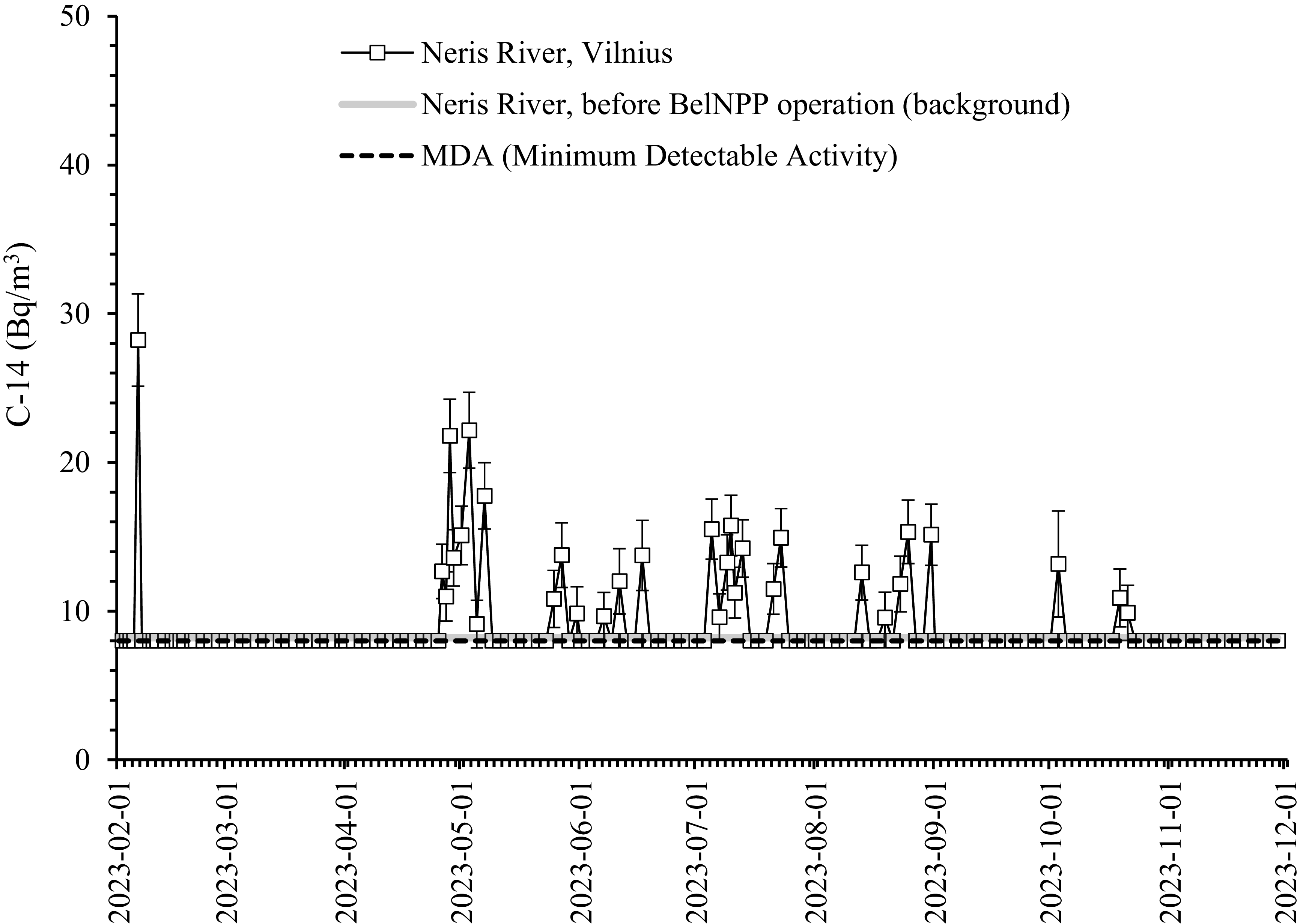
The initial finding of a significant 1⁴C excess in the DIC of the Neris River—detected even through infrequent sampling—prompted a more intensive monitoring campaign to capture its dynamics. Consequently, in 2023, we implemented a high-frequency sampling regimen (every other day), utilizing the OXYSOLVE C-400 method, albeit with a trade-off of lower analytical sensitivity (Figure 3).
Specific activity of 14C (with 1σ measurement uncertainty) in DIC of surface water samples collected from the Neris River (Vilnius station) in the Lithuanian part of the 30 km zone of the BelNPP in 2023. Every second day sampling was performed for 10 months. The gray line indicates the background 1⁴C levels (8.2 Bq/m3) measured before the start of BelNPP operation, while the dotted line marks the Minimum Detectable Activity (MDA = 8.0 Bq/m3).

A year 2023 was particularly significant as it followed the first long-term scheduled maintenances for Unit 1 of the BelNPP, which occurred in 2022 and 2023. As we have previously demonstrated (Skuratovič et al. Reference Skuratovič, Mažeika, Petrošius, Jefanova, Romanenko, Paškauskas, Adamovich and Erturk2025), these maintenance periods are critical, as levels of tritium (3H) in the Neris River consistently exceeded natural background during or near these events, showing pronounced temporal variability.
The 2023 high-frequency 1⁴C data on DIC confirmed frequent and substantial exceedances above background levels. A correlation was observed, with most 1⁴C peaks coinciding with or occurring close to the 3H peaks. The maximum recorded 1⁴C activities (22–28 Bq/m3) exceeded the pre-operational background for the Neris River (8.2 ± 1.2 Bq/m3 (SD)) by a factor of up to three.
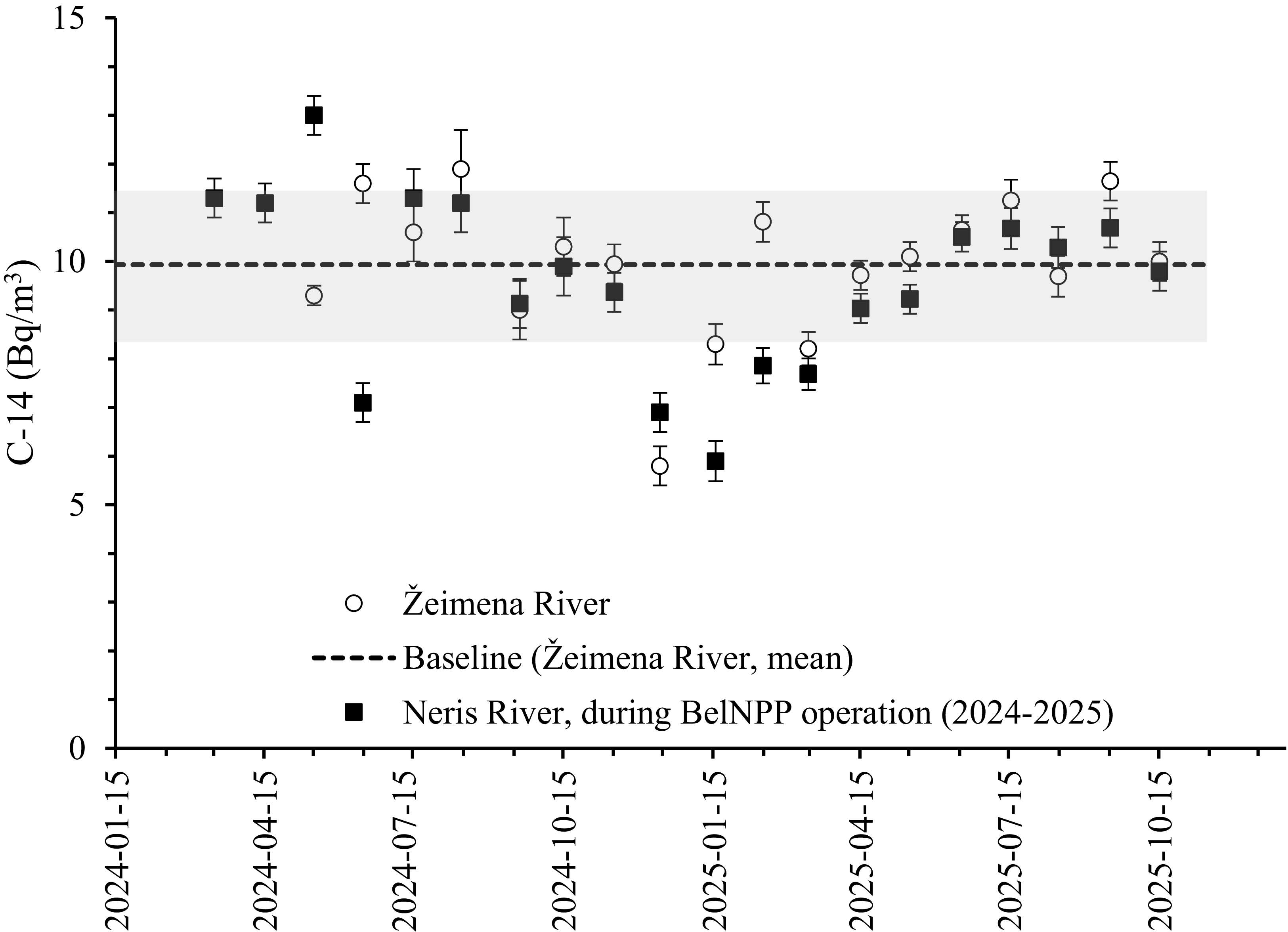
This high-frequency (every-other-day) sampling was concluded in November 2023. The monitoring strategy was subsequently adjusted, and from March 2024 to the present, sampling has continued monthly (Figure 4).
Specific activity of 14C (with 1σ measurement uncertainty) in DIC of surface water samples collected from the Neris River (Buivydžiai station) in the Lithuanian part of the 30 km zone of the BelNPP and from a background water body, the Žeimena River, in 2024–2025. Sampling was carried out once a month. The specific activity of 14C was measured in CO2 extracted from the medium volume of water (up to 20 L) and trapped in a scintillation cocktail (OXYSOLVE C-400, MDA = 0.8 Bq/m3). The gray band shows the range between –1SD and +1SD of the Žeimena River mean.

Based on a series of 14C measurements in DIC in water of the Neris River for the period 2024–2025, no excess of 14C relative to the background level was detected, despite the scheduled maintenance works being carried out at Units 1 and 2 of the BelNPP in the second half of 2024 and early 2025. Data on 14C for the main tributary of the Neris River in this section, the Žeimena River, were taken as the background level. Due to the lower FRE value for the Žeimena River, the background level of 14C sometimes even exceeded the 14C content in the DIC of the Neris River.
4. Conclusion
This study reveals a distinct contrast in 1⁴C distribution between terrestrial and aquatic ecosystems near nuclear power plants. While no 1⁴C excess was detected in terrestrial environments at the outer boundary of the 30-km zones, a residual excess of up to 7.7 ± 2.5 pMC was found in the immediate vicinity (0–5 km) of the decommissioned INPP, 15 years after its shutdown.
Conversely, aquatic ecosystems with limited dilution—specifically the Neris River (BelNPP) and a canal feeding Lake Drūkšiai (INPP)—showed significant 1⁴C excess, with levels reaching 540 pMC and 394 pMC, respectively, unequivocally originating from the NPPs. In the Neris River on September 15, 2022, more than one year after the commissioning of the BelNPP and immediately following the first scheduled maintenance of Unit 1, the activity of 14C in DIC was 618.9 ± 2.7 pMC (background value 79 pMC). This corresponds to an excess of 14C of 56.5 Bq/m3 relative to the background value of 8.2 Bq/m3 equivalent to an estimated 14C release of 0.3 GBq.
The key finding is not merely the presence of 1⁴C during plant operation, but its persistent detection long after decommissioning. This underscores the need for a revised understanding of the long-term environmental impact of NPPs and highlights the necessity for extended monitoring and further investigation into the post-operational dynamics of radionuclides.
Acknowledgment
We express our gratitude to the reviewers and editors for their valuable comments, which helped us improve the manuscript.