INTRODUCTION
In this article, we empirically evaluate the assumption advanced by much of the religion and politics literature that religious interest groups are qualitatively different from their secular counterparts. Many scholars assume that religious interests, broadly considered, speak prophetically to government and society by their very nature (Gutterman Reference Gutterman2005; Hofrenning Reference Hofrenning1995). In order for religious groups to be prophetic, they need to hold the world to account by seeking out and embracing opposition in order to deliver their message. Seeking out opposition is clearly different from what most interest group theories would predict (Browne Reference Browne1990; Gray and Lowery Reference Gray and Lowery1996b). To assess whether religious interests are indeed challenge-seeking and prophetic, we use the results of an inquiry into a simple question: under what circumstances do local religious interest groups engage the political process?
In order to test whether religious interests are distinctive and prophetic, we evaluate the extent to which religious interest groups depart from expected engagement patterns of political interest groups at the local level where they are quite active (Djupe and Olson Reference Djupe and Olson2007). We study a nearly ubiquitous local, religious interest group, the ministerial organization (MO) — the formal or informal associations of clergy of one or more faiths in a community. MOs are located in most American communities and facilitate the integration and mobilization of disparate religious groups for religious, social, and political purposes (Djupe and Gilbert Reference Djupe and Gilbert2003). They have also been at the forefront of important social movements and community politics throughout American history, especially during the civil rights era (for example, see Campbell and Pettigrew Reference Campbell and Pettigrew1959).
Using data collected from a national survey of local MO leaders, we explore how internal attributes and ecological influences shape whether MOs pursue a public political mission and how they pursue that mission in terms of collaboration with other groups. We suspect that religious interests are not much different from those of other interest groups. We briefly review the place of MOs in local politics before describing our data. We then review and develop theoretical expectations and analyze the results separately for each specific research question.
MO IN AMERICAN POLITICS
MOs are present in roughly two-thirds of American communities, most commonly in the Midwest and Northeast and in areas with high concentrations of mainline Protestants and less commonly in suburbs (Djupe and Gilbert Reference Djupe and Gilbert2003, 151). Some MOs have permanent quarters, staff, and a budget, while others meet informally at varying locations with varying frequencies (Linden Reference Linden2003; Niles and Djupe Reference Niles and Djupe2006). As the most common activity of clergy in the public square behind voting, membership in MOs appears to be a defining characteristic of the associational, public life of clergy in America (Djupe and Gilbert Reference Djupe and Gilbert2003).
While MOs are not typically organized for political action, at times they have been important drivers of political and social reform (Campbell and Pettigrew Reference Campbell and Pettigrew1959; McRoberts Reference McRoberts2003; Morris Reference Morris1984), pursuing a distinctive, religiously inspired agenda through a variety of mechanisms, including lobbying government officials, taking positions on pressing social issues, and providing direct aid to groups in need (Niles and Djupe Reference Niles and Djupe2006). MOs were particularly prominent during the civil rights era (Ammerman Reference Ammerman2005; Djupe and Gilbert Reference Djupe and Gilbert2003; Earle, Knudsen, and Shriver Reference Earle, Knudsen and Shriver1976; Niles Reference Niles, Djupe and Olson2007), representing African-Americans in the political process. According to one scholar, MOs represented the “entire spectrum of black society,” as clergy members could be prompted to mobilize their congregants (Morris Reference Morris1984, 11–12; Owens Reference Owens2007). For example, in 1957, in Little Rock, Arkansas, MOs were instrumental in organizing resistance to anti-integrationists (Campbell and Pettigrew Reference Campbell and Pettigrew1959).
MOs have been involved with a broad range of social and political issues. MOs have spoken out on gay marriage, global warming, and pornography, have helped raise funds for senior-citizen transportation and inoculation, have helped build homes for poor persons, and have sponsored literacy programs (Niles and Djupe Reference Niles and Djupe2005). To be sure, collections of respected, allied religious leaders are likely to invite the attention of politicians and other community leaders, and their activities can encourage and discourage social and policy change due to the moral authority they represent.
Despite the prominence of MOs in American social and political history, they have received no systematic treatment by those who study religion and politics. Only recently have political scientists started to explore systematically the world of local religious interest groups, finding that such organizations regularly engage politics (Chaves et al. Reference Chaves, Konieczny, Beyerlein and Barman1999; Djupe and Olson Reference Djupe and Olson2007). Much of this oversight is no doubt due to the difficulty in assembling a sample and the belief that, because of their primarily religious mission, religious organizations are only potentially politically active, which we consider as a strength in this context. Moreover, while faith-based groups may only intermittently engage politics, research suggests that the amount of influence they wield is disproportionate to their level of activity. According to a recent survey of civic leaders in 68 medium-sized cities, Cooper, Nownes and Roberts (Reference Cooper, Nownes and Roberts2005) found that when religious interest groups are mobilized, they are perceived as exerting more influence on the political process than their overall level of engagement might suggest.
Thus, of course, this study also contributes to the literature on local interest groups. A handful of recent studies provide evidence that interest groups are important actors in local politics (Cooper, Nownes and Roberts Reference Cooper, Nownes and Roberts2005; Ferman Reference Ferman1996; Fleischmann Reference Fleischmann and Vogel1997; Sabatier and McLaughlin Reference Sabatier and McLaughlin1990), representing a range of interests, including those of business and labor (Logan and Molotch Reference Logan and Moltoch1987; Regalado Reference Regalado1991; Stone Reference Stone1989), neighborhoods (Dilger Reference Dilger1992; Elkins Reference Elkins1995), and minority groups (Browning, Marshall and Tabb Reference Browning, Marshall and Tabb2003). At the same time, surprisingly little is known about the nature and extent of local interest group activity, or how and why levels of activity and influence might vary by locality, leading one study to describe the literature as “limited” (Cooper, Nownes and Roberts Reference Cooper, Nownes and Roberts2005, 207). Many studies of local interest groups fail to employ an integrated theoretical approach and some rely heavily upon single location case studies. Moreover, because of a dearth of comparative analysis, answers concerning the influence of context on group behavior remain ambiguous. Since most interest group studies focus on groups at the state and federal levels, they are left with little variance on such crucial matters as what motivates organizations to engage in political affairs in the first place (Andrews and Edwards Reference Andrews and Edwards2004, 500).
Our study also addresses the religion and politics literature, which has advanced the claim that religious interests groups are different from, say, business or labor interest groups (Djupe and Gilbert Reference Djupe and Gilbert2003; Gutterman Reference Gutterman2005; Hofrennning 1995; Djupe and Olson Reference Djupe and Olson2007). Because of their faith imperatives, many scholars believe that religious interest organizations inject a prophetic voice into the political process. We ask if religious groups are indeed behaviorally different from their secular counterparts. This allows us to assess whether studying religious interest groups can yield insights that apply to other kinds of groups or whether they constitute a distinct sub-category.
The theoretical framework we employ in this endeavor comes from organizational ecology, which has its roots in population biology — specifically, niche and foraging theories. This collection of theories draws our attention to precisely the elements that concern our determination of whether religious interest behavior is prophetic — the role of the ecological influences (social, cultural, and political) and the internal function and resources of organizations in shaping behavior. Furthermore, because these theories have been applied to non-religious interests, we have a baseline to which to compare our results, reinforcing our claims.
To address our questions, we take a different tack from most previous studies of interest groups by investigating one organizational form to ask about organizational presence and prominence in public affairs across ecologies. This design choice maximizes variance of the environment and within a specific organizational type and allows us to ask new and important questions about the mix of ecological and internal group motivations for getting involved in public affairs.
Not only does organizational ecology help us to understand the contours of the public presence of religious organizations — the breadth of their engagement and whether they engage in broader coalitions — but also, from a theoretical perspective, it squares with a “prepositional” approach to the study of religious groups (Niebuhr Reference Niebuhr1951). That is, a concern for the prophetic witness of religious organizations mandates the study of the relationship between religion and the state and specifically indicates looking for evidence that religious organizations live in tension with society and government.
The normative foundation for our inquiry is a view of the role of religious groups in a democracy that is not widely shared among political scientists. While it is widely agreed that American religion's independence from government is an important reason for its continued vitality, religious organizations have not been freed from a sense of responsibility to that government. A free society does not remain so without a civil society that maintains control of itself and its governance, and value-instilling organizations like houses of worship play an important, Madisonian role in maintaining the status quo and managing desires for change (Parsons Reference Parsons1937). But, “in order for the church to be the church it cannot withdraw from the world or be under the control of the state” (Wood Reference Wood1999, 74; Kelley Reference Kelley, Woods and Davis1991). Churches must instill democratic virtues in their membership and speak out on important policy debates to hold government to account — what Bellah (Reference Bellah1978) called civil religion in its super-structural role. Taken together, these constitute elements of a religious civility — the obligations of an active democratic citizenship that play upon religious organizations. Essentially, we seek to place the study of the political participation of religious interests within the fold of the concerns of democratic theory.
DATA AND METHOD
There are no available lists of MOs in communities or the United States. Systematic assessments of local groups are difficult without lists from which to sample, but are not impossible. To gain access to these “hidden” grassroots organizations (Smith Reference Smith1997), we employed hyper-network sampling methods (McPherson Reference McPherson1982; Chaves et al. Reference Chaves, Konieczny, Beyerlein and Barman1999 for the same procedure used to build a national sample of congregations). We began with a representative sample of communities in the United States (by zip code) and paired them to corresponding clergy from the United Methodist Church (UMC), which has the fortunate attribute of the most extensive geographic coverage of United States counties of any religious group (Jones et al. Reference Jones, Doty, Grammich, Horsch, Houseal, Lynn, Marcum, Sanchagrin and Taylor2002).Footnote 1 When more than one UMC clergyperson lived in the sampled community, we randomly picked one.
In the Fall of 2004, we sent nearly 4,300 letters to UMC clergy asking them to identify a contact person, preferably an officer, for any MOs in their community. We followed up with non-respondents in the Spring of 2005. From the two waves, we received about 800 replies for a 19 percent response rate. Some were able to identify multiple organizational contacts, some identified themselves, and some identified none.
Soon after compiling the list of MO contacts generated from the UMC sample, we sent the first of two survey waves, with a follow-up wave to non-respondents that was completed by May 2005. We received responses from just under 300 (a response rate of 37 percent), although not all were usable. Depending on the question, the usable sample comes in around 250–260 (a usable response rate of 32–33 percent). The zip codes of the final sample of MOs are essentially representative of United States zip codes.Footnote 2 For select analyses, we combine our survey data with aggregate demographic and religious data for the respondent's county and zip code.Footnote 3 Full variable coding is available in the Appendix.
ESTABLISHING A PUBLIC NICHE
Our first question concerns whether MOs pursue a public, political mission. Typical research in this area has investigated the scope of an organization's interests, which befits studies of groups registered to lobby. These investigations, and ours, have employed some version of niche theory. With roots in political ecology (Grinnell Reference Grinnell1917; Hutchinson Reference Hutchinson1957), niche theory fixes attention on the input and output sides of group behavior, suggesting that the environment influences the requirements (group resources) as well as the impact (group activity) of a species (Elton Reference Elton1927; Goldberg Reference Goldberg, Grace and Tilman1990; Gray and Lowery Reference Gray and Lowery1996a; Griesemer Reference Griesemer, Fox-Keller and Lloyd1992; Leibold Reference Leibold1995; Schoener Reference Schoener and Cherrett1989; Vandermeer Reference Vandermeer1972; Whittaker, Levin and Root Reference Whittaker, Levin and Root1973). Researchers look for species to differentiate their habitat and behaviors over time to gain control over essential resources in response to scarcity and competition (Grinnell Reference Grinnell1917). Thus, niching is a relative concept that can only be assessed in comparison, when ecological pressures encourage different behaviors.Footnote 4
The idea has clear applications to the study of organizational goal seeking, such as lobbying, the pursuit of which is constrained by other actors, the environment, and the internal resources of the group (Gray and Lowery Reference Gray and Lowery1996a; Hannan and Freeman Reference Hannan and Freeman1989; Hojnacki Reference Hojnacki1997). Interest group scholars have used the concept of a niche in various ways, primarily and profitably in the search for pluralism. Establishing a niche is antithetical to pluralistic politics and promotes the representational role of a group. Essentially, to the extent groups establish a niche they do not fulfill our expectations for their prophetic participation in vibrant and sustained political battle.
A niche provides the sense of maintaining a distinct reputation, which absorbs the notion of issue ownership, and access to a dedicated constituency that together facilitate group longevity (Browne Reference Browne1990; Salisbury et al. Reference Salisbury, Heinz, Laumann and Nelson1987). The most systematic treatment of interest group niche-seeking is by Gray and Lowery (Reference Gray and Lowery1996a), who focus on resource use. In their account, competition with isomorphic (i.e., similarly structured) groups fuels the pursuit of a niche and should entail variance in the use of resources due to partitioning. Partitioning can occur on multiple resource dimensions, allowing a wide variety of behaviors from the same types of groups responding to similar pressures. Gray and Lowery examine variation in five crucial resource sets that interest groups are most dependent on: access to members (assuming they are non-institutional groups), selective benefits, finances, access to government, and an interest created by potential or real government action (Gray and Lowery Reference Gray and Lowery1996a, 96). They find considerable evidence of resource partitioning in response to competition, especially in terms of internal resources, which seem “to be more important than controlling a narrow issue domain” (Gray and Lowery Reference Gray and Lowery1996a, 107). According to this perspective, sorting out interests in society is a greater challenge in the longevity of organizations than may be bidding on an issue space auctioned by elected representatives.
In the case of MOs, the full set of isomorphic groups is not clear. It is clear, however, that other MOs are in that set. How many MOs face such competition? About one-quarter of respondents to our survey report at least one other MO in the community; interaction with the other MO is hit or miss. Very few (9 percent) suggest that they compete with the other MO for resources while just fewer than 50 percent report some coordination of activities with it. Reporting both coordination and competition is rare (4.3 percent).
Respondents perceive some good reason for the other MO to exist, with some (28 percent) indicating that the MO is primarily composed of members of another race, half indicating that the other MO is largely oriented to another religious tradition, and about two-thirds indicating that the other MO has a different “group mission.” Respondents could mention more than one difference, and the average number of differences noted is 1.3 — a third noted two or more differences, 10 percent noted none of those listed, and the remainder suggested one difference.
While we do not propose a serious advance in the niche theory approach, we do wish to expand upon two components of its application. First, while niche theory may be fairly ecumenical about which behaviors are shifted under competition (Gray and Lowery Reference Gray and Lowery1996a), interest group research should be rather particularistic in this regard. Organizations may elect not to pursue their interests in politics in the face of competition due to partitioning. This is obviously an essential question, especially if this particular response to competition is non-random. The interest group literature, however, studies groups that are registered to lobby or are known to be active, a choice that precludes asking about the ecological circumstances under which groups foreclose on political action (see Hojnacki Reference Hojnacki1997, 77 for an attempt).
Second, as Gray and Lowery (Reference Gray and Lowery1996a, 109) noted, there are notable resources missing from their list and they are particularly appropriate for the study of small and local organizations. Their list, of course, is a natural one from the perspective of studying big, state- and national-level organizations. One of the missing resources is the degree of unity of purpose in the group (Truman Reference Truman1951), which would be less than salient if political action is a byproduct of selective benefit satisfaction (Olson Reference Olson1965). The other is the legitimacy of the group's actions in public (Meyer and Scott Reference Meyer and Scott1983). If group action is dependent on an exchange between the leader and member, legitimacy matters little. If the reputation of group members might be sullied by actions the group would take in public, however, then legitimacy may be a crucial resource affecting group political action.
PURPOSE-DRIVEN NICHING
One of the central questions about local interest groups is the extent to which they find political ends important to pursue. It is the purpose of the organization that, in effect, bestows a particular mix of benefits to current and potential members. Purpose can vary, based on what attracts enough members to sustain an entrepreneur (Salisbury Reference Salisbury1969), which depends on the degree of interest in a given population, the degree to which the market is satiated, and the opportunity structure that creates or sustains the interest (Gray and Lowery Reference Gray and Lowery1996a, Reference Gray and Lowery1996b; Leech et al. Reference Leech, Baumgartner, La Pira and Semanko2005; Nownes Reference Nownes1999; Nownes and Freeman Reference Nownes and Freeman1998). Thus, a group's purpose will reflect its efforts to find a niche in order to provide efficacious outcomes and organizational development.
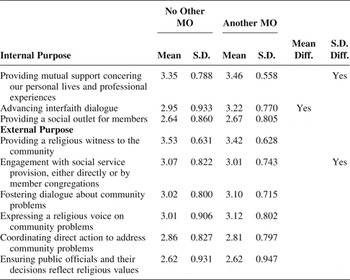
Do MOs compose their mix of internal and external purpose differently when a similar group inhabits their community? Table 1 explores the composition of organizational purpose in the face of such competition — it displays the means and standard deviations of the items that compose internal and external purpose scales for MOs with and without another MO locally. The items are sorted by their level of importance to respondents. Internally, professional support is an integral part of the mission of MOs, much more important than merely providing a social outlet. Among external purpose items, it is clear that MOs are not as concerned with the actions of government officials as they are providing religious witness to the community and direct social services, yet there is still considerable variance to study.
The Composition of Organizational Purpose in the Face of Competition

Source: 2006 Ministerial Organization Survey.
Note: All items are coded 1 = not at all important to 4 = very important. The difference in means is calculated via a t test (p < 0.10), while the difference in the variance is measured via an F test (p < 0.10).
We also assess the differences in the means and standard deviations between the MOs facing competition and not (see the last two columns of Table 1). There are very few differences between populations under these two conditions. When there is another MO locally, the respondent MO places greater importance on interfaith dialogue and there is less variance in “providing mutual support” and “social service provision” (although there is no difference in the mean level of importance granted those programs).
It may not be surprising that internal and external missions are not different on average because resource partitioning may occur in various combinations. Thus, to assess if the mix of organizational purpose shifts under competition, we compared the correlation between internal and external purpose when another MO is present and not. Without competition, the two scales are strongly correlated (r = 0.345, p = 0.000), suggesting that MOs without competition are omnibus organizations fulfilling a multitude of missions in the community. When there is another MO locally, however, the two become unhitched; the correlation is in the same direction, but is far from significant (r = 0.085, p = 0.485). That is, when faced with competition, MOs develop a niche as represented by the variable combination of internal and external purposes composing their organizational mission. A first pass suggests, therefore, that a group's political agenda may be affected by competition, but it appears to shift in unpredictable ways.
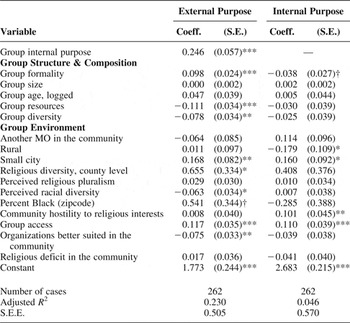
Logically, the next question is how do these internal and external factors combine to affect group mission? In Table 2, we take a more systematic look at how each component of group purpose is shaped, presenting separate models of indices of external and internal purpose. To compose the dependent variables, the items listed in Table 1 under internal and external purpose were separately averaged, producing alphas of 0.824 for the external purpose scale and 0.541 for the internal purpose scale. The determinants of external and internal purpose are separated into measures of the community environment, group composition, and group structure.Footnote 5
Factors Affecting the MO's External and Internal Purpose (OLS Regression Estimates)

Source: 2006 Ministerial Organization Survey. ***p < 0.01, **p < 0.05, *p < 0.10 (two-tailed test), †p < 0.10 (one-tailed test). See Appendix for variable coding.
The degree to which the group has an external purpose is derived from both internal and external sources.Footnote 6 Groups that are more formally organized direct their energies outward and have a weaker pursuit of internal matters. This result is surely the long-run effect of pursuing a public purpose — orderly meetings accomplish more — which makes pursuing an internal purpose as we have measured it that much more difficult. Indeed, it would be surprising to find an organization using Robert's rules to conduct a support group. The results also suggest that groups with resource deficits (in terms of limited time and funds) and substantial internal diversity are less likely to pursue an external mission. At the same time, a lack of resources and diversity do not boost an internal purpose, the default purpose of MOs that should be independent of resources and political differences.
The perceived religious diversity of the community does not encourage MOs to engage in public action through an elevated external purpose. Instead, religious pluralism at the county level encourages an external mission. The mismatch of the supply of potential members and the level at which the group would engage in advocacy is critically important to understand the typically weak public presence of MOs. Significant government action (the interest), better captured at the county level, does not coincide well with the natural, smaller constituency of the average MO, thus inhibiting a clear motivation to engage.
Both the internal and external purposes of MOs are subject to the size and type of community. We tried a wide variety of specifications and alighted on “small cities” (population between 15,000 and 50,000) and rural areas. MOs in big cities, suburban areas, and small towns had indistinguishable levels of external and internal purposes (results not shown). Rural areas are small enough that member clergy know each other from other settings, suggesting why their internal purpose score is lower. MOs in small cities are just large enough so that MOs fulfill a crucial social function and surely provide professional contacts in lieu of a cluster of same-denomination clergy who would be present in a larger metropolitan area. Hence, MOs in small cities have higher internal purpose scores. But, they also have higher external purpose scores, likely reflecting the coincidence of the clergy's jurisdiction with the local government. Moreover, if “local politics is groupless politics” (Peterson Reference Peterson1981, 116), then the few groups that do form can have a disproportionate impact.
The insignificant results point toward competition from another MO also driving down an external purpose, but driving up internal dialogue, ratifying the result above that competition results in a variety of combinations of group purpose. When the community is perceived to be hostile to religious interests, MOs are not more or less likely to pursue an external purpose. Instead, they are more likely to find internal dialogue and member-support activities important. That is, the very conditions that would call for an external mission from MOs instead boost self-reflection. Of course, a host of features about a group must change if the group is to effectively minister to its members, such as devoting time to it and reorienting the structure of meetings, which influence the group's ability to affect an external purpose.
Where MOs have greater access to public officials, both external and internal purposes increase (of course, greater access is negatively related to community hostility). Thus, MOs hold their ground but do not increase their activity in communities where a religious voice may be most needed. Instead, they augment their activity in response to friendly invitations. Moreover, where there are groups the MO thinks are better able to handle social service delivery, external purpose shrinks.
At the same time, a strong internal purpose has a significant and positive effect on having an external purpose. This result would not be surprising among large interest groups governed by the provision of selective benefits. Here, however, the kinds of group structures that best promote one purpose are at odds with pursuing the other since the results of these two models suggest that different factors affect the importance of internal and external purposes. Thus, many groups will live in tension, although clearly some groups find a way to be all things to their members.
The evidence about the environmental effects on pluralism is mixed. Since MOs stand their ground in the face of opposition, we might conclude that they are immune to pressure, contribute to pluralism, and exercise a prophetic voice. At the same time, MOs boost their attention to internal matters when there is opposition in the community, reduce their external mission when there is sufficient organization in the community to address its problems, and boost their external purpose when their contributions are welcomed. None of these relationships is a hallmark of the prophet.
COALITIONS AS FORAGING BEHAVIOR
Like any other group confronting a public mission, MOs need to decide if it is beneficial to work with other groups and with which groups to work. The decision may not be an easy one, as it is accompanied by real risks and benefits (Hula Reference Hula, Cigler and Loomis1995), although the risks are theoretical ones in the literature, posited as threats to a distinct reputation. Salisbury et al. (Reference Salisbury, Heinz, Laumann and Nelson1987) find that coalitions form along the same ideological lines as isomorphic groups, a pattern which varies a bit by policy area. Hula (Reference Hula, Cigler and Loomis1995) argues that coalitions are expressions of self-interest by groups, where groups receive information, marginal benefit gains, and the symbolic benefits of perceived activity (Hertzke Reference Hertzke1988; Hofrenning Reference Hofrenning1995), even if their participation level within the coalition may be in fact marginal. Further, the extent and intensity in coalition participation has been found to vary across policy issues and organizational types (Gray and Lowery Reference Gray and Lowery1998; Hojnacki Reference Hojnacki1997; Salisbury et al. Reference Salisbury, Heinz, Laumann and Nelson1987). No study thus far, however, has investigated whether competitive pressures affect both whether a group has a public purpose and the form in which it is carried out.
The root of our approach is in the perspective advanced first by Browne (Reference Browne1990), who finds that the clientele of an organization shapes the extent to which it addresses comprehensive issues, participates in public debate, and engages with other actors combatively or in coalition. Following Browne, the most unified perspective is again advanced by Gray and Lowery (Reference Gray and Lowery1998), who provide an inventive application of social foraging to lobbying coalitions. Because collective foraging is risky, a variety of environmental pressures shape whether animals hunt alone or in flocks. Hunting in concert may heighten the probability of success, but will diminish the marginal distribution of the kill, and attract the attentions of predators. Animals face competition from others of their species, predation, variable access to food, and territory that is more or less defendable. Thus, the environmental pressures on resources, competition, and predation alter the balance of risks and benefits to collective foraging.
A loose translation of these notions to organizations is possible and will help us understand patterns of MO collaboration in public matters. Our operationalization of collective foraging might be best described as alliance behavior — MO collaboration with other groups in the community to pursue some form of public purpose. Since, all things equal, “… coalition size and diversity increase the likelihood of eventual policy success” (Hula Reference Hula, Cigler and Loomis1995, 251; Heinz et al. Reference Heinz, Laumann, Nelson and Salisbury1993), we examine two dependent variables: the number of groups MOs worked with and the diversity of their coalition.
To gauge the size of an MO's coalition, we provided respondents with a list of 16 types of groups with which they might have worked in the past year (see the Appendix for the list). It is common for MOs to work with other groups because only 10 percent suggested they collaborated with no other groups in the past year and the mean is 4.3 groups. Not surprisingly, the most commonly reported collaboration was with social service providers and school officials, both of whom garnered mention by over 70 percent of respondent MOs. What follows is a reporting of the dominant institutions of community life, including city government, the police, groups involved with the homeless, the Chamber, and local business. It was far less common for MOs to collaborate with groups engaged in culture wars (“Christian Right groups” and abortion), political parties, or unions and environmentalists (all less than 20 percent).
The diversity of the groups with which MOs collaborated may also be an important marker of the environmental pressures that groups experience. The interest group literature has not explored in depth a diversity angle to foraging, perhaps because “inter-species cooperation” is an unlikely parallel and defining group types is quite difficult when groups lobby for often a wide variety of issues (Salisbury et al. Reference Salisbury, Heinz, Laumann and Nelson1987). Diversity is not the same as the number of groups with which collaboration was established (though these measures are highly correlated in our study), the intensity of alliance behavior, or the simple frequency of working with other groups as Gray and Lowery (Reference Gray and Lowery1998) investigated.
Instead, the diversity of a coalition, for lobbying or any other public mission, would seem to be a crucial component of a winning coalition and signal the breadth of a group's concern. This is the impetus behind Schattschneider's (Reference Schattschneider1960) rule that a losing side attempts to expand the scope of conflict. A diverse coalition may also be related to the intensity of the drive to pursue a public mission or may simply show the organizational distance traveled in search of a viable niche. Essentially, some measure of coalition diversity is particularly useful in gaining an understanding of a group's place in public life and the prospects for a pluralistic democracy (Salisbury et al. Reference Salisbury, Heinz, Laumann and Nelson1987).
To create a diversity measure, we first submitted the 16 group types listed to a factor analysis, from which six categories emerged (see the Appendix). From this, we created an additive index with one point given for working with a group in each category. Our general expectation is that the number of groups with which MOs worked and the diversity of the coalition are two separate dimensions. We expect that the size of the collaborative alliance is set by the degree to which MOs have an “external purpose” — a public mission. The diversity of the groups with which they work, however, is shaped more by environmental pressures — competition, predation, food access, and territory. Our specific expectations for each dimension are spelled out below.
Competition
Competition is readily located in the presence of another MO in the community, though we also asked respondents if they coordinated activities with the other MO and if they competed with the other MO for resources. However, niche theory provides a counter-intuitive notion of how this operates — Hannan and Carroll (Reference Hannan and Carroll1992) suggest that the absence of conflict or cooperation may suggest that competition is fierce. We suspect that the mere presence of another MO may not affect the size of the coalition, but explicit indications of competition or cooperation with another MO will drive groups to create a more diverse coalition (Hojnacki Reference Hojnacki1997).
Predation
Predation is an odd notion to apply to groups, but perhaps opposition is an acceptable substitute. It is also perhaps strange to think of opposition to ecumenical collections of clergy, especially in small communities that may not be terribly diverse. Nevertheless, it is a sentiment expressed by a not insignificant number of MOs. We asked MOs if there was, “Community opposition to a public airing of views from the faith community.” 60 percent of respondents disagreed or strongly disagreed with the statement, 15 percent agreed or strongly agreed, and the remainders were neutral. We also envision a soft opposition in play when there are organizations seen as better equipped to confront community problems than a MO. A third of respondents agreed or strongly agreed that “there are other social service agencies in the area better suited to deal with most issues.” Taken together, opposition should drive down the number of collaborative opportunities MOs encounter or pursue. Opposition should also make collaboration more diverse as any effort to pursue common goals successfully would need coalition partners with more experience and legitimacy.
Access
A basic notion in foraging theory is that the more dangerous and inaccessible the prey, the larger the hunting party (Gray and Lowery Reference Gray and Lowery1998, 8–9). Applied to groups, a larger coalition is needed to achieve success when faced with a difficult public goal. We gauge “difficulty” through perceptions of access to public officials — if public officials seek out their views, listen to their views, are influenced by their views, allow access, and are difficult to share the MO's views with (among a few others). When submitted to a factor analysis, these questions loaded onto two factors, one of which we labeled “group access” and the other “religious interest deficit” (see the Appendix for further discussion). Group access captures the external efficacy of sharing the MO's views, while religious interest deficit captures the group environment in which the MO might take action. While greater access should reduce coalition size, access also suggests the legitimacy of the group, which should attract alliance invitations. Similarly, a deficit of religious voices in the community suggests religious groups exhibit a degree of weakness and should boost coalition size.
Securing resources should be easier when there are many options. In the case of MOs, we would expect that urban environments simply offer more opportunities to exercise their mission to reform society and minister to its needs. But, larger urban areas also probably attract more group activity, which means a more difficult lobbying environment for religious groups. Therefore, paralleling the results in Table 2, we expect a larger coalition in small cities and a smaller one in rural areas.
Group Attributes
The choice to work with others will depend, as noted above, on the balance of risks and rewards perceived by the group. We include a selection of variables to tap the capacity of MOs to engage in the pursuit of a public mission. The primary notion is that those with a drive to pursue some public mission (an “external purpose”) are most likely to work with more groups, but probably have a more focused mission that would drive down diversity. We also expect that those with a strong internal purpose are also likely to work with a greater number and wider selection of groups since their public mission is likely to be reactive.
All of the MOs included in this article are small groups in the classic sense (Bales Reference Bales1950; Fine and Harrington Reference Fine and Harrington2004; Verba Reference Verba1961). More than a handful of members are necessary to pursue much of any public project, so group size should have a positive relationship with organizational collaboration. Larger groups and those with a more formal structure may have a defined mission, perhaps even by a constitution, so coalition diversity may be impeded.
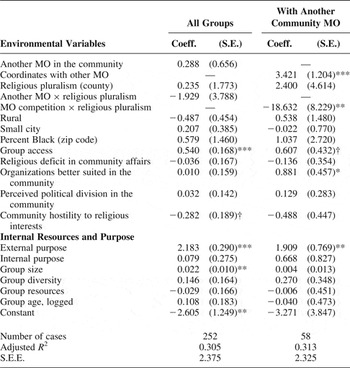
Coalition Size Results
Table 3 reports ordinary least square (OLS) regression estimates of the size of the coalition respondent MOs reported working with in the past year. We examined the effects of included variables among all MOs and then just among those reporting another MO exists in their community. We expect systematic differences to emerge, varying in particular around ecological pressures. When MOs face another of their species, they should become attuned to the diversity of interests in the community, particularly religious interests. Generally, we expect group-level variables (such as group size) to function similarly across models.
Factors Affecting the Number of Community Groups the MO Reported Collaborating With, Among All MOs and Just Those Reporting another MO in the Community (OLS Regression Estimates)

Source: 2006 Ministerial Organization Survey. ***p < 00.01, **p < 0.05, *p < 0.10, (two-tailed test), †p < 0.10 (one-tailed test). See Appendix for variable coding.
That expectation is born out in the results. Among all MOs, only two ecological variables are significant predictors of alliance size — group access and community hostility to religious voices. The greater access to government officials, the more groups the MO worked with. While we expected to see MOs collaborating with more groups when they sensed community hostility to religious interests (a prophetic stance), we find the opposite among all groups (the coefficient when another MO is present is in the right direction, but is far from significant). The decrease in alliance participation under such conditions may reflect intense competition for the smaller pool of resources available to MOs and greater attempts to define a niche. Alternately, the fact that we see few ecological factors influencing the number of groups with whom the MO forms partnerships with may suggest that they are impervious to community pressure to a degree. That is, MOs pursue their mission with other groups to the extent their own purpose divines. However, we have already seen that the environment helps to shape the contours of group mission (see Table 1), meaning that ecological pressures affect alliance behavior indirectly for those MOs not facing competition.
In the presence of another MO in the community, respondent MOs appear to be more responsive to ecological pressures. Access remains a significant predictor of more collaboration, while the presence of more expert, resourceful groups in the community drives up collaborative activity even as it serves to depress an external purpose (see Table 2). Only in the presence of competition do MOs make an extra effort to seek out resourceful partners to fulfill their public mission.
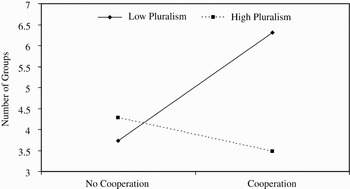
MO collaboration is environmentally-dependent in another way when facing another MO in the community. The interaction of coordination with the other MO and the religious diversity of the county (see Fig. 1) show that high religious pluralism suppresses the effect of organizational interaction.Footnote 7 Only in conditions of low pluralism does coordination have an effect, serving to enlarge alliance participation. Essentially, the more an interest exists in the community, the less need the group has to work hard to establish new ties. At the same time, less collaboration might be seen as evidence of more competition and the search for a defining niche (Gray and Lowery Reference Gray and Lowery1998; Hannan and Carroll Reference Hannan and Carroll1992). Put another way, it is easier for MOs to speak for the faith community in more homogeneous areas, especially when motivated to have an external purpose by the presence of an isomorphic group.
The interactive effect of religious pluralism and group cooperation on the number of groups the MO reported working with.

Looking inside MOs, greater external purpose predicts working with more groups in both models and a greater group size boosts collaboration among all groups. The fact that size, as a measure of strength, predicts greater collaboration contradicts expectations from the foraging literature, although the translation to organizational collaboration when the groups are small requires granting some latitude. Larger “small groups”Footnote 8 may be more attractive partners and have a greater capacity for action, both serving to drive up the size of their coalition.
Coalition Diversity Results
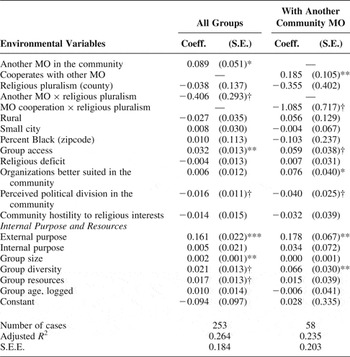
Because this measure of diversity gains one point for each group type with which the MO reported working, it is highly correlated with the sum of all groups dependent variable used above (r = 0.85). However, the results are somewhat different from those in Table 3, and, unlike the results in Table 3, the results of the environmental variables across the two models in Table 4 have relatively consistent and expected results. In both, the interaction of group presence (or coordination) and religious pluralism suggests a pattern closely resembling that shown in Figure 1. That is, presence/coordination pushes MO coalitions to be more diverse only when faced with less religious pluralism; otherwise presence/coordination has no net effect. When there is ample access to resources, the presence of another similar-type group poses less of a threat; when faced with scarcity, foraging behavior is likely to change and diversify.
Factors Affecting the Total Number of Group Types in the Coalition (“Diversity”) the MO Reported Collaborating With, Among All MOs and Just Those Reporting Another MO in the Community (OLS Regression Estimates)

Source: 2006 Ministerial Organization Survey. ***p < 0.01, **p < 0.05, *p < 0.10 (two-tailed test), †p < 0.10 (one-tailed test). See Appendix for variable coding.
Note: The results vary slightly when looking at groups without another group in the community: only the external purpose, group size, urban, and access are significant predictors.
Access to government officials encourages diversity in both models. The effect of political division of the community, as perceived by the respondent, has a consistent effect across the two models. A divisive political atmosphere appears to partition some combination of resources, access, or issues, such that the diversity of MO collaboration is negatively affected; this effect is similar to Salisbury et al.'s (Reference Salisbury, Heinz, Laumann and Nelson1987) findings about peak associations. Political division appears to act as a river dividing an eco-system, inhibiting diverse collaborations. As noted above, much of the collaboration patterns of MOs seem to avoid groups involved in hot political matters, so the effects of political division, while not overwhelming, are still unexpected. The only ecological variable that does differ in effect across models is the effect of the presence of expert, resourceful organizations, which drives up the diversity of collaboration when MOs face another MO in the community.
The effects of group descriptors are largely consistent across models (the standard errors are larger in the MO presence model, but the coefficients are not much different). A more encompassing external purpose enhances collaborative diversity, as do larger group size, higher group resources, and the diversity of the group, perhaps as signs that internal diversity encourages a diversity of mission.
CONCLUSION
In this account of the ecology of MO public presence, the main point is that we have learned more than we could have by focusing independently on either their interactions with government or their internal dynamics — typical, if receding-strategies in the interest group literature. Incorporating both their internal dimension and the environment in which they function has given us a more complete picture of their place in public affairs.
To the study of collaboration, we have added a measure of alliance diversity, which helps to tell a more complete story about organizations' public efforts. In part, the measure helps us understand how organizations respond to competition, in the face of which they increase the diversity of their coalition. As a complement to this story, we also found (results not shown) that MOs diversify the sources relied on to fund their budget when faced with competition. While diversification is dependent on the roots of competition (religious pluralism), it also serves to diffuse the working ties of MOs through the community. Perhaps this is why the external mission of MOs did not diminish when faced with competition or hostility — MOs simply intensify their efforts to sustain the group's mission by forging a wider network. At the same time, this likely means that they have to change the nature of their work to accommodate additional partners.
We have added at least two critical resources that found purchase in explaining several attributes of public presence. One is the internal cohesion of the group; the other is the public legitimacy of the group taking action (operationalized as community hostility to religious interests). Both have strong roots in the literature examining groups and should not be assumed away as is done in the state and national interest group literature (but see Rothenberg Reference Rothenberg1988).
Because MOs have considerable variance in their engagement with public affairs, we have come to a more nuanced understanding of the ecology of that engagement. While MOs may seem like a unique form of community group, we think they are not far from representative of a variety of “community peak associations” that gather professional representatives from a wide variety of interests to speak on community affairs and support themselves. At the very least, taking a step back from examining big, state, or nationally registered lists of lobbying groups can help to validate previous findings and push the literature forward.
We can now return to the question that initiated this research: are religious groups different? Contrary to the prophetic rhetoric that religious groups often employ (or at least encourage), MOs respond predictably to ecological pressures. They are more active in public where the community is inviting, where there are more religious interests to sustain membership, and where they have sole claim to be the religious voice of the community. To an extent, MOs are conflict-avoidant, but clearly pursue a public mission through collaborative efforts with a wide range of groups that is only diversified, if not augmented, by competition under scarcity.
The results, then, are largely in agreement with expectations from organizational ecology theory, suggesting that religious groups are not much different from secular interest groups in their reliance on resources and their response to environmental pressures. On the one hand, this suggests that we can use results from religious interest groups to evaluate theory concerning all interest groups. At the same time, these results are not particularly sanguine for the prophetic role of religion. Although there are ways to read the evidence in a slightly different way, we can tentatively conclude that American religion is not in full accord with its democratic role of challenging government to function according to a higher set of values.
APPENDIX: VARIABLE CODING
Dependent Variables
Group external purpose. Is an averaged index composed of variables coded 1= not at all important, 2 = not important, 3 = important, and 4 = very important, and introduced by: “Please tell us how important these activities are to the mission of your group.” The statements, listed in Table 1, include: ensuring public officials and their decisions reflect religious values; providing a religious witness to the community; Fostering dialogue about community problems; coordinating direct action to address community problems; engaging with social service provision, either directly or by member congregations; and expressing a religious voice on community problems.
Group internal purpose. Has the same foundation as external purpose, but is composed of: Advancing interfaith dialogue; Providing mutual support concerning our personal lives and professional experiences; Providing a social outlet for members.
Coalition size and diversity. Respondents were presented with a list of 16 group types and were asked with which they have had the occasion to work in the past year. When submitted to a factor analysis, the groups coalesced into the following six collections (with the proportion working with a group in each collection noted in parentheses: (1) Local businesses, Police/law enforcement, City/county elected officials, Chamber of Commerce, State/federal goverment officials, School officials, PTA/PTO (78.9 percent); (2) United Way and a Political party (16.7 percent); (3) Pro-choice/pro-life groups and Christian Right groups (18.9percent); (4) Homelessness groups and Social service providers (71.6 percent); (5) Labor unions and Environmental groups (10.2 percent); and (6) Community organizers (26.9 percent). The size measure sums reports of working with each of the 16 group types; the diversity measure sums entries from each of the 6 group collections.
Independent Variables
Note: The following four variables are factor analytic variables created when all constituent items were entered simultaneously. The specific items, all coded 1 = strongly disagree to 5 = strongly agree, are introduced with the instructions, “Please tell us whether you agree or disagree that your group generally faces these challenges to taking public action on issues.”
Group access. Public officials consider our views in their decision making; We have influence over the direction of public affairs when we express the views of the faith community; Public officials seek out our views on addressing social problems; We can gain access to public officials when we need to share our views or point out neglected problems.
Group diversity. The theological diversity within my group; The political diversity within my group; The diversity of interests within my group.
Group resources. Limited time of members to be active; Limited enthusiasm of members to be active; Difficulty of formulating views on and solutions to social problems; Limited funds to back an issue campaign; The complexity of social problems.
More capable organizations in the community. There are other social service agencies in the area better suited to deal with most issues; There are other organizations in the community that have greater political access.
Religious deficit. A factor analytic variable of the listed items (all coded 1 = strongly disagree to 5 = strongly agree) introduced by: “Please tell us your views on the effectiveness of sharing your views publicly — do you agree or disagree with the following statements?” We face competition for the attention of public officials; There is a deficit of religious voices in my community's affairs; It has gotten harder to share our views with public officials; Limited access to public officials.
Group size. “Approximately how many members does your group have?” Ranges from 1 to 100 with a mean of 16 and median of 10.
Group age. “When was your organization founded? (We are interested in the most recent founding of the group, in case it was dormant for a time” Ranges from 1 to 137 with a mean of 24 and median of 21. This value was logged.
Group formality. An index ranging from 0 to 5, gaining one point for having each of the following: meetings with a formal agenda, meetings following rules of order, an elected chair or president, a constitution, and elected officers.
Community hostility. “Please tell us whether you agree or disagree that your ministerial alliance faces these challenges to taking public action on issues…Community opposition to a public airing of views from the faith community.” 1 = strongly disagree to 5 = strongly agree.
Religious pluralism (county). A Herfindahl type index composed of the sum of the squared proportions of seven major religious traditions in the county population (mainline Protestant, evangelical Protestant, Catholic, Jewish, Orthodox, Muslim, and other) as reported by Jones et al. (Reference Jones, Doty, Grammich, Horsch, Houseal, Lynn, Marcum, Sanchagrin and Taylor2002).
Perceived religious pluralism. Think about the religious diversity of your community. Please assess your community on a scale from 1 to 5, where 1 signifies a community almost solely composed of one religious group and 5 signifies a community with many religious groups of roughly similar size.
Perceived racial diversity. Think about the racial diversity of your community. Please assess your community on a scale from 1 to 5, where 1 signifies a community almost solely composed of one racial group and 5 signifies a community with many racial groups of roughly similar size.
Perceived political division. Think about the political diversity of your community. Please assess your community on a scale from 1 to 5, where 1 signifies a community that identifies with one political party and 5 signifies a community evenly divided between the two parties.
Small city. “In what size community does your group operate?” 1 = “Small city/town (15,000 to 50,000 people),” 0 = any other selection.
Rural. “In what size community does your group operate?” 1 = “Rural or farm,” 0 = any other selection.
Percent Black. The percent of the zip code that is black in the Fall of 2002.
Another MO in the community. “Is there another ministerial association serving your community?” 1 = yes, 0 = no.
Coordinates with other MO. Respondents were first asked, “Is there another ministerial association serving your community?” Then, “If yes, does your group coordinate activities with the other group?” 1 = yes, 0 = no.