1. Introduction
Quantum plasmas have been intensively studied during the past two decades (Kremp et al. Reference Kremp, Bornath, Bonitz and Schlanges1999; Shokri & Rukhadze Reference Shokri and Rukhadze1999; Golubnychiy et al. Reference Golubnychiy, Bonitz, Kremp and Schlanges2001). Quantum effects in the electron component of plasmas become noticeable at low temperature. Hence, electrons are in the state of a degenerate electron gas. Between 1999 and 2006, a major interest of researchers was on the quantum Bohm potential (Kuz'menkov & Maksimov Reference Kuz'menkov and Maksimov1999; Haas, Manfredi & Feix Reference Haas, Manfredi and Feix2000; Anderson et al. Reference Anderson, Hall, Lisak and Marklund2002; Haas et al. Reference Haas, Garcia, Goedert and Manfredi2003; Haas Reference Haas2005). The quantum Bohm potential can be interpreted as the quantum part of the pressure appearing in addition to the Fermi pressure. The quantum Bohm potential increases the contribution of the Fermi pressure to the dispersion dependencies of waves. This increase becomes comparable with the Fermi pressure if the wavelength decreases to an average interparticle distance. Some of these effects have already been reviewed (Shukla & Eliasson Reference Shukla and Eliasson2010, Reference Shukla and Eliasson2011).
Spin dynamics of electrons provides diverse effects in quantum plasmas. A fundamental derivation of the quantum hydrodynamic equations for the spin-1/2 quantum plasmas was made in 2001 (Kuz'menkov, Maksimov & Fedoseev Reference Kuz'menkov, Maksimov and Fedoseev2001a,Reference Kuz'menkov, Maksimov and Fedoseevb). However, major interest in this field only began in 2007 (Andreev & Kuz'menkov Reference Andreev and Kuz'menkov2007; Brodin & Marklund Reference Brodin and Marklund2007; Marklund & Brodin Reference Marklund and Brodin2007; Andreev & Kuz'menkov Reference Andreev and Kuz'menkov2008; Mahajan & Asenjo Reference Mahajan and Asenjo2011; Koide Reference Koide2013; Uzdensky & Rightley Reference Uzdensky and Rightley2014). The spin of the electron leads to an additional hydrodynamic equation, which is called the spin density evolution equation. The quasi-classical part of the flux of the spin has been considered in all papers on spin quantum plasmas. The quantum part of the flux of the spin, which is the analogue of the quantum Bohm potential, has also been considered in some papers (see for instance Mahajan & Asenjo Reference Mahajan and Asenjo2011). However, the pressure-like part of the flux of spin, called the Fermi spin current or the thermal spin current, has not been considered in the majority of works in this field. Its explicit form has been considered in recent papers for degenerate electrons (Andreev Reference Andreev2016a, Reference Andreev2017a,Reference Andreevb; Andreev & Kuz'menkov Reference Andreev and Kuz'menkov2019).
The separate spin evolution quantum hydrodynamics, where electrons are considered as two different fluids, was developed in 2015 (Andreev Reference Andreev2015; Andreev & Kuz'menkov Reference Andreev and Kuz'menkov2015). This model shows that there is a spin-electron acoustic wave in the spin polarized electron gas (Andreev Reference Andreev2015; Andreev & Kuz'menkov Reference Andreev and Kuz'menkov2016a,Reference Andreev and Kuz'menkovb). Its existence is caused by the difference of pressures for the spin-up and spin-down electrons. The possibility of separation of electrons in two different fluids can be seen from the structure of the Pauli equation, where the evolution of electron with chosen spin projections is described by an independent equation. However, these two equations are traditionally combined into a single matrix equation. Moreover, the identification of each electron in plasmas to the state with fixed spin projection is not necessary. Each electron has a probability to belong to both subsystems simultaneously. The electrostatic limit of the separate spin evolution quantum hydrodynamics can be considered for the study of plasma waves, because the spin-electron acoustic waves are found in this regime (Andreev Reference Andreev2015; Andreev & Kuz'menkov Reference Andreev and Kuz'menkov2015, Reference Andreev and Kuz'menkov2016a,Reference Andreev and Kuz'menkovb). The Langmuir waves correspond to the simultaneous oscillations of all electrons. The spin-electron acoustic waves correspond to oscillations of spin-up and spin-down electrons with opposite phases.
There are examples of extended hydrodynamics (Tokatly & Pankratov Reference Tokatly and Pankratov1999, Reference Tokatly and Pankratov2000; Miller & Shumlak Reference Miller and Shumlak2016), where the equations for the evolution of the second-rank tensors (the momentum flux and the spin flux) are included. These cover some spin-related wave phenomena in quantum plasmas.
Here, it is demonstrated that the account of the higher-rank material field tensors like the momentum flux and the third-order tensor, which is the flux of the momentum flux, leads to a new source for the quantum effects in the quantum hydrodynamics of plasmas. This is true for the spin-less regime because it appears as the quantum part of the Coulomb interaction. This new source also contributes to the spin-electron acoustic waves.
Obviously, a similar generalization can be made for the spin–spin interaction. Moreover, the third-rank tensor, which is the flux of the spin-current, evolution equation can also be considered for a complete model of spin effects. These generalizations are left for future papers.
This paper is organized as follows. In § 2, some fundamental definitions are introduced. Final equations for the suggested model are presented in § 2. In § 3, dispersion dependencies are derived and analysed. In § 4, a brief summary of the obtained results is presented.
2. Electrostatic limit of the extended separate spin evolution hydrodynamics
Here, the extended quantum hydrodynamics is presented, which demonstrates a novel source of quantum effects generalizing the quantum Bohm potential contribution.
The first equation of all sets of hydrodynamic equations is the continuity equation demonstrating the conservation of the number of particles:

where the subindex $s$ corresponds to the projection of spin of the electron, $s=u$
 corresponds to the spin-up electrons and $s=d$
 corresponds to the spin-down electrons.
Electrons are spin-1/2 fermions. They have two projections of spin. Electrons with different spin projections can be considered as two different fluids. The quantum hydrodynamic equations presented here give a generalization of the separate spin evolution quantum hydrodynamic model. However, the electrostatic approximation is considered here. Hence, no spin flip is presented in the continuity equation and the other hydrodynamic equations below. Equation (2.1) shows the conservation of the number of electrons with a fixed spin projection. Change of spin projections of the electrons is not considered in this model. However, some spin effects come into play owing to the relative motion of electrons with different spin projections.
The velocity field $\boldsymbol {v}_{s}$ presented in the continuity equation obeys the Euler equation:

The Greek indexes $\alpha$ , $\beta$
 , etc. are the tensor indexes. Einstein's rule is used for the summation of the repeating Greek indexes.
Equations (2.1) and (2.2) are the fundamental hydrodynamic equations. They are well known in classic hydrodynamics (Aleksandrov, Bogdankevich & Rukhadze Reference Aleksandrov, Bogdankevich and Rukhadze1984; Tokatly & Pankratov Reference Tokatly and Pankratov2000; Miller & Shumlak Reference Miller and Shumlak2016). Their quantum analogues are well known in quantum hydrodynamics (Haas et al. Reference Haas, Manfredi and Feix2000; Shukla & Eliasson Reference Shukla and Eliasson2010, Reference Shukla and Eliasson2011).
The electrostatic potential $\varPhi$ on the right-hand side of (2.2) has the following explicit form:

Quasi-electrostatic potential $\varPhi (\boldsymbol {r},t)$ (2.3) obeys the Poisson equation:

where $n_{0i}$ is the equilibrium concentration of ions.
The left-hand side of the Euler equation contains the tensor associated with the quantum Bohm potential $T_{s}^{\alpha \beta }$ . The non-interacting part of the quantum Bohm potential is given by

The partial pressure $p_{s}^{\alpha \beta }$ is an independent function. Therefore, an equation for pressure evolution is derived:

Purely quantum terms like $T_{s}^{\alpha \beta }$ and the third-rank quantum Bohm potential tensor $T_{s}^{\alpha \beta \gamma }$
 cancel each other in (2.6). The pressure evolution equation has been considered in classical plasmas (Tokatly & Pankratov Reference Tokatly and Pankratov1999, Reference Tokatly and Pankratov2000; Miller & Shumlak Reference Miller and Shumlak2016).
The pressure evolution equation (2.6) obviously contains an independent function $Q_{s}^{\alpha \beta \gamma }$ , which is the third-rank tensor. Next, the evolution equation for this third-rank tensor is derived:

The complete expression for this equation is presented and discussed in the supplementary material available at https://doi.org/10.1017/S002237782100101X before truncation is made.
The derivation of (2.1)–(2.7) is made within the many-particle quantum hydrodynamic method (Kuz'menkov & Maksimov Reference Kuz'menkov and Maksimov1999; Kuz'menkov et al. Reference Kuz'menkov, Maksimov and Fedoseev2001a; Andreev Reference Andreev2016a; Andreev & Kuz'menkov Reference Andreev and Kuz'menkov2019; Andreev Reference Andreev2021). It means that the microscopic quantum dynamics of many quantum objects is represented in terms of collective variables. Moreover, these collective variables are quantum observable, which have a clear physical meaning.
Equations (2.1)–(2.7) give the generalization of the separate spin evolution quantum hydrodynamics (Andreev Reference Andreev2015) considered in the quasi-electrostatic regime. This generalization is in the presence of the pressure evolution equation and the third-rank tensor evolution equation. Below, it is shown that the pressure evolution equation gives the increase of the speed of sound for the spin-electron acoustic waves in the long-wavelength limit. The speed of sound increases by approximately 1.5 times. The further application of the third-rank tensor evolution equation gives the contribution in the short-wavelength limit, where a decrease of frequency is found. Moreover, the third-rank tensor evolution equation contains a novel quantum term which is proportional to the third derivative of the scalar potential of the electric field.
Equation (2.7) contains some independent functions. Derivation of (2.7) is motivated by an attempt to find new quantum effects, which are presented mainly by the first term on the right-hand side of (2.7). This term is proportional to $\hbar ^{2}$ , while other terms are proportional to $\hbar ^{4}$
 . However, terms proportional to $\hbar ^{4}$
 can be crucial in the regime of the separate spin evolution as is demonstrated below. It is expected that further derivation of hydrodynamic equations for the higher-rank tensors will give small corrections which are proportional to $\hbar ^{4}$
 and $\hbar ^{6}$
 . For instance, the derivation shows that the evolution equation for the fifth-rank tensor contains the interaction term proportional to $\hbar ^{4}\partial ^{\alpha }\partial ^{\beta }\partial ^{\gamma }\partial ^{\delta }\partial ^{\mu }\varPhi _{e}$
 . Therefore, the truncation is made in the third-rank tensor evolution equation. To get a closed set of hydrodynamic equations, we need to present all functions via the basic hydrodynamic functions of our model: the concentration, the velocity field, the pressure and the pressure flux third-rank tensor. The equation of state for $P_{s}^{\alpha \beta \gamma \delta }$
 is derived. For the zero temperature Fermi distribution function, it has the following form:

where

Derivation of this equation is given in the Supplementary material.
The application of equation of state for the pressure perturbations in the Euler equation gives a shift of the speed of sound. Similarly, the application of expression (2.8) for the perturbations of $P_{s}^{\alpha \beta \gamma \delta }$ allows us to make an estimation of the corresponding effects, but it does not give a correct coefficient.
Manfredi (Reference Manfredi2005) included the physically clear idea that the expression for pressure should not always coincide with the Fermi pressure. The Fermi pressure provides the results found for the equilibrium regime. Hence, if one considers the wave propagation, the pressure perturbations can be described by an equation different from that for the Fermi pressure. Equation (4.36) in Manfredi (Reference Manfredi2005) (see also discussion after (5.12)) shows that the equation is equal to that for the Fermi pressure in the equilibrium limit and gives the correct coefficient in front of the Fermi velocity in the spectrum of the Langmuir wave. However, it is a phenomenological formula. Tokatly & Pankratov (Reference Tokatly and Pankratov1999) and Tokatly & Pankratov (Reference Tokatly and Pankratov2000) demonstrated that the correct expression for the perturbations of the pressure can be found from the hydrodynamics itself. However, this requires the pressure evolution equation.
3. Collective excitations
The analysis of collective excitations is presented in a set of five subsections. However, they can be split into two groups. §§ 3.1–3.4 are dedicated to the instabilities that appear arising from the dynamics of the third-rank tensor and some generalizations of the model. The second group is presented in § 3.5, which shows the stabilization of the spectrum that accounts for the motion of ions.
Let us point out some more details on the physical motivation of the structure of the paper. The first part is focused on the description of the perturbation of electrons as the high-frequency excitations, so the motion of ions is neglected. Usually it works well because the mass of ions is three–four orders larger than the mass of the electron. However, the presence of quantum effects introduces a small-scale component in the electron dynamics. So, a part of quantum dynamical properties of electrons appears in the low-frequency regime. Therefore, the neglect of ion motion is inappropriate. Nevertheless, the formal application of the limit of motionless ions is made in §§ 3.1 and 3.2 to understand the consequences of this approximation within the presented model. However, the complete physical picture is given in § 3.3, where the motion of ions is included. So, no unexpected and unphysical instability exist.
3.1. Collective excitation in the electron gas described as a single fluid
Consider the propagation of plane longitudinal waves in an isotropic macroscopically motionless electron–ion plasma medium.
The equilibrium concentration of electrons $n_{0e}$ is equal to the equilibrium concentration of ions $n_{0i}$
 . The ions are assumed to be motionless for the consideration of the high-frequency excitations. The equilibrium velocity field are equal to zero $\boldsymbol {v}_{0e}=0$
 . The equilibrium pressure $p_{0e}^{\alpha \beta }$
 is given by the isotropic Fermi pressure $p_{0e}^{\alpha \beta }=\delta ^{\alpha \beta }\cdot p_{\textrm {Fe}}$
 , where $p_{\textrm {Fe}}=(3{\rm \pi} ^{2})^{2/3}n_{0e}^{5/3}\hbar ^{2}/5m_{e}$
 , $p_{0e}^{\alpha \beta }=p_{0u}^{\alpha \beta }+p_{0d}^{\alpha \beta }$
 is the superposition of partial pressures. The equilibrium third-rank tensor is equal to zero for the zero temperature isotropic fermions $Q_{0e}^{\alpha \beta \gamma }=0$
 (see Supplementary material). The equilibrium fourth-rank tensor is expressed via the equilibrium concentration in accordance with the expression (2.8):

The scalar potential of the electric field is equal to zero in the equilibrium state $\varPhi _{0}=0$ .
Let us consider the small amplitude perturbations of all material fields involved in the presented model for perturbations propagating parallel to $x$ -direction: $n_{e}=n_{0e}+ \tilde {n}_{e}$
 , $v_{e}^{x}=0+ \tilde {v}_{e}^{x}$
 , $\delta p_{e}^{\alpha \beta }=p_{0e}^{\alpha \beta } +\delta ^{x\alpha }\delta ^{x\beta } \tilde {p}_{e}^{xx}$
 , $Q_{e}^{\alpha \beta \gamma }=0+\delta ^{x\alpha }\delta ^{x\beta }\delta ^{x\gamma } \tilde {Q}_{e}^{xxx}$
 , $P_{e}^{\alpha \beta \gamma \delta }=P_{0e}^{\alpha \beta \gamma \delta }+\delta ^{x\alpha }\delta ^{x\beta }\delta ^{x\gamma }\delta ^{x\delta } \tilde {P}_{e}^{xxxx}$
 and $\varPhi =0+\tilde {\varPhi }$
 , where

with the Fermi velocity $v_{\textrm {Fe}}=(3{\rm \pi} ^{2}n_{0e})^{1/3}\hbar /m_{e}$ and $I_{0}^{xxxx}=3$
 .
Perturbation of each function is presented in the form of a plane wave:

The described procedure leads to the standard form of the linearized continuity equation:

The linearized Euler equation has one modification. The single element of the pressure tensor $\tilde {p}_{e}^{xx}$ is presented as the independent function:

The perturbation of the pressure $\tilde {p}_{e}^{xx}$ can be found from the linearized pressure evolution equation:

The first term on the right-hand side of the pressure evolution equation (3.6) provides the partial expression for the pressure perturbation in accordance with the kinetic model (Landau & Lifshitz Reference Landau and Lifshitz1980; Aleksandrov et al. Reference Aleksandrov, Bogdankevich and Rukhadze1984; Andreev Reference Andreev2016a):

Novel quantum effects enter the model via the second term on the right-hand side of (3.6).
The linearized equation for the third-rank tensor evolution has the following form:

The presented model contains the traditional form of the linearized Poisson equation:

Linearized equations (3.4)–(3.8) lead to the following dispersion equation, which is the quadratic equation relative to $\omega ^{2}$ :

where $\omega _{\textrm {Le}}^{2}=4{\rm \pi} e^{2}n_{0e}/m_{e}$ is the Langmuir frequency. The explicit form of the last term in (3.10) can be found from (3.2). However, it is kept in implicit form to track its source. The last group of terms is caused by the simultaneous contribution of the pressure evolution equation and the third-rank tensor evolution equations. This group consists of two terms. The first term is caused by the Coulomb interaction located on the right-hand side of the third-rank tensor evolution equation (2.7). The second term, which is proportional to $P_{0}^{xxxx}$
 , is caused by the last term on the left-hand side of (2.7).
It is useful to specify that the regime of electrostatic waves propagating parallel to the external magnetic field is considered. However, the quantum effects entering the model via the evolution of the third-rank tensor give an additional solution.
Here, the solution of (3.10) is presented as

Solution $\omega _{-}^{2}$ can be rewritten in the following form:

Equation (3.12) shows that $\omega _{-}^{2}<0$ . This can be also seen from (3.11).
It is clear that the second solution exists in the quasi-classical limit. However, it is suppressed by the small thermal velocity $d P_{0}^{xxxx}/d n_{0}\sim v_{T}^{4}$ in the low-temperature limit. In the quantum regime with temperature $T$
 below the Fermi temperature $T_{\textrm {Fe}}=mv_{\textrm {Fe}}^{2}/2$
 , the quasi-classical contribution is also suppressed because it is proportional to the high degree of the Planck constant $\hbar ^{4}$
 . However, the quantum-interaction part demonstrated in this paper is proportional to the $\hbar ^{2}$
 and the large frequency value $\omega _{\textrm {Le}}^{2}$
 . Therefore, the existence of a solution is mainly caused by the first term on the right-hand side of (3.12) found from the right-hand side of (2.7).
The prefactor in front of the quantum Bohm potential can differ from the single-particle expression (Moldabekov, Bonitz & Ramazanov Reference Moldabekov, Bonitz and Ramazanov2018), while the linear part of the quantum Bohm potential can be strictly expressed via the concentration for the arbitrary many-particle wave function and arbitrary strength of interaction. However, the account of the evolution equations for the higher tensor rank like the pressure and the pressure flux leads to modification of the coefficient in front of the Fermi velocity. Moreover, further extension of the set of hydrodynamic equations can give correction of the prefactor in front of the quantum Bohm potential. However, it requires the derivation of the corresponding model beyond 20-moments approximation. Some phenomenological model for the coefficient in front of the quantum Bohm potential can be adopted. However, our comment is related to the systematic and consistent derivation of the coefficient in question in terms of the quantum hydrodynamic method.
Let us consider the small wave vector limit of the obtained solution:

and

where $r_{DF}=v_{\textrm {Fe}}/\omega _{\textrm {Le}}$ is the Debye radius for the degenerate electrons.
Let us present the dimensionless form of (3.10):

where $\xi =\omega /\omega _{\textrm {Le}}$ , $\kappa =kv_{\textrm {Fe}}/\omega _{\textrm {Le}}$
 and $\varLambda =\hbar ^{2}\omega _{\textrm {Le}}^{2}/(4m^{2}v_{\textrm {Fe}}^{4})=[3{\rm \pi} (3{\rm \pi} ^{2})^{1/3}]^{-1}/(r_{B}n_{0}^{1/3})$
 , where $r_{B}=\hbar ^{2}/me^{2}$
 is the Bohr radius. Figure 1 shows two wave solutions in accordance with (3.11)–(3.14). The short-wavelength decrease of the frequency of the Langmuir wave caused by the non-zero contribution of the third-rank tensor can be seen from a comparison of the two upper lines. The increment of the instability presented by the second wave solution (3.12) is also demonstrated in figure 1. It appears in the short-wavelength regime. Its stabilization can be expected under the influence of tensors of higher ranks.
The novel quantum effects presented by the third-rank tensor evolution manifest themselves at $\kappa \sim 1$ , which corresponds to the wavelength $\lambda =2{\rm \pi} /k=\sqrt {{\rm \pi} }(3{\rm \pi} ^{2})^{1/3}\sqrt {ar_{D}}$
 , where the average interparticle distance is used $a=\sqrt [3]{n_{0}}$
 . As an estimation, we have $\lambda \approx 6\times 10^{-8}$
 cm$\approx a\approx r_{D}$
 for $n_{0}=10^{23}$
 cm$^{-3}$
 , which corresponds to the limits of the quasi-classical motion.
3.2. Spin-electron acoustic waves
Consider the propagation of plane longitudinal waves in the direction of the external magnetic field. The external magnetic field is one of the mechanisms of the spin polarization formation. Magnetic conductive materials create a spontaneous spin polarization of the lattice and the electron gas. For these materials, spin polarization of electrons is non-zero even for the zero external magnetic field. The $z$ -axis is directed parallel to the equilibrium spin polarization $S_{0z}=n_{0\uparrow }-n_{0\downarrow }$
 .
The structure of the equilibrium state and the form of the perturbations are similar to those described above for the single-fluid regime. Evolution of perturbations leads to the following dispersion equation:

where $\omega _{Ls}^{2}=4{\rm \pi} e^{2}n_{0s}/m$ is the partial Langmuir frequency.
The dispersion equation (3.16) is obtained for the regime, where two waves (the Langmuir wave and the spin-electron acoustic wave Andreev Reference Andreev2015) exist in the traditional separate-spin-evolution quantum hydrodynamics construct of two continuity equations and two Euler equations (Andreev Reference Andreev2015). Here, four waves are found. Hence, there are two new solutions. One of them is found in the single-fluid regime (3.14). Therefore, the regime of the separate spin evolution brings the novel solution.
If the contribution of the third-rank tensor is dropped, (3.16) simplifies to

Equation (3.17) includes the contribution of the pressure perturbations from the pressure evolution equation. Therefore, the speed of sound for the spin-electron acoustic waves corresponds to the kinetic model (Andreev Reference Andreev2016a) in contrast with hydrodynamics based on the continuity and Euler equations (Andreev Reference Andreev2015).
Let us present the dimensionless form of (3.16) as

where $\eta =\mid n_{\uparrow }-n_{\downarrow }\mid /(n_{\uparrow }+n_{\downarrow })$ is the spin polarization. It is used to plot the spectrum. The result is demonstrated in figures 2 and 3. The spin polarization $\eta$
 is caused by the magnetic field $\eta =\tanh (\mu _{B}B_{0}/\varepsilon _{\textrm {Fe}})$
 , where $\mu _{B}$
 is the Bohr magneton, $B_{0}$
 is the external uniform magnetic field and $\varepsilon _{\textrm {Fe}}=mv_{\textrm {Fe}}^{2}/2$
 is the Fermi energy. However, ferromagnetic metals demonstrate spin polarization. In the simplest way, it can be modelled as the result of action of the effective inner magnetic field $B_{\textrm {eff}}$
 . Hence, we have $\eta =\tanh (\mu _{B}(B_{0}+B_{\textrm {eff}})/\varepsilon _{\textrm {Fe}})$
 . Let us mention that the account of the internal field is a simple phenomenological assumption showing the influence of the ferromagnetic state of the sample on the conductivity electrons.
Numerical analysis of (3.11), (3.10) and (3.15) is presented. The three upper lines show the spectrum of the Langmuir wave in different regimes. The black continuous line corresponds to the hydrodynamic spectrum based on the continuity and Euler equations together with the Fermi pressure: $\omega ^{2}=\omega _{\textrm {Le}}^{2}+(v_{\textrm {Fe}}^{2}k^{2})/3+{\hbar ^{2}k^{4}}/{4m^{2}}$ . The red dotted line corresponds to the application of the pressure evolution equation with the zero contribution of the third-rank tensor. The green dashed line presents the spectrum of the Langmuir wave under influence of the third-rank tensor evolution equation. The lowest line describes the module of the negative frequency square $\mid \omega ^{2}\mid$
 of novel solution caused by the third-rank tensor evolution equation in accordance with (3.14). The value of parameter $\varLambda$
 is presented in the figure. It corresponds to $n_{0}=10^{23}$
 cm$^{-3}$
 .

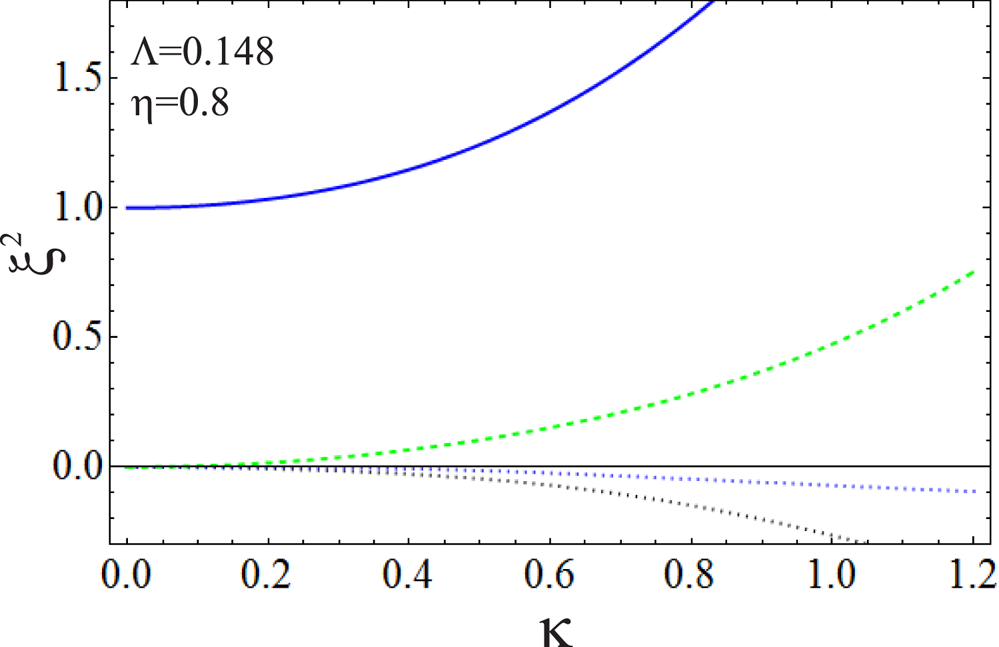
Numerical analysis of (3.16) and (3.18). The blue continuous line shows the spectrum of the Langmuir wave. The green dashed line shows the spectrum of the spin-electron acoustic wave. The blue and black dotted lines correspond to the instabilities following from the application of the pressure evolution equation and the third-rank tensor evolution equation, respectively.

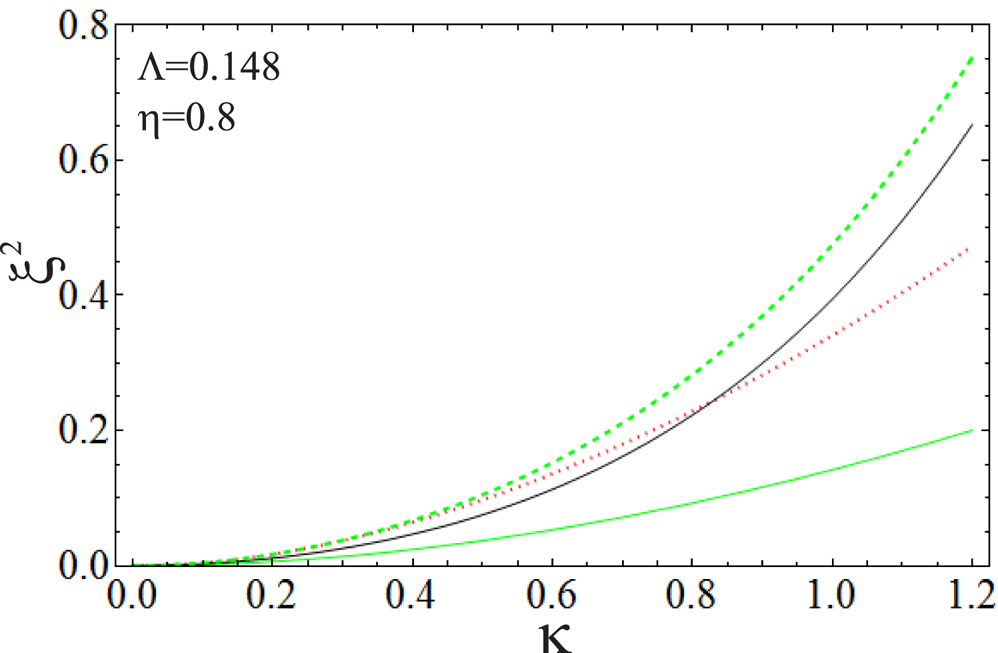
Numerical analysis of (3.16) and (3.18). The spin-electron acoustic waves are considered in different regimes. The green continuous line corresponds to the hydrodynamic spectrum based on the continuity and Euler equations together with the Fermi pressure, where coefficient $1/3$ is found in front of the square of the Fermi velocity $v_{\textrm {Fe}}^{2}$
 . The other three regimes correspond to the application of the pressure evolution equation. Hence, coefficient $3/5$
 is found in front of the square of the Fermi velocity $v_{\textrm {Fe}}^{2}$
 . The red dotted line corresponds to the spectrum of spin-electron acoustic waves under influence of the third-rank tensor evolution equation at the zero contribution of the quantum Bohm potential. The black continuous line includes the contribution of the quantum Bohm potential with zero contribution of the third-rank tensor. The green dashed line presents the spectrum under the influence of all effects presented in (3.16).

The separate spin evolution leads to the appearance of the second electrostatic wave (for the motionless ions) (Andreev Reference Andreev2015). Moreover, (3.16) shows that the instability found in the single-fluid regime of electrons (3.11) splits into two instabilities. Frequency of these instabilities are shown in figure 2.
Modifications of the spectrum of the spin-electron acoustic waves under influence of different effects are demonstrated in figure 3.
3.3. Variation of the fourth-rank tensor under the evolution of higher-rank tensors
Further extension of the hydrodynamic model of electrons is considered for stabilization of the spectrum found above.
Here, we present the ‘main’ part of the fourth-rank tensor evolution equation

where tensor $\boldsymbol{\mathsf{Q}}_{4}$ (tensor $\boldsymbol{\mathsf{Q}}_{5}$
 ) is the fourth (fifth)-rank tensor in the comoving frame and $\partial$
 presents the divergence of tensor $\boldsymbol{\mathsf{Q}}_{5}$
 . Tensors $\boldsymbol{\mathsf{Q}}_{4}$
 and $\boldsymbol{\mathsf{Q}}_{5}$
 are variations from the ‘equilibrium-like’ terms presented by (2.8) for the fourth-rank tensor. The equilibrium-like part of the fifth-rank tensor is equal to zero. Equation (3.19) is the ‘continuity’ equation for the fourth-rank tensor. Hence, it is assumed that the flux of tensor $\boldsymbol{\mathsf{Q}}_{4}$
 (which is presented by tensor $\boldsymbol{\mathsf{Q}}_{5}$
 ) is the major cause of the evolution of tensor $\boldsymbol{\mathsf{Q}}_{4}$
 . Interaction does not appear in (3.19), so it is not neglected there. We need to consider the contribution of the Coulomb interaction in the evolution of tensor $\boldsymbol{\mathsf{Q}}_{4}$
 . It can be found via the study of the evolution of tensor $\boldsymbol{\mathsf{Q}}_{5}$
 .
Let us present the simplified equation for the evolution of tensor $\boldsymbol{\mathsf{Q}}_{5}$ :

where $\partial ^{(5)}$ is the fifth-rank tensor composed of five space derivatives with different indexes. Here, the flux of tensor $\boldsymbol{\mathsf{Q}}_{5}$
 is neglected. It is assumed that the major cause of evolution of tensor $\boldsymbol{\mathsf{Q}}_{5}$
 is the interaction.
The application of additional equations (3.19) and (3.20) gives the extension of the model presented above (2.1)–(2.7).
The linear approximation gives the following dispersion equation for the single-fluid model of electrons:

where $\omega _{q}^{2}={\hbar ^{2}k^{4}}/{4m^{2}}$ . Here the last term is caused by the evolution of the fourth-rank tensor and the fifth-rank tensor.
We do not present the numerical analysis of (3.21). We point out that no stabilization of the instabilities found above is obtained.
However, the instability found above is a rather fast instability which is not observed in plasmas. Therefore, we need to consider other mechanisms for the stabilization.
3.4. On exchange interaction
Two identical particles are indistinguishable in the quantum description. Hence, it is not enough to present the many-particle wave function as the product of the single-particle wave functions for the weakly interacting limit,

where $R=\{ \boldsymbol {r}_{1},\ldots, \boldsymbol {r}_{N}\}$ , $\kappa _{j}$
 is the full set of quantum numbers for $j$
 th particle. It is necessary to include the property of anisotropy of the wave function relative to the permutation of arguments:

For the many-particle wave function, the weakly interacting particles can be presented in the form of the Slater determinant:

The average energy of interaction of each pair of particles appears in the form of two terms. One resembles the average energy which can also be obtained within the simple wave function (3.22). The other, called the exchange part, appears owing to the (anti)symmetrization of the wave function. This integral is non-zero if the wave functions of two interacting particles overlap each other in some area of space. The average collective exchange term is obtained for the hydrodynamic models (Lee & Jung Reference Lee and Jung2013; Jung & Akbari-Moghanjoughi Reference Jung and Akbari-Moghanjoughi2014; Andreev & Ivanov Reference Andreev and Ivanov2015; Andreev Reference Andreev2016b). It is found in the regime of small exchange interaction, so the Hartree part of the interaction in the Hartree–Fock approximation, for the mean-field interaction gives the major contribution in the collective effects.
From the practical point of view, the exchange interaction appears as an effective shift of pressure. Moreover, the exchange term is negative, so it decreases the contribution of the pressure. This is the decrease of the Fermi velocity from the constant value, where there is the mechanism giving a positive shift of the Fermi velocity depending on the wave vector. This mechanism is the another quantum effect, the quantum Bohm potential.
A systematic model of the exchange effects would require the calculation of the exchange interaction in the pressure evolution equation and in the third-rank tensor evolution equation.
3.5. Contribution of ions and stabilization of spectrum
Dispersion equations (3.10)–(3.18) are obtained in the high-frequency limit, where ions are assumed to be motionless. However, the analysis of the obtained solutions shows that the second solution $\omega _{-}^{2}$ approximately presented by (3.14) is a low-frequency solution. It shows that proper analysis of this phenomena requires an account of the ion motion.
Particularly, dimensionless frequency square $\xi _{-}^{2}$ at the dimensionless wave vector near the classical limit $\kappa =0.1$
 gives the value $\xi _{-}^{2}\sim 10^{-5}$
 . We compare it with the contribution of ions. For the estimation of the contribution of ions, we choose the minimum of two parameters $min\{\omega ^{2}_{IS}/\omega ^{2}_{\textrm {Le}}, \omega ^{2}_{Li}/\omega ^{2}_{\textrm {Le}}\}$
 $=\{(3/5)(m_{e}/m_{i})\kappa ^{2}, m_{e}/m_{i}\}$
 $=(3/5)(m_{e}/m_{i})\kappa ^{2}$
 $=6\times 10^{-3}\times (m_{e}/m_{i})$
 $\approx 10^{-5}$
 for the hydrogen ions. Here, $\omega _{IS}$
 presents the spectrum of ion sound, $\omega ^{2}_{IS}=(3/5)(m_{e}/m_{i})v_{\textrm {Fe}}^{2}k^{2}$
 .
We substitute the contribution of all linearized hydrodynamic equations of electrons in the Euler equation:

where $\omega ^{2}_{q}=\hbar ^{2}k^{4}/4m^{2}$ is the characteristic quantum frequency. Frequency $\omega ^{2}_{q}$
 appears from different sources: the quantum Bohm potential and the quantum part of the Coulomb interaction in the third-rank tensor evolution equation. The term proportional to $\omega ^{4}_{q}$
 presents the contribution of the fifth-rank tensor evolution. Similarly, the Euler equation for the ions appears in the following form:

Here, we repeat the Poisson equation,

where the perturbations of ions are presented.
We combine (3.25), (3.26) and (3.27). As the result, we get the dispersion equation:

where the term proportional to $\omega ^{4}_{q}$ is neglected.
Equation (3.28) can be simplified in the required limit. We consider $\omega ^{2}\sim \omega ^{2}_{q}$ at $\kappa \ll 1$
 . Hence, we find $\omega ^{2},\omega ^{2}_{q},{v_{\textrm {Fe}}^{4}k^{4}}/{5\omega ^{2}}\ll 3(v_{\textrm {Fe}}^{2}k^{2})/5$
 . Therefore, (3.28) reduces to

Equation (3.29) shows that the contribution of the third-rank tensor presented with $\omega ^{2}_{q}$ modifies the coefficient in the spectrum of the ion acoustic wave, and gives no new solution.
Let us show corresponding spectrum:

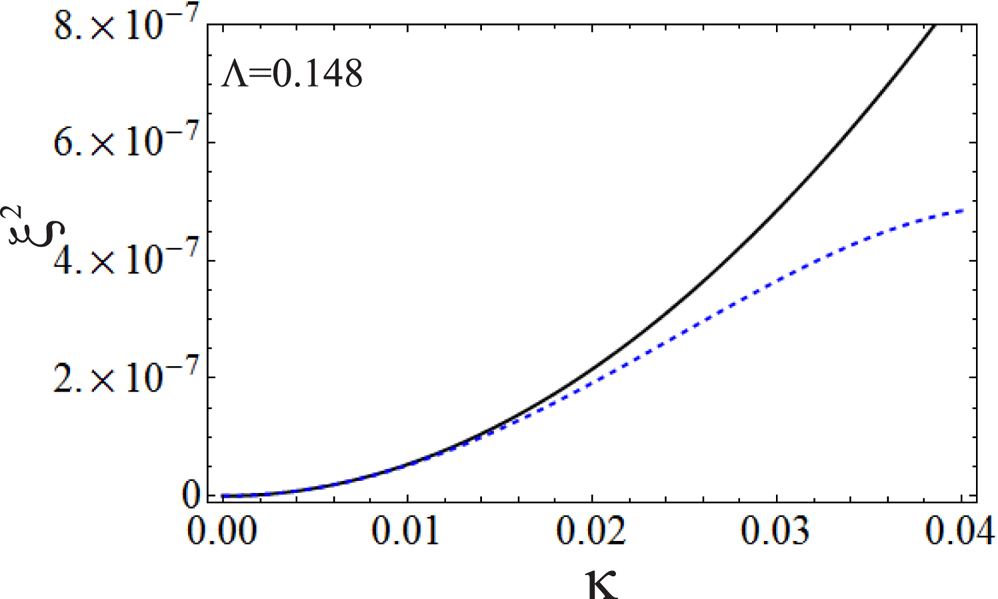
The quantum contribution appearing from the third-rank tensor evolution equation gives the decrease of the ion acoustic wave frequency. Let us mention that the quantum corrections, like the quantum Bohm potential for ions, are small in comparison with the described effects. This spectrum is illustrated in figure 4. It demonstrates the decrease of the frequency under the influence of the pressure evolution equation and the third-rank tensor evolution equation.
Numerical illustration of (3.30) is shown. The black solid line shows the spectrum of the ion acoustic wave obtained with no application of the pressure evolution equation. It corresponds to the absence of quantum term in (3.30). The blue dotted line shows the spectrum of the ion acoustic wave following from the application of the pressure evolution equation and the third-rank tensor evolution equation.

4. Conclusion
An extended hydrodynamic model demonstrating novel quantum effects is developed. These quantum effects appear in addition to the well-known quantum Bohm potential and spin effects. The model is presented for the electrostatic regime. Hence, the Coulomb interaction is considered. Therefore, the quantum corrections to the Coulomb interaction is found via evolution of the third-rank tensor. However, if one includes the spin–spin interaction, this model gives the quantum part for the spin–spin interaction or any other interaction. Such generalizations will be considered in future work. Here, novel quantum phenomena in plasmas are demonstrated using simple examples. Therefore, other phenomena may not be covered by the known quantum effects. The presented model gives the background for re-innovation of quantum phenomena caused by the quantum Bohm potential.
Supplementary material
Supplementary material is available at https://doi.org/10.1017/S002237782100101X. The Supplementary material contains details of the derivation of the basic equations (2.1)–(2.7). The definitions of hydrodynamic functions are also presented as well as calculations of the equations of state for the equilibrium values of the pressure second-rank tensor, the third-rank tensor and the fourth-rank tensor.
Funding
This work was supported by the Russian Foundation for Basic Research (grant no. 20-02-00476). This paper was supported by the RUDN University Strategic Academic Leadership Program.
Editor Dmitri Uzdensky thanks the referees for their advice in evaluating this article.
Declaration of interests
The author report no conflict of interest.
Data availability
Data sharing is not applicable for this article as no new data were created or analysed in this study as this was a purely theoretical investigation.