





Non-technical Summary
Hyaenodonts are an extinct group of carnivorous mammals that were highly successful early in the Cenozoic. Hyaenodonts are often compared with living carnivores to understand their ecology and how they moved. However, the skeletons of hyaenodonts have a number of unique features that are not found in any living carnivores. We tested whether living carnivores are the best point of comparison by comparing hyaenodonts with a number of other mammals. We chose to compare the shape of the pelvis because it is an important anchor for muscles in the hindlimb and back that contribute to movement. We found that no living mammal in our sample had a pelvic shape that matched the two hyaenodonts we tested. Instead, we found that hyaenodonts have a unique combination of pelvic features. The differences between carnivore and hyaenodont pelvic shape likely come from differences in their evolutionary history, because carnivores evolved from a more climbing ancestor and hyaeondonts likely evolved from a more ground-dwelling ancestor. These differences can be taken into account with future interpretations of hyaenodont movement.
Introduction
Unrelated lineages often evolve convergent morphology when occupying similar ecological niches, because morphology constrains an organism’s function (Bels and Russell, Reference Bels, Russell, Bels and Russell2023). Convergent morphology can be used to infer the ecology of extinct organisms through comparison to extant organisms with known ecology (Schwab et al., Reference Schwab, Figueirido, Martín-Serra, Van Der Hoek, Flink, Kort, Esteban Núñez and Jones2023). However, different morphologies can achieve the same ecological function, a phenomenon referred to as many-to-one mapping (Wainwright, Reference Wainwright2005, Reference Wainwright2007). Two lineages with similar ecology can differ in morphology due to disparate ancestral conditions or subtle variations in function that do not directly impact the organism’s broader ecology. Therefore, when inferring the ecology of an extinct species with a comparative sample of extant species, both the taxonomic breadth of the extant species and how broadly the ecology of each organism is defined impact the analysis (Schwab et al., Reference Schwab, Figueirido, Martín-Serra, Van Der Hoek, Flink, Kort, Esteban Núñez and Jones2023). We explore how these factors have influenced the ecological interpretations of locomotion in Hyaenodonta, an extinct clade of carnivorous mammals.
Hyaenodonta is one of several extinct clades that were historically grouped in Creodonta, a polyphyletic order of extinct carnivorous placentals (Gunnell, Reference Gunnell, Janis, Scott and Jacobs1998; Zack, Reference Zack2019). Like most ‘archaic’ placental groups, the phylogenetic affinities of Hyaenodonta remain unclear, but hyaenodonts are most commonly placed along the stem to Carnivora (Zack, Reference Zack2009; Spaulding and Flynn, Reference Spaulding and Flynn2012; Halliday et al., Reference Halliday, Upchurch and Goswami2017; Velazco et al., Reference Velazco, Buczek, Hoffman, Hoffman, O’Leary and Novacek2022). Of the groups placed in Creodonta, hyaenodonts were the most successful, spreading across North America, Asia, Europe, and Africa, and surviving from the Paleocene into the Miocene (Gunnell, Reference Gunnell, Janis, Scott and Jacobs1998; Van Valkenburgh, Reference Van Valkenburgh1999; Borths et al., Reference Borths, Holroyd and Seiffert2016). Early hyaenodonts tended to be smaller, like the limnocyonines of North America, whereas later hyaenodonts trended toward larger, hypercarnivorous forms, e.g., the massive 3000 kg hyainailourine Megistotherium osteothlastes (Savage, Reference Savage1973) of Africa (Morlo and Gunnell, Reference Morlo and Gunnell2003; Borths and Stevens, Reference Borths and Stevens2019). This evolutionary ratchet, along with increasing competition from carnivorans, appears to have ultimately driven the extinction of hyaenodonts, first in North America at the end of the Oligocene, then in Africa at the end of the Miocene (Van Valkenburgh, Reference Van Valkenburgh1999; Friscia et al., Reference Friscia, Macharwas, Muteti, Ndiritu and Tab Rasmussen2020)
Variation in postcranial morphology indicates that hyaenodonts evolved a range of locomotor adaptations across their long evolutionary history (Rose, Reference Rose2006). Earlier hyaenodonts have generally been interpreted as scansorial, terrestrial, semifossorial, or subcursorial, whereas later species trended toward cursoriality (Matthew, Reference Matthew1906; Rose, Reference Rose1990; Janis and Wilhelm, Reference Janis and Wilhelm1993; Morlo, Reference Morlo1999). Extant carnivorans have frequently been used as functional analogs for hyaenodonts, due to their inferred ecological similarity and close phylogenetic relationship (Jenkins and Camazine, Reference Jenkins and Camazine1977; Van Valkenburgh, Reference Van Valkenburgh1987; Gebo and Rose, Reference Gebo and Rose1993; Ahrens, Reference Ahrens2017; Panciroli et al., Reference Panciroli, Janis, Stockdale and Martín-Serra2017). The extensive ecological diversity of Carnivora also contains representative species for nearly every locomotor mode (Van Valkenburgh, Reference Van Valkenburgh1987). Despite the breadth of locomotor adaptations in Carnivora, in quantitative morphological comparisons, hyaenodonts often fall outside the morphological range set by extant carnivorans (Ahrens, Reference Ahrens2017; Panciroli et al., Reference Panciroli, Janis, Stockdale and Martín-Serra2017). The discrepancy in carnivoran and hyaenodont morphology is likely caused by differences in the underlying ancestral morphology of each group, especially because hyaenodonts retain plesiomorphic characters not found in Carnivora. For instance, even the most cursorial hyaenodonts, e.g., Hyaenodon Lacépède, Reference Lacépède1799 (Laizer and Parieu, Reference Laizer and Parieu1838), have relatively robust limbs, a trait found in many ‘archaic’ placentals (Mellett, Reference Mellett1977; Gunnell, Reference Gunnell, Janis, Scott and Jacobs1998; Ahrens, Reference Ahrens2017). Most hyaenodonts also lack a fused scapholunate, the carpal bone(s) that articulate with the radius, a synapomorphy of Carnivora (Spaulding and Flynn, Reference Spaulding and Flynn2012). Finally, hyaenodonts retain revolute articulations in the lumbar vertebrae, a trait lost in Carnivora (Denison, Reference Denison1937; Kort, Reference Kort2023). Although these characteristics are plesiomorphoric or synapomorphic to the entire clade, they can still have functional implications (e.g. Kort and Jones, Reference Kort and Jones2024). By identifying these systematic postcranial discrepancies between hyaenodonts and carnivorans, we can trace the effect of ancestral traits on locomotor evolution across both clades and compare how the resulting morphological differences map to the same ecology.
Although many elements of the mammalian skeleton, including tarsals, limb bones, and vertebrae, have clear morphological correlates with locomotor mode, some elements, e.g., the pelvis, have a more complex functional role that complicates ecomorphological interpretations (Van Valkenburgh, Reference Van Valkenburgh1987; Panciroli et al., Reference Panciroli, Janis, Stockdale and Martín-Serra2017; Lewton et al., Reference Lewton, Brankovic, Byrd, Cruz, Morales and Shin2020; Kort and Polly, Reference Kort and Polly2023). The pelvis anchors the hindlimb to the spine and provides attachment sites for major muscles used in body support and locomotion. Both epaxial and hypaxial muscles insert onto the pelvis, e.g., the m. longissimus lumborum, which originates on lumbar vertebrae and inserts onto the ilium, or the m. rectus abdominus, which originates on the ribs and inserts onto the pubis (Slijper, Reference Slijper1946; Evans, Reference Evans1993; Reilly et al., Reference Reilly, McElroy and White2009; Schilling and Carrier, Reference Schilling and Carrier2010). Likewise, the major propulsive muscles of the hindlimb originate on the pelvis (Gambaryan, Reference Gambaryan and Hardin1974). The pattern of extensors, flexors, rotators, adductors, and abductors is preserved across mammals, although the sizes and precise positions of these muscle attachments can vary (Cuff et al., Reference Cuff, Sparkes, Randau, Pierce, Kitchener, Goswami and Hutchinson2016; Wright et al., Reference Wright, Sears and Pierce2022). The hip extensors attach to both the anterior and posterior ends of the pelvis, with the gluteal series originating on the ilium and the ‘hamstrings,’ including the m. biceps femoris, originating on the ischium (Evans, Reference Evans1993). Hip flexors, especially the m. rectus femoris (part of the quadriceps), originate on and around the tubercle for the rectus femoris, anterior to the acetabulum. Hip rotators and adductors primarily originate on the pubis, around the obturator foramen.
Although many muscles crucial for locomotion and body support originate and insert on the pelvis, previous studies have found limited correlation between locomotor mode and pelvic morphology (Jenkins and Camazine, Reference Jenkins and Camazine1977; Álvarez et al., Reference Álvarez, Ercoli and Prevosti2013; Lewton, Reference Lewton2015a, b; Lewton et al., Reference Lewton, Brankovic, Byrd, Cruz, Morales and Shin2020; Tavares and Pessôa, Reference Tavares and Pessôa2020). Instead, body size and phylogenetic relatedness appear to have a stronger influence (Lewton et al., Reference Lewton, Brankovic, Byrd, Cruz, Morales and Shin2020). This could indicate many-to-one mapping, in which different lineages have evolved disparate pelvis morphologies that are capable of similar locomotor function (Lewton et al., Reference Lewton, Brankovic, Byrd, Cruz, Morales and Shin2020). However, apparent many-to-one mapping could disappear depending on which taxa are sampled, how morphology is measured, and how locomotion is categorized. For instance, the clearest locomotor signal has been found when mammals are sampled broadly, rather than restricting sampling to a single order (Álvarez et al., Reference Álvarez, Ercoli and Prevosti2013). Furthermore, more specific measurements of locomotion that directly relate to hindlimb function, e.g., maximum speed, perform better than more ambiguously defined classifications of locomotor mode (Álvarez et al., Reference Álvarez, Ercoli and Prevosti2013; Lewton et al., Reference Lewton, Brankovic, Byrd, Cruz, Morales and Shin2020).
We compare the pelvic morphology of two basal hyaenodonts to extant mammal species from across multiple orders, including Carnivora, to test whether carnivorans are the best morphological analog. We then use several different locomotor classification schemes to assess whether pelvic morphology can be used to predict vertical climbing ability or posture. By breaking single locomotor modes into multiple classifiers, we can determine whether many-to-one mapping exists for specific functions, rather than a broad ecology. Finally, we use the findings from our extant dataset to infer locomotor function of the two basal hyaenodonts.
Material and methods
Specimens
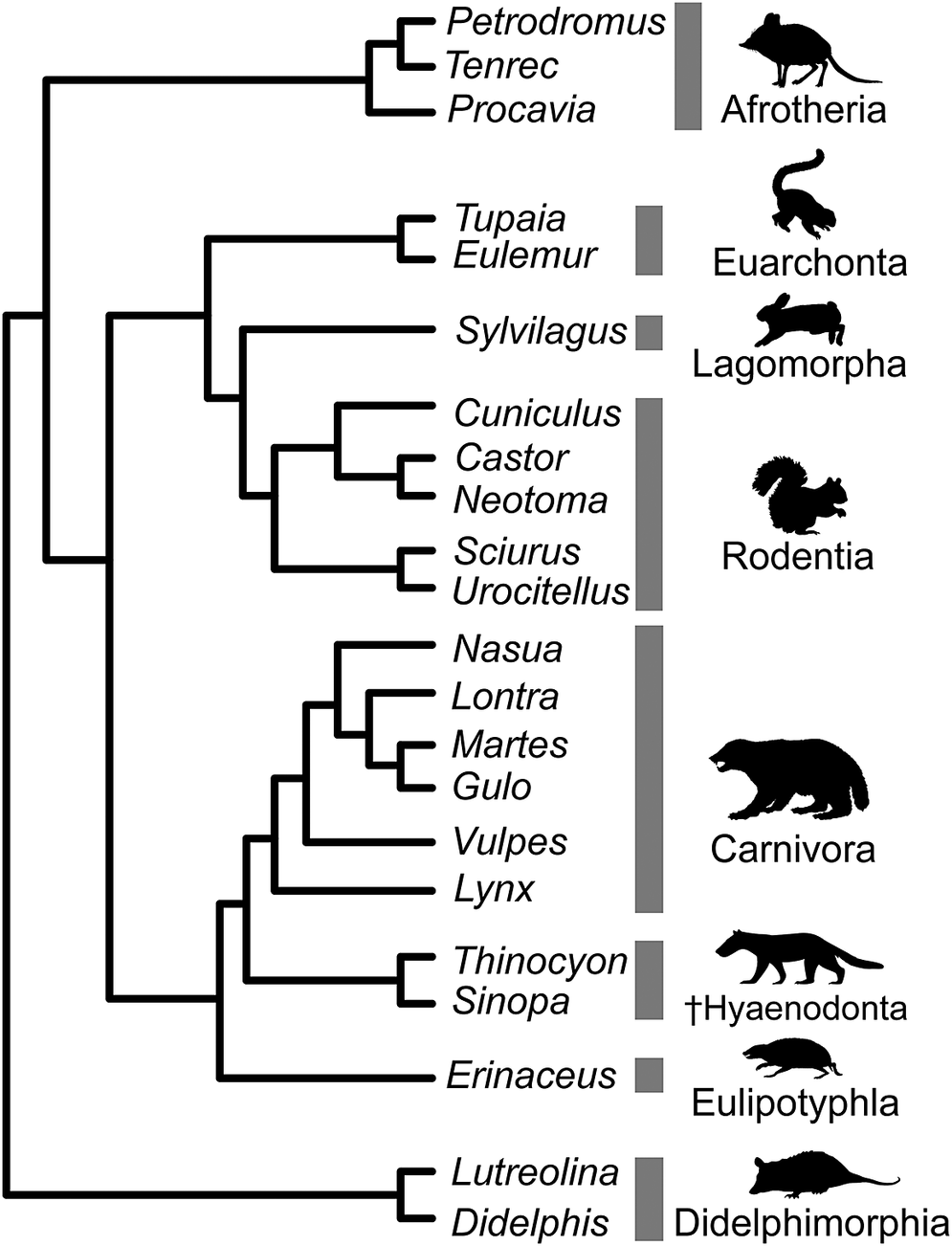
We sampled pelves from 20 extant mammals from across 10 orders with a range of locomotor modes (Fig. 1). Rodents and carnivorans were limited in sampling to avoid a strong phylogenetic bias toward these groups. Xenarthrans were not included due to the extensive fusion of the sacrum and ischium, which is not found in most mammals, including hyaenodonts. Additionally, mammals larger than ~ 20 kg were excluded, because body size is known to impact pelvic morphology (Lewton, Reference Lewton2015a; Lewton et al., Reference Lewton, Brankovic, Byrd, Cruz, Morales and Shin2020). Any other orders not represented were limited by access to specimens. All specimens were accessed through the University of Michigan Museum of Zoology (UMMZ).
Phylogeny of sampled taxa. Clades are labelled at the ordinal level, except in the case of Euarchonta (grandorder) and Afrotheria (superorder). Silhouettes are from phylopic.org.

Figure 1 Long description
Phylogeny showing major clades of taxa sampled in study. Taxa and clades are as follows: Afrotheria includes Petrodromus, Tenrec, and Procavia; Euarchodonta includes Tupaia and Eulemur; Lagomorpha includes Sylvilagus; Rodentia includes Cuniculus, Castor, Neotoma, Sciurus, and Urocitellus; Carnivora includes Nasua, Lontra, Martes, Gulo, Vulpes, and Lynx; Hyaenodonta (extinct) includes Thinocyon and Sinopa; Euliptyphla includes Erinaceus; Didelphimorphia includes Lutreolina and Didelphis.
We then sampled two hyaenodont specimens with well-preserved pelves from the University of Michigan Museum of Paleontology (UMMP): UMMP VP 33479, Thinocyon velox (Marsh, Reference Marsh1872) and UMMP VP 101086, Sinopa sp. indet. (Leidy, Reference Leidy1871). These species are closely related, and although not basal to Hyaenodonta, the morphology of these early hyaenodonts is likely to represent the ancestral condition for the order more than later, more derived forms. Both genera are also known from the early Eocene Bridger Formation of southwestern Wyoming (Gunnell, Reference Gunnell, Janis, Scott and Jacobs1998; Borths et al., Reference Borths, Holroyd and Seiffert2016). UMMP VP 33479 was originally collected by R.M. West in 1980 from a locality located in Sweetwater County, Wyoming, referred to by field number 2934 in West’s field notes and BRW015 in the UMMP records. UMMP VP 101086 was collected by Gregg Gunnell in 1993 at BRW159, a locality in Uinta County, Wyoming. Both localities fall in the Bridgerian Biochronological Zone Br-2 in the Blacks Fork Member of the Bridger Formation. Br-2 roughly corresponds to Matthew’s (Reference Matthew1909) Bridger B horizon, the most fossiliferous section of the formation (Gunnell et al., Reference Gunnell, Murphey, Stucky, Beth, Robinson, Zonneveld and Bartels2009). The Church Butte Tuff sits in the middle of this section and is dated to 48.27 Ma (Murphey and Evanoff, Reference Murphey, Evanoff, Olstad and Aase2011). Specific location information can be requested by qualified researchers from the UMMP.
CT scanning
Each fossil specimen was X-ray computed tomography (CT) scanned at the University of Michigan CT in Earth and Environmental Sciences (CTEES) Facility. A Nikon XT H 225 ST industrial μCT scanner with a Perkin Elmer 1620 X-ray detector panel and a tungsten reflection target was used for scanning. The block of UMMP VP 33479 containing the pelvis, last lumbar vertebra, sacrum, and proximal caudal vertebrae was scanned with the following parameters: 180 kV, 180 μA, copper filter of 0.1 mm, and an effective pixel size of 36.35 μm (Supplemental Data 1). The right innominate of UMMP VP 101086 was scanned with the following parameters: 180 kV, 180 μA, copper filter of 0.1 mm, and an effective pixel size of 59.59 μm (Supplemental Data 2). The left innominate of UMMP VP 101086 was scanned with the following parameters: kV, 170 μA, copper filter of 0.1 mm, and an effective pixel size of 64.06 μm (Supplemental Data 3). Segmentation of each scan was done in 3D Slicer to create three-dimensional (3D) models of the pelves isolated from any matrix (Fedorov et al., Reference Fedorov, Beichel, Kalpathy-Cramer, Finet and Fillion-Robin2012).
Linear morphometrics
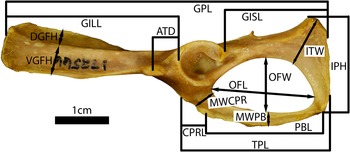
We chose to use linear morphometrics to measure pelvis morphology. Although 3D geometric morphometric methods might have better captured the complex shape of the pelvis, linear morphometrics are more robust against the minor distortion and missing portions found in both our fossil specimens (Arbour and Brown, Reference Arbour and Brown2014). A suite of 15 linear measurements was taken for each pelvis following the scheme developed by Tavares and Pessôa (Reference Tavares and Pessôa2020) (Fig. 2; Table 1). Measurements of modern specimens were taken using digital calipers down to the nearest hundredths of a millimeter (Table 2). To maintain consistent comparison across species, we did not take any measurements of the epipubic bones for the two marsupials in the set. Although epipubic bones support the hypaxial musculature in marsupials, as opposed to the direct attachment to the pubis found in placentals, locomotion in generalized placentals, e.g., rodents, is still more similar to marsupials than to cursorial placentals (Reilly et al., Reference Reilly, McElroy and White2009). Measurements of the fossil specimens were taken from the 3D models using the line tool in 3D Slicer down to the nearest hundredths of a millimeter (Table 2). For fossil specimens, the most intact innominate was used for the majority of measurements, and the less intact innominate was used to fill in missing measurements where possible. Despite this technique, both specimens have missing measurements, with four missing from UMMP VP 33479 and one missing from UMMP VP 101086.
Linear measurements illustrated on the left innominate Sciurus niger (Linnaeus, Reference Linnaeus1758) (UMMZ 172566). ATD, acetabular-tubercle (for rectus femoris) distance; CPRL, cranial pubic ramus length; DGFH, dorsal gluteal fossa height; GILL, greatest iliac length; GISL, greatest ischial length; GPL, greatest pelvic length; IPH, ischiopubic height; ITW, ischial tuberosity width; MWCPR, minimum width of the cranial pubic ramus; MWPB, minimum width of the pubic body; OFL, obturator fossa length; OFW, obturator fossa width; PBL, pubic body length; TPL, total pubic length; VGFH, ventral gluteal fossa height.

Description of linear measurements (taken from Tavares and Pessôa, Reference Tavares and Pessôa2020). ATD, acetabular-tubercle (for rectus femoris) distance; CPRL, cranial pubic ramus length; DGFH, dorsal gluteal fossa height; GILL, greatest iliac length; GISL, greatest ischial length; GPL, greatest pelvic length; IPH, ischiopubic height; ITW, ischial tuberosity width; MWCPR, minimum width of the cranial pubic ramus; MWPB, minimum width of the pubic body; OFL, obturator fossa length; OFW, obturator fossa width; PBL, pubic body length; TPL, total pubic length; VGFH, ventral gluteal fossa height

Table 1. Long description
15 linear measurements are listed with an abbrevation, name, and anatomical description.
Specimen list with all linear measurements in millimeters. ATD, acetabular-tubercle (for rectus femoris) distance; CPRL, cranial pubic ramus length; DGFH, dorsal gluteal fossa height; GILL, greatest iliac length; GISL, greatest ischial length; GPL, greatest pelvic length; IPH, ischiopubic height; ITW, ischial tuberosity width; MWCPR, minimum width of the cranial pubic ramus; MWPB, minimum width of the pubic body; OFL, obturator fossa length; OFW, obturator fossa width; PBL, pubic body length; TPL, total pubic length; VGFH, ventral gluteal fossa height
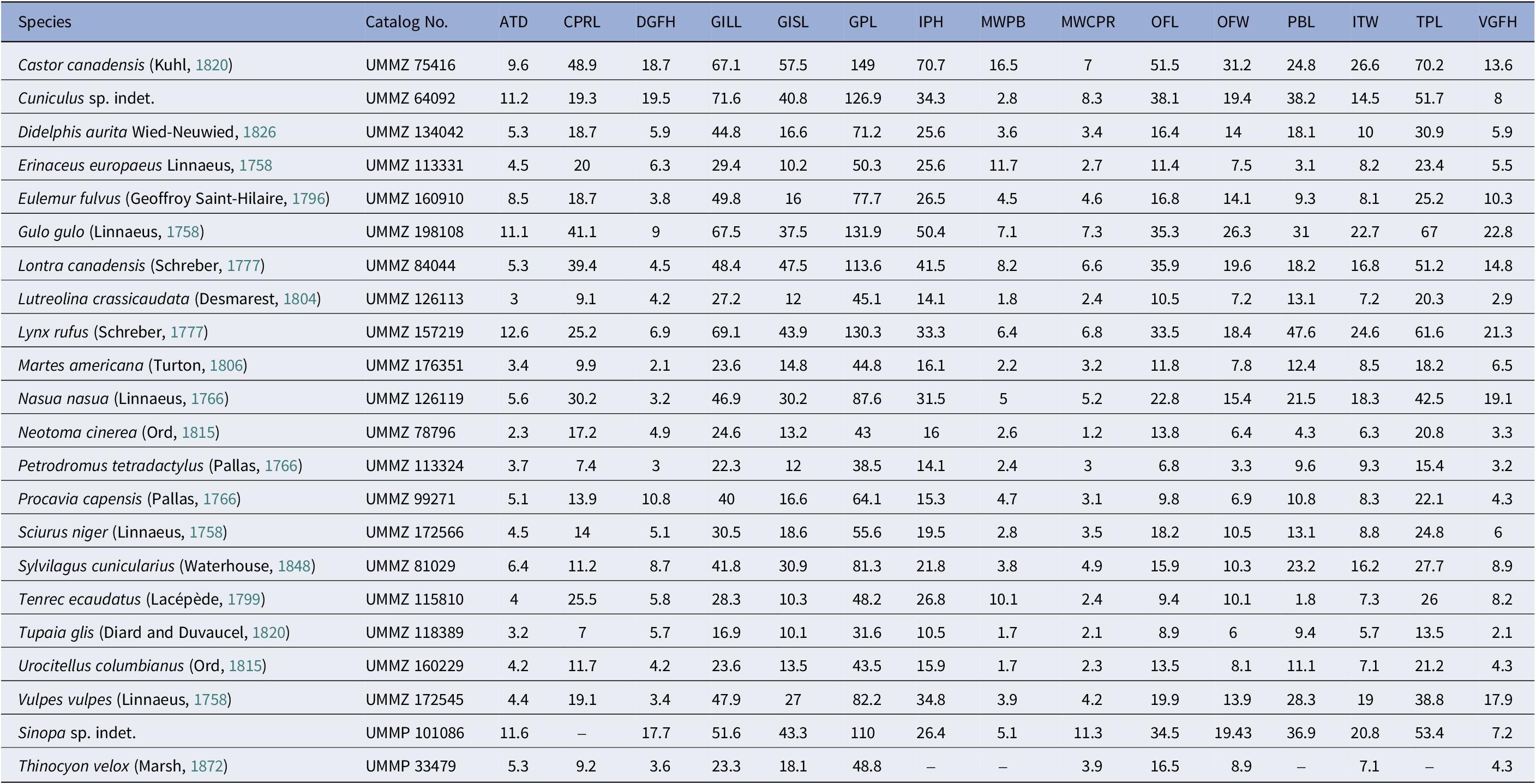
Table 2. Long description
Table listing species in the study, the catalog number for the specimen used, and the linear measurements taken in millimeters for each specimen’s pelvis. Measurement abbrevations are explained in Table 1.
Clustering analysis
PAST (Paleontological Statistics) was used for all data analysis (Hammer et al., Reference Hammer, Harper and Ryan2001). Row normalization was first applied by dividing each value in a row by the sum of squares for that row (Hammer and Harper, Reference Hammer and Harper2006). This effectively removes the relative size of each specimen from the set of measurements. Next, a principal components analysis (PCA) was performed on the row normalized dataset to identify the major components of variation in pelvic morphology and where specimens sat in the morphospace. Mean value imputation was used to handle missing values. Finally, an unweighted pair group method with arithmetic mean (UPGMA) clustering analysis was performed on the row normalized dataset to group specimens by morphology and pinpoint which of the extant taxa the two hyaenodont specimens most resembled (Hammer and Harper, Reference Hammer and Harper2006).
Locomotor classification
We used multiple methods to classify the locomotion of the extant species in our dataset (Table 3). First, traditional categories, e.g., semiaquatic, cursorial, and scansorial, were identified for each species through a literature search. However, because these categories can encompass a wide range of actual locomotor performance, we also designed three binary categorization schemes with more specific definitions to test: digitigrady, vertical ascent, and vertical descent. Species were classified as digitigrade if they obligately maintained a digitigrade posture while moving and not if they flexibly changed posture or remained plantigrade. Vertical ascent and descent were determined by a species ability to climb up or down vertical surfaces, regardless of their classification as arboreal or scansorial. Any species capable of climbing up a vertical surface headfirst was classified as capable of vertical ascent, whereas any species capable of climbing down a vertical surface headfirst was classified as capable of vertical descent. For instance, the red fox, Vulpes vulpes (Linnaeus, Reference Linnaeus1758), cannot ascend or descend vertically; the bobcat, Lynx rufus (Schreber, Reference Schreber1777), can ascend vertically but must jump down rather than climbing; and the squirrel, Sciurus niger (Linnaeus, Reference Linnaeus1758), can both ascend and descend vertical surfaces.
Locomotor variables used in MANOVA analyses. Locomotor category is the traditional classification. All other categories are binary, with 0 indicating a species that does not have that trait, and 1 indicating a species does have that trait. Digitigrade indicates whether or not the species is obligately digitigrade. Vertical ascent indicates whether the species can climb headfirst vertically up and vertical descent indicates whether the species can climb headfirst vertically down

Table 3. Long description
For each species in the study, a traditional locomotor category was assigned. Additionally, 3 binary classifications were used. For each binary classification, a 1 indicate that species is capable of that behavior, as explained in text.
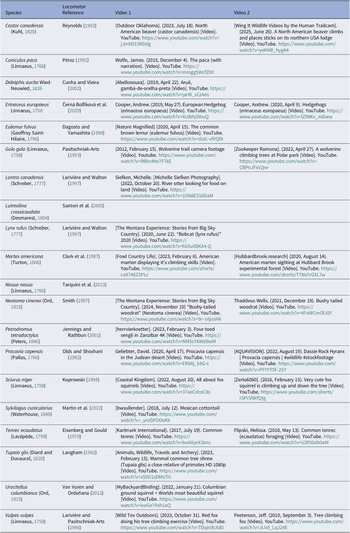
Although some specific descriptions of locomotor behaviors are available in prior literature, to ensure standard classification, we supplemented our literature search with public videos posted on YouTube (Appendix Table A1). Although public videos need to be carefully vetted for authenticity, they can provide valuable insights into animal behavior (Pokharel et al., Reference Pokharel, Sharma and Sukumar2022). Videos of each species were searched on YouTube using several iterations of terms using both the scientific and common names, e.g., ‘gulo gulo,’ ‘gulo gulo locomotion,’ ‘wolverine climbing,’ and ‘wolverine.’ For each video, the uploader was checked to ensure they had multiple videos with a consistent location appropriate for the species. All videos were also inspected for indications of fakery, such as artifacts or inconsistent lighting. Video searches were conducted between February 2025 and January 2026. For each video, the name of the YouTube channel, year of publication, and URLs were recorded.
A multivariate analysis of variance (ANOVA) was performed to test for any significant difference in pelvis shape for each binary classification of locomotion. We used the first three principal components as the continuous variables, which accounted for 77.8% of the variance. We then performed a discriminant function analysis (DFA) on classifications that showed a significant difference to classify the hyaenodonts into each category.
Repositories and institutional abbreviations
UMMP VP, Vertebrate Paleontology, University of Michigan Museum of Paleontology, Ann Arbor, USA; UMMZ, University of Michigan Museum of Zoology, Ann Arbor, USA. Other cited repositories are AMNH, American Museum of Natural History, New York; ANSP, Academy of Natural Sciences of Drexel University, Philadelphia; UCM, University of Colorado Museum of Natural History, Boulder; and USNM, National Museum of Natural History, Washington, DC.
Systematic paleontology
Order Hyaenodonta Van Valen and Leigh, Reference Van Valen and Leigh1967
Family Hyaenodontidae Leidy, Reference Leidy1871
Subfamily Limnocyoninae Wortman, Reference Wortman1902
Genus Thinocyon Marsh, Reference Marsh1872
Type species
Thinocyon velox Marsh, Reference Marsh1872; Eocene of southwestern Wyoming.
Thinocyon velox Marsh, Reference Marsh1872
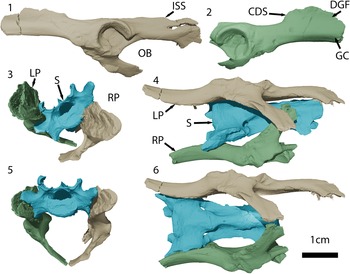
Pelvis of Thinocyon velox (Marsh, Reference Marsh1872) (UMMP VP 33479). (1) Left innominate in lateral view, and (2) right innominate in lateral view. The pelvis in its original position of preservation in (3) anterior and (4) ventral views. Note the sacrum disarticulated from the pelvis. Reconstruction of the articulation of the pelvis and sacrum in (5) anterior and (6) ventral views. CDS, caudal dorsal iliac spine; DGF, dorsal gluteal fossa; GC, gluteal crest; ISS, ischiatic spine; LP, left pelvis; OB, obturator foramen; RP, right pelvis; S, sacrum.

Reference Marsh1872 Thinocyon velox Marsh, p. 202.
Reference Wortman1902 Limnocyon velox; Wortman, p. 118.
Reference Matthew1909 Thinocyon cledensis Matthew, p. 460.
Reference Matthew1909 Thinocyon mustelinus Matthew, p. 461.
Reference Thorpe1923 Thinocyon mustelinus; Thorpe, p. 35.
Reference Denison1937 Thinocyon cledensis; Denison, p. 180.
Reference Denison1937 Thinocyon mustelinus; Denison, p. 179.
Reference Gazin1976 Thinocyon mustelinus; Gazin, p. 10.
Reference Gunnell, Janis, Scott and Jacobs1998 Thinocyon cledensis; Gunnell, p. 99.
Holotype
YPM 11797, left mandible with c1, p1, broken p2–3, p4, roots of m1, and m2 talonid, from the Bridger Formation, southwestern Wyoming, USA (Wortman, Reference Wortman1902, fig. 76).
Description
UMMP VP 33479 includes a well-preserved cranium and mandible, several long bones, and a pelvic girdle imperfectly articulated with the last lumbar vertebra, the sacrum, and the first three caudal vertebrae. Morlo and Gunnell (Reference Morlo and Gunnell2003) included this specimen in their description of Thinocyon velox. Both sides of the pelvis are preserved, although the right innominate is more complete (Fig. 3).
The lateral surface of the ilium of Thinocyon is convex, with a ventrolateral and dorsolateral surface that come together at a low, rounded gluteal crest. The gluteal crest is less distinct than in other larger hyaeonodonts and oxyaenodonts (Denison, Reference Denison1937). The ilium is thicker ventral to the gluteal crest and thin dorsally. Distal to the tubercle for the rectus femoris, the dorsal margin of the ilium abruptly expands into a thin, broad plate forming the dorsal gluteal fossa. This is more evident on the left innominate, although breaks along the dorsal margin prevent the true extent of the fossa from being determined. The expansion of the dorsal gluteal fossa has been noted in other hyaenodonts, as well as oxyaenodonts, but is absent in Carnivora (Denison, Reference Denison1937). Breaks at the distal ends of both ilia also obscure the exact length of the ilium, but only a small portion of the total length is likely missing.
The acetabulum of Thinocyon faces laterally. The dorsal portion of the lunate surface faces near ventral, more similar to a cat than a dog or raccoon (Jenkins and Camazine, Reference Jenkins and Camazine1977). The acetabular notch is somewhat open, but less so than in ambulatory carnivores, like the wolverine, Gulo gulo (Linnaeus, Reference Linnaeus1758). The tubercle for the rectus femoris anterior to the acetabulum is well developed. The posterior portion of the pelvis is relatively long in Thinocyon compared to most extant carnivores sampled. Although the pubis is mostly missing, the ovular obturator foramen indicates a long pubic symphysis. The posterior portion of the innominate points ventrolaterally and would have formed a sharp angle at the pubic symphysis, rather than the broad continuous surface seen in the bobcat (Lynx rufus) or the fox (Vulpes vulpes). The ischial tuberosity appears to have been less developed than in the fox.
Remarks
Our findings from UMMP VP 33427 broadly agree with previous descriptions of the Thinocyon pelvis (Matthew, Reference Matthew1909; Denison, Reference Denison1937). However, UMMP VP 33427 is more complete, which can allow for more detailed comparison of hindlimb morphology.
Subfamily Sinopaninae Solé, Reference Solé2013
Genus Sinopa Leidy, Reference Leidy1871
Type species
Sinopa rapax Leidy, Reference Leidy1871 (ANSP specimen missing, casts in AMNH, UCM, and USNM), from the Bridger Formation, Green River Basin, Wyoming, USA.
Sinopa sp. indet.
Pelvis of Sinopa sp. indet. (UMMP VP 101086). (1) Left innominate in lateral view, and (2) right innominate in lateral view. CDS, caudal dorsal iliac spine; DGF, dorsal gluteal fossa; GC, gluteal crest; ISS, ischiatic spine; IST, ischiatic tuberosity; OB, obturator foramen.

Description
UMMP VP 101086 includes a well-preserved pelvis (Fig. 4), alongside elements of the hindfoot, a partial tibia, partial scapula, and several vertebrae. A right dentary with p3–m3 was originally found with this specimen, but this element is presumed missing, having been on loan since 2007. UMMP VP 101086 was identified as Sinopa sp. by Gregg Gunnell, former collections manager of the UMMP VP, likely using the now missing dentary and associated teeth. Given Gunnell’s expertise in creodonts (e.g., Gunnell, Reference Gunnell, Janis, Scott and Jacobs1998), we trusted this identification but confirmed it using the remaining elements. A single lower molar remains associated with the specimen and has the basin-shaped talonid characteristic of Sinopa, rather than the trenchant talonid of Tritemnodon Matthew, Reference Matthew1906 (Matthew, Reference Matthew1909). The presence of m3 as recorded with the specimen eliminates Limnocyon Marsh, Reference Marsh1872, which has only two lower molars (Matthew, Reference Matthew1909). Furthermore, the astragalus has an elongated neck, which neither Limnocyon nor Tritemnodon show (Matthew, Reference Matthew1909). Thus, we used Gunnell’s initial identification of Sinopa for this specimen.
The ilium is similar to that of Thinocyon in that a gluteal crest divides a smaller ventral gluteal fossa from a larger dorsal gluteal fossa. However, the ilium is overall thinner mediolaterally than in Thinocyon, with a more sharply defined gluteal crest. Additionally, the ventral gluteal fossa is more concave than in Thinocyon. The dorsal gluteal fossa abruptly expands dorsally as in Thinocyon, but this expansion begins farther posteriorly along the ilium, close to the anterior margin of the tubercle for the rectus femoris. The dorsal gluteal fossa appears to have extended farther dorsally in Sinopa when compared with Thinocyon, although breakage along the margin makes this difficult to ascertain.
The acetabulum of Sinopa is similar to that of Thinocyon, with a somewhat open acetabular notch, most comparable to Lynx rufus of the species sampled. The dorsal portion of the lunate surface also points ventrally, although the acetabulum itself points laterally. The tubercle for the rectus femoris of Sinopa is reduced relative to that of Thinocyon, with less breadth dorsoventrally. The ischium of Sinopa is long, as in Thinocyon, and noticeably longer than the ischia of carnivorans like Gulo gulo. The intact pubic bone of the right innominate shows a long pubic symphysis following the ovular obturator foramen. The posterior portion of the pelvis would have formed a sharp angle when intact with the ischium and pubis facing laterally, similar to the pubis of Lynx rufus. The ischial spine is prominent halfway along the dorsal margin of the ischium, and the ischial tuberosity is well defined and rugose, although not large. A notable difference from Thinocyon is a sharp ridge that runs from the ventral margin of the lunate surface of the acetabulum to the ischial tuberosity. This is similar to a ridge seen in Lynx rufus, creating a clear divide between dorsolateral and ventrolateral surfaces of the ischium.
Remarks
The pelvis of Sinopa has previously been briefly described (Matthew, Reference Matthew1906, Reference Matthew1909). Our findings from UMMP VP 101086 broadly match the previous descriptions with added anatomical detail that can be used for further functional interpretations.
Results
PCA
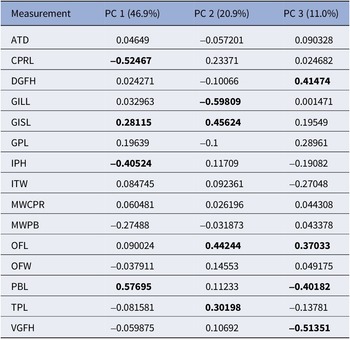
The first three principal components include the majority of the total variance: PC1 (46.9%), PC2 (20.9%), and PC3 (11.0%). The proportions of the ischium and pubis dictate the variation along PC1 (Fig. 5; Table 4). Cranial pubic ramus length and ischiopubic height contribute the most to the negative end of PC1, whereas pubic body length and greatest ischial length contribute to the positive end. PC2 is most influenced by the relative size of the ilium and ischium. Greatest iliac length contributes the most to the negative end of PC2, whereas greatest ischial length and obturator foramen length contribute to the positive end. Finally, PC3 has high ventral gluteal fossa height and pubic body length on the negative end and high obturator foramen length and dorsal gluteal fossa height at the positive end.
Principal component analysis of pelvic measurements. Lateral views of the left pelvis, or right pelvis mirrored, of specimens at the extreme ends of both axes show the major patterns of variation in the morphospace. Tenrec ecaudatus (Lacépède, Reference Lacépède1799) (UMMZ 115810) and Lynx rufus (Schreber, Reference Schreber1777) (UMMZ 157219) sit at the negative and positive ends of PC1, respectively, and Procavia capensis (Pallas, Reference Pallas1766) (UMMZ 99271) and Lontra canadensis (Schreber, Reference Schreber1777) (UMMZ 84044) sit at the negative and positive ends of PC2, respectively. Loading of each measurement onto PC1 and PC2 are shown. Note that ATD, DGFH, ITW, MWCPR, OFW, and VGFH did not majorly contribute to either axis and have been removed from the plot to improve readability. CPRL, cranial pubic ramus length; GILL, greatest iliac length; GISL, greatest ischial length; GPL, greatest pelvic length; IPH, ischiopubic height; MWPB, minimum width of the pubic body; OFL, obturator fossa length; PBL, pubic body length; TPL, total pubic length.

Loadings for the first three principal components (PC) of the PCA. The four largest contributions to each PC appear in bold font. ATD, acetabular-tubercle (for rectus femoris) distance; CPRL, cranial pubic ramus length; DGFH, dorsal gluteal fossa height; GILL, greatest iliac length; GISL, greatest ischial length; GPL, greatest pelvic length; IPH, ischiopubic height; ITW, ischial tuberosity width; MWCPR, minimum width of the cranial pubic ramus; MWPB, minimum width of the pubic body; OFL, obturator fossa length; OFW, obturator fossa width; PBL, pubic body length; TPL, total pubic length; VGFH, ventral gluteal fossa height

Table 4. Long description
The four highest loadings onto PC1 are cranial pubic ramus length (negative), greatest ischial length (positive), ischiopubic height (negative), and pubic body length (positive). For PC2, highest loadings are greatest iliac length (negative), greatest ischial length (positive), obturator foramen length (positive), and total pubic length (positive). For PC3, highest loadings are dorsal gluteal fossa height (positive), obturator foramen length (positive), pubic body length (negative), and ventral gluteal fossa height (negative).
Clustering analysis
Neither Thinocyon nor Sinopa closely clustered with any extant mammal sampled (Fig. 6). Sinopa clustered weakly with Lynx rufus, at the base of a large group containing the marsupials, nonsemiaquatic carnivores, and rodents. Thinocyon was recovered just outside of the larger group that includes Sinopa, not clustering with any extant mammal. The Cophenetic correlation coefficient of 0.83 suggests that the relationships found in this analysis are well representative of the pairwise distances between the specimens.
Cluster diagram produced from UGPMA analysis of liner measurement data. Each taxon is labelled with a traditional locomotor classification. Lateral views of the left pelvis of extant species are shown. Scale bars = 1 cm.

Figure 6 Long description
Branch 1 is Erinaceus and Tenrec, and Branch 2 is everything else. Within Branch 2, Procavia and Eulemur cluster together on 2-2, whereas everything else clusters on 2-1. Within 2-1, Neotoma, Castor, and Lontra cluster together as a branch, whereas everything else sits in a larger cluster. Within this larger cluster, Thinocyon sits on a branch by itself at the base. The other major clusters in this large cluster are Sylvilagus and Petrodromus together, Lynx and Sinopa together, Vulpes, Gulo, Nasua, Martes, Sciurus, and Urocitellus together, and Tupaia, Cuniculus, Lutreolina, and Didelphis together. Very little clustering of locomotor mode is visbile, though most of this large cluster are scansorial.
Locomotor analysis
Of the binary locomotor classifications, only digitigrady was close to the threshold of significance with a p-value of 0.053. Vertical ascent had a p-value of 0.870, whereas vertical descent had a p-value of 0.871. The DFA on the digitigrady classification performed better than chance, classifying 75% of species correctly in a jack-knife analysis. Notably, some of the incorrectly classified species, e.g., Sylvilagus cunicularius (Waterhouse, Reference Waterhouse1848), could be considered of intermediate condition. Neither Thinocyon nor Sinopa were classified as digitigrade by the DFA.
Discussion
Taxonomic signal in pelvic morphology
No clade or taxon sampled emerged as a clear analog for hyaenodont pelvic morphology, because the large cluster encompassing both hyaenodonts included marsupials, carnivorans, and rodents. Instead, both hyaenodonts share a combination of features not found in the other taxa. The ischium and obturator foramina of our specimens are elongated, with an exceptionally long pubic symphysis directly observed in Sinopa and inferred in Thinocyon. Note that the length of the acetabulum worked as a point of comparison for cases in which ilium length could not be determined. Although several of the extant taxa have an elongate pubis and ischium, in our sample, only the bobcat (Lynx rufus) shows the same elongation of the pubic symphysis. However, both hyaenodonts had more laterally facing ischia in comparison with the more ventrally facing ischia of the bobcat. Unlike any extant carnivorans, the hyaenodonts also have a clear gluteal crest, a characteristic found in the rodents and the elephant shrew, Petrodromus tetradactylus (Peters, Reference Peters1846). Finally, the thin, expanded dorsal gluteal fossa of the ilium is unique to the hyaenodont pelvis of the taxa sampled.
Although our cluster analysis did find some taxonomic groupings, overall we did not find similarity in pelvic morphology to closely match phylogeny (Fig. 6). For example, both didelphids, the only marsupials in the analysis, were recovered together, but they grouped with the treeshrew, Tupaia glis (Diard and Duvaucel, Reference Diard and Duvaucel1820), and the paca, Cuniculus paca (Linnaeus, Reference Linnaeus1766), rather than being found as an outgroup to the rest of the dataset. Notably, both the treeshrew and didelphids are relatively plesiomorphic in their ecology and morphology and have been used as models to understand locomotion in early mammals (Jenkins, Reference Jenkins1971). The pelvis of these species also resembles that of Alcidedorbignya inopinata (Muizon and Marshall, 1987), an early pantodont known from an exceptionally complete skeleton (Sargis, Reference Sargis2002; Muizon et al., Reference Muizon, Billet, Argot, Ladevèze and Goussard2015). The shared pelvic morphology of these species, like the long, narrow ilium, more laterally facing ischium, and relatively short pubic symphysis, could constitute the ancestral condition of the pelvis for placental mammals (Álvarez et al., Reference Álvarez, Ercoli and Prevosti2013; Lewton et al., Reference Lewton, Brankovic, Byrd, Cruz, Morales and Shin2020; Tavares and Pessôa, Reference Tavares and Pessôa2020). Both hyaenodonts deviate from this condition and some of these features could be synapomorphic to hyaenodonts. The thin flange along the dorsal margin of the ilium was noted as occurring in hyaenodonts by Denison (Reference Denison1937), although he did not specify which species. Elongate obturator foramina have been found in a number of early hyaenodonts: the late Eocene Apterodon langebadreae (Grohé et al., Reference Grohé, Morlo, Chaimanee, Blondel and Coster2012); the early Eocene Wyolestes apheles (Gingerich, Reference Gingerich1981); and the early Eocene Prolimnocyon atavus (Matthew, Reference Matthew1915), although the early Eocene Arfia shoshoniensis (Matthew, Reference Matthew1915) has a proportionately shorter obturator foramen and longer ilium (Gingerich and Deutsch, Reference Gingerich and Deutsch1989; Gebo and Rose, Reference Gebo and Rose1993, Zack et al., Reference Zack, Rose and O’Leary2025). This could indicate that some functional evolution occurred early in the clade’s evolutionary history.
Functional signal in pelvic morphology
Both the cluster analysis and the DFA indicate some detectable locomotor adaptations in the pelvis. The two semiaquatic species sampled—the otter, Lontra canadensis (Schreber, Reference Schreber1777), and the beaver, Castor canadensis (Kuhl, Reference Kuhl1820)—grouped closely together, away from the other rodents and carnivorans, due to their highly expanded ischia. Two small cursors—the rabbit (Sylvilagus cunicularius) and the elephant shrew (Petrodromus tetradactylus)—grouped together, sharing a long ilium and small obturator foramen, although the larger cursor, the fox (Vulpes vulpes), did not cluster with these species. Instead, the fox shows an overall shorter and wider pelvis. However, scansorial and arboreal taxa showed no clear clustering, and the DFA found no significant difference in pelvic morphology between species with different vertical climbing ability. This lack of correlation could be due to vertical climbing being a more forelimb-driven mode of locomotion for ascent and only requiring distal hindlimb adaptations for hindfoot reversal during descent (Muñoz, Reference Muñoz2021). Additionally, scansoriality, a generalist locomotor mode defined by alternating between trees and the ground, is the likely ancestral condition for placental mammals (O’Leary et al., Reference O’Leary, Bloch, Flynn, Gaudin, Giallombardo, Giannini and Ni2013). Taxa that have reduced climbing ability but no locomotor specialization in the hindlimb, e.g., the terrestrial wolverine (Gulo gulo), might simply retain the pelvic morphology of a more scansorial ancestor.
The more laterally facing ischia of the two hyaenodonts, although likely plesiomorphic to the clade, do have functional implications (Jenkins and Camazine, Reference Jenkins and Camazine1977). More ambulatory taxa tend to have a more abducted limb than specialized, highly cursorial mammals, e.g., the fox (Vulpes vulpes) (Jenkins, Reference Jenkins1971; Jenkins and Camazine, Reference Jenkins and Camazine1977). Our quantitative analysis supports this interpretation, finding that neither hyaenodont was digitigrade, consistent with a more abducted posture. This finding agrees with prior analysis of hindlimb morphology in Thinocyon but contradicts reconstructions of Sinopa (Matthew, Reference Matthew1906, Reference Matthew1909; Denison, Reference Denison1937; Morlo and Gunnell, Reference Morlo and Gunnell2003). In our anatomical comparison with modern taxa, we noted that the openness of the acetabular notch in both hyaenodonts indicates an intermediate hip mobility, between more ambulatory taxa like Gulo gulo and highly cursorial taxa like Vulpes vulpes, most similar to felids like the Lynx rufus sampled (Jenkins and Camazine, Reference Jenkins and Camazine1977). Thus, our binary classification of digitigrady could explain this result, because Sinopa likely was semidigitigrade, rather than obligately digitigrade as in the extant taxa we sampled.
Both hyaenodonts appear to have had elongate pubic symphyses, which is likely derived relative to the ancestral condition for placental mammals. Among extant mammals, an elongate pubis and ischium is found consistently, although not exclusively, in species with high maximum speed (Álvarez et al., Reference Álvarez, Ercoli and Prevosti2013). The larger attachment area for the posterior hip extensors increases their potential power during rapid acceleration, whereas a longer pubic symphysis could help brace the pelvic girdle against high forces. Previous work on Sinopa suggests that it had a mobile spine, similar in shape to that of a rabbit, and its limb morphology indicates some incipient cursorial adaptation (Matthew, Reference Matthew1906; Kort and Polly, Reference Kort and Polly2023). Sinopa might have been well adapted to move quickly for short periods.
The hyaenodonts did not cluster together, indicating that possible functional differences between the two species influenced pelvic shape. Sinopa is larger than Thinocyon, and size is known to influence pelvic shape across Mammalia (Álvarez et al., Reference Álvarez, Ercoli and Prevosti2013; Lewton, Reference Lewton2015b; Lewton et al., Reference Lewton, Brankovic, Byrd, Cruz, Morales and Shin2020). For instance, the ilium of Sinopa is dorsoventrally wider than in Thinocyon, creating a larger gluteal attachment area, similar to the differences seen between the small cursors, the elephant shrew and rabbit, and the larger cursor, the fox. Thinocyon also lacks the semidigitigrade foot morphology and subcursorial adaptations of Sinopa (Morlo and Gunnell, Reference Morlo and Gunnell2003). Instead, Thinocyon has been compared to a mink, e.g., Neogale vison (Schreber, Reference Schreber1777), and has been proposed to have a very generalized mode of locomotion (Matthew, Reference Matthew1909; Gebo and Rose, Reference Gebo and Rose1993; Morlo and Gunnell, Reference Morlo and Gunnell2003).
Although hyaenodonts were generally ecologically analogous to carnivorans as a diverse group of predators, systematic postcranial differences limit the power of one-to-one functional comparisons between the two clades. Differences in the pelvis, like the defined gluteal crest in hyaenodonts, suggest a distinctive configuration of musculature that might have had downstream effects on hindlimb function. Rather than comparing hyaenodonts exclusively to carnivorans, comparing morphology across a wider range of taxa allows for more universal form-function relationships to be identified (Álvarez et al., Reference Álvarez, Ercoli and Prevosti2013). Additionally, a taxonomically broad sample can establish a morphological baseline for traits that are shared across entire clades. Ultimately, no one extant clade is an exact match for hyaenodonts or any extinct clade, so sampling a broader phylogenetic bracket provides the next best option for reconstructing locomotor function (Witmer, Reference Witmer and Thomason1995).
Many-to-one mapping of locomotor mode
Ecomorphological methods for inferring locomotion in extinct species are inherently complicated by many-to-one mapping of form to function (Fabre et al., Reference Fabre, Salesa, Cornette, Antón, Morales and Peigne2015). Any system with three or more parts can express many-to-one mapping (Wainwright, Reference Wainwright2007). This phenomenon was first explicitly described in vertebrates in the four-bar linkage in the jaws of labrid fishes, a set of levers in the crania that rotate the maxilla open (Wainwright, Reference Wainwright2005). Different combinations of lever lengths can produce the same degree of rotation in the maxilla, so disparate morphology does not necessarily indicate disparate function (e.g., Chatar et al., Reference Chatar, Fischer and Tseng2022). Many-to-one mapping has subsequently been described in a number of vertebrate form-function relationships, including mammalian locomotion (Higham, Reference Higham2007; Moen, Reference Moen2019; Lewton et al., Reference Lewton, Brankovic, Byrd, Cruz, Morales and Shin2020; Chatar et al., Reference Chatar, Fischer and Tseng2022). For extinct taxa with no extant descendants, such as hyaenodonts, identifying the underlying causes of many-to-one mapping can help improve functional inferences (Fabre et al., Reference Fabre, Salesa, Cornette, Antón, Morales and Peigne2015). These include the hierarchal level at which form and function are measured, multiple interacting selective pressures, and differing ancestral conditions (Wainwright, Reference Wainwright2007).
Because biological systems are hierarchal, the level at which form and function are measured can change the appearance of many-to-one mapping. For instance, running function can be described by a single muscle’s activation, hindlimb posture, maximum speed, or endurance covering long distances (Hildebrand, Reference Hildebrand1959; Janis and Wilhelm, Reference Janis and Wilhelm1993; Stein and Casinos, Reference Stein and Casinos1997). Although several hyaenodonts are considered subcursorial or cursorial (Matthew, Reference Matthew1906; Mellet, 1977; Rose, Reference Rose1990; Borths and Seiffert, Reference Borths and Seiffert2017), the pelvic and lumbar morphology of basal hyaenodonts indicate that they were better adapted for speed than endurance (Kort and Polly, Reference Kort and Polly2023). In contrast, canids, a highly cursorial carnivoran family, are well-adapted for endurance (Janis and Wilhelm, Reference Janis and Wilhelm1993). Although some hyaenodonts, like Sinopa and extant canids, could both be broadly adapted for running, breaking running into more specific components, like maximum speed or endurance, can reveal the underlying differences in function that cause many-to-one mapping.
The interaction of multiple selective pressures can also generate many-to-one mapping, because single structures often engage in several different functions. For instance, in frogs, the hindlimb is critical for both swimming and jumping performance (Moen, Reference Moen2019). Most frogs jump well, because it is their primary mode of locomotion, with many hindlimb morphologies achieving similarly high performance (Moen, Reference Moen2019). However, frogs are much more variable in swimming ability, with strong swimming tending to be associated with more muscular hindlimbs (Moen, Reference Moen2019). Many-to-one mapping of hindlimb morphology to jumping performance therefore allows high swimming performance to drive the evolution of hindlimb morphology without any trade-off compromising jumping performance. When inferring function from morphology in an extinct species, the influence of multiple different functions on the same structure should be considered. In our pelvis dataset, we considered climbing ability separately from posture and found that posture had a clearer relationship with pelvis morphology. Thus, we only inferred posture for the hyaenodonts, because many-to-one mapping obscures any inference of climbing ability from pelvis morphology.
Finally, differing ancestral morphology and nonparallel evolutionary trajectories frequently generate many-to-one mapping when comparing across disparate clades (Bolnick et al., Reference Bolnick, Barrett, Oke, Rennison and Stuart2018). Pinpointing ancestral morphology, whether relative to a single clade like Hyaenodonta or relative to placental mammals more generally, is crucial for understanding how morphology evolves alongside ecology (Goswami et al., Reference Goswami, Noirault, Coombs, Clavel and Fabre2022). The basal hyaenodonts sampled are not as deviated from the proposed ancestral placental pelvic morphology, as represented by the didelphid-treeshrew cluster, as some extant taxa like the tenrec, Tenrec ecaudatus (Lacépède, Reference Lacépède1799), or the hyrax, Procavia capensis (Pallas, Reference Pallas1766). However, neither Thinocyon nor Sinopa are as similar to the placental baseline as most of the rodents and carnivorans in our dataset (Fig. 6). The derived features, e.g., the shared elongation of the obturator foramen, could be ancestral to the clade and simultaneously have implications for locomotor function. If a characteristic like the elongate pubic symphysis seen in Sinopa is ancestral to the clade, this trait, which has been found to correlate with maximum speed, might have predisposed later hyaenodonts toward cursoriality over other locomotor modes. In contrast, carnivorans evolved from a more scansorial ancestor, and the cursorial adaptations found in canids and hyaenids arose later in Carnivora’s evolutionary history, at the intrafamilial level (Law et al., Reference Law, Hlusko and Tseng2025). Carnivorans and hyaenodonts started with different ancestral morphology, and subsequently, these clades showed nonparallel evolution of postcranial morphology, even when under similar selective pressures as carnivorous mammals in the latter half of the Cenozoic (Janis and Wilhelm, Reference Janis and Wilhelm1993; Van Valkenburgh, Reference Van Valkenburgh1999).
Although many-to-one mapping can hamper the inference of function in extinct species with no close extant analog, inferences can be improved by considering the underlying causes of this phenomenon (Fabre et al., Reference Fabre, Salesa, Cornette, Antón, Morales and Peigne2015). In our case study, we considered the possible causes of many-to-one mapping to improve our inferences of hyaenodont locomotion. We used a taxonomically broad comparative sample of extant mammals to reduce the bias caused by a single clade’s ancestral condition and tested multiple categorizations of locomotion to find which functions specifically map to pelvic morphology. We encourage paleontologists to use these techniques when designing ecomorphological datasets to anticipate the outlined causes of many-to-one mapping. This approach moves many-to-one mapping from a post hoc explanation for failed detection of correlation between form and function to a more intentional investigation of divergent morphological evolution. Beyond inferring the function of an extinct species, the fossil record offers an invaluable glimpse into the processes that produce many-to-one mapping. Fossils preserve the long evolutionary trajectories of extant clades, like carnivorans, and the unique morphology of extinct clades, like hyaenodonts. By tracing the morphological evolution of different clades through deep time, the convergence or divergence of morphology under similar selective pressures can be detected (Bolnick et al., Reference Bolnick, Barrett, Oke, Rennison and Stuart2018). Consequently, hyaenodonts, along with other extinct clades, present a challenging, yet exciting opportunity to understand the processes that have produced disparate morphologies in the same ecological niche.
Acknowledgments
Thanks to the University of Michigan Museum of Zoology and mammalogy collections manager, C. Thompson, for access to modern specimens. Thanks to A. Rountrey with the University of Michigan Museum of Paleontology for access to the fossil specimens. This study includes data produced in the CTEES facility at University of Michigan, supported by the Department of Earth and Environmental Sciences and College of Literature, Science, and the Arts. Funding was provided by the Michigan Society of Fellows and Undergraduate Opportunity Program at University of Michigan.
Competing interests
The authors declare none
Data availability statement
Supplemental Data 1, CT scan of pelvic girdle UMMP VP 33479, is available on DeepBlue at https://doi.org/10.7302/dfab-wj93. Supplemental Data 2, CT scan of right innominate of UMMP VP 101086, is available on DeepBlue at https://doi.org/10.7302/txsa-6s72. Supplemental Data 3, CT scan of left innominate of UMMP VP 101086, is available on DeepBlue at https://doi.org/10.7302/8zxd-2214.
Appendix
Locomotor behaviors for the extant species in our dataset as documented in public videos posted on YouTube

Appendix Table A1. Long description
The table consists of four columns: Species, Locomotor Reference, Video 1, and Video 2. It contains 20 rows of data:
* Castor canadensis: Reference Reynolds 1993. Video 1 from Outdoor Oklahoma. Video 2 from Wing It Wildlife Videos.
* Cuniculus paca: Reference Pérez 1992. Video 1 from James Wolfe.
* Didelphis aurita: Reference Cunha and Vieira 2002. Video 1 from Abellosouza.
* Erinaceus europaeus: Reference Černá Bolfíková et al. 2020. Video 1 and 2 from Andrew Cooper.
* Eulemur fulvus: Reference Dagosto and Yamashita 1998. Video 1 from Nature Magnified.
* Gulo gulo: Reference Pasitschniak-Arts 1993. Video 1 from Wolverine trail camera. Video 2 from Zookeeper Ramona.
* Lontra canadensis: Reference Larivière and Walton 1997. Video 1 from Michelle Siefken Photography.
* Lutreolina crassicaudata: Reference Santori et al. 2005. No videos listed.
* Lynx rufus: Reference Larivière and Walton 1998. Video 1 from The Montana Experience.
* Martes americana: Reference Clark et al. 1987. Video 1 from Fowl Country Life. Video 2 from Hubbardbrook.research.
* Nasua nasua: Reference Targuini et al. 2023. No videos listed.
* Neotoma cinerea: Reference Smith 1997. Video 1 from The Montana Experience. Video 2 from Thaddeus Wells.
* Petrodromus tetradactylus: Reference Jennings and Rathbun 2001. Video 1 from herrvierkoetter.
* Procavia capensis: Reference Olds and Shoshani 1982. Video 1 from David Geliebter. Video 2 from AQUAVISION.
* Sciurus niger: Reference Koprowski 1994. Video 1 from Coastal Kingdom. Video 2 from Zerlo 6 0 6 0.
* Sylvilagus cunicularius: Reference Martin et al. 2022. Video 1 from bwsullender.
* Tenrec ecaudatus: Reference Eisenberg and Gould 1970. Video 1 from Karlmark International. Video 2 from Melissa Flipski.
* Tupaia glis: Reference Langham 1982. Video 1 from Animals, Wildlife, Travels and Archery.
* Urocitellus columbianus: Reference Van Vuren and Ordeñana 2012. Video 1 from MyBackyardBirding.
* Vulpes vulpes: Reference Larivière and Pasitschniak-Arts 1996. Video 1 from Wild Tex Outdoors. Video 2 from Jeff Peeterson.






 Open access

