Introduction
Primary care doctors are often faced with the task of detecting different affective disorders. Depressive disorders are the most common affective disorder in the elderly (López-Torres et al., Reference López-Torres2005). Prevalence varies depending on the characteristics of the sample and the depressive disorder evaluated. In older people with no cognitive impairment it was found that the prevalence of major depression varied between 2.02% in one sample aged between 55 and 85 years (Beekman et al., Reference Beekman, Deeg, van Tilburg, Smit, Hooijer and van Tilburg1995) and 7.5% in a sample aged over 89 years (Forsell and Winblad, Reference Forsell and Winblad1998). In older people with cognitive impairment this prevalence varied between 11.8% (Forsell and Winblad, Reference Forsell and Winblad1998) and 19.6% (Gabryelewicz et al., Reference Gabryelewicz2004). In general, the prevalence of depressive symptoms and other depressive disorders in older persons is between 10% and 26.5%. (Baldwin, 1995 cited in Sutcliffe et al., Reference Sutcliffe2000; Beekman et al., Reference Beekman, Deeg, van Tilburg, Smit, Hooijer and van Tilburg1995; Gabryelewicz et al, Reference Gabryelewicz2004). A common affective state in older people is dysthymia, its prevalence being estimated at 25% in people aged 65 years and older (McCall et al., Reference McCall, Parks, Smith, Pope and Griggs2002).
In a world with an aging population the availability of tools to diagnose depressive disorders quickly and efficiently is essential in the primary care setting. At present, healthcare professionals have several scales to help diagnose depressive disorders, such as the Hamilton Rating Scale for Depression (Hamilton, Reference Hamilton1967), the PRIME-MD, the Montgomery-Åsberg Depression Rating Scale (Montgomery and Åsberg, Reference Montgomery and Åsberg1979) and the Composite International Diagnostic Interview (CIDI) (Semler et al., Reference Semler1987). Although these scales have been validated in older people, they were not specifically created to be used in this population age group.
Currently, the most commonly used tool to diagnose depression in older people is the Geriatric Depression Scale (GDS) (Yesavage et al., Reference Yesavage1982). The GDS was specifically designed to be used in older people and meets its objective of identifying depressive symptoms. One of the most significant barriers for the positive identification of depression in older persons is that depressive symptoms overlap with those of a wide range of chronic diseases or conditions, typical of older people (Karp et al., Reference Karp, Rudy and Weiner2008).
Like the GDS, the Detection of Depression in the Elderly Scale (DDES) (see Appendix 1) was designed and validated specifically for older people. In a previous study (López-Torres et al., Reference López-Torres2005) we demonstrated its good psychometric qualities and that it constituted a clinically useful tool in the detection of major depressive disorder (MDD) in older people in the primary care setting.
The main objective of the present study was to determine the frequency of MDD in persons aged 65 years and older using the DDES. A second objective was to determine the convergent validity of the DDES and the GDS in a representative sample of older people.
Methods
We performed a cross-sectional, observational study in persons aged 65 years or older in the city of Albacete in southeast Spain. Albacete has 159,518 inhabitants, 13.4% of whom are aged 65 years or older. Subjects aged 65 years or older were selected from the register of public health cardholders using simple randomized sampling. The sample size was 1,387 subjects. In a previous study (López-Torres et al., Reference López-Torres, Boix Gras, Téllez Lapeira, López Verdejo, del Campo del Campo and Escobar Rabadán2009), the functional state of the participants was determined and the sensory defects in this age group quantified.
Inclusion criteria were: aged 65 years or over, resident in Albacete, and able to give signed informed consent to participate in the study. Exclusion criteria were: sufficiently impaired intellectual ability to make collaboration in the study impossible; and lack of mobility.
The following variables were considered:
■ Affective state: GDS (in the 15-item version and using a cut-off point of 9/10 for indicating probable established depression) (Sociedad Española de Medicina de Familia, 2001) and DDES (25 items and cut-off point of 14/15 for identifying probable MDD). In a study performed in 2005 (López-Torres et al., Reference López-Torres2005), the DDES demonstrated a high internal consistency (Cronbach's α = 0.79). For a score of equal to or more than 15 the DDES had, compared to the diagnosis of MDD by psychiatrists using DSM-IV criteria, a sensitivity of 90.1%, a specificity of 74.8% and a positive probability ratio of 3.58. In this same study, the interclass correlation coefficients corresponding to intra- and inter-rater reliability were 0.858 and 0.908, respectively. Prevalence of MDD in the validation study, where authors used people with mood complaints, was 37.5% (CI 95% 31.1–44.4).
■ Physical and cognitive functional status: Katz Index, (Katz et al., Reference Katz, Downs, Cash and Grotz1970) and Short Portable Mental Status Questionnaire (Pfeiffer, Reference Pfeiffer1975). Using the Katz Index, two categories were defined: independence in all activities of daily living (ADL) versus dependence in one or more ADLs. A further two categories were defined using the Short Portable Mental Status Questionnaire: normal (0–2 mistakes) and cognitive impairment (3 or more mistakes).
■ Sociodemographic characteristics: gender, age, marital status, type of co-residence, educational level, social class based on the occupation of the participant and his/her carers.
■ Health problems (International Classification of Primary Care – ICPC) and medication.
The selected subjects were contacted by letter and later by telephone in order to explain the purpose of the study. They were then requested to attend the Albacete Area VI Health center for an interview. The study was approved by the Albacete Institutional Review Board.
The study data was entered onto a computer for subsequent analysis using the SPSS 15.0 software program. First, a descriptive analysis of the subjects was performed using proportions and measures of central tendency and dispersion, according to the nature of the variables. Next, the affective state in subjects with different characteristics was compared, using comparison of means tests (Student's t) and proportions (χ2) in independent groups. The degree of correlation between the GDS and DDES scores was determined by Spearman's correlation coefficient and the intra-class correlation coefficient. The discordance between the two methods was assessed by McNemar's test and the degree of concordance by the Kappa index. Using multivariate analysis (logistic regression) the association of probable MDD with its possible clinical or sociodemographic conditioning factors was determined, with statistical adjustment for the potential confounding variables. The predictive variables were added to the model by the forward stepwise procedure. The variables with the most statistical significance according to the Wald test (outcome criteria: p = 0.10) were included.
Results
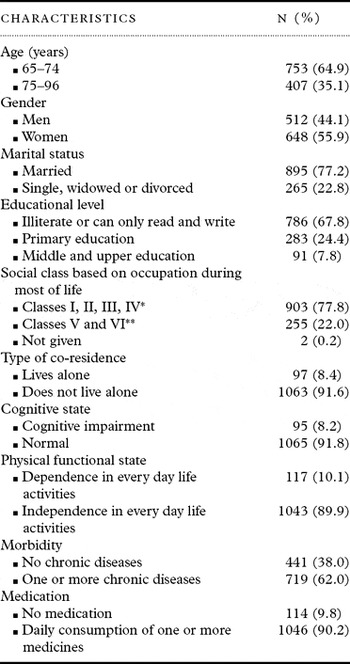
Of the 1,387 older adults selected, 1,160 (83.6%) could be evaluated. There were no statistically significant differences as regards age and gender between the participating subjects and those who refused to take part. The mean age of the participants was 73.3 years ± 5.9 SD (95% CI: 73.0–73.7). The full set of characteristics measured is given in Table 1.
Characteristics of the participants

*Directors, civil servants, liberal professions, highly qualified technicians, middle management, administrative workers, safety and protection service staff, skilled manual workers.
**Unskilled manual workers (industry, business, services and primary sector) and housewives.
The mean score of the DDES was 4.4 ± 0.1 SD (CI 95%: 4.1–4.7) and the mean score of the GDS-15 was 1.9 ± 2.3 SD (CI 95%: 1.8–2.1). The skewness coefficients were 1.3 (SE: 0.7) and 1.9 (SE: 0.7), respectively.
According to the results of the GDS, 91.7% of subjects had a normal mood state (score between 0 and 5), 6.1% of subjects had probable mild depression (score between 6 and 9) and, 25 subjects had a score of 10 or more (2.2%; 95% CI: 1.4–3.2), compatible with established depression. In turn, using the DDES, we identified probable MDD in 50 subjects (4.3%; 95% CI: 3.2–5.7). A moderate correlation was found between the scores of the two scales (r = 0.570; p < 0.001). The intra-class correlation coefficient between the scores of the two scales was 0.578 (95% CI: 0.539–0.615). By means of the Kappa index we determined that the degree of concordance between the level of depression according to GDS and probable MDD according to DDES, was 0.520. Using McNemar's test of symmetry we found a statistically significant (p < 0.001) discordance between the two scales (30 subjects were DDES positive and GDS negative, 5 subjects were DDES negative and GDS positive, and 20 subjects were DDES positive and GDS positive).
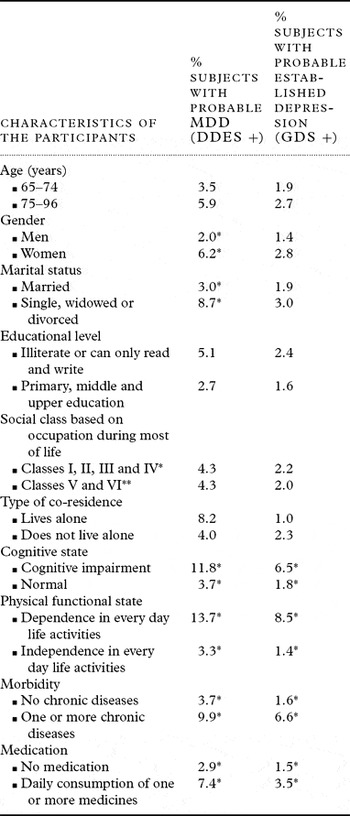
The mean age was not significantly different in subjects with a positive or negative result, both in the DDES and the GDS; however, the proportion of subjects with multiple diseases was significantly superior both in subjects with DDES + (36.0 versus 20.2; p = 0.007) and in subjects with probable depression according to the GDS (48.0 versus 20.3; p = 0.001). Table 2 shows the proportion of subjects with probable MDD (DDES +) or with probable established depression (GDS +) according to the rest of the variables used in the study.
Proportion of subjects with probable MDD or probable established depression according to participant characteristics

*Statistically significant difference (p< 0.05).
MDD = Major Depressive Disorder; GDS = Geriatric Depression Scale; DDES = Detection of Depression in the Elderly Scale.
According to logistic regression analysis, the variables associated with a probable MDD (DDES +) were: dependence in activities of daily living (OR: 3.3; 95% CI: 1.7–6.4), female gender (OR: 2.3; 95% CI: 1.1–4.9), marital status single/widowed/divorced (OR: 2.0; 95% CI: 1.1–3.6) and the presence of four of more health problems (OR: 2.1; 95% CI: 1.1–4.3). In the case of established depression (GDS+) the associated variables according to multivariate analysis were: dependence in activities of daily living (OR: 5.3; 95% CI: 2.3–12.4) and presence of four or more health problems (OR: 3.2; 95% CI: 1.3–7.8).
Discussion
The problem of identifying and distinguishing MDD in the primary care setting is widely mentioned in the literature. Only about a third to a half of patients with MDD are recognized as having such a disorder by their doctors (Volkers et al., Reference Volkers, Nuyen, Verhaak and Schellevis2004). Several explanations for this have been proposed, such as inadequate training of primary care doctors in mental health or the lack of sufficient time to dedicate to each patient (Fernández-San Martín et al., Reference Fernández-San Martín2002). This difficulty in detecting MDD increases in older people, who often have other symptoms that could be confused with depressive symptoms (Fernández-San Martín et al., Reference Fernández-San Martín2002; Segulin and Deponte, Reference Segulin and Deponte2007). The validation of the DDES was performed with older persons in a primary care setting. Their sociodemographic characteristics and educational level were similar to those for whom the scale was designed and the items were easily understood by all the interviewees. In this respect, it is essential that the scales are suitably adapted to the cultural setting in which they will be used.
Psychiatrists are generally of the opinion that general practitioners could treat many of the patients they refer to them, if the detection and diagnosis process were improved (Gabinete de Estudios Sociológicos de Bernard Krief, 1997). However, given the current difficulty in primary care of ensuring thorough diagnostic procedures, scales to support diagnosis need to be developed that specifically focus on MDD and not only on detecting depressive symptoms, which is what most of the available screening tools do. To meet this requirement, the DDES provides appropriate reliability indices (López-Torres et al., Reference López-Torres2005) and was specifically validated in the primary care setting. It has a high sensitivity (90.4%) corresponding to that needed for an early diagnosis of this disorder in primary care and has moderate specificity which enables 74.8% of persons without MDD to be classified correctly.
We found only a moderate correlation between the DDES and the GDS, and a considerable degree of discordance. The prevalence of MDD (4.3%) obtained with the DDES is notably higher than that of established depression (2.2%) obtained with the GDS. This prevalence is compatible with that reported in the literature where studies of Spanish people older than 64 suggest an MDD prevalence of 4.8% using DSM-IV criteria (de la Cámara et al., Reference de la Cámara, Saz, López-Antón, Ventura, Día and Lobo2008) and 5.0% using clinic criteria (Urbina Torija et al., Reference Urbina Torija, Flores Mayor, García Salazar, Torres Buisán and Torrubias Fernández2007). Although both findings are compatible with the prevalence of MDD found in previous studies, ranging from 1% to 5% (Conde and Bescos, Reference Conde and Bescos1993; Henderson et al., Reference Henderson1993), the DDES may be a more sensitive tool in primary care, with fewer false negatives when identifying MDD. In any event, future studies need to establish simultaneously the validity of the criteria of both scales compared to the diagnosis of MDD by psychiatrists. So far, in Spain, this comparison has only been made with the DDES.
Our findings did not reveal any statistically significant differences as regards the age of the subjects with a positive DDES result compared to those with a negative DDES result. However, we found a significant difference in the number of health problems between those subjects with positive results and those with negative results, both for the DDES and the GDS. The correlation between the numbers of health problems and positive result has been reported in earlier studies (Meara et al., Reference Meara, Mitchelmore and Hobson1999; López-Torres et al., Reference López-Torres, Escobar Rabadán, Boix Gras, Galdón Blesa, del Campo del Campo and López Verdejo2006; Karp et al., Reference Karp, Rudy and Weiner2008) and has been identified as one of the major problems in the diagnosis of depression in older persons.
In conclusion, using the DDES (previously validated in the primary care setting for identifying MDD using, as the gold standard, the diagnosis by psychiatrists based on DSM-IV criteria), we found a prevalence of 4.3% in a representative sample of older people. This prevalence is compatible with that reported in the literature in this population group. Compared to the most commonly used scale, the GDS, the DDES may by considered a more sensitive screening tool for the identification of MDD in primary care.
Conflict of interest
None.
Description of authors’ roles
Beatriz Navarro, Fernando Andrés, Ignacio Párraga and Jose Miguel Latorre carried out the study and analyzed the data; Susana Morena collected the data; and Jesús López-Torres formulated the research question, designed the study and analyzed the data. All authors contributed to the writing of the paper.
Acknowledgments
The study was financed by the Carlos III Institute of Health (Ministry of Health and Consumer Affairs Program for the Promotion of Biomedical and Health Sciences Research, Regulation SCO/3425/2002 of 20 December, file no. P1031562) and by the Ministry of Health of Castilla-La Mancha (Resolution 05–09–2003, D.O.C.M. no. 131 of 12 September 2003).
Appendix 1. Detection of Depression in the Elderly Scale (DDES)
The DDES is administered to patients aged 65 years or older who give a positive response to the question “Have you felt downhearted recently?”

Score: one point for each positive response to items 1, 2, 3, 4, 7, 8, 9, 10, 11, 12, 13, 14, 15, 16, 17, 18, 20, 21, 22, 24 and 25 and one point for each negative response to items 5, 6, 19 and 23.