Debates around cultural properties tend to focus on law and ethics, on appropriation and ownership, with media representations often producing stereotypes that reinforce and polarize the terms of the debate. The common, typically polemical, notion is that rapacious museums are merely a final resting point for captive static objects, with repatriation viewed as simply restorative compensation. A robust challenge to this view was developed in the Declaration on the Importance and Value of Universal Museums signed in 2002 by the directors of 19 leading museums in Europe and North America.Footnote 1 The concept of the universal museum asserts that objects are cared for and held in trust for the world, overriding shifting political and ethnic boundaries and enabling the visitor to see “different parts of the world as indissolubly linked.”Footnote 2 Although many would be in sympathy with the rhetorical position asserted, critics have argued that the declaration is a thinly veiled attempt to bolster immunity to repatriation claims. On both sides of the debate, the hegemonic position of many museums remains unsettling.
Jason Hall, The do-it-yourself repatriation kit (2006). Open leather briefcase containing a club hammer, with a baggage tag from London's Heathrow airport. The interior foam lining has a recessed compartment in the characteristic shape of a Maori hei tiki ornament.

Drawing on the experience of the exhibition Pasifika Styles at the University of Cambridge Museum of Archaeology and Anthropology (MAA),Footnote 3 and the processes involved in its creation and reception, the article shifts the focus on utterly fixed objects unambiguously owned by individuals, communities, and institutions, to a more relational understanding of the dynamic links between people and things. A central premise of relational models is that entities (both objects and people) emerge from (and thus acquire substance, meaning, and value through) the relations in which they are enmeshed.Footnote 4 A relational approach to the museum and the objects it contains highlights the productive potential of museum collections and exhibitions to link people and ideas over time and space.Footnote 5 Recent projects, both within the Pacific and between particular Pacific communities and museums in Europe and America, have shifted the emphasis from ownership (in a narrow sense of the term) to considerations of access, use, and interpretation.Footnote 6 In many instances, this shift has reconnected communities with treasured historic objects, reinvigorating their potency and reinforcing the presence of the ancestral past in the present. Furthermore, contemporary art practice, often involving members of diasporic communities, provides an insightful and powerful commentary on ideas about appropriation and reciprocity.Footnote 7
Pasifika Styles was initiated by museum curator Amiria Salmond with guest curator Rosanna Raymond, a Samoan New Zealander living in London, who has continued to be an influential figure in Maori/Polynesian fashion, performance, and installation art.Footnote 8 Rosanna Raymond's leading role as both cocurator and participating artist was crucial to the development of the project, as was the active involvement of numerous Maori- and New Zealand–based Pacific Island artists, many of whom came to Cambridge to participate in its creation, opening, and associated outreach activities. Pasifika Styles was generated from a less proprietorial form of curatorship, which facilitated members of local and diasporic communities to reconnect with their tãonga (ancestral treasures) and revitalize the museums collections, both physically and spiritually.
Working with museums and collections can help bridge the gaps that have opened in the process of housing, collecting and writing about indigenous people over the past 200 years. They could be arenas for cultural exchange, going outside the boundary of the space into everyday life.Footnote 9
The poster image for Pasifika Styles features Raymond's tattooed hand reaching toward a Maori tãonga, a hei tiki neck pendant (MAA Z 6498) collected in 1907 by Baron Anatole von Hügel, the museum's founding curator. Her arm is decorated with boar's tusk ornaments from Samoa (also in the museum's collection) and her gesture highlights the living and dynamic aspects of Pacific art (Figure 2). Commenting on the image Raymond stated, “I see him coming into the world of light, re-connecting to the living aspect … and binding Maori with the Pacific.”Footnote 10
The poster image for Pasifika Styles featuring Raymond's tattooed hand reaching toward a Maori tãonga, a hei tiki neck pendant (MAA Z 6498) collected in 1907 by Baron Anatole von Hügel, the museum's founding curator.

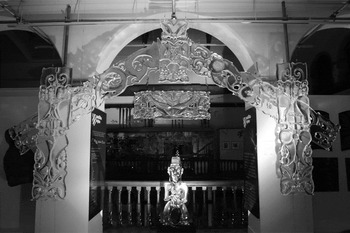
The exhibition opens with George Nuku's Outer Space Marae (2006), carved from acrylic Perspex and inlaid with paua (Haliotis shell). Its positioning at the entrance of the exhibition highlights the transformation of parts of the gallery into Maori space and the connection between ancestors and their contemporary kin (Figure 3). Adept at moving between cultural worlds, Nuku describes his “multitudinal self,” his ability to take his family and tribe with him: “When you enact your culture you don't need to translate your culture anymore.”Footnote 11
George Nuku, Outer Space Marae (2006), carved from acrylic Perspex and inlaid with paua (Haliotis shell).

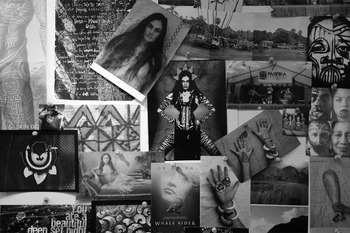
Visible through the marae's facade, on the opposite side of the gallery, is Rosanna Raymond's large glass-case installation, Eye land Part II: Welkome 2 da K'lub (2006). Raymond's work plays with puns and analogies that tease as well as elicit insightful connections between things. Da K'lub is framed with a selection of Polynesian clubs from the museum's collections, arranged along the top of the long case in a manner inspired by the symmetrical arrangements of weapons on the walls of colonial residences and the layout of many ‘traditional’ museum displays (Figure 4). Her Eye land is a strong visual evocation of contemporary Polynesian life in New Zealand and beyond. The walls are covered with hundreds of overlapping photographs, posters, magazine covers, and ephemera, which document a vibrant and intense period of intercultural creativity involving Auckland-based Maori and Pacific Islander artists in dialogue with international youth and fashion culture (Figure 5). As a performing artist and founding member of the art collective Pacific Sisters, Raymond's own art practice has been central to these developments.Footnote 12 The case also includes many personal items such as photographs, jewelry, ornaments, and T-shirts. A Samoan raffia and pandanus skirt from the museum's collection (MAA 1925.151) is displayed alongside a new skirt created by Raymond from plaited yellow plastic raffia strips decorated with cowrie shells.
Rosanna Raymond's large glass-case installation Eye land Part II: Welkome 2 da K'lub (2006). Suspended in front of the case is Annie O'Neil's etuit/little stars (2006) composed as part of an outreach project for children at the museum.

Detail from Rosanna Raymond's large glass-case installation Eye land Part II: Welkome 2 da K'lub (2006), with central image of Raymond from the Pacific Sisters.

Raymond carefully selected specific museum objects to include in her artwork, which allude to varied and complex historic relations between Cambridge and the Pacific. A nineteenth-century Samoan mat (MAA 1951.775) is displayed on the case floor with an old hand-written label, which reads as follows:
King Matafa of Samoa and his Queen sat on this mat to receive Dr Alex Hill [late Master of Downing College in Cambridge] and his wife and son and daughter, at a kava drinking in 1895 when they visited the islands. After the ceremony, King Matafa rose and presented the mat to Dr Hill … donated by Miss E. Hill 1951.775.
Positioned on the mat, a roughly carved wooden female figure from Fiji, donated by the museum's founding Curator Baron von Hügel, hints at more ambiguous relations. As a young man, von Hügel worked in Fiji between 1875 and 1876 recording details of customary life and collecting objects. The catalog card for the figure (MAA Z 2869) notes that it was “given to the collector by Ninona, a pretty half caste Kai Loma girl at (Bau) Mbau as her portrait.” Although ‘portrait’ is a misnomer, the figure appears to have been a memento of a relationship between von Hügel and the girl. Prior to display Raymond was concerned that the figure appeared neglected, so carefully dressed her with a whale-tooth necklace from the collection, a miniature plaited hula skirt she crafted herself and a feather and shell anklet, thus restoring a sense of decorum to the figure and clothing it as it might have been clothed in the past.Footnote 13 Researching the museum's collections, Raymond explained that she feels “a strong bond to my ancestors when I meet ‘artefacts.’ It is like a direct line opens up with my cultural heritage, the past becomes present.”Footnote 14
The living dynamic between the past and present is demonstrated in a powerful and evocative installation by Maori artist Lisa Reihana, a leading figure in the development of multimedia art in Aotearoa New Zealand. Her he tautoko (2006) features a carved wooden tekoteko (MAA 1939.70), an ancestral figure originally attached to a house gable. The carving was collected in the 1830s by Baron von Hügel's father near the Bay of Islands, tribal homeland of the artist's father (Figure 6). This region was also the first center of colonial government and therefore the location from where some of the first Maori objects left Aotearoa. The tekoteko, nearly a meter in height, is positioned in the top half of the case so that its iridescent shell eyes look down on the visitor. The figure is wearing large white headphones, plugged into a visitor's listening post, and placed with its back to a video screen displaying digitally manipulated images of nineteenth-century Maori collections in the museum and of the artist's journey between New Zealand and Cambridge. The movements on the screen, the stories, and the songs (including a rendition of the artist singing “My Bonnie Lies Over the Ocean”), animate the figure, highlighting its continued ancestral presence and ongoing connection to both past and contemporary events. Rather than being didactic, the artist's intention is to activate people into thinking for themselves about the possible meanings created by the repositioning of objects from the museum's collections. Commenting on the creation of this installation within the museum, Reihana notes the following:
It's interesting territory for an artist to work in a museum; they have collections—rich and loaded material. It's not the blank canvas that a gallery usually presents … We call treasured artefacts ‘tãonga.’ Pasifika Styles allows me the opportunity to show people these aren't just objects, they embody the life blood of our living culture.Footnote 15
Lisa Reihana, he tautoko (2006). The installation features a carved wooden tekoteko (MAA 1939.70), an ancestral figure originally attached to a house gable. The figure is wearing headphones, plugged into a visitor's listening post, and positioned in front of a video screen.

An adjacent photographic installation by Reihana, Hongi Hika BA (Cantab.): ‘an emblem of wisdom … ?’ (2006) refers to a critical historic encounter between the University of Cambridge and Hongi Hika (1772?–1828), a Maori chief and war leader of the Ngapuhi iwi (tribe). Hongi Hika travelled to England in 1820 on board the whaling ship the New Zealander, accompanied by the missionary Thomas Kendall. He spent five months in London and Cambridge, where he worked closely with the linguist Professor Samuel Lee at Queens College. Lee went on to write the first orthography of the Maori language, but Hongi Hika's contribution to this important scholarly work was never formally acknowledged. This is redressed in a series of three photographs, where another Pasifika Styles artist, Reuben Paterson, standing in for Hongi Hika, is shown in front of a college wall receiving his long-overdue Cambridge degree. In the photograph Reihana has painted lines over Paterson's face, alluding to Hongi Hika's moko (tattooed visage). He wears a Maori cloak composed by Reihana of Cambridge college scarves, stitched together and embellished with tassels of goat hair, and holds a rolled degree certificate (Figure 7). The photographs, positioned above the cloak itself, are captioned “word power” and “fire power,” the latter alluding to the guns Hongi Hika brought back with him from England and used to overrun much of the North Island.
University of Cambridge Newsletter with image from Lisa Reihana's installation Hongi Hika BA (Cantab.): ‘an emblem of wisdom … ?’ (2006). The photograph shows artist Rueben Paterson, wearing a Maori cloak composed of Cambridge college scarves, standing in for Maori chief Hongi Hika (1772?–1828), who is belatedly receiving an honorary degree from Cambridge.

Drawing on extensive research on historic Pacific photographs held in museums and archives, artist Shigeyuki Kihara explores how people and places are collected and classified. Her large and compelling photographic triptych, Fa'a fafine in a manner of a woman (2005), challenges stereotypic representations of Polynesian women as sensuous “dusky maidens” and raises questions regarding the attribution of gender and racial identity (Figure 8). Transgendered and of mixed Japanese and Samoan descent, Kihara positions herself centrally within the series of black and white images which both mimic and critique the techniques of nineteenth- and early twentieth-century studio photography. The artist is posed in a semireclined position on a Victorian settee flanked by potted plants with a backdrop covered by a plaited mat. In the first image she is wearing a scant hula skirt, with a floral ear ornament and a strand of beads hanging loosely from her left shoulder. Although her posture and expression are identical in all three images, the subsequent photographs are surprisingly revealing. Responding to the voyeuristic and titillating expectations of the genre, in the second image her hula skirt is removed and in the final image a penis protrudes from between her tightly closed legs. Although positioning herself as the fictive subject of a typically male, colonial gaze, Kihara looks directly at the viewer, as if to challenge their presumptions. Her reenactment both highlights and subverts the power of colonial photography to classify and subjugate. The ‘reality’ of the image is also undermined by the torn edge of the mat background, which reveals a further backdrop and draws attention to the artificiality of the studio setting.
What people see with me is the surface of what's being presented to them, but not necessarily what you would call a reality. I am Polynesian, I am Asian, I appear publicly and live as a woman within my male anatomical body—this is known as fa'a fafine in Samoa—third gender is the closest western interpretation. The Fa'a fafine work questions the western classification of races, gender and sexuality. I can never fit into them, but at the same time I ask myself—are they worth fitting into?Footnote 16
Shigeyuki Kihara's photographic triptych, Fa'a fafine in a manner of a woman (2005). MAA 2007.465

A series of installations by Maori artist Maureen Lander feature her exquisite and at times fanciful weavings, some of which extend beyond the confines of the display cases. Her artwork has been inspired by more than 15 years of research on feather and fibre objects in museum collections in New Zealand and overseas. She describes the intriguing qualities of objects that have been “kept in the dark” in museum storerooms. “Discovering them is like meeting old friends for the first time—a sense of recognition and sadness, and an urge to bring them back into the light and give them new life through referencing them in my art-making process.”Footnote 17 Lander is also interested in how objects are interpreted and displayed in museums and how different kinds of meanings are brought up in particular contexts. One of her installations in the gallery, This is not a kete (1994/2006), focuses on a large kete (woven bag), which she made specifically for display. Here the kete becomes a kind of meta-object that invites reflection rather than use. Lander has created site-specific installations at a number of museums and galleries, including Mrs Cook's Kete, originally developed at the Pitt Rivers Museum in Oxford and adapted for Pasifika Styles.Footnote 18
Developing customary weaving skills for new contexts and creatively incorporating new material and techniques, Lander's artworks directly challenge the distinction between traditional and contemporary. “One of the main things that I have learnt from Museums is that weavers were always innovating in response to new materials, developing new technologies. So I have come to believe that that is what is traditional—to be innovative—and in that way there is a continuum.”Footnote 19
Another continuum between past and present evident in the exhibition is the strong link between land and indigenous identity and the creative use of artwork to assert political entitlements to customary resources. Lander's main installation, Crown Grab Bag (2006), features a magnificent fibrous crown perched on a royal, purple silk pillow embellished with golden tassels (Figure 9). The work references the New Zealand Foreshore and Seabed Act of 2004, which empowered the New Zealand government, “the Crown,” to override tribal rights to pursue customary claims to the foreshore and seabed through the courts. Lander's crown is delicately woven from a variety of fibres, including plant materials that grow along the foreshore—the creation of the crown itself is thus a subtle but defiant act of reappropriation. Shells and fishing hooks from the museum's collection are placed on the base of the case. Strands of pingao fiber, stitched into the fabric lining at the back of the case, form inverted U-shapes representing the raised eyebrows of Tane (god of the forest). According to Maori legend, following a dispute between Tane and Tangaroa (god of the sea), Tane's eyebrows were flung on to the sand dunes, which mark the liminal space between the forest and the sea. Here Lander connects contemporary political conflicts to legendary battles. This part of the installation is reflected on the other side of the gallery in a large-scale version arranged over the archway leading through to the museum's stores. In this work, Tane Raises his Eyebrows (2006), Tane expresses his surprise and disapproval at the crown's decision to expropriate resources that are collectively owned and used by Maori people and connect them back to their ancestors. This theme is also picked up in Kewana Duncan's costume piece Fulltime Revolutionary, which includes a video presentation of the massive hikoi or protest march against the confiscation of the seabed and foreshore of Aotearoa.
Maureen Lander's Crown Grab Bag (2006) features a magnificent fibrous crown perched on a royal purple silk pillow embellished with golden tassels.

Fuelled by the entangled colonial history embodied within museum collections and contemporary artworks, the exhibition space is a powerful forum for contemporary political debates. Although Pasifika Styles provides the opportunity for artists to reconnect with and breath new life into their tãonga, which have been carefully preserved by the museum over many decades, the exhibition also offers a forum to express frustrations and raise questions about museum practices of collection, classification, and containment. Wayne Youle's installation is composed of numerous modular storage boxes, stacked together in a locked display case. Some were crafted by Youle himself, based on those formerly used to store preserved Maori heads in the museum prior to their repatriation, others are actual museum boxes containing Maori artifacts (Figure 10). The labels on the boxes both follow and extend the museum's classification system, from functional categories and object types such as “weapons” and “adze heads” to “someone else's stuff” or “visitor (special).” One of Youle's boxes displays a nineteenth-century image of British military officer Horatio Robley in front of his substantial collection of toi moko or tattooed Maori heads.Footnote 20 It alludes to the fascination of Western collectors for these highly exoticized human objects, which prompted a grisly trade in the nineteenth and early twentieth century and epitomized the macabre extremes of collecting. Belatedly, many museums have cooperated with Maori requests for their repatriation and these ancestors are quietly and steadily making their way back home. The notion that artifacts or tãonga are still alive is suggested by the breathing holes drilled into some of the storage boxes and via the headphones attached to others. The sounds of breathing or scratching, as if something or someone inside was attempting to escape, are a powerful evocation of the pain of alienation and separation.
Museums are that kind of hush-hush, clean, untouchable, tapu kind of space. You wanna touch everything but you can't. It's a thing I'd like to explore, like what's behind all those boxes.Footnote 21
Detail of Wayne Youle's installation hahea (2006) composed of numerous modular storage boxes, stacked together in a locked display case. The box on the left has breathing holes, whereas that on the right displays a nineteenth-century image of British military officer Horatio Robley in front of his collection of toi moko or tattooed Maori heads.

The right of museums to hold material from other cultures is most forcefully challenged by Jason Hall's The do-it-yourself repatriation kit (2006). An open leather briefcase, with baggage tag from London's Heathrow airport attached to the handle, contains a club hammer (see Figure 1). The interior foam lining, with a recessed compartment in the characteristic shape of a Maori hei tiki ornament, makes the intended purpose of the hammer obvious. Ironically, the installation, which seems to advocate the forceful liberation of tãonga, is itself contained within a museum display case. Although the suggestion of smash and grab may be interpreted as overtly threatening, its positioning within the museum is both playful and provocative. The do-it-yourself repatriation kit is perhaps best understood as a demand for recognition and engagement.
Although several of the artists' installations incorporate historic pieces from the museum's collections, contemporary artworks have also been used as interjections in the main anthropology gallery, bringing a renewed vitality to the predominantly historical displays. Next to the Maori case is a video installation, Tales of the Maori Border (2006) by Natalie Robertson and Hemi Macgregor, which refers to Maui, a shapeshifter and popular character in Polynesian legends (Figure 11). Opaque window inserts with avian designs composed by Sheyne Tuffery accentuate the spiritual importance of birds in the Pacific, where feathers are also an important symbol of wealth and status. Chris Charteris' alluring greenstone pendants and necklaces made of Perspex whale's teeth stand out against the symmetrical arrangement of Fijian ivory and shell ornaments based on nineteenth-century display aesthetics (Figure 12). Charteris pays great attention to materials and form, activating the energy inherent within his creations:
Before I start making, I think about what sort of energy I wish to portray. In making these works I have contemplated what would be appropriate for a chief or a person with big mana to wear. What would have enough power, status and impact.Footnote 22
George Nuku's placement of a specially carved perspex patu (hand club) in the Maori display case in the permanent gallery is an eloquent evocation of the productive potential and ambiguities involved in the movement of objects and ideas between the Pacific and the United Kingdom (Figure 13). Nuku's Patoo Patoo Pasifika (2006), gifted to the museum and inscribed with a version of the Pasifika Styles logo, refers to much earlier exchanges through which Cambridge acquired eighteenth-century Maori tãonga collected during the voyages of Captain Cook. The label for Nuku's patu reads as follows:
After returning with Captain Cook from the Pacific in 1771, the naturalist Joseph Banks commissioned a set of bronze patu (hand clubs) bearing his coat-of-arms, cast from a Maori patu onewa. His purpose was to take them on Cook's second voyage to use to impress the locals. This work is an echo of those earlier works. By bringing this Patu to England, I am returning the favour.Footnote 23
Natalie Robertson and Hemi Macgregor, Tales of the Maori Border (2006).

Chris Charteris greenstone pendant displayed in front of a symmetrical arrangement of Fijian ivory and shell ornaments collected in the nineteenth-century.

George Nuku's Patoo Patoo Pasifika (2006) carved from Perspex with the Pasifika Styles logo.

The distinctive spaces and environments created within the Pasifika Styles gallery also reveal the different regimes of the senses at play.Footnote 24 In Europe there is a long history of privileging visual perception, reinforced by colonial practices that attempted to impose Western hierarchies of the senses as well as Euro-American museums and galleries, which cultivated particular ways of seeing now seen as paradigmatic. A critical aspect of the ‘politics of liberation in museums' involves challenging the sensory relations between people and objects. The artists' engagement with ancestral tãonga is not limited to visual appreciation and the presentation of the artworks similarly invites a range of sensory engagements. Sounds from the art videos, shown in a cinematic viewing area, subtly permeate the gallery. Two of the artists’ installations include headphones on listening posts, as described earlier; and interviews with individual artists, recorded by Sarah Robins, are accessible on audio handsets at a purpose-built audio station looking out over the gallery. Filipe Tohi's tactile and interactive Tupu'anga (ancestor, origin or source) (2005) is composed of a series of three dimensional black and white rectilinear shapes, which the visitor is encouraged to fit together to make a variety of forms (Figure 14). His work is based on the ancient Pacific Island art form of lalava (lashing) that was used for joining and binding materials together. He describes lalava patterns as a “mnemonic device for representing a life philosophy. Lalava patterns advocated balance in daily living and were metaphorical and physical ties to cultural knowledge.”Footnote 25
Filipe Tohi Tupu'anga (ancestor, origin or source) (2005) composed of three-dimensional rectangular shapes.

The Living Room section of the gallery creates a sensuous and cozy ambience, with dappled light filtered through Tracey Tawhiao's curvilinear designs painted over the window (Figure 15). Her textured wallpaper, made from pieces of newspaper, is over-painted with lustrous colors to obscure many of the stories and to highlight particular phrases such as “lend us your ear,” “we're looking for people to take us to our future” and “a foothold in paradise”—in what Tawhiao describes as an attempt to “find the news beyond the newspapers,”Footnote 26 which so often contain ill-informed and negative portrayals of Maori and Pacific peoples. Photographs by Greg Semu, exploring the affect of Christianity on his Samoan people, hang next to the mantelpiece. Visitors to the exhibition are encouraged to sit on the customized sofa, covered by Ani O'Neil with a patchwork of brightly coloured floral-patterned fabric, and to feel the tactility of the crocheted throw. They can watch ‘television’ via a video monitor playing a documentary commissioned for the project from New Zealand-Samoan academic and broadcaster Lisa Taouma, featuring interviews with many of the artists. Here they are able to speak all but directly to the viewers about their work, framed within the political and social context of their lives and ambitions. Two Edwardian display cases in the living room, arranged to resemble household cabinets, contain a variety of personal tãonga: greenstone hei tiki, pieces of barkcloth, tattooing implements, and hand clubs, all from the museum's collections. These museum objects are not labeled as artifacts but rather displayed as personal and family heirlooms within this simulated domestic settling. Their meanings are embodied in the personal and social relations of their production and use. This popular area of the exhibition is different from the static room-sets found in other museums; visitors often hang out in this comfortable and familial interactive space.
Living Room installation with wall paper and window screen design by Tracey Tawhiao and sofa customized by Annie O'Neil. The video monitor shows George Nuku, part of a series of artist's interviews.

During their visits to Cambridge, the Pasifika Styles artists engaged with the museum and its collections on many levels. Che Wilson composed a waiata (traditional song) for Pasifika Styles, which was sung on and off throughout the installation and performed at the opening by members of Ngati Ranana, the London Maori Club, together with many of the artists. With care and respect, tãonga were handled, caressed, smelled and used in ceremonies and performances. Although acknowledging the role of museums in preserving these artifacts, Nuku expressed his frustration at their separation from daily life.
I feel sorry that the tãonga aren't breathing like they would out in the garden or wherever, getting damaged and getting sweaty Maori hands fondling them and snot and tears all over them and being kissed and stuff.Footnote 27
The museum agreed to the request that specific items from the collections be used in the opening ceremonies, confident that the cultural descendants of their makers would ensure their wellbeing. Che Wilson, a distinguished Maori orator, together with his relative Gerrard Albert, developed the tikanga or protocol surrounding the opening of the exhibition. Che officiated on the day carrying a taiaha staff (MAA Z 6381) and wearing a korowai (cloak) made by Raymond, which they nicknamed a sugawai, referring to its innovative style that blended aspects of hula skirt and a cloak.Footnote 28 He led the formal blessing that took place before the exhibition opening, involving the artists and museum staff, which was intended to lift the spirit of the tãonga and unite together the participants in the exhibition's creation (Figure 16). Prior to the spectacular opening event, guests were required to wait outside the museum while Wilson explained what was to follow. Suddenly, artist George Nuku emerged for the wero or ceremonial challenge, intended to test the intentions of incoming visitors. Displaying his full body moko (tattoo), he charged toward the visitors, wielding his Perspex taiaha (club), and chanting loudly with hisses and a protruding tongue. His vigorous and agile movements were a forceful demonstration of the power and strength of the Maori people (Figure 17). Guests were then invited to come inside, where they were welcomed by members of Ngati Ranana and Beats of Polynesia, a Cook Islands group, with singing, drums, and chants. Throughout the evening, bullroarers were swung in the gallery, Jerome Kavanagh played traditional musical instruments, and Raymond performed with a greenstone mere (hand club) from the museum's collection.
Che Wilson leading the blessing before the opening carrying a taiaha staff (MAA Z 6381). Pasifika Styles artists and museum staff circle the gallery lifting the spirit of the taonga.

Artist George Nuku's wero, a Maori ceremonial challenge.

The power of the opening and the strength of the exhibition overall was made possible by the collective efforts of artists and curators, facilitated by museum staff relinquishing strict authority over the collections and methods of presentation. In this way Pasifika Styles demonstrates the importance and potential of acknowledging different kinds of expertise and interests in the objects they hold in trust. Here, the museum itself shifts from being a hegemonic institution, aligned to the pedagogical and self-serving interests of state,Footnote 29 to a restorative agent, which provides a forum for debate and creative dialogue. Pasifika Styles demonstrates the potency of developing the collaborative capacity of kaitiaki or guardians, both of the objects and of crucial relationships between people and their tãonga.
Thanks especially to Cambridge we are able to touch our tãonga, and by touching our tãonga without white gloves we give life back to the tãonga … They have had a very long sleep … When we touch them it gives them life and they give us life—it is a reciprocal thing.Footnote 30