Behavioral disinhibition models propose that aggressive behavior can contribute to experiencing negative peer relationships, which increases risk for adolescent substance use (Iacono, Malone, & McGue, Reference Iacono, Malone and McGue2008; King et al., Reference King, Keyes, Malone, Elkins, Legrand, Iacono and McGue2009; Zucker, Heitzeg, & Nigg, Reference Zucker, Heitzeg and Nigg2011). Identifying developmental pathways to adolescent marijuana use is important based on increases in marijuana use with legalization and evidence that early chronic marijuana use can adversely affect cognitive functioning across the lifespan (Meier et al., Reference Meier, Caspi, Ambler, Harrington, Houts, Keefe and Moffitt2012; Volkow et al., Reference Volkow, Swanson, Evins, DeLisi, Meier, Gonzalez and Baler2016). In particular, aggression in middle childhood (ages 6–11 years) is associated with peer rejection (Chen, Drabick, & Burgers, Reference Chen, Drabick and Burgers2015), which can contribute to marijuana use in adolescence (Prinstein & La Greca, Reference Prinstein and La Greca2004). Importantly, one's underlying genetic predisposition for behaviors such as aggression, can influence peer relationships (e.g., peers a child affiliates with, quality of peer relationships), a phenomenon known as a gene–environment correlation (rGE; Plomin, DeFries, & Loehlin, Reference Plomin, DeFries and Loehlin1977). Thus, in addition to being influenced by social context, peer relationships may provide risk for adolescent substance use through genetic processes.
Emerging evidence indicates that genetic influences on risk for psychopathology and substance use may be moderated by psychosocial interventions. For example, a meta-analysis found that genetic effects were detected in control groups but muted in intervention groups (see Van IJzendoorn & Bakermans-Kranenburg, Reference Van IJzendoorn and Bakermans-Kranenburg2015 for a meta-analysis). Accordingly, psychosocial programs are thought to provide parent and/or child level supports for behavior that may prevent the expression of underlying genetic predispositions. However, in the absence of such positive supports, aggression and negative peer relationships can increase risk for substance use. Thus, it is important to identify etiological risks for negative peer processes originating from genetic predispositions and test whether psychosocial interventions may be able to prevent their expression.
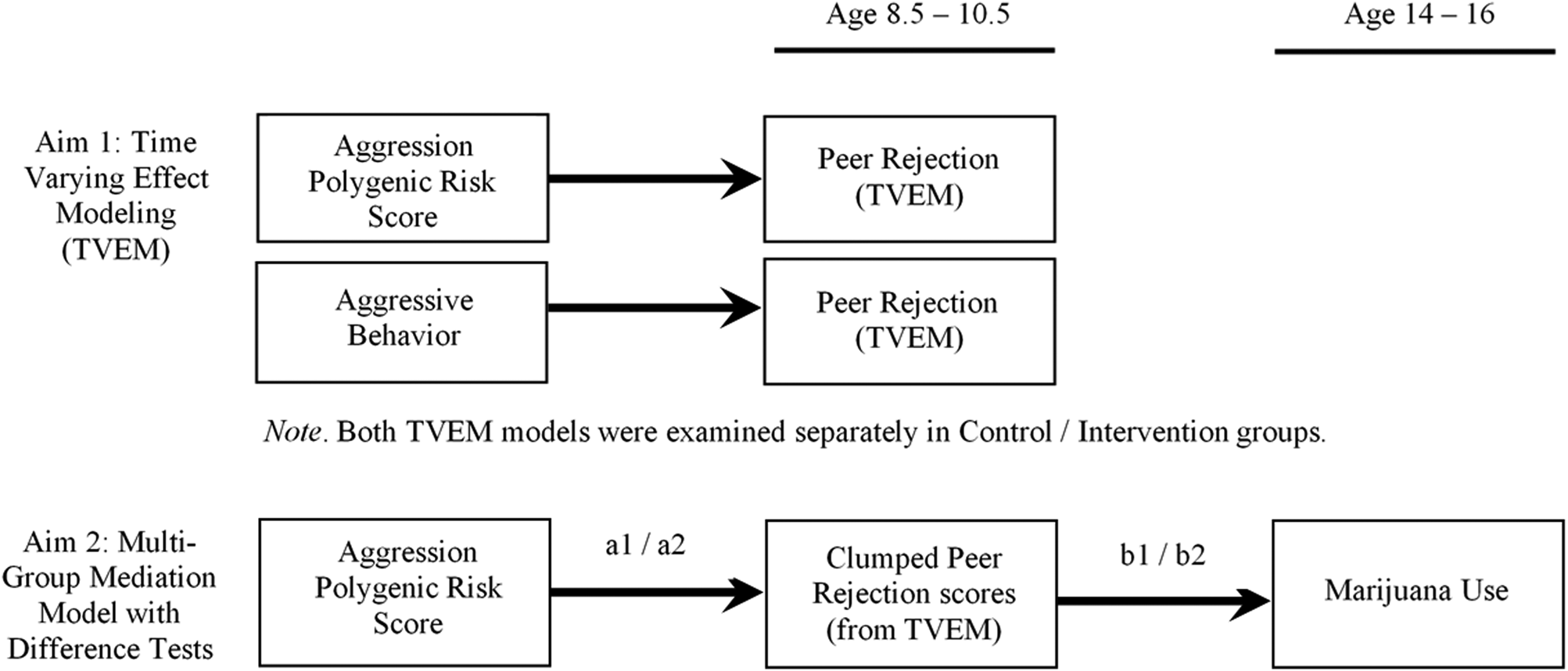
To address these gaps, we formulated two aims as part of our conceptual model (see Figure 1). The first aim focuses on polygenic risk for aggression and aggressive behavior as two risk factors for peer rejection across middle childhood. The second aim leverages findings from the first aim to examine a mediated model in which polygenic risk for aggression predicts adolescent marijuana use via age-specific peer rejection. Because the design of the current study included a randomized controlled trial examining the efficacy of a family-based intervention, the Family Check-Up (FCU), all models were tested separately in intervention and control groups. For the second aim this provided an opportunity to test whether the strength of paths from genetic risk for aggression to peer relations to substance use differed between intervention and control groups.
Conceptual model. Note: The mediation model was examined separately in Control / Intervention groups. Difference tests compared the equivalence of the “a” paths (a1 = a2), and “b” paths (b1 = b2) across intervention and control groups.

This preventive intervention was administered beginning at age 2 years and was designed to prevent children's problem behavior by incorporating motivational interviewing and family management practices to motivate parents and provide training to improve parenting skills. Thus, two-group models were tested to examine possible buffering effects of the intervention on pathways leading to adolescent substance use.
In support of the first aim we provide background literature on the role of aggression and genetic effects underlying peer rejection. In support of our second aim we build on the prevention literature to illustrate cascading associations between genetic predispositions for aggression, peer rejection, and marijuana use. Finally, we conclude by illustrating how a novel approach, time-varying effect modelling (TVEM), can be used to examine developmental genetic effects.
Aggression and peer rejection
Middle childhood is a particularly important time for the development of peer relationships as children develop key social skills, and failure to develop such skills can lead to long-term social difficulties (Chen et al., Reference Chen, Drabick and Burgers2015). Behavioral difficulties during middle childhood are particularly disruptive for peer relationships. In particular, a robust literature has found aggression to elicit peer rejection (Brendgen, Reference Brendgen, Boivin, Dionne, Barker, Vitaro, Girard and Pérusse2011; Brendgen & Boivin, Reference Brendgen, Boivin, B.N and J.M2015; Chen et al., Reference Chen, Drabick and Burgers2015). The association between behavioral difficulties and peer rejection is proposed to occur as normative peers do not endorse, accept, or tolerate aggressive behavior, typically reacting by excluding aggressive peers from social interactions and activities (Brendgen & Boivin, Reference Brendgen, Boivin, B.N and J.M2015; Chen et al., Reference Chen, Drabick and Burgers2015). This body of research finds there are concurrent and longitudinal reciprocal effects between aggression and peer rejection during middle childhood. For some children, a genetic predisposition for aggression may, in part, underlie peer difficulties (Boivin et al., Reference Boivin, Brendgen, Vitaro, Dionne, Girard, Pérusse and Tremblay2013a; Boivin et al., Reference Boivin, Brendgen, Vitaro, ForGEt-Dubois, Feng, Tremblay and Dionne2013b; Brendgen & Boivin, Reference Brendgen, Boivin, B.N and J.M2015; Brendgen et al., Reference Brendgen, Boivin, Dionne, Barker, Vitaro, Girard and Pérusse2011).
Genetic predisposition and peer rejection
An evocative rGE occurs when children evoke a reaction from their environment, such as from peers, based on heritable traits or behaviors (Plomin et al., Reference Plomin, DeFries and Loehlin1977). Twin studies provide evidence of rGE in peer relationships (see Brendgen & Boivin, Reference Brendgen, Boivin, B.N and J.M2015 for a review) by estimating the extent to which an individual's genetic predisposition accounts for variation in peers’ behaviors and whether covariation between children's behavior and their peers’ behavior is genetically influenced (DiLalla, Mullineaux, & Elam, Reference DiLalla, Mullineaux, Elam, Haith and Benson2008). Using twin designs, significant genetic variance has been found to underlie the link between peer rejection and victimization (e.g., Ball et al., Reference Ball, Arseneault, Taylor, Maughan, Caspi and Moffitt2008; Boivin et al., Reference Boivin, Brendgen, Vitaro, Dionne, Girard, Pérusse and Tremblay2013a; Boivin et al., Reference Boivin, Brendgen, Vitaro, ForGEt-Dubois, Feng, Tremblay and Dionne2013b; Brendgen & Boivin, Reference Brendgen, Boivin, B.N and J.M2015), indicating a rGE. Based on evidence that aggression is a heritable trait and that genetic effects on aggression vary with age (Lubke, McArtor, Boomsma, & Bartels, Reference Lubke, McArtor, Boomsma and Bartels2018; Pappa et al., Reference Pappa, St Pourcain, Benke, Cavadino, Hakulinen, Nivard and Evans2016; Porsch et al., Reference Porsch, Middeldorp, Cherny, Krapohl, Van Beijsterveldt, Loukola and Kaprio2016), twin studies have investigated concurrent and longitudinal associations between aggression and peer rejection. Findings indicate that genetic factors, in part, account for the association between aggression and peer rejection/victimization, providing further evidence that a child's genetic predisposition for aggression, operating through rGE, can evoke peer rejection (Boivin et al., Reference Boivin, Brendgen, Vitaro, Dionne, Girard, Pérusse and Tremblay2013a; Boivin et al., Reference Boivin, Brendgen, Vitaro, ForGEt-Dubois, Feng, Tremblay and Dionne2013b; Brendgen & Boivin, Reference Brendgen, Boivin, B.N and J.M2015; Brendgen et al., Reference Brendgen, Boivin, Dionne, Barker, Vitaro, Girard and Pérusse2011).
Whereas twin studies provide consistent evidence that rGE may underlie peer rejection, very few studies have examined molecular genetic variants in rGE with peer processes or how rGE may vary as a function of age. A handful of studies have examined peer processes using candidate genes across developmentally diverse periods. In one study, dopamine active transporter 1 (DAT1) variants were found to be associated with affiliation with substance-using peers in young adult males (Yun, Cheong, & Walsh, Reference Yun, Cheong and Walsh2011). DAT1 also was linked to affiliation with substance-using peers for white adolescent males from high-risk families (Beaver, Wright, & DeLisi, Reference Beaver, Wright and DeLisi2008). In another study, adult male friends were found to have similar variation in the dopamine active transporter 2 (DRD2) gene, which may indicate peer selection effects based on genotype (Fowler, Settle, & Christakis, Reference Fowler, Settle and Christakis2011). Finally, in late adolescent boys, a polymorphism within the serotonin 2A receptor gene (5HT2A) (-G1438A) was associated with peer likability, and the association of 5HT2A serotonin and peer likability was mediated by rule-breaking behavior (Burt & Mikolajewski, Reference Burt and Mikolajewski2008).
The existing studies only examine single or a few genetic variants that are unable to capture much of the genetic variance relevant to aggression. Polygenic risk scores (PRSs) aggregate across multiple genetic variants; using such scores to study peer processes serves to replicate and extend findings from twin studies and capture greater genetic variance than single candidate gene studies. To our knowledge, there are no studies that examine rGE in peer rejection using PRS. In addition, previous molecular studies of rGE in peer processes have not investigated developmentally specific genetic effects. Genetic effects on aggression are known to vary across the life course but also be transitory during specific developmental periods (Lacourse et al., Reference Lacourse, Boivin, Brendgen, Petitclerc, Girard, Vitaro and Tremblay2014; Porsch et al., Reference Porsch, Middeldorp, Cherny, Krapohl, Van Beijsterveldt, Loukola and Kaprio2016). However, no research has examined age-varying evocative genetic effects (rGE). In support of our first aim (see Figure 1), we examined the association between an aggression PRS and peer rejection using TVEM, which estimates age-varying associations. The TVEM method has the ability to reveal specific ages when evocative rGE underlies peer rejection. We also examined associations between aggressive behavior and peer rejection to confirm findings with past literature. Further, peer rejection in middle childhood can contribute to continued aggression, peer rejection, and deviant behavior, all of which increased risk for substance use in adolescence (see Chen et al., Reference Chen, Drabick and Burgers2015 for a review; Ettekal & Ladd, Reference Ettekal and Ladd2015). Thus, in support of our second aim we examined whether genetic predisposition for aggression may contribute to adolescent marijuana use via peer rejection. To note, the association between genetic predisposition for aggression and aggressive behavior was previously examined using TVEM as part of Elam, Clifford, Shaw, Wilson, & Lemery-Chalfant (Reference Elam, Clifford, Shaw, Wilson and Lemery-Chalfant2019), which we extend as part of the current study.
Gene–environment interplay, peer rejection, and substance use
Building on literature that demonstrates evocative rGE may contribute to negative peer interactions in middle childhood, peer rejection in middle childhood may subsequently contribute to substance use in adolescence. Whereas extant literature demonstrates concurrent links between adolescent peer influences and substance use (e.g., Dishion & Loeber, Reference Dishion and Loeber1985), there is less evidence for longitudinal links between peer rejection in middle childhood and substance use in adolescence. However, exceptions do exist. In one early study of boys in middle childhood, low social preference was associated with alcohol, marijuana, and tobacco use in univariate models of substance use, but not in multivariate models that simultaneously examined parent, family, and individual level characteristics, and their interactions (Dishion, Capaldi, & Yoerger, Reference Dishion, Capaldi and Yoerger1999). More recently, Ettekal and Ladd (Reference Ettekal and Ladd2015) found high peer rejection in middle childhood to mediate the association between early aggression and adolescent rule breaking, which included substance use. Also, aggression and greater peer rejection for girls in middle childhood were related to greater marijuana use, hard drug use, and drinking in adolescence (Prinstein & La Greca, Reference Prinstein and La Greca2004).
Genetic predisposition is also implicated in associations between peer processes and substance use. A substantial body of genetics research, consolidated in multiple reviews (e.g., Dick & Kendler, Reference Dick and Kendler2012; Milaniak, Watson, & Jaffee, Reference Milaniak, Watson and Jaffee2015; Young-Wolff, Enoch, & Prescott, Reference Young-Wolff, Enoch and Prescott2011), has predicted substance use from interactions between peer processes and single candidate genes thought to reflect predispositions for disinhibited behaviors and substance use. An important extension is to examine rGEs underlying peer processes, which suggests that peer processes may mediate the association between genetic predisposition and substance use. Based on the reviewed literature, genetic predisposition for aggression may contribute to substance use by evoking peer rejection. This process has been termed the social mediation pathway (Reiss & Leve, Reference Reiss and Leve2007), in which the social environment partially mediates the influence of genetic predisposition on psychopathology. To our knowledge, no study has investigated rGEs underlying peer processes in pathways to adolescent marijuana using a PRS. Related studies have found that polygenic risk for impulsivity evoked poorer parental monitoring via impulsive behavior, which predicted affiliation with deviant peers (Elam et al., Reference Elam, Chassin, Lemery-Chalfant, Pandika, Wang, Bountress and Agrawal2017), and that polygenic risk for aggression evoked less family cohesion in predicting alcohol use in young adulthood (Elam, Chassin, & Pandika, Reference Elam, Chassin and Pandika2018). Elam's previous studies provide evidence that harmful developmental cascades to adolescent substance use may originate from early genetic predisposition for aggression and behavioral disinhibition. These findings also highlight the importance of identifying genetic risk factors for behavioral precursors of substance use, such as aggression, and how rGEs may be implicated in peer processes earlier in life and contribute to subsequent substance use to help inform preventive interventions.
Preventive family interventions attenuating pathways to substance use
Social mediation pathways may be attenuated by psychosocial interventions. Robust evidence indicates that negative peer relationships and risk for substance use can be reduced by preventive family-based interventions (Connell, Dishion, & Deater-Deckard, Reference Connell, Dishion and Deater-Deckard2006; Gifford-Smith, Dodge, Dishion, & McCord, Reference Gifford-Smith, Dodge, Dishion and McCord2005). There is accumulating evidence that such interventions can buffer genetic predisposition for aggression, disinhibited behavior, and/or substance use (e.g., Schlomer et al., Reference Schlomer, Cleveland, Feinberg, Wolf, Greenberg, Spoth and Vandenbergh2017; Shaw et al., Reference Shaw, Galán, Lemery-Chalfant, Dishion, Elam, Wilson and Gardner2019; Van IJzendoorn & Bakermans-Kranenburg, Reference Van IJzendoorn and Bakermans-Kranenburg2015) such that genetic associations with youth problem behavior are detected in the control group but not in the intervention group, a genotype–intervention effect (GxI). Buffering effects between peer relationships and adolescent substance use may occur when psychosocial preventive interventions provide parent and/or child level supports and skills that over time lead to more prosocial adolescent behavior that may not reflect underlying genetic predispositions. However, with the exception of Shaw et al. (Reference Shaw, Galán, Lemery-Chalfant, Dishion, Elam, Wilson and Gardner2019), genetic studies have examined single candidate genes, with few examining cumulative measures of genetic risk.
One recent study examined the interaction between polygenic risk for alcohol dependence and a family-based intervention in predicting lifetime alcohol dependence diagnosis at ages 26–27 years (Kuo et al., Reference Kuo, Salvatore, Aliev, Ha, Dishion and Dick2019). Within the control condition, the PRS was associated with alcohol dependence diagnosis, but effects were absent in the intervention condition. Using TVEM, Russell et al. (Reference Russell, Schlomer, Cleveland, Feinberg, Greenberg, Spoth and Vandenbergh2018) examined the interactive effect between the GABRA2 gene and a preventive intervention on alcohol misuse across ages 11 to 20. Russell and associates found unique developmental effects in which the intervention reduced alcohol misuse for those with the risk genotype, but only from ages 12.5 to 17 years (Russell et al., Reference Russell, Schlomer, Cleveland, Feinberg, Greenberg, Spoth and Vandenbergh2018). However, of the very few TVEM studies that exist, most examine single candidate genes or single nucleotide polymorphisms (SNPs) that account for very little genetic variance. The only study to date to examine polygenic risk in conjunction with TVEM examined the association between a PRS for aggression and aggressive behavior across early and middle childhood in the same data set as the current study (Elam et al., Reference Elam, Clifford, Shaw, Wilson and Lemery-Chalfant2019), finding that genetic main effects on aggression varied nonlinearly with age. As both genetic and peer processes are inherently developmental, it is important to examine the specificity of developmental effects by age. Age specificity has important implications for prevention efforts in light of emerging evidence that preventive interventions can buffer genetic risk factors. Taking a developmental approach also has important implications for identifying early risk factors for adolescent substance use. Thus, the following section highlights one approach for examining age-specific genetic effects.
A developmental approach to examining genetic effects
One limitation of past polygenic approaches is that very often PRSs are tested in samples that do not developmentally align with the discovery genome-wide association study (GWAS). That is, polygenic scores are examined in childhood samples, but SNPs were derived from a GWAS of adults. An additional limitation is that SNPs from GWAS may not have any functional effects. An innovative extension of the polygenic approach is to further refine the SNPs in a PRS to only include functional variants. In the current context, “functional” indicates that a SNP has a known biological function or is located in a coding region, which is an important distinction as many SNPs have no functionality, acting simply as placeholders. The present study provides further confidence that biological mechanisms underlie the genetic association. A recent study addressed these developmental and functional limitations by creating a functional PRS for aggression and testing it in a developmentally aligned sample (Elam et al., Reference Elam, Clifford, Shaw, Wilson and Lemery-Chalfant2019).
Based on a meta-GWAS on aggression in childhood, Pappa et al. (Reference Pappa, St Pourcain, Benke, Cavadino, Hakulinen, Nivard and Evans2016) identified SNPs associated with aggression separately in early and middle childhood. Leveraging summary statistics from Pappa et al. (Reference Pappa, St Pourcain, Benke, Cavadino, Hakulinen, Nivard and Evans2016), Elam et al. (Reference Elam, Clifford, Shaw, Wilson and Lemery-Chalfant2019) filtered SNPs from the meta-GWAS using gene-set enrichment analysis (Mooney & Wilmot, Reference Mooney and Wilmot2015; Zhang, Chang, Guo, & Wang, Reference Zhang, Chang, Guo and Wang2015) to identify functional SNPs, which were subsequently formed into a functional PRS for aggression in middle childhood. Age-varying associations between the functional PRS and aggression in middle childhood were tested using TVEM in the current sample. TVEMs are unique in that they model the strength of associations as a varying function of age with no assumption of the shape of the TVEM's associations (Tan, Shiyko, Li, Li, & Dierker, Reference Tan, Shiyko, Li, Li and Dierker2012). The functional PRS was associated with aggression from approximately 8.75 to 10 years of age (see Elam et al., Reference Elam, Clifford, Shaw, Wilson and Lemery-Chalfant2019 for details). Using a functional PRS extends past genetic and longitudinal research.
The functional approach offers some advantages over the standard approach by including SNPs with known biological functions. The functional strategy offers a more stringent approach, increasing confidence that associations represent true genetic effects. Whereas less stringent criteria may explain greater variance in a phenotype, it also likely includes SNPs that are spuriously associated in the original meta-GWAS or those that have less biological relevance. Using functional PRSs as predictors in TVEM advances the credibility of findings by identifying age-specific genetic effects. The current study uses the functional PRS for middle childhood aggression created in Elam et al., (Reference Elam, Clifford, Shaw, Wilson and Lemery-Chalfant2019) to study variation in rGE by child age. We extend these findings through the following aims all of which were tested separately in control and intervention groups. It is not currently possible to examine mediation using TVEM or to compare estimates across groups; thus, our first aim was to identify age-specific genetic effects on peer rejection. Second, where peer rejection was genetically influenced, we examined it as a mediator of polygenic risk for aggression and marijuana use in adolescence and tested whether the magnitude of the aforementioned pathways varied as a function of family's random assignment to the FCU.
The present study
Collectively, research demonstrates the importance of aggression in the emergence of peer rejection and subsequent associations with substance use (Chen et al., Reference Chen, Drabick and Burgers2015; Leung, Toumbourou, & Hemphill, Reference Leung, Toumbourou and Hemphill2014). Twin studies provide evidence of genetic covariance between aggressive behavior and peer rejection (Brendgen & Boivin, Reference Brendgen, Boivin, B.N and J.M2015), consistent with evocative rGE. Peer rejection is a known risk factor for psychopathology and substance use in adolescence. Although implicated in theory, empirical examination of the rGE processes in middle childhood and associations with marijuana use in adolescence is sparse. The current study examined the association between a functional PRS for aggression (from Elam et al., Reference Elam, Clifford, Shaw, Wilson and Lemery-Chalfant2019) with peer rejection from 8.5 to 10.5 years of age, and subsequent associations with marijuana use from age 14 to 16. TVEM was first used to examine age varying longitudinal associations between the PRS for aggression and peer rejection across time. As half of the participants in the current study had been randomly assigned to the family-based FCU intervention as part of a multisite randomized controlled trial (the Early Steps Multisite Study), associations were examined separately in intervention and control groups. Subsequent to this, a multi-group model was fit to examine associations between the PRS and adolescent marijuana use via peer rejection, also separately in intervention and control groups. We first hypothesized that the FCU would mitigate the effect of genetic risk for aggression on peer rejection, and aggressive behavior on peer rejection. Thus, we expected to see associations between aggressive behavior and peer rejection in the control group but not the intervention group. Similarly, we hypothesized that where associations were found between genetic risk for aggression and peer rejection, that the peer rejection scores would mediate the association between genetic risk for aggression and adolescent marijuana use but only in the control group.
Methods
Participants
Seven hundred and thirty-one ethnically and racially diverse, low-income families with 2-year-old children were recruited between 2002 and 2003 from Women, Infants, and Children Nutritional Supplement Programs (WIC) at three sites in metropolitan Pittsburgh, Pennsylvania (urban), Eugene, Oregon (suburban), and within and outside Charlottesville, Virginia (rural). Screening procedures were used to recruit families of toddlers at high risk for conduct problems, based on socio-demographic risk, primary caregiver risk, and toddler behavior problems. Participation rates of those families invited to participate who qualified by risk status were high across the three sites [83.2% total (49% female); 84% in Eugene (n = 271), 76% in Charlottesville (n = 188), and 88% in Pittsburgh (n = 272)]. More than two thirds of the families reported an annual income of less than $20,000, with 24% of primary caregivers having less than a high school education, 41% having a high school diploma or general education diploma, and an additional 32% having 1–2 years of more than high school education. Primary caregivers (96% mothers) self-identified as belonging to the following ethnic groups: 11% Latino, 28% African American, 54% European American, 4% biracial, and 3% other groups (e.g., Native American, Asian American, Pacific Islander). For more information about sample characteristics, see Dishion, Shaw, Connell, Gardner, Weaver, & Wilson (Reference Zucker, Heitzeg and Nigg2008).
Families were randomly assigned to control or intervention conditions after the baseline assessment at child age 2 years. Those in the control condition received WIC services as usual. Those in the intervention condition had the opportunity to receive the FCU following each of the assessments from ages 2 to 10.5. Incorporating motivational interviewing, the FCU includes a formal assessment of youth and family factors that have been found to predict youth problem behavior, then sharing with the family the revealed concerns and family strengths during a feedback session to both motivate change but also demarcate assets the family can build on to address youth risk for problem behavior. At the end of the feedback session, parents identify goals they have for their child and family in the coming year and are given the option to work with the family coach on the family issues using evidence-based family management practices. In clinical practice, an initial interview precedes the assessment component, but to ensure that control and intervention families had comparable levels of contact with research staff, the assessment was convened for families in both the control and intervention groups, but only intervention group families were offered the initial interview, feedback, and follow-up parent management sessions. All families were re-contacted at child ages 3, 4, 5, 7.5, 8.5, 9.5, 10.5, 14, and 16 years (81% of the sample participated at age 16) for home-based assessments. In terms of engagement in the intervention among intervention families, 76% of families engaged at age 2, with over 90% of the families engaging in at least one session of the FCU by child age 5. Of the adolescents who participated at 14 years, 515 were genotyped (86.7% of the sample who participated in home visits at age 14), and a subsample of the genotyped adolescents with data available on peer rejection and marijuana use (n = 485) comprise the sample for the current study. Selective attrition analyses revealed no significant differences between members of the initial sample with no genetic data and those who were genotyped with respect to parental education, race, gender, study site, child problem behaviors at age 2, temperament, or parental depression.
Procedures
All assessments were conducted in the home at ages 2–16 with primary caregivers (96% biological mothers at age 2) and children. Primary caregivers completed questionnaires regarding the physical and socio-cultural environment and children's behavior. All study protocols were approved by the university Institutional Review Board, parental written consent was obtained for all families (with assent obtained from children beginning at age 14), and families were compensated for their time at each age.
Participants provided saliva samples with Oragene kits for genotyping during the age-14 home visit. RUCDR Infinite Biologics at Rutgers University extracted and normalized the DNA, and then genotyped the samples using the Affymetrix Axiom Biobank1 Array. SNPs that did not meet the criteria of Hardy–Weinberg equilibrium at p < 10−6 and SNPs with a minor allele frequency less than 1% were removed. Also, any SNP or individual with a missing data rate greater than or equal to 5% was removed (no participants met the Hardy–Weinberg criteria).
Measures
Polygenic risk score (PRS)
The functional PRS used in this study was created as part of previous work in the same sample. Elam et al. (Reference Elam, Clifford, Shaw, Wilson and Lemery-Chalfant2019) created the PRS based on summary statistics from a meta-GWAS of aggression in early childhood and middle childhood (Pappa et al., Reference Pappa, St Pourcain, Benke, Cavadino, Hakulinen, Nivard and Evans2016). Briefly, PRSs for aggression in middle childhood were created at the p < .05 threshold using both the standard unit-weighted score approach and a functional approach. Gene set enrichment analysis using iGSEA4GWASv2 (Zhang et al., Reference Zhang, Chang, Guo and Wang2015) was used to identify functional SNPs (e.g., annotated, regulatory, expression quantitative trait loci [eQTLs]) from all SNPs in the original meta-GWAS, and these functional SNPs (n = 66) were formed into a functional PRS (see Elam et al., Reference Elam, Clifford, Shaw, Wilson and Lemery-Chalfant2019 for greater detail). Briefly, the functional PRS, but not the standard PRS, was associated with aggression in both early and middle childhood and the functional PRS explained greater variance than the standard PRS. The current study uses the functional PRS created for middle childhood.
Population genetic admixture
We conducted a principal components analysis of all autosomal SNPs to represent population admixture using PLINK (see Price et al., Reference Price, Patterson, Plenge, Weinblatt, Shadick and Reich2006). Prior to extracting principle components, we screened out regions of long-range linkage disequilibrium (LD; correlation among the SNPs), and used PLINK's sliding window procedure to prune local LD. We extracted the first 20 components. The first component (PC1) had an eigenvalue of 28.84 and differentiated European-American and Latino groups from African-American groups, with most biracial participants falling in the middle. The second component (PC2) had an eigenvalue of 5.62 and differentiated non-Latino participants (European and African American) from Latino participants. The first two principal components were controlled for in all genetic analyses. The remaining components had eigenvalues ranging from 1.45 to 1.21 and were excluded from the analyses.
Peer eejection
Primary caregivers reported on their child's peer rejection using the Peer Acceptance and Social Affiliation scale (ASA; Dishion & Kavanagh, Reference Dishion and Kavanagh2003) at ages 8.5, 9.5, and 10.5. The ASA measure assesses the percentage of the child's peers (1 = very few – less than 25% to 5 = almost all – more than 75%), who exhibit dislike or rejection toward him/her based on three items (e.g., what percentage of your child's peers at school disliked or rejected him?). The three peer rejection items were mean composited and had good internal consistency at each age (αs ranging from .72 to .83).
Aggression
Primary caregivers completed the Child Behavioral Checklist 6–18 (Achenbach & Rescorla, Reference Achenbach and Rescorla2001) at the age 8.5, 9.5, and 10.5 assessments. Parents rated each item on a 3-point scale (0 = not true, 1 = somewhat or sometimes true, 2 = very true or often true). The aggression subscale was used in the current analyses, which assesses children's aggressive behavior in middle childhood (e.g., “Cruel, bullying, or mean to others”). Internal consistency was good across middle childhood (αs range .91 to .92). Aggression T-scores were computed and used in analyses.
Marijuana Use
Adolescents reported on their own marijuana use at the age 16 assessment using one self-report question (Dishion & Kavanaugh, Reference Zucker, Heitzeg and Nigg2003 adapted from Skinner & Allen, Reference Zucker, Heitzeg and Nigg1982)), “Have you ever used marijuana?” (0 = no, 1 = yes). It should be noted that this measure of marijuana use did not specify a response period, so to ensure the temporal precedence of peer rejection (maximum age 11.58) we excluded cases that reported marijuana use at age 13 or younger (n = 58). Thus, this measure only represents marijuana use for those age 14 to 16 years old.
Covariates
Covariates for all analyses included gender (females = 2, males = 1), study site location (1 = rural, 2 = suburban, 3 = urban), child race, primary caregiver education, and the first two genetic ancestry principal components in genetic analyses. The first two ancestry principal components were controlled for to account for population admixture.
Statistical analyses
We examined all relevant statistical assumptions (e.g., multivariate normality) and affirmed prior to analyses. All variables were normally distributed (West, Finch, & Curran, Reference West, Finch, Curran and Hoyle1995). As a preliminary test, an analysis of variance (ANOVA) was conducted in SPSS v26 to determine whether study variables differed by intervention versus control condition. TVEM analyses were examined using a time-varying effects model macro in SAS v9.4 (Li et al., Reference Li, Dziak, Tan, Huang, Wagner and Yang2015). TVEMs estimate the association between a predictor and longitudinal outcome allowing the predictor's effect to vary as a function of time. TVEMs are an extension of linear regression but makes no parametric assumptions about the shape (e.g., linear, quadratic) or rate of change over time in associations (Tan et al., Reference Tan, Shiyko, Li, Li and Dierker2012). Rather, using a regression framework, TVEMs allow the effect of the predictor(s) to vary across time as a function of continuous time or age, with the shape of change modeled as the time-varying unstandardized regression coefficients and 95% confidence intervals. Significant effects are indicated when the 95% confidence interval around a regression coefficient does not include zero.
In the current models we included the standardized functional PRS as a time-varying predictor and covariates as time-invariant effects in line with TVEM recommendations (Li et al., Reference Li, Dziak, Tan, Huang, Wagner and Yang2015; Tan et al., Reference Tan, Shiyko, Li, Li and Dierker2012). The PRS was included as a time-varying predictor of peer rejection from ages 8.5 to 10.5 years old (actual ages ranged from 100–139 months). The TVEM framework allows the strength of the association between the PRS and peer rejection to vary over time. Separate models were run for the intervention (n = 238) and control (n = 247) groups. Within the TVEMs, a normal distribution for a continuous outcome (peer rejection) was specified using the penalized truncated power-spline method. Currently, it is not possible to examine variables as outcomes of TVEM functions, so secondary analyses were performed to examine peer rejection scores as mediators between the PRS and adolescent marijuana use.
Following TVEM, peer rejection scores were clumped based on patterns of associations observed in TVEM models. That is, where significant associations were detected, peer rejection scores for those age periods were clumped into a single measure and peer rejection scores for the age periods prior to and after significant associations were clumped, respectively. A mediation model was then tested between the PRS, the clumped peer rejection scores, and marijuana use, separately for the control and intervention groups using multi-group modelling via logistic regression with a weighted least squares estimator in Mplus 8.3 (Muthén & Muthén, Reference Muthén and Muthén2005). Aggression was also included as a mediator from the PRS to marijuana use to account for its influence. Relevant covariates were examined and retained where significant. Chi-square difference tests were used to test the equivalence of the association between the PRS and peer rejection and peer rejection and marijuana use across the two groups. Model constraints were used to test the equivalence of the indirect effects across the two groups. Indirect effects were estimated using RMediation (Tofighi & MacKinnon, Reference Tofighi and MacKinnon2011).
Results
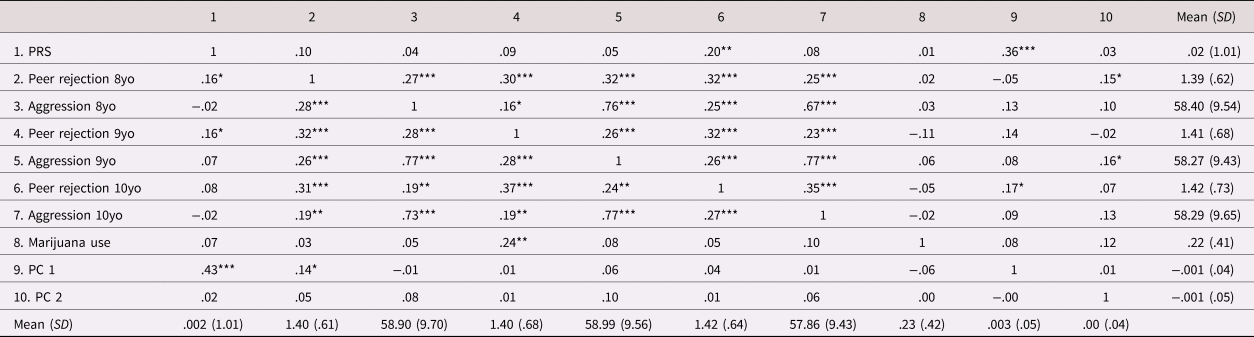
Means, standard deviations, and correlations among primary study variables can be found in Table 1. Across middle childhood, there was no evidence of change in mean levels of peer rejection in either the control or intervention group. The PRS was associated with age-8 and -9 peer rejection in the control group and with age-10 peer rejection in the intervention group. Peer rejection was correlated across ages and was correlated with aggression within and across age in both groups. In the control group peer rejection at age 9 was associated with marijuana use assessed at age 16. Finally, mean levels of study variables did not differ by intervention versus control condition (ps > .33).
Correlations, means, and standard deviations of study variables for the intervention group (above the diagonal) and the control group (below the diagonal)

Note. Intervention group n = 238, control group n = 247. Peer rejection reflects scale scores.
PRS = aggression polygenic risk score, PC = ancestry principal component.
*p < .05, ** p < .01, *** p < .001.
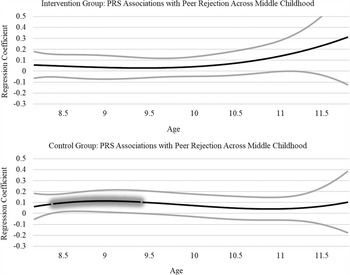
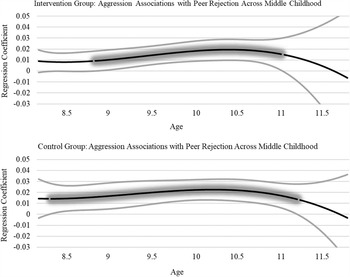
TVEM results for associations between the PRS and peer rejection can be found in Figure 2. In the control group, the PRS was associated with peer rejection from approximately age 8.50 to 9.50 (association from age 8.56 to 9.44). The glowing portion of the line illustrates the significant effect, where the lower bound of the confidence interval departs from zero. In the intervention group, there were no associations between the PRS and peer rejection. TVEM results for associations between aggression and peer rejection can be found in Figure 3. Aggression was associated with peer rejection from approximately age 8.50 to 11.00 in the control group (association from age 8.50 to 11.06). Aggression was also associated with peer rejection from approximately age 9.00 to 11.00 in the intervention group (association from age 9.02 to 10.91).
Polygenic risk scores (PRS) associations with peer rejection in intervention and control groups.

Aggression associations with peer rejection in intervention and control groups.

Following the TVEM analyses, peer rejection clumps were created by grouping individual scores into the following ages: (a) prior to 8.50 years old, (b) 8.50–9.50 years old, (c) 9.5–10.50 years old, and (d), 10.50–11.50 years old. Respectively, peer rejection clumps represented the period prior to the genetic effect, the period during the genetic effect, and two periods following the genetic effect. In preliminary tests only the peer rejection clump for 8.50–9.50 years old, representative of the span when a genetic influence on peer rejection was observed, was associated with marijuana use in the control group (β = .25, SE β = .10, p = .014) but not the intervention group (β = −.17, SE β = .14, p = .23) and these estimates were found to be significantly different (Wald X2(1) = 5.62, p = .018). No other peer rejection clumps were associated with marijuana use in either group so were not retained for the mediation analyses.
In the multi-group mediation model (X2 (3) = .934, root mean square of approximation (RMSEA) = 0.0, comparative fit index (CFI) = 1.0, Tucker–Lewis index (TLI) = 1.0), a significant indirect effect was found in the control group (β = .051, SE β = .026, 95% confidence interval (CI) [.006, .11]) whereby the PRS predicted peer rejection (β = .22, SE β = .06, p < .001), and peer rejection predicted adolescent marijuana use (β = .23, SE β = .10, p = .024). The PRS was not associated with aggression and aggression was not associated with adolescent marijuana use. No associations were found in the intervention group. Comparing estimates in the intervention and control groups, a trend level difference was detected for the path between the PRS and peer rejection (Wald X2 (1) = 3.26, p = .07), and a significant difference for the path between peer rejection and adolescent marijuana use (Wald X2 (1) = 4.93, p = .026). The comparison of the indirect effect across intervention and control groups yielded a significant difference (β = .07, SE β = .03, p = .047).
In post hoc sensitivity analyses, significant effects in the larger sample were examined separately for European American (EA) and African American (AA) subgroups. However, based on the small sample sizes represented in the subgroups, these results bear replication. The shape of the EA control and AA control TVEM results were the same as the overall control sample with significant effects in both subgroups. In the control group the PRS was positively associated with peer rejection from approximately 9.15 to 9.65 in the EA subgroup and from 8.5 to 9.0 in the AA subgroup. Aggression was associated with peer rejection from 8.65 to 11 in the EA subgroup and 9.5 to 11 in the AA subgroup. In the intervention group there were no significant associations between the PRS and peer rejection in either the EA or AA subgroup. Aggression was associated with peer rejection from 9.5 to 10.9 in the EA subgroup and 9.7 to 10.6 in the AA subgroup. For the mediation model, significant indirect effects were found from the PRS to adolescent marijuana use via peer rejection in both the EA control subgroup (β = .07, SE β = .04, 95% CI [.001, .16]) and AA control subgroup (β = .14, SE β = .07, 95% CI [.02, .32]). In the intervention group, no significant effects were detected from the PRS to peer rejection, or peer rejection to adolescent marijuana use for EA (ps > .63) or AA (ps > .22) subgroups.
Discussion
Collectively, results indicate that genetic predisposition for aggression and aggressive behavior are associated with peer rejection during specific developmental periods in middle childhood. In turn, peer rejection during middle childhood mediated the association between genetic predisposition for aggression and marijuana use in adolescence. The effects were not apparent for children whose family were offered the FCU, but only in children of families in the control group.
We hypothesized that the PRS for aggression and aggressive behavior would be associated with peer rejection during middle childhood in the control group but not the intervention group. In support of this hypothesis, the PRS was associated with peer rejection in the control group from approximately 8.50 to 9.50 years, but no associations were present in the intervention group. Complementary to the genetic association, aggression was found to be associated with peer rejection during the 8.5–9.5 age period in the control group. However, aggression was also associated with peer rejection in the intervention group. These findings indicate that when aggression is present, despite intervention effects, it is still associated with peer rejection. However, the genetically influenced path to aggression was only present in the control group.
In line with Brendgen and Boivin (Reference Brendgen, Boivin, B.N and J.M2015), the presence of PRS and aggressive behavior associations with peer rejection likely represent an evocative rGE in which genetic predisposition for aggressive behavior evokes or elicits greater rejection from peers via aggression. It is interesting to note that genetic influences on aggression were found using the same PRS and sample from approximately age 8.75 to 10.5 (Elam et al., Reference Elam, Clifford, Shaw, Wilson and Lemery-Chalfant2019). Thus, genetic predisposition for aggression appears to be both contributing to aggression and evoking peer rejection during a similar period. That is, genetic risk for aggression contributes to aggression, which evokes peer rejection, an evocative rGE.
The presence of an evocative rGE between genetic predisposition for aggression and peer rejection from 8.50 to 9.50 years of age may be due to a number of factors. Aggression in middle childhood is heritable with some evidence that new genetic effects emerge during the period of middle childhood (van Beijsterveldt, Bartels, Hudziak, & Boomsma, Reference Van Beijsterveldt, Bartels, Hudziak and Boomsma2003). Concurrently, during middle childhood children are encountering new social experiences and pressures, such as peer pressure, social conformity, and gender identity, making peer rejection during the middle childhood period especially salient (Chen et al., Reference Chen, Drabick and Burgers2015). The presence of aggressive and other externalizing behavior is a primary risk factor for poor social interactions, including rejection in middle childhood (Brendgen & Boivin, Reference Brendgen, Boivin, B.N and J.M2015; Chen et al., Reference Chen, Drabick and Burgers2015; Ettekal & Ladd, Reference Ettekal and Ladd2015). The effect of poor social interactions likely fades with age; as individuals enter pre-adolescence, internalizing problems, such as anxiety and social withdrawal, are more negatively perceived by peers, and aggressive behavior becomes less associated with rejection and victimization and more associated with popularity (Boivin, Petitclerc, Feng, & Barker , Reference Boivin, Petitclerc, Feng and Barker2010; Brendgen, Girard, Vitaro, Dionne, & Boivin, Reference Zucker, Heitzeg and Nigg2016; Cillessen & Mayeux, Reference Cillessen and Mayeux2004).
In addition, the genetic association was only present in the control group, indicating that the FCU buffered the association between genetic predisposition for aggression and peer rejection. As the FCU was initially offered to families when the child was 2 years old, the effects may be evident because of long-term changes in the family environment, which have been documented in this sample previously for such factors as parenting (Dishion et al., Reference Dishion, Shaw, Connell, Gardner, Weaver and Wilson2008), maternal depression (Shaw, Connell, Dishion, Wilson, & Gardner, Reference Zucker, Heitzeg and Nigg2009), and social support satisfaction (McEachern, Fosco, Dishion, Shaw, Wilson & Gardner, Reference Zucker, Heitzeg and Nigg2013), all during early childhood. The novel finding of FCU effects on the association between genetic predisposition for aggression and peer rejection adds to a growing literature showing that family-based preventive interventions can moderate genetic predisposition for disinhibited behaviors and risk for substance use (Chhangur et al., Reference Chhangur, Weeland, Overbeek, Matthys, Orobio de Castro, van der Giessen and Belsky2016; Glenn et al., Reference Glenn, Lochman, Dishion, Powell, Boxmeyer and Qu2018; Shaw et al., Reference Shaw, Galán, Lemery-Chalfant, Dishion, Elam, Wilson and Gardner2019). Sensitivity analyses with the major racial subgroups indicated that although the PRS was calculated based on a GWAS of European Americans, effects held in the control group for both the EA and AA subgroups.
Second, we hypothesized that in the control group peer rejection would mediate the association between genetic predisposition for aggression and subsequent marijuana use in adolescence. An indirect effect was found between the PRS and adolescent marijuana use via the peer rejection clump representing the genetic effect, again only in the control group. This cascading effect is consistent with behavioral disinhibition models of substance use (Iacono et al., Reference Iacono, Malone and McGue2008; King et al., Reference King, Keyes, Malone, Elkins, Legrand, Iacono and McGue2009; Zucker et al., Reference Zucker, Heitzeg and Nigg2011), a developmental cascade framework (Masten & Cicchetti, Reference Masten and Cicchetti2010), and a social mediation pathway (Reiss & Leve, Reference Reiss and Leve2007). Genetic predisposition for aggression in middle childhood can lead to greater rejection by peers, driven by an evocative rGE, and those rejected children are at greater risk for marijuana use in adolescence. The longitudinal prediction of marijuana use from peer rejection across an approximate 4-year span illustrates how important peer processes are in middle childhood. Theoretical models propose that middle childhood factors associated with increased risk for adolescent substance use may occur via continued aggressive behavior, chronic peer rejection, greater affiliation with deviant peers, or a combination of these adolescent developmental processes (Chen et al., Reference Chen, Drabick and Burgers2015; Ettekal & Ladd, Reference Ettekal and Ladd2015). It may be that genetic predisposition for aggression initiates a developmental cascade by evoking peer rejection (evocative rGE), which increases risk for marijuana use in adolescence. This may preferentially occur in the absence of positive supports, such as psychosocial interventions (Schlomer et al., Reference Schlomer, Cleveland, Feinberg, Wolf, Greenberg, Spoth and Vandenbergh2017; Shaw et al., Reference Shaw, Galán, Lemery-Chalfant, Dishion, Elam, Wilson and Gardner2019; Van IJzendoorn & Bakermans-Kranenburg, Reference Van IJzendoorn and Bakermans-Kranenburg2015), leading to other maladaptive processes, such as affiliation with deviant peers, which also increase risk for marijuana use during adolescence. Relatedly, genetic and peer rejection effects were present only in the control group, illustrating that the FCU buffered both genetic and social risk factors across childhood. The genetic and peer rejection finding highlights the utility of early preventive interventions in mitigating psychosocial and genetic risk early in life. Of note, the PRS was not associated with aggression in the control or intervention group. This is in-line with findings from Elam et al., (Reference Elam, Clifford, Shaw, Wilson and Lemery-Chalfant2019), which illustrated that associations between the PRS and aggressive behavior only emerged using TVEM models to identify developmentally specific effects.
In addition to the novel genetic and peer rejection findings, this study advances developmental genetic research in a number of ways. Broadly, this study addresses a recent call that integrating genetic measures into longitudinal studies has the ability identify developmental risky pathways to psychopathology (Dick et al., Reference Zucker, Heitzeg and Nigg20189). The current study considered developmentally targeted environmental risks (peer rejection), the role of intervention effects (the FCU) and functional genetic indices to better identify such risk mechanisms. This study is the first to use a PRS to examine rGE underlying peer processes in developmental pathways to marijuana use, and our findings support and extend evidence from twin studies that peer rejection is partially explained by genetic influences on children's aggression. Further, the PRS was based on a large meta-GWAS of children in middle childhood, and only included functional genetic variants. Developmentally aligning the discovery GWAS used to create the PRS with that of the subsequent sample is crucial, as these and other results indicate variable genetic effects with age (e.g., Russell et al., Reference Russell, Schlomer, Cleveland, Feinberg, Greenberg, Spoth and Vandenbergh2018). The focus on functional SNPs increases confidence that associations are meaningful rather than due to randomly associated genetic variants. More specifically, SNPs included in the current PRS represent serotonin and glutamate systems among others, which have been associated with neurodevelopmental deficits and aggression in childhood (Moretto, Murru, Martano, Sassone, & Passafaro, Reference Moretto, Murru, Martano, Sassone and Passafaro2018; Narvaes & Martins de Almeida, Reference Narvaes and Martins de Almeida2014). Finally, we were able to investigate these genetic (rGE) and behavioral effects using TVEM, a developmentally sensitive method. The TVEM method allowed for detection of age varying associations rather than testing concurrent associations, longitudinal associations at single time points, or being constrained to trajectories of behavior. In some cases, estimating influences on longitudinal trajectories of behavior may not reveal developmentally specific associations (Sher, Jackson, & Steinley, Reference Sher, Jackson and Steinley2011). Given the importance of friendship during the developmental period of middle childhood, negative peer processes can emerge and stabilize, and subsequently have long-term impacts on adolescent substance use (Cambron, Guttmannova, & Fleming, Reference Cambron, Guttmannova and Fleming2017; Otten, Mun, Shaw, Wilson, & Dishion, Reference Otten, Mun, Shaw, Wilson and Dishion2019).
Limitations should also be considered. Many of the effect sizes in the current study were small, particularly for the PRS associations. The small effect sizes are similar to past studies using PRS (e.g., Elam et al., Reference Elam, Chassin, Lemery-Chalfant, Pandika, Wang, Bountress and Agrawal2017), and indicate PRSs that include a smaller number of meaningful SNPs have utility. The current PRS only had 66 SNPs, which can be expanded as more is learned about SNP functionality. The use of a functional PRS increases confidence that the present findings, albeit modest, represent a true genetic association. Relatedly, the GWAS used to create the PRS was only for EA participants which may not generalize to AA participants. However, in the larger sample we controlled for the first two genetic ancestry principal components, and when performing sensitivity analyses we observed similar associations in the EA and AA subgroups. Second, the current sample is high risk and results may therefore not generalize to lower-risk community-based samples. Finally, the peer measure was parent-reported, which may be a weakness because of parent's lack of awareness of their child's peer relationships. However, adolescents reported on their marijuana use, and parents and children have both been found to be valid reporters of peer behaviors (Fergusson & Horwood, Reference Fergusson and Horwood1999; Tilton-Weaver, Burk, Kerr, & Stattin, Reference Tilton-Weaver, Burk, Kerr and Stattin2013).
Despite these limitations, the current study advances research on the interplay between genetic and social processes in substance use. First, it provides evidence that genetic influences can act via social pathways, which are in turn susceptible to intervention. Second, it illustrates that improving children's overall family environment is protective across a number of domains. Finally, this study provides evidence of specific developmental periods connecting evocative rGE, peer rejection, and adolescent marijuana use. This approach highlights the importance of using GWAS that are developmentally aligned with the samples in which PRS are subsequently created and tested. As GWAS data grow in diversity, it is similarly important to align racial/ethnic groups in GWAS and PRS samples, one approach being the use of multi-ethnic PRS (Márquez-Luna, Loh, & Price, Reference Márquez-Luna, Loh and Price2017; Peterson et al., Reference Peterson, Kuchenbaecker, Walters, Chen, Popejoy, Periyasamy and Carey2019). Collectively the findings of this study can help to inform prevention and intervention strategies regarding developmental risk for aggression and peer rejection, and in the presence of peer rejection strategies to decrease risk for substance use (Dishion & Tipsord, Reference Dishion and Tipsord2011; Fite, Colder, & O'Connor, Reference Fite, Colder and O'Connor2006).
Acknowledgments
The content of this paper is solely the responsibility of the authors and does not necessarily represent the official views of the National Institutes of Health. We gratefully acknowledge the research staff for their assistance, and all the participating families.
Funding Statement
The research reported in this paper was supported by the National Institute on Drug Abuse (DS, TD, MW, grant numbers DA25630 and DA26222; KE, grant number DA042828) and the National Institutes of Health: Office of the Director, and Office of Behavioral and Social Sciences Research (KE, grant number DA042828).
Conflicts of Interest
None.