The online streaming service Beats Music was launched in January 2014. Just over a year later, in June 2015, it passed into history, having been acquired by Apple as part of the technology giant's efforts at adapting to the emerging ecosystem of cloud-based music streaming.Footnote 1 Having seen the dominant position iTunes once enjoyed within the digital music market erode along with the ownership model of music distribution upon which its dominance was founded, Apple's acquisition of Beats presumably aimed at smoothing its transition to an economy in which music was less a good to be exchanged than a utility or service to be rented.Footnote 2 Much of the fanfare that surrounded Beats during its brief life span – and much of the justification for the $500 million price tag the platform commanded upon its sale – concerned the premium it placed on curation. Highlighting the ineffable ‘human touch’ that artists, music industry professionals, celebrity DJs, and other cultural authorities conferred on the playlists they had been commissioned to compile, Beats sought to differentiate its service from those of competing platforms, above all industry leader Spotify. ‘We appreciate the importance of what music is, that it's not just a digital file’, remarked Trent Reznor, Nine Inch Nails frontman turned chief creative officer for Beats.Footnote 3 Such respect for the value of music was also manifest in the belief that the task of contextualizing and lending meaning to individual tracks was not something that could be entrusted to algorithms. According to Jimmy Iovine, the company's founder and chairman, what separated Beats from its competitors was the importance it attached to ‘humanity, taste, and context’.Footnote 4 The algorithmically driven recommendation engines powering Spotify, Pandora, Deezer, and other platforms were, in Iovine's and Reznor's estimation, incapable of stitching together songs into cohesive playlists – and thus incapable of sustaining a consistent mood or atmosphere for the user. Where such algorithms failed in appropriately contextualizing songs, the human curators employed by Beats would presumably succeed. The argument was summarized in Iovine's oft-repeated refrain: ‘What song comes next is as important as what song is playing now.’Footnote 5
Iovine's locution is curious. More curious still is the way it was echoed and distilled in a marketing campaign launched in August 2015 by one of Beats's competitors, Pandora.Footnote 6 The centrepiece of the campaign was a thirty-second long video advertisement. Its tagline: ‘The next song matters.’ Broadcast on television as well as over the internet, the advertisement dramatized not only the affective charge music can impart, but also the affective charge the mere anticipation of music can impart. The video features three teenagers driving in a car, listening to the song ‘The Front Row’ by the band The Black Tibetans. This mise-en-scène builds on long-standing representations of the automobile as a space of sociability, particularly among adolescents, foregrounding the role music plays in the construction of this space. It does so both positively and negatively: positively, insofar as music functions as a pole of shared investment and social identification among the passengers, fusing them together; negatively, insofar as music contributes to what Karin Bijsterveld and her colleagues have described as the ‘acoustic cocoon’ that isolates the automobile's interior from the external soundscape.Footnote 7
What, then, transpires over the course of this advertisement? It begins with an ending, as the song the three friends had been listening comes to a close. The resulting hiatus in the flow of music ‘doesn't last long’, the voice-over reassuringly tells us. Yet the advertisement depicts it as a moment of uncertainty, a miniature crisis whose eventual resolution translates into a heightened experience of musical pleasure. What is put at risk by this hiatus is the small bubble of sociability fostered by music. Where the gestures of the three adolescents are roughly synchronized at the beginning of the advertisement, entrained to the music that plays, with the song's cessation this shared movement breaks down. So too do the glances and smiles they exchange. Instead, the gaze of each drifts elsewhere, at the same time as external noises begin to penetrate the ‘acoustic cocoon’ (Figures 1 and 2). In Sartrean terms, what had been a small-scale ‘group-in-fusion’ is reduced to a collection of discrete individuals, existing in a state of seriality with respect to each other.Footnote 8
Music as an inducement to sociability (still from Pandora advertisement ‘The Next Song’).

Sociability diminished with absence of music (still from Pandora advertisement ‘The Next Song’).

Like all advertisements, this one has as its goal the creation of a need that the product being sold promises to satisfy. It is therefore hardly surprising that as soon as the crisis depicted in the commercial presents itself, a solution is tendered, in the form of the personalized curation service provided by Pandora. More precisely, it is the specific socio-technical assemblage that is put to work by Pandora, the combination of human expertise and algorithmic sorting, that promises to re-establish the sociability ruptured by music's absence. The advertisement portrays the operation of this assemblage in a couple of ways. Elements of sound design are used to illustrate the hypersensitivity of Pandora's proprietary technologies, which are depicted as having the ability to register fleeting actions, behavioural tics, and bodily responses that pass below the threshold of human consciousness. Thus the blink of an eye of one of the three adolescents is rendered as a dull thud; what is scarcely audible to the person resounds for the machine (Figure 3).Footnote 9 Similarly, the use of slow motion serves to establish the disjunction between two distinct temporalities, that of human response versus that of machine processing. Even if the moment of uncertainty is brief by the standards of human consciousness, passing by in a few fleeting seconds, it is sufficiently long for the algorithms Pandora employs to determine which among its catalogue of over one million songs is the correct one to recommend for this group of people, at this particular moment in time. Success in the task of selecting the right song produces a specific kind of musical pleasure, one intensified by the moment of uncertainty that precedes it. But doing so also serves to restore the social bonds that had frayed in music's absence. Or so the advertisement suggests (Figure 4).
The dull thud of an eye blinking (still from Pandora advertisement ‘The Next Song’).

Sociability restored with music's return (still from Pandora advertisement ‘The Next Song’).

There is much more that can be said of this commercial. What I would like to focus on in particular is the value being accorded to music recommendation, both within this advertisement and in the pronouncements of figures such as Iovine and Reznor. The insistence that what matters is the next song points to the importance that curation, recommendation, and other discovery tools have assumed within contemporary cloud-based music streaming – and, by extension, within the emerging regime of platform capitalism. Indeed, recommender systems have become a core feature of many digital platforms, including Netflix, Amazon, Facebook, Tinder, Twitter, and Snapchat, among others. In all of these instances they function as a key means by which consumer desire may be produced, reproduced, and managed, indispensable tasks if platforms are to succeed in recruiting and retaining users within the competitive market for their time and attention. Yet the value that accrues to recommender systems cannot be fully compassed by the crude metrics of the money economy. Rather, their value derives just as much from the peculiar psychic economy in which such systems are embedded. As regards music streaming in particular, recommendation and curation are cast as technological fixes that will not only mitigate the ‘paradox of choice’, but also reinvest music with the affective intensity that has allegedly eroded as a result of its ready accessibility in the digitized, networked world of the present.Footnote 10 A heightened sense of anticipation is one way this renewed affective investment expresses itself, at least if we are to believe the scenario depicted in the Pandora commercial. Recommendation, the advertisement suggests, entails a particular kind of temporal experience, an orientation towards the future whose radical foreshortening is captured succinctly in the figure of the ‘next song’.
This article undertakes an analysis of the interlaced psychic and political economies of online streaming. Key to this undertaking are the dreams, desires, and aspirations that are projected onto music recommendation, a contemporary manifestation of the kinds of ‘media fantasies’ that Carolyn Marvin has discussed in connection to technologies of electric communication in the late nineteenth century.Footnote 11 To unpack these fantasies, the present article undertakes close readings of various media representations, industry discourses, and marketing images that circulate around streaming. In keeping with psychoanalytic theories of fantasy's role in producing and stabilizing social reality, I argue that such representations of streaming (and music recommendation more specifically) do not stand apart from or in opposition to the actually existing technologies that they reference; rather, they serve as important means of constructing these technologies. Pertinent here are Eric Kluitenberg's remarks about the relation between what he terms ‘imaginary media’ and their real-world counterparts:
The imaginary and the realized in the histories of the media continually weave in and out of each other and, more importantly, also constitute each other . . . Actual media machines give rise to intense speculation of what such machines might be able to achieve or what they signify. Conversely, imaginations of possible media continually give rise to actual media machines, even though these may not achieve what was imagined for them.Footnote 12
A major concern of this article therefore has to do with the way such fantasies configure existing technologies of music recommendation. But a no less major concern has to do with the way these same fantasies strive to configure prospective users.Footnote 13 Just as discourses extolling the virtues of customized recommendation ‘premediate’ this media technology for individuals, preparing them for an interaction that has yet to occur, so too are individuals ‘premediated’ for the benefit of recommendation engines.Footnote 14 To the extent that these technologies are construed as a dynamic and adaptive, modulating in tandem with users’ fluctuating needs, dispositions, and desires, they demand users who are no less dynamic and adaptable, and who imagine themselves in analogous terms: less as individuals having cohesive identities, and more as a diffuse set of fluctuating needs, dispositions, and drives, whose only constant is their inconstancy.
Musical abundance and its vicissitudes
In order to unpack the significance of the claim that ‘the next song matters’, we might begin by considering its unstated corollary: that the present song in some sense does not. The diminished value accorded to that which is merely present, as opposed to that which lies just beyond the temporal horizon, is expressed in another of Iovine's aphorisms: ‘Curation is everything. Access is average.’Footnote 15 There are a couple of observations to be made about Iovine's statement. First, it appears to reject the database logic that underpins on-demand streaming services, at the same time as it expresses a desire to establish a different logic, one predicated on selectivity, exclusion, and ordered succession. What is disavowed in Iovine's comment, in other words, is the central role that content aggregation plays in ‘keep[ing] the stream flowing’.Footnote 16 If the database as a symbolic form is characterized by an associative, non-linear, and open-ended structure, per Lev Manovich's oft-cited account, then a curated or algorithmically generated playlist would appear to be its perfect opposite – and, for precisely that reason, its perfect complement.Footnote 17 Or, to use Katherine Hayles's formulation, the playlist, like narrative, would seem to be a ‘natural symbiont’ of the database.Footnote 18 And yet it is vital to cast a critical eye towards this binary opposition. Pace Iovine, access and curation are not simply opposed to one another. Nor, pace Hayles, are they harmoniously symbiotic. Such interpretations of the access/curation binary are fetishistic insofar as they conceal the dialectical relation at work. The database is itself already curated, just as curation is itself a means of realizing access. The ‘givenness’ of the data housed in the database is itself the outcome of a series of acts of collection, assembling, and ordering: the negotiation of rights agreements, the fabrication of associative links between database items, the datafication of music, and the generation of metadata to render this data intelligible.Footnote 19
A second observation to be made about Iovine's elevation of curation over access concerns the striking reversal that this gesture represents. It signals a decisive shift in the way streaming services market themselves. Early on, in order to get labels to agree to license their catalogues, firms such as Deezer, Spotify, Rdio, and Rhapsody had to present themselves as a means by which the widespread practice of file-sharing might be stemmed, by which individuals lost to forms of extra-commercial exchange might be ushered back into a digital enclosure and remonetized.Footnote 20 To succeed in this endeavour required persuading targeted publics that all the advantages won by operating outside the confines of commodity exchange could henceforth be realized through commodity exchange. Key in this regard was the explicit promise of legal, unfettered access. ‘No. More. Limits.’Footnote 21 Such was the way one Spotify advertisement characterized the experience users of the service would enjoy. A similar slogan was emblazoned on gift cards sold by Deezer, promising ‘musique illimitée’. Of course, the reinsertion of music consumption into the sphere of market exchange depended as much upon the continuing existence of constraints as it did upon their disavowal. The persistence of such constraints is nowhere more evident than in the terms and conditions detailed in the End User License Agreements that individuals are obliged to accept in order to use streaming services.Footnote 22 Nonetheless, by making available such a vast catalogue of songs – thirty million and counting, in the case of Spotify, Deezer, and comparable platforms – services afforded prospective users an illusion of consumer sovereignty. Where once the scarcity conditions imposed by the rivalrous, excludable character of physical commodities had disempowered music consumers relative to producers and distributors, the non-rivalrous, non-excludable character of digital commodities seemed to reverse this power relation.Footnote 23 Real scarcity has been replaced by virtual abundance. Yet this abundance is virtual not on account of digital music's seeming immateriality, which is after all more fiction than reality. Rather, it is virtual in the sense of being a scarce abundance. The musical cornucopia promised to listeners was limited to but a few commercial platforms, accessible only under certain conditions.
Given the importance ascribed to ‘access’ in the early marketing of streaming services, what explains its repudiation by these same services in recent years? Partly this is due to platforms’ need to differentiate themselves within a crowded marketplace.Footnote 24 But it is also due to the difficulties that inhere in ‘access’ as an inducement to consumption. This is apparent in the problem of ‘churn’ that platforms confront, that is, the rate of user turnover. A 2013 report noted that 70 per cent of Spotify's and 62 per cent of Deezer's registered users were inactive, a level of customer disaffection that appeared to threaten the long-term financial viability of these and other streaming services.Footnote 25 A number of explanations have been advanced by services to make sense of this high level of ‘churn’; for our purposes, the most notable of these has to do with the experience of overload or ‘infoglut’ that many users are imagined to experience when faced with choosing among tens of millions of tracks.Footnote 26 Paul Lamere, an employee of music analytics firm the Echo Nest (acquired by Spotify in 2014), remarks that ‘a music listener armed with an iPhone and a ten dollar-a-month music subscription is a couple of taps away from being able to listen to almost any song that has ever been recorded. All of this music choice is great for the music listener, but of course it brings its own problems.’ Principal among these is how to negotiate the database to which the user is given access. ‘The folks that run music subscription services realize that all of this choice for their listeners can be problematic’, which explains why they ‘are all working hard [to simplify] the listening experience.’Footnote 27 Lamere's diagnosis has been echoed by others; for instance, New York Times music critic Ben Ratliff observes in his 2016 book Every Song Ever how ‘infinite access . . . can lead to an atrophy of the desire to seek out new songs ourselves’.Footnote 28 Readers of Lacan will have recognized the implicit theory of desire operative in statements such as these. If desire is a function of lack, then the unlimited and inexhaustible musical plenitude to which streaming services provide access does not fulfil desire so much as short-circuit it. By removing barriers to the immediate satisfaction of musical desire, streaming platforms inadvertently transmute a potential source of gratification into its antithesis. In a way, streaming services risk ending up as victims of their own rhetorical success, as their promise of saturating musical desire has the unintended effect of suffocating it instead.
In response to the so-called ‘paradox of choice’, platforms have increasingly turned away from access and towards recommendation, curation, and discovery within the promotion of on-demand streaming. One effect of doing so has been to blur the boundaries between two broad models established early on in the history of streaming music, between what is referred to within the industry as ‘lean back’ versus ‘lean forward’ services. The former refers to less interactive, internet radio firms (exemplified by Pandora and iHeartRadio), while the latter refers to more interactive, on-demand streaming platforms (exemplified by Spotify, Apple Music, or Deezer). But with the growing prominence accorded to various automated recommendation and discovery services within on-demand sites – to say nothing of the increasing prominence of interactive, on-demand options among internet radio sites – this once hard-and-fast distinction has eroded considerably. But this is not the only – or the most important – effect of the ‘paradox of choice’. Facing a crisis created by the very abundance they heretofore celebrated, streaming platforms seek to forestall this crisis by transforming abundance into its opposite. Both the discourses and the material practices of music recommendation aim to transfigure plenitude into a form of lack, reimagining it as a lack of lack, as scarcity become scarce. A particularly vivid expression of this reversal of values may be seen in the appeals streaming platforms increasingly make to nostalgia. Figures who in some real or imagined past were seen to possess some uncommon knowledge of or affectively intense relation to music are evoked as tokens of something precious that has been lost as a result of digital disintermediation. These figures include the clerks who once staffed now-shuttered independent record stores; the enthusiasts responsible for the vibrancy of local music scenes; or – more intimately still – older siblings whose role as unofficial ‘cultural intermediaries’ was inseparable from their status as musical ego-ideals. ‘Where Beats Music differs from the competition’ one review reported, ‘is that it serves as a music-loving older brother or sister who turns you onto music you may not have heard, or have forgotten.’Footnote 29 When such nostalgia does not accrue to a human actor, it is directed instead at the material objects that populated a bygone, pre-digital epoch. Exemplary are Pandora's video clips profiling the ‘musicologists’ it employs to analyse and tag songs with metadata. Superimposed over voices describing the musical passions that drive their affective labour are images of disembodied hands flipping through vinyl, carrying boomboxes, pulling cassettes from racks, and tinkering with guitar pick-ups (Figure 5). A panoply of older media formats and music technologies unfolds before the viewer. These images not only dredge up memories of a musical material culture whose tangibility contrasts with a digitized present presumably drained of such erotic qualities, but such tokens of an analog past also function as signs of the musicologists’ almost carnal connection to music: the aura suffusing such objects of nostalgia is seemingly transferred onto the musicologists via a form of contagious magic.
Touching music (still from Pandora ‘Musicologist Monday’ video).

Recasting abundance as scarcity is performative in that it fabricates a need, a problem that platforms suggest only they can resolve. If what is lacking is lack, then that is precisely what must be reinstituted. Algorithmically generated recommendation represents one strategy whereby an imaginary sense of rarity may be imparted. This new mode of machine-driven ‘infomediation’ contrasts with – and is dialectically bound to – forms of intermediation that foreground the input of human actors, such as curation of the sort that Beats and later Apple Music have wagered on.Footnote 30 ‘In an era of data abundance, the thing that is scarce is taste’ writes Steven Rosenbaum in his book Curation Nation.Footnote 31 By appealing to an uneven distribution of cultural authority, services stressing the taste and judgement of human curators partake of a more conventional response to the problem of recruiting audiences for music commodities. What platforms promoting playlists fashioned by musicians, celebrity DJs, critics, and other music experts offer clients is not just access to an abundance of music, but also access to the more distinctive powers of discrimination such curators are seen to possess. Tidal, for example, features a page devoted to celebrity-curated playlists, providing users with the possibility of learning who their favourite artists’ favourite artists are (among the playlists one might choose from are ‘Grimes’ Deep Vibes’ and Jay Z's ‘Songwriting Hall of Fame’).Footnote 32 One might characterize the exchange being proposed by such celebrity-curated playlists as adhering to what Wesley Shrum has termed a ‘status bargain’, wherein users yield ‘partial rights of control of one's own judgment to experts in exchange for . . . higher status’.Footnote 33 But this is not the only bargain that is struck, since symbolic capital is not the only thing that is acquired in delegating one's musical choices to others. Other exchanges include the affective bargain that mood-based playlists promise, or the physiological bargain that is the remit of activity-based playlists. Many other such bargains may be identified, as many as there are expertly curated playlists. In other words, what services touting their curated selections are selling clients is, in addition to music, a range of subject positions they can adopt through music, alleviating them of the burden of having to fabricate such subjectivities themselves.
In itself, this kind of musical subjectivation is continuous with practices developed in an earlier historical moment, when broadcast media such as radio, television, and publishing were ascendant. One might characterize it in broad terms as a disciplinary mode of subjectivation, obliging individuals to adjust to some external ideal or norm. The main difference lies in the way streaming services are able to tailor a selection of prefabricated playlists – and hence a selection of prefabricated ways of being – according to the peculiarities of the individual user.Footnote 34 Algorithmically generated playlists and other recommendation services push this customization further, imposing a different kind of artificial scarcity: not one that is rooted in the symbolic authority that celebrity curators are credited with possessing, but one that stems from an asymmetric distribution of information, above all the concentration of proprietary music and user data in the hands of streaming platforms.Footnote 35 By using the accumulated data from activity logs, combining this with user information collected during the registration process, contextual data picked up by various sensors, and the plethora of music data that platforms derive by means of machine listening or data mining, recommendations can be pitched not just at the individual level, but at what Deleuzians call the dividual level – that is, at the level of the subcomponents into which individuals can be – and have been – discomposed.Footnote 36 Notable examples of such in/dividuated forms of recommendation include Pandora's personalized radio stations and the Discover Weekly playlists Spotify unveiled in summer 2015. But such initiatives are but the thin edge of a much bigger wedge, if we are to believe the comments of the music data analysts in the employ of major streaming services. The perfected world they envisage is one where the interfaces by which users access streaming music exempt them from having to make any decisions whatsoever. Echo Nest co-founder and CTO Brian Whitman describes ‘the ultimate interface’ as one where ‘you hit play and you don't have to do anything else’. Such a ‘zero-button user interface’ would ‘know that at 10 a.m. you are listening to a certain kind of music, or you are using your phone or at work or at home . . . And mood is a big part of it as well.’Footnote 37 As Whitman's comments make clear, from the perspective of the streaming service, the scarce resource that enables the enterprise to generate surplus profits is the proprietary data that enables it to anticipate each user's fluctuating musical whims and desires. From the perspective of the user, however, scarcity reappears in the guise of the one perfect song, the song that is right not just for the individual, but also for the particular situation she finds herself in, the particular mood she happens to be in, and so forth. Recall the promise the Pandora commercial discussed at the beginning of this article makes to users: the promise that it will deliver, ‘this song, your song, right here, right now’. This suggests another interpretation of why the next song matters. By training our attention on the horizon of the ‘proximate future’ it points to the idea that for each successive moment there is but one song that is the right song. If the ideologeme of access bandied about by streaming services in their early years held out the prospect that it was now within one's power to enjoy any song, any time, anywhere, that of personalized recommendation suggests that there is only ever one song: the song that is perfectly matched to the distinct point in space and time the user happens to occupy.Footnote 38 In this scenario, the gap between individual and the subject position that is symbolically constructed via music appears to collapse: the streaming service apparently interpellates us as ourselves and as nothing else. We are not hailed as members of some abstract category, but as a concrete particular.
To model this dynamic, one might appeal to another concept of Deleuze's, one inextricably tied to that of dividuation: what he referred to as ‘control’, a technique of power that does not operate according to a logic of compulsion or coercion, but according to a logic of adaptation. As Deleuze describes it, control adjusts to the in/dividual in the manner of ‘a self-deforming cast that will continuously change from one moment to the other, or like a sieve whose mesh will transmute from point to point’.Footnote 39 Scholars of digital media have often resorted to the notion of control in order to describe the kind of governance that is proper to algorithmic processes. In doing so, they tend to follow Deleuze in contrasting this form of power with the kind of disciplinary power that Foucault studied at length.Footnote 40 Much as the older ‘societies of sovereignty’ gave way to the ‘societies of discipline’ that emerged during the eighteenth and nineteenth centuries, the latter's administration of the conditions of life marking a break with the former's rule over the conditions of death, so too have the ‘societies of discipline’ been superseded in Deleuze's estimation by the ‘societies of control’ established during the second half of the twentieth century.Footnote 41 But what is to be noted about the fantasies surrounding recommendation and curation services is the way in which they entwine discipline and control, rather than set these two techniques of power in opposition to one another.Footnote 42 Testimonials to the importance of the next song, advertising images such as those promulgated by Pandora, or ‘imaginary media technologies’ such as the Zero-Button User Interface are themselves means of training prospective users of streaming services. They seek to configure these users so that they might be as fluid and mutable as the idealized algorithmic system that would accommodate their every vicissitude. Even if the emerging regime of ‘algorithmic governmentality’ intervenes at the level of ‘individual data and supra-individual patterns’, as Antoinette Rouvroy has argued, this does not mean that discipline ceases to be exercised, or that this occurs ‘without . . . calling the subject to account’.Footnote 43 Potential users must still be disciplined. Or rather they must be taught to discipline themselves, having been enjoined to adjust to a machine that will presumably adjust to them.
Minimal futures and enforced dividuations
The foregoing points to why recommendation and curation have assumed such a central place within the commercial logic of contemporary cloud-based streaming. The transformation of musical plenitude from an asset into a problem to be solved, and the particular imbrication of discipline and control that this entails, are crucial to securing the value of streaming platforms. What both recommendation and curation serve to recover is a sense of rarity that has been put at risk by music's migration to the cloud, at the same time as platform operators seek to teach potential users to prize this rarity. If this sheds light on why the next song matters, what remains to be explicated is why it is the next song that matters. This shift in emphasis raises the question of the specific kind of temporality that is fashioned for users by streaming, and by automated recommendations in particular. A peculiar conception of the future, and its relation to past and present, can be discerned in the importance streaming sites attach to their (alleged) capacity not only to anticipate the desires, needs, and actions of individual users, but also to do so even before these have been registered by users themselves. How might we understand the kind of temporal experience that recommendation systems afford listeners? What relation to the future is constituted through their efforts to direct users’ attention to the horizon that is marked by the figure of the next song?
To shed some light on these questions, it is useful to return to the short-circuiting of desire that takes place once lack, understood in Lacanian psychoanalysis as the engine of desire, itself proves lacking. More specifically, the translation of plenitude into its opposite – and hence from a condition of satiation into a problem that recommendation services might remedy – bears an uncanny resemblance to the structure of psychosis as described by Lacan. Indeed, ‘lack of lack’ is a fruitful way of construing foreclosure, the mechanism Lacan situates at the root of psychosis.Footnote 44 In foreclosure, there is a failure of the paternal function to take hold in the subject (paternal to be understood here as a functional, rather than biological, designation). This contrasts with neurosis, where parental prohibitions compel the child to cede primitive forms of gratification and thereby win entry into the symbolic/social order.Footnote 45 In the case of psychosis, such prohibitions prove ineffective. Instead of trading one form of satisfaction for another, alienated form – alienated insofar as it is conceived in relation to what is thought to arouse desire in the otherFootnote 46 – the psychotic is unable to participate in this trade-off, remaining in the grip of the overwhelming pleasure-in-pain that is jouissance. Without this primary prohibition, there is no primary repression that can keep the drives in check and allow the subject control over them.Footnote 47 The absence that constitutes the neurotic, the defining trauma of repression, is itself absent in the psychotic – whence the lack that is lacking in foreclosure. Translating this into the linguistic terms Lacan used to describe the unconscious, the ‘paternal metaphor’ does not take root. The substitution of one signifier (the name of the father) for another that has been placed out of reach (maternal desire) fails to occur. As a result, the riddle that is posed by the signifier of the other's desire remains unanswered; the signifier that might stand in the place of the latter, and thus provide the subject some clue as to what the object of this desire consists of, is missing.Footnote 48 An important consequence of this for Lacan is the crisis of meaning that afflicts the psychotic, who lacks the absent centre provided by this primary metaphor and/or repression, along with the provisional stability it provides within the field of signification.
At this point a caveat is in order. Namely, Lacan's account of psychosis is not to be taken as an immutable constant, whose workings are somehow timeless and universal. Rather, this particular psychic condition is better understood as a ‘social symptom’, as an ‘expression of cultural discontent and an inevitable collateral damage of capitalism’, whose salience and specific configuration will vary from one socio-historical conjuncture to another.Footnote 49 Notable in this regard has been the increasing incidence of what Jacques Alain Miller has dubbed ‘ordinary psychosis’. Within the classic clinic of Freud and Lacan, neurosis represented the unmarked term against which psychosis stood out as an exception. By contrast, their relation has shifted, if not reversed, in recent years. The ‘link between normalcy and neurosis’ that was heretofore taken as given, Miller remarks, a link that presumed a ‘supposedly normal person [to be] a neurotic who doesn't suffer from his neurosis, or who doesn't suffer too much from his neurosis’, has given way to a situation in which psychosis is just as likely to be the default condition.Footnote 50 Viewed from this angle, the fact that the ‘lack of lack’ characteristic of foreclosure finds a strange resonance in the sleight of hand currently being performed by streaming services is itself revealing: the latter's translation of the positivity of musical plenitude into a double negative, into the becoming-scarce of musical scarcity, would seem to be yet another symptom of the changing status of psychosis under digital capitalism, transforming what had been exceptional in an earlier moment of capitalist modernity into an increasingly normal, if not normative, condition.
Yet this resonance is significant for another, perhaps more important reason, insofar as it provides an initial approach to the question of music recommendation's peculiar temporality. If, as Lacan maintains, one function of the paternal metaphor is to provide subjects with a means of coordinating their desire, then the failure of this metaphor to take root leaves the subject bereft of any handle on how to desire, or what to desire. The psychotic is thus deprived of the ability to order their drives, to subordinate them to some socially sanctioned project. But this freedom from alienation in the other's desire is experienced less as an emancipation than as the subjugation to feelings of intolerable excitation that evade one's control. If neurotic desire ensures that satisfaction of the drives is deferred, then in psychosis this process of deferral is inoperative. Crucially, the same process of deferral also characterizes signification and temporal experience, binding their fates together with that of desire. The metonymic movement from one signifier to another, which circles around the focal point provided by the primary repression/metaphor without ever alighting upon it, is isomorphic with the movement of desire. ‘Desire is a metonymy’ Lacan avers.Footnote 51 Which means that the interruption of this movement is marked by a crisis not only of desire, but also of meaning and – importantly for present purposes – time consciousness.Footnote 52 Lacking the absent centre around which meaning is organized and towards which desire tends, the psychotic lives in a perpetual present where everything is equally meaningful – and for that reason equally meaningless.Footnote 53
The importance of this last point is not to be discounted. For the seizing-up of the movement of desire and of the metonymic displacements on the basis of which both meaning and temporality unfold are consequential not just to the users of streaming platforms: they are equally consequential for the operators of streaming platforms. We have already seen this with regard to the phenomenon of ‘churn’ that streaming services are compelled to confront. Speaking more generally, one might say that the breakdown of the signifying chain and the correlated breakdown of temporal experience produce a crisis not just for the subjects of capital, but also for capital itself. A temporal horizon so radically foreshortened that it consists of nothing but a ‘series of pure and unrelated presents’Footnote 54 would prove fatal to the need to keep the circuit of capital flowing smoothly. And keep flowing it must, if capital is to function as such: ‘Effectively, capital must always be in motion in order to be capital; when capital is not in movement, it is stuck in a particular form . . . and therefore negated and devalued.’Footnote 55 Without the production of desire, there is no continuous self-transformation of capital. And without the continuous self-transformation of capital – its transmutation from money into productive capital into commodities endowed with surplus value back into an increased sum of money – one is left with a collection of inert entities: money that buys nothing, labour that is idle, machines that gather dust, commodities that nobody buys. Insofar as the surplus value generated in production can only ever be realized through the circulation of commodities, through their exchange for money, this means that consumption is both a necessary moment in the process of accumulation and a potential impediment to it. As Marx observed in the Grundrisse, the ‘first barrier’ to the realization of surplus value is ‘consumption itself – the need for it’.Footnote 56 It is the prospect of such a disruption in the circuit of capital that has led cloud-based streaming services to replace appeals to unlimited access with appeals to a rarity regained: either music commodities made scarce through the operation of taste, as with curated playlists; or, in the case of customized, contextual recommendation, the scarcest commodity imaginable, that of the one perfect song.
The temporality inscribed in the anticipatory logic of music recommendation may therefore be understood as a key element in streaming platforms’ efforts to forestall a breakdown in the signifying chain, the movement of desire, and thus the circulation of capital. In place of a series of disconnected moments, music recommendation engines pry open just enough of the near future to keep streams of capital and data, as well as those of music, moving. Ideally, these technologies provide listeners with more than just a series of songs. They also fashion a particular experience of ‘flow’, as Raymond Williams defined the term in his seminal account of television broadcasting.Footnote 57 A defining characteristic of this flow is its truncated envelope. To the extent that attention is not exclusively fixed on the present moment, it extends only to the moment that lies directly ahead. This, at least, is how the flow experience instituted by music recommendation is figured in the media fantasies that surround it. But it is important to recall Kluitenberg's observation (cited above) that these are not ‘idle’ fantasies, since they also inform existing media technologies and the practices that develop around them. One place where this can be witnessed is in the interface design for the kind of customizable radio station first pioneered by Pandora, but now a standard element of most streaming platforms. The sleek visual display for the radio feature on the defunct platform Rdio is exemplary in this regard.Footnote 58 In the centre is a thumbnail image of the album art for the song currently being played; to its left one for the song just heard, while to its right is the next in line. Listeners are provided with a means to situate themselves in the temporal flow, but only to a limited degree. One song ahead and one song behind are as far as the ‘cognitive map’ of the musical stream extends. All one is given is a fringe around the present, just large enough to sustain the sense of time's passage. Anything beyond this, memories of a more distant past or anticipations of a more distant future, lie outside this constricted temporal frame.
It is this same temporality that the figure of the ‘next song’ clearly evokes: to the extent that the slogan employed by both Pandora or Beats conjures to mind some sense of the future, it is a minimal futurity, one that lacks any long-range perspective. The same goes for music analytic and distribution firms such as Next Big Sound or Next Song On.Footnote 59 Despite the very different services these companies offer clients, their names bespeak a similar ideological investment in the phenomenon of ‘next-ness’, one that has become a characteristic feature of algorithmic culture. While this formal emphasis on what comes next has ample historical antecedents in commercial cultural production – one need only think of the serialized novels of the nineteenth century or television programmes of the twentieth century – what is arguably without precedent is the sheer pervasiveness of seriality, evident not just within a variety of cultural artefacts (videogames, film franchises, etc.), but also within a host of media forms (newsfeeds, software updates, Twitter threads, etc.).Footnote 60 Within the more restricted domain of music streaming, a particularly vivid representation of this emphasis on ‘next-ness’, of the way fantasies of music recommendation conjugate continuous flux with a shrunken temporal horizon, is to be found in another advertisement, a thirty-second commercial that launched Deezer's first major promotional campaign in France in January 2013.Footnote 61 Featuring animation by the illustrator McBess and a remix of Pop Levi's song ‘Wannamama’, the spot crystallizes a number of themes that typify the media fantasies circulating around cloud-based music streaming.
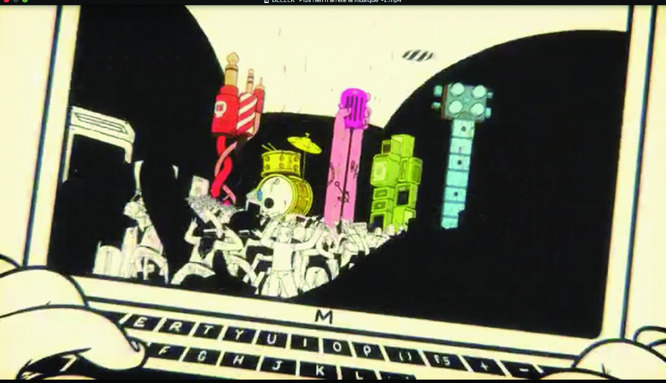
The advertisement begins with an image of a curious Molotov cocktail. Placed within a bottle is a single quaver note, whose stem doubles as a lit fuse that burns slowly. Tied around the bottle is a piece of rope, a symbol of containment that is as obvious as it is redundant. Accompanying this image is a low fidelity recording of a throbbing electrical signal, its analog warmth offset by its discomfortingly inhuman quality. A hand at the end of a tattooed arm reaches out to grasp the bottle. We cut to a scene of three people in a padded room, the characters identified as alternative, hipster types by the t-shirts, tank tops, baseball caps, tattoos, beards, and jeans they wear. One of them holds the Molotov cocktail in his hand. After a pregnant pause, he hurls it to the ground, triggering a sonic and visual explosion. Guitars and drums kick in. A stack of amplifiers bursts through the floor, lifting the three figures along with it into the sky. Upward it rises, like the beanstalk of the fairytale or, less naively, a seemingly boundless phallus. Reaching the end of the ascent, the three figures point in one direction and then another. The stack of amplifiers rotates, revealing a series of cables plugged into their back. These are suddenly yanked out, at which point the music that has only just begun begins to wind down, like a mechanism whose energy source is slowly running out. The cords are transformed into strands of pasta that disappear into a gaping, disembodied mouth, framed by two hands holding a fork and knife. The shot pans out to reveal the mouth's placement within an otherwise featureless black circle. But this soon becomes something else again, metamorphosing into a kick drum, which, as the panning outward of the shot continues, is seen to form part of a drum kit. Just as the music is grinding to a halt, the drummer seated behind the set lifts his arms. As they come crashing down onto the kit, a second eruption occurs. In a sense, the advertisement begins again: the music recommences, the original Pop Levi track now becomes more recognizable as guitars and drums play with renewed vigour, while the moment of the drummer's attack is synched with the bursting of the drum kit into a mass of fragments that fills the visual field.
The chain of metamorphoses now accelerates: the (male) drummer transforms into a roller-skate wearing, bikini-clad (female) keyboardist; she transforms into an aging, bearded (male) guitarist, who, upon being trapped in another bottle transforms yet again, this time into a concert pianist; his piano opens up into an accordion, which turns into a boy wearing a baseball cap, who turns into a tattooed Wagnerian soprano, complete with horned helm; her singing causes the glass bottle to first crack and then to shatter. The sound quality of the music track parallels the shifting virtual environments the advertisement traverses: when the musicians are bottled up, the sound of the music becomes muffled, dull, only to regain its clarity once the soprano's voice breaks the container holding the music. The remainder of the commercial continues along similar lines. What seems to be the final point of rest within this vertiginous stream of images is a surreal open air concert, at which a crowd of music fans stands enthralled before pieces of musical equipment; having been blown up to massive proportions, these jut out of the earth like a set of musical megaliths. But this seeming point of rest is destabilized in turn, as the shot zooms out once again, enfolding this exterior space within the inner space of a computer screen, the towering edifices of the outdoor concert transformed into the multicoloured bars of a signal level meter. The enfolding of one space inside another, virtual one does not end there, however, as the computer is revealed to be an image on the screen of a tablet, which is in turn revealed to be an image on the screen of a smartphone. As this recursive embedding of one media device in another unfolds, a voice over intones the tagline: ‘Plus rien n'arrête la musique. Deezer’ (‘Nothing stops the music from now on. Deezer’).
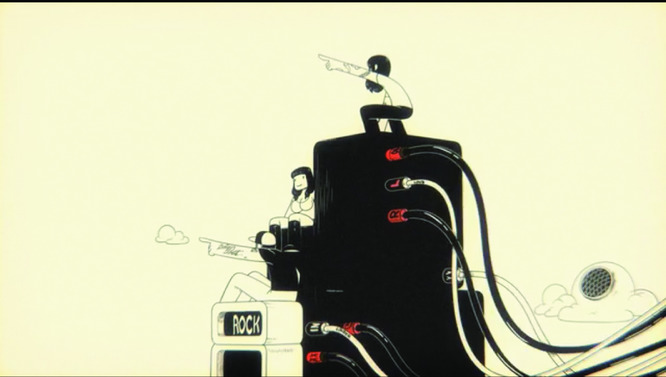
As with the Pandora advertisement discussed earlier, there is much that can be said about this thirty-second advertisement. A thematic opposition of constraint and rupture runs like a red thread through the commercial. The advertisement repeatedly presents us with images of music's or musicians’ confinement in a variety of closed spaces: bottles, padded cells, glass jars. But it does so only in order to prepare the way for music's subsequent irruption from these confining spaces: the bottle is smashed, the cell is breached by an amplifier stack, the jar shattered by a soprano's voice (Figures 6 and 7). The remix of ‘Wannamama’ contributes to this dynamic, with the artful use of filtering effects conveying an audible figure of music's enclosure, and the return to the full bandwidth signalling its escape. This recurrent staging of musical constraint and its overcoming clearly resonates with the rhetoric of unfettered access that has animated streaming from its beginnings. So too does the tagline for the advertisement, with its promise of a stream of musical sound that will never again be interrupted. The only exception to this general tendency comes, ironically, at the point when Deezer is named. Here the grammar of the advertisement reverses. Now there is an image of an open-air concert that is encased in a series of digital devices (Figure 8). While a limitless and labile musical experience is promised in the commercial, the closing moments point to the fact that this promised land can only be attained by passing through the restricted point of access that is the platform itself.
Music entrapped (still from Deezer advertisement ‘Plus rien n'arrête la musique’).

Music liberated (still from Deezer advertisement ‘Plus rien n'arrête la musique’).

Music reintegrated into a ‘digital enclosure’ (still from Deezer advertisement ‘Plus rien n'arrête la musique’).

If one of the major themes of the advertisement relates to a longer-standing topos relating technology to limitless abundance, another connects to the fluidity of musical and temporal experience that streaming – and music recommendation more particularly – affords.Footnote 62 At the level of the advertisement's manifest content, one will note the constant transformation in the identity of the individuals depicted, both sociologically and musically. Men become women, youth passes into old age, while keyboardists become guitarists become pianists become singers. Such changes in gender and generation are not independent of changes in musical affiliation. The two are entwined: the representation of musical identities is signalled principally through the social identities with which a given musical genre is typically associated. At the same time, however, the advertisement does not refrain from poking fun at such habitual associations, confounding them by superimposing incongruous attributes. The tattoos sported by the Wagnerian soprano are the most obvious example of this playful subversion of expectations. But such transgressions of generic boundaries merely encapsulate synchronically the underlying ethos that drives the ever-changing socio-musical identities diachronically. It is an ethos according to which any fixed identity represents yet another limit to be transcended, another barrier that needs to be overcome – and that streaming will aid users in overcoming. In this way omnivorousness and eclecticism are posited as the natural endpoints of listening practice towards which streaming tends.Footnote 63 The user implicitly valourized is one who is both capable of and comfortable with listening to musics spanning electro-pop, classic rock, classical music, hip hop and opera, among others.
Less obvious, but no less important than such constant mutations of identity, are the formal processes governing them. Indeed, it is through such processes that the advertisement articulates streaming to a specific form of temporal experience. Transposing the metonymy/metaphor distinction that so fascinated Lacan onto the domain of audiovisual rhetoric, one can discern a pattern that emerges over the course of the thirty seconds of the commercial. This involves the constant alternation between the two devices: every time a process of metonymic linkage gets underway, chaining together objects associated with one another by virtue of their belonging to some shared context, it is invariably cut short by an act of metaphoric substitution, as some shape or aspect of an object is isolated and transfigured into something else altogether. These periodic substitutions continually disrupt the unfolding of the contexts in which the action takes place. But they also set the stage for a new context, for the initiation of a new process of metonymic linkage. The thematic consistency that would endow a sequence of signifiers with a degree of coherence were it to persist is, without fail, broken before it can stabilize.
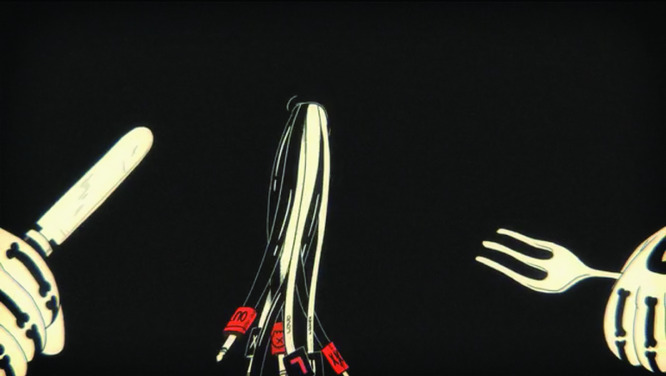
Consider, for instance, the sequence initiated by the irruption of the amplifier stack through the floor of the padded cell. The amplifiers are metonymically linked to the cables that one might expect to find plugged into their backs (Figure 9). Together, the two establish a fragile sense of continuity across time, a shared context to which both belong and which might be further populated by other, related items (instruments, performers, effects pedals, mixing boards, sound engineers, stadiums, fans). Yet before any other entities can be added to this nascent string of associations, a retranslation takes place. The amplifier cables undergo a metaphoric substitution, replaced by the strands of pasta into which they are magically transformed (Figure 10). In this way the metonymic series that had only just begun is brought to an abrupt end. But even as this curious displacement closes down one avenue of metonymic linkage, it opens up another, connecting food to utensils to a gaping disembodied maw. These links could of course be extended even further, by hooking up with other entities that might further elaborate this context (table, napkins, drink). Here, too, a metaphoric substitution intervenes before such metonymic connections can take flight, as the indeterminate object in which the mouth is embedded becomes something else again, namely the head of a kick drum. And so it goes for the bulk of the commercial.
Metonymic link of cables and amplifiers (still from Deezer advertisement ‘Plus rien n'arrête la musique’).

Metaphoric substitution of cables with pasta (still from Deezer advertisement ‘Plus rien n'arrête la musique’).

These metaphoric substitutions have the effect of breaking up the various metonymic chains presented in the advertisement just as they are getting underway. The thematic consistency that would enable a series of signifiers to cohere is upset before it has a chance to stabilize. The horizon of expectation shrinks as a result, without disappearing altogether. The fluidity with which objects become other than themselves staves off their collapse into a series of disconnected moments. Ironically, what little sense of temporal continuity the advertisement exhibits is largely a function of the soundtrack. Even as the commercial presents a stream of images that depict the flux of identities, both socio-demographic and musical, that streaming presumably releases, the song's steady pulse and repeated harmonic cycles function as a sonic glue that binds together a stream of images that threatens at each moment to lapse into incoherence.
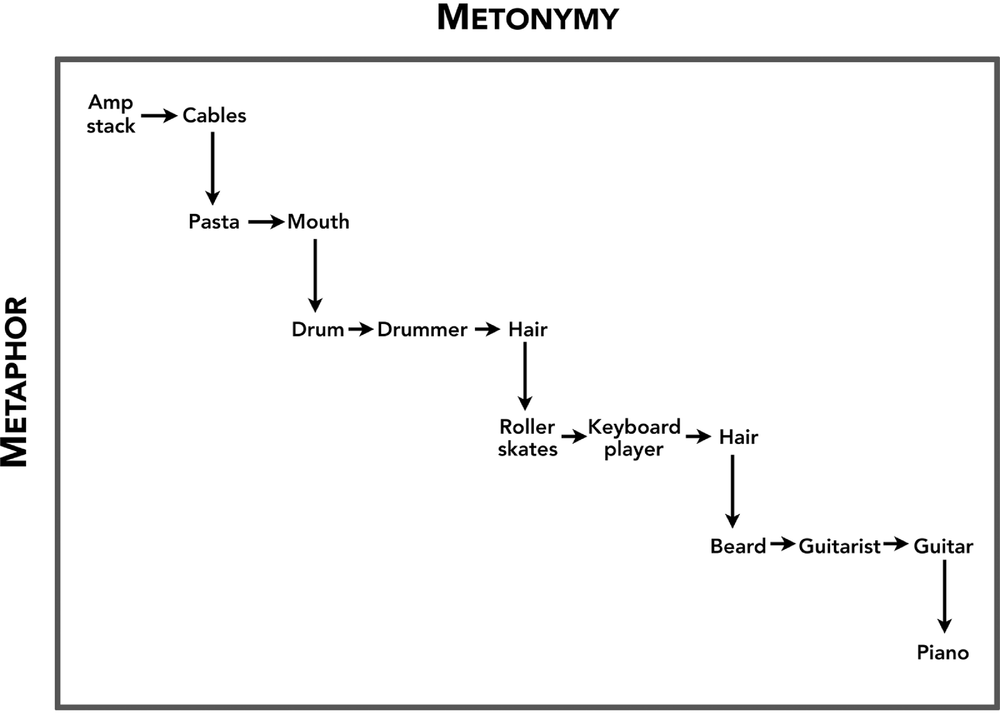
Figure 11 provides a graphic representation of the pattern that emerges over the course of the Deezer advertisement. It might be read as follows: the amp stack is connected to cables that turn into pasta that are eaten by a mouth that turns into a drum played by a drummer whose hair turns into roller skates worn by a keyboardist whose hair becomes the beard of a guitarist whose guitar becomes a piano. What are we to make of this zig-zag motion between metonymy and metaphor? Like Pandora's and Beats's insistence that the ‘next song matters’, the Deezer commercial presents us with a powerful fantasy of streaming, and music recommendation more specifically, one that it seeks to impress upon us, making it our fantasy as well. A key feature of this fantasy is what might be described as its excessive metaphorization of music. The continual interruption of each metonymic chain by some metaphoric substitution communicates a particular image of streaming, one in which the movement of desire is at once propped up, propelled, and yet destabilized by virtue of its persistent reorientation. Metonymic continuities may emerge between consecutive items, offering a modicum of temporal contiguity. But such connections do not last for long. By this reading, each new song in the stream, each new recommendation has a metaphoric function, reflecting back a musical image of a subject whose fluctuating preferences, shifting moods, and variable activities are embodied in the song.Footnote 64 In something like the Zero-Button User Interface envisaged by Lamere and his associates at the Echo Nest, the music and playlists proposed to users would serve as so many signifiers, each revealing some unknown truth about one's self to oneself: who one is at this particular moment and in this particular context, what one desires, how one feels, and so forth.Footnote 65
Traversing the space of metaphor and metonymy in the Deezer advertisement ‘Plus rien n'arrête la musique’.

Bolstering such fantasies are much ballyhooed claims made about the capacity of services to know users ‘better’ than they know themselves.Footnote 66 The ability to capture various forms of user activity that individuals are scarcely aware of themselves – the ‘digital traces’ emitted by the movement of cursors across screens, the time spent on one page versus another, the moment in a given song where one skips to the next, and so forth – seemingly equips streaming platforms with the power to pierce the veils of individuals’ musical ego-ideals, the images we have of our musical selves.Footnote 67 In one journalist's account of Nestify, the prototype of a new recommendation engine under development at Spotify, its capacity to tap into the company's detailed stockpile of listening behaviour data enables a multiplication of the number of musical personae seen to inhabit the individual user. In place of a binary division between private and public musical selves (‘the music you listen to, and the music you tell people you listen to’), there is instead a tripartite division – between ‘the music that you tell people you listen to, the music that you think you listen to, and the music that you actually listen to’.Footnote 68 It is in those moments where recommendations ‘surprise us and break us out of our habits’ that something akin to the disruption in the metonymic unfolding of musical desire depicted in the Deezer advertisement would seem to have a real-world corollary.Footnote 69 Cast as a stand-in for those aspects of one's behaviour and preferences unbeknownst to the subject, a recommended song or playlist would ideally be equal parts revelation and enigma: a source of intense meaningfulness whose meaning is anything but clear.Footnote 70
It is not just the metaphorization of music that is crucial to this fantasy, however, but also its serial iteration. If the Deezer advertisement offers viewers a way of imagining what the experience of streaming could or should be, then the fact that metaphoric substitutions repeatedly disrupt metonymic chains suggests that each new song proffered the user has the potential to pose the riddle of the musical self anew. The current push to develop context-, activity-, and mood-aware recommendation systems would presumably exacerbate this tendency. Such systems would use information gathered on users’ context, mood, and activities to adjust recommendations in real time. The ideal towards which the designers of recommendation engines aspire is one in which the truth of one's self that is revealed by recommendation is time- and context-sensitive. The question that each recommendation raises – what is it that makes this song or that playlist of interest to me, right here, right now? – does not necessarily find a response in some musical metonym, some consequent that might further flesh out and specify the meaning of this enigma. Rather, it finds its response in another recommendation – which is to say, in another question. By the time the mythic next song arrives, whatever revelation about the self the previous one promised has already expired, a victim of the unceasing changes to which context, mood, user behaviour, and all the other variables determinative of recommendation are subject. The result, as Nedim Karakayali, Burc Kostem, and Idil Galip remark in connection to Last.fm's recommender system, is an experience of ‘constant “disorientation”, as today's recommendations are quickly displaced by new ones tomorrow’.Footnote 71 The need to fashion a new metaphor for the listening subject with every passing song or playlist is nothing more than an expression of the belief that the subject a new recommendation targets is no longer the same one for whom the previous recommendation was aimed.
This inconstancy in the subject of music streaming finds visual expression in the Deezer commercial, in the ceaselessly mutating identity of the figures depicted. A fruitful way of reading these transformations is to see them not as signifying the passage from one listener to another, but as mutations taking place within a single listener. The change from one kind of music to another would by this reading mark the user at one instant as female, at another as male; now as old, then as young; first as a hipster, then a Wagnerite, before becoming something else altogether.Footnote 72 One's identity, musical or otherwise, would not be defined in terms of an adherence to fixed, normative categories, but in terms of an unceasing movement between such categories.Footnote 73 As before, the Deleuzian notions of dividuation and control might help in making sense of this inconstancy. The fantasy propagated by both the Deezer advertisement and the Pandora spot discussed at the outset of this article is one in which streaming services hail the user not as an individual, but as an individual discomposed into a succession of dividuals. To say this is a fantasy is not to deny that such dividuation actually occurs. Nor is it to impute ontological primacy to the category of the individual, itself an object of ideological fantasies that extend from the bourgeois liberalism of the nineteenth century to the neoliberalism of the present. Rather, it is to acknowledge that in addition to being dividuated, would-be users of streaming services are actively enjoined to imagine themselves as such – to imagine themselves not as singular but as split, not as coherent wholes but as beings dispersed across a variety of spaces, situations, and occasions. A form of subjectivation continues to take place. But it is one that disavows the very category of social being, the subject, which it endeavours to fabricate. This mode of subjectivation that dares not speak its name is a corollary of the relation between discipline and control discussed earlier in connection with automated recommendation systems, a relation that aims at disciplining users so as to make them more amenable to control. In much the same way, the dividual and individual are not so much opposed in fantasies of streaming as they are entwined. What is durable and coherent about the subject position these fantasies project is, paradoxically, its very transience and fragmentation. It is a subject that is consistent in its inconsistency, whose unity is achieved through its relentless self-division. The normative listener as depicted in the media discourse of Deezer, Pandora, and other streaming platforms is one whose musical tastes would not cohere by virtue of conformance to some durable norm, but by virtue of a steadfast refusal of any positive principle of coherence, fluctuating according to context, affect, setting, and other contingent factors.
This figure of the dividuated individual is one that clearly informs the work of programmers in the employ of Spotify, Deezer, and other platforms, even if they do not put it in quite these terms. ‘We believe that it's important to recognize that a single listener is usually many listeners, and a person's preference will vary by the type of music, by their current activity, by the time of day, and so on.’Footnote 74 But if the effort by streaming platforms to transform abundance into its opposite is to succeed, it will depend upon precisely this fractionation of the listener. To reinstitute scarcity in conditions of virtual abundance, to thereby generate demand for the service being offered, streaming platforms must endeavour to persuade users that their lives are decomposable into a series of moments, and that for each of these moments there corresponds an ideal song or piece of music (‘We're not in the music space’ Spotify founder Daniel Ek has famously declared, ‘we're in the moment space’Footnote 75). This makes it incumbent upon services to produce not just a series of recommendations, but also the series of dividuals to which these would be directed. In addition to conjuring up the next song, there is a need to conjure up a listening subject no less defined by the contingencies of the proximate future that the platform anticipates. This is not simply because platforms require consumers suited for the products and services they purvey, but also because for these platforms consumers are themselves a valuable product, forming the basis of the audience, user, and data commodities to be sold to advertisers, data aggregators, and other third parties.Footnote 76 Indeed, the dividuation of users presents economic advantages that are hard for streaming sites to resist, given that it permits individual user profiles to be disassembled, dispersed, and recombined in a variety of ways, much in the same way that derivatives can subdivide assets, bundle together their disparate parts, and sell the resulting tranches at a premium. Likewise, the imperatives of marketing and data collection also exert an outsized influence on the precise manner in which individuals are dividuated, by defining the nature and pertinence of the ‘moments’, contexts, and activities suitable for musical accompaniment. As Robert Prey incisively observes, ‘everyday life can be sliced and diced into an innumerable number of different contexts’, noting that ‘while is not surprising that “party”, “workout”, and “chill time” are popular contexts in which to listen to music, they also happen to be effective marketing segments for products sold by Bacardi, Gatorade, and Bose’.Footnote 77 Seen in this light, the dividuation that platforms perform upon users – and that they encourage users to perform upon themselves, via playlists and songs recommended on the basis of contingent practices – conforms to what Arjun Appadurai would qualify as a ‘predatory’ form of dividuation, one whose ‘interests are narrow and control oriented, with no regard for individuals except as holding addresses for a large variety of dividual features and possibilities’.Footnote 78 The diffraction of the user should therefore not be construed as a pre-existing reality that services simply (and innocently) seek to address, even if each of us is, in a sense, always already multiple. Rather, what we need to be cognizant of is the performative force of recommendation, the way in which it induces the dividuation to which it allegedly responds. If, as Martin Scherzinger has argued, one effect of music's move to the cloud has been a perversion of the emancipatory promise of deterritorialization, its transformation into what he dubs ‘enforced deterritorialization’, then the vision articulated in musings about the context-aware recommendation systems of the future, or in marketing rhetoric such as Deezer's or Spotify's, may be characterized in analogous terms: as a matter of enforced dividuation.Footnote 79
Conclusion: for whom does the next song matter?
So much for the fantasy of music recommendation. But what of the reality? What of the capacity of recommendation engines and discovery services to live up to the promises made on their behalf? From one perspective, such questions are misleading, positing a false dichotomy between fantasy and reality. If psychoanalytic theory has taught us anything, it is the degree to which our sense of social reality is produced and propped up by fantasy. Viewed from a different perspective, however, this line of questioning is altogether apt, speaking to the way streaming platforms’ promise of providing users with a song appropriate for each passing moment cannot help but be belied in practice. For every testimonial that extolls a recommendation engine's uncanny ability to ‘know my musical tastes better than any person in my entire life’, acting like a user's ‘virtual best friend’, there are just as many that attest to the failures, mismatches, and false positives that recommenders return.Footnote 80 This is particularly true for listeners whose preferences tilt towards more marginal artists and genres.Footnote 81 ‘After sampling my Discover Weekly suggestions for some time now, I am less than impressed by the results.’ So remarked a self-described aficionado of popular music of the 1930s and 1940s in a post to the Spotify user forum – though the user readily conceded in a subsequent post that their musical preferences likely ‘skew toward the edges of the Spotify distribution curve’.Footnote 82 Along similar lines, the kinds of subtle discriminations that might prove meaningful to fans of a particular genre or subgenre – and that might, therefore, spell the difference between a good and a bad recommendation – prove particularly challenging for recommendation algorithms. A contributor to a reddit thread devoted to subpar music recommendations noted ‘I listen to metal, but it's most symphonic and gothic. My discover weekly playlist is full of all kinds of metal I don't like. So I am bound to not like the songs.’ This comment was seconded by another user, who expressed their dissatisfaction in less delicate terms: ‘the metal suggestions are shite’.Footnote 83
Notwithstanding specific instances like these, where the fantasies woven around streaming do not appear to correspond to the lived experience of listeners, there are other metrics according to which these fantasies may be said to have succeeded. A key argument of this article, after all, has been that the ideological work music recommendation performs is less a matter of the specific kinds of musics being addressed to users, and more a matter of the form that such recommendations take – which is, at the same time, a form that is imposed upon users. Even if artists, labels, and producers have an interest in ensuring that a particular track or album gets promoted over others, resorting at times to dubious measures to improve the position of their music in recommendations (‘playlist payola’, artificially inflating play- and follower-counts, etc.),Footnote 84 platforms themselves have little vested interest in steering users towards one type of content over another. Indeed, given their ambition to accommodate every kind of music imaginable (and hence every kind of music consumer imaginable), platforms have an incentive to resist such inducements and instead make good on the promise of matching users with musics that correspond to their idiosyncratic and fluctuating tastes. And even if they never manage to achieve this perhaps impossible goal, this does not mean that the fantasy subtending this promise lacks efficacy. For as soon as users such as those cited above evaluate whether a recommendation is right or wrong for themselves, whether a suggested song or playlist accurately reflects who they are a given moment, in a given situation, in a given mood, by doing so they tacitly accept the particular model of subjectivity that streaming platforms promulgate. Judging the success or failure of recommendation in these terms is to accept the underlying notion that for every person and for every moment there exists a song that goes along with them. It is also to accept the premise that one's life is reducible to a series of moments, occasions fit for musical accompaniment. Judging recommendations in these terms, in other words, is to imagine oneself as precisely the sort of a dividuated individual streaming platforms enjoin their users to be. And this is true not only for platforms specializing in music: given the pervasiveness of recommender systems within contemporary algorithmic culture, a commonplace of retailers such as Amazon, video streaming services such as Netflix, or social media platforms such as Facebook, the sort of dividuated individuality being sketched here may exert an ideological grip that extends far beyond the world of music consumption, narrowly construed.
Persuading listeners to conceive of themselves not just as individuals, but also as an aggregation of dividuals, is only one aspect of this fantasmatic ideology. As we have seen, another, equally crucial aspect is its seriality, encapsulated nowhere more clearly than in the rhetorical trope of the ‘next song’. To ensure their viability, it is not enough for streaming platforms to attract a large number of individual users and to aggregate a large number of individual tracks;Footnote 85 nor is it enough for them to then subdivide both users and tracks into an equally large number of attributes, even if doing so better facilitates their matching. Also necessary is the transformation of such synchronic aggregates into diachronic sequences. The Pandora and Deezer advertisements analysed in this article offer vivid illustrations of this sort of serialized in/dividuation, a form of listening subjectivity that streaming platforms present as normative, proper to the kind of musical flow that they fashion. In Lacanian terms, this psychic structure is characterized by a back-and-forth movement between metonymy and metaphor, with each new recommendation presenting a cipher of the self that does not prolong so much as divert the desire elicited by previous ones. The result is a short-term cycle that only persists for as long as it takes to proceed from one song to the next. Yet it is by means of its constant reiteration that this short-term cycle can nonetheless serve the long-term interests of streaming services, establishing a durable relation of dependency between users and platforms.Footnote 86 This suggests that just as important as the question of why the next song matters is the question of for whom it does. Clearly it matters for streaming platforms. Not because they have some virtuous interest in matching musics and users, despite marketing rhetoric to that effect, but rather because it opens a temporal horizon just wide enough to enable the ongoing reproduction of their business – which amounts to the ongoing reproduction of capital. Whether it matters as much to listeners remains an open question, though it is one that streaming platforms and other digital media companies are striving to resolve in their favour, deploying the considerable resources they command in an effort to fabricate a desire for the curation services they provide. For those dissatisfied with music's reduction to yet another stream, whether of sound, data, or revenue, what matters more perhaps than the next song is what lies on its far side: the possibility of a culture and a world beyond the current regime of digital capitalism.