Implications
As expected by society, meat rabbits should be reared collectively in pens that allow the animals to express their species-specific behaviour. Technical protocols for pen rearing need to be defined. According to our results, the type of floor, stocking density and slaughter age play important roles. Rabbits can be successfully reared in collective pens (with 20 to 27 animals) on plastic slatted floors to reach final weights of 40 to 42 kg/m2 and be slaughtered within 83 days, as requested by the Italian market. The differences in the incidence of injuries due to gender warrants further research to determine whether females and males need to be separated.
Introduction
Currently in Europe, the majority of rabbit meat production is obtained from rabbits reared in groups of two (the Italian and Hungarian systems) or four to six animals (the French and Spanish systems) in wire net cages at stocking densities of ~16 to 18 rabbits/m2 (Trocino and Xiccato, Reference Trocino and Xiccato2006). These conditions do not permit rabbits to fully express their species-specific behaviours, such as rearing, hopping, running, allo-grooming, etc. (Verga et al., Reference Verga, Luzi and Carenzi2007; Szendrő and Dalle Zotte, Reference Szendrő and Dalle Zotte2011; Trocino et al., Reference Trocino, Filiou, Tazzoli, Bertotto, Negrato and Xiccato2014). Society call for welfare-friendly rearing techniques have created a demand for the application of housing systems alternative to those largely present in the Mediterranean countries (i.e. the major producers of rabbit meat). Northern countries are going to definitively ban the cage rearing of rabbits, but technical protocols and equipment requirements for pen housing are still missing or being defined before being safely acquired by all producing countries and farmers.
In collective pen systems with large group sizes (>10 rabbits/pen), the risks of aggression among animals and distress due to hierarchy establishment are increased, particularly at later ages and during the approach to sexual maturity (Lambertini et al., Reference Lambertini, Paci, Morittu, Vignola, Orlandi, Zaghini and Formigoni2005; Szendrő and Dalle Zotte, Reference Szendrő and Dalle Zotte2011). Pen housing might also result in impaired growth performance and meat quality traits compared with conventional small group (Maertens and Van Oeckel, Reference Maertens and Van Oeckel2001; Dalle Zotte et al., Reference Dalle Zotte, Princz, Metzger, Szabó, Radnai, Biró-Németh, Orova and Szendrő2009; Princz et al., Reference Princz, Dalle Zotte, Metzger, Radnai, Biró-Németh, Orova and Szendrő2009). European Food and Safety Authority (EFSA) (2005) established 16 rabbits/m2 as a ‘safe’ stocking density from the perspective of both rabbit performance and animal welfare and basing mostly on literature on cage housing. The benefit from further reducing stocking density (⩽16 animals/m2) with alternative pen housing systems have not been definitively identified (Lambertini et al., Reference Lambertini, Vignola and Zaghini2001; Szendrő and Dalle Zotte, Reference Szendrő and Dalle Zotte2011; Xiccato et al., Reference Xiccato, Trocino, Filiou, Majolini, Tazzoli and Zuffellato2013b).
Few differences have been reported in the performance and behaviours of rabbits maintained on different types of floor (e.g. plastic, steel nets or slats) compared with the standard wire net floor in cages (Petersen et al., Reference Petersen, Schlender-Böbbis and Mennicken2000; Trocino et al., Reference Trocino, Xiccato, Majolini and Fragkiadakis2008) and pens (Princz et al., Reference Princz, Dalle Zotte, Radnai, Bíró-Németh, Matics, Gerencsér, Nagy and Szendrő2008 and Reference Princz, Dalle Zotte, Metzger, Radnai, Biró-Németh, Orova and Szendrő2009). Although alternatives to the latter standard solution have been proposed to benefit welfare issues, unsuitable floors (e.g. straw-bedded floors) in pen-housed rabbits have been proven to jeopardise both the growth performance and animal welfare itself (Morisse et al., Reference Morisse, Boilletot and Martrenchar1999; Dal Bosco et al., Reference Dal Bosco, Castellini and Mugnai2002).
The goal of the present study was to identify how the type of floor (plastic slatted floor v. wooden slatted floor), the stocking density (12 v. 16 animals/m2) and the slaughter age (76 v. 83 days) of rabbits housed in collective pens in large groups (20 to 27 rabbits) affect their growth performance and meat quality traits.
Material and methods
This study was approved by the Ethical Committee for Animal Experimentation of the University of Padova and funded by the University of Padova. All animals were handled according to the principles stated in EC Directive 86/609/EEC regarding the protection of animals used for experimental and other scientific purposes.
Animals and housing
The trial took place during the months of May to June in an experimental stable with temperatures that varied between 18 and 25°C. The rabbits were submitted to a natural photoperiod (11 to 13-h daylight).
At weaning (33 days age), a total of 376 Hyplus rabbits (Hypharm, Groupe Grimaud, Roussay, France) of both genders were selected from healthy litters and monitored from d 34 until the day before slaughter (76 and 83 days of age). The animals were distributed into 16 open-top pens (1.20×1.40 m, i.e. 1.68 m2) at two stocking densities (12 and 16 animals/m2). Half of the pens were equipped with a wooden slatted floor (slat dimensions: 8×8 cm; distance between the slats: 3 cm), and the other half were equipped with a plastic slatted floor (dimensions of the grids: 7 cm length and 1 cm width; distance between the grids: 0.7 cm). The sidewalls of the pens (105 cm height) were composed of wooden material, and the back/front walls were made of galvanised wire net. The study involved the following four experimental groups:
-
∙ W12 (wooden slatted floor, 12 animals/m2): 80 rabbits maintained in four pens with 20 animals/pen.
-
∙ W16 (wooden slatted floor, 16 animals/m2): 108 rabbits maintained in four pens with 27 animals/pen.
-
∙ P12 (plastic slatted floor, 12 animals/m2): 80 rabbits maintained in four pens with 20 animals/pen.
-
∙ P16 (plastic slatted floor, 16 animals/m2): 108 rabbits maintained in four pens with 27 animals/pen.
Within each experimental group, half of the animals (two pens) were slaughtered at 76 days of age, and the remaining animals (two pens) were slaughtered at 83 days of age.
The animals had ad libitum access to fresh water through nipple drinkers and to a pelleted diet (diameter: 3.5 mm; length: 1.0 to 1.1 cm) through feeders for manual distribution. During the first period (from weaning until 61 days of age), a post-weaning diet (dry matter: 89.5%, CP: 15.0%, NDF: 35.5%, ADF: 19.2% and ADL: 4.8%) containing coccidiostat was fed to all rabbits. Thereafter until slaughter, a growing diet (dry matter: 89.4%, CP: 15.1%, NDF: 34.0%, ADF: 18.3% and ADL: 4.5%) without coccidiostat was provided. The diets were formulated as in De Blas and Mateos (Reference De Blas and Mateos2010).
Growth performance, sanitary status and lesion recordings
Individual live weight and cage feed intake were recorded once per week. The health statuses of the rabbits were monitored daily to detect any clinical signs of diseases. During the trial, five animals died, including three in the W12 pens and two in the W16 pens. The dead animals did not present any clinical signs of diseases and were not submitted to necropsy.
Before slaughter, all animals were individually examined for the presence of injuries due to bites and grazes on the ears and genitals.
Commercial slaughter and carcass and meat quality recordings
At the first slaughter at 76 days of age, 186 rabbits reared in eight pens (two pens per experimental group) were individually processed in a commercial slaughterhouse. At the second slaughter at 83 days of age, 185 rabbits in the remaining pens (two pens per experimental group) were individually processed.
At both ages, the slaughtering took place after 6 h of fasting and a transport time of ~1 h. The animals were stunned by electro-anaesthesia, which was followed by jugulation according to the current practice of the slaughterhouse. After 2.5 h of cooling at 3 to 4°C, the commercial carcasses were weighed to measure the individual dressing out percentages. The carcasses of 96 rabbits (24 per experimental group that were representative in terms of average weight and variability) were transported to the departmental laboratory and stored at 3 to 4°C until the next when they were dissected. The reference carcasses were obtained by removing the head, the thoracic organs and the kidneys according to the procedures described by Blasco and Ouhayoun (Reference Blasco and Ouhayoun1996).
The pH of the longissimus lumborum muscles were measured in duplicate with a pH meter (Basic 20; Crison Instruments Sa, Carpi, Italy) equipped with a specific electrode (cat. 5232; Crison Instruments Sa). The L*a*b* colour indexes (Commission International de l’Eclairage, 1976) were measured in duplicate in the same muscles using a Minolta CM-508 C spectrophotometer (Minolta Corp., Ramsey, NJ, USA). The hind legs and l. lumborum muscles were separated, and the meat of the right hind leg was separated from the bones to measure the meat-to-bone ratio (Blasco and Ouhayoun, Reference Blasco and Ouhayoun1996).
The weight, length, and minimum and maximum diameters of the femur were recorded. The resistance to fracture was tested at the middle of the femur (i.e. the point corresponding to the minimum diameter) with a TA.HDI dynamometer (Stabel Micro System Ltd, Godalming, Surrey, UK) and a structure analyser with a 100-kg load cell (resolution 2 g) and an attached three-points-Bend-Rig (HDP/2PB) with a 40-mm distance between the points and speed of 2 mm/s.
The l. lumborum muscles were stored under vacuum in plastic bags at −18°C until the meat analyses. Thawing and cooking losses were measured. After thawing, the l. lumborum were kept in plastic bags and cooked in a water bath for 1.0 h, respectively, until an internal temperature of 80°C was achieved. After a 1-h cooling period, the l. lumborum was cut into three parts (length: 4 cm; thickness: 1 to 3 cm). On these sections, the maximum shear force was measured with the TA.HDI dynamometer using the Allo-Kramer (10 blades) probe (load cell: 100 kg; distance between the blades: 5 mm; thickness: 2 mm; cutting speed: 500 mm/min) according to the methods of Bianchi et al. (Reference Bianchi, Petracci, Pascual and Cavani2007).
Statistical analyses
Individual data regarding the initial and final weights, daily growth, slaughter results, and carcass and meat traits were analysed by ANOVA with stocking density, type of floor, slaughter age and gender as factors with pen as a random effect; the PROC MIXED procedure of the Statistical Analysis System (SAS, 2013) was used for this analysis. The cage data for feed intake and feed conversion were analysed by ANOVA with stocking density, type of floor and slaughter age as factors; the PROC GLM procedure of SAS was used for this analysis. The frequency of injuries was analysed with the CATMOD SAS procedure according to stocking density, type of floor, slaughter age, gender and the interactions of these factors. Differences between the means with P⩽0.05 were accepted as statistically significant differences.
Results and discussion
Effect of floor type: plastic floor v. wooden slatted floor
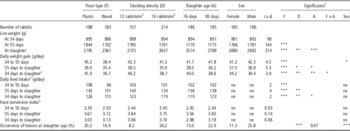
Rearing rabbits on plastic slatted floors rather than wooden floors had a clear positive effect on the production results, which also implies a positive effect on rabbit welfare conditions. Specifically, the rabbits maintained on the plastic floor exhibited greater daily weight gain (+18% and +11%) and feed intake (+13% and +9%) during both the first and second periods of growth (P⩽0.001); accordingly, their live weights were higher at both 55 days of age (1844 v. 1702 g) and at slaughter (2795 v. 2567 g) (Table 1). In our previous trial (Xiccato et al., Reference Xiccato, Trocino, Filiou, Majolini, Tazzoli and Zuffellato2013b), the rabbits reared collectively in the same pens with wooden slatted floor exhibited lower growth performance compared with the rabbits in conventional bicellular cages, and we attributed this effect to the type of floor rather than to the rearing system per se (i.e. bicellular cages v. collective pens). The present results confirm this hypothesis. Similarly to the findings described by Petersen et al. (Reference Petersen, Schlender-Böbbis and Mennicken2000), our comparison of the different slatted floors suggested that the 3-cm distance between the wooden slats used in our studies is likely too great to safely support the rabbits, particularly the young animals.
Effect of floor type, stocking density, slaughter age and sex on performance from weaning (34 days of age) until slaughter and occurrence of lesions in growing rabbits reared in collective pens

ne=not-estimable.
1 Probabilities of the interactions were not reported when P>0.10.
2 Probability of the interaction floor×slaughter age, P⩽0.05; daily weight gain: 43.1 and 40.6 g/day in rabbits reared on plastic floor and slaughtered at 76 and 83 days of age; 36.9 and 36.6 g/day in rabbits reared on wooden floor and slaughtered at 76 and 83 days of age.
3 Pen data.
*P⩽0.05, **P⩽0.01, ***P⩽0.001.
Notwithstanding the substantial effect of the type of floor on growth performance, no differences in the proportions of rabbits that exhibited injuries due to aggression at the end of the trial were observed between the rabbits maintained on the plastic and wooden floors (18.6% on average; P>0.05) (Table 1).
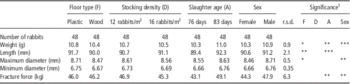
The femur weights, lengths and maximum diameters were significantly greater in the heavier rabbits that were reared on the plastic slats compared with those reared on the wooden slats; however, the femur fracture resistances were not different (Table 2). Indeed, the resistance to fracture of the bones might be enhanced with increases in movement possibilities as has been proven by comparisons of housing systems that were characterised by substantial differences in functional space (e.g. individual cages, bicellular cages and collective pens of different sizes) (Combes et al., Reference Combes, Postollec, Cauquil and Gidenne2010; Xiccato et al., Reference Xiccato, Trocino, Majolini, Tazzoli and Zuffellato2013a).
Effect of floor type, stocking density, slaughter age, and sex on femur characteristics in growing rabbits reared in collective pens

1 Probabilities of the interactions were not reported when P>0.10.
*P⩽0.05, **P⩽0.01, ***P⩽0.001.
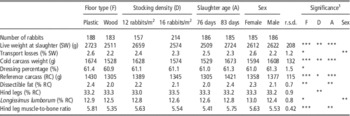
The changes observed in the slaughter traits were mainly dependent on the differences in live weight (Parigi-Bini et al., Reference Parigi-Bini, Xiccato, Cinetto and Dalle Zotte1992). The heavier rabbits maintained on the plastic floor exhibited higher (P⩽0.001) live and carcass weights and dressing percentages than did the rabbits maintained on the wooden floor; the former rabbits also exhibited greater transport losses (+18%), dissectible fat percentages (+29%), l. lumborum proportion (+6%) and hind leg muscle-to-bone ratios (+9%) (P⩽0.05) (Table 3).
Effect of floor type, stocking density, slaughter age, and sex on slaughter traits and main characteristics of 24-h chilled carcasses in growing rabbits reared in collective pens

1 Probabilities of the interactions were not reported when P>0.10.
*P⩽0.05, **P⩽0.01, ***P⩽0.001.
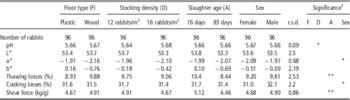
Despite the abovementioned differences, the rheological meat traits were not affected (Table 4). Similarly, other studies have not found relevant differences in slaughter results or meat quality traits of pen-housed rabbits according to floor type (Dalle Zotte et al., Reference Dalle Zotte, Princz, Metzger, Szabó, Radnai, Biró-Németh, Orova and Szendrő2009). Only when growth is greatly lowered due to unsuitable floors (e.g. straw-bedded floors) carcass and meat quality traits are also impaired (Dal Bosco et al., Reference Dal Bosco, Castellini and Mugnai2002).
Effect of floor type, stocking density, slaughter age and sex on meat traits of longissimus lumborum muscle in growing rabbits reared in collective pens

1 Probabilities of the interactions were not reported when P>0.10.
*P⩽0.05, **P⩽0.01.
Effect of stocking density: 12 v. 16 rabbits/m2
Increasing the stocking density from 12 to 16 rabbits/m2 impaired daily growth (−7%) (P⩽0.05) and feed intake (−1%) (P⩽0.01) only during the second period of the trial; consequently, the final live weight decreased (2725 v. 2637 g; P⩽0.01) (Table 1). At the end of the trial, the slaughter weights per unit of pen surface were 32.7 and 42.2 kg/m2 in the pens with 12 and 16 rabbits/m2, respectively. The latter figure was somewhat higher than the recommended value (40 kg/m2; EFSA, 2005) above which both growth performance and behaviour pattern might exhibit some weakness when rabbits are reared in cages (Maertens and De Groote, Reference Maertens and De Groote1984; Morisse and Maurice, Reference Morisse and Maurice1997). Indeed, at the end of our trial, a higher percentage of rabbits with scratches and lesions owing to aggression was observed in the pens with 16 animals/m2 compared with the pens with 12 rabbits/m2 (26.2% v. 8.2%, respectively; P⩽0.001) (Table 1), which evidences impairments of both general welfare conditions and performance. The available surface likely became a limiting factor during the last week of the trial under our conditions, that is, the Italian market which requires heavy live weight (2.6 to 2.8 kg) and rather late slaughtering (>75 days of age). The availability of a larger functional space to be used by rabbits in pens compared with cages would permit to overpass the 40 kg/m2 recommended by EFSA (2005) without negative consequences when rabbits are kept in pens, provided that slaughtering occurs within 10 to 11 weeks of age. In fact, until 9 weeks of age, the increase of space allowance did not affect behaviour and use of space in rabbits kept in cages (Buijs et al., Reference Buijs, Keeling and Tuyttens2011). The possibility of maintaining the same production level per unit of surface even in alternative pen housing systems is crucial for the economic sustainability of rabbit farmers and for the transition from classical cages to pen systems in rabbit meat producing Countries.
Similar to the increased final live weight, the slaughter weight and carcass weight were also significantly increased (P⩽0.01) among the rabbits that were maintained at the lower stocking density; however, the opposite pattern was observed for the hind leg proportions of the reference carcasses (Table 3). The pHs of the l. lumborum muscles increased (P⩽0.05) as stocking density increased from 12 to 16 rabbits/m2, whereas the meat thawing and cooking losses and shear force were unaffected (Table 4).
Weak effects of stocking density (12 v. 16 rabbits/m2) on performance and carcass and meat quality have been reported in rabbits reared in pens in large groups (20 to 54 rabbits) (Xiccato et al., Reference Xiccato, Trocino, Filiou, Majolini, Tazzoli and Zuffellato2013b). In contrast, under unconventional deep litter housing conditions (i.e. pens on granular zeolite and bedded with straw or wood shavings), increasing in stocking density (from 8 to 16 rabbits/m2) impaired the performance of pen-housed rabbits (Lambertini et al., Reference Lambertini, Vignola and Zaghini2001).
Effect of slaughter age: 76 v. 83 days of age
With the increase in slaughter age, the daily weight gain during the second period of growth (55 days of age until slaughter) decreased (−5.5%; P⩽0.05), and the daily feed intake and final slaughter weight increased (+8%; P⩽0.001) (Table 1). Accordingly, the feed conversion index was impaired with age (Table 1). A significant interaction (P⩽0.05) between slaughter age and floor type was observed; the daily weight gain decreased with age among the rabbits that were maintained on the plastic floor (43.1 v. 40.6 g/day in rabbits slaughtered at 76 v. 83 days of age) but did not change on the wooden floor (36.9 v. 36.6 g/day). The significant reduction in the growth rates of the rabbits that were maintained on the plastic floor when slaughter age was delayed by 1 week was expected as muscular growth decreases with age. In contrast, the rabbits that were maintained on the wooden floor maintained a similar growth rate despite the different slaughter ages because they were not capable of expressing their full growth potential during the first period of growth.
Major development of the femur was observed in the older and heavier animals (P⩽0.01); the weights, maximum diameters and fracture forces of the femurs were higher in the rabbits at 83 days of age compared with those at 76 days of age (Table 2). The slaughter traits also varied according to growth performance; the older rabbits exhibited greater (P⩽0.001) live and carcass weights than did the younger rabbits. The former rabbits presented with greater proportions of dissectible fat (+20%) and hind leg muscle-to-bone ratios (+6%) (P⩽0.01) (Table 3). The meat pH and colour did not vary, whereas the thawing losses (P⩽0.01) and shear forces (P⩽0.01) decreased with the increase in slaughter age (Table 4).
The effects of slaughter age on productive performance, slaughter traits and carcass quality are well known for rabbits maintained in individual and bicellular cages (Parigi-Bini et al., Reference Parigi-Bini, Xiccato, Cinetto and Dalle Zotte1992). In collective pens, some interactions might be expected between slaughter age and housing conditions, and such interactions were observed in the present trial. Specifically, conditions of greater stress are expected with the increasing age of collectively pen-reared rabbits because the functional space available decreases as the body sizes increase. In addition, the competition to establish hierarchy intensifies with age and sexual maturity.
In our conditions, the occurrence of injured animals tended to increase from 15.0% to 22.0% in the rabbits at 76 and 83 days of age (P⩽0.10) (Table 1). Similar results had been reported by Szendrő et al. (Reference Szendrő, Princz, Romvári, Locsmándi, Szabó, Bázár, Radnai, Biró-Németh, Matics and Nagy2009) for collectively housed rabbits at 9 to 11 weeks and by Rommers and Meijerhof (Reference Rommers and Meijerhof1998). However, in our trial, the difference was not so dramatic, and the severity of the injuries did not imply the downgrading of the carcasses even at the later ages requested by the Italian market at commercial slaughter.
Effect of gender
The low sexual dimorphism and the early slaughter age of rabbits justify the standard practice of mixed rearing of females and males in intensive commercial farms.
Indeed, under our conditions, gender only affected daily weight gain from weaning to 55 days, which was lower in females than in males (P⩽0.05) (Table 1). The femur traits differed in terms of weight (P⩽0.001), maximum diameter (P⩽0.01) and fracture force (P⩽0.01) (Table 2) and thus demonstrated a minor skeletal development in the females compared with the males at slaughter time.
At slaughter, few differences between the genders were recorded. The females exhibited greater transport losses (P⩽0.01), which might have been due to their greater gut contents (Parigi-Bini et al., Reference Parigi-Bini, Xiccato, Cinetto and Dalle Zotte1992; Trocino et al., Reference Trocino, Xiccato, Queaque and Sartori2003) and higher proportions of l. lumborum (P⩽0.01) (Table 3). The meat pH and colour were not affected with the exception of lower a* indices and cooking losses for l. lumborum in the females (P⩽0.05) than in the males (Table 4).
Overall, the small and non-relevant differences in growth performance, slaughter traits and meat quality do not justify the separation of rabbits by gender when they are maintained in the most common and standard housing conditions (i.e. bicellular cages or small cages with four to six rabbits). However, in collective housing systems (i.e. large pens with >10 subjects), the different degrees of social interactions might justify such separation. Vervaecke et al. (Reference Vervaecke, De Bonte, Maertens, Tuyttens, Stevens and Lips2010) demonstrated that rabbits, even those in cages and in small groups (eight animals), develop hierarchies beginning at 10 weeks of age and that males and females do not develop separate hierarchies. In our conditions, differences in the occurrence of injured animals were significantly dependant on gender; 11.3% of the females were injured compared with 25.8% of the males at the end of the experimental trial (P⩽0.001) (Table 1). We do not know if this result depended on major aggressiveness of the females towards the males or major aggressiveness among the males approaching sexual maturity. In this regard, Di Meo et al. (Reference Di Meo, Piccolo, Stanco, Gazaneo, Taranto and Nizza2003) observed a higher occurrence of injuries in rabbits that were maintained in mixed-sex pens (30 rabbits/pen) compared with rabbits that were maintained in single-sex pens.
Conclusions
In the conditions of our trial, the use of slatted plastic floors substantially enhanced the productive results and likely enhanced the welfare conditions of the pen-reared growing rabbits compared with the unsuitable wooden slatted floors that were characterised by large spaces between the slats. Pen stocking density (12 v. 16 rabbits/m2), slaughter age (76 v. 83 days) and gender exerted only minor effects on growth performance and product quality. However, a higher incidence of injuries was observed among the male rabbits, at the higher stocking density and the increased slaughter age. From the perspective of optimising conditions for rearing rabbits in pens and in large groups, the option of separately rearing females and males deserves further investigation.
Acknowledgement
This study was funded by the University of Padova (Year 2011; Research Project CPDA119830 – CUP: C21J11000500005).