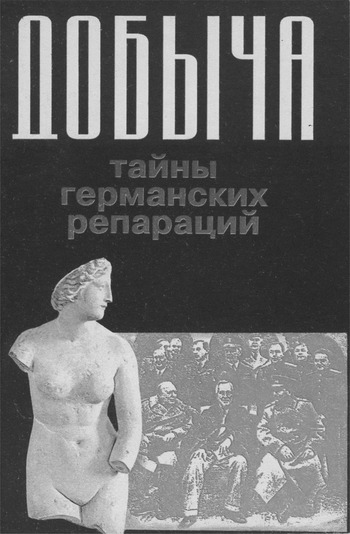
The decrees issued by Joseph Stalin in 1945 for the Soviet removal of cultural property from Eastern European and German territories occupied by the Red Army were few. They are still classified and unavailable for researchers (as of mid-2010). We are aware of the existence of several of the most important of them only through the sensational publication of Dobycha in 1994 by the late Russian military historian Pavel Knyshevskii,Footnote 1 who at the beginning of perestroika had access to classified documentation in military and Communist Party archives (Figure 1). Knyshevskii explained that all of the decrees (postanovlenie) and general orders (rasporiazhenie) authorizing the transport of movable goods (factories, construction materials, etc.), as well as specifically designated cultural property, from German territories were signed only by Stalin himself.Footnote 2 Although not referenced as such, presumably these are the only documents (albeit decrees) that make such transports “legal” under terms of the 1998 Russian cultural property law.
The cover of the sensational book Dobycha [Loot] by Pavel Knyshevskii (Moscow: “Soratnik,” Reference Knyshevskii1994), featuring a background picture of Winston Churchill, Franklin D. Roosevelt, and Joseph Stalin seated at the conference in Yalta, February 1945. The book contains the texts of many of Stalin's decrees establishing the Trophy Administration and the Trophy Brigades, along with the authorizing decrees for transport of some of their loot and related texts. The author, a military historian, who died a year after the book appeared, had special access to the former Communist Party and military archives, but most of the documents cited are still classified in Russia.

Ten days after returning from the conference in Yalta, on 21 February 1945 Stalin signed the “Decree (postanovlenie) of the State Committee of Defense (Gosudarstvennyi Komitet oborony, GKO) No 7563 (top secret) on the establishment of permanent commissions at the operating Soviet military fronts and on orders for removal of industrial equipment and materials from Poland and Germany.”Footnote 3 This decree ordered the creation of different trophy brigades to be sent to the front lines to remove to the USSR everything from heavy industry machinery to paintings by Rembrandt, shoes, hats, and typewriters.
Four days later Stalin signed the next decree, namely, the Decree of the State Committee of Defense (GKO) No 7590. Like the previous document, it too was top secret. The decree ordered the establishment of the Special Committee under the State Committee of Defense headed by Grigorii Malenkov. The new body was to coordinate the activities of the trophy brigades.Footnote 4
On 26 June, Stalin signed the most important of four decrees of the State Committee of Defense dealing specifically with removal of art collections: It was dedicated to the fate of the Dresden Gallery. The decree did not mention restitution in kind or compensation for Soviet museum collections plundered or damaged by the Nazi occupiers. Its language was quite straightforward. The State Committee of Defense was ordered to remove “to Moscow for enrichment of state museums the most valuable works of painting, sculpture and applied arts and also antiquarian and museum valuables in quantities not exceeding 2000 items from the trophy warehouses in Dresden.”Footnote 5 That was a month after another GKO decree at the end of May 1945 ordered the removal of the most valuable Dresden treasures, among them the collections of the Grünes Gewölbe (Green Vault) and the unique collection of coins and medals.Footnote 6 An additional GKO decree a year later provided for the transport from Dresden of objects from the Meissen porcelain factory,Footnote 7 and another ordered transport of extensive laboratory, construction, and library materials, to be directed to the Soviet Academy of Architecture.Footnote 8
It would seem that by the second part of 1945 the necessity to compensate for Soviet cultural losses by equally important artifacts from specific named German collections was forgotten and replaced by the conception of total removal of cultural property from the Soviet-occupied territories.
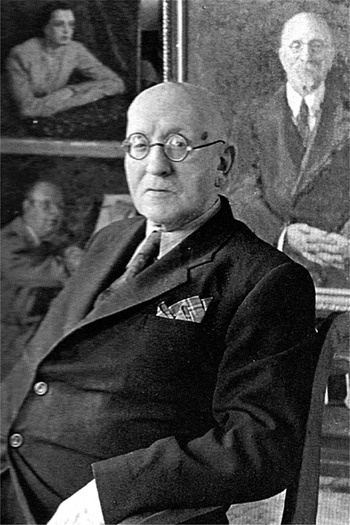
The idea to use the concept of “restitution in kind” after the end of the war to compensate for cultural losses of the Soviet Union belonged not to the government but to art historians. In 1943 academician Igor Grabar (Figure 2), the famous artist and art historian, wrote a letter to Nikolai Shvernik, the head of the Extraordinary State Commission on the Registration and Investigation of the Crimes of the German-Fascist Occupiers and their Accomplices and the Damage Done by them to Citizens, Collective Farms, Public Organizations, State Enterprises, and Institutions of the USSR (ChGK).Footnote 9 As its long Soviet-style name implies, that was the official Commission established to compile precise lists of Soviet losses and damage. Grabar had become famous before the October Revolution as a decadent artist and the author of a famous History of Russian Art.Footnote 10 He also succeeded in making a career in Soviet Russia. As a member of the Academy of Sciences, awarded the Stalin Prize, the highest award of the Soviet state, Grabar was an important figure in the country's cultural establishment. In his letter to Shvernik, he proposed a plan of compensation for the cultural losses suffered by the USSR, namely, by replacing the losses with art works from enemy collections after the end of the war.
Igor Emmanuilovich Grabar (1871–1960), painter, art historian, and member of the Academy of Sciences of the USSR. Image courtesy ITAR-TASS

In a more detailed proposal on the activities of the body that would be responsible for the selection of equivalents the academician wrote:
Because the matter of collecting equivalents in certain cases in compensation for art works removed or destroyed by the GFO (German-fascist occupiers) was settled positively by the ChGK (Extraordinary State Commission) of the SNK (Council of People's Commissars) of the USSR, I think it is a timely measure to establish now a special division of the ChGK to make up lists of objects in the museum collections of Germany, Austria, Italy, Hungary, Romania, and Finland that could be named as eventual equivalents.Footnote 11
The expert group proposed by Grabar was to be headed by three experts: the academician himself; Viktor Lazarev, the well-known art historian and former curator of paintings of the Pushkin Museum of Fine Arts in Moscow; and Sergei Troinitskii, the former director of the Hermitage.Footnote 12
Shvernik approved Grabar's proposal and sent it to the Politburo of the Communist Party for approval.Footnote 13 On 8 September 1943 the Bureau of Experts was established by Decree No. 12 of the Extraordinary State Commission (ChGK).
Grabar's Bureau had two main tasks: (1) to assess the damage caused by the Nazis to the Soviet museums and (2) to select so-called eventual equivalents from museum collections in the Axis countries. From the very beginning the activity of the bureau was impeded by the virtual impossibility of achieving the first aim: a large part of the Soviet territory was still under occupation. Information about the Nazi destruction and removal of cultural property was fragmented, and more was being damaged in the course of liberation. In addition to this, museum documentation in the majority of provincial museums proved to be either nonexistent or at best unreliable. Many of these institutions were established after the revolution, their catalogues were never published, and art works were badly attributed. For example, to assess the damage to the museum situated in the town of Istra near Moscow, experts of the State Historical Museum had to interview art historians who had visited the museum before the war, and only then, relying on the art historians' memories, were they able to compose a list of the most valuable objects.Footnote 14
During a meeting of the bureau, Viktor Lazarev sadly commented, “What is the tragedy of provincial museums? The level of provincial museum officials was not very high, and if the Rembrandt is mentioned in the inventory book it does not prove that it is really a Rembrandt.”Footnote 15 Lazarev was referring to a Soviet newspaper publication about Nazi looting of a provincial museum that allegedly lost masterpieces of Rubens and Rembrandt; in reality, they turned out to be copies sent to the museum from the Hermitage.
Having no real possibility to compose a reliable list of losses, the bureau was busy compiling the lists of “equivalents.” This list turned into wish lists of masterpieces, which were to replace the art works that had disappeared from Soviet museums, although neither the scale nor quality of such losses were known to the experts. It is interesting that the lists of equivalents composed separately for every Axis country included not only works from state museums but also objects from private collections.Footnote 16 Such an approach betrayed the communist mentality and a complete disregard of private property typical of the Soviet experts of the period.
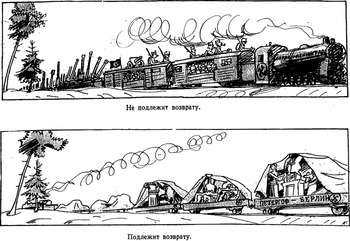
Cartoons published in the Soviet satirical magazine, Krokodil, 1944, no. 7 (July), by Aminadav Moiseevich Kanevskii (1898–1976). The top cartoon depicts German soldiers arriving with the caption reading “No return required”; the second with Soviet cultural treasures being carried off has the caption, “Return required.” Unfortunately the Soviet side lacked detailed knowledge of what was really removed by the Germans from the occupied territories.

The list of equivalents turned into a catalogue of highlights in the museums of enemy countries. It is enough to regard the selection of artwork experts of the bureau wanted to get from Italy. Among them were 10 paintings from Palazzo Ducale in Venice, including Tintoretto's Portrait of Two Senators and Tiepolo's Copper Serpent. Among five paintings from the Uffizi Gallery in Florence were Madonna with Pomegranate by Botticelli, Adoration of the Magi by Ghirlandaio, Perseus and Andromeda by Piero di Cosimo and two Madonnas by Filippino Lippi. From Verona the experts wanted to receive Crowning with Thorns by Cavazzola; from Rome, Velasquez's Portrait of Innocent X; and from Naples, Brueghel's Blind Leading the Blind.Footnote 17 Of course, the experts had some understanding that compensation for the unknown losses by masterpieces of world art could be opposed by the Allies.
Heated discussion about evaluation of losses and equivalents was also notable during the bureau sessions. It was clear that if the Western Allies supported the conception of restitution in kind, it would be necessary to substantiate the value of the Soviet objects lost. In December 1943 Nikolai Belekhov, head and chief architect of the State Inspectorate for the Preservation of Monuments in Leningrad, attended a meeting of the Bureau. Belekhov proposed that the total value of an artwork comprised such components as “the price of canvas, a stretcher, and the work of an artist,” as well as the “quantity of socially useful time needed for recreation of such a piece.”Footnote 18 To arrive at a total value for a work of art, he recommended use of a special coefficient (or an additional price) for the type of painting: a genre painting according to his view was more expensive than a portrait, a portrait more expensive than still life, and so forth. He also believed that the price would have to be increased if the lost artwork had a high national or ideological value. As an example, Belekhov selected for his estimate the masterpiece of Ilya Repin, Zaporozhian Cossacks Write a Letter to the Turkish Sultan. According to Belekhov's evaluation system, it would be worth $1,425,500.Footnote 19
In fact, the painting in question had not been destroyed or damaged, but rather evacuated together with the rest of the collection of the State Tretiakov Gallery to Novosibirsk. However, if the evaluation system offered by Belekhov betrayed a mixture of nationalism with the vulgar sociological method popular in the USSR in the beginning of the 1930s, and was dismissed by the experts of the bureau, his choice of painting for estimation was not accidental. The majority of art works in the museums in the German-occupied territories belonged to Russian and other local schools. An international market for them was nonexistent, and establishing their market value was virtually impossible. In addition to this, Soviet art historians had been cut off from the international art market since the beginning of the 1930s. They had no idea of prices and no access to Western auction catalogues. The experts tried hard to find international equivalents for the Russian realist Repin, comparing him to Matisse or Adolph von Mentzel.Footnote 20
A more realistic system of evaluation was proposed by Yurii Almazov, the deputy director of the Scientific Research Institute for Museum and Regional Studies in Moscow. According to the Almazov's price list, a fourteenth-century icon would cost about $250,000, and a painting by a member of the nineteenth-century realist Wanderers group not more than $125,000. Almazov's estimates were an attempt to overcome the problem of isolation of Soviet art experts and their complete lack of knowledge of the realities of the contemporary art market. Researchers of the Scientific Research Institute for Museum and Regional Studies simply consulted prerevolutionary Russian auction catalogues and recalculated prices in the equivalent of Soviet rubles in 1927, when the ruble had been briefly convertible, and at a favorable rate of exchange.Footnote 21
However, evaluation of losses was not the only challenge for the bureau. No less problematic was estimation of value for the eventual equivalents chosen. In this case Grabar and his colleagues decided to rely on the only experience Soviet art historians had with the Western market during the 1930s, namely, the secret sales of masterpieces from Soviet museums during the first Five-Year Plan. Such experts working for the Bureau as Vladimir Levinson-Lessing, Nikolai Vlasov, and Grabar himself had taken active part in the sales and were aware of the prices the Soviet government received from Western art dealers. Explaining their estimates in 1945, Grabar and Vlasov wrote:
In 1935 Andrew Mellon, the well-known American collector, had to publish the prices he had paid for masterpieces of Raphael, Titian, van Eyck, Rembrandt, Rubens, Van Dyck, and other great masters. Mellon donated his famous collection to the state, and the National Gallery in Washington was created on its basis.Footnote 22
Grabar and Vlasov did not need American sources to know the prices Mellon paid for the masterpieces mentioned. All of them were sold from the Hermitage.
In discussing the possibility of restitution in kind after the end of the war, the bureau experts paid special attention to the problem of compensation for the destroyed architectural monuments. Fantastic ideas to move medieval cathedrals from the Axis countries to the Soviet Union, obviously inspired by the Cloisters in New York, were rejected.Footnote 23 In the end Grabar and his colleagues agreed that more plausible compensation for the destroyed architectural monuments could be the removal of architectural-sculptural complexes in the Berlin museums, for example, the Pergamon Altar.Footnote 24 On 26 February 1945 the Bureau of Experts provided the final list of equivalents to Andrei Konstantinov, the deputy head of the Committee on Arts of the Council of People's Commissars. The total value of the described equivalents was $70,587,200. The Sistine Madonna was evaluated at $2,000,000. The most expensive object on the list was the Pergamon Altar, evaluated at $7,500,000.Footnote 25
While the wish list may have been ready, registration of Soviet losses was quite far from finished. The Extraordinary State Commission completed it only in 1946. The list had no estimates of even approximate value. According to the list, the Nazis removed, damaged, or destroyed 564,723 museum objects in the entire Soviet Union.Footnote 26 When the final list of proposed equivalents was delivered to the Committee of Arts, its experts were already receiving new military uniforms and were ready to depart for Poland and Germany. The time for academics was finished.
It then became the trophy brigades' turn. At least five or six different types of brigades representing different Soviet institutions or subject specialties were involved in the removal of cultural property. The main role in search and confiscation of art works belonged to the trophy brigades of the Committee on Arts.Footnote 27 However, the brigades of the Committee on Scientific-Educational Organizations, which were involved in the removal of a broad variety of cultural goods, from library collections to pianos, were also removing art works as well.Footnote 28
In addition to these two major players, various brigades of the Academy of Sciences were operating with more specific goals, which usually included significant numbers of books and other cultural valuables, along with scientific equipment and other materials. And a special brigade for archival and manuscript treasures was directly responsible to the Communist Party, although it was military counterintelligence units of SMERSH (literally Death to Spies) that were searching for important concentrations of archives, which were eventually to be removed by special archival brigades sent by the State Archival Administration under the Peoples' Commissariat of Internal Affairs (NKVD), on Lavrentii Beria's (head of the NKVD) orders. Apart from those named from Moscow, the Ukrainian Soviet Republic had its own trophy officers in various army units, along with other brigades from Kyiv, quietly competing with their colleagues from Moscow.
From the very beginning of operations in Soviet-occupied territories, it became apparent to the trophy brigades that the search for the specified art works designated as “eventual equivalents” was virtually impossible, although they did find the Pergamon Altar. Instead, within weeks of Stalin's decrees, mentioned earlier, the trophy experts started to load entire collections on trains heading for the Soviet Union, often without even sorting them out. The first theater of operations by the trophy brigades was what then was still the eastern territory of the German Reich, namely, Silesia and adjacent areas, which later came within the newly redrawn western border of Poland. With an operating center in Gleiwitz (now Polish Gliwice) in an industrial area not far from Kattowitz (now Polish Katowice) from March through May 1945, the brigade under command of Boris Filippov operated in a wide territory gradually being “liberated” by the Red Army.Footnote 29
Another brigade from the Committee on Arts under command of Andrei Belokopytov, on the way to Berlin, was removing art works from the territory that today belongs to the Lubusz Voivodeship in Poland. The first major removal to Moscow took place in March 1945, when the brigade discovered an underground shelter in the village of Hohenwalde (now Polish Wysoka) situated in the area of Meseritz (now Polish Miedzyrzecz). They found the collections of what had been before 1918 the Kaiser Friedrich Museum in Posen (known in the interwar period as the Wielkopolskie Museum in Poznan). The storage vaults also contained collections removed by the Nazis from museums of Tallinn and Riga. Despite the posting of military guard, the storage areas were being looted and were in a chaotic state. It was hardly possible to move in the underground tunnels, let alone to sort out the art works. In addition, the brigade worked under a severe time pressure: that area, designated to become western Poland, soon had to be handed over to Polish military administration. Finally, Sergei Sidorov, the commanding officer of the unit under which the Belokopytov's trophy brigade was operating in Hohenwalde, received an order not to take time to select the best, but to send everything to Moscow. The treasures were loaded in 22 railway cars and sent to the USSR.Footnote 30 Such modus operandi became typical for all trophy brigades.
Following the trainloads from what had been eastern German territories, and sometimes at the same time, trophy brigades from the Committee on Arts and the Committee on Scientific-Educational Organizations were working in Berlin and Dresden areas immediately after the German surrender. The contents of their train and planeloads to Moscow are already well known.
The most mysterious of the brigades that operated on the Soviet-occupied European territories remain those of the State Treasury (Gokhran), nominally under the Peoples' Commissariat of Finance, but undoubtedly taking orders from Beria, the head of the NKVD—the all-powerful Soviet Secret police. The main targets of such brigades were bank vaults. They were searching for currency, precious metals, and gems. It is possible only to guess what else fell into their hands. The only documented operation known of the Gokhran brigades was removal of the jewelry collection of the Grünes Gewölbe (Green Vault), the Dresden museum that contains the largest collection of jeweled treasures in Europe.Footnote 31 That removal was ordered by the same special top-secret decree that ordered the removal of the Dresden collection of coins and medals, issued as the State Committee of Defense (GKO) Decree No. 8894, personally signed by Stalin on 31 May 1945:
… Oblige the Peoples' Commissariat of Finance of the USSR (Narkomfin), under the direction of Comrade Zverev to remove the Jewelry gold and silver ware (iuvelirnye izdeliia) [and] the Collection of Coins and Medals from the Dresden region to the Narkomfin base of the Administration of Precious Metals in Moscow, … and with further authorization of Comrade Zverev as the responsible director [of the operation].Footnote 32
That was a month before Stalin's decree ordering removal of the paintings from the Dresden Gallery at the end of June, as mentioned earlier.Footnote 33
The Council of the Peoples' Commissars of Ukraine, led by the powerful Nikita Khrushchev, had sent its own trophy brigades to Germany, also centering operations in the Dresden area.Footnote 34 Among other things, these brigades succeeded in airlifting to Kyiv a substantial part of the collection of the Dresden Gallery—497 paintings, including the famous Dresden Triptych by Albrecht Dürer.Footnote 35 Other shipments of Dresden materials in the autumn of 1945 can be documented from reports to the Ukrainian Communist Party authorities in Kyiv.Footnote 36 The Committee of Arts in Moscow had very little knowledge about the Ukrainian operation.
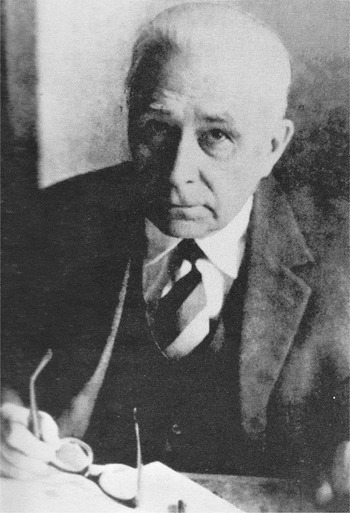
Only one member of the Soviet Bureau of Experts visited occupied Germany: Viktor Lazarev arrived to Berlin on the 14 May 1945, five days the Nazi surrender (Figure 4). He played an instrumental role in the selection of art works from the Berlin museums that were sent to Moscow. Being a professional art historian, Lazarev protested sharply against removal of the German museum records. He proposed a logical plan for removal of art works. The art historian recommended that only important pieces in limited quantities be taken from state museum collections, leaving representative collections behind. Lazarev wrote about the situation in Berlin to Georgii Malenkov, the secretary of the Central Committee and the head of the Special Committee under the State Committee of Defense:
Because the best and the most valuable museum exhibits were removed by the Germans to the western zones of occupation, it makes sense to limit the selection from the half-ruined museums and cellars only to the most interesting objects (not more than 300–400). The works of the German masters, as a rule, should not be removed.Footnote 37
Viktor Nikitich Lazarev (1897–1976), art historian. Courtesy Konstantin Akinsha.

Lazarev also advised Malenkov that the Soviets should not ruin such historic entities as the palaces of Potsdam, arguing that numerous objects there were site-specific; the expert recommended that they “limit the removal to the most valuable … statues and paintings (not more than 250–300 exhibits) created by foreign masters.”Footnote 38 He also noticed that “it makes sense to remove 20–30 objects of eighteenth-century furniture that could be used to enrich our palaces on the outskirts of Leningrad that were ruined by the Nazis.”Footnote 39 It is interesting that this Lazarev report, written after his visit to Potsdam, is the only known document composed during the trophy operations that mentions compensation for specific losses of Soviet museums. Another such reference to compensation was much more general, involving nine freight cars full of archives and early manuscripts seized by the special Archival Trophy Brigade, including vast medieval Hanseatic records. Georgii Aleksandrov justified their transport to Communist Party Central Committee Secretary Malenkov as possible “compensation for the losses wrought by the German occupiers on scholarly and cultural institutions in the Soviet Union.”Footnote 40
Lazarev, however, was not foreign to the typical Soviet negation of private property. In the same report, he wrote that the USSR should “work all the time to find private collections belonging to the Nazis, representatives of the bourgeoisie and art dealers. All things must be transported to Moscow immediately.”Footnote 41 For the Soviet art historian, the difference between the Nazis and bourgeoisie involved in Nazi crimes was thin, if existing at all. Lazarev not only gave recommendations but also personally participated in the selection of objects belonging to private collections hidden in the cellars on the Museum Island in Berlin.
The art historian made a short trip to the U.S. Central Collecting Point in Munich and was quite impressed with the activities of the Monuments, Fine Arts, and Archives (MFA&A) restitution program. Lazarev believed that the Soviet Military Administration in Germany (SVAG) should establish a comparable service, which could deal with restitution issues. Upon his arrival in Moscow, Lazarev suggested the creation of a Soviet analogy to the American MFA&A facility. He wrote in his report to the head of Extraordinary State Committee: “Work on the restitution of art valuables is very specific, that is why it should be separated into an independent branch, in the way that it is done by Americans.”Footnote 42
Lazarev wanted to involve the Western Allies in a large-scale action of compensation for Soviet losses by German cultural valuables. However, the majority of his recommendations were not taken into account. The selective confiscation of art works he advocated, which would have required serious expertise, could not compete with the total removal following the pattern of reparations that Stalin demanded in Yalta.
In 1945, during Yalta Conference, the Inter-Allied Reparations Commission was launched. It was supposed to generate proposals for reparations and restitution, necessary for signing a peace treaty between Germany and the Allies. In June 1945, the Commission started its work in Moscow.
The Commission included Committee No. 4 (on reparations, war trophies, and restitution). On 19 June, the first meeting of this committee took place. During this meeting a discussion about compensation of Soviet cultural losses was held for the first time. Soviet lawyer Ivan Pereterskii gave a speech on “Restitution and Exchange.” Then P. I. Bogoiavlenskii, the secretary of the Extraordinary State Commission made a short report on Soviet cultural losses. He announced that the Extraordinary Commission was already in possession of a list of lost valuables, which should be subject to restitution and compensation.Footnote 43 Bogoiavlenskii was obviously too quick with his declarations. The list was not yet ready. More than that, work on this list was seriously delayed. The best Soviet experts had already been very busy for several months, trying to sort out the “cultural trophies” arriving in the USSR from Europe.
Immediately after the meeting of the 19 June, the Extraordinary State Commission sent letters to all the Peoples' Committees, demanding submission of information about losses in two weeks. But even the Committee on Arts, by March 1946, was able to submit information about losses from only nine museums out of 40 damaged.Footnote 44 By that time, however, it was almost too late for such lists, which indeed would have been badly needed for the discussion about restitution in kind which was developing in the Allied Control Council (ACC), which was governing Germany on behalf of the four Allies. In March 1946, representing the SVAG as head of the Department of Reparations and Deliveries, Leonid Zorin sent a substantial letter to the chairman of Extraordinary State Commission, Nikolai Shvernik. He wrote, “In the nearest future representatives of four countries will form a quadripartite committee, under the aegis of the Control Council. This Committee will be dealing exclusively with the question of compensation of lost unique objects of art, registration of their return, definition of their equivalents, etc.”Footnote 45 At that point, Zorin demanded to work out the mechanism of restitution as soon as possible.
Meanwhile, under the auspices of the ACC, discussion was starting in Berlin about the “Special Instructions Concerning Replacement by Similar or Comparable Property of Objects of a Unique Character.”Footnote 46 In January 1946 a quadripartite Special Working Group within the ACC Reparations, Deliveries and Restitution Directorate had been charged with finalizing the draft text.Footnote 47 Transcripts from February 1946 meetings of the Working Group shed considerable light on those negotiations and explain the failure of the Working Group to come up with a viable draft of the needed “Special Instructions.” Apparently Lieutenant Colonel Grigorii Nikolaevich Guliaev, who since January 1946 headed the Sub-Division of Restitution, under the SVAG Division (Otdel) for Reparations and Deliveries, was representing USSR in the Working Group in Berlin during the February 1946 quadripartite discussions of the projected draft “Special Instructions.”Footnote 48
Already during one of the first meetings of the Working Group, 1 February 1946, a heated discussion among Soviet, American, and British representatives set the stage for failure to draft viable Special Instructions. At issue was a paragraph (4b) in the draft Special Instructions requiring any of the four occupying powers in connection with claims for replacement of unique objects “to submit a list of all similar or equivalent German-owned property removed from its zone by the Occupying Power submitting the request and the basis on which such removals were made.”Footnote 49 The transcript of the meeting perfectly demonstrates the Soviet approach to the cultural “trophies,” which in their eyes were not to be counted as “eventual equivalents”:
R. (USSR) How shall we understand in the requirement for presenting of the lists, “The property that was taken away from the Zone of Occupation since May 1945, and the present location of this?”
A. (USA) That refers to German-owned works of art that were in this country at the end of the war and that have been removed since the seventh of May.
R. It is not necessary to present such lists. Objects belonging to the Germans that were exported after the seventh of May are Soviet property, as military trophies, and there is no case of replacement. The Germans hid property such as valuable works of art to save them from military action. Such property and property taken by troops, especially the Red Army, is without doubt military trophies and cannot be used for replacement; it is useless to make a list for such property.
A. I don't understand how works of art can at one time be considered a priceless national asset and the next moment classed with inartistic objects such as a truck or a cannon. When, for safety, a work of art is placed in a military objective, why should it be considered any different than a work of art not stored in a military objective? I thought that the quadripartite occupation of Germany was being conducted on a uniform basis and that each party adjusted policies on a common basis. I did not know till now that a work of art was considered as a military trophy.B. (UK) I am not clear on this, whether the Soviet delegate referred to objects taken by individuals during or after a battle, or things removed with the authority of the Army. How can the quadripartite group work for replacement if it does not know what has been taken away?
R. The property taken by individual soldiers or authorities? I mean property taken by the nation itself. For instance at Berlin there were anti-aircraft fortifications which were captured by the Red Army; then works of art were found in these fortifications.Footnote 50 It is natural that the military authorities took everything that was found in these fortifications, as trophies, to the nation that captured them. It would be strange if the military authorities took only military property, leaving the works of art to the Germans. These objects are certainly military trophies. As to the American delegate's remark about uniform military government policy, as far as I know we are carrying out a uniform policy and it has nothing to do with the question. The sense of the American delegate's remarks has no sense for me.
A. Unilateral removal of works of art from Germany is a policy which has no echo among the other occupying powers of Germany. I thought the terms of the instructions given to us would presuppose that objects found in Germany which are of sufficient value to be used as replacements would of course be held for disposal by the CC. That is why I referred to uniform policy for the occupation of Germany. To assist our restitution organizations, who cannot work without such lists, we should make lists of the property in German museums, art galleries, and collections of private owners and submit them to our restitution authorities for replacement of lost property.
B. I cannot agree with the Soviet delegate that we don't need lists of objects removed. The policy that was worked out had nothing to do with works of art as trophies of war. If we cannot agree I should like to add a rider to the paper that the United Kingdom thinks lists of object removed from Germany since May 1945 should be given to the committee.
A. I am of the same opinion. It is necessary to know what was in Germany at the end of the war to be able to make replacements.
F. (France) I agree with the British and American delegates that we need an inventory. If the Soviet delegate thinks there is some property that can be considered as trophies of war, it would be normal that the Soviet delegate express this on paper, by making a special reservation for the war trophies.”Footnote 51
The Soviet delegate did in fact submit a formal reservation and blatantly demanded the removal of the paragraph in question (4b). A fatal divide within the Working Group was apparent.
Already by mid-February 1946, representatives of the office for legal counsel under the U.S. Office of Military Government in Germany (OMGUS) provided legal opinion on the question as to “whether works of art come within the terms ‘war booty’ and ‘trophies of war’ corresponding to the norms of international law. “The answer is in the negative, regardless of where the works of art were captured and whether they were publicly or privately owned.” The legal memorandum cites Article 56 of the Hague Convention of 1907, and then the Oppenheimer text, International Law.Footnote 52 A later opinion from the Department of State reaffirmed the U.S. position and noted that they had informed the French Government, “and that it has been announced to public bodies concerned that works of art will not be removed as reparations.”Footnote 53 Lawyers came to the conclusion that the Allies, including the USSR, taking responsibility for governing the defeated Germany, agreed to follow international conventions, including the Hague Convention of 1907, which was adopted by a tsarist Russia and ratified by the Soviet Union. The commander-in-chief of each occupation zone, including the Soviet one, should respect the Hague Convention. American lawyers wrote with bewilderment that the representatives of the USSR at the Nuremberg trials were constantly stressing violation of the Hague Convention by the Nazis, who looted and destroyed Soviet cultural heritage.Footnote 54 However, the USSR not only refused to provide the lists of art works removed from the Soviet Zone of Occupation of Germany but also failed to furnish the list of the cultural losses of the Soviet Museums. Without such lists, restitution in kind was simply impossible.
By 21 February, in preparation for a subsequent meeting of the Working Group, Colonel John H. Allen, chief of the Economics Division of OMGUS, submitted a full report on the subject to General Clay, with this recommendation in light of the “Soviet Reservation”:
It is manifestly impossible for the Control Council to create a pool from which replacements may be drawn unless all four Zones of Occupation are included, and unless the lists of available items reflect the status of these objects at the end of hostilities.
And in a concluding statement of “Additional Observations,” he added with reference of the “Soviet Reservation”: “Insofar as this inhibits uniform action on a quadripartite basis, this Reservation would appear to make impossible the adoption of a policy of restitution by replacement in kind.”Footnote 55
The 1998 Russian Law affirms the legality of Soviet removal of cultural objects from Germany, because they were removed according to orders of the commander-in-chief of SVAG. In some cases any order of a commanding officer is treated today in Russia as enough legal ground for the removal of cultural valuables in compensation of the Soviet loses. Ironically, in the discussion of procedures for claims for cultural property under the auspices of the ACC at the time, the Soviet representative took quite an opposite stand.
In a later meeting of the Working Group at the end of February, the American representative made the point that claims of any country should be considered only by a four-sided commission under the aegis of the Directorate: “I do not think that this should be considered by Commanders-in-Chiefs of Zones, because in this case the quadripartite nature of this process would be lost.”Footnote 56
The Soviet representative supported him completely:
A quadripartite commission should take decisions, approved by all four sides, while a Commander-in-Chief could represent only one nation. That is why decision by a Commander-in-Chief is absolutely out of the question here. Restitution and replacement by comparable property is a substantial part of the Directorate's work. It would be more useful to leave the leadership of this commission to a special committee of the Directorate.Footnote 57
The recommended quadripartite commission, however, was never established, because of the earlier Reservation of the Soviet delegation on the matter of lists of German property to be submitted.
In April 1946 the Coordinating Council approved the document entitled “Quadripartite Procedure for Restitution.” This document included an article about restitution in kind, and specially emphasized that
… for property of a unique character, restitution of which is impossible, special instructions will be set up for the category of property, subject to compensation, and the character of this kind of replacement and conditions of replacement of this kind of property by comparable property will be defined there as well.Footnote 58
However, a program of restitution in kind could never be implemented, because of the Soviet Reservation regarding the necessary paragraph in the draft Special Instructions as was apparent from the February Working Group meetings. The Soviet stance on that point would be repeated many times, as was made clear, for example, when Soviet General Dratvin again insisted on dropping the paragraph 4b requirement for lists in a 9 July 1946 meeting of the Coordinating Committee of the Allied Control Authority.Footnote 59 Despite the fact that discussion of that particular question at various levels within the Control Council continued into 1947, the result was fruitless, not only because it turned into endless arguing. Even more important was the fact that the needed “Special Instruction” could never be finalized because Soviet representative continued to block the inclusion of a paragraph requiring lists of cultural items already removed from Germany.
In his final report in November 1948 with the end of U.S. cultural restitution operations approaching, Richard F. Howard, deputy chief for Cultural Restitution (MFA&A), provided a succinct summary of the issue and its nonimplementation on the question of replacement in kind:
Related to all these problems is the one of replacement of unique objects by similar material from German holdings. This principle was agreed upon in the European Advisory Commission in 1944 and was vaguely reiterated in the Allied Control Authority definition of restitution. Upon the theory, however, that two wrongs do not make a right, this Headquarters has consistently refused to take steps to implement this general agreement. Also it is believe that it would be impossible to do so without the pooling of information and of available valuable German works of art throughout the four zones. Here again the Soviet removals from their zone gravely affect even a consideration of the problem. It is believed that the entire matter should be forgotten.Footnote 60
By the second half of 1946, Soviet authorities had already forgotten the question of restitution in kind, although it was still a topic of the endless discussion in the ACC in Germany. The Soviets instead concentrated on the impressive removal of “trophy” cultural property. The “eventual equivalents” were no longer mentioned.
In the majority of cases the cultural valuables removed from occupied European countries to the Soviet Union were never delivered to the museums that had actually been damaged during the Nazi occupation, but instead they were concentrated for the benefit of such cultural centers as Moscow and Leningrad. The whole content of museums of Dresden, Leipzig, Weimar, and Gotha, along with hundreds of thousands of art works from public and private collections, were crowded in the Pushkin Museum in Moscow and the Hermitage in Leningrad. One exception was in Ukraine, where the damaged museums of Kyiv were the main recipients of cultural trophies.
In the fall of 1946, highlights of the “trophy” paintings were being included in the expositions of both museums. In the last moment, however, the order was given to remove them. The displaced masterpieces were exhibited in special halls closed to the public but accessible only to high-ranking officials. However, at the end of 1948 and beginning of 1949, those were also closed down. After Stalin's personal secretary, Aleksandr Poskrebyshev, visited one such exhibition in the Pushkin Museum, it was ordered to keep the art “trophies” in complete secrecy. Obviously that order came from Stalin himself.Footnote 61
CONCLUSION
Grabar's plan to compensate the USSR for the losses of Soviet museums by so-called eventual equivalents failed for variety of reasons. One of them was rooted in the activity of the Bureau of Experts: The wish lists composed by art historians were not related to real Soviet museum losses. To demand restitution in kind without knowledge of what actual losses should be compensated for was impossible.
The list of cultural losses of the USSR compiled by the Extraordinary State Commission was incomplete and unreliable. However, the problem had another side. Losses of Soviet museums were of moderate quality. Among the art works removed or destroyed by the Nazis were no masterpieces of the world art with exception of the Dürer drawings removed from Lviv for the collection of the Museum Hitler planned in Linz and the Amber Room sent to Königsberg, which disappeared there without any trace. Stalin's secret sales of the end of the 1920s and the early 1930s damaged Soviet museum collections much more than the Nazis, who did not succeed in putting their hands on any masterpiece equal to those that were sold to Andrew Mellon or Caloust Gulbenkian. This could be explained through the geography of the Nazi occupation of the USSR—the heaviest toll was paid by the republics of Ukraine, Belarus, and the Baltic states, which were completely occupied. In Russia, the Nazis never succeeded in occupying such major museum centers as Moscow or Leningrad. (In any case, the collections of their museums were evacuated.) However, they occupied ancient cities of Novgorod and Pskov and the imperial palaces situated on the outskirts of Leningrad. The main cultural losses of Russia were not movable cultural property but architectural monuments destroyed during the war. And at least some of those were destroyed as a result of Stalin's scorched earth policy ordered in 1941. Hence, it is possible to discuss whose troops caused ruination of this or that monument,Footnote 62 but there is no doubt that the Nazi Germany as the aggressor state was responsible for all of this destruction.
After the end of the Second World War, Soviet authorities replaced the initial conception of restitution in kind proposed by Grabar by the total removal of cultural property from the occupied territory of Germany and Western Poland and partial removal from such countries as Hungary. The problem of provenance of trophy art was never of concern to Soviet experts. Art works from public and private collections, cultural property looted by the Nazis in third countries or confiscated from Jews or enemies of the Reich, without any hesitation all was removed to the Soviet Union. In contrast to the Western Allies, the Soviet Military Administration not only did not return most of the cultural property to German institutions, but it also did not restitute most of the Nazi loot to its countries of origin.
The total approach to the removal of cultural trophies led to two results—the quantity and value of the art works sent to the USSR many times exceeded the wish lists composed by the Bureau of Experts and led to complete destruction of the museums of East Germany and western Poland. According to information collected by the Ministry of Culture of the USSR in 1957, even after a large part of the collection of the Dresden Gallery was already sent back home, and when the second return of cultural property to East Germany was in preparation, the special repositories of the Soviet museums housed 2,614,874 art objects and 534 crates of archaeological materials.Footnote 63 This number was more than four and a half times higher than the quantity of the museum objects lost by Soviet museums according to the final list of the Extraordinary State Commission. (The numbers mentioned do not include books and archival materials.) At the same time impressive amounts of cultural property that had exclusively local interest or value, as, for example, works of provincial German painters of the eighteenth century or tens of millions of German books, were moved East for no particular reason and became a burden to Soviet cultural institutions.
The Soviet government had a clear understanding of these obstacles in the end of the 1940s, when, on Stalin's order, the trophy art was hidden in secret repositories, and again in the second half of the 1950s when the Khrushchev government started the massive return of museum collections to East Germany and Poland.
The Soviet returns of the cultural trophies were provoked by a variety of political events, for example, the Hungarian uprising of 1956,Footnote 64 and they were aimed at appeasing the satellite states. The political situation of the period defined the character of such returns—art works belonging to the public collections of West Germany and third countries were doomed to stay indefinitely in the secret repositories. The same fate awaited art works from private collections: According to the calculations of the Ministry of Culture in 1957, the vaults of Soviet museums contained 108,338 objects belonging to private owners of which 915 were paintings.Footnote 65 Documents of that period and the decisions of the government not to return those categories of art trophies never mentioned that they were kept in the USSR as restitution in kind or compensation for the wartime losses of Soviet museums.
The very geography of such compensation would look very peculiar. When in 1995–1998 the proposed Federal Law “On Cultural Valuables Displaced to the USSR as a Result of World War II and Located on the Territory of the Russian Federation” provoked a heated discussion in Moscow, the question as to why the art works destroyed or looted from Russian museum collections had to be compensated for by cultural valuables from West Berlin, Bremen, or even Rotterdam, and not from Dresden or Leipzig was never asked. The fate of private collections confiscated in violation of all existing international norms was never discussed.
It seems that Stalin and Khrushchev had a better understanding of international law than legislators of postcommunist Russia. Relying on such a traditional Soviet way of dealing with problems by surrounding them with a fog of secrecy, they did not try to pretend that millions of works of art removed from occupied European countries were legitimate “compensatory restitution” blessed by the Allies and permitted by international law.