Introduction
Challenging behavior due to dementia and/or delirium in older patients has been identified as a prominent problem in our acute care geriatric hospital according to staff interviews and a questionnaire-based survey. Serious concerns were raised regarding the outcomes of the hospital stay among these vulnerable patients as well as concerns about staff burden. The normal organization of acute care hospitals creates a hazardous environment for patients with dementia, with a prevalence of delirium exceeding 50% (Fick et al., Reference Fick, Agostini and Inouye2002) and a higher mortality in patients with cognitive impairment (Dinkel and Lebok, Reference Dinkel and Lebok1997; Fields et al., Reference Fields, MacKenzie, Charlson and Sax1986). Additionally, suffering delirium worsens the prognosis of dementia and accelerates cognitive decline (Fick et al., Reference Fick, Agostini and Inouye2002). Challenging behavior in patients with dementia can be stimulated or worsened by the interactions of people in their surroundings (Kitwood, Reference Kitwood1990). Thus, staff education and training in communication techniques are essential. Patients with behavioral and psychological symptoms of dementia (BPSD) and concomitant acute somatic disease are at risk of not being adequately treated in respect to all their problems either in a somatic or in a psychiatric setting. This also results in frequent and often repetitive transfers between institutions.
Special Care Units (SCUs) for people with dementia in the nursing home setting have been shown to improve quality of life of the residents (Reimer et al., Reference Reimer, Slaughter, Donaldson, Currie and Eliasziw2004). The main characteristics of these SCUs are small groups of residents, activity programs, and non-institutional design features with a homelike ambiance (Day et al., Reference Day, Carreon and Stump2000). For delirious patients a separate “delirium room” in a geriatric unit improved the outcome of the hospital stay (Flaherty et al., Reference Flaherty, Tariq, Raghavan, Bakshi, Moinuddin and Morley2003). Implementation of tight guidelines on a Special Unit for the medical management of cognitive impairment and delirium in patients admitted from the Emergency Department was associated with improved psychotropic medication use, reduced incidence of delirium, and hospital savings (Naughton et al., Reference Naughton, Saltzman, Ramadan, Chada, Priore and Mylotte2005). In the literature we found a description of segregated care concepts for patients with dementia for the Alzheimer's Acute Care Unit at the Department of Internal Medicine and Geriatrics at the University Hospital in Toulouse, France (Soto et al., Reference Soto2008) and the Acute Care Dementia Unit at Cabrini Medical Center, New York City (Nichols, Reference Nichols2002). The Special Care Unit for patients with dementia described in this paper, which incorporates findings of long-term care into the structures of an Acute Care of the Elderly (ACE) Unit, is the first of its kind in Germany.
Methods
Description of the Special Care Unit (SCU) for patients with challenging behavior
The Bethanien Hospital in the Geriatric Center at the University Hospital of Heidelberg has 100 acute care beds, a 72-bed rehabilitation unit, and a day care clinic. A six-bed Special Care Unit was created on one of the acute care wards by dividing off the end section of a floor with a newly installed code-locked door. Thus, there is no through-traffic which would produce distracting, unrelated noise. One room of the SCU was designed as a living room with a couch, an antique wardrobe containing games, books, wool etc., a TV set and a table for the shared meals.
At the weekly multidisciplinary team meetings, in addition to the typical nursing issues, nurses are requested to comment on behavioral problems during the past week. Such observations are complemented by other team members. For management of concomitant medical diseases, all diagnostic and therapeutic equipment of the acute care hospital is available.
The nurse-patient ratio was not increased, but additional therapeutic interventions were established with two trained lay helpers arranging a diversity of activities to structure the day. Since the patients on the unit are extremely vulnerable, being prone to the development of delirium or already delirious, therapeutic interventions have to be specially adapted to their needs. The psychologist conducts a biography-oriented conversation group applying the concepts of “self-maintenance therapy” (Romero and Wenz, Reference Romero and Wenz2001) and “integrative validation” (Richard, Reference Richard2003). In addition, music therapy takes place twice a week and individual therapies (physiotherapy, behavioral therapy, speech therapy) are available as needed. Two therapists take their breakfast together with the patients to create a family-like atmosphere.
Proxies of our patients are welcome on the ward at all times. Family caregivers are invited to take part in the daytime activities, where our psychologist can contact them and offer particular counseling. Appointments with the social worker are arranged as needed.
One objective was to avoid using physical restraints as well as antipsychotics, which can be considered to be “pharmacological restraints”. One approach is to structure the day using the activities described above. The needs of these patients also include the environment of attitudes and non-pharmacological approaches that nurses use with these patients.
An intensive mandatory training program (six all-day in-house courses) inspired by the concept of Carol Archibald (Archibald, Reference Archibald2003; Reference Archibald2007) was attended by nurses and therapists. The training program and its evaluation have been described and published previously (Zieschang et al., Reference Zieschang2008).
Feasibility criteria
To examine whether this segregated care concept is feasible in the setting of a somatic acute care hospital, we investigated various parameters: First, we assessed staff acceptance with a questionnaire. It was developed in correspondence with the questions of the initial questionnaire which had led to the creation of the SCU. The second survey was conducted one year after the SCU opened, and sought to establish whether there had been an improvement compared to the situation before the ward existed. Second, we assessed the number of cases that required transferral to a geriatric psychiatry unit. There was a concern that the number of transferrals to geriatric psychiatry might increase due to behavioral problems exceeding our means, since we have promoted our SCU to referring hospitals and general practitioners and, as a consequence, referrals of patients with challenging behavior to our hospital have increased. Third, as we promoted mobility on the unit among older and often frail patients with limited insight concerning their fall risk, the number of falls, especially injurious falls, appears to be an important criterion to assess whether this concept of letting them wander at liberty is acceptable.
Finally, a comparison of overall hospital mortality with that of the patients treated outside the unit gives an impression of the degree of safety for these vulnerable patients.
Patient outcomes
From November 2004 through April 2007 we collected descriptive data of the patients treated on the Special Unit (n = 332), which were documented by the resident. The hospital database was used to obtain the length of the stay in hospital (LOS) and main diagnostic category. Mean LOS is an important criterion concerning cost effectiveness. Patient function (Barthel-Index), mobility (Tinetti-Test) and behavior are evaluated in a pre-post design. Place of residence before and after the hospital stay is described.
Statistical methods
For quantitative variables mean and standard deviation are presented when normally distributed. Otherwise median, minimum and maximum are shown. For qualitative variables, absolute and relative frequencies are calculated. For comparison of measurements at admission vs. discharge, a two-sided Wilcoxon signed rank test was used. For comparison of patients treated on the SCU to other patients in terms of variables that are not normally distributed, the Mann-Whitney-U test was applied; the t-test was applied for normally distributed variables. To compare frequencies at admission vs. discharge for dichotomous variables the McNemar test was used. Statistical analyses were conducted with SPSS statistical software, version 15.0.
Results
Patient characteristics
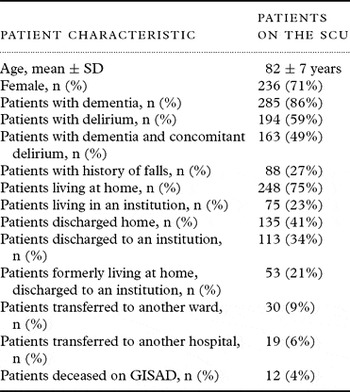
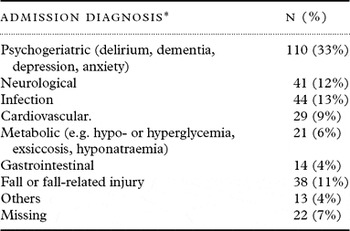
The characteristics of the 332 patients treated on the SCU are detailed in Table 1. Dementia was diagnosed in 285 (86%) patients, delirium in 194 (58%); delirium superimposed on dementia occurred in 163 patients which corresponds to 57% of the patients with dementia. In Table 2 the admission diagnoses are categorized. Psychogeriatric diagnoses have caused the admission in one third of the patients, with concomitant somatic disease accounting for placement in our geriatric hospital versus geriatric psychiatry. In two-thirds of the patients, somatic disease was the leading diagnosis on admission.
Characteristics of patients treated on the SCU in 30 months (n = 332)

Category of admission diagnosis, n = 332

*Admission diagnosis as classified by the Ward Resident.
Admission, referral and institutionalization
Of the 75 nursing home patients, 34 (45%) were directly admitted to the SCU; of the 248 community-dwelling patients, 120 (48%) came directly. Referral from other hospitals or emergency departments occurred in 86 (26%) patients; another 86 patients were transferred from another ward within the hospital when challenging behavior developed.
Of the 248 patients living at home before admission, 134 (54%) returned home; 53 (21%) were newly placed in a nursing home. Of those with delirium, 22% were institutionalized. Of the 16 patients transferred to another hospital, six were transferred to geriatric psychiatry. Five patients were transferred to a surgical ward. Of the 30 patients transferred to another ward, eight went back home, six went back to their nursing home, four were newly placed in a nursing home and five died.
Feasibility and patient safety
Twelve patients died on the SCU, and, as noted above, five of the 30 patients transferred to another ward of the hospital died in the hospital. The in-hospital mortality rate of 6% for patients treated on the SCU (17 of 269 patients) is considerably lower than the 12.5% rate for the other patients treated in the acute hospital (608 of 4866 patients).
Six of the 332 patients were transferred to geriatric psychiatry. Four patients showed aggressive behavior or made a sexual assault; two were transferred because of depression having come to the fore while their somatic disease was under control. Eighty-two (25%) of the patients suffered a fall during their stay on the SCU, and two had to undergo surgery because of a hip fracture.
Length of hospital stay
The length of stay (LOS) was derived from the hospital database. After excluding re-admissions and patients in rehabilitation for technical reasons, 269 (81%) patients remained for analysis. Mean LOS for patients treated on the SCU did not significantly differ from LOS of other patients treated in the acute hospital during the same period (n = 4866) (15.3 ± 8.3 days vs. 15.0 ± 10.3 days, t-test, p = 0.54). The same is true for the diagnostic-related group (DRG)-based excess LOS (actual LOS minus DRG based expected LOS) (median of 4.0 (−17.0 – 43.0) days vs. 2.8 (−27.3 – 72.0), Mann-Whitney-U-test, p = 0.30).
Patient outcomes: challenging behavior, mobility and ADL, antipsychotic use
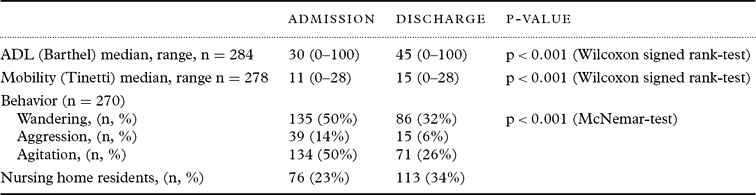
A pre-post comparison of function and mobility at admission vs. discharge is shown in Table 3. The median scores in ADL (Barthel-Index) and mobility (Tinetti-Test) improved significantly during the stay (ADL: 30 vs. 45, range 0–100; Tinetti: 11 vs. 15, range 0–28, Wilcoxon signed-rank test, p < 0.001). Of the 284 patients in whom the Barthel-Index was documented on admission as well as discharge, only 24 (8.5%) patients suffered functional loss. The Tinetti Test was documented both on admission and at discharge in 278 patients, of whom only 6 (2.2%) scored less at discharge. In 230 patients a Mini-mental State Examination (MMSE; Folstein et al., Reference Folstein, Folstein and McHugh1975) was conducted with a mean of 12±8 points; of these, 161 patients (70%) scored fewer than 17 points.
Significant improvement of function and mobility as well as reduction of behavioral symptoms at discharge compared with admission
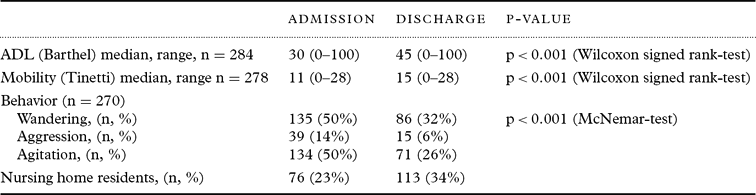
ADL = activities of daily living
The course of challenging behavior was documented for 270 patients. The number of patients with challenging behavior on admission to the unit was significantly higher than at discharge: wandering 135 (50%) vs. 86 (32%), aggression 39 (14%) vs. 15 (6%), agitation 134 (50%) vs. 71 (26%), McNemar-test, p < 0.001.
Apart from bedrails for 44 (13%) patients, no physical restraints were used. At discharge 185 (56%) patients were still being treated with antipsychotics; of these 117 (63%) had a diagnosis of delirium. Of the 164 patients with dementia treated with antipsychotics 104 (63%) had concomitant delirium.
Discussion
The creation of a SCU for patients with challenging behavior due to dementia and/or delirium was stimulated by a staff survey which highlighted the need for improved care of these patients in our geriatric acute care hospital.
Acceptance of the SCU by the staff of the hospital has been unanimous (Zieschang et al., Reference Zieschang2008). It is perceived as a relief to have a place where patients with challenging behavior, especially wandering, are safe and can be treated by a specialized team. An attempt to conduct a formal survey among caregivers of our patients was abandoned due to a very low response rate. However, feedback as obtained in informal contacts with the staff was good, many caregivers already having had bad experiences with hospitalization of their family member with dementia. Occasional criticism concerned organizational issues.
The mean age (82 years) and gender distribution (71% female) of patients are similar to our patient population and typical for a geriatric unit in Germany. Only 16 patients treated on the SCU had neither the diagnosis of dementia nor of delirium, which shows that the hospital admission policy identifies adequately the patients requiring beds in the SCU.
Most patients admitted to the SCU have several risk factors for falls such as age, frailty, gait disorders, cognitive impairment, co-morbidities and psychotropic medication. Concern therefore arose about promoting ambulation in a unit where patients are allowed to walk unassisted and where rejection of physical restraints might increase the number of falls and fall-related injuries, especially fractures. In 25% of the patients at least one fall was registered during their stay. Published fall rates among older inpatients vary from 3% to 20% of patients falling at least once during their stay (Vassallo et al., Reference Vassallo, Sharma, Briggs and Allen2003; Cumming et al., Reference Cumming2008). The study by von Renteln-Kruse et al. (Reference von Renteln-Kruse and Krause2007) showed that 14.3% of patients had falls on the general geriatric wards and 1.1% patients suffered fractures (10 of 893). Our patient population has an increased fall risk due to dementia and delirium, which might account for the higher fall rate. Since only two of our 332 patients suffered a fracture, the fracture rate is comparatively low (0.6%). Even though these events may happen, it is our estimation that the benefits of unrestricted ambulation outweigh the risks. Fall prevention interventions, such as review of medication, restrictive use of sedatives, adequate footwear and lighting, are applied.
In-hospital mortality was lower on the SCU (6%) compared with the overall in-hospital mortality (12.5%). However, the sample is too small to draw any further conclusion from mortality data and adjusting for co-morbidity and severity of disease is not possible due to a lack of data for the patients not treated on the SCU. Nevertheless, compared with findings in the literature describing mortality rates of 5.2% to 17% for inpatients with dementia (Fields et al., Reference Fields, MacKenzie, Charlson and Sax1986; Lyketsos et al., Reference Lyketsos, Sheppard and Rabins2000) and mortality rates of 14.5% to 37% for patients with delirium (Siddiqi et al., Reference Siddiqi, House and Holmes2006), the results are encouraging.
From this sample of 332 patients with challenging behavior, six had to be transferred to geriatric psychiatry. In only four cases was this due to challenging behavior that exceeded the capability of the SCU to handle the situation. In the other two cases, the reason for transferral was depression in patients whose somatic disease was controlled. Apparently, treatment of patients with challenging behavior in a somatic hospital is feasible if structures are adapted to the needs of these patients.
Among patients with dementia a hospital stay is often associated with a loss of function followed by discharge to a nursing home. We did not assess baseline ADL-function before admission. Thus we can only compare ADL-function at admission and discharge. In a study by Covinsky et al. (Reference Covinsky2003) of 2293 patients aged 70 and older hospitalized through medical illness, a decrease in ADL between baseline and discharge occurred in 35% of all patients (in over 50% of patients aged over 85 years), while 23% of patients declined between baseline and admission, 5% underwent further decline during the hospital stay, and 12% did not decline between baseline and admission but between admission and discharge. In our patients with dementia and/or delirium, who were especially prone to a decline in function, only 24 patients (8.5%) declined in ADL function between admission and only six (2.2%) had a decrease in Tinetti's mobility score. Of the patients with delirium, 8.9% (17/192) suffered a decline in function, which is even less than the 13% described for the Delirium Room (Flaherty et al., Reference Flaherty, Tariq, Raghavan, Bakshi, Moinuddin and Morley2003). This supports our observation that the patients profit from the SCU and that functional decline can be prohibited by improving the environment and staff interaction with the patients.
Institutionalization of patients living at home prior to admission occurred in 22% of patients with delirium and dementia and in 19% of patients with delirium and no prior dementia; overall, 34% of patients were discharged to an institution (compared to 18% in the rest of the acute hospital). In the literature, new institutionalization is described in 13% to 22% of older medical inpatients (Landefeld et al., Reference Landefeld, Palmer, Kresevic, Fortinsky and Kowal1995; Brown et al., Reference Brown, Friedkin and Inouye2004). However, for patients with delirium, institutionalization rates of 56% and 55% (with and without prior dementia respectively) were found by Pitkälä et al. on geriatric acute wards (Pitkälä et al., Reference Pitkälä, Laurila, Strandberg and Tilvis2005); a rate of 65% is described for the Delirium Room (Flaherty et al., Reference Flaherty, Tariq, Raghavan, Bakshi, Moinuddin and Morley2003). A similar rate of only 18% is given for the SCU in Toulouse (Soto et al., 2007).
Since we do not have a control group we cannot evaluate whether the SCU has reduced the use of psychotropic substances. Even though antipsychotics are applied with caution, they are used in the treatment of more than half of the patients. Of these, 63% had the diagnosis of delirium, in which the use of antipsychotic drugs is indicated additionally to non-pharmacological measures (Lonergan et al., Reference Lonergan, Britton, Luxenberg and Wyller2007; Meagher and Leonard, Reference Meagher and Leonard2008). Sixty patients with dementia without delirium were treated with antipsychotics. Some patients are admitted to the SCU with a request from the referring doctor and/or proxies to adjust the medication to control BPSD which threaten continuation of family care. There is some evidence that psychotropic drug treatment for BPSD can increase quality of life in persons with dementia (Martin-Cook et al., Reference Martin-Cook, Hynan, Rice-Koch, Svetlik and Weiner2005). The fact that mobility and functionality increased in most patients indicates that on the SCU antipsychotics were not used to restrain them. Nevertheless, in regard to the short- and long-term risks of antipsychotic treatment in persons with dementia, further efforts to reduce their use are necessary.
The Special Care Unit can be considered a new model of care for acutely ill older patients with challenging behavior due to dementia and/or delirium, who have been admitted to a somatic hospital. The key elements of the Special Unit are: (1) safe and unrestricted ambulation within the unit with a code-locked door preventing patients from wandering off the unit; (2) meaningful activities to structure the day and the presence of a staff member on the SCU for most of the daytime hours; and (3) special staff training programs. In addition, geriatric principles of care are applied. The fact that patients cannot leave the unit unaccompanied not only ensures the safety of the patients but also relieves the staff of the necessity to observe them constantly. It also spares patients being repeatedly admonished for not staying in the room, which can evoke aggressive behavior. We frequently observe aggressive behavior to dissolve once the patient is admitted to the SCU. This is probably due to a more relaxed atmosphere on the unit, unrestricted ambulation inside the unit, and the option to be left alone until willing to communicate. Apart from ensuring additional professional presence on the unit, the daytime activities prevent boredom and daytime sleep. Meaningful activity has been shown to reduce sleep disturbances during the night (Smith, Reference Smith2001). Furthermore, they enable targeted therapeutic intervention by the psychologist or music therapist. Daytime activities are conducted especially during the afternoon when staffing by the nurses is reduced and the sun-downing phenomenon might occur. Overall, challenging behavior in the patients treated on the ward was significantly reduced over the hospital stay. The training of the staff is crucial for this. This includes basic knowledge about the biomedical and psychological issues of dementia and delirium as well as communication skills with persons with dementia. Feedback on the training program clearly shows that knowledge, awareness and esteem for the work have increased during the training period and that the nurses feel more comfortable in treating persons with dementia and/or delirium (Zieschang et al., Reference Zieschang2008).
The creation of the SCU out of an existing geriatric acute care ward was accomplished with minor reconstruction effort. The cost of providing daytime activities (26 hours a week, €1800 per month) seems to be reasonable for this population at risk of poor outcomes. It also has to be seen in relation to the reduced workload of the nurses on the other wards who are relieved of these time-demanding patients. This might result in an overall decrease of LOS (Needleman et al., Reference Needleman, Buerhaus, Mattke, Stewart and Zelevinsky2002). LOS in medical patients with dementia has been shown to be longer than in patients without dementia (Lyketsos et al., Reference Lyketsos, Sheppard and Rabins2000), but LOS of patients treated on the SCU did not differ from other patients in the acute hospital. This also indicates that the model might very well be cost effective.
This evaluation has several limitations due to the lack of a control group, which would have been difficult to provide for this study. We must assume that more patients with challenging behavior are now admitted to our hospital than before the SCU opened due to publicity of its role among referring hospitals and general practitioners and a change in admission policy. Therefore, it would not be feasible to compare with a group of patients before the opening of the SCU, because many of the patients we treat now would not have been admitted at that time. Randomization of patients to another ward to provide a control group raises ethical concerns, especially in patients who wander, and would not deliver strong evidence due to contamination of knowledge. Further formal intervention trials would be an appropriate next step to evaluate the generalizability, comparative effectiveness, and economic viability of this model versus usual care.
All onsite feedback, as well as the descriptive results presented in this paper, lead the authors to conclude that the realization of a Special Care Unit as described in this paper represents an innovative advance in the care of acutely ill hospitalized older persons with dementia.
Conflict of interest
None.
Description of authors’ roles
T. Zieschang, I. Dutzi, E. Müller, and U. Hestermann were project leaders. T. Zieschang wrote the manuscript. N. Specht-Leible provided the initial idea and assisted with the concept. D. Hüger and A. Braun were residents on the unit and helped with data collection assisted by K. Grünendahl. P. Oster supervised all authors involved and re-edited the manuscript together with D. Kopf.
Acknowledgments
The authors thank the team of the ward, especially head nurse Nelli Herrmann, for their courage to try a new model. We thank Hanne Detterbeck and Dr. Bettina Beinhauer for their help with the data base. This project was funded by the Otto-and Edith-Mühlschlegel-Stiftung in the Robert Bosch Foundation (project number: 11.4.1365.0006.0). T. Zieschang has a research grant from the Robert Bosch Foundation. D. Kopf is supported by the Dietmar Hopp Foundation.