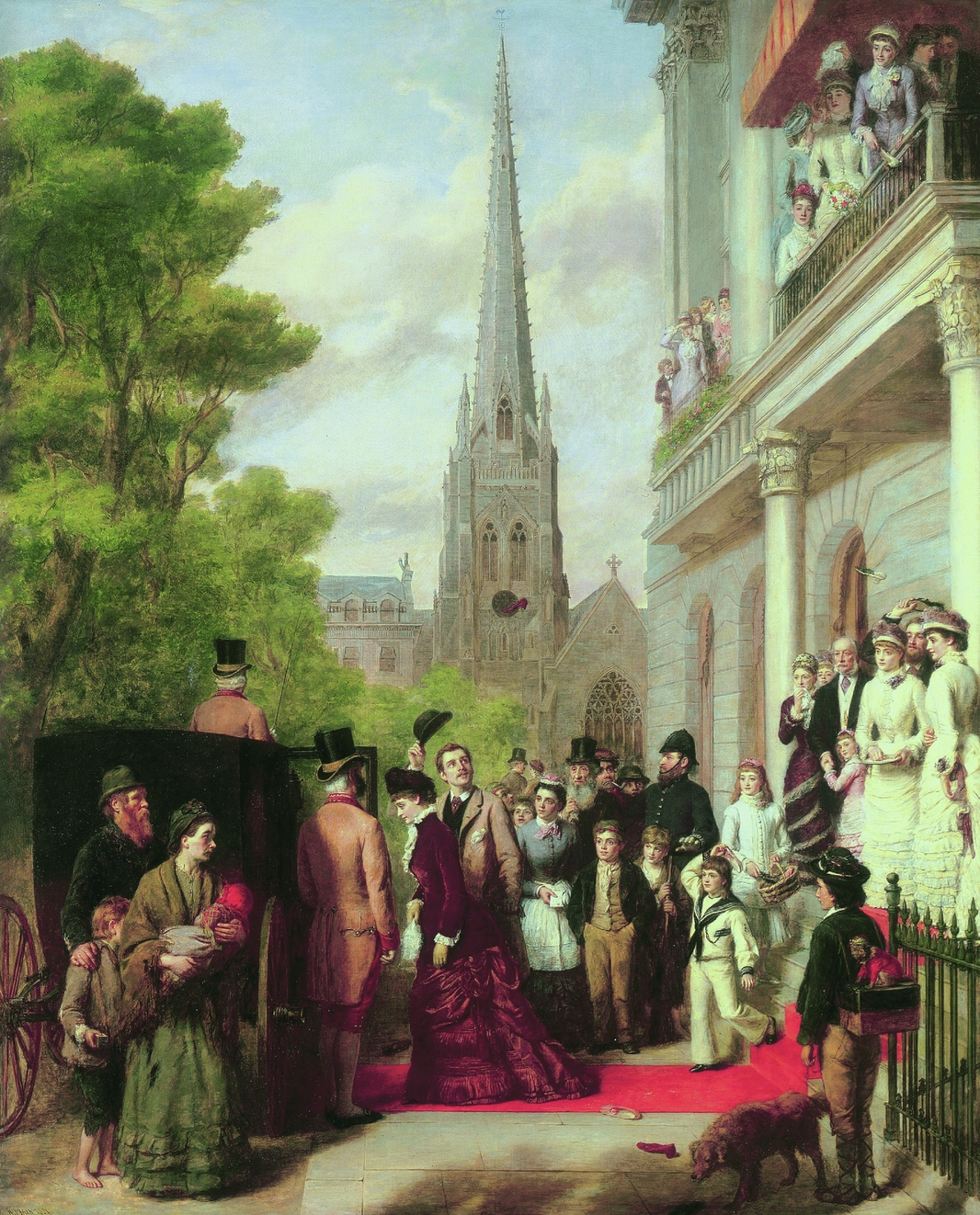
In 1881 William Powell Frith (1819–1909) exhibited a painting at the Royal Academy in London titled For Better For Worse (1881; oil on canvas; Private Collection). It depicts a well-to-do wedding Frith had witnessed in Bayswater (Figure 3).Footnote 1 The newly married couple are represented crossing the pavement on a red carpet, just about to step into a waiting carriage pulled close to the kerb. The audience for their departure comprises a broad mix of classes and types. In his own description of this work, Frith identified the bride and groom, the bride's family and friends arranged on the steps of the house, plus a crowd standing behind the red carpet that included street boys, a Jewish second-hand clothes seller, and a policeman. In the foreground, on the left, a family of beggars approach from the street, while on the right-hand side, with his back to the viewer, stands a figure identified by Frith as an Italian boy with a monkey (2: 209–10).
W. P. Frith, For Better For Worse. Oil on canvas. 1881. Private Collection. Photograph courtesy of the Bridgeman Art Library, London.

Reflecting Frith's own interest in the representation of those classes and types to be found within the urban milieu, the reporter for the Times used this concern with identification as the basis for his own evaluation of the painting. Having first acknowledged the relative wealth of the wedding party, comprising “a fashionable house in a fashionable square, with a fashionable footman holding open the door of the brougham,” the reporter went on to describe the contrast created by the poorer onlookers. “Then come the regular street crowd, consisting, as we all know, of a beggarwoman and her child, a street Arab with his broom, a policeman repressing everybody, a beery rough and an Italian boy with a monkey.”Footnote 2 The reporter concluded this brief evaluation by establishing that each of the participants conformed to established models for the representation of class and type, “the feelings of everyone concerned, from the Arab to the footman, are exactly as they ought to be” (“Royal Academy. First Notice” 10).
This final comment on Frith's painting implies that the work offered the viewer more than a taxonomy of the urban milieu, it also functioned as the pictorialization of a deeper, more totalising social pattern, in which both those who participate in, and observe the wedding celebrations, conform to established social models regarding the hierarchy of classes, the painting serving as conformation that all of these people are fulfilling those roles that social convention has allotted them. But what are the visual means through which Frith was able to imply, and to organize, this deeper, more totalising social hierarchy, one that was so readily recognized and judged a success by the Times reporter?
The role of space as a means to order social relations has been considered by Lynda Nead in her essay, “Mapping the Self: Gender, space and modernity in mid-Victorian London” (1997). Arguing that social identity was not fixed for those who occupied the streets of the capital, Nead asserted that social space, in this context, “is not a passive backdrop to the formation of identity, but is part of an active ordering and organizing of the social and cultural relations of the city” (167). While Nead centred her argument on the issue of gender and the gendering of public space in relation to social practices associated with Holywell Street, this paper – by contrast – will develop this argument by considering the physical construction of the street itself rather than a particular location, as a vehicle through which social order could be reasserted. Through the analysis of a series of urban representations by Frith, considered in tandem with contemporary text, this paper considers the extent to which the pavement, the gutter, and the carriageway operate as a series of discrete spatial zones across which classes and types could be distributed, allowing Frith to reconstruct the increasingly crowded London street as a social space within which all could indeed know their place.
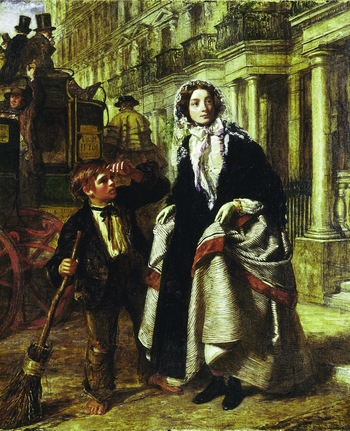
Within the field of urban representation the work of Frith occupies a place of particular significance. His primary interest in the city, as he himself acknowledged, was the depiction of urban variety and the identification of metropolitan types (Frith, Autobiography 1: 243). Although not the first artist of the Victorian period to address the subject of the busy street, Frith's close association with the modern subject was established at an early stage in his career with three panoramic paintings. The first two of these famous works, Ramsgate Sands (1854; oil on canvas; The Royal Collection), and Derby Day (1856–58; oil on canvas; Tate Britain, London), addressed the theme of the crowd and leisure; the third, The Railway Station (1862; oil on canvas; Royal Holloway, University of London, London), used the London location of Paddington Station as the setting for his depiction of the urban milieu. However, alongside these works utilizing well known locations associated with London and London life, Frith was also developing an interest in the complex and often contested world of the London street. The first in this series of works is a small painting titled The Crossing Sweeper (1858; oil on canvas; Museum of London, London), in which Frith focused not on the crowd but on a more intimate, if rather uneasy exchange between a wealthy, fashionable woman and a poor crossing sweeper, whose job was to clear the road of mud for anyone wishing to cross in the hope of a small handout (Figure 4).
W. P. Frith, The Crossing Sweeper. Oil on canvas. 1858. Courtesy of the Museum of London, London.

Four years later, Frith returned to this subject with three oil sketches titled The Streets of London (1862; oil on canvas; Private Collection). These works, which Frith subtitled “Morning,” “Noon,” and “Night,” were made in response to a commission from the art dealer Ernest Gambart and were to be developed into a series of paintings which would offer a mid nineteenth-century response to representations of London by William Hogarth, and in particular his series of etchings The Four Times of the Day (1738) (Bills, “The line which separates character from caricature” 48).Footnote 3 In the 1880s he addressed this theme with two more works, For Better For Worse and Poverty and Wealth (1888; oil on canvas; Private collection). In this last work, as in all of these paintings, Frith sought to pictorialize the stark contrast between rich and poor so frequently experienced in the streets of the capital (Burgan 52); an enactment of surveillance and identification through which the scale and illegibility of the crowd could be re-presented in a more coherent form.
This visual response to the experience of the real street is very close, both in content and purpose, to the work of journalist Henry Mayhew, and in particular to his most famous text London Labour and the London Poor (1861–62) (Treble 7). At the outset of this work Mayhew established his intention to construct a taxonomy of urban street life.Footnote 4 This was achieved through a series of short studies of metropolitan types that included costermongers, flower girls, and prostitutes, all of whom appear in Frith's The Streets of London.Footnote 5
Alongside his interest in the variety and identification of the urban milieu and in the contrast between rich and poor, these six paintings also demonstrate the extent to which Frith recognized the visual possibilities offered by the discrete zones of pavement, gutter, and carriageway as a means to establish class identity and to maintain class separation. In all of these works the spaces of the street function as a means to organize the social hierarchy, underlining – as the reporter for the Times indicated – a more totalising social pattern, for which Frith's work provided visual confirmation.
This co-relation between social position and spatial placement, used as a means to achieve and maintain social control, has been theorized by Michel Foucault in his book Discipline and Punish: The Birth of the Prison (1975), in which he argued that it is predicated on the interdependency between surveillance, knowledge, and power. Foucault characterized this ordering of space as fulfilling a disciplinary function by establishing that such a space, properly observed, could then operate as “an apparatus of knowledge” whose purpose was the identification of difference and potential danger hidden in the everyday practices of those who occupy the space (126). Foucault identified this process as one of enclosure and partitioning, whose aim was
to establish presences and absences, to know where and how to locate individuals, to set up useful communications, to interrupt others, to be able at each moment to supervise the conduct of each individual, to assess it, to judge it, to calculate its qualities or merits. It was a procedure, therefore, aimed at knowing, mastering and using. Discipline organizes an analytical space. (143)
Foucault's model of what he termed a “disciplinary space” (143), has particular significance for the evaluation and representation of the nineteenth-century city and its streets, where a dramatic rise in urban population and the consequent increase in social problems such as homelessness, crime, and prostitution, presented a particularly graphic illustration of the need for social order and control. This desire for social order is reflected in the work of Mayhew and Frith whose shared interest in the surveillance of the urban milieu offered a means by which knowledge could be used to identify and categorize the occupants of the street, constructing, through pictorial and textual practices, a degree of social order that in the real street was much harder to achieve. As a setting for this act of surveillance the street then operated as a Foucauldian “apparatus of knowledge,” its ordering function expressed through its discrete spatial zones. However, for this function to operate effectively in the representation of a space as complex and chaotic as the nineteenth-century city street, it was necessary for these spatial zones to carry connotative meanings which would serve to codify and amplify the function of these spaces as urban signifiers through which class identity and separation could be established and maintained.
This issue of urban signification, expressed through cultural practices, has been addressed by Raymond Ledrut in his essay “Speech and the Silence of the City” (1973). Ledrut argued that while it cannot speak directly, the city does operate as a text, speaking to its inhabitants as “a work of art, which means as an object charged with meaning by the production and the use men make of it” (120). More recently, sociologists Rob Shields and John Urry, have also considered the manner in which spaces and locations are never neutral but acquire meaning through cultural intervention.Footnote 6 Drawing upon the theoretical approaches of Foucault and the model of socio-semiotics developed as an analytical tool by writers such as Ledrut, Shields offered the following formulation of this process through which social order, encapsulated by power relations are defined through spatial relations.
In this “grid” or apparatus, each position or place is coded as a value so that the distribution of functions is transposed into relations fixed in this structured grid. The success of this arrangement thus depends on the coding of this space. In this manner, individuals and values become places and positions in a grid defined by power which are observed and administered with great efficiency. (40)
Shields further underlined the role of the street and its representation as an agent of social organisation, arguing that “social division and cultural classification are often spatialised, that is expressed using spatial metaphors or descriptive spatial divisions” (29). While the configuration of the street as a disciplinary space whose discrete zones offered an opportunity to order the urban milieu may find its clearest expression through the street in its represented form, this “coding of space” had evolved in response to the development of the real street.
This division of the street into discrete zones was largely a consequence of urban developments that took place primarily in England during the eighteenth century, and in which London, as a result of the imperative to rebuild after the Great Fire of 1666, played a key role. While the paved street had been an urban feature since the Romans, it was during the eighteenth century in England that new materials for paving, such as macadam, could be combined with other improvements such as sewers, piped water, and pavements, giving rise to the modern street (Kostof 201). These developments not only improved the material quality of the street surface, and therefore its instrumental function, they also served to protect the street's social function as a site of display, exchange, and interaction, by ordering these activities within more clearly defined and controlled spatial divisions. This was achieved through a lengthy process of legislation that began in 1667 and which continued into the nineteenth century. However, the key elements of the modern street as a space divided by usage were established by the first Westminster Paving Act of 1762 (Porter 125). This act specified that the street be well paved in stone, that the pavement be raised above the level of the carriageway and protected from it by a kerb, and that the drainage channel be moved from the middle of the street to the gutter beside the kerb, facilitating the function and cleanliness of both pavement and carriageway (Kostof 211).Footnote 7
This division of the street resulted in a hierarchy of spaces in which the carriageway, where legislation imposed the principle of keeping to the left, was viewed as naturally more orderly than the space of the pavement, upon which no such legal restrictions could be imposed.Footnote 8 This hierarchy was further underlined by patterns of social behaviour. Upon the carriageway, whose purpose was the desire (if not the attainment) of continual and unrestricted movement, social contact was kept to a minimum. The pavement, by contrast, had to accommodate a much wider range of activities: walking, shopping, selling, begging, and even stealing, and was thus required to incorporate patterns of movement and stasis in which the function of the former was often contradicted by the effect of the latter.Footnote 9 As a consequence, those who could afford to ride in carriages, upon horses, and even in hansom cabs, were able to occupy a position of greater prestige than those who walked (Winter 100). Meanwhile, the pavement, whose function allowed for the greatest degree of social interaction, became the most clearly contested space within the street.
The social implications embedded in this restructuring of the street were acknowledged by commentary of the period. In Twice Round the Clock: Or The Hours of the Day and Night in London (Reference Sala1859), George Augustus Sala described those travelling by carriage as belonging to “the first-class genteel circles, the very superior middle ranks” (221). On the subject of the pavement Augustus Mayhew (Henry Mayhew's younger brother) began his novel, Paved with Gold: Or The Romance and Reality of The London Streets (Reference Mayhew1858), with a description of a policeman trying to move on a homeless woman huddled in a doorway. The scene brings the passing crowd to a halt as they observe and debate the situation, providing Mayhew with the opportunity to identify the variety of class and type “always to be found in a London crowd,” (2) as well as it establish the contested nature of this space.Footnote 10
However, between the two zones of carriageway and pavement lay a third that included the gutter and the kerb. The function of the gutter as a drain gave to this space a liminal, even potentially dangerous aspect. This negative connotation was enacted in everyday practices by socially marginally groups, such as street sellers, who set up temporary stalls in this space, thus interrupting the efficient flow of people. Augustus Mayhew identified this problem, describing a narrow street that was “rendered still narrower by a double flank of stalls trestled along the kerb” (10). Sala also considered this particular zone as problematic. In his description of Regent Street the author identified, amongst the crowd of shoppers and carriages, one particular type, the dog seller, whom he described as “forbidding-looking gentry” who “lurk about the kerbs of the purlieus of Regent Street and Waterloo Place” (160–61). This conflict between the movement of shoppers and the static presence of street sellers was further underlined by Sala who went on to describe how these forbidding characters were regularly moved on by the police from London's main shopping thoroughfares (161).
Sala's concern regarding the efficient functioning of the street has been theorized by Richard Sennett, who discussed the architectural structure of Regent Street as an example of how to solve the conflict between movement and stasis, through the development of a “single-function street,” devoted to commerce and designed to maintain constant movement (328). Sennett's argument that the health and vitality of the city was guaranteed by the extent to which its thoroughfares remained free flowing, expressed through the metaphor of the city as a human body whose streets functioned as arteries and veins,Footnote 11 carried a particularly powerful charge in the nineteenth century (324–25). Unhealthy blockages caused by marginal groups such as street sellers, not only conflicted with the instrumental function of the street, but also with this metaphorical interpretation, their spatial position within the street underlining the socially problematic, and therefore morally questionable, nature of their activities.
Other socially marginal groups who often occupied this liminal space included street entertainers and crossing sweepers. In Mayhew's Paved With Gold, the principal character, Philip Merton, joins a gang of crossing sweepers who also perform acrobatics. In his illustration of a scene set in the Haymarket, Hablot K. Browne (Phiz) depicted the boys performing their acrobatics along the gutter, observed by a shocked elderly man who watches from the relative safety of the pavement. In Bleak House (1853), Dickens also deployed this connection between the gutter and the socially marginal in his portrayal of Jo the Crossing Sweeper, a tragic figure who “fights it out, at his crossing, among the mud and wheels, the horses, whips, and umbrellas” (259; vol. 5, ch.16). While the frontispiece illustration for this book, also by Browne, depicted Jo leaning against a post situated in the gutter, his social position is further amplified by the presence of a dog, which – unlike Jo – occupies a space on the pavement itself.Footnote 12
This associative relationship between the gutter and the social hierarchy was also reflected in the many connotations of the word itself, and was frequently used by writers of the period to imply extreme levels of poverty. On the subject of Seven Dials, one of London's most notorious slums, Sala offered the following graphic description of children in the street: “but, heavens and earth! the little children! who swarm, pullulate – who seem to be evoked from the gutter, and called up from the kennel, who clamber about your knees, who lie so thickly in your path. . .” (351). Here Sala's text reflected the commonly held view of the poor as animalistic other, a mass who swarm, and whose natural home is the gutter.Footnote 13
This associative relationship between the zones of the street and the social hierarchy is equally evident in pictorial practices of the period, and is demonstrated with particular clarity by Frith's six paintings of the London street in which his use of these spatial zones, particularly the gutter, are consistent with patterns of urban signification established by textual practices. This is clearly demonstrated by the first of these paintings, The Crossing Sweeper.
In this representation of a well appointed west London street,Footnote 14 Frith pictorialized the extremes of poverty and wealth through the figure of the fashionably dressed woman who has just stepped from the pavement and the crossing sweeper, standing in the gutter. Holding her skirt clear of the dirt, the woman is shown surveying the street, indicating her desire to cross. Standing beside the woman the young crossing sweeper touches his forelock, acknowledging his lower social status, as he offers his assistance. Frith's representation of the street itself is visually blocked by the scale of these two figures, by the Notting Hill omnibus, and a hackney carriage, situated behind the woman and the crossing sweeper. In his autobiography Frith claimed that he had, “taken a foolish fancy to paint a small picture of a lady at a crossing, waiting till her passage might be made safely, and paying no attention to a crossing sweeper, who was to be represented in the usual begging attitude” (2: 216). Here Frith identified the contested nature of the street, its difficulties represented not only by the traffic but also by the figure of the boy.Footnote 15 The woman's hesitant response, when confronted with these difficulties, is underlined both by her rejection of the crossing sweeper's offer, indicated by her glance away from the zone of the street within which this exchange takes place, and the presumed direction of her attention towards the traffic and the possibility of safe passage. After all, the gutter may be a natural space for the crossing sweeper, but for the wealthy woman it is a liminal zone, to be occupied briefly before crossing the street and regaining the safety and class security of the pavement on the other side.
Frith's interest in the contrast between classes and the manner in which this contrast was to be signified visually was recognized by critical opinion of the period. The Athenaeum, identifying the problem posed by the need for both realism and for moral significance, stated that the crossing sweeper “though ragged, seems too neat and clean, for Mr. Frith wants the dust, without which poor life, when painted, seems always dressed up false” (“Fine Arts. The Winter Exhibition” 559). Deploying the tool of physiognomy – a pseudo-science, much in vogue during the Victorian age, which claimed that a person's outward appearance gave indications of inner characteristics and class – the Building News focused the viewer's attention on the visual differences between the facial features of the woman and the boy.Footnote 16 However, the spatial relationship between the two figures and their particular placement in the street also provided Frith with a means to determine social position. Though both figures stand in the gutter, it is the woman who is positioned closest to the kerb, and therefore the relative safety of the pavement of this prosperous residential street; while the crossing sweeper stands further into the carriageway and therefore, like Dickens's Jo, is more likely to face the danger of traffic signified by the omnibus.
This work has been recently studied by Mark Bills in his article “William Powell Frith's ‘The Crossing Sweeper’: an archetypal image of mid-nineteenth-century London.” His analysis also focused on Frith's interest in physiognomy and on the wider cultural engagement with the subject of the crossing sweeper as social signifier, but did not consider the narrative significance of the street zone within which this action takes place, the gutter.Footnote 17 Frith, however, did return to the explicit representation of these street zones in five more significant depictions of the London thoroughfare, all of which utilize what had become a well-established pattern of social spatialisation within the street, deployed as a means to identify and order the urban milieu.
In his three oil sketches, The Streets of London, Frith elaborated upon his earlier work in two important respects. Firstly, rather than a suburban street in the West End, he selected famous city centre locations for his urban narrative. Secondly, these narratives were played out with a much larger cast of characters, deployed as a means to develop a more complex visual discussion of street life. In his description of the first of these sketches, “Morning,” Frith identified “a variety of incidents possible to the occasion: homeless wanderers, asleep and sleepless; burglars stopped by police red-handed; flower-girls returning from Covent Garden.” The second sketch, “Noon,” included “costermongers in donkey-carts,” identified as part of “Regent Street in full tide of active life”; while “Night” was set in the Haymarket, a street notorious for prostitution (White 302), amongst whose bourgeois theatregoers was to be found (almost inevitably), “an over-dressed and berouged woman, whose general aspect plainly proclaims her unhappy position” (Frith, Autobiography 1: 336–37). However, in spite of this more extensive and complex narrative structure, in which the focus of attention (in contrast to The Crossing Sweeper) is on the extent of the crowd and on the construction of a far more detailed social topography, the street's discrete spatial zones continued to play a significant role, providing a means to locate classes and types within the social hierarchy, while amplifying those moral issues raised by the behavioural practices and events that make up the narrative elements of these three works.
In the first of these sketches, “Morning,” the space of Covent Garden is occupied by a mix of well known metropolitan types, most of whom were organized by Frith into three distinct groups. On the right of the picture is a small group of the homeless, huddled on the steps of a building. On the left, a flower girl, carrying her basket of flowers, walks towards a second seller who is being accosted by two drunken men, representing the upper classes; standing beside them two street urchins observe this exchange. The third group, positioned prominently in the centre foreground, comprises two burglars being arrested by a police detective (Wood, Victorian Panorama 148). Frith's careful placement of this last group offers a clear example of the practice of addressing the socially marginal by making them culturally central (Stallybrass and White 5). Their spatial positioning, close to the gutter, underlines the role played by this particular space as a means to reassert the social hierarchy, a hierarchy further underlined by the policeman, whose presence serves to reassure the viewer that even in a space such as the gutter, replete with negative connotations, social order could still be maintained.
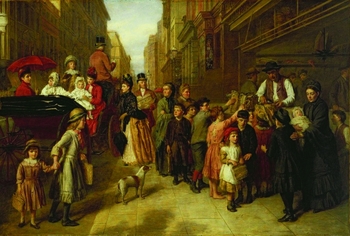
This association between the space of the gutter and those whose occupation or class placed them at the bottom of the social hierarchy, is also present in the second oil sketch, “Noon.” In this painting of Regent Street, Frith sought to demonstrate the extent and variety of the urban milieu through the representation of a crowd so dense that it stretches right across the street, making this famous thoroughfare all but impassable. Alongside costermongers in carts, Frith also identified women in carriages, dog sellers, a blind beggar being led across the street by his daughter, and some foreign tourists studying a map of London (Frith, Autobiography 1: 336). Frith's pictorialization of the crowded street, in which those who should be contained within the space of the pavement have spilled out and now block the function of the carriageway, demonstrates both the level of chaos experienced on the real street, and the value of its spatial zones deployed as a means to reassert urban order through the street in its represented form.
The difficulty in navigating this chaotic setting is visually underlined both by the confused foreigners studying their map and by the presence of the blind beggar, whose expression indicates his alarm at the confusion he can plainly hear, but cannot see, while his position in the street repeats (though not as explicitly as in “Morning”) the association between poverty and the gutter. In this case the connection is established by the blind beggar's dog, which has already reached the gutter towards which his master makes unsteady progress. The narrative significance of this small group is once more underlined through its compositional placement in the central foreground. In her own analysis of this work, Mary Cowling, following her own innovative and well-established interest in physiognomy, focused on the identification of class and type (Victorian Figurative Painting 142), but made no mention of the spatial placement of this group within the street, or the extent to which such placement offered visual confirmation of the social hierarchy, and of the street's discrete spatial zones deployed as a means to order this hierarchy.
Frith, on the other hand, made clear use of the spaces of the street as a means to order his representation of the crowd. Standing immediately behind and to the left of the blind beggar, a flower seller attempts to sell a posy to a group of wealthy women riding in a carriage, her social status in relation to those riding in the carriage underlined by her position precisely in the gutter. On the pavement itself Frith depicted another small trio whose make up reflected the contested nature of this space. Positioned in the foreground on the left stands a bourgeois woman with her daughter; behind her lurks a dog seller, whose notorious presence, as discussed by Sala, represented a challenge to the bourgeois hegemony of this famous shopping street, a challenge that is underlined by his furtive expression. The placement of the dog seller on the left of this composition was balanced by Frith on the right through the inclusion of two more representatives of the poor, both of whom also represented a common and problematic presence on the street: the young girl selling flowers and the sandwich board-man.
Frith's interest in the construction of a social topography and his use of the gutter as a means to underline the social hierarchy is also evident in the last of these sketches. In his representation of the Haymarket at night Frith repeated the same compositional device of placing a representative of the poor in the central foreground, in this case a street urchin. Occupying a space on the pavement, but close to the gutter, he turns with outstretched hand towards a quartet of well-to-do men and women. The tonal contrast between his hand and the illuminated dresses of the two women draws the viewer's attention to his act of supplication and to the contrast between poverty and wealth. On the far right of this painting stands the “berouged” prostitute. Marking the outer edge of this illuminated area she waits close to the wall, looking towards the bourgeois group from whom she remains spatially separated; while the necessity of her social isolation, indicated by her profession, is further amplified by the visual contrast between the white dresses worn by the two bourgeois women and the gaudy manner of her own dress (Nead, Myths of Sexuality 176). Representing the darker side of city life, the prostitute and the street urchin, positioned at the margins of the pavement, mark a space between which this wealthy group must pass, as they so often must, if they are to continue to make their way along the pavement's contested space. Standing on the carriageway a beggar family observe this moment of class conflict. Their position on the far right of this work repeats a compositional format in which social types closely associated with poverty, criminality, and the street occupy places at the far edges and in the centre of all three oil sketches.
With his painting For Better For Worse Frith returned to the subject of the London street, once again utilizing its spatial zones as a means to amplify the relative social positions of different classes. As in The Crossing Sweeper, the scene is set in a wealthy residential area. However, in this later work there is no interaction between classes, instead the representatives of the poor provide an admiring audience for the activities of the wealthy, reaffirming, by their presence (as the Times reporter observed) that the actions of both rich and poor conform to accepted standards of behaviour (“Royal Academy. First Notice” 10).
Clearly this tableau of figures indicates Frith's already well-established interest in the representation of class, an interpretation noted by Christopher Wood and Mary Cowling, who, in recently published work on Frith, centred their analysis of this painting on the issue of physiognomy and urban surveillance.Footnote 18 However, this work also provided Frith with an opportunity – not considered by these writers – to amplify the classification of the crowd through the spaces they occupy in the street, demonstrating how, in its represented form, these spaces could be populated, as Shields has argued, as a means to establish or reassert power relations.
Within the painting's narrative structure this relation between power and spatial placement was explicitly addressed by Frith through the central position occupied by the policeman, whose presence on the pavement provides a guarantee that this space, and by association the rest of the street, will remain orderly and controlled, in spite of the broad mix of classes that occupy it. This guarantee is strengthened visually by the tonal contrast between the policeman's head and the wall behind, and by the calming gesture he makes with his left hand, outstretched and with palm facing down, towards the crossing sweeper who, subject to his control, stands immediately in front of him.Footnote 19 In addition to the presence of the policeman, this spatial ordering of the social hierarchy is clearly pictorialized by the crowd as a whole, which has been organized by Frith as a social tableau, beginning on the right at the top of the steps with the paterfamilias who looks benignly down upon the scene, and ending on the left with the beggar and his family positioned in the gutter; a distribution of figures within the spatial zones of the street that conforms closely to the semiotic connotations of these spaces.
Frith's pictorialization of social order by spatial distribution is further amplified by the important issue of the gaze. While the proximity of poverty and wealth and the largely uncontrolled interaction between classes formed part of the everyday experience of the real street, amplifying urban anxiety and the problem of social discipline, in its depicted form the artist was able to use the gaze, in conjunction with the zones of the street, as a means to reconstruct interaction between classes in a more controlled form. Thus a commentary could be established through which class superiority and distance is enacted, as Susan Casteras has argued, both by looking at, and by ignoring, those of a different social rank (265), reflecting both the distribution of power and the socially contested nature of the street.
This use of the gaze, already evident in The Crossing Sweeper in which the wealthy woman ignores the young boy, is once again used by Frith as a means to underline class distance. It is clearly stated by the beggar and his family who watch the wedding party from their position in the gutter, but who, because they are partially hidden by the back of the carriage, may not be visible to the bride and groom; while those members of the wedding party who can see them, choose to ignore them. Standing a few feet away, and clearly visible to all members of the party, the Italian boy is also being ignored, his lack of significance amplified visually by the shadow within which he stands, indicating his low social rank, in spite of the fact that both he and the newly married couple occupy the same stretch of pavement.
This co-relation between social order and the spaces of the street is also evident in Frith's Poverty and Wealth. In this later work, depicting Bond Street towards the end of the day, the road is shown filled with the wealthy travelling in open carriages (Figure 5). The pavement, reflecting its role as the most contested of these spatial zones, particularly evident on busy shopping streets, is crowded both with the poor, queuing to buy fish cheaply, and with the rich, some of whom have also been shopping and who are now preparing to depart by carriage. Although the distinction between classes, established through spatial placement, is not quite as clearly stated here as it had been in For Better For Worse, this distance is still very much in evidence, allowing this representation of a well known shopping street to offer the same carefully ordered corrective to the everyday experience of such settings. In addition, Frith's compositional device of placing representatives of the poor in the foreground and in the gutter, allowed class distance to be reasserted by the space of the street, while offering maximum clarity in the identification of the poor. In this case, repeating a compositional device he had already used in For Better For Worse, it is two young girls who occupy this position, standing close, but still hidden, from the wealthy group who sit in the carriage pulled up to the kerb. This pictorialization of economic extremes, amplified by the proximity of classes, carried a moral charge that did not go unnoticed. The reviewer for the Athenaeum identified this painting as another example of Frith's “moralizing spirit which leads him to present a distinct theory of life . . . [which] has from time to time contrasted various social grades, such as are represented in this view of Bond Street” (“Royal Academy. Second Notice” 668).
W. P. Frith, Poverty and Wealth. Oil on canvas. 1888. Private Collection. Photograph courtesy of the Bridgeman Art Library, London.

However, aside from the contrast between a suburban and a shopping street, this work does differ from For Better For Worse in one important respect. In this later painting Frith's use of the gaze as a means to identify class difference and distance shows both rich and poor engaging in the act of observation. This scrutiny of the rich by the poor is most clearly stated by the figure of a boy dressed in brown queuing to buy fish, his narrative significance underlined by Frith through his central placement within the composition, slightly apart from the rest of the queue. Along with the elderly woman standing behind him, he looks directly at the family in the carriage. Their gaze is then reflected back by the wealthy woman in red who sits in this carriage, her attention drawn to the queue by the child positioned next to her. However, this woman does not return the boy's gaze directly, instead her attention seems focused on a girl, whose bare feet help identify the social rank of those queuing.
The significant role played by the gaze in this work was identified by reviewers of the period and featured prominently in their analysis; the Art Journal stated that “‘Poverty and Wealth’ shows a carriage and a pair, containing ladies and children, who are being stared at by the ragged crowd around a fishmonger's shop” (“Royal Academy Exhibition” 181). The Athenaeum, by contrast, focused on the act of looking undertaken by those in the carriage, but did not comment on the poor who also look (“Royal Academy. Second Notice” 668), an indirect acknowledgment of the lack of connection between classes and the social marginality of the poor, in spite of their placement at the centre of this composition.
As with much criticism and analysis of Frith's paintings of the London street, both contemporary and recent, these reviewers focused on the identification of urban types and the moral issues raised by the contrast between poverty and wealth, but did not address the significance of the spatial placement of these figures within the street.Footnote 20 Frith, on the other hand, did draw upon the well-established connotations associated with the spaces of the street. How these discrete zones could be used as a means to discuss and amplify notions of social order is most clearly stated by following the line of the kerb and the gutter as it leads back into the picture. Assembled along this line, as in his earlier representation of nearby Regent Street, Frith positioned figures both rich and poor, using this liminal space as a means to bring them into visual proximity, over which he then deployed particular details such as mode of transport, purpose, and specific spatial placement as means to affirm class difference and so reassert social order.
As in all of these representations of the London street it is the poor who stand in the foreground of this line; in this case the two girls, maybe sisters, who hurry to purchase fish cheaply before all the stock is gone. Their last minute dash, and the slight desperation of the elder girl, pulling the younger behind her, stands in sharp contrast to the relaxed demeanour of the wealthy carriage folk immediately behind her, who remain protected from the contaminating influence of the nearby gutter, both by their money and by the carriage in which they ride. Just beyond this carriage stands a wealthy woman who has now completed her shopping. She waits at the edge of the pavement, her detachment from the crowd indicating, perhaps, a sense of unease at her placement within this contested space. Immediately behind her a well-dressed servant carries her purchase, a toy Noah's Ark. This luxury item poignantly underlines the difference between the classes assembled along the line of the kerb. For the two girls, hurrying across the gutter, there can be no possibility of ever owning such a toy, a fact that is further underlined by the servant who, keeping a careful grip on the parcel, attempts to re-enact the role of the policeman in For Better For Worse by maintaining a careful surveillance of the queue.
By following the line of the kerb through Poverty and Wealth, it is possible to identify what I would argue to be Frith's deliberate practice of amplifying social order through specific spatial placement. In all six of these London scenes Frith's depiction of the street's discrete zones allowed the artist to consistently identify those social hierarchies upon which that order was constructed. Through these works he was able to offer the viewer, as the Times reporter intimated, a representation of the complex, chaotic and often dangerous space of the street, in which everyone is shown both knowing, and occupying, their place in the urban milieu; a spatialized pattern of social order that even extended out to the Victorian viewer, who also knew his place, and who was relieved to see that everyone else did too.