The European education system incorporates a multilayered interaction between private and public institutions as the founders of school facilities. This relationship entails both tension and complementation. Entrepreneurial activities in this field are usually motivated by an effort to profitably trade in education as a specific commodity, in which the state generally does not impose unsurpassable obstacles but only regulates these activities. There are, however, different examples when education is an entrepreneur's means of shaping the labor market in order to provide paternalistic care for his employees. By doing this he might find himself in sharp conflict with the state's paternalistic care for its inhabitants. The mutual strain between private entrepreneurship and state power as regards their attitude toward providing education could be seen on a huge scale in the example of company towns, monumental social engineering projects that served to adapt the labor market in a specific location to particular entrepreneurial intentions.
This study aims at understanding, within the scope of industrial and state paternalism, the interdependent dynamics among the employer, employee, and the Austro-Hungarian state in the development of the education system of the Vítkovice company town (Witkowitz in German), located in northeastern Moravia (today the Moravskoslezský region, the Czech Republic). Why was Witkowitzer Bergbau- und Eisenhüttengewerkschaft,Footnote 2 a business entity dominating the urban space of the Vítkovice company town, promoting its own “industrial paternalism” in education? How and for what purposes did the local, district, regional, and central authorities regulate and adjust these activities through “state paternalism” policies?
Methodological Background: Workers, Company, and the State
It was the year 1909 when the workers from Velká Polom (Groß Pohlom), a borough near the Vítkovice company town, wrote a letter to the management of the Witkowitzer Bergbau- und Eisenhüttengewerkschaft asking for financial support for the local school. They stressed the importance that the education of their children had for the development of the industrial concern. “Our children will be workers, workers who dedicate their efforts to these factories where their fathers earned their living, and it is therefore fitting and fair that these factories contribute to the education of their future workers.”Footnote 3 This passage outlines the basic premise of the negotiating strategies used by workers—however heterogeneous a group they were otherwise—where the company education system was concerned. Workers connected their children's school attendance to the objectives of the company as a market agent, one that required a qualified and loyal workforce. For this reason, workers believed, the company should develop paternalistic policy that could benefit them. These arguments, however, were not merely an expression of the autonomous efforts of the working class to improve their situation. They also served as proof of the success of the employer's strategy, which, in order to prevent frequent labor fluctuations, sought to instill in the workforce a feeling of paternalistic dependence on so-called welfare facilities (Wohlfahrtseinrichtungen), the main components of which were educational institutions. It is this context that, this article uses the notion of the “industrial paternalism” of the Witkowitzer Bergbau- und Eisenhüttengewerkschaft to refer to the social- and power-based interaction between an entrepreneur and their staff outside the boundaries of the ordinary labor contract, but also impinging upon the staff's private life.Footnote 4
The interdependent employer–employee relations in education outlined previously were not spared the influence of external agents. The main interventions were from the state,Footnote 5 as was pointed out in 1929, taking the Witkowitzer Bergbau- und Eisenhüttengewerkschaft as an example, by the Czech economist and theoretician of share-based business making, Jiří Hejda (1895–1985):
It is not only the worker … who is interested in the production in Vítkovice, but also the state, which receives millions in taxes from the company each year, whether directly or indirectly, and which receives certainly high guaranteed amounts from the enterprise in its export balance, thus assisting in its active payment balance. Could the economy of such an enterprise be decided upon without limits by its owner or its manager? Could the enterprise be closed down one day merely because the owners decided to transfer production elsewhere?Footnote 6
The central European state had a wide choice of regulatory measures aimed at securing social stability as well as achieving economic expansion. These two aspects, however, did not always necessarily go together well. The Habsburg Monarchy played a highly ambivalent role, especially as regards its approach to the child labor market. Because of its low price, child labor was perceived as one of the factors of economic development in the nineteenth century, but it prevented the implementation of compulsory school attendance.Footnote 7 Wasn't the interventionist balancing of this dilemma a representative example of “state paternalism” (meaning the state authorities' unsolicited meddling in the private sphere of other subjects, with the motivation to improve the well-being of the inhabitants, whether they wanted it or not)?Footnote 8 Was it not so that this “state paternalism” inevitably interfered with the exclusive bond between the employer and employee as embodied in the “industrial paternalism” of the Witkowitzer Bergbau- und Eisenhüttengewerkschaft?
The methodology employed here—which consists of tracing conflicts between industrial and state paternalism—has the advantage of allowing for interpretive consideration of both entrepreneurial and state strategies toward the structural changes that made themselves felt in the central European economy during the so-called second industrial revolution. On the entrepreneur's side, besides increasing efficiency and the related social engineering that resulted in the establishment of so-called company towns, these strategies also included fine mechanisms for adapting to external inputs from other agents, namely the state, trade unions, public space, and the media. In the same way, state authorities followed their own social- and power-related objectives, the implementation of which went hand in hand with the nationalist tension of the late Habsburg Monarchy.Footnote 9 The argumentation herein will focus on preschool and school education, accompanied by examples of apprenticeship institutions whose functionality was emphasized by the Witkowitzer Bergbau- und Eisenhüttengewerkschaft.
The opening point of our research is the year 1869, when Cisleithania, one of the two composite states of the Habsburg Monarchy, adopted the so-called Hasner law (Act No. 62/1869 of the Imperial Codex), which reformed the school system and defined the primary relationship between public and private educational institutions. The closing point is February 1914, with its new intervention into the educational policy in the crown land of Moravia (Mähren), also referred to as the second Moravian pact. The period selected herein, spanning almost fifty years, promises to provide a comprehensive description of the establishment and functioning of the education system in the Vítkovice company town, considering the context of external administrative interventions by state agencies.
Industrial Paternalism and Welfare Facilities in the Vítkovice Company Town
In 1876, Paul Kupelwieser (1843–1919),Footnote 10 a highly competent manager, was appointed as the managing director of the Witkowitzer Bergbau- und Eisenhüttengewerkschaft, one of the largest industrial concerns in the Habsburg Monarchy.Footnote 11 He began to carry out an ambitious urban project called Nové Vítkovice (New Vítkovice), which bore the clear traits of a company town.Footnote 12 By doing this, he de facto completed the sophisticated model of Vítkovice's “industrial paternalism,” whose origins could be seen already in the early nineteenth century; however, it could only be adopted as the company's dominant strategy after the systematic building up of the company town had begun.
The study uses the notion of the “company town” as a designed urban space, owned or controlled by a single company,Footnote 13 typical for its social hierarchy and work with the space in the interests of the company management. Such an organization comprises many factors, including a merging between the company management and the municipal government, the development and control of housing, catering, health care, the education system, transport, and other activities that influence the everyday life of the employees. It must be emphasized that the development of the company town did not result from a unilateral policy adopted by the company management, but was also a direct response to workers’ demands for social care and state investment incentives (in Cisleithania, for instance, tax write-offs for entrepreneurs when building worker's apartments).Footnote 14 Vítkovice joined the ranks of company towns in the last quarter of the nineteenth century, when these urban units in western Europe and the United States were already in the transition from the paternalistic model to the so-called “new company town,” strongly accentuating its architectural aspects (sometimes also referred to as the “garden city”).Footnote 15 The Vítkovice company town was predominantly built within the boundaries of the “obsolete” industrial paternalism because it was the model that still met the needs of a “less demanding” central European employer and his rapidly changing business far better than its more up-to-date and more polished alternatives.
So-called welfare facilities (Wohlfahrtseinrichtungen) were a natural part of company towns, not only of those of central Europe. Unlike with other enterprises, the Witkowitzer Bergbau- und Eisenhüttengewerkschaft did not specifically advertise such facilities throughout the nineteenth century. The absence of self-presentation was an integral part of the Vítkovice model of industrial paternalism, which sought to create an isolated “microcosmos” in the interaction between the employee and the employer (these trends were further strengthened by the company's control of local governments).Footnote 16 Nor may we rule out the possibility that this could have been a well devised business strategy for preserving trade secrets. A review of this approach took place during the first decade of the twentieth century. It was probably prompted by the social destabilization of the Habsburg Monarchy as a result of a sharp surge in consumer prices,Footnote 17 which motivated the company to vaunt its successes in the field of social care. The silence was thus interrupted in 1908 with the publication of a short essay entitled “Witkowitzer Bergbau- und Eisenhütten-Gewerkschaft” in the prestigious publication Die Groß-Industrie Österreichs Footnote 18 and also by the release of two representative volumes of Wohlfahrts-Einrichtungen des Eisenwerkes Witkowitz, in which the Witkowitzer Bergbau- und Eisenhüttengewerkschaft was presented as an altruist company that provided its employees with excellent living conditions.Footnote 19 Besides security in the event of illness, old age, or the death of an employee, the company provided accommodation (worker colonies and dormitories), catering (canteens, slaughterhouses, markets, soup cookshops) and hygiene facilities (laundries, baths). The pride of the Vítkovice company town was its hospital, then one of the biggest in central Europe. The welfare facilities also included a network of crèches, kindergartens, and primary and vocational schools where the offspring of the employees, that is, the concern's future employees, were purposefully brought up. Children who had lost their parents were cared for in orphanages. During the first two decades of the twentieth century, sports and cultural facilities were established, such as gym halls, an outdoor swimming pool, playgrounds, and a cycling stadium, as well as reading, walking, and singing clubs.Footnote 20 Through these “welfare facilities” the company controlled the leisure time of its staff and also decided who would receive these benefits and under what conditions.
What primary impulse, stemming from the internal needs of the Witkowitzer Bergbau- und Eisenhüttengewerkschaft, motivated Paul Kupelwieser and his successors to systematically develop welfare facilities? The economic boom of the Gründerzeit period (1867–1873) resulted in an increasing number of workers (there were some four thousand staff at the ironworks, and the same figure is also given for miners in the black coal mines).Footnote 21 The concern also expanded in the following years, and during the first decade of the twentieth century it had almost twenty-eight thousand blue-collar staff, sixteen thousand of whom worked in the ironworks.Footnote 22 Some employees lived directly in the Vítkovice company town, whereas others came from the surrounding area. The massive growth of the concern in the latter half of the nineteenth century was accompanied by difficulties with fluctuations of the workforce, especially in the 1870s when 82 percent of the ironworks staff were first-generation workers.Footnote 23 In any case, the last third of the nineteenth century and the early twentieth century saw considerable labor mobility all over the Habsburg Monarchy. The custom of working for one employer for a longer time, if not for the whole of one's productive life, was only just emerging. The general trends were rather for day-laboring, that is, for people to earn some money and go back to their home village where the rest of the family farmed the land. There was a lack of qualified staff, in particular, but also nonqualified staff immediately before World War I.Footnote 24 The issue could not be resolved even by raising wages, because wages in the German Reich remained much more attractive. An estimated 40 to 60 percent of the whole staff in an enterprise changed every year between 1895 and 1918, while for those with blast furnaces this figure was more than 80 percent.Footnote 25 The company therefore tried to retain its workers by providing a comprehensive social system, characterized by a complex remuneration scheme and the provision of retirement and pension care. The company chose educational facilities as the central component of this chain. These educational facilities focused on maintaining the existing labor force not only by providing care for their children, but also by instrumentally educating their future staff. An elaborate bond of mutual dependence between the worker and his “sponsor” gradually built up “inside the gates of the Vítkovice company.” This system, however, did not stem just from the company's internal demand but also from the external interventions of the state and other agents.
State Paternalism and Nationalist Tension in the Vítkovice Company Town
The history of the Witkowitzer Bergbau- und Eisenhüttengewerkschaft has been a very popular topic for researchers, which provides us with a solid basis for further research. The published studies, however, perceive the company's education system, with the exception of its unquestionable contribution to training the working class, either within the bounds of the rapid Germanization taking place in the broader context of the nationalist tension of the late Habsburg Monarchy,Footnote 26 or they reflect upon the company's rationalization aimed at eliminating linguistic, cultural, and national workforce differences through Germanization.Footnote 27 The aforementioned interpretational outcomes are logically justified. In the Vítkovice company town, nationalist conflicts became points of contact among the Witkowitzer Bergbau- und Eisenhüttengewerkschaft, the working class, and the local government, as Vítkovice was prevalently a Czech town, but also attracted Polish workers, and the qualified labor force consisted of German-speaking employees and managers.Footnote 28 German was the concern's internal official language, and from the viewpoint of the company management it was therefore desirable that the children of the inhabitants of the worker colonies, mostly Czech and Polish, learned it from a very young age.Footnote 29 The beginning of every school year was accompanied by the company urging parents to enroll their children in schools where they would be taught in German.Footnote 30 The era of rapid Germanization was linked especially with the “Bismarck von Wittkowitz,” the nickname of Emil Holz (1840–1915), who replaced Paul Kupelwieser as the managing director of the Witkowitzer Bergbau- und Eisenhüttengewerkschaft in 1893.Footnote 31 It was, however, not only pressure from the management that made parents put their children into German-speaking schools, but it was also an important factor that graduation from these schools was a crucial prerequisite for entering secondary school or university.Footnote 32 This is also evidenced by a petition dispatched to state authorities in 1901 in which the citizens of Vítkovice called for many more German classes to be included in the curriculum of one of the Czech-language schools. The petition eventually reached that school's staff, who approved the request, reasoning that “the needs of this region”Footnote 33 truly required that the children “be able to communicate well in German.”Footnote 34 It must be emphasized at the same time that the parents strongly appealed for a Czech-language school “so that … children could be educated in their mother tongue,”Footnote 35 which only proves how multifaceted the national interactions in the Vítkovice “melting pot” really were.
The focus of the existing historiographical discourse lies in the interaction between the employer and employee, emphasizing industrial paternalism and its Germanizing aspects. As soon as this game is also taken up by state institutions, they are judged to have the role of a tool for various interest groups as the arbiter of social and nationalist conflicts, albeit one that also often fails in this role. The state institutions are subjected to the nationalist tension at a personal level, making them the driving force of further conflict. Interpretations treating the state, meaning local, district, regional, or central authorities, as an ambitious agent that tries to promote its own interests, thereby indirectly disturbing the exclusive paternalistic links between the entrepreneur and his worker, have so far been missing in context of the Witkowitzer Bergbau- und Eisenhüttengewerkschaft. The following argumentation will show that the central administration developed a model of “state paternalism.” The rudiments of this paternalism, as regards its relationship to the Cisleithanian education system, stemmed from the interaction between child labor and compulsory school attendance, already implemented through Maria Theresa's reforms in the latter half of the eighteenth century.
***
The historiographical discourse on the education system of the Witkowitzer Bergbau- und Eisenhüttengewerkschaft has reflected upon child labor only marginally. Even though it has not gone unnoticed that for legislative reasons an entrepreneur could not employ children without them completing their compulsory school attendance,Footnote 36 this statement is less than precise given that the exceptions lawmakers intended, which allowed children to work while attending school, are thereby played down. It is indicative that these legislative loopholes alone could motivate entrepreneurs to establish educational “welfare facilities” just as strongly as care for employees did within the bounds of industrial paternalism. Why was this the case?
The reforms implemented by Maria Theresa understood the growth of the population's educational potential as a useful tool of economic development, and therefore sought a balance between child labor, which played an important role in manufacture-based production and emerging industry, and compulsory school attendance, that is, removing children from the labor market. It was exactly with this in mind that Ludwig von Mises (1881–1973) wrote in one of his early studies that “the Austrian state of the 18th century is the friend and supporter of industrial child labour. The objective of its economic policy is to create powerful large-scale industry and the state takes it as a well-proven truth that it can be achieved only by providing the cheap labour of women, children and the elderly.”Footnote 37 This is why the Theresian Allgemeine Schulordnung of December 6, 1774, which implemented into the legal system the compulsory six-year school attendance for children ages six to twelve, contained no legislative regulation concerning the relationship between child labor for the production sector and schools.Footnote 38 The milestone came with the enlightened policy of Joseph II, preferring the well-being of the people to actual economic rationality,Footnote 39 fully in the sense of the New Age model of the absolutist state of “wellbeing and order.”Footnote 40 The regulation issued on February 18, 1787, declared that it was of extraordinary importance to the state that children working in factories not remain in “deep lack of knowledge” (“rohe Unwissenheit”) and “savage immorality” (“wilde Sittenlosigkeit”). The intention was not to deprive employers of “necessary hands” (nötige Hände), however, and evening schools or public classes taught by priests and school teachers on Sundays and public holidays eventually became the solution. The key component of this regulation was a factory owner's duty to pay, together with the parents, the financial costs incurred by this special school-attendance regime.Footnote 41 Controls were lacking at the beginning, but from 1816 reports on the education and health of children working in factories had to be filed, to be sent for confirmation to the regional governments.Footnote 42
The aforementioned regulatory mechanisms indicated the state's changing paradigm regarding its approach to the child labor market, and this was also stimulated by an initiative “from below,” which developed from the late 1830s with the objective of humanely eliminating child labor from factories.Footnote 43 An entrepreneur in the Habsburg Monarchy was gradually pressured by the state to supervise the education of the children he employed, and also provide financial support for the purpose, while the social context called on him to altruistically improve the social conditions of child workers.Footnote 44 Was it not better in economic terms, less demanding in administration, and more socially prestigious for the employer to establish his own school rather than pay individual attention to every child working in the factory? This dimension of “state paternalism” probably played, in the establishment of “company schools” (Fabrikschule) in the Habsburg Monarchy, a role just as important as the employer's “paternalistic” care for the children of his employees. Of course, this does not mean that an entrepreneur would not try to take advantage of the situation and create bonds of dependency with workers just within the context of industrial paternalism and to adjust education to suit his long-term needs, such as the administrative rationalization of the company's internal environment through a Germanizing policy at schools.
State legislative pressure on entrepreneurs increased still further in the late nineteenth century. This time the authorities did not seek so much a symbiosis between child labor and school attendance, but rather tried to move children from factories to schools. However, the active participation of the entrepreneur in the development of the education system was still expected because it was de facto a “tax” on legislative exceptions for the child labor market. The Hasner school law from 1869 (taking the name of the Cisleithanian minister of culture and education, Leopold Hasner von Arth, 1818–1891) clearly declared that not only parents were responsible for ensuring compulsory school attendance, which this law extended to eight years (for children from six to fourteen), but also employers.Footnote 45 The implementation law for the Moravian land, also applicable to the Vítkovice company town, even established sanctions in the event of failure to comply.Footnote 46 If a child was unable to attend a public school because of factory work, the entrepreneur, either alone or in cooperation with other employers, had to establish a “private institute” (Privatanstalt) compliant with the standards for a “public institute” (öffentliche Anstalt), that is, such a school was subjected to strict state “supervision.”Footnote 47
Restrictions on child labor in factories were older than the Hasner law. The crucial role in this was played by the Imperial Patent dated December 20, 1859, on the “Trades Code,” which prohibited factory owners from employing anyone younger than ten years of age (it was already common practice that children younger than nine years of age should not work in factories).Footnote 48 As soon as the child was older than this limit, though, the law could be circumvented by combining work and compulsory school attendance, which the employer could fulfill by establishing a special educational regime.Footnote 49 The Hasner law brought a substantial change, setting forth that weekly education time could not be less than twelve hours, equally divided over the whole week if possible, spanning from 7:00 a.m. to 6:00 p.m.Footnote 50 An 1883 amendment to the Hasner law did not bring a move forward; on the contrary, it allowed more exemptions from compulsory school attendance for children of poor parents.Footnote 51 The regulations for work by “adolescent auxiliary workers” (jugendliche Hilfsarbeiter), that is, children younger than sixteen years of age, were not considerably tightened until an amendment to the Trades Code in 1885. The law completely abolished “regular” (regelmäßig) work in factories for children younger than fourteen years of age. As regards work in nonfactory trades, however, all adolescents older than twelve years of age were allowed to work assuming good health and safety at work and compulsory school attendance were guaranteed, but for no more than eight hours per day and the authorities had to be informed in detail.Footnote 52
That is why from 1908 the representative publication Wohlfahrts-Einrichtungen des Eisenwerkes Witkowitz stressed that employing children for auxiliary work, such as cleaning and carrying, was far from rare in trades and agriculture. This was also supported by the Cisleithanian investigations into child labor. The central statistical committee compiled official statistics on child labor in 1900, according to which 8.6 percent of all schoolchildren in Moravia, irrespective of their age, were used for agriculture and trades. According to a private census conducted by teachers at the same time, as many as one-third of all schoolchildren in Moravia worked (the downside of this statistic is the low number of schools that participated in the census, and the results could therefore be quite misleading).Footnote 53 The importance of children's work for the Moravian economy is clearer from the official investigation carried out by the Cisleithanian Ministry of Trade in 1908.Footnote 54 This probe into the functioning of five schools in Moravská Ostrava (Mährisch-Ostrau), located in the close vicinity of the Vítkovice company town, showed that 66 percent of children worked, the vast majority of whom were younger than twelve years of age. They usually did agricultural and auxiliary household work, but many of these activities were probably related to local industrial business activities.Footnote 55 Although the Witkowitzer Bergbau- und Eisenhüttengewerkschaft formally distanced itself from employing schoolchildren,Footnote 56 other sources make it clear that the company used children in the nineteenth century for even more demanding work and strictly opposed state interventions in the child labor market.Footnote 57
Even though compulsory school attendance ended at the age of fourteen, this does not mean that adolescents would freely enter the labor market after that.Footnote 58 If an adolescent decided to engage in a trade or work as qualified labor in a factory, he became an “apprentice” (Lehrling) under the Trades Code from 1859, and a “foreman” (Lehrherr, in fact the employer) was responsible for the apprentice's education. The process was initially defined in a very liberal way, and the state did not urge factory owners to send apprentices to specialized schools, but if such an institute was located near the industrial enterprise, attendance had to be ensured.Footnote 59 A major change was brought by the amended Trades Code in 1885, following which the employer had to enable adolescent apprentices to spend several years attending a specialized school,Footnote 60 which was operated under the older amendment to the Trades Code from March 1883 or under the relevant instructions of the minister of trade.Footnote 61 This legislative regime was tightened up even further by the amendment to the Trades Code in 1897, which explicitly ordered employers to supervise apprentices’ attendance at specialised schools.Footnote 62
The Witkowitzer Bergbau- und Eisenhüttengewerkschaft was a giant concern with considerable entrepreneurial ambition, and developing and maintaining an education system including specialized schools was therefore not only a legislative duty for the company, implied by the increasing “state paternalism” of Cisleithanian authorities, but also a useful means of attracting labor within the context of “industrial paternalism,” especially when its employees demanded financial contributions from the company for the compulsory education fees they had to pay.
The Building Up of the Education System in the Vítkovice Company Town
The organization of preschool, school, and specialized education in the Vítkovice company town was linked with the entrepreneurial strategies of the Witkowitzer Bergbau- und Eisenhüttengewerkschaft that were shaped through close cooperation among state authorities, the locals, and interest associations. This mutual interaction was carried out in line with the intentions of the company's management and its social and influence networks within Vítkovice's urban space, also accompanied by local nationalist promotion. Vítkovice's education system comprised preschool institutions, especially “kindergartens” for children ages four to six; primary schools, both “elementary” (Volksschule) and “municipal” (Bürgerschule); and vocational schools for the secondary education of crafts and practical disciplines (from the age of fourteen). The first grade of compulsory school attendance was provided by the “elementary” schools in five years for children ages six to eleven. The second grade comprised the final three years (children ages eleven to fourteen) and could be attended either at an “elementary” school or at a “municipal” school, which placed emphasis on mathematics and practical disciplines.
The Cisleithanian interventionism in the education system was carried out in accordance with the relevant sections of the Hasner law (1869), or its implementation regulations in Moravia “on supervision over schools” (1870). Besides the central supervising authority, which was the Cisleithanian Ministry of Culture and Education in Vienna, three lower-rank supervisory authorities were established, namely land (Landesschulrat), district (Bezirksschulrat), and local (Ortsschulrat) educational councils.Footnote 63 The degree of intervention understandably differed, depending on whether the institution was public or private, the latter also including “company schools” (Fabrikschule),Footnote 64 for which there was no precise legal definition. The Land Educational Council for Moravia was established in Brno (Brünn) with the power to supervise district and local educational councils; otherwise, its authority was focused on secondary and specialized schools. An important fact is that it provided the ministry with recommendations regarding the appointment of the “district school supervisor,” who inspected all schools in the particular political district and subsequently reported on their activities to the relevant district educational council. His special task was to check the “private institutes” (Privatanstalt) that had to follow the rules given in their incorporation deeds approved by the land educational councils.Footnote 65 The education system in the Vítkovice company town was heavily regulated by educational supervision at the district and local levels. Vítkovice was initially within the competence of the District Educational Council in Místek (Friedberg),Footnote 66 but that changed after the year 1900. A new political district with its capital in Moravská Ostrava (Mährisch-Ostrau) was established,Footnote 67 also including Vítkovice. This was the supervising authority that held the key competence in the establishment, funding, and financing of schools. Control over the actual classes and school attendance was the task of the “local educational supervisor” appointed by the district educational council.Footnote 68 The lowest instance of state supervision here was the Local Educational Council in Vítkovice (Witkowitz), but its actions were paralyzed by the Witkowitzer Bergbau- und Eisenhüttengewerkschaft, which interfered in the staffing of local government (the decisive majority of the members of the local educational council were appointed by the Vítkovice Borough Council, which included members of the company management).Footnote 69 Paul Kupelwieser, the top manager of the Witkowitzer Bergbau- und Eisenhüttengewerkschaft and the creator of the Vítkovice company town, was actually a member of the Local Educational Council in Vítkovice in the 1870s.Footnote 70 The company was therefore able to intervene not only in the operation of “private” schools but also “public” schools, and secure the local implementation of the decrees of the superior educational offices at the district and land political levels.Footnote 71
The system outlined previously was not disrupted until the “first” Moravian pact in 1905, which included the so-called Lex Perek, or the Schools Act (silently amended in 1914 based on the so-called second Moravian pact).Footnote 72 State supervision was changed with the division of local and district educational councils by nationality into Czech and German councils, but their competences largely remained unchanged.Footnote 73 The example of the Lex Perek law shows that nationalist tension played an ever important role in the Vítkovice education system from the end of the nineteenth century, as it did elsewhere in Moravia.Footnote 74 It became the subject of political talks at the land political level. The Lex Perek declared that “as a rule, only those children that can handle the language of lessons may usually be accepted into elementary schools,”Footnote 75 that is, that children should be provided with lessons in the language that they spoke and knew. The Witkowitzer Bergbau- und Eisenhüttengewerkschaft responded by extending German classes at lower grades within the sphere of its influence, so that the children would soon be able to understand the concern's internal language.Footnote 76 As outlined previously, the teaching of German was also supported by parents because the language was an important prerequisite to success in the Vítkovice labor market.
***
Preschool education in Vítkovice was provided by “kindergartens,” most of which were established especially by the Witkowitzer Steinkohlengruben,Footnote 77 a subsidiary of the Witkowitzer Bergbau- und Eisenhüttengewerkschaft. The system of preschool education was not specifically regulated, yet it was subject to the decree of the Ministry of Culture and Education from June 1872, which imposed state supervision over “public” as well as “private” kindergartens. The founding of new private institutes was subject to approval by the Land Educational Council, and their everyday operation was provided by the “school head” appointed by the founder of the institution with the approval of the District Educational Council.Footnote 78 The care of the youngest children was the task of the “children's nursery,” which had probably existed in Vítkovice from 1856 under the name of Kleinkinderbewahranstalt.Footnote 79 The legislation presumed that these special kindergartens had the objective of “accepting children from working class families to be supervised and assigned suitable tasks, to accustom them to cleanliness, tidiness and good manners, and teach them love for work.”Footnote 80 Vítkovice's first kindergarten gradually took shape from this children's nursing home.Footnote 81 Vítkovice's preschool education system rapidly expanded from the 1890s, so the Witkowitzer Bergbau- und Eisenhüttengewerkschaft eventually ran a total of twelve kindergartens before 1914.Footnote 82 This sharp surge was probably due to the company's efforts to free up cheap women's labor to make it available in Vítkovice's labor market.
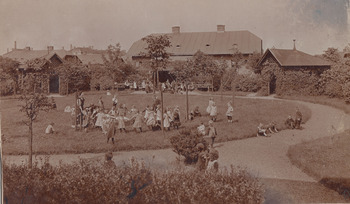
Children from kindergarten located in Josefinská colony in Vítkovice (Witkowitz). Source: Archives of Vítkovice, a. s., Vítkovice Mining and Iron Corporation 1828–1950, Foto Collection, box. 4, inv. no. 88.

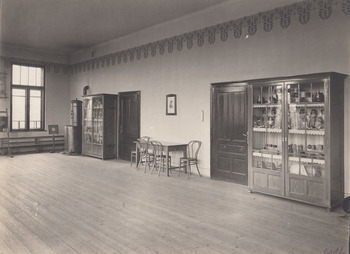
Playroom of kindergarten in Vítkovice, Místecká ulice (Witkowitz, Mistekerstrasse). Source: Archives of Vítkovice, a. s., Vítkovice Mining and Iron Corporation 1828–1950, Foto Collection, box. 4, inv. no. 88.

Classes at the Witkowitzer Bergbau- und Eisenhüttengewerkschaft kindergartens consisted of games, singing, memorizing, and narration, while emphasis was placed on physical and motor development.Footnote 83 For the formation and the following development of preschool education in Vítkovice, the theories of the German pedagogue Friedrich Fröbel (1782–1852) were essential.Footnote 84 It was Fröbel who devised the term Kindergarten (“children's garden”), which became used in many languages. Fröbel emphasized the development of children's cognitive and physical skills.Footnote 85 Kindergartens should therefore be aimed at promoting especially physical ability, although it must be noted that the educational component was also stressed. Given that the character of Vítkovice's industrial work called for manual dexterity, the development of children's skills was logically supported in preschool education. It was certainly no coincidence that one of Vítkovice's female teachers wrote an essay entitled “Fingerspiele im Kindergarten.”Footnote 86 Kindergartens also declared their aim to discipline children for future education. Specifically, children were expected to arrive at the kindergarten at 9:00 a.m. and leave for lunch at home between 11:00 a.m. and noon, depending on the decision of the specific institute. The children were then supposed to come back to the kindergarten and stay there from 2:00 p.m. to 4:00 p.m. The time of year was obviously an important factor; some kindergartens were open until 5:00 p.m. in the summer. Only some afternoons were free, but this also depended on the specific regime of each kindergarten—it could be Friday, Saturday, or Sunday afternoons. Company kindergartens also allowed children whose parents did not work for the company to attend, but a special approval from the company's management was required in such cases.Footnote 87
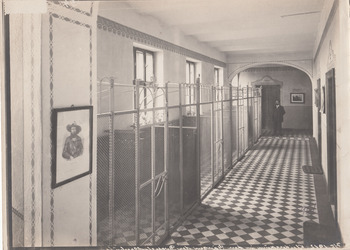
Corridor of dressing room of one of the primary schools in Vítkovice, Místecká ulice (Witkowitz, Mistekerstrasse). Source: Archives of Vítkovice, a. s., Vítkovice Mining and Iron Corporation 1828–1950, Foto Collection, box. 4, inv. no. 90.

***
The transition from kindergarten to school was, and still has been, a significant event. Children were expected to learn to read, write, and count. For the employees of the Witkowitzer Bergbau- und Eisenhüttengewerkschaft, school attendance meant a considerable amount spent on shoes and clothes for their children.Footnote 88 These pragmatic considerations regarding the financing of school attendance, that is, the need to pay for school aids and fees, and the profitability of the education achieved, in conjunction with the nationalist tension of the Vítkovice company town, formed the main axis of the parents’ actions as agents in relation to the education system. Their offspring were, with the vision of immediate financial gain, often sent to work instead of attending school, and this was also one of the reasons why still at the outbreak of World War I almost one-third of children in some of the schools around Moravská Ostrava had to repeat the first class.Footnote 89 The conflicting interaction between the profitable children's work and the costly school attendance, as defined previously, was affected in Vítkovice also by the nationalist viewpoint, which was related to the utilitarian interests of the participating agents. If Czech parents did send their children to school, in many cases they emphasized that the children should also gain a good mastery of the German language as an important element in their future professional life. Not only did this open the way for the children to attain a better position in the German-speaking structures of the Witkowitzer Bergbau- und Eisenhüttengewerkschaft; they could also more easily achieve a secondary and tertiary education, which was easier to obtain in German around Moravská Ostrava.
The historian Pavel Kladiwa, who focused on the topic of Vítkovice schools in the context of the nationalist tension of the late Habsburg Monarchy, emphasized the multilayered nature of the whole process. Taking Vítkovice as an example, he noticed both the continuous influx of uneducated and the less than nationalistic Czech and Polish rural population trying to find work, as well as the dominance of Witkowitzer Bergbau- und Eisenhüttengewerkschaft within the company town as limiting factors for potential nationalistic and social conflicts while other involved groups exercised only weak power.Footnote 90 Nationalist disputes, including both clashes between children and between children and teachers,Footnote 91 began to play a more important role only at the end of the nineteenth century when the local associations were already more established and had become the bearers of the alternative educational concept, including its language aspect, than that originally followed by the Witkowitzer Bergbau- und Eisenhüttengewerkschaft in its rationalistic and nationalistic policy of Germanization. The Germanizing strategies of the company also changed as its management took a much more confrontational stance toward the Czech and Polish inhabitants of Vítkovice from the end of the nineteenth century. The company town was ceasing to be an enclosed microcosmos, and its education system often became the subject of disputes between the company and local or more remote associations that found recourse even at the land's political level.Footnote 92 In these conflicts, the state became a tool of foreign interests rather than an ambitious agent with its own strategies, as the schools in Vítkovice, with the exception of those associated with Witkowitzer Bergbau- und Eisenhüttengewerkschaft, were primarily founded by the municipality (to a lesser extent also by associations), and controlled by company management, who adjusted the functions of the school system in the Vítkovice company town to their own interests.Footnote 93
What specific schools these were, depending on which institution founded and operated them (a company, municipality, or association), cannot be determined given that control changed considerably over the years and no archival or printed sources provide a detailed description. Long-term efforts of the Witkowitzer Bergbau- und Eisenhüttengewerkschaft to include the local educational institutions within the company's sphere of influence can be seen, whether by direct administrative control or by indirect control through staffing links between the company and the local government. Besides the company and municipality, schools in Vítkovice were also founded by interest associations, but their most important objective was to fill the vacuum of teaching in Czech and Polish, and after this intention was fulfilled the financial responsibility for control over the schools could be transferred to the concern. Between 1869 and 1910, the population in Vítkovice grew from 1,677 to 23,151, the highest relative population increase in the whole of Cisleithania,Footnote 94 and the network of primary schools under the influence of the Witkowitzer Bergbau- und Eisenhüttengewerkschaft provided education to approximately four thousand children.Footnote 95
What was the difference between the primary schools of the Witkowitzer Bergbau- und Eisenhüttengewerkschaft and those controlled by the local government? The degree of state supervision was naturally higher with “public” than “private” institutes, but if a company school sought to gain the public right (Öffentlichkeitsrecht), that is, the authority to issue officially authenticated education certificates, the independence of the entrepreneur was limited. The curriculum was not allowed to differ greatly from that of public schools, and the directors could only be appointed and teachers hired with the approval of the Land Educational Council in Brno, whose representatives also chaired the official exams.Footnote 96 If we also take into consideration the staffing links between the Witkowitzer Bergbau- und Eisenhüttengewerkschaft and the local government, most of the differences regarding state supervision were wiped away, as can be seen in the statistical materials preserved in the company's archives. They do not particularly differentiate whether a specific school was administered by the municipality or the company.Footnote 97 The major difference between public and private schools was in their funding, that is, whether the operating costs were paid for by an entrepreneur or the municipality.
The origins of Vítkovice's primary education date back to 1844, when the first school was established there, with classes taught in German and in “Moravian,” that is, the Czech dialect used in Moravia. It was established at the instigation of Salomon Mayer von Rothschild (1784–1855), who shortly before that had bought the Vítkovice Ironworks and the whole of the Hukvaldy (Hochwald) estate of which Vítkovice formed part.Footnote 98 Rothschild not only promised to build a school with an apartment for the teacher, but also established a foundation that was legally binding for himself and the future owners of the ironworks. Through the foundation deed, he promised funding for the operation of the school and the teachers’ salaries; in fact, the school was a “foundation institute” rather than a “company institute.” The actual reason why Rothschild decided to do this was that there had previously been no educational institution directly in Vítkovice. The nearest school was in Moravská Ostrava (Mährisch-Ostrau), and the long journey there was potentially bad for children who therefore only rarely attended it, so Rothschild “altruistically” wanted to provide them with compulsory school attendance near their home.Footnote 99 Besides the aforementioned, the foundation deed also contained provisions that derived from industrial and state paternalism. Rothschild maintained the right to select teachers, which helped him gain actual control over the school curriculum, and also relieved his employees’ offspring of the duty to pay school fees. However, he suppressed the fact that there were many children working for the ironworks, while the legislation required him as the company owner to provide financial support for their education and control of compulsory school attendance. (The careful stylization of the foundation deed could have resulted from expert debates from the late 1830s and early 1840s concerning the inhumanity of child labor, which may have prompted Rothschild to emphasize altruistic motives over legislative requirements to establish an educational institution in Vítkovice.)
The primary components of the curriculum were reading, writing, and religion, that is, the usual trivium. The school building slowly ceased to suffice, if it ever had sufficed, and had to be extended in the early 1870s. This posed substantial difficulties, however, because the Hasner school law (1869) and its implementation regulations for the Moravian land (1870) de facto made it a “public” institution, not a “private” educational institute as the 1844 foundation deed had originally assumed. Therefore, uncertainty arose regarding ownership rights to the school building and the competence to hire teachers because the authority granted to the ironworks owners through the foundation deed was in direct conflict with the new legislation. The Witkowitzer Bergbau- und Eisenhüttengewerkschaft was still obliged to pay all the costs of running the school and the salaries of the teacher,Footnote 100 given that Section 37 of the Moravian Land Act No. 17/1870 on “Regulating the Establishment, Maintenance and Attendance of Public Primary Schools” required the company to fulfil all its obligations stipulated in the foundation deed.Footnote 101 A series of talks among the company, educational authorities, and the local government was held as the school was extended. The situation was eventually resolved by the 1876 decree of the Ministry of Culture and Education, which instructed that the Witkowitzer Bergbau- und Eisenhüttengewerkschaft again take over control of the school. Taking this opportunity, Paul Kupelwieser made an agreement that the classes would be taught only in German, stating the reason that teachers’ wage costs were constantly increasing.Footnote 102
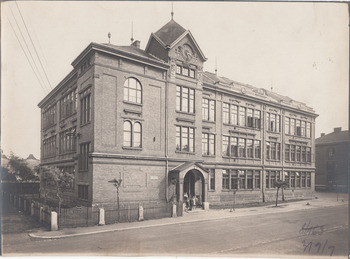
Building of primary school in Zábřeh, Hulváky (Heinrichsdorf, Hulwaken). Source: Archives of Vítkovice, a. s., Vítkovice Mining and Iron Corporation 1828–1950, Foto Collection, box. 4, inv. no. 91.

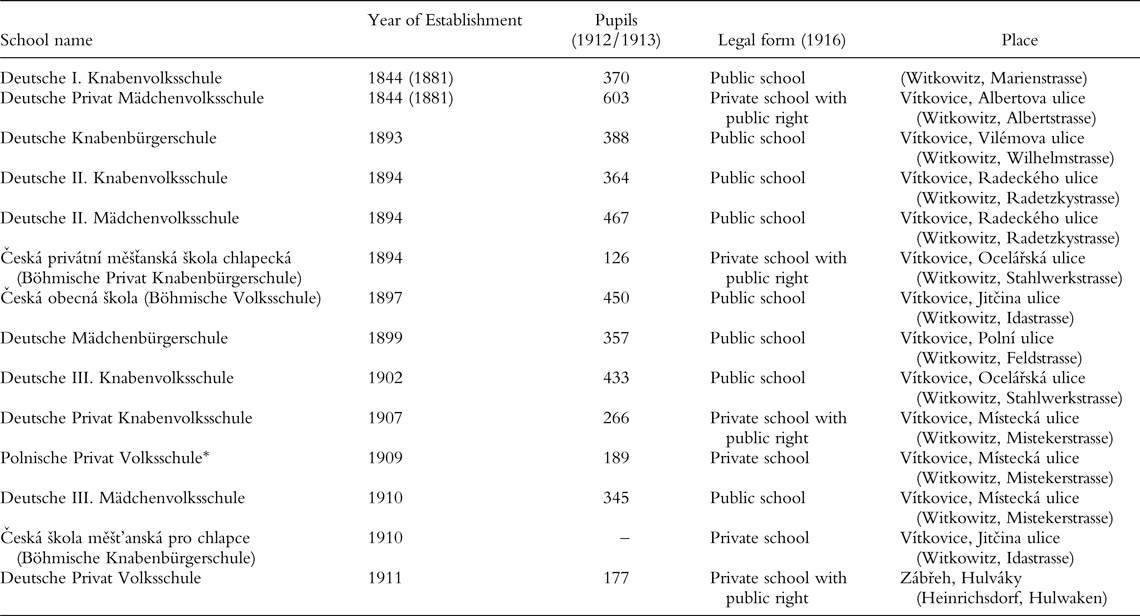
It was not long before the capacity of the Vítkovice company school again became insufficient. It was divided into a part for boys and a part for girls in 1881. From the 1890s, the expanding company town demanded that other boys’ and girls’ schools be founded, but besides the company, they were also founded by the local governments and interest associations, especially the Czech national association, Ústřední matice školská (The Central Educational Convention).Footnote 103 The first Czech school and kindergarten was established in 1894 and was financially supported by the Ústřední matice školská.Footnote 104 The demand for classes in Czech was higher than expected, and 262 children were enrolled. The local interest associations therefore called upon the local authoritiesFootnote 105 to also establish a Czech public school, which eventually happened in 1897 after many protests and interpellations. The school was later acquired by the Witkowitzer Bergbau- und Eisenhüttengewerkschaft and made part of the company's education system,Footnote 106 and the same happened later with the Polish school, established there in 1909.Footnote 107 Probably only the private school in Jitčina ulice (Idastrasse), established by the Ústřední matice školská in 1910, remained independent of the company.Footnote 108 The outline of the primary education system in Vítkovice, comprising elementary and municipal schools, is given in the table, which also shows the legal form of the institutes as of 1913/1916 (public, private, private with the public right).
Overview of elementary and municipal schools in the Vítkovice company town in 1913.

* The Polish name of the school could not be found.
Source: Archives of Vítkovice, a. s., Vítkovice Mining and Iron Corporation 1828–1950, box 249, inv. no. 1394, Schulanstalten, April 17, 1913; Archives of Vítkovice, a. s., Vítkovice Mining and Iron Corporation 1828–1950, Zustand des Schulwesens 1916; Wohlfahrts-Einrichtungen des Eisenwerkes Witkowitz, Wien: 1908, 96; Wohlfahrts-Einrichtungen des Eisenwerkes Witkowitz: Ergänzungsband, Mährisch-Ostrau: 1915, 40–41.
One key aspect of Vítkovice's “industrial paternalism” was the provision of selective contributions toward school fees granted to workers’ children. This thesis is supported by unsuccessful requests for financial aid for school fees from workers from Velká Polom (Groß Pohlom), almost 20 kilometers away, which were motivated by the rise in prices of farming products (1909).Footnote 109 A similar request for financial support came from the primary school in Hulváky (Hulwaken) because it was attended by many children of Vítkovice's employees, “mostly those who earn less and have many children obliged to attend school” (1907).Footnote 110 The Vítkovice company resolutely rejected thisFootnote 111 and established a private elementary school in the workers’ colony in Hulváky to cater to the needs of the growing number of employees from the agglomeration (this was the only case when the Witkowitzer Bergbau- und Eisenhüttengewerkschaft subsidized an educational institute outside the boundaries of the Vítkovice company town).Footnote 112 The company archives of the Witkowitzer Bergbau- und Eisenhüttengewerkschaft as well as the archives of the local educational institutions contain a number of other requests from schools in the area asking for school fees to be paid for the children of the concern's employees. The company always rejected them and asked the schools to state the legal grounds for their request.Footnote 113 Other large-scale enterprises paid school fees for the children of their employees (maybe, among other reasons, to financially support the education of their potential child workforce);Footnote 114 however, there was no direct legislative requirement for such a payment unless the children were occasionally employed by the Witkowitzer Bergbau- und Eisenhüttengewerkschaft. Attendance in the company's educational system was thus considered not only an employee benefit but also a more advantageous alternative for the company than having to cover the costs for the potential child workforce being educated in the institutes outside its sphere of influence. Fully in line with this argument, the Witkowitzer Bergbau- und Eisenhüttengewerkschaft provided company schools with considerable financial support, which, for instance, comprised 3.4 percent of the company's net profits in 1907–1912.
***
In order to gain a comprehensive picture of the education system in the Vítkovice company town, one must also focus on the company's specialized education, the organization of which was even taken as a model by the Krupp companies in Germany.Footnote 115 The tradition of apprentice education in Vítkovice dates back to 1865,Footnote 116 but it wasn't until amendments were made to the Trades Act (1883, 1885, and 1897) that this type of education was standardized. The Witkowitzer Bergbau- und Eisenhüttengewerkschaft established a company continuation school in 1883, which was in fact a professional vocational school seeking to bridge the theoretical and practical knowledge of the concern's future employees. It was a two-year curriculum where, besides specialized subjects, company accounting, namely wage and accord pay computation, was also taught in the first year. The second year included more classes on physics, mechanics, optics, electricity, chemistry, and mineralogy as the knowledge necessary for the company's qualified technical staff.Footnote 117 The teachers wrote on the blackboard, and the students copied everything down in their notebooks. Although a library with some five hundred professional books was available, no textbooks were used in the classes. According to the management, this was a method that made the pupils actually cooperate with their teachers.Footnote 118 The lessons started in the late afternoon and were held from 4:00 p.m. to 6:00 p.m. for the first-year students, and from 6:15 p.m. to 8:00 p.m. for the second-year students; in addition, lessons were also held on Sundays (hence the name “evening school” or “Sunday school”). Emphasis was put on the practical aspects of classes, such as physical experiments. The company invested in the qualification of its staff, for instance, by paying for their notebooks and pencils. However, anyone not employed by the company who attended the school had to pay for the classes.Footnote 119
Two other specialized schools, namely a German and a Czech educational institute, were established in Vítkovice in 1895 by the municipal government after it had gained the necessary financial support from the state and land authorities and from the District Trades Chamber in Olomouc.Footnote 120 The distribution of competence between company and municipal institutes was logical and was entirely in line with the needs of the concern, which took on some five hundred apprentices every year. Although the company vocational school (Gewerkschaftliche Fortbildungsschule) focused on qualifications to operate machinery and technical electric equipment, the municipal vocational schools (Deutsche gewerbliche Fortbildungsschule and the Česká průmyslová škola pokračovací [Czech Industrial Continuation School]) educated youngsters in less-demanding tasks. Fully in accordance with this intention, the municipal schools were attended by almost ten times more students (approximately 70 percent of them working in the ironworks) than the company school. The company also provided university internships to educate the top labor force.Footnote 121 At the beginning of the twentieth century, two girls’ specialized continuation schools were also established in Vítkovice, both of them on the national basis, by a private initiative of interest associations, namely the Czech Školský spolek (Educational Association) and the German Bund der Deutschen Nordmährens.Footnote 122 It was probably no coincidence that the company did not follow the initiative of third parties in establishing girls’ educational institutes because it was not obliged to constitute them by legislation or by the needs of Vítkovice's labor market.
Conclusion
The provision of school attendance for the (numerous) offspring of Vítkovice's workers, together with company accommodation, was a crucial part of the “industrial paternalism” of the Witkowitzer Bergbau- und Eisenhüttengewerkschaft. The company's management purposefully tried to motivate its employees not to leave “the iron kingdom,” as the concern was sometimes known. Key components of this mechanism included building up an education system in the Vítkovice company town and increasing its appeal through the provision of financial benefits to those workers who sent their children to schools in Vítkovice, which not only broadened the social differences between the workers in the company town and elsewhere, but also stimulated the concentration of labor in the Vítkovice agglomeration and the paternalistic transformation of the labor market. As a result of legislative exemptions in the child labor market, this strategy enabled young people to be used for auxiliary work in the ironworks and facilitated the systematic rearing of workers’ children from preschool age to specialised education. However, the argument could not be complete without emphasizing the role of “state paternalism” in this comprehensive process. On the one hand, the state authorities motivated entrepreneurs to establish and finance private educational institutions, whereas on the other hand, they generated control mechanisms for these activities, which were based on the 1869 Hasner law and were organized in four instances, namely at the local, district, land, and nationwide levels. Besides its moral dimensions, this model of state paternalism also had strong legitimizing potential because only the authorities, and not the entrepreneur, were seen, within the traditions of the central European state of “welfare and order,” as the guarantor of social emancipation, including the offspring of industrial workers. The participation of entrepreneurs in the building up of the Cisleithanian education system was highly desirable, but it was certainly not supposed to create a fully autonomous “industrial paternalism,” especially not in education, which played an important role in the process of state building and social emancipation.
The example of the education system in the Vítkovice company town shows that the legislative supervision over private schools could be eroded through interference in the staffing of local politics. This is what makes the example of Vítkovice so unique. It is typical for the company's efforts to modify “state paternalism” to suit its needs to such an extent that it decided to create a large-scale institutional system, from preschool institutes through compulsory school attendance to specialized education. State incentives partially motivated and partially forced the Witkowitzer Bergbau- und Eisenhüttengewerkschaft to control the education of the workers’ children, but the establishment of an extensive education system in the Vítkovice company town proves that it was a well-devised strategy, not merely the fulfilment of legislative obligations. The aim was not to create an autonomous education system shaped solely by the company's interests, but to modify it slightly to most closely suit the company's long-term entrepreneurial intentions in the labor market and the intergenerational reproduction of the labor force. Despite the extensive intrusion of “industrial paternalism” in the local education system, interaction between private business and the state was synergic rather than antagonistic, even though conflicting views, resulting from the financial demands of the education system and the nationalist tension of the late Habsburg Monarchy, also surfaced.