Pharmaceutical manufacturers, regulators, patients, providers, and payers all have a shared interest in improving health outcomes for patients with cancer. Each plays an important role in helping to achieve this common goal. Pharmaceutical manufacturers seek to develop new medicines that are supported by robust and clinically meaningful evidence of their safety, efficacy, and effectiveness. Regulators authorize these medicines based on evaluations of their safety and efficacy. Patients and providers together make treatment decisions and desire access to the most effective treatment options. Payers appraise new medicines with the goal of ensuring access to those medicines that constitute efficient uses of healthcare expenditure. Profits generated from the sale of the medicines provide a return to the manufacturer, which helps to drive continued research and development in an effort to improve patient health outcomes and societal well-being. Many payers have initiated health technology assessment (HTA) activities to inform decision making in light of the rising costs of health care. Given the financial constraints imposed as a result of the global economic crisis, HTAs are likely to become increasingly important as payers seek value for money solutions to major health problems. Successful collaboration and aligning incentives across stakeholders is critical to ensuring that patients are able to access the most effective medicines.
This study reviews appraisals of breast cancer and colorectal cancer medicines carried out by HTA agencies in a selection of industrialized countries. The aims are to identify key drivers of decisions and to understand the similarities and differences in the requirements of different agencies. Breast cancer and colorectal cancer represent two of the most prevalent types of cancer in industrialized countries (Reference Wilking, Jönsson and Hogberg1), with a relative abundance of publicly available data relating to pharmaceutical advances in these diseases.
BACKGROUND ON PHARMACEUTICAL DEVELOPMENTS IN BREAST CANCER AND COLORECTAL CANCER
Health outcomes for breast cancer patients have improved considerably due to important advances in diagnostic testing, surgery and drug therapy (Reference Berry, Cronin and Plevritis2–Reference Sun, Jena and Lakdawalla4). The hormonal therapy tamoxifen represents the first major pharmaceutical advancement in the treatment of breast cancer. It was launched in the mid-1970s and continues to play an important role in treating both early and advanced disease (5). Tamoxifen was followed by the development of adjuvant chemotherapy combinations containing alkylating agents and anti-metabolites in the 1980s and early 1990s. Since then, aromatase inhibitors (anastrozole, exemestane, and letrozole), used in the treatment of early estrogen receptor positive disease, and taxanes (paclitaxel and docetaxel), used in the treatment of advanced or metastatic breast cancer as well as adjuvant treatment of early disease, have been added to the therapeutic arsenal (6). More recent advancements have been the development of trastuzumab, lapatinib, and pertuzumab for the treatment of patients with human epidermal growth factor receptor 2-positive (HER2+) breast cancer.
Up until the late 1980s, improvements in colorectal cancer health outcomes had been driven mainly by developments in diagnostic and surgical techniques, with pharmaceutical treatment considered to have little effect (Reference Wilking, Jönsson and Hogberg1). It was then discovered that modulating 5-fluorouracil (5-FU) with folinic acid (FA) enhanced the former agent's activity. This 5-FU/FA combination offered survival benefits over best supportive care and became established as standard therapy for the treatment of colorectal cancer. Additionally, in recent years several important pharmaceutical advances have helped to prolong survival for patients with late stage disease from approximately 5 months to over 20 months (Reference Kanavos and Schurer7), with several agents found to deliver benefits either in combination with 5-FU/FA or as second- or third-line options. These advancements have included the development of cytotoxic agents (irinotecan and oxaliplatin), oral analogues of fluorouracil (such as capecitabine), and targeted biologics (bevacizumab, cetuximab, panitumumab, regorafenib, and aflibercept).
METHODS
We began with a sample of sixteen countries, both European and non-European. The European countries were prominently featured in a review of HTA reports focusing on cancer which were registered in the database of the International Network of Agencies for Health Technology Assessments (Reference Wilking, Jönsson and Hogberg1). The non-European countries were those that were well represented in studies related to cancer that have been presented at meetings of the International Society for Pharmacoeconomics and Outcomes Research (8). After detailed searches of the relevant Web sites of HTA agencies, payers, and decision-making bodies in these countries, we identified five agencies representing regions or countries that met the following criteria: (i) use some form of HTA to guide decisions; and (ii) publish detailed English language HTA or appraisal reports on a drug by drug basis. These were: the Pharmaceutical Benefits Advisory Committee (PBAC; Australia), the Committee to Evaluate Drugs (CED; Ontario, Canada), the National Institute for Health and Clinical Excellence (NICE; England and Wales), the High Health Authority (Haute Autorité de Santé; HAS; France), and the Scottish Medicines Consortium (SMC; Scotland).
A recent report on access to cancer medicines (Reference Wilking, Jönsson and Hogberg1) and consultations with two medical advisors whose contributions to the field of oncology research have been published widely in leading medical journals (see acknowledgements) were used to identify potentially relevant medicines and indications for each of the two diseases. We then reviewed the official Web sites of the agencies listed above to determine which of these medicines and indications had been assessed by at least one of the five agencies. Only those indications for which HTA reports were available for download from the Web sites of the agencies at the point of data extraction (November/December 2009) were included in the study. Appraisals published after the data extraction period have not been included. The HTA reports formed the main source of data for the study (see Supplementary Table 1, which can be viewed online at www.journals.cambridge.org/thc2013080). In addition, we reviewed studies reporting the results of key clinical trials, identified through follow-up of the references in the HTA reports (see Supplementary Table 2, which can be viewed online at www.journals.cambridge.org/thc2013080).
The final selection of medicines and indications was as follows: paclitaxel, docetaxel, anastrozole letrozole, exemestane, trastuzumab (all for the adjuvant treatment of early breast cancer); trastuzumab, gemcitabine, capecitabine, vinorelbine (advanced and/or metastatic breast cancer); capecitabine, tegafur with uracil, irinotecan, oxaliplatin, raltitrexed, cetuximab, bevacizumab, panitumumab (metastatic colorectal cancer).
The method of analysis was as follows. First, we compiled the information obtained from the HTA reports into a database, organized using the following fields: disease area (breast cancer / colorectal cancer), medicine, indication, and which of the five agencies had assessed each particular medicine/indication. Second, we recorded the recommendations made by the agencies. These were grouped into three categories: (i) Green – medicine recommended for the indication for which it was being assessed; (ii) Amber – medicine recommended but with some specified restriction; (iii) Red – medicine not recommended for public reimbursement. Third, we identified instances where recommendations differed across agencies for the same medicine/indication and conducted a thorough review of the reasons given by the agencies in their HTA reports for each decision. This stage of the analysis was undertaken by two members of the research team (K.K.S. and J.M.F.) working independently, who conducted a thematic analysis to identify prominent and recurring reasons for decisions, and key similarities and differences between the agencies. The findings of this review were discussed in detail by all members of the research team, and form the basis of the Discussion section of this study.
RESULTS
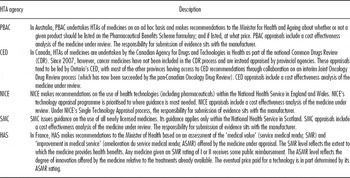
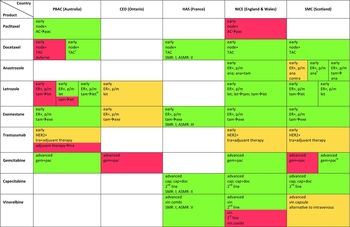
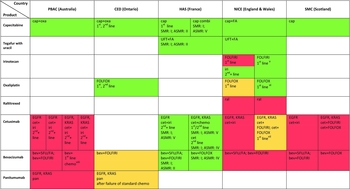
A total of seventy-six decisions were reviewed (40 for breast cancer; 36 for colorectal cancer). Figure 1 summarizes the decisions made by the five agencies for each breast cancer medicine; Figure 2 does the same for colorectal cancer. The figures are color-coded according to the categorization of decisions described in the Methods section. Cells shaded amber refer to several different types of restriction. For example, in the case of trastuzumab, the NICE recommendation was to restrict its use to patients who have either a left ventricular ejection function greater than 55 percent or no significant cardiac risk factors, which are safety considerations for patients receiving this therapy. In other cases, the restriction applied was that the medicine should only be used when patients are contra-indicated to the first-line treatment (for example, SMC's first decision on the use of anastrozole). In the case of the CED, an amber cell suggests that the medicine will be funded on the Ontario Drug Benefit formulary as a “Limited Use” product (9). Blank cells specify that no HTA report could be obtained for that medicine/indication/agency using the search method described in the Methods section. In some cases this is because the HTA agency had not yet assessed or appraised the medicine in question, including situations where the manufacturer of the product did not submit information for HTA review. In other instances, it is because the relevant documents were not publicly available (PBAC, for example, began publishing Public Summary Documents in 2005). In the case of France, if a medicine has been given an SMR rating of I or II (see Table 1), the relevant cell is shaded green as this suggests that the medicine receives some public subsidy.
Descriptions of the HTA Agencies Included in the Review

Breast cancer. Green shading: positive recommendation without restriction. Orange shading: accepted for restricted use. Red shading: negative recommendation (no public reimbursement). HAS value assessment outcomes: SMR: I = Important; ASMR: I = Major; II = Important; III = Modest; IV = Minor; V = No improvement. Indication: early: early breast cancer. advanced: advanced or metastatic breast cancer. [note: all treatments for colorectal cancer are for metastatic disease] node+: node positive disease only. ER+: oestrogen receptor positive disease only. HER2+: HER2 overexpressing disease only. EGFR: human epidermal growth factor receptor positive disease only. KRAS: Kirsten rat sarcoma wild-type disease only. p/m: postmenopausal patients only. Treatment regimen: A+B: B given concurrently with A. A → B: B given sequentially to A. combi: as part of combination therapy with other treatments. Acronyms for particular treatments and combination therapies [note: the acronyms are often established using the proprietary name rather than the generic name]: AC, doxorubicin and cyclophosphamide; TAC, docetaxel, doxorubicin, and cyclophosphamide; FA, folinic acid; 5FU/FA, fluorouracil and folinic acid; FOLFIRI, fluorouracil, folinic acid, and irinotecan; FOLFOX, fluorouracil, folinic acid, and oxaliplatin; UFT, tegafur with uracil. Therapy line: 1st line = recommended for first-line therapy; 2nd line = recommended for second-line therapy; 2nd line+ = recommended for second-line or subsequent therapy. Other: contra = for patients who are contraindicated to the first-line treatment option; chemo = standard chemotherapy; deferral = decision was deferred until submission of further evidence. Note: i In 2005, PBAC deferred the submission of docetaxel because of problems with the economic model. The 2006 resubmission included a modelled economic evaluation which addressed these problems and provided evidence that docetaxel was acceptably cost-effective. Notes: (ii) In 2004, SMC recommended the use of anastrozole as primary adjuvant therapy only in patients who were contra-indicated to tamoxifen. In 2005, SMC judged that the evidence was sufficiently strong for this restriction to be lifted. (iii) In 2006, PBAC rejected the submission of letrozole as extended adjuvant therapy due to unacceptable cost-effectiveness and uncertainties surrounding the overall survival data. The 2007 resubmission used a lower cost for letrozole, which reduced the incremental cost-effectiveness ratio to an acceptable level. (iv) In 2005, SMC rejected the submission of gemcitabine because, amongst other things, the cost-effectiveness estimates were based on the unsound assumption that docetaxel and paclitaxel had equal efficacy. The 2006 resubmission used data from studies involving a range of taxane-based comparators (including docetaxel monotherapy) and therefore did not rely on assumptions about the relative efficacy of docetaxel and paclitaxel.

Colorectal cancer. Green shading: positive recommendation without restriction. Orange shading: accepted for restricted use. Red shading: negative recommendation (no public reimbursement). HAS value assessment outcomes: SMR: I = Important; ASMR: I = Major; II = Important; III = Modest; IV = Minor; V = No improvement. Indication: early: early breast cancer. advanced: advanced or metastatic breast cancer. [note: all treatments for colorectal cancer are for metastatic disease] node+: node positive disease only. ER+: oestrogen receptor positive disease only. HER2+: HER2 overexpressing disease only. EGFR: human epidermal growth factor receptor positive disease only. KRAS: Kirsten rat sarcoma wild-type disease only. p/m: postmenopausal patients only. Treatment regimen: A+B: B given concurrently with A. A → B: B given sequentially to A. combi: as part of combination therapy with other treatments. Acronyms for particular treatments and combination therapies [note: the acronyms are often established using the proprietary name rather than the generic name]: AC, doxorubicin and cyclophosphamide; TAC, docetaxel, doxorubicin, and cyclophosphamide; FA, folinic acid; 5FU/FA, fluorouracil and folinic acid; FOLFIRI, fluorouracil, folinic acid, and irinotecan; FOLFOX, fluorouracil, folinic acid, and oxaliplatin; UFT, tegafur with uracil. Therapy line: 1st line = recommended for first-line therapy; 2nd line = recommended for second-line therapy; 2nd line+ = recommended for second-line or subsequent therapy. Other: contra = for patients who are contraindicated to the first-line treatment option; chemo = standard chemotherapy; deferral = decision was deferred until submission of further evidence. Notes: v In 2002, NICE rejected the submission of irinotecan, in part due to uncertainty surrounding the overall survival data. The 2005 resubmission included data from a greater number of clinical trials, thus providing more robust evidence of an improvement in overall survival with irinotecan. Notes: (vi) In 2002, NICE recommended the use of oxaliplatin as first line therapy only in patients whose metastases are confined solely to the liver and may become resectable following treatment. In 2005, NICE judged that the evidence was sufficiently strong for this restriction to be lifted. (vii) In 2007, NICE rejected the submission of cetuximab because the cost-effectiveness of cetuximab plus irinotecan compared with standard therapy had not been proven. The 2009 resubmission, which used different comparator/comparator regimens (adding cetuximab to FOLFOX or FOLFIRI), estimated incremental cost-effectiveness ratios that fell within the levels considered acceptable. (viii) In March 2008, PBAC rejected the submission of bevacizumab due to unacceptably high and uncertain cost-effectiveness. The July 2008 resubmission addressed the main areas of concern to the PBAC by restricting use to the first line setting and by providing an updated cost-effectiveness analysis.

In some cases one medicine has been assessed by the same HTA agency on more than one occasion. This is denoted by splitting the relevant cell into multiple columns, with the earliest assessment on the left and the latest assessment on the right. Each cell contains abbreviated details of the indication and medicine (or combination therapy) being assessed. In cases where there is a well-established acronym for a particular combination therapy (e.g., FOLFOX), this has been used. In all other cases, each medicine is referred to using the first three letters of its nonproprietary name (e.g., letrozole is denoted by “let”).
Only three of the medicines—exemestane (for breast cancer), capecitabine and bevacizumab (both for colorectal cancer)—appear to have been assessed by all five agencies. Two medicines—irinotecan and raltitrexed (both for colorectal cancer)—appear to have been assessed by only one of the agencies, although it may be the case that other agencies did assess these medicines but did not make the relevant reports available in such a way that they were identified by our search method. For breast cancer medicines, 25 (62.5 percent) of decisions were positive without restriction; 7 (17.5 percent) were positive with restriction; 8 (20.0 percent) were negative. For colorectal cancer medicines, 16 (44.4 percent) were positive without restriction; 5 (13.9 percent) were positive with restriction; 15 (41.7 percent) were negative. In France, all of the medicines were judged to be of major therapeutic value (SMR rating of I) but none were recognized as providing major innovation or therapeutic progress (ASMR rating of I).
On the whole, the treatments for breast cancer were associated with favorable decisions, with the majority of assessments leading to positive recommendations. This was also the case for some colorectal cancer medicines—the use of capecitabine, for example, was approved by all five agencies. The three more recent biological treatments (cetuximab, bevacizumab and panitumumab), however, have mostly failed to receive positive recommendations from agencies that consider cost-effectiveness. Our review suggests that, although agencies considered these medicines to be effective in generating health improvements, they were typically deemed too expensive for the benefit they deliver.
DISCUSSION
The HTA agencies considered in this study all share a common goal of seeking to establish whether the medicines under appraisal constitute efficient uses of healthcare expenditure. Yet our review shows that they sometimes reach different conclusions about the same medicines. From our analysis of the reasons given by the agencies for making particular decisions (which inevitably involved an element of subjective judgment), we identified several areas where differences in approach to HTA appear to have driven differences in the recommendations made. In this section we provide some examples to illustrate three of these areas: (i) differences in the ways in which agencies interpret data on surrogate end points; (ii) differences in the extent to which agencies consider “patient voice”; and (iii) differences in what is considered an appropriate comparator technology. We consider these three areas to have emerged as recurring themes in our analysis, but note that a number of other aspects, such as the extent to which agencies use all of the available evidence and the ways in which agencies deal with uncertainty, were also identified but are not explored further in this study for the sake of brevity. Furthermore, we acknowledge that there may be differences in prices (and pricing systems), treatment practice, cost structure, and health priorities across the jurisdictions which could lead to differences in agencies’ assessments of what constitutes value, and, therefore, to differences in their recommendations. Although we recognize that our selection of discussion points is based in part on our own value judgments, we note that these points have also been deemed important in other research (Reference Kanavos, Nicod, van den Aardweg and Pomedli10).
Use of Surrogate End Points
The “gold standard” for end points in most solid tumor oncology studies is overall survival (OS) (Reference McCabe, Bergmann and Bosanquet11). However, it can be very difficult to demonstrate in a clinical trial that a medicine improves OS because of the lengthy period of time and increased numbers of patients that are required to demonstrate a benefit (particularly in tumors where longer survival times have been demonstrated). OS takes into consideration all therapies that the patient has received, which can make it difficult to ascertain the direct benefit of the treatment under investigation, and within the conduct of clinical trials, patients are often permitted to cross over from the control arm to the treatment arm or switch to other therapies (Reference Axelrod12). Alternative end points such as progression-free survival (PFS) have commonly been used as surrogates for OS in clinical trials. However, the validity of PFS as a surrogate for OS can vary from one tumor type to another (Reference Saad, Katz and Buyse13). Although it is important to ensure that OS is not ultimately compromised, PFS can be a valid outcome in its own right by providing a period of time in which patients experience a reduction in symptoms, clinical consequences of the disease, and/or improved quality of life. For example, according to the European Medicines Agency (EMA), PFS represents relevant clinical benefit for patients with metastatic breast cancer. Moreover, it can be attributed directly to a specific treatment and is not confounded by subsequent lines of therapy (14). In many cases, EMA and other regulatory agencies have granted marketing authorizations to medicines on the basis of PFS or disease-free survival (DFS).
In many of the assessments considered in this study, the clinical trial data indicated that the treatment under review was associated with statistically significant improvements in either DFS or PFS (compared with the nominated comparator) but not a statistically significant improvement in OS. These surrogate end points have been interpreted differently across agencies. For example, in the CED's evaluation of letrozole for the adjuvant treatment of breast cancer, the trial evidence showed no difference in OS between the treatment groups after a median follow-up of 25.8 months. However, the Committee considered DFS to be a valid surrogate marker for OS in breast cancer and recommended the funding of letrozole (with restriction) on this basis. By contrast, when considering the interim analysis (median follow-up of 28 months) of a different trial examining the use of letrozole in the extended adjuvant setting, PBAC noted in its initial assessment that early changes in DFS often fail to lead to corresponding improvements in OS, and judged that in the absence of a longer follow-up period, the long-term effects of letrozole therapy in the extended adjuvant setting remained unclear.
Patient Voice
Most of the HTA reports considered in this study focus predominantly on the impact that the medicine under review has on OS (or some surrogate marker for OS). However, another important aspect of these medicines is their effect on patients’ well-being and quality of life. In many of the assessments reviewed, we found that the supporting clinical trials did not measure the impact of the new technology on quality of life. This is despite the existence of cancer-specific quality of life instruments which capture domains that are of relevance to cancer, such as fatigue and nausea (Reference Aaronson, Ahmedzai and Bergman15;Reference Cella, Tulsky and Gray16). Whereas the assessment of health-related quality of life and other aspects of patient preferences have become increasingly important in clinical trials carried out in recent years, in cases where these aspects were not assessed it may be useful to supplement evidence from trials with evidence from other sources to obtain a more comprehensive understanding of the overall impact of a given product.
The impact of patient voice seems only to have been incorporated formally in the HTAs conducted by NICE. NICE routinely invites specialist groups and patient (and caregiver) representative organizations to provide input either as consultants or as commentators. Our review identified cases where such input has been acknowledged explicitly in the NICE guidance documents. For example, in the appraisal of hormonal therapies for early estrogen receptor-positive breast cancer, the trial data indicated that the aromatase inhibitors had different adverse event profiles from tamoxifen. Although the trials typically reported no statistically significant difference in overall quality of life between those treated with tamoxifen and with aromatase inhibitors, NICE heard from patient organizations that these side effects are a very important aspect of quality of life for many patients undergoing cancer treatment. Similarly, in the appraisal of capecitabine and tegafur with uracil for the treatment of metastatic colorectal cancer, NICE took into account that both products could be taken orally. It heard from patient representatives that most patients preferred oral therapy to intravenously administered treatments as it is more convenient and permits them greater control over the management of their disease.
We did not find any specific references to patient preferences in the HTA reports published by the other four agencies. It may be that some of the agencies did consider patient preferences but do not routinely report this type of information in publicly available guidance documents. In Australia, for example, Messina and Grainger (Reference Messina and Grainger17) report that there is a process in place for soliciting patient comments by means of a Web-based template process. However, they note that patient participation within PBAC's model is not systematic (the submissions tend to be used only for rare or poorly understood conditions), and there is no evidence in the public summary documents we reviewed of patient voice being considered or having any impact on PBAC's recommendations. Alternatively, it may be that consideration of patient voice lies outside the remits of these agencies but such information is incorporated elsewhere in the healthcare decision-making process. Whatever the reason, it is currently unclear whether patient preferences are routinely elicited and considered in the assessments carried out by PBAC, CED, HAS, and SMC; and if so, how. Based on the findings of our review, we would conjecture that observed differences in recommendations about particular medicines may have been driven in part by differences in the extent to which agencies considered information on patient voice and quality of life.
Comparator Issues
When assessing a particular medicine, all five HTA agencies consider the relative value that the product confers compared with the most appropriate alternative treatment option. In most cases, this refers to the most commonly used “standard therapy” in that country at the time of the assessment. Our review reveals several instances of submissions being rejected primarily due to the comparator being deemed inappropriate. For example, in the case of gemcitabine for metastatic breast cancer, the CED considered that the evidence submitted, which referred to the results of a trial comparing gemcitabine plus paclitaxel with paclitaxel monotherapy, was unsuitable because docetaxel was more widely used than paclitaxel as standard therapy in Canada. As a result, it judged that value for money could not be determined and rejected the submission. Similarly, in NICE's appraisal of paclitaxel for early breast cancer, the submission was based on clinical studies examining the effect of adding paclitaxel to four cycles of the doxorubicin / cyclophosphamide (AC) combination regimen. Although NICE's Appraisal Committee accepted that this evidence demonstrated the benefit of adding paclitaxel to four cycles of AC, the submission was rejected, in part because the comparator was judged to be inappropriate, with other regimens argued as being more effective and more widely used in England and Wales. In contrast, the same comparator was considered appropriate in the PBAC's corresponding assessment, which resulted in a positive recommendation despite being based on the same data as were used in the NICE appraisal.
Regulatory agencies and HTA agencies can express differences in opinion about what constitutes an appropriate comparator. In the case of docetaxel, the submissions in all countries were based on data from the pivotal trial that underpinned its regulatory approval for use in the adjuvant treatment of early breast cancer. This trial compared six cycles of the docetaxel-containing TAC (docetaxel / doxorubicin / cyclophosphamide) regimen with six cycles of the FAC (5FU / doxorubicin / cyclophosphamide) regimen. However, NICE, SMC and HAS all noted that the FAC regimen did not reflect the standard therapy for early breast cancer in their respective countries. The three agencies used different approaches to obtain the necessary additional data. NICE referred to evidence which supported the use of the FAC regimen as a proxy for the more commonly used FEC (5-FU / epirubicin / cyclophosphamide) regimen, and considered data from a part-published analysis of the Programmes d'Actions Concertées Sein (PACS) 01 trial that used FEC as the comparator (Reference Roché, Fumoleau and Spielman18). The SMC report discussed the results of the PACS 01 study in greater detail, and noted that an indirect comparison had been used to examine regimens that were considered standard therapy in Scotland. The HAS assessment also relied heavily on the PACS 01 study, with the guidance noting that its results indicated that the impact of docetaxel was unlikely to be as great as suggested by the pivotal trial.
CONCLUSION
The pharmaceutical treatment of both breast cancer and colorectal cancer has been characterized by an important early breakthrough product (tamoxifen for breast cancer; 5FU/FA for colorectal cancer), followed by a series of stepwise innovations. By and large, the HTA agencies considered in this study have recognized the benefits associated with medicines developed for breast cancer and colorectal cancer, with the majority of appraisals resulting in positive recommendations, although some of the newer colorectal cancer medicines have not been as successful as their clinical and/or cost-effectiveness has been judged to be unsatisfactory. We are aware that the agencies have completed several appraisals (and re-appraisals) of breast cancer and colorectal cancer medicines since we completed the data extraction for this study, but these appraisals are beyond the scope of this study. Among other factors, differences in the ways in which data on surrogate end points, patient voice and comparator technologies are interpreted can sometimes mean that HTA agencies reach different recommendations when assessing the same products. Although the focus of our study was oncology, many of our findings and recommendations have been found to apply to the assessment of medicines in other therapeutic areas (Reference Kanavos, Nicod, van den Aardweg and Pomedli10;Reference Clement, Harris and Li19).
By understanding these differences and learning from assessments that have either succeeded or failed in achieving positive recommendations, there may be steps that both manufacturers and HTA agencies can take to improve the quality of the evidence generated and the processes for assessing that evidence. Such improvements may help to ensure that the incremental improvements provided by a new medicine find their way to patients more quickly; so long as a price can be determined which reflects the relative value of that medicine to a particular society (acknowledging potential differences across countries) and which generates a suitable return on investment for the manufacturer. It would be constructive for evidence requirements to be made more explicit by HTA agencies, and for manufacturers to pursue available opportunities to gather input on research designs early in the drug development process. Additionally, given that the gold standard oncology end point of OS can sometimes be difficult to achieve in the clinical trial setting, it would be helpful for HTA agencies to clarify the acceptability and appropriateness of surrogate end points such as PFS as a predictor of OS, or indeed to consider whether PFS is a worthwhile outcome in its own right.
In cases where the pivotal trial did not use a comparator that reflects standard therapy, HTA agencies could consider whether additional data are available that could be used to support the assessment. Likewise, manufacturers should proactively consider whether data on indirect comparisons could be generated and useful. Related to these points, increased collaboration between regulatory and HTA agencies could help to avoid the situation where evidence requirements for regulatory approval are inconsistent with those for health technology appraisal.
Finally, HTA agencies could be more transparent about how information on patient preferences and quality of life informs their recommendations. In some cases, it may be useful to supplement trial evidence with testimonials and preference data from patient and clinical representatives to get a more complete picture about the effects of a treatment and the value it confers to patients. A further suggestion is for manufacturers to seek input from patient advocates early in the development process to better understand what outcomes are important and relevant to patients and to use this information to inform the choice of instruments and measures in clinical trials.
ACKNOWLEDGMENTS
The authors are grateful to the anonymous reviewers and to Daniel Ball and David Grainger of Eli Lilly and Company for their input to the study and insightful comments on earlier drafts. Valuable feedback was also received from Nils Wilking (expert in breast cancer) and Bengt Glimelius (expert in colorectal cancer).
SUPPLEMENTARY MATERIAL
Supplementary Table 1: www.journals.cambridge.org/thc2013080
Supplementary Table 2: www.journals.cambridge.org/thc2013080
CONTACT INFORMATION
Koonal Kirit Shah, MSc (kshah@ohe.org), Office of Health Economics, 7th floor Southside, 105 Victoria Street, London, SW1E 6QT, United Kingdom
Jorge Mestre-Ferrandiz, PhD, and Adrian Towse, MPhil, Office of Health Economics, London, United Kingdom
Emily Nash Smyth, PharmD, Eli Lilly and Company, Global Health Outcomes, Indianapolis, Indiana, United States
CONFLICTS OF INTEREST
Koonal Shah, Jorge Mestre-Ferrandiz and Adrian Towse report receiving grant money to their institution from Eli Lilly and Company; this manuscript is based on findings from a research project that was funded by Eli Lilly and Company. Their institution (OHE) is regularly commissioned to undertake consulting projects by commercial clients, including pharmaceutical companies, and receives grants, honoraria and travel funding for the purpose. Emily Smyth is an employee and shareholder at Eli Lilly and Company.