The dairy industry which is already generating vast volumes of wastewater (Demirel et al. Reference Demirel, Yenigun and Onay2005) is faced with the difficult problem of constantly increasing volumes of wastewater being generated, coupled with more stringent discharge standards being put in place by bodies such as the European Environment Agency and, in the case of Ireland, Environmental Protection Agency (EPA). This has brought about the need for new and innovative methods of treating the wastewater (Henry, Reference Henry2014). Another problematic factor is that many currently employed methods of wastewater treatment in the dairy industry require the use of expensive and often hazardous chemicals; these treatment options are also often energy-severe.
Dairy wastewaters often contain high levels of phosphorus, nitrogen and organic content (Kushwaha et al. Reference Kushwaha, Srivastava and Mall2011). Biological treatment was thought to be an appropriate solution for treating wastewater of such composition. The EPA has recommended in its Best Available Techniques (BAT) guidelines for the treatment of dairy wastewater that biological treatment is used in conjunction with other processes. According to these BATs, activated sludge systems, namely Sequencing Batch Reactors (SBRs) are suitable for the treatment of dairy wastewater due to there being high levels of Chemical Oxygen Demand (COD), nitrogen and phosphorus present (EPA, 2008). If the SBR process could be improved upon to maximise nutrient removal, it could potentially offer a new BAT to the industry for the treatment of dairy wastewater. One such modification to the SBR that has previously been applied to treating high strength wastewater is the Intermittently Aerated Sequencing Batch Reactor (IASBR). An IASBR is a biological wastewater treatment system which has been adapted from SBR operation in an attempt to achieve higher removal efficiencies of COD and nutrients such as nitrogen and phosphorus, whilst reducing the operational cost of the system. An IASBR operation can be imposed on a conventional SBR (cSBR) by changing the way in which the react phase runs in the system (Li et al. Reference Li, Healy, Zhan, Norton and Rodgers2008; Leonard et al. Reference Leonard, Finnegan, Tarpey and Zhan2018). SBR system efficiency can be improved upon by employing the IASBR aeration strategy. By utilising the intermittent aeration strategy it is possible to diminish nitrogen removal at the beginning of the react phase, allowing for readily biodegradable COD to be used up by phosphate accumulating organisms (PAOs) in their assimilation of phosphate. In the phases to follow, nitrogen removal can be performed by utilising organic carbon stored in the PAOs (Li et al. Reference Li, Healy, Zhan, Norton and Rodgers2008), further reducing the organic carbon requirement of the system. By employing an intermittent aeration system, a higher level of control can be achieved within an IASBR than an SBR. Balancing the phase lengths in order to maximise system efficiency in nutrient removal is essential in these systems (Pan et al. Reference Pan, Henry, Liu, Huang and Zhan2014). Using this system and applying aeration at different periods it is possible to increase the removal efficiency of the system by controlling at what point different nutrients are reduced or oxidised (Leonard et al. Reference Leonard, Finnegan, Tarpey and Zhan2018).
When applied to slaughterhouse wastewater, the IASBR system exhibited its potential for use in wastewaters with high concentrations of nitrogen, phosphorus and organic content (Henry, Reference Henry2014). IASBRs have also been compared to cSBRs which employ a continuous aeration strategy rather than an intermittently aerated one (Pan et al. Reference Pan, Chen, Hu and Zhan2013; Henry, Reference Henry2014; Pan et al. Reference Pan, Henry, Liu, Huang and Zhan2014). In these studies, the IASBR showed that if operated correctly it can be more efficient with regards to removal efficiency and cost than the conventional SBR systems. IASBR technology has been applied to dairy processing wastewater at laboratory scale with a high degree of success exhibiting that this technology has great potential for use within the dairy sector (Tarpey, Reference Tarpey2016; Leonard et al. Reference Leonard, Finnegan, Tarpey and Zhan2018).
In this study, the initial operation of a pilot-scale IASBR system, which is located at an Irish dairy processing factory, is detailed. The operational methodology and initial results are presented. The levels of NH4+-N and ortho-phosphate (PO43−-P), including the removal efficiencies based on the influent into the system, have been detailed and discussed. These first results allow for an initial evaluation of the system and its potential for implementation in the Irish and other dairy processing industries.
Material and methods
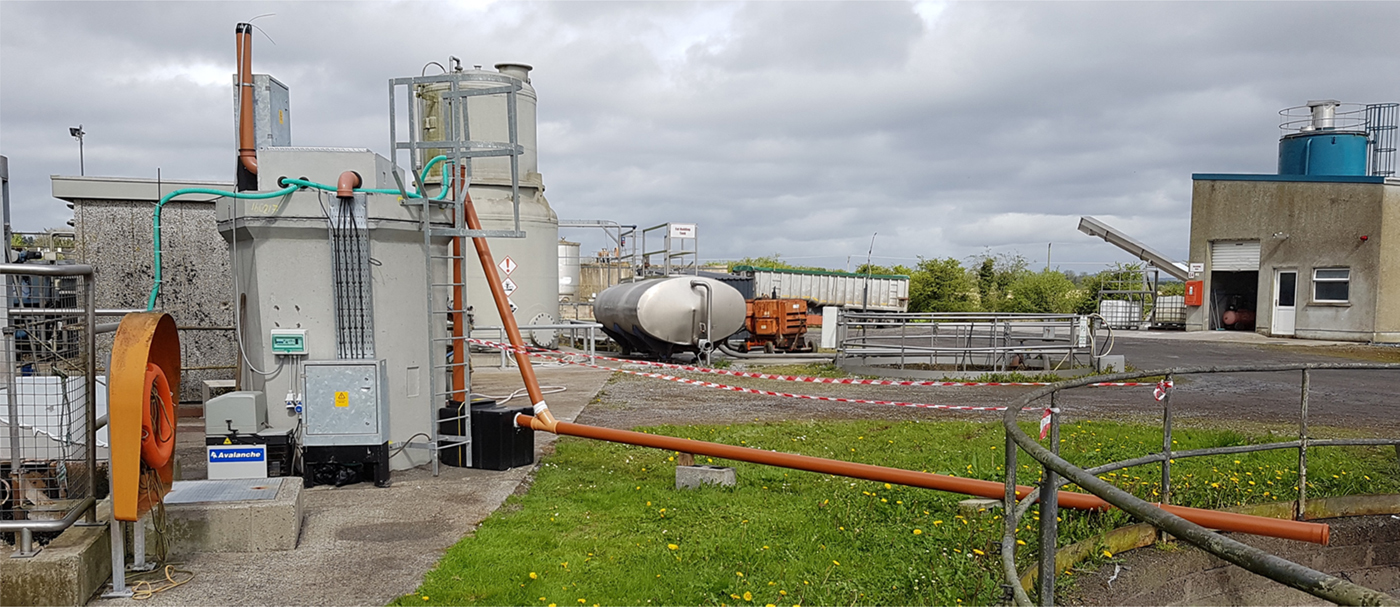
The pilot-scale IASBR system has been installed at an Irish dairy processing factory (Fig. 1). To design the pilot-scale system, operation parameters and details from the laboratory-scale experimental testing (Leonard et al. Reference Leonard, Finnegan, Tarpey and Zhan2018) have been scaled for a system with a working volume of 3000 l, which will give a more accurate indication of its performance at a dairy processing factory, compared to the 8-l laboratory-scale system.
Pilot-scale IASBR system on-site at an Irish dairy processing factory.
This system is controlled by a programmable logic controller (PLC: Siemens LOGO! 8) in order to operate the pumps and aeration system at scheduled intervals to set the aeration regime, cycle length, Hydraulic Retention Time (HRT) and Sludge Retention Time (SRT). The aeration is supplied to the unit via a compressor connected to air diffusors located at the bottom of the tank (2 × 750 mm and 2 × 500 mm). A refrigerated auto-sampler takes effluent samples, which are stored for up to one week. Subsequently, nutrient analysis is performed on these samples, which is carried out in the same way as discussed in the previous Research Communication (Leonard et al. Reference Leonard, Finnegan, Tarpey and Zhan2018) using standard methods (APHA, 2005).
Pilot-scale IASBR system operation
Initially, the pilot-scale system was operated on two 12-h cycles per day. At the beginning of every cycle 375 l of wastewater was pumped in, giving the system a hydraulic retention time of 4 d, the same as used at laboratory-scale. The system is intended to have an SRT of 16 d also, removing 93·75 l of mixed liquor per cycle. Float switches are used in order to ensure that exact volumes are pumped in and out of the reactor at the appropriate times during the cycle.
The 12-h cycle is made up of a fill phase, react phase, settle phase and a decant phase. The system fills at the beginning of every cycle, followed by 8 alternating periods of non-aeration, which is 100 min in length, and aeration, which is 60 min in length. Additionally, the circulation pump runs throughout these periods to ensure the wastewater and sludge remain mixed. At the end of the cycle, the circulation pump and aeration is stopped for 80 min to allow the mixture to separate, where biomass settles to the bottom of the unit, allowing for the treated effluent to be decanted from the top.
Results and discussion
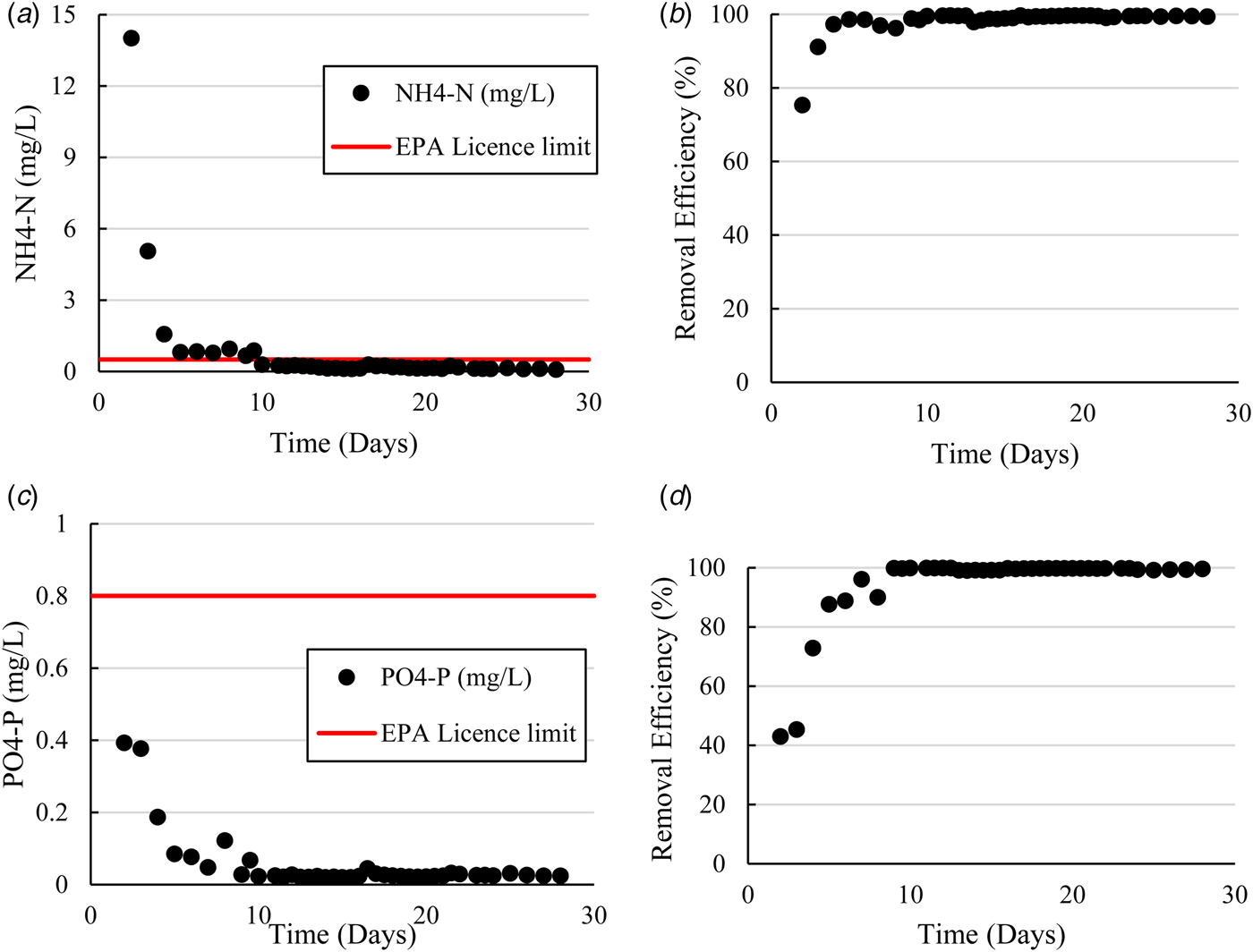
The initial results of the nutrient analysis for the first 30 d of system operation are displayed in Fig. 2. These have shown high removal efficiencies of above 95% in NH4+-N and PO43−-P (Fig. 2b and d).
Results from performing a nutrient analysis on treated effluent from the pilot-scale IASBR system for early days of operation, where: (a): ammonium-nitrogen (NH4-N) content in mg/l; (b): NH4-N removal efficiencies; (c): ortho-phosphate (PO4-P) content in mg/l; and (d): PO4-P removal efficiencies.
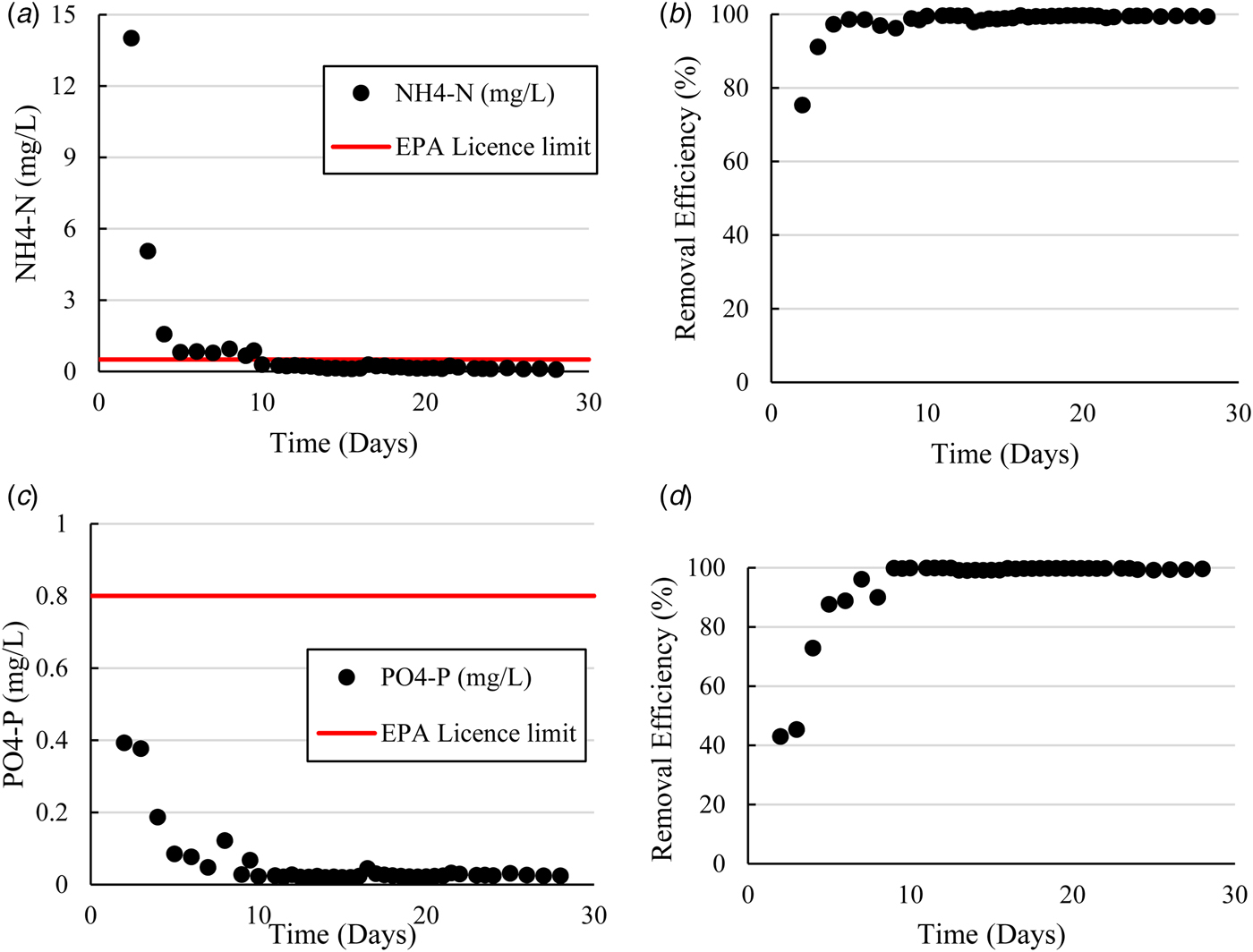
Figure 2a illustrates the NH4+-N levels in the effluent in comparison to the licence limits. After a 9-day adjustment period to the new system operation, the system was discharging treated effluent to below the EPA licence limits. The Fig. 2a exhibits that the nutrient content of the effluent at 0·169 mg/l is far below what the licence permits (0·5 mg/l). Figure 2b shows that removal efficiencies of above 95% were observed for NH4+-N removal.
In Fig. 2d the removal efficiency of PO43−-P can be seen. Removal efficiencies above 95% were observed after 3 d, and were generally above 99%. Although the system follows after the DAF system, in which aluminium sulphate is added in order to precipitate phosphorus, what remains is removed by the IASBR system, bringing the levels down to below 0·1 mg/l. There have, however, been times when the DAF system has not successfully removed the phosphorus. For example, on Day 9 the levels of PO43−-P were seen to be 22·83 mg/l before treatment and 0·028 mg/l after treatment, which yields a removal efficiency of 99·8%. This demonstrates the IASBR system's high capacity to remove PO43−-P from dairy wastewater whilst still maintaining removal of other nutrients. In Fig. 2c the levels of PO43−-P can be seen. The licence limits for PO43−-P are 0·8 mg/l, whereas the treated effluent from the IASBR system tested less than 0·03 mg/l in most samples. This illustrates that the IASBR system has very good potential for biological phosphorus removal. The prospect of eliminating the need for chemical phosphorus removal is a stance that most dairy processing factories would look upon favourably, reducing the cost of treatment whilst simultaneously reducing the need for potentially environmentally harmful chemicals.
In conclusion, the initial pilot-scale IASBR system results, which are presented in this study, indicate that the technology has great potential for utilisation within the dairy sector. Once the system stabilised (after 9 d), the effluent was treated to an acceptable quality for discharge into surrounding water bodies (below the EPA discharge limits). This technology is easily implemented as it is a modification in the operational parameters of a conventional SBR, which may be performed using changes to the PLC program. As a biological system, it potentially offers the industry a more sustainable, cheaper and environmentally friendly alternative to currently used chemical treatment solutions. Further optimisation of the operational conditions is to be carried out in order to increase the volume of wastewater being treated, whilst maintaining effluent quality below the EPA discharge limits.
The authors would like to acknowledge the funding provided by the Department of Agriculture, Food and the Marine for the DairyWater project (Ref.: 13-F-507). For additional details please see http://www.dairywater.ie. Additionally, the DairyWater research team would like to the members of the Irish dairy sector for their cooperation and contributions throughout the research project.