Introduction
The programmed death 1 (PD-1) receptor, along with its ligand programmed death ligand 1 (PD-L1), induces inactivated and exhausted T cells. PD-L1 is predominantly expressed on tumor cells, and the interaction between PD-1 and PD-L1 suppresses T-cell activation and antitumor immunity. Nivolumab, an antihuman immunoglobulin 4 (IgG4) PD-1 antibody, has been approved for use in patients with metastatic or recurrent head and neck squamous cell carcinoma (HNSCC) after platinum-based therapy.Reference Ferris, Blumenschein, Fayette, Guigay, Colevas and Licitra1 Beyond HNSCC, nivolumab has demonstrated efficacy against various cancer types such as melanoma, nonsmall-cell lung cancer (NSCLC), renal cell carcinoma, urothelial cancer, gastric cancer, esophageal squamous cell carcinoma, and Hodgkin’s lymphoma.Reference Topalian, Hodi, Brahmer, Gettinger, Smith and McDermott2–Reference Kato, Cho, Takahashi, Okada, Lin and Chin7 Nivolumab binds to the PD-1 receptor on T cells, facilitating the restoration of T-cell function and the promotion of antitumor immune response.
Recently, there has been a growing focus on predictive biomarkers for the prognosis of PD-1/PD-L1 blockade therapy. Prognostic biomarkers derived from tumor cell analysis in tumor tissue encompass PD-L1 expression, major histocompatibility complex (MHC) molecule expression, and tumor mutation burden.Reference Taube, Klein, Brahmer, Xu, Pan and Kim8–Reference Li, van der Merwe and Sivakumar13 Additionally, prognostic biomarkers derived from immune cell analysis in tumor tissue involve CD8+ T cells, CD4 T+ cells, and myeloid-derived suppressor cells (MDSCs).Reference Li, van der Merwe and Sivakumar13–Reference Chen, Roh, Reuben, Cooper, Spencer and Prieto17 Tumor tissue analysis is a highly invasive procedure, and undergoing repeated analyses of tumor tissue can be burdensome. In contrast, peripheral blood analysis is a less invasive option for patients compared to tumor tissue analysis. Furthermore, it is well-suited for capturing treatment-induced changes in the body due to its ease of repeated analysis. Prognostic biomarkers derived from peripheral blood analysis encompass circulating immune cells, cytokines, and circulating tumor DNA.Reference Boutsikou, Domvri, Hardavella, Tsiouda, Zarogoulidis and Kontakiotis18–Reference Frigola, Inman, Krco, Liu, Harrington and Bulur22 Furthermore, prognostic markers based on routine blood tests conducted in clinical practice have been reported, including lymphocyte count, neutrophil count, neutrophil-to-lymphocyte ratio (NLR), Glasgow Prognostic Score (GPS), and modified GPS (mGPS).Reference Nakamura, Kitano, Takahashi, Tsutsumida, Namikawa and Tanese23–Reference Zhang, Chen, Chen and Li26
GPS and mGPS, incorporating C-reactive protein (CRP) and serum albumin (Alb) levels, serve as valuable prognostic tools for various malignant tumors.Reference Proctor, Morrison, Talwar, Balmer, O'Reilly and Foulis27, Reference McMillan28 Previously introduced, the immune-modified GPS (imGPS) enhances mGPS by incorporating lymphocyte count, thereby improving its predictive ability in patients with HNSCC.Reference Terazawa, Ohashi, Shibata, Ishihara and Ogawa29 The imGPS is simply calculated as the conventional mGPS with one additional point for a low lymphocyte count (<1250/µL). Patients with high imGPS (i.e., imGPS = 2 or imGPS = 3) were found to have worse prognosis than patients with low imGPS (i.e., imGPS = 0 or imGPS = 1). The imGPS reflects the systemic inflammation status (indicated by CRP level), nutrition status (indicated by Alb level), and immune status (indicated by lymphocyte count) in cancer patients. Thus, imGPS stands as a multidimensional prognostic marker assessing the overall systemic conditions of patients. This study aims to evaluate the utility of imGPS in predicting the treatment response to nivolumab in patients with unresectable recurrent or metastatic HNSCC.
Materials and methods
Patient selection and study design
We conducted a retrospective analysis, identifying 76 patients with recurrent or metastatic HNSCC who underwent nivolumab treatment between March 2017 and July 2022. Nivolumab was administered at a dosage of 3 mg/kg or 240 mg/body every two weeks or 480 mg/body every four weeks. The median follow-up duration was 408 days (range: 36–1,779 days). Exclusion criteria comprised patients who received a single dose of nivolumab, underwent radiotherapy within eight weeks of starting nivolumab, had hematologic malignancies, or were on steroid therapy.
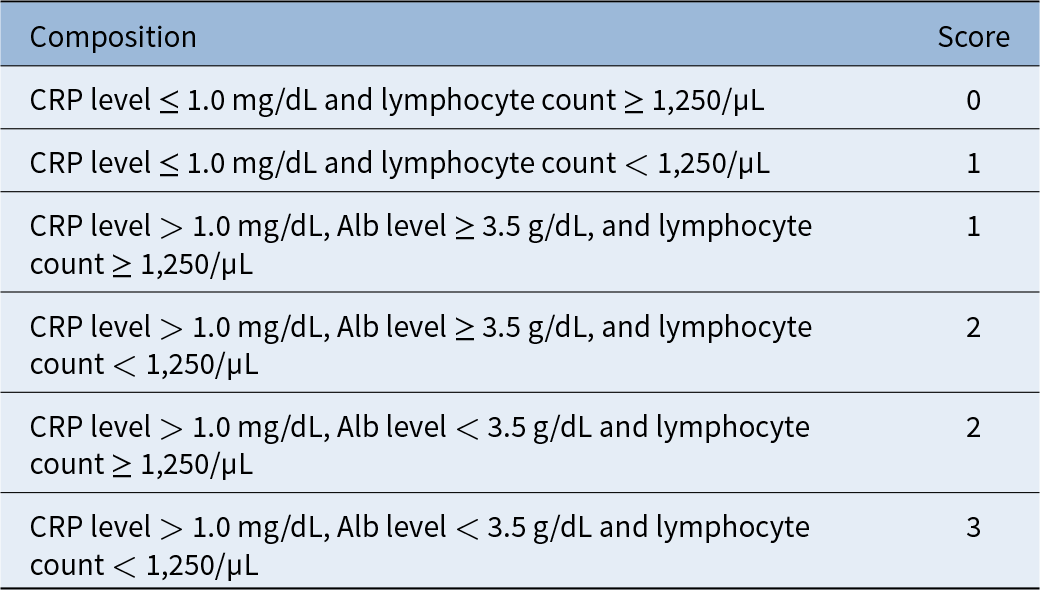
Blood parameters, including serum Alb level, total peripheral lymphocyte count, and CRP level, were assessed before commencing nivolumab treatment. The imGPS was determined following the methodology outlined in a previous study: imGPS equal to 0 (CRP level ≤ 1.0 mg/dL and lymphocyte count ≥ 1,250/µL, regardless of Alb level); imGPS equal to 1 (CRP level ≤ 1.0 mg/dL and lymphocyte count less than 1,250/µL, or CRP level > 1.0 mg/dL and Alb level ≥ 3.5 g/dL and lymphocyte count ≥ 1,250/µL); imGPS equal to 2 (CRP level > 1.0 mg/dL and Alb level ≥ 3.5 g/dL and lymphocyte count less than 1,250/µL, or CRP level > 1.0 mg/dL and Alb level less than 3.5 g/dL and lymphocyte count ≥ 1,250/µL); and imGPS equal to 3 (CRP level > 1.0 mg/dL and Alb level less than 3.5 g/dL and lymphocyte count < 1,250/µL) (Table 1).Reference Terazawa, Ohashi, Shibata, Ishihara and Ogawa29 The imGPS was assessed before the initial dose of nivolumab (pre-imGPS) and four weeks after the first dose of nivolumab (4W-imGPS).
Composition of the imGPS

Alb = albumin; CRP = C-reactive protein; imGPS, immune-modified Glasgow Prognostic Score.
Note that the definitions of imGPS adhered to those outlined in a previous study Link to Ref. 29
Approval for this study was granted by the Institutional Review Board of Gifu University Graduate School of Medicine (study approval number: 2019-037), and the research adhered to the ethical standards outlined in the Declaration of Helsinki.
Statistical analysis
Patient characteristics were presented using the median and range for continuous variables and frequency and percentage for categorical variables. To assess the efficacy of imGPS, multivariate Cox proportional hazards regression analysis was conducted for overall survival (OS) and progression-free survival (PFS). The multivariate Cox proportional hazards model included age, gender, Eastern Cooperative Oncology Group Performance Status (ECOG PS), histopathology, pre-imGPS, and 4W-imGPS as potential predictors. Chi-squared tests were employed to compare the best overall response rates between groups. Kaplan–Meier method was utilised to generate survival curves, and the log-rank test was used to compare each survival curve. The Bonferroni method was used to adjust for multiple comparisons. Significance was determined with a two-sided p less than 0.05. All statistical analyses were performed using GraphPad Prism 7 (GraphPad Software Inc.) or R software version 4.0.3 (http://www.r-project.org/).
Results and analysis
Characteristics of the included studies
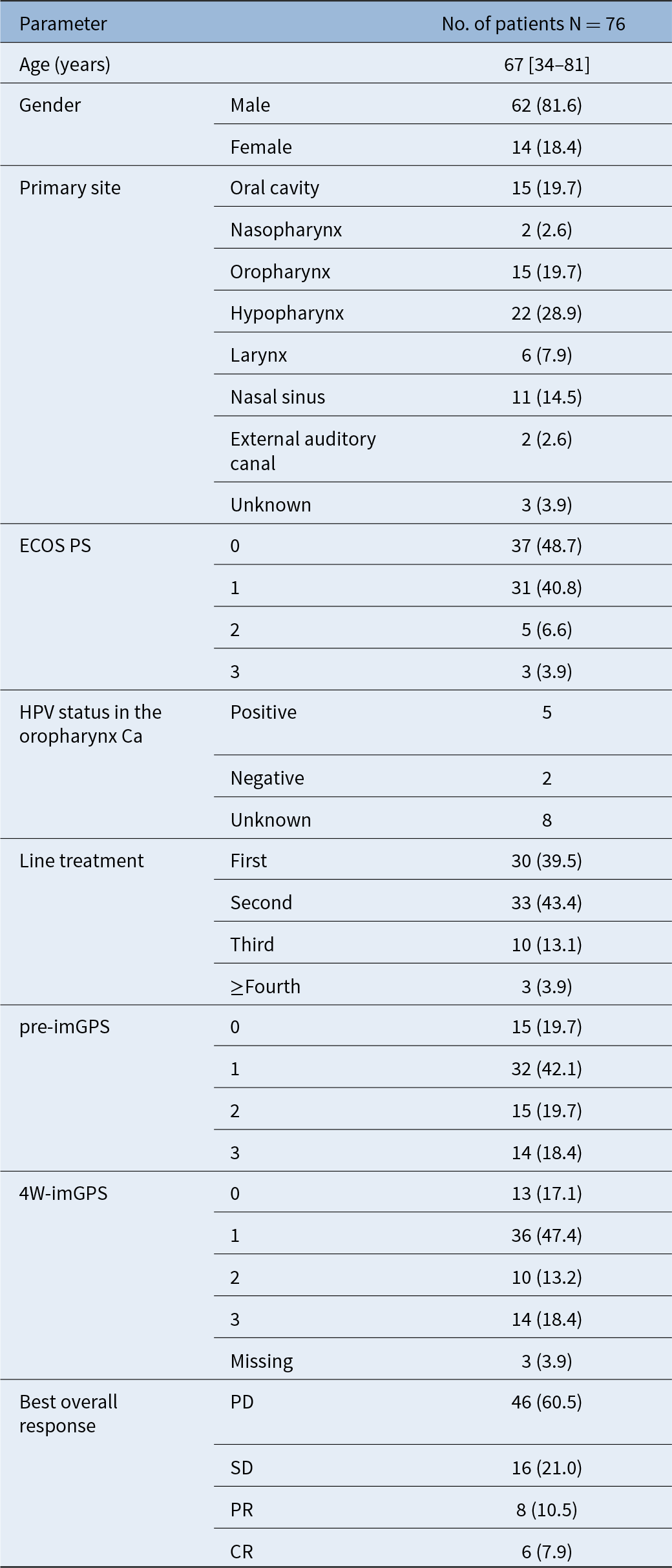
The baseline characteristics of the entire patient cohort are outlined in Table 2. Out of the 76 patients, 62 (81.2%) were male and 14 (18.4%) were female. The median age of the subjects was 67 years (range: 34–81 years). Distribution by cancer type showed that 15 patients (19.7%) had oral cavity cancer, 2 (2.6%) had nasopharyngeal cancer, 15 (19.7%) had oropharyngeal cancer, 22 (28.9%) had hypopharyngeal cancer, 6 (7.9%) had laryngeal cancer, 11 (14.5%) had nasal and sinus cancer, 2 (2.6%) had external auditory canal cancer, and 3 (3.9%) had cancer of unknown primary. Nivolumab was administered as first-line inhibitor therapy in 30 patients (39.5%), as second-line therapy in 33 patients (43.4%), as third-line therapy in 10 patients (13.1%), and as fourth-line or higher therapy in 3 patients (3.9%). None of the patients received immunotherapy as neoadjuvant or adjuvant therapy.
Patient characteristics

Data are expressed as number (percentage) or median [range].
Ca = cancer; CR = complete response; ECOG PS = Eastern Cooperative Oncology Group Performance Status; HPV = human papillomavirus; imGPS, immune-modified Glasgow Prognostic Score; PD = progressive disease; PR = partial response; SD = stable disease.
Patients were categorised based on pre-imGPS as follows: pre-imGPS equal to 0 (n = 20; 22.0%), pre-imGPS equal to 1 (n = 32; 42.1%), pre-imGPS equal to 2 (n = 15; 19.7%), and pre-imGPS equal to 3 (n = 14; 18.4%). Classification according to 4W-imGPS resulted in the following groups: 4W-imGPS equal to 0 (n = 13; 17.1%), 4W-imGPS equal to 1 (n = 36; 47.4%), 4W-imGPS equal to 2 (n = 10; 13.2%), and 4W-imGPS = 3 (n = 14; 18.4%).
Comparison of prognostic values of pre-imGPS and 4W-imGPS in patients with HNSCC
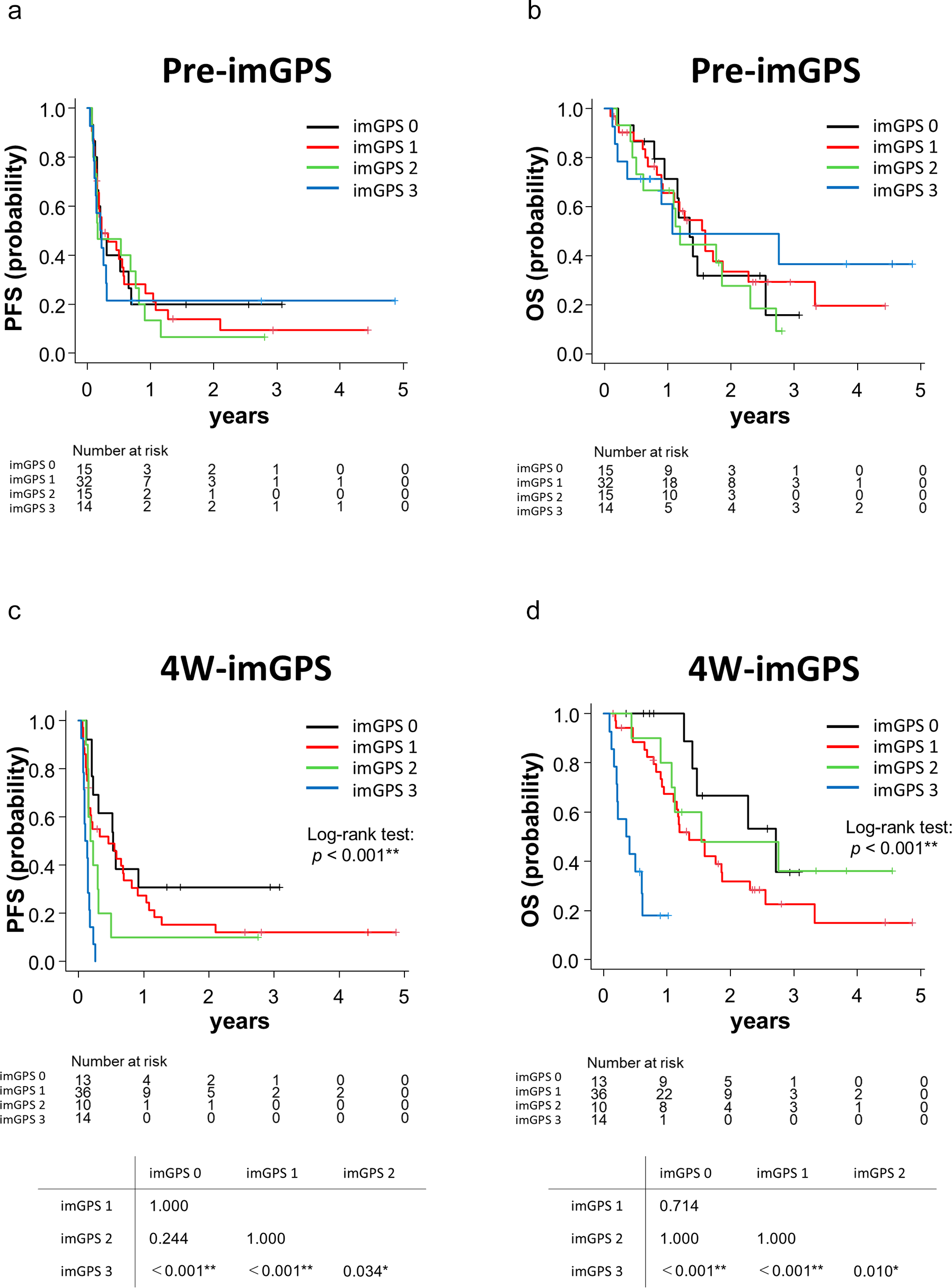
Initially, the prognostic efficacy of pre-imGPS and 4W-imGPS in patients with HNSCC was evaluated through multivariate analysis. Table 3 displays the relationship between survival and clinical factors (age, gender, ECOG PS, histopathology) in patients with HNSCC undergoing nivolumab treatment. Multivariable analysis revealed that 4W-imGPS independently associated with PFS and OS. Specifically, 4W-imGPS emerged as an adverse prognostic factor for PFS (hazard ratio [HR] 2.498, p < 0.001**) and OS (HR 2.492, p < 0.001**). Kaplan–Meier curves and log-rank tests demonstrated no significant differences in PFS and OS among the four pre-imGPS groups (Figures 1A and 1B). However, statistically significant differences in PFS and OS were observed among the four pre-imGPS groups (Figures 1C and 1D; PFS: p < 0.001**, OS: p < 0.001**). PFS was significantly different for the patients with 4W-imGPS equal to 3 compared with either the patients with 4W-imGPS equal to 0 (p < 0.001**), the patients with 4W-imGPS equal to 1 (p < 0.001**), or the patients with 4W-imGPS equal to 2 (p = 0.034*). OS was significantly different for the patients with 4W-imGPS equal to 3 compared with either the patients with 4W-imGPS equal to 0 (p < 0.001**), the patients with 4W-imGPS equal to 1 (p < 0.001**), or the patients with 4W-imGPS equal to 2 (p = 0.010*). Therefore, patients with 4W-imGPS equal to 3 were found to have lower OS and PFS than patients with lower 4W-imGPS (i.e., 4W-imGPS = 0, 4W-imGPS = 1, or 4W-imGPS = 2). Compared to patients with 4W-imGPS equal to 1, patients with 4W-imGPS equal to 2 appeared to have increased OS and decreased PFS. However, patients with 4W-imGPS equal to 2 had no significant difference in OS and PFS compared to patients with 4W-imGPS equal to 0 or 1.
Kaplan–Meier analysis depicting PFS and OS among patients with HNSCC. (a, b) Patients stratified for PFS (a) and OS (b) based on the pre-imGPS model. (c, d) Patients stratified for PFS (c) and OS (d) according to the 4W-imGPS model. p-values were determined using the log-rank test, and the Bonferroni method was used to adjust for multiple comparisons. HNSCC = head and neck squamous cell carcinoma; imGPS = immune-modified Glasgow Prognostic Score; OS = overall survival; PFS = progression-free survival. *p < 0.05, **p < 0.01.

Cox proportional hazards regression analysis

* p < 0.05, **p < 0.001.
CI = confidence interval; ECOG PS = Eastern Cooperative Oncology Group performance status; HR = hazard ratio; imGPS = immune-modified Glasgow prognostic score; OS = overall survival; PFS = progression-free survival.
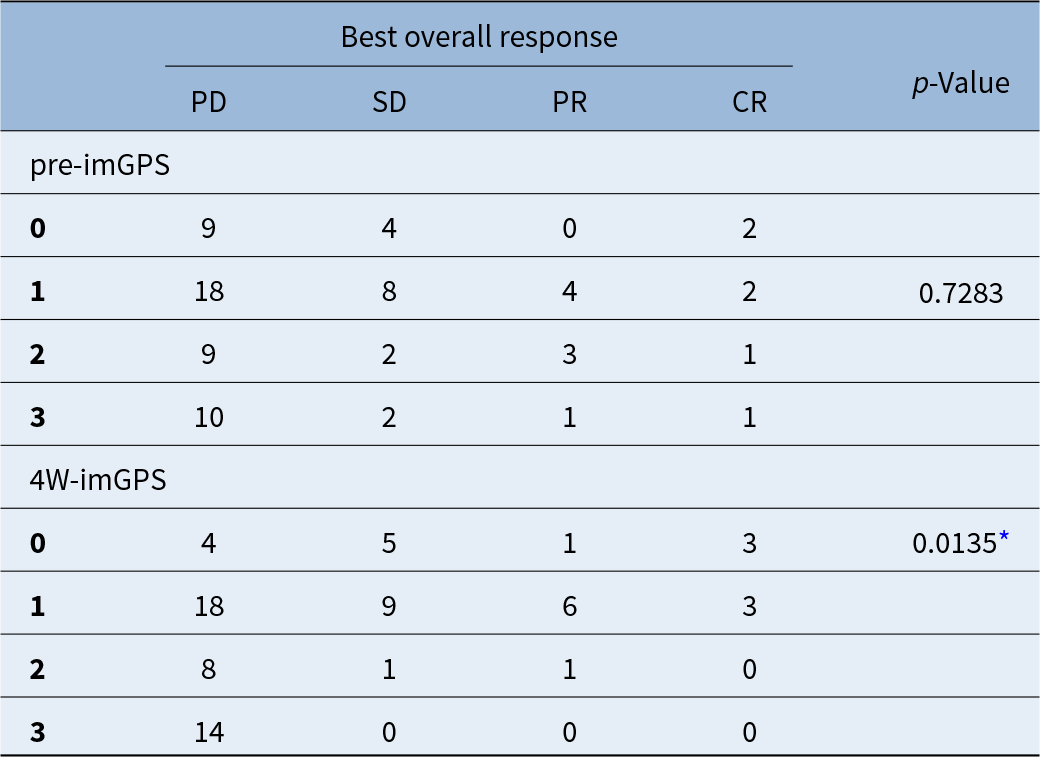
Table 4 presents the best overall response. Notably, while 6 (42.9%) out of 14 patients with partial response (PR) or complete response (CR) exhibited pre-imGPS equal to 0 or 1, a substantial majority of 13 (92.3%) out of 14 patients with PR or CR had 4W-imGPS equal to 0 or 1. Surprisingly, all patients with 4W-imGPS equal to 3 and the majority (80.0%) of patients with 4W-imGPS equal to 2 experienced progressive disease (PD). The association between the best overall response and 4W-imGPS was statistically significant (p = 0.0135*). Importantly, 4W-imGPS emerged as an adverse prognostic factor and was also associated with treatment response, whereas pre-imGPS showed no association with either prognosis or treatment response.
Comparison of the best overall response on imGPS using the chi-squared test

* p < 0.05, **p < 0.001
CR = complete response; imGPS = immune-modified Glasgow Prognostic Score; PD = progressive disease; PR = partial response; SD =stable disease.
Changes after four weeks of nivolumab treatment
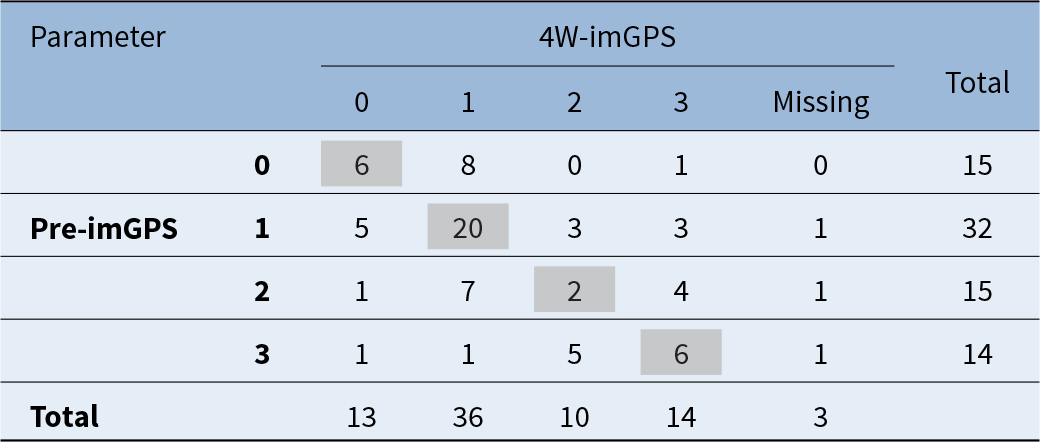
Next, we sought to identify changes occurring before and four weeks after the initiation of nivolumab treatment. Table 5 illustrates the changes in reclassification of patients from pre-imGPS to 4W-imGPS. Among the patients, 34 (46.6%) exhibited no change in imGPS before and four weeks after nivolumab administration, 19 (26.0%) were upgraded, and 20 (27.4%) were downgraded. Over the four weeks, imGPS increased by 1, 2, and 3 points in 15, 3, and 1 patient, respectively. Conversely, imGPS decreased by 1, 2, and 3 points in 17, 2, and 1 patient, respectively. The distribution of patients with upgraded and downgraded imGPS after four weeks was comparable. These results indicate that nivolumab treatment-induced changes in imGPS after four weeks in half of the patients, with the alteration in scores not favouring an increase or decrease.
Change in the number of patients when reclassified from pre-imGPS to 4W-imGPS

4W = four week; imGPS = immune-modified Glasgow Prognostic Score.
Discussion
In this study, the imGPS after four weeks of nivolumab treatment demonstrated association with treatment response and served as a prognostic marker for PFS and OS in patients with HNSCC. Conversely, imGPS before the initial dose of nivolumab treatment exhibited no association with these parameters. Approximately half of the patients experienced a change in imGPS after four weeks of nivolumab treatment. Nivolumab may create an environment conducive to an anti-tumor immune response.
4W-imGPS equal to 3 is considered an adverse prognostic factor for patients with HNSCC treated with nivolumab. However, it is unclear whether 4W-imGPS equal to 2 is also an adverse prognostic factor. Despite the fact that 80.0 per cent of patients with 4W-imGPS equal to 2 experienced PD, patients with 4W-imGPS equal to 2 had no significant difference in OS and PFS compared to patients with 4W-imGPS equal to 0 or 1. In addition, although not statistically significant, patients with 4W-imGPS equal to 2 appeared to have increased OS compared to patients with 4W-imGPS equal to 1. Further studies are needed to determine whether 4W-imGPS equal to 2 is an adverse prognostic factor for patients with HNSCC treated with nivolumab.
The imGPS is a composite index assessing immunity (lymphocyte count), inflammation (CRP), and nutrition (Alb). As lymphocyte counts decrease, CRP increases, and/or Alb decreases, imGPS increases. Chronic inflammation in the tumor microenvironment is known to attenuate anti-tumor immune responses.Reference Ohashi, Akazawa, Aoki, Kuze, Mizuta and Ito30, Reference Zhao, Wu, Yan, Chen, Zhou and Wu31 Changes in CRP levels may mirror changes in the chronic inflammatory status of the tumor site, with elevated CRP indicating increased chronic inflammation. Lymphocytes, encompassing cytotoxic T cells, helper T cells, B cells, and natural killer cells, play crucial roles in various anticancer immune responses. A reduced lymphocyte count suggests fewer immune cells directly involved in the anti-tumor immune response indicating a less likely or absent antitumor immune response. A decline in Alb levels signifies worsening nutritional status, leading to decreased physical fitness and overall condition. Given that nivolumab operates through autologous immune cells, decreased physical fitness or poor general condition may impede a robust antitumor response. Therefore, we posit that nivolumab is less likely to exert its anti-tumor effects in patients with higher imGPS, indicative of compromised immune status, worsening chronic inflammation, and poor nutritional status.
Numerous studies have explored the correlation between alterations in blood test results following the administration of immune checkpoint inhibitors (ICIs) targeting the PD-1/PD-L1 axis and the therapeutic effectiveness of ICIs. In a study involving NSCLC patients, it was observed that those exhibiting an early increase in CRP levels faced a higher risk of recurrence, while those experiencing an early decline had a reduced risk of recurrence.Reference Riedl, Barth, Brueckl, Zeitler, Foris and Mollnar32 Another study in patients with melanoma revealed that patients with lymphocyte counts less than 1,000 at three to six weeks after administering PD-1/PD-L1 ICIs exhibited poorer OS.Reference Nakamura, Kitano, Takahashi, Tsutsumida, Namikawa and Tanese33 Similarly, a study involving patients with HNSCC found that those with lymphocyte counts below 770 at six weeks post PD-1/PD-L1 ICI treatment had inferior PFS.Reference Park, Durbeck and Clark34 Notably, both studies indicated that lymphocyte counts before the initial dose of PD-1/PD-L1 ICIs were not associated with OS or PFS. In a separate study involving NSCLC patients, it was reported that patients with Alb levels less than 3.5 at six weeks after PD-1/PD-L1 ICIs had shorter OS and PFS, although the Alb level before the first dose of PD-1/PD-L1 ICIs showed no association with OS or PFS.Reference Guo, Wei, Patel, Lopez, Grogan and Li35 These reports collectively support the notion that elevated CRP levels, reduced lymphocyte counts, and decreased Alb levels after PD-1/PD-L1 ICI administration are associated with decreased therapeutic efficacy.
The NLR, the ratio of neutrophils to lymphocytes, has been recognised as a valuable prognostic marker in nivolumab treatment across various malignancies.Reference Capone, Giannarelli, Mallardo, Madonna, Festino and Grimaldi24, Reference Yasumatsu, Wakasaki, Hashimoto, Nakashima, Manako and Taura25, Reference Dharmapuri, Özbek, Lin, Sung, Schwartz and Branch36–Reference Simonaggio, Elaidi, Fournier, Fabre, Ferrari and Borchiellini38 Neutrophils are indicative of inflammation, while lymphocytes signify immune activity. Similar to the imGPS, an increased NLR is associated with poor prognosis, suggesting increased chronic inflammation and inactive immunity. Reports align with our perspective, indicating that NLR after nivolumab treatment is a reliable prognostic marker, emphasising the link between increased inflammation, decreased immunity, and prognosis.Reference Yasumatsu, Wakasaki, Hashimoto, Nakashima, Manako and Taura25, Reference Dharmapuri, Özbek, Lin, Sung, Schwartz and Branch36–Reference Simonaggio, Elaidi, Fournier, Fabre, Ferrari and Borchiellini38 However, the clinical utility of NLR is constrained due to the lack of consensus on a standardised cutoff value, hindering its ability to efficiently distinguish patients likely to respond well or poorly to nivolumab. Contrastingly, imGPS, while not optimal for identifying patients likely to respond to nivolumab, excels in identifying those unlikely to respond. In this study, patients with 4W-imGPS equal to 3 exhibited significantly shorter OS and PFS, all displaying PD as the best treatment response. In three key aspects, imGPS suggests superior to NLR as a prognostic marker for nivolumab treatment. First, it evaluates not only inflammation and immunity but also nutritional status as parameters. Second, it provides a clear cutoff value. Third, it efficiently identifies patients unlikely to respond to treatment. As imGPS relies on routine clinical blood tests, it stands out as a straightforward and effective prognostic marker for nivolumab treatment.
This study has some limitations. First, it is a retrospective study. Second, the patients with HNSCC included in the study had diverse origins, and they underwent various types of pretreatments (surgery, radiotherapy, chemoradiotherapy, and chemotherapy) prior to nivolumab, as well as salvage chemotherapy after nivolumab. Third, the mechanism by which nivolumab acts on changes in Alb, CRP, and lymphocyte counts is not clear. Alb, CRP, and lymphocyte counts can be altered by a variety of external factors, and the possibility that they may be altered by other factors cannot be ruled out.
Despite these limitations, the imGPS, a prognostic marker relying on just three routine blood tests, demonstrates potential for predicting the prognosis of patients with HNSCC undergoing nivolumab treatment. Notably, imGPS excels at identifying patients unlikely to respond favourably to nivolumab. In practical clinical scenarios, imGPS proves most beneficial when formulating a treatment strategy for patients with PD during the initial response evaluation to nivolumab. The imGPS offers valuable insights in deciding whether to persist with nivolumab beyond PD or switch to an alternative regimen. Based on the results of this study, a strong recommendation is made to consider switching to another regimen when imGPS reaches 3 at four weeks after nivolumab treatment. Future research aims to verify the effectiveness of imGPS as a prognostic marker across diverse cancer types. Additionally, investigation is planned to assess the utility of imGPS in predicting treatment responses for ICIs other than nivolumab.
• Predictive biomarkers for the prognosis of PD-1/PD-L1 blockade therapy are controversial
• The immune-modified Glasgow Prognostic Score (imGPS), incorporating C-reactive protein, serum albumin levels and lymphocyte count, proves valuable for predicting prognosis in patients with head and neck squamous cell carcinoma undergoing nivolumab treatment
• The imGPS after four weeks (4W-imGPS) of nivolumab treatment associated with treatment response and highest 4W-imGPS (i.e., imGPS = 3) was identified as an adverse prognostic factor for progression-free and overall survival
• The imGPS excels at identifying patients unlikely to respond favorably to nivolumab
Conclusion
The findings indicate the potential of imGPS as a practical tool for predicting prognosis in nivolumab-treated HNSCC patients, offering insights into individuals less likely to benefit from this specific treatment, thus contributing to personalised oncological care.
Acknowledgements
The authors thank all staff of the Department of Otolaryngology-Head and Neck Surgery, Gifu University Hospital, for their contribution to this project. This work was supported by JSPS KAKENHI Grant Number JP20K18307.
Conflict of interest
The authors declare that they have no known competing financial interests or personal relationships that could have appeared to influence the work reported in this paper.
Funding
This work was supported by research grants from JSPS KAKENHI (Grant Numbers JP20K18307).