Children undergoing various short surgical procedures in the intensive care unit, in the operating room, or in the catheterization unit all require effective sedation and analgesia without causing depression of cardiac function and respiratory drive. In many of the procedures, immobility is required. Those with cardiac anomalies are prone to changes of systemic and pulmonary haemodynamic parameters when sedated.Reference Krauss and Green 1 The mixture of midazolam and ketamine is widely used and effective for sedation. The major disadvantage of using this combination is its potential for respiratory and cardiac depression.Reference Da Silva, Brasil, Iglesias, Leao, Aguiar and De Carvalho 2 – Reference Cheuk, Wong and Ma 5 Ketamine has been demonstrated to show hypertension, tachycardia, psychomimetic effects, and prolonged recovery periods as adverse effects. The use of ketamine alone is not optimal in those with congenitally malformed hearts because of the increased incidence of side effects and the prolonged period of recovery.Reference Lebovic, Reich, Steinberg, Vela and Silvay 6 Propofol, therefore, has been preferred, as it has favourable anaesthetic properties, including smooth induction and rapid recovery. This agent is reported to decrease the mean arterial pressure, and consequently the systemic vascular resistance, which may cause alterations in heart rate and arterial saturations of oxygen in children with right-to-left shunting.Reference Williams, Jones, Hanson and Morray 7 , Reference Oklu, Bulutcu, Yalcın, Ozbek, Cakalı and Bayındır 8 In this study, therefore, our aim was to compare the intravenous use of the mixture of midazolam and ketamine as opposed to propofol during procedural sedation in children already given intramuscular midazolam for preparation. We evaluated the effects of the sedative agents on the haemodynamic data during any agitation over the period of recovery, as well as observing all adverse effects.
Methods
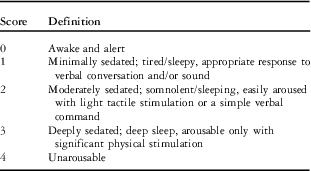
In a prospective and randomized clinical trial, we divided our patients into a group of 72 children sedated with a mixture of midazolam and ketamine as opposed to 46 receiving propofol. The study, completed over a period of 2 years, was granted approval from our institutional review committee, and we obtained verbal and written informed parental consent. The total number of patients was 128, and ages in the groups were from 6 months to 16 years. All patients were in the second or third categories for physical state as set out by the American Society of Anesthesiologists, and all had been scheduled for cardiac catheterization under sedation. The criterions for exclusion included abnormalities in the airways, intracranial hypertension, glaucoma, hyperthyroidism, severe respiratory disease, history of psychosis, children with acute or chronic alteration in mental state, known adverse reaction to the drugs used in the study, and deafness. All patients were randomly assigned into the groups using the closed-envelope method. The data collected included heart rate, non-invasive systolic arterial pressure, respiratory rate, arterial saturations of oxygen, and sedation as scored in the system devised by the University of Michigan. Values were collected at baseline, after induction and every 15 minutes thereafter. The baseline was taken as the time the child was given midazolam with atropine intramuscularly route as a premedication, this being prior to the administration of sedation. All data was collected non-invasively. In cyanotic patients, we evaluated also the relation between the haemodynamic data and peripheral arterial saturations of oxygen. The total amount of sedatives in milligram per kilogram per hour were recorded, as well as awakening times and adverse effects. We scored the level of sedation and analgesia as proposed in the University of Michigan scale every 15 minutes (Table 1). During procedural sedation and analgesia, the sedative agents were titrated to maintain a depression of consciousness of the child so that he or she could not easily be aroused, but remained able to respond purposefully to painful stimulation. This represents scores of 2 to 4 in the system devised at the University of Michigan.Reference Malviya, Voepel-Lewis, Tait, Merkel, Tremper and Naughton 9
The scale for assessing sedation as developed at the University of Michigan.

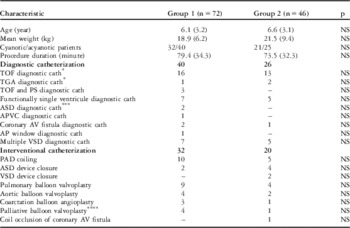
The demographic data, cardiac diagnoses, and types of intervention are summarized in Table 2. All patients were fasted for 4 to 6 hours before the procedure, and were premedicated on the ward 30 to 45 minutes before the procedure. In all procedures, we administered midazolam at 0.15 milligram per kilogram along with atropine at 0.02 milligram per kilogram intramuscularly as premedication. Before the start of the procedure, we placed an intravenous line and started an infusion of onethird saline solution in all patients. The femoral cutaneous area was anaesthetized locally with 1 to 4 millilitres of 1 percent lidocaine. Patients were fully monitored and observed by an anaesthesiologist trained in advanced paediatric life support during the procedure, and in the recovery room, until they were fully awake. Patients with severe hypoxia prior to the initiation of the procedure, and in case of a change in arterial saturation of oxygen of more than five points, received oxygen at 3 to 4 litres per minute via nasal cannulas. We recorded any decrease if saturation of oxygen of more than 5 from the initial value, and changes greater than 20% in systolic arterial pressure and heart rate. Tachycardia was defined as a heart rate faster than 160 per minute in children below 1 year, faster than 140 per minute in children aged from 1 to 6 years, and faster than 120 per minute in children older than 6 years.
Background characteristics and types of procedures.

*Pulmonary atresia and DORV with pulmonary stenosis included, **DORV with transposition included, ***Large ASD not available for device closure, ****Pulmonary valvoplasty for cyanotic patients, cath: catheterization; TOF: tetralogy of Fallot; TOF with PA: tetralogy of Fallot with pulmonary atresia; TGA: transposition; VSD: ventricular septal defect; PS: pulmonary stenosis; ASD: atrial septal defect; ADVC: aorta ductal venous conduit; AV: atrioventricular; AP: aortopulmonary; PAD: patent arterial duct.
In those given midazolam and ketamine, repeat boluses of midazolam of 0.05 milligram per kilogram were given at intervals of 10 to 20 minutes if necessary. Depending on the scores in the scale of sedation, ketamine at doses of 1 milligram per kilogram was added, and repeated at a dose of 0.5 milligram per kilogram or 1 milligram per kilogram as necessary. The drugs were administered to the same level of sedation in both groups. In general, children weighing up to 20 kilogram received 0.1 milligram per kilogram of midazolam up to a maximum dose of 2 milligram, followed by an initial dose of 1.0 milligram per kilogram of ketamine. The maximum total dose for midazolam was 0.3 milligram per kilogram, and for ketamine was 6 milligram per kilogram.Reference Parker, Mahan, Giugliano and Parker 4
Propofol is available in Turkey as Diprivan® (Zeneca, USA) in 20 millilitre ampules, as well as 50 millilitre vials. The emulsion was diluted with 5 percent dextrose to a concentration of 5 milligrams per millilitre. Propofol was administered as an induction dose of 1 milligram per kilogram. If needed, half of this dose was administered after an interval of 5 minutes. The dose was titrated to immobility during preparation of the groin up to 2 milligram per kilogram.Reference Williams, Jones, Hanson and Morray 7 A continuous infusion was started at 100 micrograms per kilogram per minute. If movement occurred, a bolus of one-half the induction dose was administered, and the rate of infusion was increased by half.
Recovery from sedation, as measured by level of awareness and/or response to verbal stimulation, was assessed using the scoring system established by Steward, anticipating a score of 6 or higher at 15, 30, and 45 minutes after the completion of the procedure.Reference Steward 10
Statistical analysis
Statistical analysis of the data was performed using SPSS software (version 13.0; SPSS, Inc., Chicago, IL, USA). Background characteristics and haemodynamic data were compared between groups by use of Student’s unpaired t test. Incidences in the groups were determined using the Chi-square test. Differences between values at baseline and 30 minutes after administration of sedation, variables within groups, and changes in variables from baseline to 120 minutes, were analyzed using the paired Student t test and ANOVA, respectively. The median values of the score for sedation established at the University of Michigan were compared using the Mann-Whitney U test. The results are presented as mean and standard deviations. A probability value of p less than 0.05 was considered significant.
Results
Characteristics of subjects
There were 128 patients, 52 males and 74 females, with a mean age of 6.4 years, and standard deviation of 3.1 years. The ages ranged from 6 months to 16 years. Mean weight was 20.2 kilograms, with standard deviation of 7.8 kilograms, and a range from 2.1 to 52 kilograms. In those receiving midazolam and ketamine, the age ranged from 6 months to 12 years, and weight from 6 to 31 kilograms. In those randomised to propofol, the age ranged from 12 months to 16 years, and weight from 10 to 48 kilograms. The catheterizations themselves involved 52 interventional and 66 diagnostic procedures. The demographic data, cardiac diagnoses and types of interventions are summarized in Table 2. There were no statistically significant differences between the two groups regarding age (p equals to 0.34)), weight (p equals to 0.13), whether the procedure was diagnostic or interventional (p equals to 0.36), or the mean duration of the procedures (p equals to 0.42). There were no deaths in either group.
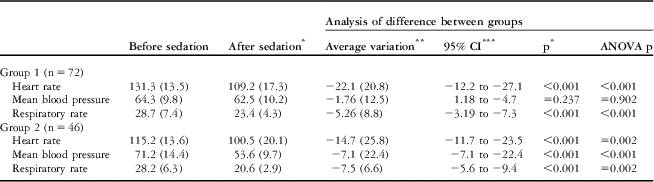
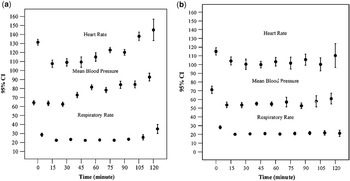
In those randomized to receive midazolam and ketamine, mean systemic arterial pressures before and 30 minutes after sedation were 64.3, with standard deviation of 9.8, and 62.5, with standard deviation of 10.2 millimetres of mercury (p equals to 0.237), and heart rates were 131.3, with deviation of 13.5, and 109.2, with deviation of 17.3 beats per minute (p less than 0.001). In those randomized to propofol, the comparable values were 71.2, with deviation of 14.4, and 53.6 with deviation of 9.7 millimetres of mercury (p less than 0.001), and 115.2 with deviation of 13.6, and 100.5 with deviation of 20.1 beats per minute (p less than 0.01), respectively (Table 3).
Comparison of parameters for all patients obtained before and half an hour after the administration of sedative agents.

*30 minutes after induction of sedative agent.
**Average variation of heart rate (beats/min); mean blood pressure (mmHg) and respiratory rate (breaths/min) for both groups before and after sedation.
***Paired t test with confidence intervals.
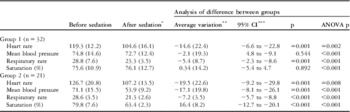
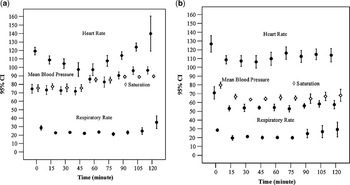
In cyanotic patients randomized to receive midazolam and ketamine, the same values were 74.8, with standard deviation of 14.6, and 72.7 with deviation of 12.4 millimetres of mercury (p equals to 0.544), and 119.3, with standard deviation of 12.2, and 104.6 with deviation of 16.1 beats per minute (p equals to 0.001). In those receiving propofol, values were 71.1, with standard deviation of 15.5, and 53.9 with deviation of 9.2 millimetres of mercury (p equals to 0.001), and 126.7, with standard deviation of 20.8, and 107.2 with deviation of 13.5 beats per minute (p equals to 0.001 – Table 4). Cyanotic patients randomized to receive propofol showed a significant drop in arterial saturation from 79.8, with deviation of 7.6, to 64.3 with deviation of 2.3%, (p less than 0.001) whereas in those sedated with midazolam and ketamine there was an increase in saturation from 75.6, with standard deviation of 10.9, to 76.1 with deviation of 12.7% (p equals to 0.892 – Table 4). Those sedated with midazolam and ketamine group were more agitated during recovery, with 7% showing this feature, with 13% suffering emesis, compared to none being agitated when sedated with propofol, and only 3% suffering emesis amongst those aged 6 years or older (p equals to 0.04). All side effects, including agitation during recovery, emesis, risk of bronchospasm, or stridor were similar when comparing children of all ages (p less than 0.05) (Table 5).
Comparison of parameters of patients with cyanotic heart diseases obtained before and half an hour after the administration of sedative agents.

*30 minutes after induction of sedative agent.
**Average variation of heart rate (beats/min); mean blood pressure (mmHg) and respiratory rate (breaths/min) for both groups before and after sedation.
***Paired t test with confidence intervals.
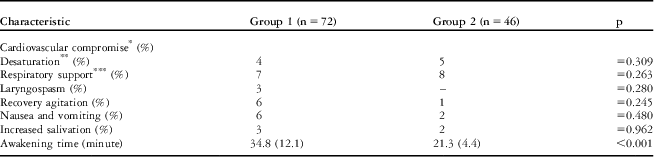
Comparison of the adverse effects and the awakening time.

*Cardiovascular compromise includes cardiac arrest, cardiac rhythm disturbances, and haemodynamic instability that persists and requires cardiovascular therapy.
**Desaturation = SpO2; peripheral oxygen saturation decrease >5 point compared with baseline.
***Respiratory support includes mask ventilation, laryngeal mask application or intubation.
The total dose of midazolam was a mean of 2.69 milligrams per kilogram per hour, with standard deviation of 0.66, and that of ketamine was 1.88, with deviation of 0.53 when calculated for children of all ages. The comparable dose of propofol was 10.8, with standard deviation of 2.8. This dose calculated in milligrams per kilogram per hour is equivalent to 180 micrograms per kilogram per minute.
Period of awakening
The children exhibited a score of 6 or higher in the system devised by Steward scoring for significantly longer when sedated with midazolam and ketamine than when given propofol (p less than 0.01). The total doses for each sedative agent, adverse effects, and time to awakening are presented in Table 5.
Each patient was assessed every 15 minutes using the scoring system devised at the University of Michigan to assess depth of sedation, and a median value for each group before and after sedation was calculated. The values that are in the range of 2 to 4 were calculated for each group, and there was no statistically significant difference between the groups.
Discussion
By comparing mean arterial pressure, heart rate, respiratory rate, and arterial saturations in children being sedated for catheterization procedures, we have obtained valuable data relating to the haemodynamic effects of propofol as compared to the mixture of midazolam and ketamine. The parameters evaluated are vital simple signs that are required to be monitored during every sedation procedure according to well-accepted guidelines. 11 By evaluating the values obtained using 95 percent confidence intervals, we have demonstrated the effects of these agents in children at various ages, ranging from 6 months to 16 years of age. We studied larger groups than previously explored.Reference Lebovic, Reich, Steinberg, Vela and Silvay 6 – Reference Oklu, Bulutcu, Yalcın, Ozbek, Cakalı and Bayındır 8 , Reference Kogan, Efrat, Katz and Vidne 12 – Reference Miller, Levy and Patel 15 By using these simple vital signs, we showed a significant decrease in mean arterial pressure for those sedated with propofol when compared to those randomized to midazolam and ketamine. Heart rate and respiratory rate were both significantly decreased with sedation. The parameters were collected before and every 15 minutes whether sedative agents were administered or not; the Figures 1 and 2 show that there was a decrease in heart rate and respiratory rate with sedation at around 30 minutes which was attributed to the peak effects of sedatives. At this dynamic peak, the medication achieves its greatest haemodynamic effects, as some drugs accumulate in the body. Another reason for choosing parameters measured at 30 minutes after sedation is that all of the procedures undertaken during this study had durations of greater than 30, but longer durations are not representative for all patients. In Figure 1, we show that blood pressure remained stable during the first half hour in those sedated with midazolam and ketamine, tended to rise between the period of 30 and 45 minutes, and then remained elevated. Heart rate was also increased well after 60 minutes during the procedure. The difference in mean arterial pressure before and after sedation with midazolam and ketamine also proved to be statistically significant (Fig. 1). In our opinion, this persistent rise of mean arterial pressure could be overcome by addition of another sedative at low doses, possibly propofol, rather than increasing the doses of midazolam and ketamine, which would increase the chance of respiratory side effects.
The mean heart rate, blood pressure, respiratory rate and changes in saturation are shown during the period of sedation for all patients receiving midazolam and ketamine (a; left) as opposed to those randomized to receive propofol (b; right). Values shown along with 95% confidence intervals (CI).

The mean heart rate, blood pressure, respiratory rate and changes in saturation are shown during the period of sedation of cyanotic patients receiving midazolam and ketamine (a; left) as compared to cyanotic patients randomized to receive propofol (b; right). Values shown along with 95% confidence intervals (CI).

For this reason, recent studies have focused on combining propofol and ketamine at lower doses to facilitate the haemodynamic stability, and to prevent adverse side effects that may occur when either medication is used individually in larger doses.Reference Tosun, Akin, Guler, Esmaoglu and Boyaci 14 , Reference Miller, Levy and Patel 15 Our data revealed that, for cyanotic patients, the mean arterial pressure and saturations of oxygen remained stable throughout the procedure, with a mean rise in blood pressure of around 10 to 20% (Fig. 2). In contrast, we found a mean decrease of 10 to 20% in mean arterial pressure after induction of the patients sedated with propofol, this fall persisting throughout the procedure, along with the decrease in heart rate and possible venodilation, the latter known to cause a decrease in systemic vascular resistance,Reference Williams, Jones, Hanson and Morray 7 , Reference Oklu, Bulutcu, Yalcın, Ozbek, Cakalı and Bayındır 8 and in turn dose-dependent myocardial depression and decrease in arterial saturation. Taken together, such an unstable haemodynamic state could easily threaten the life of a small infant with a congenitally malformed heart. Our experience suggests, therefore, that propofol in isolation is not a good choice for sedating patients with right-to-left shunts and cyanosis. Combining propofol with ketamine at lower doses, with supplementation using midazolam, can provide better haemodynamic stability, albeit that such a combination needs investigation in a larger group of patients with congenitally malformed hearts.
The other issue in the use of propofol in small infants is that it may be associated with metabolic acidosis, increased incidence of apneoa, the propofol infusion syndromeReference Miller, Levy and Patel 15 . It also has the disadvantage of lacking any analgesic effects. Ketamine is contraindicated in children aged less than 3 months, and is relatively contraindicated in those aged less than one year because of hypersalivation and the increased risk of adverse respiratory effects, such as laryngospasm, bronchospasm, nausea, and vomiting. This agent can also delay recovery, as well as causing delirium, excessive salivation, and potentially increasing intracranial pressure.Reference Doyle and Coletti 16 Gayatri and colleaguesReference Gayatri, Suneel and Sinha 17 recently compared the combination of propofol, at 25 micrograms per minute, and ketamine at 25 micrograms per minute with the combination of propofol at the same dose and ketamine at half the dose in patients undergoing cardiac catheterization. The total dose of ketamine used decreased significantly, along with time to wakening, confirming the additive effects of propofol and ketamine, and providing data that the two drugs counterbalance each other’s haemodynamic effects. As yet, however, there is no consensus on the optimal doses of propofol and ketamine when used in combination for children, especially in those undergoing cardiac catheterization.Reference Kogan, Efrat, Katz and Vidne 12 – Reference Miller, Levy and Patel 15 Further studies are warranted to determine the optimal dosage in children with right-to-left shunting so as to prevent haemodynamic alterations and respiratory depression.
Most of the pharmacologic agents used for procedural sedation in children, including propofol, midazolam and ketamine, may produce respiratory depression. Midazolam used alone and in high doses, for example, is associated with a high incidence of respiratory depression. Ketamine is a dissociative analgesic, having properties of cortical and limbic dissociation, bronchodilation, and airway patency when compared to benzodiazepines. When combined with midazolam, it is reported to prevent dysphoric reactions, reduce the total dose required, and lessen the risk of respiratory depression. Midazolam in turn is known to abate the associated cardiovascular effects of ketamine.
There are many studies of safe and effective combined use of midazolam and ketamine, for example the recent study of Da Silva and colleagues.Reference Da Silva, Brasil, Iglesias, Leao, Aguiar and De Carvalho 2 In our study, we did not divide patients according to their ages, so we are unable to compare the total doses of midazolam and ketamine to those used in several other studies,Reference Da Silva, Brasil, Iglesias, Leao, Aguiar and De Carvalho 2 , Reference Parker, Mahan, Giugliano and Parker 4 , Reference Cheuk, Wong and Ma 5 including our own recent study further exploring sedation during cardiac catheterization in children.Reference Baysal, Polat, Yalcin and Celebi 18 This latter study, nonetheless, confirmed the opinions of others,Reference Kogan, Efrat, Katz and Vidne 12 , Reference Wheeler, Vaux and Ponaman 19 who reported that propofol could be safely and effectively administered in children at a dose of 179 microgram per kilogram per minute.
In conclusion, our own study, conducted by assessing simple vital signs such as arterial pressure, heart and respiratory rate, and peripheral saturations of oxygen, shows that use of propofol as a sedative agent in children undergoing catheterization with right-to-left intracardiac shunting causes a decrease in mean arterial pressure and systemic vascular resistance which may lead to a decrease in the ratio of pulmonary to systemic flows and hence arterial desaturation. Ketamine administered together with midazolam produces a more stable haemodynamic situation in children with congenitally malformed hearts, albeit that use of ketamine, because of its side effects, is limited in children such as those less than 12 months old and those aged from 6 to 16 years. During cardiac catheterizations, therefore, all physicians should be aware of the side effects of sedative agents.
Acknowledgement
Support was provided solely from institutional sources.