Introduction
Human stature has an important influence on individual life chances and success in education (Bielicki & Charzewski, Reference Bielicki and Charzewski1983; Bielicki & Waliszko, Reference Bielicki and Waliszko1992; Szklarska et al., Reference Szklarska, Koziel, Bielicki and Malina2007), the labour market (Strauss & Thomas, Reference Strauss and Thomas1998; Schultz, Reference Schultz2002; Judge & Cable, Reference Judge and Cable2004; Case & Paxson, Reference Case and Paxson2008), political election (McCann, Reference McCann2001), migration and residence (Krzyżanowska & Borysławski, Reference Krzyżanowska and Borysławski2008; Krzyżanowska & Umławska, Reference Krzyżanowska and Umławska2010), and marriage or sexual union (Beigel, Reference Beigel1954; Murray, Reference Murray2000; Pawlowski et al., Reference Pawlowski, Dunbar and Lipowicz2000). As it is related to nutrition intake, exposure to infectious diseases and access to medical facilities, height is often used as an indicator of health, and as such it also entails wealth, social status and individual welfare (Eveleth & Tanner, Reference Eveleth and Tanner1990; WHO, 1995; Alter, Reference Alter2004). It is generally understood, for example, that the rising average height of the Chinese population in mainland China, Hong Kong and Taiwan reflects the improvement in living standard in recent decades (Huang & Malina, Reference Huang and Malina1995; Leung et al., Reference Leung, Lau, Tse and Oppenheimer1996; Morgan, Reference Morgan2000).
Height is known to be related to genetic endowments, environment exposure and nutritional intake. Recent studies have shown significant relationships between month of birth and height. Inconsistent findings in height and timing of birth and inconsistencies across countries in the northern and southern hemispheres have nevertheless led to increasing speculation on the month-of-birth effect. Some suggest that the birth-month effect on height may be related to cyclical patterns of exposure to sunshine (Weber et al., Reference Weber, Prossinger and Seidler1998), or to extraterrestrial factors like the varied distance of the globe to the sun in different months of the year (Henneberg & Louw, Reference Henneberg and Louw1990). Studies with consideration of social factors have demonstrated that the month-of-birth effect continues to exist when socioeconomic variables are controlled for (Banegas et al., Reference Banegas, Rodriguez-Artalejo, Graciani, De La Cruz and Gutierrez-Fisac2001; Kościński et al., Reference Kościński, Kozłowska-Rajewicz, Górecki, Kamyczek and Różycki2009). Nevertheless, these studies have been hampered by the use of a limited number of socioeconomic variables and relying on conventional tests of hypotheses or ordinary least square (OLS) regression analysis, which may obscure the birth-month effect on height by unobserved family and community factors. The present paper endeavours to solve those problems with application of household fixed and random effects models in the analysis of a unique sibling dataset collected in rural China.
Contending explanations of effects on height
Based on conscript data of adult Austrian men, Breitinger (Reference Breitinger, Töro, Szabady, Nemeskeri and Eiben1972) discovered that men born from January to May were, on average, taller than those born from August to December. A number of subsequent studies have substantiated his findings. Weber et al. (Reference Weber, Prossinger and Seidler1998), for example, based on information from a large population of military men in Austria, found a yearly sinusoidal variation in body height of 18-year-old adult men on birth month, with maxima in spring and minima in autumn, differing by 0.6 cm. Similarly, based on a representative sample of adult persons in Spain, Banegas and others (Reference Banegas, Rodriguez-Artalejo, Graciani, De La Cruz and Gutierrez-Fisac2001) demonstrated that male adults born in summer (June–July) were, on average, 1.7 cm taller than their counterparts born in winter (December–January). With conscript data of Swedish men, Kihlbom & Johansson (Reference Kihlbom and Johansson2004) also showed that those born from March to May were, on average, taller than those born in November and December.
Studies of children yield conflicting results. With data on school children in Poland, Kościński et al. (Reference Kościński, Krenz-Niedbala and Kozlowska-Rajewicz2004) found that those born from October to March were taller than those born from April to September. But using data on Canadian school children, Shephard et al. (Reference Shephard, Lavallee, Jequier, Labarre, Volle and Rajic1979) found that boys born from July to September were taller than those born April to July. Meanwhile, data from South Africa indicated that children born from August to January were taller than those born from February to July (Henneberg & Louw, Reference Henneberg and Louw1990). Xu and colleagues' (Reference Xu, Wang, Guo, Cheung and Karlberg2001) study of Chinese infants indicated that at one month of age, those born from May to July were 2 cm taller than those born from November to February; this difference in average length was reduced to 0.7 cm at 24 months of age.
The month-of-birth effect on height does not necessarily mean that birth month per se is causal for human growth. Rather, it could be explained by a combination of biological, environmental and socioeconomic factors interacting in complex ways. Biologists, for example, believe that environmental factors, such as sunshine and temperature, which vary according to cyclical seasons, may account for it. Weber et al. (Reference Weber, Prossinger and Seidler1998) have postulated that periodicity of height by months is related to influences of seasonal photic input, known to regulate body functions and growth in mammals, especially during the three months before and after birth. However, the inconsistency in findings across countries within the same hemisphere and across the northern and southern hemispheres creates the suspicion that extraterrestrial factors affect growth in a similar way at the same time over the entire planet. As Henneberg & Louw (Reference Henneberg and Louw1990) have indicated, the birth-month effect on height may be related to the ellipsoid shape of the orbit of the planet: the planet is closer to the sun in December/January than in June/July.
Other studies have investigated whether the month-of-birth effect exists when socioeconomic variables are considered. Studies by Kihlbom & Johansson (Reference Kihlbom and Johansson2004), with data from 18- and 19-year-old men, showed that month of birth had an independent effect on height, but the effect was smaller than that of the father's socioeconomic status. Banegas et al.'s (Reference Banegas, Rodriguez-Artalejo, Graciani, De La Cruz and Gutierrez-Fisac2001) analysis of Spanish men, Henneberg & Louw's (Reference Henneberg and Louw1993) study of rural South African school children, and Kościński et al.'s (Reference Kościński, Krenz-Niedbala and Kozlowska-Rajewicz2004) study of Polish school children also showed that the effect was more pronounced in groups of high socioeconomic status. Those studies, however, did not pursue further the seasonality of births that may be related to social behavioural factors and human growth. Existing studies with conventional regression analysis do not allow rigorous examination of unobserved factors (e.g. parental genetic makeup) that account for height. This study solves the problem by applying the household fixed effects and random effects models to the analysis of the Chinese sibling data.
Methods
Data
The data used in the analysis are from a multi-stage sampling survey conducted in summer 2005 for a larger research project on family dynamics in rural China. The survey included 600 households from 30 villages in three counties in Hebei. It asked parents of 50- to 69-year-olds about their family background, marriage and birth, and information on the height and date of birth of their children. The analysis includes 833 adult men aged 18–52 born during 1953–1987. The lower age limit of 18 years is selected with the consideration that men of 18 are close to their final body height (Hulanicka & Kotlarz, Reference Hulanicka and Kotlarz1983).
Briefly, the three counties under investigation are Fengrun, Zhaoxian and Chicheng. Fengrun (39° 82′ N, 118° 13′ E) is located in the north-east of Hebei province. Although rural, it is a suburb of Tangshan city, and the richest of the three counties. Zhaoxian (37° 76′ N, 114° 78′ E) is in the middle of the north China plain in Hebei province. It is a traditional agricultural county, with more per capita land ownership than the other two counties. Chicheng (40° 92′ N, 115° 82′ E) is in the mountainous area in the north-west of the province. With only one crop a year, it has the lowest per capita income of the three counties and is one of China's poorest counties.
Measurements
The dependent variable – height of adult children – was reported by parents, or by children who were present during the survey. Existing studies on a variety of populations indicate that self-reported height is generally reliable (Himes & Roche, Reference Himes and Roche1982; Stewart, Reference Stewart1982; Zhang et al., Reference Zhang, Feldblum and Fortney1993; Nakamura et al., Reference Nakamura, Hoshino, Kodama and Yamamoto1999; Wada et al., Reference Wada, Tamakoshi, Tsunekawa, Otsuka, Zhang and Murata2005; Dahl et al., Reference Dahl, Hassing, Fransson and Pedersen2010). Nevertheless, the report error in the dependent variable allows a reliable analysis with consistent estimators (Wooldridge, Reference Wooldridge2002, pp. 71–72). Further, the enumerator dummies are included in the analysis to eliminate report errors. The household fixed effect and random effect models have also the advantage of minimizing the report error problems. Parents may not accurately report the height of their children. It is, however, not a problem for parents to discern the relative height of their children. The household fixed and random effects models can capture those relative differences in estimation of the birth-month effect on height.
The key independent variables additional to months of birth, as elaborated below, concern specific family background and parental characteristics within the Chinese context that have a potential effect on human growth. They include household registration status, household economy and family class origin.
Household registration status
The household registration or hukou system, which defines the population into agricultural and non-agricultural statuses, was introduced in China in 1958. The major function of household registration was to differentiate access to food, medical services, housing, education, work and pension, with the bias of benefits toward non-agricultural household registration holders (Cheng & Selden, Reference Cheng and Selden1994; Wu & Treiman, Reference Wu and Treiman2004, Reference Wu and Treiman2007).
Household economy
Household economy is derived from the following question on the interviewee's subjective assessment of his/her household economic situation at the time of marriage: ‘Which category did your household economic situation belong in the village at the time of your marriage?’ Responses were the following five categories: rich (top 10 percentile), upper middle (top 25 percentile net of the first category), average, lower middle (below 75 percentile net of the poor category) and poor (the lowest 10 percentile). The rich and upper middle is regrouped into one category because of the small sample size in the rich category.
Family class origin
The communist revolution resulted in the redistribution of land and family properties during the land reforms of the late 1940s and early 1950s. Redistribution was based on class categories assigned mainly according to the household economic situation prior to the revolution. These included ‘landlords’ and ‘rich peasants’, ‘middle peasants’ and ‘upper middle peasants’, and ‘poor peasants’ and ‘lower middle peasants’. According to official policies, poor peasants essentially had no or little land, renting land from landlords or rich peasants, or working as hired labourers; middle peasants had some land and/or employed some labour; and landlords and rich peasants occupied a large amount of land and supposedly lived by exploiting the labour of poor peasants (Crook & Crook, Reference Crook and Crook1979, pp. 47–48).
The father's class category was thus more political than economic during the Mao era (1949–1976). It is included in the analysis mainly because it may represent the differential cumulative family economic situation before the communist revolution, which may impact on growth of their children after the revolution. The differential access to resources and social mobility opportunities in education and work, etc., during the Mao era may also impact on their children's growth.
Descriptive statistics
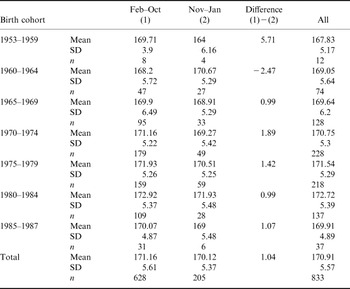
The overall height in adult men shows an upward trend over the birth cohorts. As Table 1 indicates, the younger birth cohorts have grown taller, except the most recent cohort born from 1985 to 1987, which includes young men who may have continued to grow after the age of 18. The variations in height are greatest among those born in the 1960s. The variations become smaller for the younger birth cohorts.
Height and differences in height (cm) of those born in winter and non-winter months, by birth cohort

The 1953–1959 birth cohort is aggregated for 7 years due to small sample size. The 1985–1987 birth cohort is aggregated for 3 years because of the sample cut-off at 18 years of age at the time of the survey. The other cohorts all consist of 5-year age groups.
Comparing the average height for men born in winter months (November to January) and those born in the rest of the year (February to October), those born in winter are, on average, 1.04 cm shorter than those born in other seasons. The average difference in height between the winter- and non-winter-born ranges from about 1.0 cm to 1.9 cm for various birth cohorts, except those born in the 1950s (due to small sample size) and those born in 1960–1964 (Table 1).
The 1960–1964 birth cohort in fact shows the opposite pattern: those born in winter are, on average, 2.47 cm taller than those born during the rest of the year. This anomalous birth month/height pattern might be a result of the adverse conditions during or shortly after the 1959–1961 famine. For example, studies of North Korea famine have demonstrated that Koreans born during the famine of the 1990s resulted in an anomalous birth month/height pattern that is not consistent with the pattern found for North Koreans born in non-famine years, or for South Koreans; this may be related to the disruption caused by the adverse living conditions during the famine (Schwekendiek, Reference Schwekendiek2009; Schwekendiek et al., Reference Schwekendiek, Pak and Kim2009). In China, the anomalous birth month/height pattern reported here may be related to stunting effects of famine on growth (Chen & Zhou, Reference Chen and Zhou2007; Gørgens et al., Reference Gørgens, Meng and Vaithianathan2007; Meng & Qian, Reference Meng and Qian2009), selective effects of excess mortality (Ashton et al., Reference Ashton, Kenneth, Piazza and Zeitz1984; Peng, Reference Peng1987; Song, Reference Song2009; Dikötter, Reference Dikötter2010) and miscarriage (Cai & Wang, Reference Cai and Wang2005).
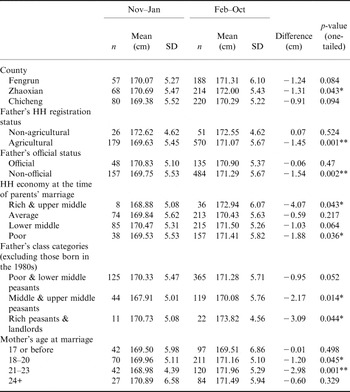
Table 2 provides basic descriptive statistics of height by various socioeconomic variables, and the t-test of mean height differences between those born in winter and non-winter months across social groups. In terms of the winter-born who are shorter than those born at other times, the birth-month effect depends on location, socioeconomic status, family class origins and age at marriage. The birth-month effect is stronger for the following: those whose father had an agricultural household registration; those whose father was not a government official; those from families who were either rich or poor at the time of the parents' marriage; those whose parents had been classified as middle or lower middle peasants, or rich peasants and landlords; and those mothers who did not marry either at younger or older ages. Those whose father had non-agricultural household registrations, or whose father was a village-level or above official, might have been less influenced by the birth season effect, since they had better access to resources that did not vary seasonally.
Descriptive statistics and differences in mean height across social groups

* p<0.05;
** p<0.01.
Empirical specifications
The analysis proceeds with the conventional OLS regression, using height as a dependent variable, and month of birth as an independent variable. Socioeconomic variables are then added to the base model to investigate if the birth-month effect continues to exist when socioeconomic variables are controlled for. In eqn (1), hij represents height for individual i in family j. In addition to months of birth for individual i in family j (Mij,), the individual-level factors (INDij), parental characteristics and family backgrounds (FAMij), and community factors (COMij) are added in the regression function.

where eij=uj+uij and βm will be biased if COV(Mij, uj) ≠ 0.
Nevertheless, unobserved factors may affect height and correlate with month of birth, thus leading to bias in the estimated birth-date effect on height in the above model. The household fixed effect can be applied to solve the problem. The model specification is given in eqn (2) below. Note that Dp is a dummy variable for households.

The household fixed effect model, with comparison of siblings, has the advantage of teasing out hitherto unobserved biological, environmental and socioeconomic variables that affect all siblings, including parental genes, latitude and altitude, water intake and access to economic resources (Plomin et al., Reference Plomin, Defries and Mcclearn1980). Nevertheless, the effects of household-level variables cannot be estimated simultaneously with the household fixed effect. The random effect model, with specification given in eqn (3), is adopted to explore the effects of household- and community-level variables, which simultaneously take into consideration unmeasured household and community factors. The subscription k in the equation indicates community k for dependent and independent variables, and the various level error terms.

Results
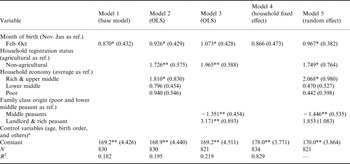
The results are shown in Table 3. The base model (Model 1), with age and residence controlled, indicates that men born in non-winter seasons are, on average 0.87 cm taller than those born in winter. With additional control of parental characteristics and family backgrounds, Models 2 and 3 indicate that the month-of-birth effect remains: those born in non-winter seasons are, on average, 0.93 cm to 1.07 cm taller than those born in winter months.
Ordinary least squares (OLS), fixed effect and random effect models of height (cm) in adult men

a Other control variables include birth cohort, mother's age at marriage, father's years of schooling and father as cadre or not. Models 1–3 include village and enumerator dummies. Robust standard errors are in parentheses. Model 5 is a three-level random-intercepts model with 515 households in 30 villages, intra-village correlation=0.01, intra-household correlation=0.49.
* p<0.05;
** p<0.01.
The household fixed effects model (Model 4) indicates that the month-of-birth effect still exists, albeit not significantly. The result is similar to the base model: those born in non-winter months are about 0.87 cm taller. The random effects model (Model 5) further confirms that the month-of-birth effect on height exists: those born in non-winter months are about 0.97 cm taller (p<0.05).
Nevertheless, the month-of-birth effect is smaller than that of the key socioeconomic variables included in the analysis. Adult men born to families with non-agricultural household registration status are, on average, 1.73–1.97 cm taller than those born to families with agricultural household registrations. As expected, men born to richer households are likely to be taller than those whose families are at an average level of household economy.
It is interesting to note that men's height is significantly related to their family class origin. Table 3 shows that children born into families where the father is categorized as a landlord or rich peasant are about 1.85–3.17 cm taller than those born to poor and lower middle peasant families. This may be because the cumulative economic situations of landlord and rich peasant families were much better than those of poor peasant families during the period before the communist revolution. This effect of better household economy on height might have carried over after the revolution, even if the families were treated unfavourably in social, economic or political terms. The puzzle is that adult men from middle peasant families are about 1.35–1.45 cm shorter than men from poor peasant families. The explanation may be the differential mortality rates of poor peasant and middle peasant families. In other words, men from poor peasant families who were born less healthy, and who would otherwise grow short if they survived, may experience higher probability of dying than those born in middle peasant families.
The month-of-birth effect on height leads to the following questions. Is there a seasonality of birth indicated in these data? If so, are those parents who produce taller children more likely to give birth in non-winter months? Patterns of seasonal peaks and troughs of births have been observed worldwide, though such demographic seasonality has experienced a dramatic decline, especially in developed countries (Anderton & Barrett, Reference Anderton and Barrett1990; Cancho-Candela et al., Reference Cancho-Candela, Andres-De Llano and Ardura-Fernandez2007). A limited number of historical and ethnographic studies indicate that Chinese fertility shows a strong pattern of seasonality. Lee & Campbell (Reference Lee and Campbell1997, p. 31) observed a seasonal pattern of births based on the historical north China registration data from 1792 to 1804, with a peak in births occurring in spring and a trough in winter. Pasternak (Reference Pasternak1978), based on births in two localities in Taiwan from 1927 to 1946, and Barrett (Reference Barrett1990), based on Taiwan island-wide data from 1906 to 1943, observed that peak births occurred in autumn and winter months. The inconsistency in peak and trough birth months in various locations in Taiwan and in mainland China suggests that there may have been a number of, rather than one singular, traditional regional patterns of birth seasonality. Liu's (Reference Liu1989) analysis of birth-month distribution in mainland China from 1946 to 1981 indicates that birth seasonality continued in twentieth century mainland China, and that birth seasonality may be contingent on regional and ethnic factors.
There is evidence that Chinese parents prefer to have children in particular years or months. Preference for a particular year is well known in Chinese culture. For example, married couples may want to have a son in the Year of the Dragon (Goodkind, Reference Goodkind1991). Further, Chinese fortune tellers may ‘foresee’ the best months for having children in particular years, e.g. in the second or third Chinese lunar month in the Year of the Tiger, or in the second to fourth, or seventh or eighth month in the Year of Dragon (see, for example, http://wenda.tianya.cn/). Nevertheless, it is not clear if people take this seriously.
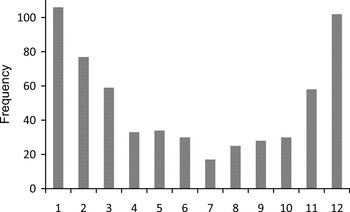
The question is, in traditional rural Chinese societies, can we reasonably believe that people aim for or avoid having children in particular seasons, responding to ecological circumstances by regulating marriage, contraception and fertility? As Lee & Campbell (Reference Lee and Campbell1997) and Pasternak (Reference Pasternak1978) suggested, seasonality of birth might be related to seasonality of food availability. However, it is necessary to look at the pattern of marriage seasonality first. Traditionally, marriages were held during the Spring Festival season, namely, the winter months. This seasonality of marriage is clearly shown in the data (Fig. 1), which is similar to the national pattern (Zheng, Reference Zheng2000). The peak season of marriages for the parental generation is from November to March, while a valley appears in the summer months of April and October.
Distribution of first marriages over 12 months (N=599).

Given this marriage pattern, it is expected that the birth of the first offspring will mostly occur during the late autumn and early winter season: (1) newlyweds did not usually use contraceptives, mainly because people wanted children, especially sons, sooner rather than later; (2) the government did not forcefully push for family planning in vast areas of the countryside until the early 1970s; (3) couples were not usually asked to practise contraception before the first child was born (Zhang, Reference Zhang2002).
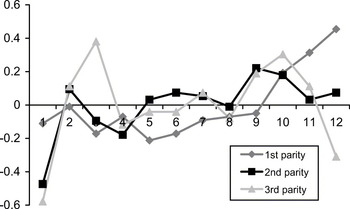
Figure 2 shows that the birth of first offspring peaks at 10 months to a year after the peak marriage season: that is, in late autumn and early winter seasons. For the second child, however, the winter months are not the peak birth season; for these children, January is the lowest valley of the year, and early summer and the autumn months become the peak birth months. The birth of the third child has a clear seasonal pattern, peaking in spring and autumn, dipping in summer and even more so in winter.
Birth seasonality by parities. The sample includes all children born from 1953 to 1983. The figure shows the monthly birth index, which is calculated as I=(B–E)/E, where I=index, B=number of births and E=monthly average births. First parity includes 594 births, second parity 570 births and third parity 313 births.

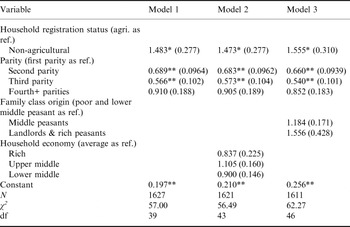
Table 4 shows the logistic regression results reporting the odds ratios of births in winter for various social groups. As expected, the second and third parity are less likely to be born in winter: the odds of having the second child in winter are about 30% lower than having the first in winter; and the odds of having the third child in winter are around 45% less than having the first. Further, the odds of families with non-agricultural household registration having children in winter are almost 50% higher than those with agricultural household registrations. In other words, families with agricultural household registration are less likely to have children in winter. This may indicate that parents working in agriculture intentionally avoid having children in what are usually, for them, harsh winter seasons. This is consistent with Huntington's (Reference Huntington1938)'s proposition that parents produce children under optimal conditions.
Logistic regression of births in winter months (Nov–Jan)

Models with all children are presented here (models with only sons are similar; likelihood ratio test between random effects models and simpler logistic models not significant). Control variables are birth cohort, mother's age at marriage, father's years of schooling and father as cadre or not. All models include village dummies. Robust z-statistics in parentheses.
* p<0.05;
** p<0.01.
In sum, the analysis indicates that there is a clear parity differentiated pattern of birth seasonality; and the observed month-of-birth effect on height – namely, that children born in non-winter seasons are taller – is not caused by higher odds of having children in non-winter seasons of those families that produce taller children.
Conclusion
The main objectives of this study were to examine: (1) if there is a month-of-birth effect on height, and if so, whether the birth-month effect is independent of socioeconomic variables; (2) the effects of socioeconomic variables on height; and (3) whether people deliberately aim to have children, or avoid having children, in particular months. The analysis of a unique sibling dataset collected from a sampling survey of 600 families in 30 villages in Hebei shows that a month-of-birth effect on height exists independent of observed socioeconomic variables and unobserved family characteristics. It shows that adult men born in winter months (November to January by the Chinese calendar) are 1.04 cm shorter than those born during the rest of the year. Nevertheless, the birth-month effect on height is smaller than the effect of socioeconomic variables, including the family household registration status, household economy and even the family class origins. Further, there are indications that those with agricultural household registrations avoid having children born in winter, albeit with different success rate for various parities. These parents may intentionally plan to have children born in an environment more conducive to the protection of the child and mother; this may enhance the health, and ultimately the height, of the children.
Unlike previous findings that the month-of-birth effect on height is much stronger for children born in families with high socioeconomic status, this study shows that differences in mean height value between winter and non-winter months are greater for the poorer segment of the population. This may explain why agricultural household registration holders are less likely to have children born in winter than those with non-agricultural registration. It supports the proposition that improvement in living conditions may reduce the seasonality of human demographic behaviour, and social cultural factors play increasingly important roles in human growth. That is, however, not to deny that cyclical environmental or extraterrestrial factors may influence human growth.
In regards to social factors affecting human growth, it is interesting to note that Maoist political and economic policy may influence height and mediate month-of-birth effect on height in various ways. It is clear that the Great Leap Forward and the subsequent famine reversed the birth-month effect on height for the specific birth cohort born during and immediately after the famine years. What is less clear is the effect of family class origin – largely a political category during the Mao era, but nevertheless representing cumulative economic status before the communist revolution – on adult height.
Acknowledgments
The author thanks Yuesheng Wang, Loren Brandt and Aloysius Siow as co-investigators and fifteen students who were involved in a larger research project on family dynamics in rural China financed by the Social Sciences and Humanities Research Council (SSHRC) of Canada. Earlier versions of the paper were presented at the Department of Economics, University of Toronto; at the Canadian Population Society Annual Meeting; and at the Institute of Population and Labour Economics, Chinese Academy of Social Sciences. The author also thanks the two anonymous reviewers for their constructive comments, Aloysius Siow for his advice on data analysis and Elizabeth Thomson for her editorial service.