Two-dimensional (2-D) materials have a broad range of applications, ranging from nanoelectronic circuits[ Reference Radisavljevic, Radenovic, Brivio, Giacometti and Kis 1 , Reference Schwierz 2 ] and energy storage systems[ Reference Zhu, Murali, Stoller, Ganesh, Cai, Ferreira, Pirkle, Wallace, Cychosz, Thommes, Su, Stach and Ruoff 3 , Reference Yoo, Kim, Hosono, Zhou, Kudo and Honma 4 ] to reinforcement in composites.[ Reference Stankovich, Dikin, Dommett, Kohlhaas, Zimney, Stach, Piner, Nguyen and Ruoff 5 , Reference Wu, Zhang, Liu and Feng 6 ] Graphene is an excellent example of what is possible in terms of controlling properties of a 2-D solid for a wide range of potential applications.[ Reference Loh, Bao, Ang and Yang 7 , Reference Gogotsi 8 ] In addition to graphite, there are few materials that can be exfoliated in 2-D layers including boron nitride,[ Reference Pacile, Meyer, Girit and Zettl 9 ] layered oxides and hydroxides,[ Reference Ma and Sasaki 10 ] and metal chalcogenides.[ Reference Novoselov, Jiang, Schedin, Booth, Khotkevich, Morozov and Geim 11 ]
Recently, we reported on the facile synthesis of 2-D early transition metal carbides and carbonitrides produced by immersing selected MAX phase powders in hydrofluoric acid at room temperature.[ Reference Naguib, Kurtoglu, Presser, Lu, Niu, Heon, Hultman, Gogotsi and Barsoum 12 , Reference Naguib, Mashtalir, Carle, Presser, Lu, Hultman, Gogotsi and Barsoum 13 ] The MAX phases represent a large (>60) family of ternary, layered, hexagonal (space group P63/mmc), early transition-metal carbides and/or nitrides with a chemistry given by M n + 1 AX n; where n = 1, 2, or 3 (viz. M 2 AX, M 3 AX 2, or M 4 AX 3, etc.), “M” is an early transition metal, “A” is an A-group (mostly groups 13 and 14) element, and “X” is C and/or N.[ Reference Barsoum 14 ] Quite recently, we produced Ti3C2, Ti2C, Ta4C3, (Ti0.5,Nb0.5)2C, (V0.5,Cr0.5)3C2, and Ti3CN.[ Reference Naguib, Kurtoglu, Presser, Lu, Niu, Heon, Hultman, Gogotsi and Barsoum 12 , Reference Naguib, Mashtalir, Carle, Presser, Lu, Hultman, Gogotsi and Barsoum 13 ] The removal the “A” group layer from the MAX phases results in the formation of 2-D sheets that are weakly bonded to each other. We are labeling this new family of compounds MXenes to denote the loss of the A-elements from the MAX structures, as well as to emphasize their similarities to graphene.[ Reference Naguib, Kurtoglu, Presser, Lu, Niu, Heon, Hultman, Gogotsi and Barsoum 12 ]
Given that these materials are quite new, very little is known about their properties. To date, we know that the sheet resistance of cold-pressed MXene disks is comparable with multilayer graphene.[ Reference Naguib, Mashtalir, Carle, Presser, Lu, Hultman, Gogotsi and Barsoum 13 ] The same cold-pressed surfaces showed hydrophilic behavior. More recently, we showed that Li can be readily and reversibly intercalated between oxygen-terminated Ti2C sheets.[ Reference Naguib, Come, Dyatkin, Presser, Taberna, Simon, Barsoum and Gogotsi 15 ]
Density function theory (DFT) calculations are an invaluable tool that has been used extensively to shed light on the electronic structure and elastic moduli of different 2-D materials, such as graphene,[ Reference Kudin, Scuseria and Yakobson 16 , Reference Zhao, Nardelli and Bernholc 17 ] BN, MoS2,[ Reference Rydberg, Dion, Jacobson, Schröder, Hyldgaard, Simak, Langreth and Lundqvist 18 ] and TiO2,[ Reference Sato, Ono, Sasaki and Yamagishi 19 , Reference Kurtoglu, Longenbach, Sohlberg and Gogotsi 20 ] and most recently MXenes.[ Reference Shein and Ivanovskii 21 ] The purpose of this letter is to predict the elastic and electronic properties of Ta2C, Ta3C2, Ta4C3, Ti2C, Ti3C2, Ti4C3, V2C, Cr2C, Zr2C, and Hf2C by the DFT method. It is important to note that the MXene structures synthesized to date are O, OH, and/or F terminated.[ Reference Naguib, Kurtoglu, Presser, Lu, Niu, Heon, Hultman, Gogotsi and Barsoum 12 ] This comment notwithstanding, the purpose of this paper is to calculate the electronic and elastic properties of pristine—i.e., with no surface termination—carbide phases. Analysis of the termination effect on properties is ongoing and will be published in a separate paper.
Calculations were conducted utilizing DFT as implemented in the CASTEP[ Reference Clark, Segall, Pickard, Hasnip, Probert, Refson and Payne 22 ] code. Each MXene structure was built from its respective MAX phase by removing the A atoms and optimizing the resulting structure. Wu–Cohen functional[ Reference Wu and Cohen 23 ] within the generalized gradient approximation (GGA) formalism was used for the exchange-correlation effects. Since it has been shown that the Wu–Cohen functional is superior to Perdew-Burke-Ernzerhof (PBE) and local density approximation (LDA) in estimating various properties of MAX phases,[ Reference Kanoun and Jaouen 24 ] we chose it for this study. Monkhorst–Pack grids were chosen such that the individual spacing was less than 0.04 Å−1. Plane-wave cut-off energy of 400 eV was enforced in all calculations. In our initial calculations, we found that increasing the cut-off energy or using a finer Monkhorst–Pack grid than the ones used in this study had negligible effects on the results. “Ultrasoft pseudopotentials” (USPs) were utilized for the calculations. Pseudoatomic calculations were performed for the transition metals using:
-
Ti 3s2 3p6 3d2 4s2
-
Ta 5d3 6s2
-
Zr 4s2 4p6 4d2 5s2
-
Hf 5d2 6s2
-
V 3s2 3p6 3d3 4s2
-
Cr 3s2 3p6 3d5 4s1
When the semicore states are not treated explicitly as valence states (as in Ta and Hf), USPs with nonlinear core corrections were utilized. The cut-off energy was limited at 400 eV as increasing the value to 500 eV did not result in any significant change in the total energy of the system (less than 0.04 eV difference in most cases).
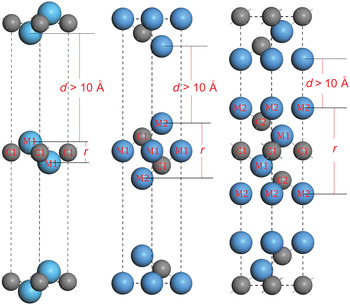
To eliminate possible errors associated with the interaction of individual layers, an interlayer spacing of 10 Å was imposed on the unit cell. The unit cells used for the calculations, for n = 1, 2, and 3, are shown in Figs. 1(a)–Figs. 1(c), respectively. For comparison purposes, we also optimized the respective Al-containing MAX phase unit cells.
MXene unit cells (not to scale) used for the calculations of (a) M 2 C, (b) M 3 C 2, and (c) M 4 C 3 electronic and elastic properties.

The elastic constant, c 11, was determined by applying a set of homogeneous (tensile and compressive) deformations—in four steps up to a maximum strain of 0.003—along the basal planes. Each loading steps were followed by the full relaxation of the internal coordinates while keeping the lattice parameters fixed, and calculating the resulting stresses in the unit cell. Since the elastic properties were calculated for the whole cell, including the empty space in Fig. 1, the obtained values have to be adjusted accordingly. The Young's modulus is defined as
 $$Y=\displaystyle{1 \over {V_0 }}\left. {\displaystyle{{\partial ^2 E} \over {\partial \varepsilon ^2 }}} \right\vert _{\varepsilon=0}\comma \;$$
where V 0 is the equilibrium volume, E is the strain energy, and ɛ is the axial strain. In case of the entire unit cell,
 $$V=a \cdot b \cdot c\comma \;$$
where a, b, and c are lattice parameters. To calculate the modulus of a single layer in the planar direction, the volume is given as
 $$V_0=a \cdot b \cdot r\comma \;$$
where r is the MXene layer thickness (see below). c 11 can then be calculated assuming:
 $$c_{11}=c_{11\comma \;{\rm cell}} \left({c/r} \right).$$
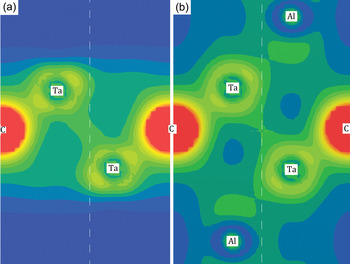
And while the above assumptions are based on known definitions, defining the effective volume (V 0) is a more daunting task due to the uncertainty of what the thickness of an individual layer should be. Similar problems are encountered when calculating the elastic moduli of graphene, where layer thicknesses that vary from 0.66Å to 3.4 Å have been reported/assumed in the literature.[ Reference Konstantinova, Dantas and Barone 25 ] In our calculations, for simplicity and clarity, the layer thickness, r, was assumed to be the M–M distance between the topmost M layers as shown in Fig. 1. To justify this assumption, we plotted the electron densities along (110), for Ta2C and its corresponding MAX phase, Ta2AlC, in Figs. 2(a) and 2(b), respectively. On the basis of Fig. 2(a), it is reasonable to argue that if this 2-D sheet were loaded in tension horizontally, the “area” supporting the load would be proportional to r. This comment notwithstanding, the r values for the M 2 C layers may still be underestimated. As noted above, the advantage of choosing this value, however, lies in its simplicity and lack of ambiguity. We note in passing that the choice of r becomes less important as n increases. It follows that our confidence in the values of c 11 calculated for the Ti4C3 and Ta4C3 sheets is considerably higher. However, it should be noted that the selection of the best approximation to slab thickness values to obtain the most accurate ‘absolute’ elastic values is beyond the extent of this study and that only the relative values should be considered.
Electron densities of the (110) plane for (a) Ta2C and (b) Ta2AlC.

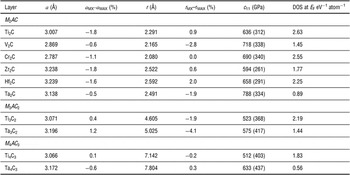
Table I summarizes the results obtained. Before discussing the properties, it is instructive to review the structural changes that occur to the MX layers when the Al layers are removed. A perusal of Table I shows that, with three exceptions, the a-lattice parameters (column 3 in Table I) shrink anywhere between ≈0.5% and 2%. For the exceptions, Ti3C2 and Ta3C2 and Ti4C3, the a-lattice parameters increase. The situation for the r distances (column 4 in Table I) is more muddled. For roughly half the compounds the distance increases and for the other half it decreases. In the case of Ta3C2, the shrinkage is about 4%. At this time we do not see any trends for these changes and they are thus assumed to reflect the intricacies of bonding.
Summary of structure characteristics and properties of 2-D layers calculated herein.

Columns 2 and 4 list lattice parameters and the r distances (see Fig. 1), in both the MXene and MAX phases, respectively. The changes of these values as compared with those of the corresponding MAX phases are listed in columns 3 and 5. The values of c 11 and the DOS at the Fermi levels are listed in the last two columns, respectively. The values of c 11 for the MAX phases are listed between brackets in column 6.
We now turn to the properties. With c 11 values >500 GPa (Table I), it appears that these 2-D solids are quite stiff, at least when pulled along the basal planes. This is not too surprising given that the M-X bonds are some of the strongest known. A comparison with the c 11 values in the MAX phases is instructive. Not surprising, when the c 11 results for the MAX and MXene phases are plotted (not shown), the correlation coefficient is 0.7. For the M 2 AX phases, the c 11 values of the MAX phases are roughly 40% lower than those of the corresponding MXenes; for the M 3 AX 2 and M 4 AX 3 phases, the reduction is closer to 70%. At this point it is not clear whether the enhancement in the c 11 values in the 2-D layers is due to an underestimation of the r values or a true increase in stiffness due to the elimination of the A layers. The answer is probably a combination of both. Note that with increasing n in M n+ 1 AX n the elastic properties approach those of the corresponding MX phases as observed. It is also worth noting that with increasing n, the errors in r are significantly reduced and yet the values of c 11 for Ta4C3 and Ti4C3 are still significantly higher than those of Ta4AlC3 and Ti4AlC3.
The c 11 values reported herein are all significantly lower than those for single-layer graphene.[ Reference Michel and Verberck 26 ] However, based on the thickness alone, it is reasonable to conclude that the bending rigidities of the MXenes, especially those of Ta4C3 and Ti4C3, are probably orders of magnitude higher than that for graphene, and the MXene mechanical properties should thus be significantly better than those of multilayer graphene of comparable thickness. It is important to note here that the bending rigidity is a strong function of thickness (α t 3, where t is the layer thickness), thus MXene layers—with a minimum of three atomic layers—are expected to possess a much higher bending rigidity than that of graphene.
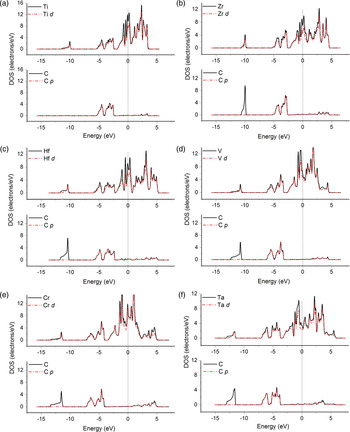
For all the 2-D sheets, the density-of-states (DOS) at the Fermi level, E F, is substantial, indicating that MXenes should be good conductors of electricity (Fig. 3). On the basis of similarity of the electron density distribution and the relatively high DOS at E F, it is reasonable to assume that the bonding in the MXenes, as in the MAX phases, is metallic. This result is in agreement with the fact that pressed MXene disks have a conductivity that is comparable with multilayer graphene.[ Reference Naguib, Mashtalir, Carle, Presser, Lu, Hultman, Gogotsi and Barsoum 13 ] It is reasonable to assume, however, that the intrinsic conductivity of single MXene sheets would be significantly higher.
Partial density of state plots for the M and C atoms in (a) Ti2C, (b) Zr2C, (c) Hf2C, (d) V2C, (e) Cr2C, and (f) Ta2C.

Not surprisingly, the DOS plots reveal electronic structure patterns that are similar to the ones reported for substoichiometric group IV–V transition metal carbides,[ Reference Gruzalski and Zehner 27 ] viz. a low-lying band composed of C 2s states, followed by a band formed from hybridized C 2p and metal d states. Two hybridized bands are evident: one composed of C s and metal d states well below E F and another comprised of C p and metal d states halfway between the former band and E F. Note that the s–d hybridized band is nonexistent in Ti2C, in agreement with the shorter M-M distances in the Ti-MXenes. An occupied DOS near E F suggests conductive behavior, similar to the MAX phases. Metal d states dominate the bands near E F, thus conductivity should be metallic in character, with the C atoms playing a minor effect. Similar to the MAX phases,[ Reference Lofland, Hettinger, Harrell, Finkel, Gupta, Barsoum and Hug 28 ] the electronic properties are likely to be determined by the transition metal. However, there may be some contribution from the C 2p states in higher MXenes, i.e., M4C3, which may have an effect on some of the electronic properties such as possibly superconductivity.[ Reference Sahnoun, Daul, Driz, Parlebas and Demangeat 29 ]
In summary, we calculated the elastic and electronic properties of a new class of 2-D solids. The 2-D sheets of transition metal carbides are quite stiff when pulled along the basal plane. They should also be excellent conductors of electricity. This new family of solids, that we are labeling MXene, offers significantly more possibilities for compositional tailoring of properties as compared with, say, graphene. The possibilities of altering the oxidation states of the transition metals in turn offer tantalizing possibilities for a wide range of potential applications.
Acknowledgments
This work was supported by the Assistant Secretary for Energy Efficiency and Renewable Energy, Office of Vehicle Technologies of the US Department of Energy under Contract No. DE-AC02-05CH11231, Subcontract 6951370 under the Batteries for Advanced Transportation Technologies (BATT) Program. This work was also supported by the Commonwealth of Pennsylvania's Ben Franklin Technology Development Authority through the Ben Franklin Technology Partners of Southeastern Pennsylvania.